
The difference between lay vs lie can trip up even experienced English speakers. You might say that you need to lay down after work or that you laid on the couch yesterday. These sentences sound natural to many people, but standard grammar uses different verb forms for putting something down and resting your body.
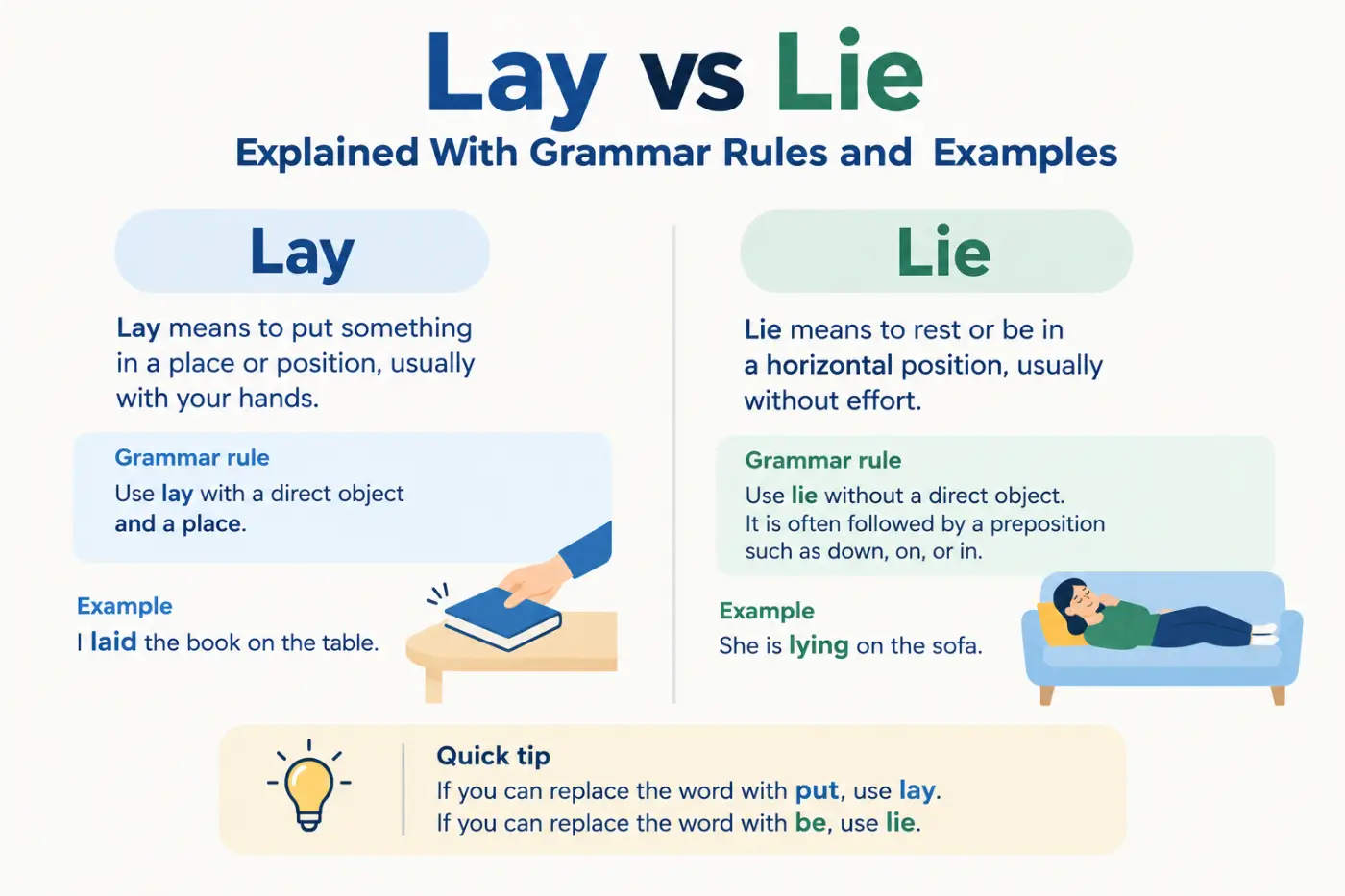
The main rule is simple. Lay means to put something somewhere, while lie means to recline or rest. Lay requires an object, such as a book, a bag, or a blanket. Lie does not need an object because the person or thing doing the action rests in a position. The confusion gets worse because the past tense of lie is lay, while the past tense of lay is laid.
Once you learn the three main forms of each verb and understand how objects work in a sentence, the distinction becomes much easier. You’ll also learn why people say laid down and lay down, how to choose the correct form in the past tense, and how to avoid mistakes in emails, schoolwork, and everyday conversation.
A related grammar guide is former vs latter Explained With Clear Examples.
Quick Answer
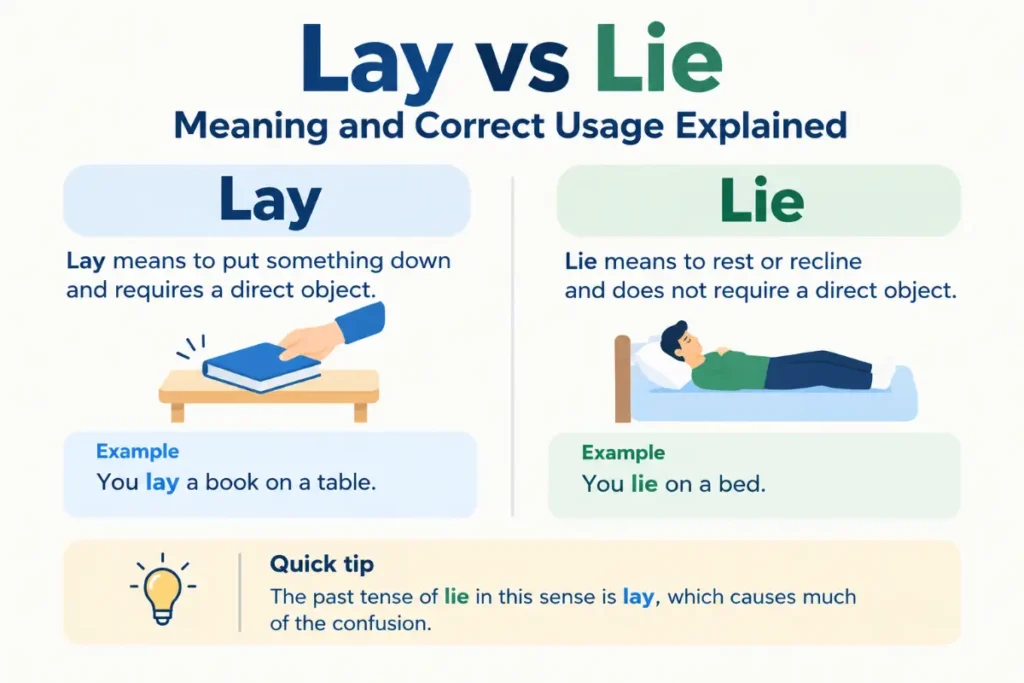
Lay means to put something down and requires a direct object. Lie means to rest or recline and does not require a direct object. You lay a book on a table, but you lie on a bed. The past tense of lie in this sense is lay, which causes much of the confusion.
Meaning and Definition
What Lay Means
Lay is a verb that means to put, place, or set something down. It describes an action that a person performs on an object. In grammar, the object is the person or thing that receives the action.
For example, consider this sentence.
I lay my keys on the kitchen counter every evening.
The keys are the object. The speaker puts them on the counter, so lay is the correct verb.
Here are more examples.
- Please lay the papers on my desk.
- She lays the baby in the crib.
- He laid his jacket on the chair.
- They have laid new carpet in the living room.
- The hen lays an egg almost every morning.
In each example, lay or one of its forms describes placing something somewhere or producing an egg. The direct object helps identify the verb.
Lay can also appear in figurative expressions. For example, someone might lay the groundwork for a project, lay the blame on another person, or lay a plan before a committee. These expressions retain the idea of placing or putting something forward, even when the action isn’t physical.
What Lie Means
Lie is a verb that means to recline, rest, or remain in a horizontal position. It can describe a person resting on a bed, a dog resting on the floor, or an object remaining in a particular place.
Unlike lay, lie does not require a direct object. The subject performs the action without placing a separate object somewhere.
For example.
I lie on the couch after dinner.
The speaker rests on the couch. No object receives the action, so lie is correct.
Here are more examples.
- I need to lie down for a few minutes.
- The dog lies beside the fireplace.
- She lay on the grass and watched the clouds.
- He has lain awake for hours.
- The village lies near the river.
Lie can also mean to exist or be located in a particular place. In the last example, lies describes the village’s location rather than a physical act of resting.
Another meaning of lie is to tell something untrue on purpose. For example, someone might lie about their age. This is a separate meaning of the same word, with its own use in sentences. The main comparison in this article focuses on lie meaning to rest or recline.
Comparison Table
| Feature | Lay | Lie |
|---|---|---|
| Main meaning | To put or place something | To recline or rest |
| Part of speech | Verb | Verb |
| Direct object | Required in its ordinary placement meaning | Not required in its reclining meaning |
| Present form | Lay | Lie |
| Third person singular | Lays | Lies |
| Simple past | Laid | Lay |
| Past participle | Laid | Lain |
| Present participle | Laying | Lying |
| Example | I lay the book on the table. | I lie on the bed. |
| Common context | Placing an object | Resting or reclining |
| Typical mistake | Using lay without an object | Using lie when the sentence requires an object |
The most important distinction is not the spelling. It’s the job each verb performs in the sentence. Lay acts on an object, while lie describes the subject resting or remaining in a position.
The Three Main Forms of Each Verb
Learning the verb forms is the best way to avoid confusion. Both verbs change with tense, and their forms overlap in ways that make them difficult to remember.
Forms of Lay
The principal forms of lay are lay, laid, and laid. Its present participle is laying.
| Verb form | Example |
|---|---|
| Base form | I lay the book down. |
| Third person singular | She lays the book down. |
| Simple past | She laid the book down yesterday. |
| Past participle | She has laid the book down. |
| Present participle | She is laying the book down. |
The base form lay is used in the present tense with subjects such as I, you, we, and they. It also follows words such as to, can, should, and will.
For example, I lay my clothes out every night. She will lay the documents on your desk. They are going to lay the foundation tomorrow.
The past form is laid. The same form appears in the present perfect, past perfect, and other constructions that use a past participle.
For example, he laid the package outside. She has laid the package outside. They had laid the package outside before the rain began.
Forms of Lie
The principal forms of lie, meaning to recline, are lie, lay, and lain. Its present participle is lying.
| Verb form | Example |
|---|---|
| Base form | I lie on the couch. |
| Third person singular | She lies on the couch. |
| Simple past | She lay on the couch yesterday. |
| Past participle | She has lain on the couch. |
| Present participle | She is lying on the couch. |
The base form lie appears in the present tense with subjects such as I, you, we, and they. It also follows to and modal verbs.
For example, I want to lie down. He should lie still. They will lie on the beach tomorrow.
The simple past is lay, not laid. The past participle is lain, which appears with helping verbs such as has, have, and had.
For example, she lay in bed all morning. She has lain in bed all morning. She had lain there for an hour before the phone rang.
Why the Past Tense Causes Confusion
The biggest challenge is that lay has two grammatical roles. It is the present form of the placement verb and the past form of the reclining verb.
Compare these sentences.
- I lay the book on the desk every morning.
- I lay on the couch yesterday.
The first sentence describes a present habit. The speaker puts the book on the desk.
The second sentence describes a past action. The speaker rested on the couch.
The words look identical, but the tense and meaning differ. The object provides an important clue. In the first sentence, the book receives the action. In the second, the speaker simply reclines.
Now compare these examples.
- I laid the book on the desk yesterday.
- I lay on the couch yesterday.
Both describe past actions. The first uses laid because the speaker placed an object somewhere. The second uses lay because the speaker rested.
The past tense of lie does not become lied. Lied belongs to the separate verb lie meaning to tell an untruth.
Grammar Rules That Make the Difference Clear
Rule One: Check for a Direct Object
A direct object receives the action of a verb. If you can ask what was placed and identify an answer, lay is usually the correct verb for that meaning.
For example.
She laid the blanket on the grass.
Ask what she laid. The answer is the blanket. Since the blanket receives the action, laid is correct.
Now consider this sentence.
She lay on the grass.
Ask what she lay. There is no direct object. She simply rested on the grass, so lay is the correct past form of lie.
This test works in many everyday sentences. It is especially useful when you are unsure about a past tense.
Rule Two: Use Laid for the Past of Lay
When you describe placing something in the past, use laid.
Correct: He laid his phone beside the computer.
Incorrect: He lay his phone beside the computer.
The phone is the direct object, so the placement verb is needed. Its simple past form is laid.
The same rule applies when the action is completed.
Correct: She has laid the documents on the table.
Incorrect: She has lay the documents on the table.
After has, have, or had, the past participle is required. For the placement verb, that form is laid.
Rule Three: Use Lay as the Past of Lie
When you describe resting in the past, use lay.
Correct: I lay in bed until noon.
Incorrect: I laid in bed until noon.
The subject is resting, and no direct object receives the action. Because the sentence refers to the past, lay is the correct form of lie.
This is the form that catches many writers off guard. They know that laid is a past tense form, but they forget that it belongs to a different verb.
Rule Four: Use Lain After Has Have or Had
When lie means to recline, its past participle is lain.
Correct: He has lain on the sofa all afternoon.
Incorrect: He has laid on the sofa all afternoon.
The helping verb has calls for the past participle. Since the subject is resting rather than placing an object, lain is correct.
In casual American speech, people often use laid in this kind of sentence. Standard edited English still distinguishes the forms.
Rule Five: Use Lying for an Ongoing Action
The present participle of lie is lying.
Correct: The cat is lying on the windowsill.
Incorrect: The cat is lieing on the windowsill.
The spelling drops the final e before adding ing. The same pattern appears in the placement verb, which becomes laying.
Compare these sentences.
The cat is lying on the windowsill.
The owner is laying a blanket on the windowsill.
The cat is resting. The owner is putting a blanket somewhere. The different meanings determine the verbs.
Quick Answer With Everyday Examples
If you need a fast answer, use lay when someone places an object and lie when someone rests.
- I need to lie down. The speaker will rest.
- Please lay the towel on the bed. Someone will place the towel.
- She lay on the couch yesterday. She rested in the past.
- She laid the baby in the crib. She placed the baby in the crib.
- The dog is lying by the door. The dog is resting.
- He is laying the cards on the table. He is placing the cards.
- I have lain here for an hour. The speaker has been resting.
- They have laid the bricks in a straight line. They have placed the bricks.
- The town lies near the coast. The town is located there.
- The hen lays an egg every morning. The hen produces an egg.
These examples cover present, past, perfect, and ongoing actions. They also show that the verb lie can describe location, not just a person lying down.
Ten Natural Sentence Examples Explained
Everyday Conversation
1. I usually lie down for twenty minutes after lunch.
Lie is correct because the speaker rests without placing a separate object. Usually signals a repeated habit, so the present form fits.
2. Lay your jacket on the chair before you sit down.
Lay is an instruction to put the jacket somewhere. The jacket is the direct object.
Text Messages and Casual Speech
3. I’m lying on the couch and watching a movie.
Lying describes an action in progress. The speaker is resting, so the reclining verb is appropriate.
4. I lay in bed for another hour this morning.
Lay is the simple past form of lie. The sentence describes resting earlier in the day.
Work and School
5. Please lay the signed forms on my desk before noon.
Lay is correct because the forms are being placed on the desk. The direct object makes the choice clear.
6. The researcher laid the samples on a clean surface.
Laid is the past form of lay. The researcher placed the samples on a surface.
Academic and Formal Writing
7. The results lie at the center of the debate.
Lie describes the position or place of the results in a figurative sense. No direct object is needed.
8. The report has laid out the main reasons for the decision.
Laid out is a phrasal verb meaning presented or explained. The report presents its reasons, so the placement verb is appropriate in this expression.
Social Situations and Storytelling
9. The child lay on the grass and watched the clouds drift by.
Lay is the past form of lie. The child rested on the grass.
10. She laid the old photographs on the table for everyone to see.
Laid describes the act of placing the photographs. The photographs are the direct object.
Many readers also check fair vs good Meaning and Usage Explained.
Common Mistakes and How to Fix Them
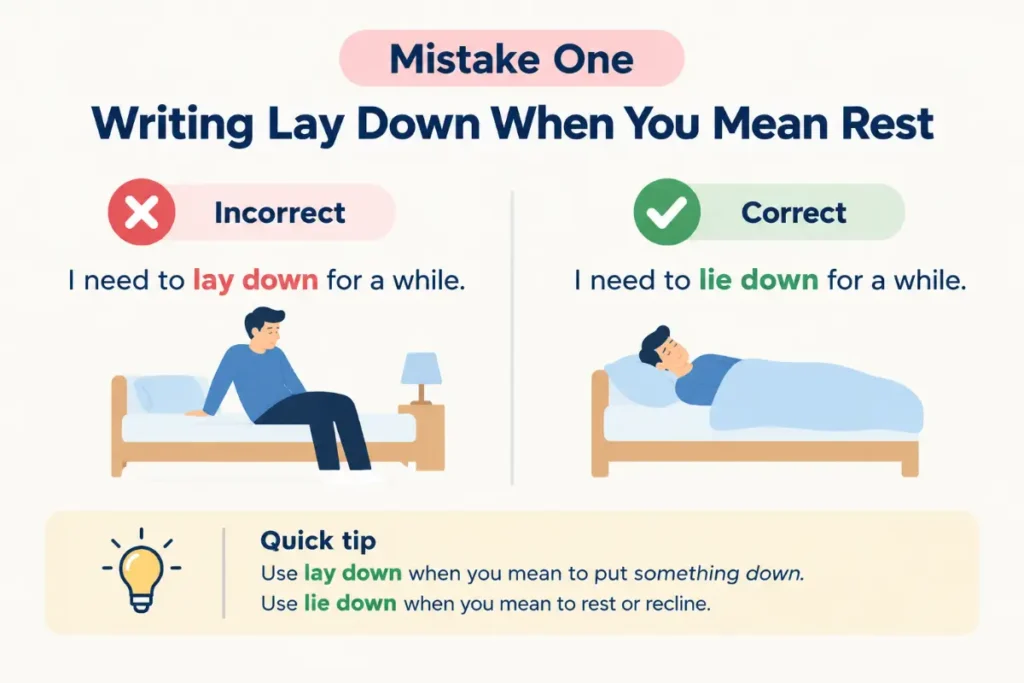
Mistake One: Writing Lay Down When You Mean Rest
Incorrect: I need to lay down for a while.
Correct: I need to lie down for a while.
The speaker is not putting an object somewhere. The speaker wants to rest, so lie is the correct base form.
In casual speech, lay down is common. In formal writing and edited American English, lie down is the standard choice when no object follows the verb.
Mistake Two: Using Laid as the Past Tense of Lie
Incorrect: I laid on the beach all afternoon.
Correct: I lay on the beach all afternoon.
The sentence describes resting in the past. Lay is the past tense of lie, while laid is the past tense of the verb meaning to put something down.
Mistake Three: Using Lay After Has or Have
Incorrect: She has lay on the couch for hours.
Correct: She has lain on the couch for hours.
The perfect tense requires a past participle. For lie meaning to rest, that form is lain.
Mistake Four: Writing Lieing Instead of Lying
Incorrect: The dog is lieing on the rug.
Correct: The dog is lying on the rug.
The final e drops before ing is added. This gives lying, not lieing.
Mistake Five: Confusing the Two Verbs in a Single Sentence
Incorrect: He laid down and laid his head on the pillow.
Better: He lay down and laid his head on the pillow.
The first verb describes his body resting. The second describes him placing his head on the pillow. Both actions occur in the same sentence, but they use different verbs because their meanings differ.
Pronunciation Guide
The two base forms sound different, but pronunciation alone is not enough to distinguish their past tense forms.
Lay
- IPA: /leɪ/.
- Syllables: One.
- Easy pronunciation: Rhymes with day and say.
- Stress: The single syllable receives the stress.
Lie
- IPA: /laɪ/.
- Syllables: One.
- Easy pronunciation: Rhymes with my and try.
- Stress: The single syllable receives the stress.
The main vowel sound separates the two words. Lay has the vowel sound heard in day. Lie has the vowel sound heard in my.
The past forms create the greater challenge. Lay and laid have different pronunciations, but lay as the past tense of lie sounds exactly like present tense lay. Readers must use context and grammar to determine the intended meaning.
Etymology and Word Origin
Both verbs have long histories in English and come from older Germanic language forms. Their related histories help explain why their present and past forms can look similar.
Lay developed from Old English lecgan, meaning to place or put down. Its modern forms include lay, lays, laid, and laying. The verb has kept its central meaning of placing something or putting something in a position.
Lie, meaning to recline, developed from Old English licgan, meaning to lie down or remain in a position. Its forms include lie, lies, lay, lain, and lying. The historical relationship between these verbs is one reason their forms overlap.
The words are related in origin, but modern English treats them as separate verbs with different grammatical patterns. Learning their forms as two distinct sets is more useful than trying to remember their history each time you write.
Regional Usage
American English
Both verbs are standard in the United States. In careful writing, Americans generally use lay for placing something and lie for resting.
However, many speakers use lay down informally when they mean lie down. You may hear this in everyday conversation, but formal writing usually keeps the distinction.
For school assignments, reports, articles, and professional emails, use the standard forms. Write I need to lie down and I lay down yesterday when describing rest.
British English
The same basic grammar rule applies in British English. Lay takes an object, while lie meaning to recline does not require one. The past forms also follow the same pattern.
There is no major regional spelling difference between the two verbs. Differences in casual speech do not change the standard written forms.
Australian English
Australian English follows the same standard distinction. Speakers may use informal patterns in conversation, but edited writing generally preserves the traditional verb forms.
Canadian English
Canadian English also follows the same grammatical rules. Writers should use lay for placing something and lie for reclining, with laid and lain used in their appropriate tense forms.
Across these English varieties, the key difference is grammatical rather than regional.
Related and Confused Terms
Laying
Laying is the present participle of lay. It describes an action in progress or can function as a verbal noun.
Example: She is laying the table for dinner.
In this sentence, she is arranging items on the table. The verb takes an object or describes a placement action.
Lying
Lying is the present participle of lie. It can describe resting or telling an untruth.
Example: The baby is lying in the crib.
Here it means resting. In another context, lying can mean deliberately saying something false.
Laid
Laid is the simple past and past participle of lay.
Example: He laid the book on the shelf.
It describes an action completed in the past.
Lain
Lain is the past participle of lie meaning to recline.
Example: She has lain awake for most of the night.
It appears with a helping verb such as has, have, or had.
Lay Down
Lay down means to put something down. It can also appear in established expressions such as laying down rules.
Example: The manager laid down clear guidelines.
The phrase means that the manager established the guidelines.
Lie Down
Lie down means to recline or rest.
Example: I want to lie down before dinner.
No direct object is required.
Set
Set can mean to put something in a particular place. Like lay, it commonly takes a direct object.
Example: Set the cup on the counter.
Set has a different set of verb forms from lay, but both can describe placing something.
Sit
Sit means to rest in a seated position. It does not normally take a direct object in this meaning.
Example: Please sit beside me.
Sit and lie can both describe body positions, but sitting and reclining are different actions.
Real Life Usage by Context
Daily Conversation
People use these verbs when talking about rest, chores, and ordinary activities.
- I want to lie down before we leave.
- Lay the groceries on the counter while I put the bags away.
The first sentence describes rest. The second describes placing groceries.
Workplace Communication
Clear verb choices make instructions easier to follow.
- Please lay the invoices in the folder marked Accounts.
- The files have lain untouched since the project ended.
The first sentence tells someone to place the invoices. The second uses the past participle of lie to describe the files remaining in a position.
Academic Writing
Formal writing often uses lie to describe the position of an issue or the location of evidence.
- The main challenge lies in the lack of reliable data.
- The researchers laid the materials on separate trays before testing them.
The first sentence uses lie figuratively to describe where the challenge exists. The second uses laid for a physical placement action.
News and Journalism
News writing may use these verbs to describe locations, events, or physical actions.
- The village lies near the state border.
- Investigators laid the recovered items on a table for inspection.
The first sentence describes the village’s location. The second reports a placement action.
Literature and Storytelling
Writers use these verbs to describe movement, rest, and setting.
- The traveler lay beneath a tree until the storm passed.
- She laid the letter beside the candle and stepped away.
The first sentence describes the traveler resting in the past. The second describes placing a letter.
Memory Tips That Work
The easiest way to remember the distinction is to pair each verb with a simple action.
Lay it down. Lie down yourself.
Lay involves putting something down. Lie involves resting your own body or describing something that remains in a position.
Another helpful trick is to remember the main forms.
- Lay, laid, laid.
- Lie, lay, lain.
Say the forms aloud a few times. The overlapping word lay may feel confusing at first, but connecting it to its sentence makes it easier.
You can also use the object test. Ask what is being placed. If the sentence has an object receiving the action, lay is usually the correct verb. If the subject is simply resting, use lie or the appropriate form of that verb.
Expert Editor Insight
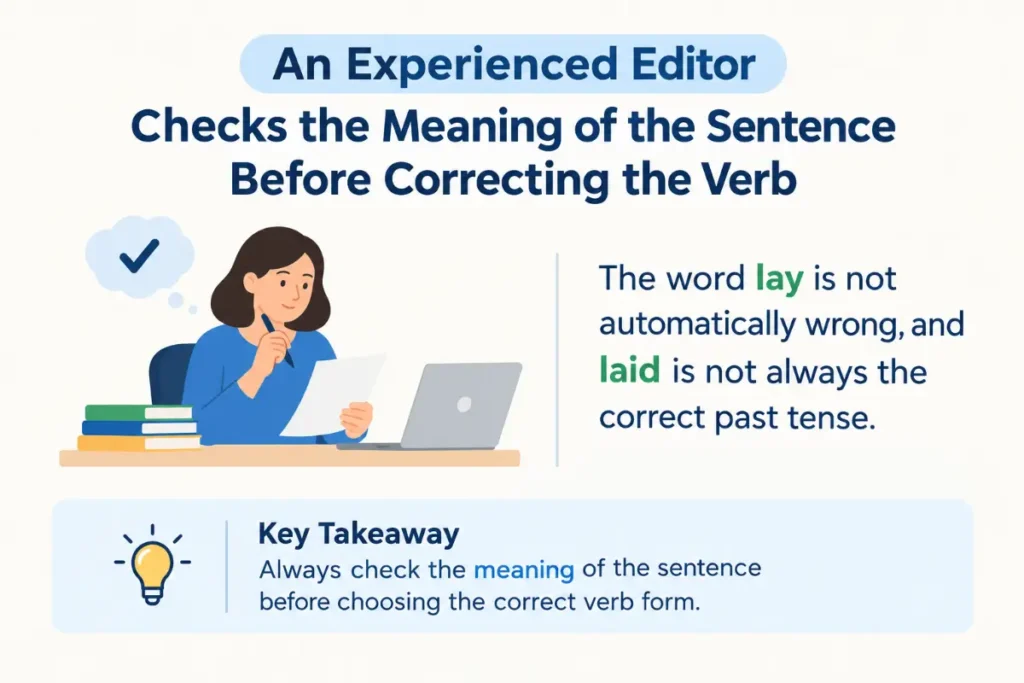
An experienced editor checks the meaning of the sentence before correcting the verb. The word lay is not automatically wrong, and laid is not always the correct past tense. The editor looks at the subject, the tense, and the presence of a direct object. Grammar checkers may catch some errors, but they can miss context dependent mistakes because both words are valid English forms. Reading the sentence with its intended meaning in mind is the most reliable final check.
Many readers also check function vs functionality Which Word Should You Use.
Conclusion
The difference between lay and lie comes down to meaning and grammar. Use lay when you put something somewhere, and use lie when you rest or recline. The past tense of lay is laid, while the past tense of lie is lay. Their past participles are also different: laid and lain.
For an easy memory trick, remember this: lay it down, lie down yourself. Then check the sentence for a direct object and make sure the verb matches the tense. With a little practice, you’ll choose the right form naturally in conversations, schoolwork, and professional writing.
FAQs
Is lay or lie correct when talking about resting?
Lie is the standard present tense verb for resting. You would write I need to lie down or the dog likes to lie by the door. Use lay for the past tense of this same verb, as in I lay down yesterday. The correct form depends on the meaning and tense.
Is lay down grammatically incorrect?
Lay down is correct when you put something down, as in lay down the package. When you mean to recline, standard edited English uses lie down. Informal speech often uses lay down for resting, but writers should use lie down in formal and academic contexts.
What is the past tense of lie?
The past tense of lie, meaning to rest or recline, is lay. For example, I lay on the sofa last night. Its past participle is lain, as in I have lain here for an hour. Remember that laid belongs to the separate verb meaning to place something.
What is the past tense of lay?
The past tense of lay is laid. Use it when someone placed an object somewhere. For example, she laid the book on the table. Laid is also the past participle, so you can write she has laid the book on the table.
Should I write I laid down or I lay down?
If you mean that you rested in the past, write I lay down. If you mean that you placed something down, use laid and identify the object when needed. For example, I laid the blanket down describes placing the blanket somewhere.
Why is it I have lain and not I have laid?
I have lain is correct because lain is the past participle of lie when it means to rest. I have laid is correct when the verb means to place something. The helping verb have requires a past participle, but the right participle depends on which verb you are using.
How can I remember the difference between lay and lie?
Remember this phrase: lay it down, lie down yourself. Lay normally takes a direct object because it means to put something somewhere. Lie means to recline and does not need a direct object. For past tense forms, remember lay, laid, laid and lie, lay, lain.
Is lay vs lie the same in American and British English?
Yes. The standard grammar rules are the same in American and British English. Both varieties use lay for placing something and lie for resting. Informal speech may differ among speakers, but the standard forms remain consistent in careful writing.