
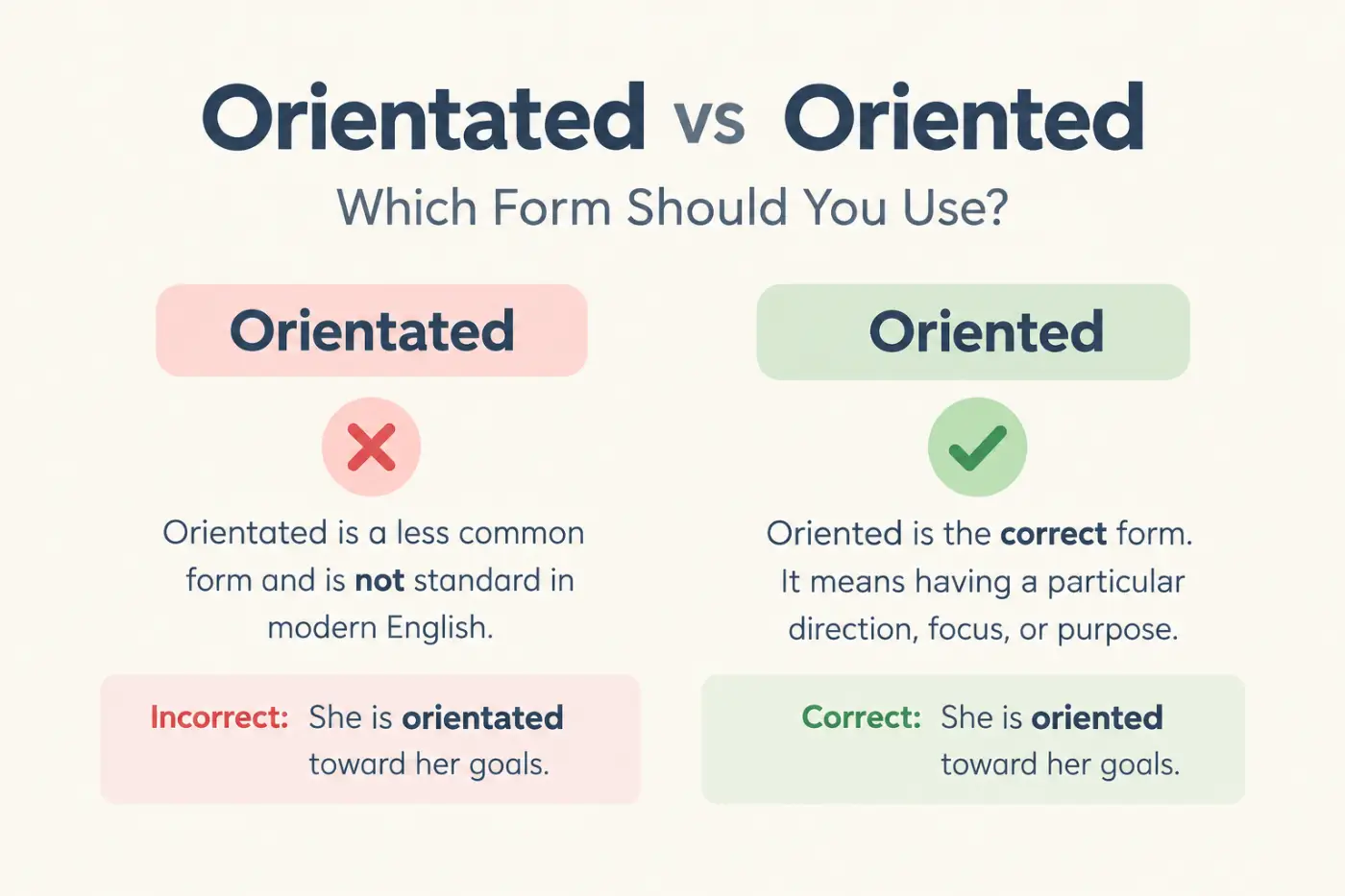
If you’re choosing between orientated vs oriented in American English, oriented is usually the better choice. It’s the form you’ll most often see in US writing and speech. Orientated is also a legitimate word, but it is more strongly associated with British English.
The confusion comes from the verb forms orient and orientate. Both verbs are recognized in English. Their past forms are oriented and orientated. The difference is mainly about regional usage rather than a simple correct versus incorrect spelling rule. Oxford lists orientate as an alternative verb in American English, while Cambridge identifies it as mainly British and notes that US English usually uses orient.
For a US audience, however, oriented is the natural default. If you’re writing an American resume, business email, school paper, website, or professional report, oriented will normally sound more familiar.
You may also want to read Leary or Leery Which Word Is Correct in 2026.
Quick Answer
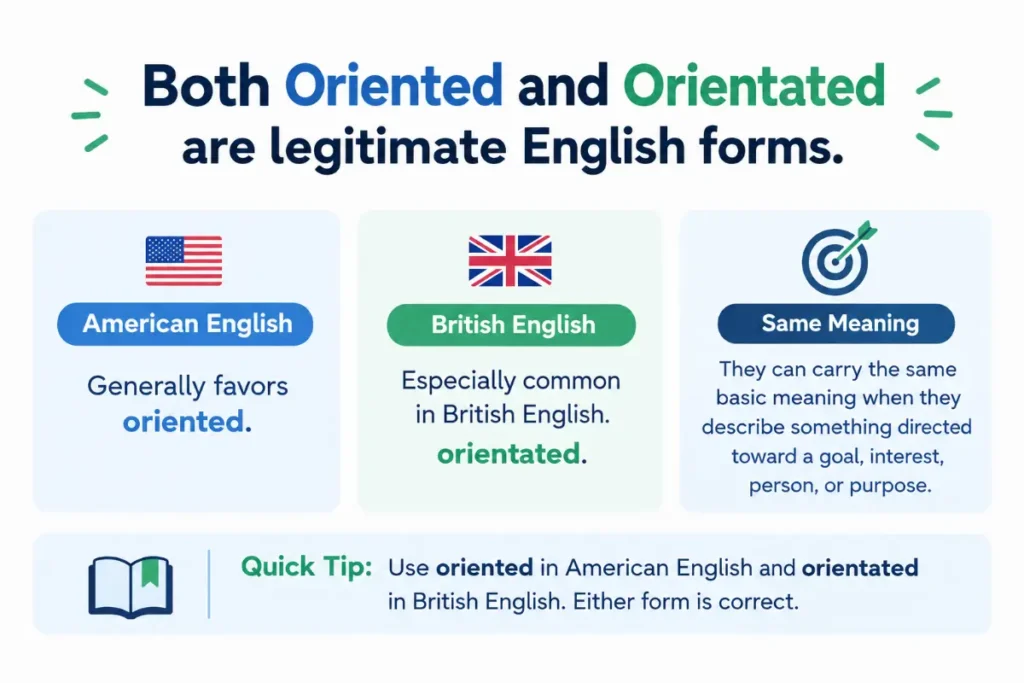
Both oriented and orientated are legitimate English forms. American English generally favors oriented, while orientated is especially common in British English. They can carry the same basic meaning when they describe something directed toward a goal, interest, person, or purpose.
The Main Difference
The easiest way to remember the distinction is to think about regional preference rather than correctness.
- Oriented is the usual choice in American English.
- Orientated is especially common in British English.
- Both forms can function as the past form of a verb.
- Both can also work as adjectives.
- The meaning is generally the same in comparable contexts.
- US readers will usually find oriented more natural.
- British readers may use either form but commonly use orientated in many contexts.
Cambridge labels oriented as mainly US and orientated as mainly UK. Its dictionary also explains that oriented means directed toward or interested in something.
That makes this a useful example of how English can have two established forms without one being an error.
Comparison Table
| Form | Meaning | Part of Speech | Origin | Usage Frequency | Formality | Common Contexts | Example |
|---|---|---|---|---|---|---|---|
| Oriented | Directed toward or interested in something | Verb form or adjective | From orient | Common in US English | Standard | Business, school, work, everyday writing | The program is oriented toward new students. |
| Orientated | Directed toward or interested in something | Verb form or adjective | From orientate | Commoner in UK English | Standard | British writing, formal and general contexts | The program is orientated toward new students. |
The table shows the practical point. Neither form needs to be treated as a spelling mistake simply because another English variety prefers a different form. Cambridge specifically marks orientated as mainly UK and oriented as mainly US.
What Oriented Means
Oriented can describe something that is directed toward a particular person, purpose, interest, or goal.
For example, a customer oriented business focuses strongly on customers. A research oriented course places emphasis on research. A career oriented student may make decisions with a future career in mind.
Oxford defines orient as directing someone or something toward a person or thing. It also gives examples involving policies directed toward particular needs and organizations focused on particular aims.
Oriented can also describe a person who has adjusted to a situation or understands where they are.
For example:
The hikers became oriented to the trail after studying the map.
In everyday American English, you may also hear phrases such as goal oriented, family oriented, and detail oriented.
Oxford lists family oriented as an adjective meaning interested in or giving importance to family. It also notes family orientated as another form that is especially British.
What Orientated Means
Orientated carries essentially the same basic meaning in the relevant contexts. It can describe something directed toward a particular aim or someone who has found their position or become familiar with a situation.
Cambridge defines orientated as directed toward or interested in something and identifies it as mainly UK.
The word also appears in compounds. For example, British English may use detail orientated where American English commonly uses detail oriented. Cambridge makes this regional distinction directly in its dictionary entries.
So if you see orientated in a British newspaper, business document, academic text, or book, you shouldn’t automatically treat it as a spelling error.
The form belongs to standard English. It simply has a different regional profile.
Which Form Is Correct
Both forms are correct.
The better choice depends on the variety of English you’re writing.
For American English, choose oriented in most situations. For British English, orientated is a common and accepted choice. British writers also use oriented, so the regional distinction is a preference rather than a strict rule.
This distinction matters in professional writing. If your readers are mainly in the United States, oriented will usually look more familiar.
Consider these examples:
The company is customer oriented.
The company is customer orientated.
Both communicate the same basic idea. The first version fits American usage more naturally. The second has a stronger British flavor.
A good editor doesn’t mark the second sentence as universally wrong. Instead, the editor considers the intended variety of English and the audience.
Why American English Favors Oriented
American English often uses the shorter verb orient rather than orientate.
Oxford’s American English entry lists orient as the main verb and gives oriented as its past form. The same entry also recognizes orientate as an alternative.
Cambridge makes the regional distinction even more directly. It describes orientate as mainly UK and says US English usually uses orient in the meaning of finding your position or becoming familiar with a situation.
That difference naturally leads to oriented being more common in American usage.
You can think of the pattern this way:
- American English commonly uses orient.
- Its past form is oriented.
- British English commonly uses orientate in many contexts.
- Its past form is orientated.
- Both forms can also appear as adjectives.
This is one reason the two forms can feel interchangeable while still sounding different to readers from different regions.
Grammar and Part of Speech
Oriented can have more than one grammatical role.
It can serve as the past tense or past participle of orient.
For example:
The instructor oriented the new employees to the safety rules.
The team was oriented toward customer service.
It can also function as an adjective.
For example:
She is highly goal oriented.
The company has a customer oriented approach.
In these examples, oriented describes a person, group, organization, or approach.
Orientated works in the same broad grammatical positions.
For example:
The instructor orientated the new employees to the safety rules.
The program was orientated toward practical skills.
She is highly goal orientated.
The main issue isn’t grammar. The important question is which form fits your audience and the variety of English you want to use.
Common Grammar Patterns
Several patterns appear frequently with oriented.
Oriented Toward
This pattern describes something directed toward a particular goal or group.
For example:
The program is oriented toward working adults.
The policy is oriented toward long term growth.
The course is oriented toward practical skills.
Oxford gives examples using orient with toward and notes that the verb can direct someone or something toward a particular purpose.
Oriented To
Oriented can also appear with to.
For example:
The service is oriented to the needs of local customers.
The course is oriented to beginners.
Both to and toward can occur. Your choice can depend on the exact sentence and the style of the publication.
Oriented Around
This expression is also common in everyday writing.
For example:
The schedule is oriented around the needs of parents.
The training is oriented around real workplace situations.
Here the meaning is close to organized or designed around something.
Oriented As An Adjective
The word often appears after linking verbs.
For example:
The company is strongly oriented toward innovation.
She is very detail oriented.
The team is customer oriented.
The adjective describes the focus or direction of the subject.
Ten Natural Example Sentences
Here are natural examples that fit American English.
- The training program is oriented toward new employees.
- Our team is strongly oriented toward customer service.
- She is a goal oriented student who plans carefully.
- The course is oriented toward people with little technical experience.
- The company has become more focused and customer oriented.
- His career choices have always been oriented toward public service.
- The new program is designed to be more practical and results oriented.
- The school offers several career oriented courses for high school students.
- The manager wants the department to become more detail oriented.
- The workshop is oriented toward helping small businesses improve their online presence.
These examples show why oriented appears so often in American professional and educational writing. It works naturally after forms of be and in compound descriptions.
Five Examples With Orientated
The following examples are useful because they show that orientated can be legitimate rather than automatically wrong.
- The course is orientated toward practical workplace skills.
- The organization is strongly orientated toward community needs.
- She is highly detail orientated in her research.
- The program is orientated toward younger learners.
- The company has become more customer orientated over the past few years.
These sentences are more likely to sound natural in British English. Cambridge specifically identifies forms such as detail orientated as mainly UK and notes that US English usually uses detail oriented.
Common Mistakes
The confusion usually comes from assuming that one form must be wrong.
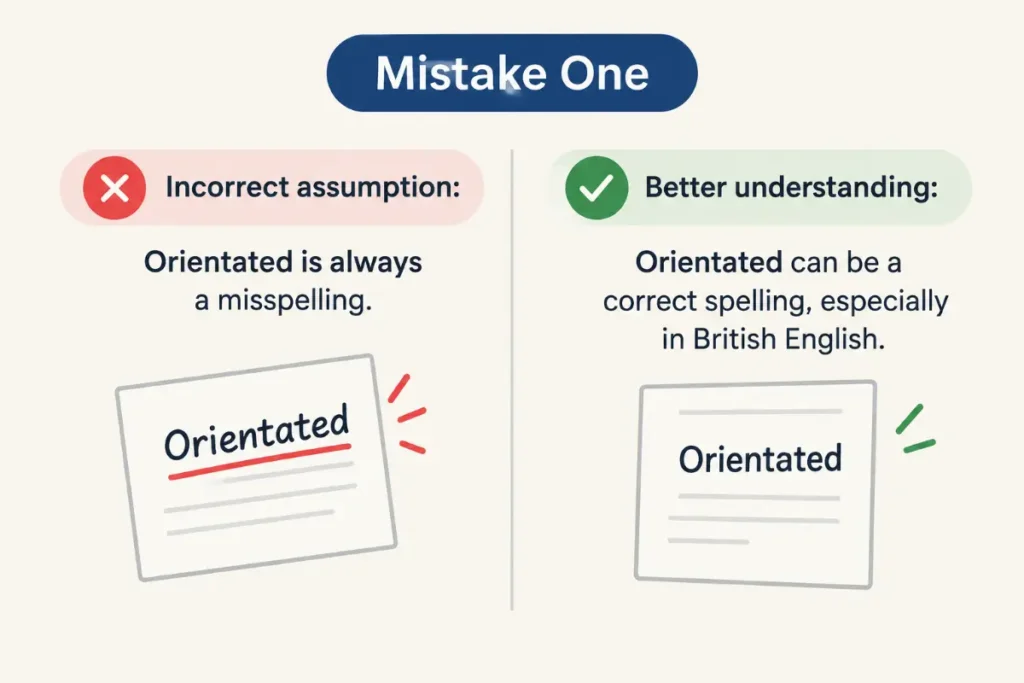
Mistake One
Incorrect assumption:
Orientated is always a misspelling.
Better understanding:
Orientated is a legitimate English form. It is especially common in British English.
Mistake Two
Incorrect assumption:
Oriented is only American slang.
Better understanding:
Oriented is a standard English form used in American English and also found in British English.
Mistake Three
Incorrect assumption:
Orient and orientate have completely different meanings.
Better understanding:
They can carry the same core meanings. The major difference is often regional preference. Cambridge identifies orientate as mainly UK and orient as mainly US for several uses.
Mistake Four
Incorrect assumption:
You must use orientated in every British English sentence.
Better understanding:
British English also uses oriented. Regional preference does not create an absolute grammatical rule.
Mistake Five
Incorrect assumption:
A spelling checker proves that one form is wrong.
Better understanding:
A spelling or style tool may follow a particular regional dictionary or house style. A flagged word isn’t automatically incorrect English.
Pronunciation Guide
The pronunciation differs slightly because the two forms contain different syllable structures.
Oriented
Cambridge gives the US pronunciation as approximately /ˈɔːr.i.en.t̬ɪd/. The word has four main syllables and stress falls on the first syllable.
An easy way to practice it is to say the word slowly in four parts:
OR
ee
en
tid
Then blend the parts together naturally.
Orientated
Cambridge gives the pronunciation of orientated as approximately /ˈɔːriənteɪtɪd/. It contains an additional syllable compared with oriented.
The extra sound comes from the ate portion of orientate.
The biggest pronunciation mistake is trying to force the two forms into exactly the same rhythm. They are related, but they don’t have identical syllable patterns.
Etymology and Word Origin
The history of these forms begins with orient.
The word is connected with the idea of the east and rising. Oxford traces orient back to a word associated with the rising sun and later development into the sense of finding or directing a position.
From orient came the broader modern meanings connected with direction, position, focus, and purpose.
Orientate developed as a related verb form. Modern dictionaries recognize both orient and orientate, although their regional patterns differ.
That history helps explain why both oriented and orientated exist today. They aren’t random spelling variations created by modern writers. They developed through established patterns in English.
American English Usage
For readers in the United States, oriented is the safest default.
You’ll commonly see it in education, business, technology, resumes, marketing, workplace communication, and everyday writing.
Examples include:
The company is employee oriented.
The program is results oriented.
She is detail oriented.
The course is career oriented.
American English also commonly uses orient as a verb.
For example:
I need a few minutes to orient myself.
The guide helped us orient ourselves in the new building.
Oxford’s American English dictionary uses oriented as the past form of orient and lists orientate as an alternative verb.
So American readers generally won’t need the longer form.
British English Usage
British English commonly uses both forms, but orientated has a stronger association with British usage.
Cambridge labels orientated as mainly UK and oriented as mainly US. Its entries also show British compounds such as detail orientated alongside the US preference for detail oriented.
This means British writers may naturally write:
The service is customer orientated.
The course is orientated toward business.
She is detail orientated.
American readers will understand these sentences without difficulty. They may simply notice that the wording sounds more British.
Australian English Usage
Australian English shares many features with British English, so orientated can appear in Australian writing.
However, usage can vary by publication, profession, and individual writer. It isn’t useful to claim that every Australian writer prefers one form.
If you’re writing for a broad international audience, oriented is easy for most English readers to understand. If you’re following an Australian publication’s established style, match that publication’s preferred usage.
Canadian English Usage
Canadian English has influences from both British and American English.
As a result, both oriented and orientated can be found. The choice can depend on the writer, context, and publication style.
For a US focused audience, oriented remains the clearest choice.
The key lesson is simple. English varieties often overlap. Regional labels describe tendencies rather than rigid walls.
Oriented In Professional Writing
Oriented is especially useful in professional writing because many workplace terms use it to describe a clear focus.
Common examples include:
- Customer oriented.
- Goal oriented.
- Career oriented.
- Results oriented.
- Detail oriented.
- Family oriented.
- Research oriented.
- Service oriented.
Oxford lists family oriented and notes family orientated as a form especially associated with British English. It also gives goal oriented as a standard adjective and identifies goal orientated as especially British.
In an American resume, oriented will generally be the more natural choice.
For example:
I am a detail oriented professional with five years of experience.
The company needs a customer oriented manager.
She takes a goal oriented approach to project planning.
These sentences sound normal and professional in US English.
Formal And Informal Usage
Both forms can appear in formal and informal contexts.
The difference is not mainly about formality.
For example, oriented can appear in an academic paper:
The study used a community oriented approach.
It can also appear in casual conversation:
He’s very family oriented.
Orientated can appear in formal British writing:
The policy is strongly orientated toward public needs.
It can also appear in ordinary conversation.
So don’t think of oriented as informal and orientated as formal. That distinction doesn’t accurately describe their usage.
The stronger distinction is regional preference.
Related Terms You May See
Several words and expressions sit close to this vocabulary.
Orient
A verb meaning to direct someone or something toward a purpose or help someone understand their position. Oxford lists this as the main American English verb and gives oriented as its past form.
Orientate
A related verb that is especially common in British English. Cambridge identifies it as mainly UK.
Orientation
A noun connected with direction, focus, beliefs, interests, or introductory training. Oxford gives examples such as an orientation course and a theoretical orientation.
Goal Oriented
Describes someone or something strongly focused on achieving a particular aim. Oxford lists goal oriented as the standard form and goal orientated as especially British.
Family Oriented
Describes something that gives importance to family or suits families with children.
Detail Oriented
Describes someone who pays close attention to details. Cambridge identifies detail oriented as mainly US and detail orientated as mainly UK.
Focused
Means giving attention or effort to a particular thing. In many sentences, focused can replace oriented without changing the basic idea.
Directed
Means aimed or pointed toward something. It can be a useful alternative when oriented feels repetitive.
How Native Speakers Use The Forms
Native speakers generally don’t stop to analyze the history of these words before choosing one.
An American writer is likely to use oriented naturally:
The program is designed for career oriented students.
A British writer may naturally choose orientated:
The program is designed for career orientated students.
Both writers can understand the other form. The difference often passes unnoticed in international communication because the meaning remains clear.
This is why context matters more than rigid spelling rules.
If you’re writing for Americans, use the form your audience expects. If you’re writing for British readers, orientated may fit the surrounding language more naturally.
Consistency also matters. If a document uses American English throughout, don’t switch randomly between regional forms.
For another common grammar confusion, see Serpent vs Snake What Is the Difference and When to Use Each.
Expert Editor Insight
An experienced editor looks at audience and style before marking orientated as an error. In American English, oriented will usually be the cleaner choice because it matches common US usage. In British English, orientated may be perfectly appropriate. A good editor won’t treat a regional variation as a typo simply because another regional standard uses a different form. Dictionary labels and the publication’s style guide provide better evidence than a spell checker alone.
When To Choose Oriented
Choose oriented when you’re writing primarily for an American audience.
It works especially well in:
- Resumes and cover letters.
- Business reports.
- Workplace emails.
- School assignments.
- College papers.
- Websites aimed at US readers.
- Marketing material for American customers.
- General American English.
For example:
Our team is customer oriented.
The position requires a detail oriented candidate.
The course is career oriented.
The first version will generally feel more natural to an American reader.
When To Choose Orientated
Choose orientated when you’re intentionally following British English or a style that regularly uses the longer form.
For example:
The service is customer orientated.
The course is orientated toward practical skills.
The organization is community orientated.
This choice can be especially appropriate in British publications or documents intended for British readers.
You don’t need to change every instance simply because American English uses oriented. The goal is consistency with the variety of English you’re writing.
Does The Meaning Change
Usually, no.
In the most common contexts, both forms express the idea of being directed toward something or having a particular focus.
Compare these sentences:
The company is customer oriented.
The company is customer orientated.
The basic meaning remains the same.
The regional feel changes more than the meaning.
This is a useful distinction because many word comparison questions involve forms that look different but carry the same meaning. Here, the difference isn’t a change in the underlying idea.
Why The Extra Syllable Matters
The difference between the two forms isn’t only visual.
Oriented contains the ending associated with orient.
Orientated comes from orientate and includes an additional sound.
That means the two forms have different rhythms when spoken.
For learners of English, this can make the choice confusing. A speaker may hear orientated and assume that oriented is missing letters. Another speaker may hear oriented and think orientated sounds unnecessarily long.
Neither reaction proves that one form is wrong.
The pronunciation reflects the different verb forms that exist in English.
Why Spell Checkers Can Be Confusing
Modern spelling and grammar tools often depend on language settings.
A tool set to American English may prefer oriented. A tool set to British English may accept or prefer orientated.
That doesn’t mean the rejected form is automatically incorrect.
For example, a US style checker may flag a British spelling choice because the software is trying to keep the document consistent with American English.
This is why writers should understand the language rule behind a correction instead of accepting every automated suggestion without question.
A spelling tool can identify patterns. It doesn’t always understand the audience or editorial context.
A Simple Memory Trick
If you’re writing for Americans, remember this:
US English usually chooses the shorter form.
Think:
Orient → Oriented.
If you’re writing British English, you may also see:
Orientate → Orientated.
This isn’t a perfect rule for every English variety, but it’s a useful practical guide.
Another easy memory trick is to connect oriented with common American phrases such as goal oriented, detail oriented, and family oriented.
Once those patterns become familiar, the spelling becomes much easier to remember.
Real Life Usage In Daily Conversation
In ordinary conversation, speakers may use these forms without thinking about regional grammar.
An American might say:
I needed a minute to orient myself after moving into the new building.
A British speaker might say:
I needed a minute to orientate myself after moving into the new building.
Both sentences communicate the same basic idea.
The choice of verb often reveals the speaker’s regional variety more clearly than the meaning does.
This is a good example of how spoken English develops naturally. People usually choose the form they have heard most often from family, teachers, colleagues, media, and local communities.
Real Life Usage At Work
Professional writing often uses oriented to describe a company, employee, service, or strategy.
For example:
The company is strongly customer oriented.
The position requires a results oriented manager.
Our new strategy is market oriented.
The training is designed to be employee oriented.
These expressions are common because oriented efficiently describes focus.
In British English, the corresponding orientated forms can appear.
The company is strongly customer orientated.
The position requires a results orientated manager.
Again, the core meaning remains stable.
Real Life Usage In Academic Writing
Academic writing often uses oriented to describe research, theories, approaches, programs, and studies.
For example:
The research is community oriented.
The course is practice oriented.
The study uses a theory oriented framework.
The program takes a student oriented approach.
British academic writing may use orientated in comparable sentences.
The important point is consistency. If an academic paper follows American English conventions, oriented is the sensible choice. If it follows British English conventions, orientated may fit better.
Real Life Usage In News Writing
News writing tends to follow the style preferences of the publication.
An American news outlet may write:
The new policy is business oriented.
A British publication may write:
The new policy is business orientated.
Neither version creates a different fact. The wording reflects editorial and regional style.
Professional writers often work within house style guides. Those guides can settle choices that dictionaries leave open.
Real Life Usage In Literature
Literary writing can use either form depending on the writer’s variety of English and the period or setting of the work.
A British author may naturally use orientated. An American author may favor oriented.
When reading literature, don’t assume an unfamiliar regional form is a spelling mistake.
The surrounding language usually provides clues about the variety of English being used.
Is Orientated A Real Word
Yes.
Orientated is a legitimate English word. Cambridge lists it as an adjective meaning directed toward or interested in something and labels it mainly UK.
It also comes from the verb orientate.
The fact that American English generally favors oriented does not make orientated invalid.
This distinction matters because many online discussions incorrectly turn regional preferences into right versus wrong arguments.
English has many pairs like this. A form can be less common in one country while remaining completely standard in another.
Is Oriented A Real Word
Yes.
Oriented is a standard English form. Cambridge identifies it as mainly US and defines it as directed toward or interested in something.
Oxford also lists oriented as the past form of orient in its American English entry.
It can work as a verb form and as an adjective.
For American readers, it is usually the more natural choice.
Can Oriented Start A Sentence
Yes.
There is no grammar rule that prevents oriented from starting a sentence.
For example:
Oriented toward practical skills, the course attracts many working adults.
Oriented toward customer needs, the company changed its service model.
However, sentence openings like these can sometimes create a dangling modifier if the sentence structure isn’t clear.
For example:
Oriented toward practical skills, the course attracts working adults.
The course is the thing being described as oriented toward practical skills, so the structure works.
Always make sure the opening phrase clearly connects to the subject that follows it.
Can Orientated Start A Sentence
Yes.
The same grammar principle applies to orientated.
For example:
Orientated toward practical training, the program appeals to new workers.
The construction is grammatically possible. The main consideration is regional style.
If the document follows American English, oriented will usually fit better. If it follows British English, orientated may be entirely natural.
Is Oriented Appropriate In Formal Writing
Yes.
Oriented is fully appropriate in formal American writing.
You can use it in academic papers, business reports, professional documents, government writing, and other formal contexts.
For example:
The policy is oriented toward improving access to education.
The study examines a community oriented approach.
The company adopted a customer oriented strategy.
The word itself is not informal.
Is Orientated Appropriate In Formal Writing
Yes.
Orientated can also appear in formal writing, especially in British English.
The key question is not formality. It is regional convention.
A British academic paper can use orientated without treating it as a casual or incorrect form. An American academic paper will generally sound more natural with oriented.
This is why editors consider audience, publication style, and regional English before changing a word.
A Better Way To Edit The Word
If you’re unsure which form to use, don’t stare at the two spellings in isolation.
Ask three practical questions.
- Who will read this?
- Which variety of English does the document follow?
- Does the document already use one regional style consistently?
If your readers are mainly American, choose oriented.
If the document has an established style guide, follow that guide.
This approach is more reliable than trying to memorize an absolute rule that doesn’t exist.
Related Confusions With Similar Words
Some related words can create additional confusion.
Orient And Orientate
These are the two base verbs. American English commonly uses orient, while orientate is especially common in British English.
Orientation
This is the noun related to both forms.
For example:
The students attended orientation before classes began.
Oxford lists orientation as a noun covering ideas such as direction, aims, interests, beliefs, and introductory training.
Focused
Focused can often replace oriented when the sentence describes attention or priorities.
For example:
The team is focused on customer needs.
This may sound simpler than:
The team is customer oriented.
Directed
Directed can describe something aimed toward a particular goal.
For example:
The campaign is directed toward younger customers.
Targeted
Targeted is useful when something is deliberately designed for a particular audience.
For example:
The company created a service targeted at small businesses.
Centered
Centered can describe something organized around a particular person, idea, or purpose.
For example:
The program is centered on practical learning.
Specialized
Specialized describes something developed for a particular purpose or group.
For example:
The clinic provides specialized care for children.
Focus
Focus is the noun connected with attention or direction.
For example:
The main focus of the program is workplace training.
These related expressions can sometimes make your writing more natural because you don’t need to repeat oriented in every paragraph.
How To Avoid Repetition
Strong writing doesn’t depend on repeating the same word.
If several sentences use oriented close together, consider changing the structure.
Instead of:
The program is student oriented. The teaching is student oriented. The activities are student oriented.
You could write:
The program puts students at the center. Its teaching methods respond to their needs, and its activities encourage active participation.
The second version sounds more natural and gives the reader more information.
This is especially useful in professional and academic writing.
Use oriented when it adds precision. Replace it when a clearer expression does the job.
A Practical Editing Rule
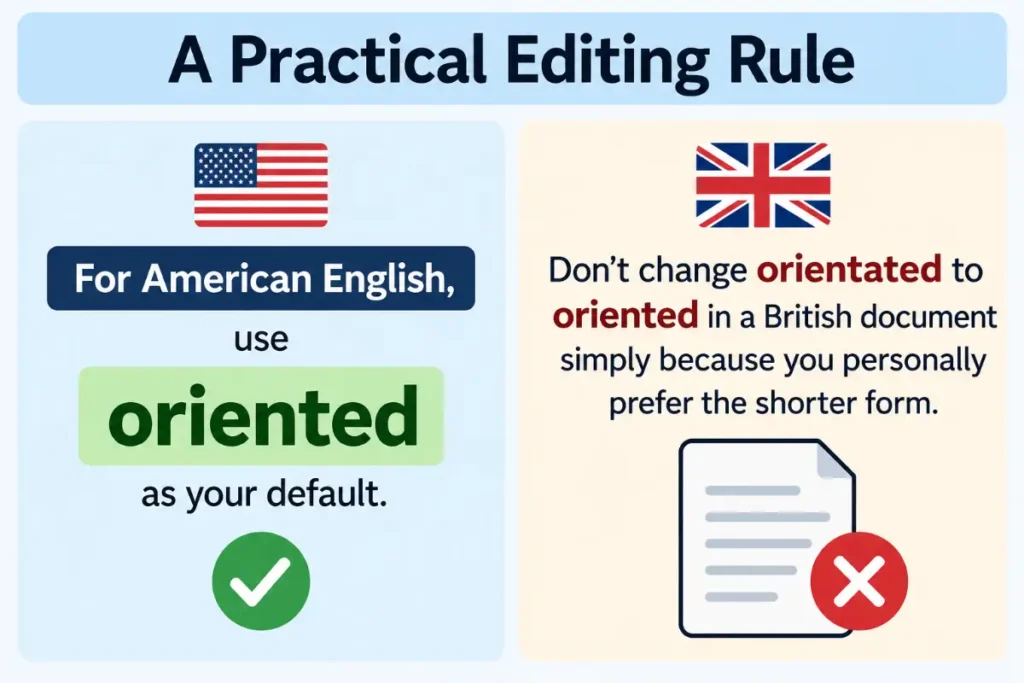
For American English, use oriented as your default.
Don’t change orientated to oriented in a British document simply because you personally prefer the shorter form.
Likewise, don’t change oriented to orientated just to make a sentence sound more formal.
Regional consistency is more valuable than forcing one form into every context.
If you edit content for an American audience, check the surrounding vocabulary too. A document that uses American spelling, American punctuation habits, and American terminology will usually benefit from oriented as well.
For another common grammar confusion, see Cryer vs Crier Which Spelling Is Correct 2026.
Final Answer
Both orientated and oriented are correct English forms. For American readers, oriented is usually the best choice because it is the standard and more familiar form in US usage. British English uses orientated much more often, although oriented also appears there.
The easiest editing rule is to match your audience. Writing for the United States? Use oriented. Writing for a British audience? Orientated may be the natural choice. Remember the base verbs too: orient gives oriented, while orientate gives orientated. Once you connect each form to its regional pattern, the confusion becomes much easier to handle.
FAQs
Is orientated a real word?
Yes. Orientated is a legitimate English form. Cambridge identifies it as mainly British and gives it the meaning directed toward or interested in something. It isn’t simply a misspelling of oriented. American English generally favors oriented, but British English commonly uses orientated.
Which is correct orientated or oriented?
Both are correct. Oriented is the usual choice in American English, while orientated is especially common in British English. The two forms can carry the same meaning when they describe something directed toward a goal, person, interest, or purpose. Your audience should guide the choice.
What does oriented mean?
Oriented means directed toward something or focused on a particular person, goal, purpose, or interest. It can also describe someone who has become familiar with a new situation or understands their position. In American English, oriented is the common past form of the verb orient.
How do you pronounce oriented?
In American English, oriented has a pronunciation represented by Cambridge as approximately /ˈɔːr.i.en.t̬ɪd/. It has four main syllables, with stress on the first. The final sound is softer than the pronunciation of the base verb.
How do you pronounce orientated?
Orientated has an additional syllable compared with oriented. Cambridge represents its pronunciation approximately as /ˈɔːriənteɪtɪd/. The extra syllable comes from the longer orientate form.
Can I use orientated in American English?
Yes. It isn’t grammatically forbidden in American English. Oxford lists orientate as an alternative verb in American English. Still, oriented is generally the more natural choice for a US audience, so it is the safer option in most American professional and academic writing.
Is oriented more formal than orientated?
No. The difference is mainly regional rather than formal versus informal. Oriented is common in formal American writing, while orientated can appear in formal British writing. Neither form automatically makes a sentence more professional. Audience and regional style matter more.
Why do people confuse orientated and oriented?
The confusion comes from the existence of two related verbs, orient and orientate. Their past forms are oriented and orientated. Because both forms are established and can express similar meanings, writers may wonder if one is an error. Regional English makes the choice more noticeable.