
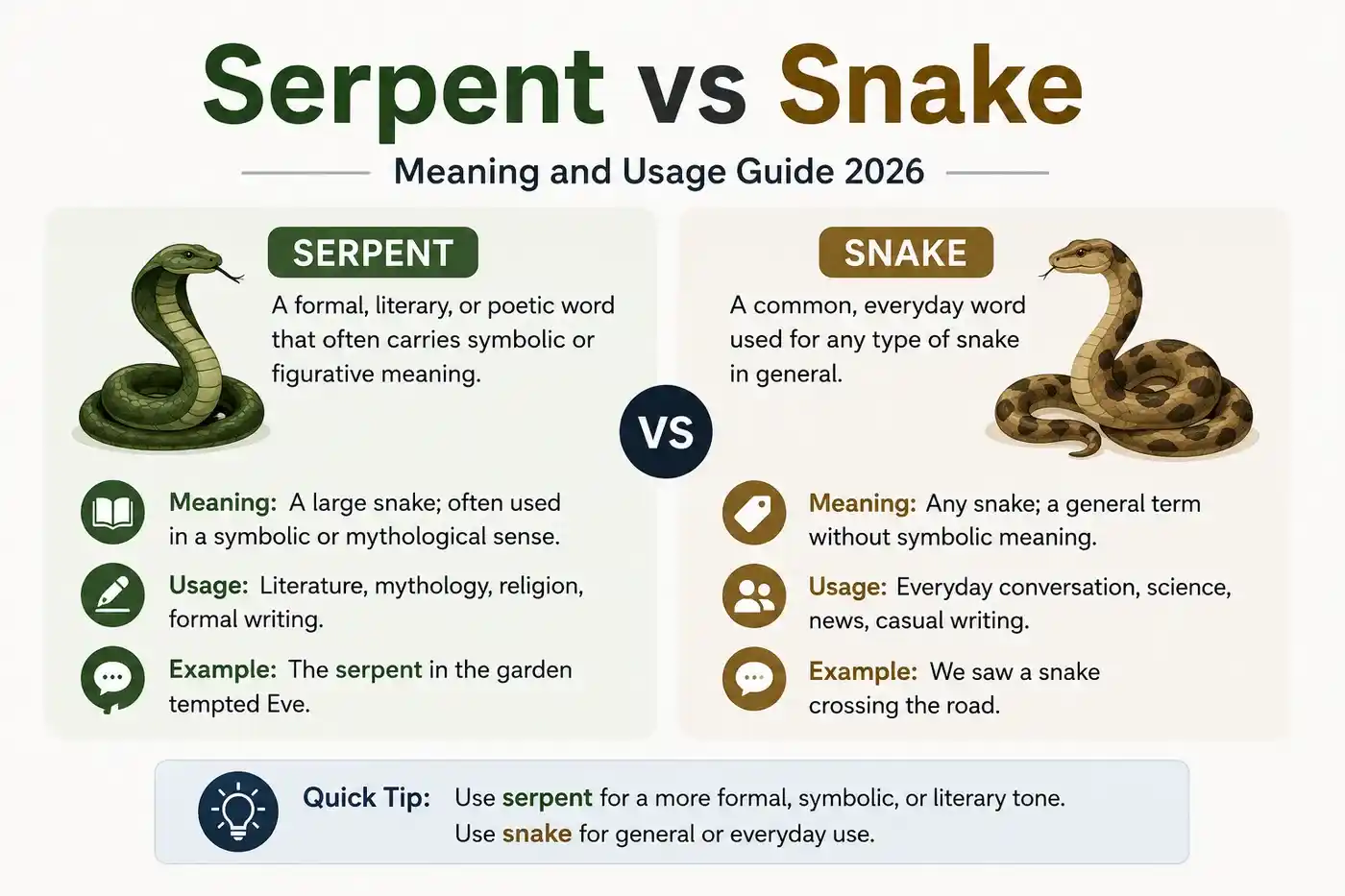
The debate around serpent vs snake isn’t really about spelling. It’s about meaning, tone, and usage.At first glance, both words describe the same reptile. A serpent is a snake, and a snake is a serpent. That simple fact makes many people assume the words are completely interchangeable. They aren’t. While both words refer to a long, legless reptile, they create very different impressions in English. One sounds modern, everyday, and straightforward. The other feels literary, symbolic, religious, or dramatic.
That’s why you’ll hear people talk about a snake in the backyard, but read about a serpent in mythology, ancient texts, and classic literature.Understanding this distinction helps writers choose the right word, avoid awkward phrasing, and communicate more effectively. In this guide, you’ll learn the exact difference between serpent and snake, their origins, pronunciation, grammar rules, usage examples, regional preferences, and the situations where one word works better than the other.
Still confused? Compare labour or labor Which Spelling Is Correct in 2026.
Quick Definition
A snake is the common modern word for any legless reptile belonging to the suborder Serpentes. A serpent is a more formal, literary, religious, or symbolic term for a snake. In everyday English, people almost always use snake, while serpent appears more often in mythology, literature, and historical or biblical contexts.
Serpent Vs Snake Quick Answer
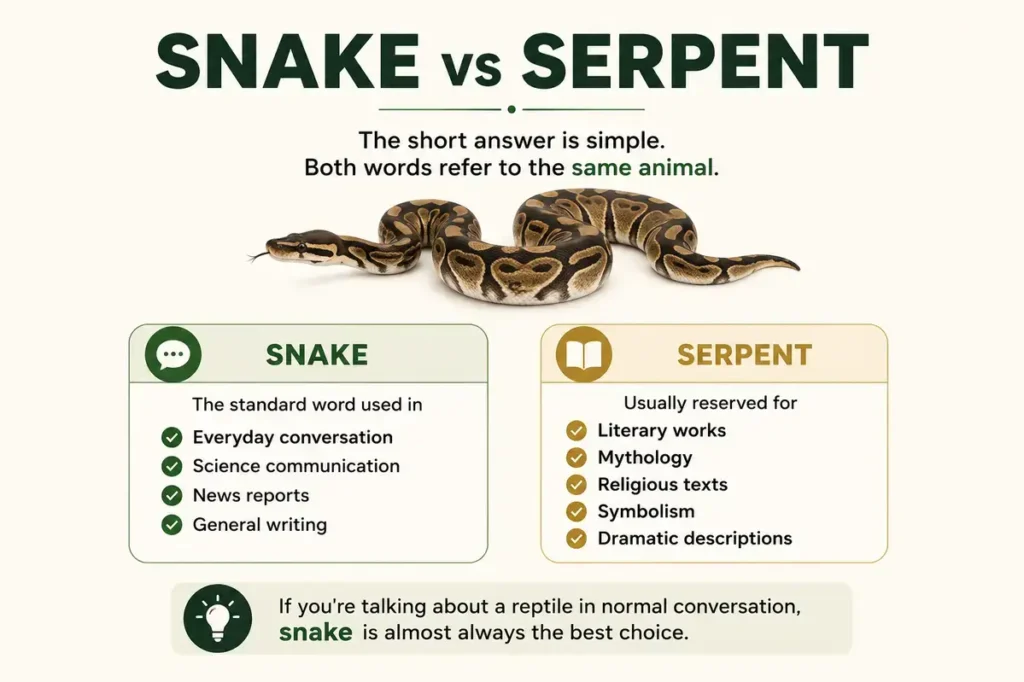
The short answer is simple. Both words refer to the same animal. However, snake is the standard word used in everyday conversation, science communication, news reports, and general writing. Serpent is usually reserved for literary works, mythology, religious texts, symbolism, and dramatic descriptions. If you’re talking about a reptile in normal conversation, snake is almost always the best choice.
Serpent Vs Snake Comparison Table
| Feature | Serpent | Snake |
|---|---|---|
| Correct Word | Yes | Yes |
| Meaning | A snake, often in symbolic or literary contexts | A legless reptile |
| Part of Speech | Noun | Noun |
| Origin | Old French and Latin roots | Old English roots |
| Usage Frequency | Less common | Very common |
| Formality Level | Formal or literary | Neutral |
| Common Contexts | Religion, mythology, literature | Daily speech, science, news |
| Emotional Tone | Dramatic or symbolic | Direct and factual |
| Modern Usage | Limited | Extremely common |
| Example | The serpent tempted Eve. | A snake crossed the road. |
Meaning Of Serpent Vs Snake
What Does Serpent Mean?
A serpent is a snake. The difference lies in the feeling the word creates. Serpent often carries symbolic meanings connected with wisdom, temptation, evil, mystery, power, rebirth, or ancient mythology. Writers frequently choose serpent when they want language that feels elevated, poetic, or dramatic.
Examples include:
- The serpent guarded the ancient treasure.
- A giant serpent emerged from the sea.
- The serpent became a symbol of temptation.
In many religious traditions, the serpent represents more than an animal. It becomes a symbol with deeper meaning.
What Does Snake Mean?
Snake is the standard modern term for the reptile itself. The word is factual, straightforward, and commonly understood by everyone. People use snake in everyday speech, educational materials, wildlife documentaries, scientific discussions, and casual conversation.
Examples include:
- A snake was hiding under the porch.
- We saw a snake while hiking.
- The zoo has several species of snake.
Unlike serpent, the word snake usually focuses on the actual animal rather than symbolism.
Key Differences Between Serpent Vs Snake
Although both words describe the same creature, several important differences exist.
Meaning Difference
- Snake primarily refers to the physical reptile.
- Serpent often includes symbolic, religious, mythological, or literary associations.
Tone Difference
- Snake sounds neutral and practical.
- Serpent sounds dramatic, formal, and descriptive.
Usage Difference
- Snake dominates modern English.
- Serpent appears mainly in specialized contexts.
Context Difference
- Snake fits everyday situations.
- Serpent fits storytelling, mythology, and symbolism.
Reader Perception Difference
- Snake feels realistic.
- Serpent feels legendary or symbolic.
A writer’s choice depends on the image they want readers to see.
Serpent Vs Snake In Literature
Literature often favors serpent because it creates stronger imagery. A serpent can feel ancient, mysterious, dangerous, or supernatural. Many authors deliberately choose serpent instead of snake when building atmosphere.
Consider these examples:
- The serpent coiled around the sacred tree.
- A winged serpent descended from the heavens.
- The golden serpent watched silently from the shadows.
Replacing serpent with snake would make these sentences feel less dramatic. That doesn’t make one word better. It simply shows that each serves a different purpose.
Serpent Vs Snake In Religion And Mythology
Religious and mythological texts frequently use serpent. The word appears across cultures and civilizations.
Examples include:
- Biblical stories.
- Greek mythology.
- Egyptian mythology.
- Norse legends.
- Hindu traditions.
- Mesoamerican mythology.
In many traditions, the serpent symbolizes wisdom, temptation, immortality, healing, transformation, or divine power. Because of these associations, serpent often carries emotional and cultural weight that snake does not.
Serpent Vs Snake In Modern English
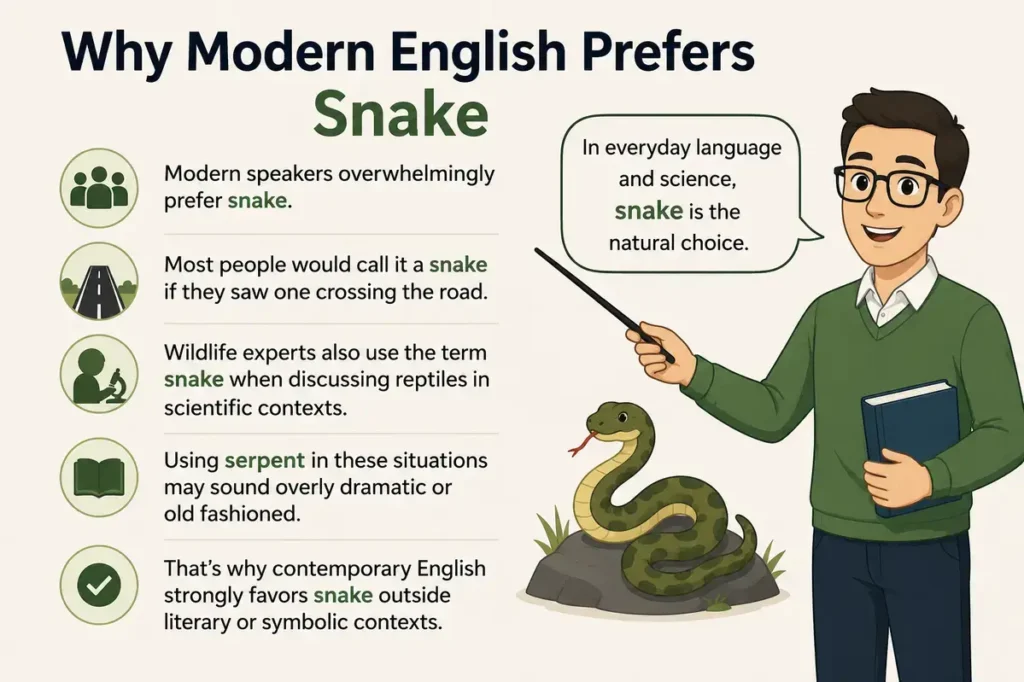
Modern speakers overwhelmingly prefer snake. Most people would call it a snake if they saw one crossing the road. Wildlife experts also use the term snake when discussing reptiles in scientific contexts. Using serpent in these situations may sound overly dramatic or old fashioned. That’s why contemporary English strongly favors snake outside literary or symbolic contexts.
Which One Is Correct In Serpent Vs Snake?
A common question is which word is correct. The answer is straightforward. Both serpent and snake are correct English words. Neither is a misspelling or grammatical mistake. The real question isn’t correctness. It’s appropriateness.
Choose snake when you’re referring to the animal in normal conversation, educational writing, scientific content, journalism, or everyday communication. Choose serpent when writing about mythology, religion, symbolism, folklore, fantasy stories, poetry, or historical texts. Think of it this way. Snake is the everyday workhorse of the English language. Serpent is the ceremonial outfit that comes out for special occasions.
When Snake Is Usually Better
- Wildlife articles.
- School assignments about reptiles.
- News reports.
- Scientific discussions.
- Casual conversations.
- Safety information.
Examples:
- A snake was found in the garage.
- The snake slithered across the trail.
- Experts identified the snake as harmless.
When Serpent Is Usually Better
- Mythological stories.
- Religious discussions.
- Fantasy novels.
- Symbolic writing.
- Poetry.
- Historical narratives.
Examples:
- The serpent guarded the sacred temple.
- The serpent symbolized eternal wisdom.
- An ancient serpent emerged from the sea.
Serpent Vs Snake Examples In Sentences
Understanding usage becomes much easier when you see both words in context.
Serpent Examples
- The serpent wrapped itself around the ancient tree.
- Legends spoke of a giant serpent beneath the ocean.
- The serpent appeared in many religious paintings.
- An emerald serpent guarded the hidden treasure.
- The story featured a winged serpent with magical powers.
- The serpent symbolized temptation throughout the narrative.
- Ancient cultures often worshipped the serpent as a sacred creature.
- The serpent moved silently through the ruins.
- Artists portrayed the serpent as a symbol of transformation.
- The mysterious serpent became the central figure in the myth.
Snake Examples
- A snake crossed the hiking trail.
- We spotted a snake near the riverbank.
- The snake disappeared into the tall grass.
- Experts relocated the snake safely.
- A snake can sense vibrations through the ground.
- The zoo cares for several species of snake.
- The snake shed its skin during the summer.
- Children learned about snake habitats in science class.
- A harmless snake was hiding under the deck.
- The snake quickly escaped into the bushes.
For another common grammar confusion, see Holistic or Wholistic Which Spelling Is Correct? 2026.
Common Mistakes In Serpent Vs Snake Usage
Many writers make the same mistakes when using these words. Avoiding them will make your writing sound more natural and accurate.
Using Serpent In Everyday Situations
Some writers choose serpent because it sounds more sophisticated. That can backfire.
Example:
Incorrect:
A serpent was found in my neighbor’s backyard.
Natural:
A snake was found in my neighbor’s backyard.
Most native speakers would use snake here.
Assuming Serpent And Snake Always Create The Same Effect
Both words refer to the same animal, but they don’t create the same image.
Compare these examples:
- The snake crawled through the grass.
- The serpent crawled through the grass.
The second sentence feels more dramatic and literary.
Believing Serpent Is More Scientifically Accurate
This is a common misconception.
Scientific and educational writing almost always uses snake.Serpent isn’t a scientific upgrade. It’s primarily a stylistic choice.
Treating Serpent As A Different Species
Some people assume serpents and snakes are different animals.
They aren’t.
A serpent is simply another word for a snake.
Overusing Serpent In Modern Writing
Using serpent repeatedly in ordinary content can make writing sound forced.Most readers expect snake unless the context clearly calls for a more symbolic or literary tone.
Serpent Vs Snake Pronunciation Guide
Pronunciation confusion isn’t common with these words, but learning the correct pronunciation helps with public speaking and voice search queries.
Serpent Pronunciation
IPA:
/ˈsɜːr.pənt/
Syllable Breakdown:
Ser • pent
Pronunciation Tip:
The first syllable receives the stress.
Say it like:
SUR pent
Snake Pronunciation
IPA:
/sneɪk/
Syllable Breakdown:
Snake
Pronunciation Tip:
The word contains a long A sound.
It rhymes with:
- Make.
- Take.
- Wake.
- Lake.
Common Pronunciation Mistakes
- Stressing the second syllable in serpent.
- Shortening the vowel sound in snake.
- Speaking serpent too quickly and dropping the middle vowel sound.
Native speakers generally pronounce both words clearly and consistently.
Etymology And Word Origin Of Serpent Vs Snake
The history of these words explains why they feel so different today.
Origin Of Serpent
Serpent comes from the Old French word serpent. That word traces back to the Latin serpens, meaning creeping animal or crawling creature. The Latin verb serpere means to creep or crawl. Because of its Latin roots, serpent developed associations with religion, mythology, literature, and formal writing. This heritage gives the word its elevated and symbolic tone.
Origin Of Snake
Snake comes from Old English snaca. It has Germanic roots and has existed in English for well over a thousand years. Because snake evolved directly through everyday speech, it became the standard term used by ordinary people. That’s one reason it sounds more natural in modern conversation.
How The Two Words Evolved
Over time, the roles of the words gradually separated.
- Snake became the everyday word.
- Serpent became the literary word.
- Religious texts preserved serpent.
- Modern speech favored snake.
This distinction remains strong today.
Regional Usage Of Serpent Vs Snake
English speakers across the world understand both words, but usage patterns remain remarkably similar.
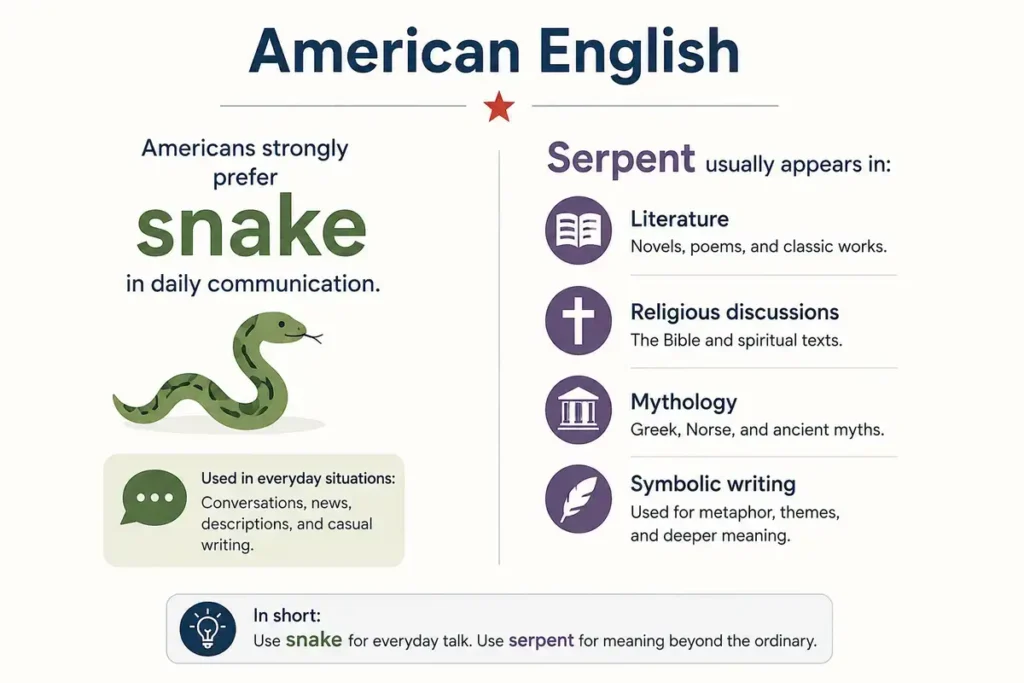
American English
Americans strongly prefer snake in daily communication.
Serpent usually appears in:
- Literature.
- Religious discussions.
- Mythology.
- Symbolic writing.
British English
British English follows the same pattern. Snake dominates everyday speech, while serpent appears mainly in formal and literary contexts.
Australian English
Australians frequently discuss snakes because of the country’s diverse wildlife. As a result, snake is overwhelmingly more common than serpent in normal communication.
Canadian English
Canadian English mirrors American and British usage. Most speakers use snake for the animal and serpent for symbolic or literary references.
Global English Preference
Across major English speaking regions:
- Snake is the default choice.
- Serpent is the specialized choice.
That pattern has remained stable for generations.
Serpent Vs Snake Grammar Rules
Understanding the grammar behind these words helps writers use them confidently.
Part Of Speech
Both serpent and snake function primarily as nouns.
Examples:
- The serpent appeared in the legend.
- The snake crossed the road.
Singular Forms
- Serpent.
- Snake.
Examples:
- A serpent guarded the temple.
- A snake hid beneath the rock.
Plural Forms
- Serpents.
- Snakes.
Examples:
- The story described many serpents.
- The guide warned visitors about snakes.
Possessive Forms
Singular Possessive:
- Serpent’s.
- Snake’s.
Examples:
- The serpent’s image appeared on the wall.
- The snake’s skin was found nearby.
Plural Possessive:
- Serpents’.
- Snakes’.
Examples:
- The serpents’ symbolism varied by culture.
- The snakes’ habitats differed greatly.
Common Sentence Structures
Subject:
- The serpent symbolized wisdom.
- The snake escaped quickly.
Object:
- They feared the serpent.
- We observed the snake.
Prepositional Phrase:
- Stories about the serpent remain popular.
- Information about the snake was available online.
Can Snake Be A Verb?
Yes.
Snake can function as a verb.
Examples:
- The river snakes through the valley.
- The road snakes around the mountain.
In this sense, it means to move in a winding or twisting path. Serpent does not commonly function as a verb in modern English.
Expert Observation On Grammar
From an editor’s perspective, grammar rarely determines the choice between serpent and snake. Tone does. If your audience expects plain, modern English, snake will almost always be the stronger option. If your goal is symbolism, atmosphere, mythology, or literary depth, serpent often becomes the better choice.
Serpent vs Snake vs Viper
Although serpent, snake, and viper are related, they are not exactly the same.
Serpent is a literary, symbolic, or mythological term for a snake. It often appears in ancient myths, religious texts, and legends, where it represents wisdom, power, temptation, transformation, or mystery.
Snake is the general scientific and everyday word for any legless reptile in the suborder Serpentes. It refers to all species, whether venomous or nonvenomous.
Viper is a specific type of venomous snake belonging to the family Viperidae. Vipers are known for their long, hinged fangs and powerful venom used to subdue prey.
In short:
- Serpent = A symbolic or poetic name for a snake.
- Snake = The general term for all snakes.
- Viper = A venomous type of snake.
Serpent Vs Snake In Real Life Usage
Looking at how people actually use these words reveals an important pattern. Both terms exist in modern English, but they don’t appear with the same frequency or purpose.
Serpent Vs Snake In Daily Conversation
In everyday speech, snake is the clear winner.
Most people say:
- I saw a snake in the garden.
- Be careful because there may be snakes nearby.
- That snake disappeared into the bushes.
Using serpent in these situations would sound unusual to most native speakers.
For example:
- I saw a serpent in my garden.
The sentence is grammatically correct, but it sounds dramatic and literary.
Serpent Vs Snake In Academic Writing
Academic and scientific writing almost always favors snake.
Examples:
- The snake uses its tongue to collect chemical information.
- Many snake species are nonvenomous.
- Researchers studied snake behavior in different environments.
Scientific publications prioritize clarity and precision. Since snake is the standard term, it appears far more often than serpent.
Serpent Vs Snake In Professional Communication
Professional writing generally follows the same pattern.
Examples:
- Wildlife officials safely removed the snake.
- The report identified the snake species.
- Emergency services responded to a snake sighting.
Using serpent in workplace communication can sound overly dramatic unless the discussion involves mythology, symbolism, or literature.
Serpent Vs Snake In Literature
Literature gives serpent much more room to shine. Authors often choose serpent because it creates vivid imagery and emotional depth.
Examples:
- The serpent guarded the gates of the forgotten kingdom.
- A silver serpent emerged from the darkness.
- The serpent whispered ancient secrets.
These examples create a richer atmosphere than the word snake typically provides.
Serpent Vs Snake In Media And Entertainment
Movies, television shows, fantasy novels, and video games frequently use serpent.
Common examples include:
- Sea serpent.
- Feathered serpent.
- Fire serpent.
- Ancient serpent.
- Celestial serpent.
These phrases help create mystery, danger, and wonder.
Related Words And Confused Terms
People searching for serpent vs snake often encounter similar words. Understanding these related terms helps build a stronger vocabulary.
Reptile
A reptile is a broad category of animals that includes snakes, lizards, turtles, and crocodiles. Every snake is a reptile, but not every reptile is a snake.
Viper
A viper is a specific type of snake.
Examples include:
- Gaboon viper.
- Puff adder.
- Rattlesnake relatives in the viper family.
Cobra
A cobra is another specific kind of snake known for its hood. Not all snakes are cobras.
Python
A python is a large nonvenomous snake. The word refers to a specific group rather than all snakes.
Boa
A boa is a large constricting snake. Like python, it’s a subtype of snake.
Serpentine
Serpentine means snake like or winding in shape.
Examples:
- A serpentine road.
- A serpentine river.
- A serpentine path through the mountains.
Dragon
In mythology, dragons and serpents often share characteristics. Many ancient cultures described dragons as enormous serpentine creatures.
Sea Serpent
A sea serpent is a legendary marine creature found in folklore and mythology. Unlike ordinary snakes, sea serpents are generally mythical.
Adder
An adder is another specific type of snake, especially in British English. Understanding these related terms helps readers recognize the broader language surrounding snakes and serpents.
Expert Language Insight On Serpent Vs Snake
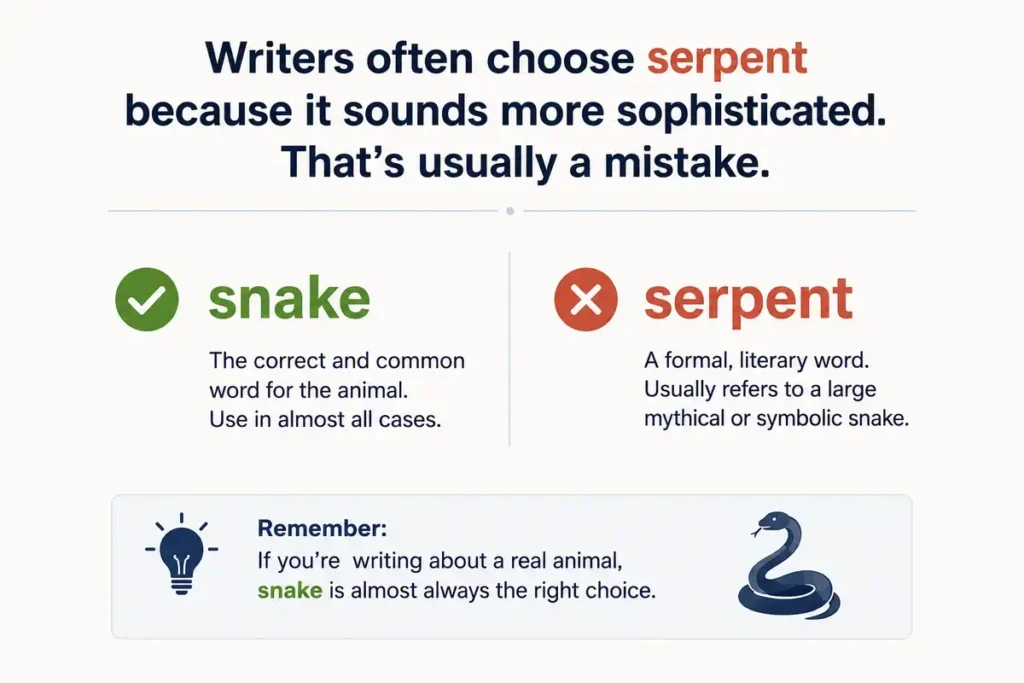
After years of editing articles, academic papers, marketing content, and creative writing projects, one pattern appears again and again. Writers often choose serpent because they think it sounds more sophisticated. That’s usually a mistake.
Strong writing isn’t about choosing the fanciest word. It’s about choosing the most appropriate word. If you’re describing a reptile in a backyard, a zoo, a science textbook, or a wildlife article, snake is almost always the better choice. Readers expect it.
It’s familiar, natural, and precise. Serpent becomes valuable when you want symbolism, atmosphere, or emotional weight. Consider these examples:
- The snake crossed the road.
- The serpent crossed the road.
The first sentence feels realistic. The second sentence feels like the opening line of a fantasy novel.
Neither is wrong.
The context determines the right choice. Native speakers instinctively make this distinction. They rarely stop to think about it, but they naturally reserve serpent for situations that feel symbolic, religious, mythical, poetic, or dramatic.
That’s why understanding audience expectations matters so much. The best writers don’t choose words simply because they sound impressive. They choose words that fit the situation.
Frequently Asked Questions About Serpent Vs Snake
Is a serpent different from a snake?
No. A serpent is a snake. The difference lies in usage and tone rather than biology. Snake is the common modern word, while serpent is more literary, symbolic, religious, or mythological.
Which is more correct serpent or snake?
Both are correct. Snake is the preferred word in everyday English, scientific writing, and normal conversation. Serpent is more common in literature, mythology, religion, and symbolic contexts.
Why does the Bible use serpent instead of snake?
Many Bible translations use serpent because the word reflects historical language and carries symbolic meaning. It helps preserve the tone and imagery found in ancient religious texts.
Is serpent an old fashioned word?
In everyday conversation, yes. Most people use snake today. However, serpent remains common in literature, mythology, fantasy writing, religious discussions, and symbolic language.
Do scientists use serpent or snake?
Scientists almost always use snake. Scientific and educational writing favors precise, widely recognized terminology. Serpent rarely appears in technical discussions about reptiles.
What is the plural of serpent?
The plural form of serpent is serpents. The plural form of snake is snakes.
Examples:
- Ancient stories featured many serpents.
- The forest contained several snakes.
Can serpent have symbolic meaning?
Yes. Across different cultures, the serpent can symbolize wisdom, temptation, healing, transformation, immortality, knowledge, danger, or spiritual power. The exact meaning depends on the cultural and historical context.
Why does serpent sound more dramatic than snake?
Serpent has strong connections to mythology, religion, folklore, and literature. These associations give the word a more powerful and symbolic tone, while snake sounds practical and straightforward.
You may also want to read optimize or optimise Correct Spelling And Usage.
Conclusion
The answer to serpent vs snake is simpler than many people expect. Both words refer to the same animal. Neither is more correct than the other. The difference comes down to tone, context, and audience expectations. Use snake when discussing the reptile in everyday situations, educational content, scientific writing, journalism, or casual conversation. It’s the standard modern term and the one native speakers use most often.
Use serpent when writing about mythology, religion, symbolism, folklore, fantasy, poetry, or dramatic storytelling. The word carries deeper emotional and cultural associations that snake usually doesn’t. A helpful rule to remember is this:If you’re describing a real animal, choose snake. If you’re creating imagery, symbolism, or literary atmosphere, serpent may be the stronger choice.Understanding that distinction will help your writing sound more natural, precise, and effective.