
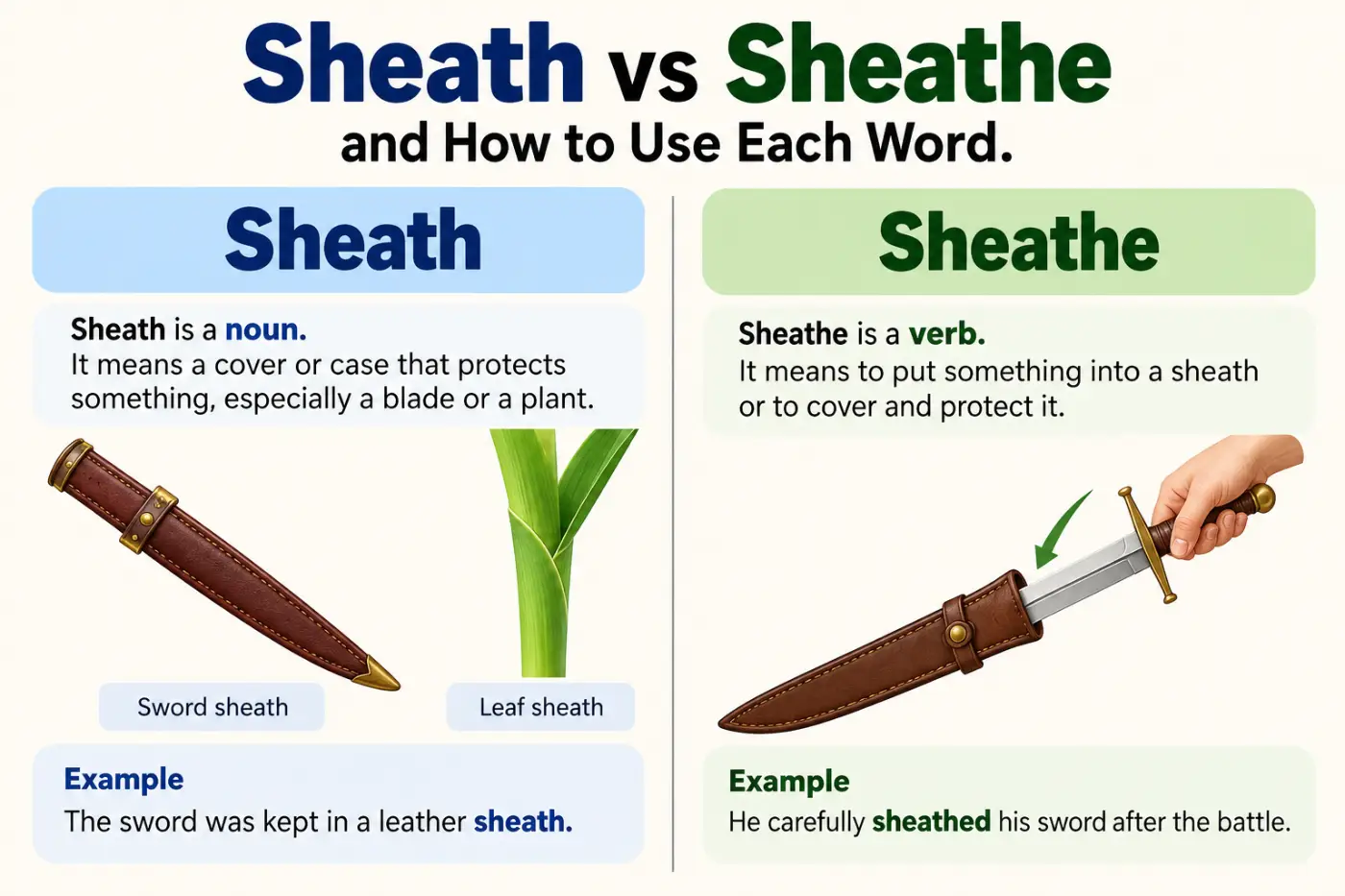
If you’re deciding between sheath vs sheathe, the difference comes down to grammar and meaning. Sheath is mainly a noun for a close fitting covering or case. Sheathe is a verb meaning to put something into a sheath or to cover something with a protective layer.
The two words look almost identical because they come from the same historical word family. The final letter changes the sound and the grammatical job of the word. Once you connect sheath with the thing and sheathe with the action, the distinction becomes much easier to remember.
You may also want to read Loose Or Lose Which Word Is Correct (2026).
Quick Answer
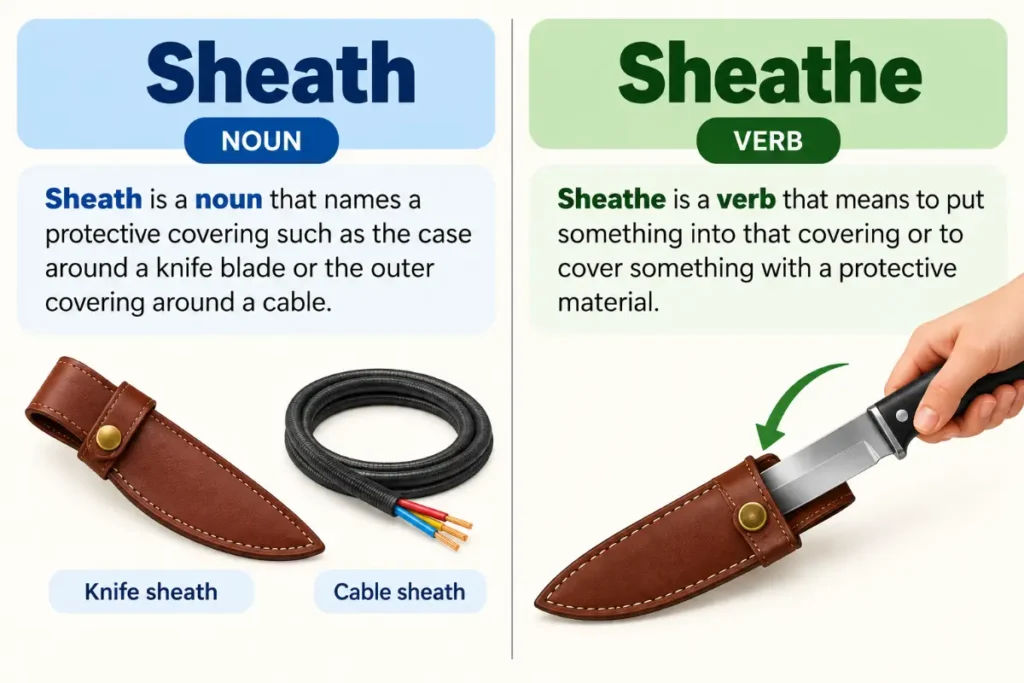
Sheath is a noun that names a protective covering such as the case around a knife blade or the outer covering around a cable. Sheathe is a verb that means to put something into that covering or to cover something with a protective material.
Think of it this way. The sheath is the container. To sheathe something is to put it into the container.
Sheath vs Sheathe at a Glance.
| Correct Form | Meaning | Part of Speech | Origin | Usage Frequency | Formality | Common Contexts | Example |
|---|---|---|---|---|---|---|---|
| Sheath | A close fitting protective covering or case | Noun | Old English with Germanic roots | Common in specific contexts | Neutral | Knives, swords, cables, biology, clothing | The knife was in its sheath. |
| Sheathe | To put something into a sheath or cover it with protective material | Verb | Derived from sheath in Middle English | Less common than the noun | Neutral to literary depending on context | Weapons, cables, buildings, natural descriptions | He sheathed the knife. |
The relationship is similar to many noun and verb pairs in English. One word identifies the object and the other describes an action involving that object.
What Does Sheath Mean.
Sheath is a noun. It refers to a close fitting covering that protects something or holds it in place.
The most familiar example is a knife or sword. A sheath covers the blade when the weapon isn’t being used.
For example:
- The hunter placed the knife back in its sheath.
- The sword remained inside its leather sheath.
- The cable has a thick protective sheath.
The important point is that sheath names the covering itself. You can point to it. You can describe it.
That makes its noun function easy to recognize.
Sheath as a General Covering.
The meaning goes beyond weapons.
A sheath can be any close fitting layer that surrounds and protects something. You might see the word in technical or scientific writing.
For example:
- The wire has a rubber sheath.
- The nerve is surrounded by a protective sheath.
- The plant stem was enclosed by a leaf sheath.
In these examples, the basic idea stays the same. Something is surrounded by a close fitting protective layer.
Sheath in Clothing.
The word also appears in fashion.
A sheath dress is a fairly straight dress that fits closely around the body.
For example:
She chose a simple black sheath dress for the dinner.
This use comes from the same basic image. The dress fits closely around the body in much the same way that a sheath fits closely around an object.
Sheath in Biology and Science.
You may also encounter sheath in medical and scientific contexts.
A myelin sheath surrounds certain nerve fibers. A plant structure can also be described as a sheath when it surrounds part of a stem or another structure.
The meaning remains consistent even in technical language. The word describes an outer layer or covering that closely surrounds something.
That gives you a strong mental picture. If you can imagine a protective layer wrapped closely around something, sheath may be the word you need.
What Does Sheathe Mean.
Sheathe is a transitive verb. It describes an action.
The traditional meaning is to put a knife or sword into a sheath. The word can also describe covering something with a protective material.
For example:
- He sheathed his sword after the fight.
- She sheathed the knife carefully.
- The worker sheathed the cable in protective material.
- The building was sheathed in metal panels.
The verb can therefore describe both putting an object into a covering and covering something itself.
The Basic Grammar Pattern.
The common pattern is:
sheathe + object
For example:
- Sheathed the sword.
- Sheathed the knife.
- Sheathed the cable.
The object tells you what receives the action.
You can also see sheathe in passive constructions.
The cable was sheathed in plastic.
The walls were sheathed in wood.
The structure was sheathed in metal.
This pattern appears especially often in technical descriptions and formal writing.
The Key Difference Between the Two Words.
The easiest distinction is grammatical.
Sheath is the thing.
Sheathe is the action.
Consider this sentence:
The sword is in its sheath.
Here you are naming the protective case.
Now change the sentence:
The warrior sheathed his sword.
Here you are describing what the warrior did.
The connection is almost like this:
Sheath means covering.
Sheathe means put into the covering.
That simple pair can solve most usage questions.
Why the Spelling Causes Confusion.
The two forms differ by only one letter. That makes them easy to mix up, especially when you know what the word means but haven’t stopped to identify its grammatical role.
There is another reason the confusion can linger. The pronunciation changes too.
In American English, sheath ends with the unvoiced th sound found in words such as think.
Sheathe ends with the voiced th sound found in words such as this.
So the spelling isn’t the only difference. The final sound changes as well.
Pronunciation Guide.
Sheath.
IPA: /ʃiθ/.
Syllables: one syllable.
Easy guide: sheeth.
The final sound is the unvoiced th sound. Put your tongue lightly between your teeth and let air pass without using your voice.
Sheathe.
IPA: /ʃið/.
Syllables: one syllable.
Easy guide: sheeth with a voiced final sound.
The final th sound uses your voice. You can feel a small vibration in your throat when you say it.
The contrast is subtle but real.
Sheath ends with /θ/.
Sheathe ends with /ð/.
That difference can help you hear the words instead of relying only on spelling.
Is Sheath a Noun or a Verb.
In standard modern usage sheath is primarily a noun. It names a protective covering.
For example:
The knife has a leather sheath.
The sheath protects the blade.
The cable has an outer sheath.
Some dictionaries also record sheath as a verb with the meaning to sheathe. For ordinary modern writing, however, sheathe is the clearer choice when you want to express the action.
That gives you a useful editing rule. If you’re writing a normal sentence and need a verb meaning put into a sheath, use sheathe.
Is Sheathe a Noun or a Verb.
Sheathe is a verb.
It describes the act of putting something into a sheath or covering it with a protective layer.
Its main forms are:
- Present form: sheathe.
- Third person singular: sheathes.
- Past tense: sheathed.
- Past participle: sheathed.
- Present participle: sheathing.
Examples include:
I sheathe the blade.
She sheathes the knife.
He sheathed his sword.
The blade was sheathed.
The word changes like other regular verbs when you use it in different grammatical forms.
Sentence Examples.
Here are natural examples that show how the words work in real sentences.
- The knife was safely stored in its leather sheath.
- He returned the sword to its sheath after the ceremony.
- The cable has a thick plastic sheath for added protection.
- The hunter checked the sheath before putting the knife away.
- She found a replacement sheath for her old camping knife.
- The soldier carefully sheathed his sword before leaving the field.
- He sheathed the knife and placed it in the drawer.
- The technician sheathed the exposed wire with protective material.
- The walls were sheathed in a layer of insulating material.
- After cleaning the blade, she sheathed it and stored it safely.
Notice how the noun naturally follows words such as the, a, its, or a possessive noun.
The verb usually appears after a subject and takes an object.
That grammatical pattern is often more useful than memorizing definitions.
Common Mistakes and Misspellings.
The confusion usually comes from treating the two words as interchangeable. They aren’t.
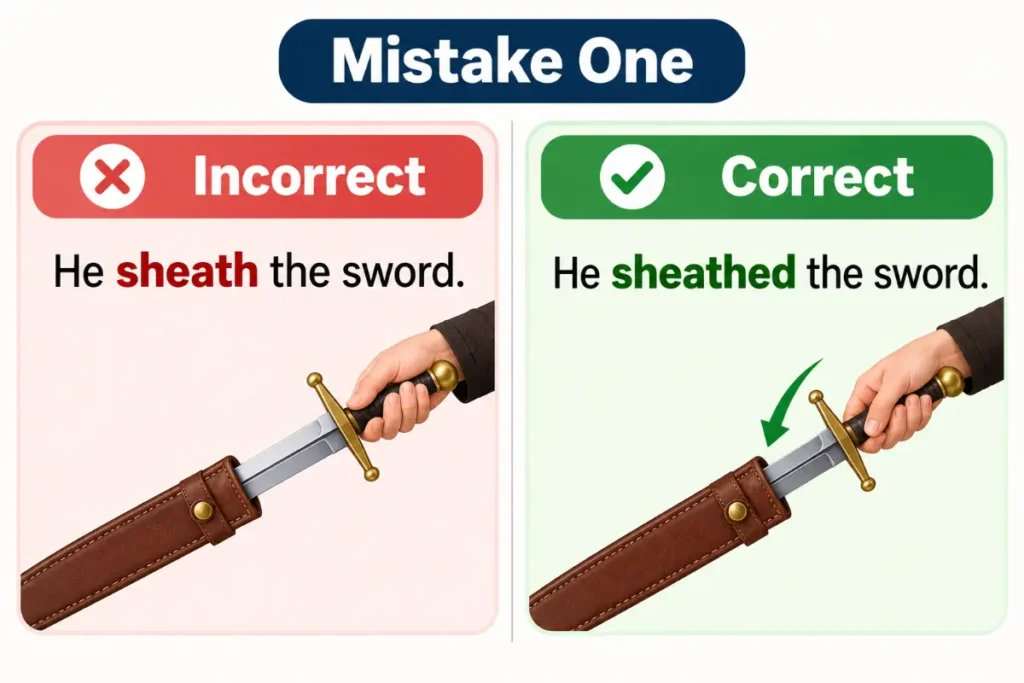
Mistake One.
Incorrect in a sentence that needs the verb:
He sheath the sword.
Correct:
He sheathed the sword.
The sentence needs a past tense verb. The correct form is sheathed.
Mistake Two.
Incorrect:
The sword was stored in its sheathe.
Correct:
The sword was stored in its sheath.
The sentence needs the name of the covering. That makes sheath the right choice.
Mistake Three.
Incorrect:
She put the knife in the sheathe.
Correct:
She put the knife in the sheath.
After the preposition in, the sentence needs the noun that names the container.
Mistake Four.
Incorrect:
He sheathes his sword and walks away.
This one is actually correct.
The form sheathes is the third person singular present tense of sheathe.
This is worth mentioning because writers sometimes assume that every form ending in sheathes must be wrong.
Mistake Five.
Incorrect:
The cable has a protective sheathe.
Correct:
The cable has a protective sheath.
The noun names the protective outer layer. The verb doesn’t belong in that position.
How to Remember the Difference.
A simple memory trick can make this almost automatic.
Think of the extra e in sheathe as part of the action.
Sheath is the thing.
Sheathe is what you do with the thing.
You can also build a short sentence pair in your mind.
The sword has a sheath.
The warrior sheathes the sword.
The first sentence names an object.
The second sentence describes an action.
Another useful test is to replace the word with cover or covering.
If covering works, you probably need sheath.
If put inside or cover with works, you probably need sheathe.
For example:
The knife needs a covering.
The knife needs a sheath.
He put the knife inside the covering.
He sheathed the knife.
That mental substitution works surprisingly well.
Learn the difference in hall vs haul: Correct Spelling, Meaning and Usage.
Grammar Patterns That Make the Choice Easier.
Grammar often gives you the answer before meaning does.
Look at the words around the target word.
If you see a, the, this, that, my, your, its, or a possessive noun immediately before the word, a noun may be required.
For example:
The sheath was damaged.
Her sheath was made of leather.
That sheath protects the blade.
Now look at a sentence with an obvious subject and action.
He sheathed the blade.
She sheathed the knife.
The worker sheathed the cable.
The verb expresses an action performed on an object.
There is also a useful passive structure:
The blade was sheathed.
Here sheathed is the past participle of the verb.
The distinction becomes especially clear if you compare these sentences:
The blade is in the sheath.
The blade is sheathed.
The first sentence tells you where the blade is.
The second describes its condition after someone has placed it inside a protective covering.
Sheath in American English.
The noun is standard American English.
American readers may encounter the word in several areas.
- Knife and sword descriptions.
- Electrical and engineering writing.
- Medical and biological terminology.
- Fashion descriptions.
- General literary writing.
The core meaning stays stable across these contexts.
Sheathe in American English.
The verb is also standard American English.
It has two major uses. The first involves putting a knife or sword into a sheath. The second involves covering something with protective material.
The weapon sense can sound literary in everyday American conversation. People often say put the knife away or put the sword back in its case instead.
Still, sheathe is perfectly valid and precise.
The broader covering sense can appear in technical and descriptive writing.
For example:
The roof was sheathed in copper.
The walls were sheathed in wood.
The cable was sheathed in rubber.
British English and Other Varieties.
There isn’t a major spelling difference between American and British English for these two words.
Both varieties use sheath as the noun and sheathe as the verb.
The pronunciation can vary slightly by accent, but the central contrast remains the same.
Australian and Canadian English do not create a major spelling distinction here either. Writers in these varieties can use the same forms.
So you don’t need to memorize a regional spelling rule. The noun and verb distinction works across standard varieties of English.
Where the Words Came From.
The close relationship between these words isn’t accidental.
Sheath comes from Old English and has Germanic roots. It originally referred to a protective case or covering associated with a blade.
The verb sheathe developed from the noun. Its original idea was to place a sword into its sheath. Over time, the verb gained a broader meaning involving covering or enclosing something.
That history explains why the words look so closely related.
The noun names the covering. The verb describes the action associated with that covering.
Why the Verb Can Describe More Than Swords.
At first glance, sheathe seems like a word that belongs only to swords and knives. Modern usage is broader.
The verb can describe covering something in a protective material.
For example:
The building was sheathed in metal.
The cable was sheathed in plastic.
The pipe was sheathed in insulation.
The landscape was sheathed in ice.
The last example is more literary. It uses the image of a protective covering to create a strong visual description.
This broader meaning is useful because it shows that the word isn’t locked inside old sword and armor vocabulary.
Related Words and Confused Terms.
Several words sit close to this vocabulary. Knowing the differences can help you choose a more natural expression.
Scabbard.
A scabbard is a cover for a sword. The word is more specific than sheath.
Cover.
Cover is much broader. It can describe almost anything placed over something else for protection or concealment.
A sheath is a particular kind of close fitting cover.
Casing.
Casing usually describes an outer layer or enclosure around an object. It often appears in technical or mechanical contexts.
Sleeve.
A sleeve is a covering that often fits around a long object. It can be protective or functional.
Sheathing.
Sheathing can refer to the act of covering something or the material used for that covering.
Shield.
A shield protects something from harm but doesn’t necessarily surround it closely. That makes it different from a sheath.
Encasing.
Encasing means surrounding or enclosing something. It describes the action more broadly than sheathe.
Enclosure.
An enclosure is something that surrounds or contains another thing. It can be much larger and less closely fitted than a sheath.
These related terms overlap in meaning, but they aren’t interchangeable in every sentence.
Real Life Usage Examples.
Daily Conversation.
The knife is still in its sheath.
Put the sword back in its sheath before you leave.
These sentences use the noun naturally because the speaker is talking about the protective object.
Workplace Communication.
The technician replaced the damaged cable sheath.
The exposed wire needs to be sheathed before the equipment is used.
The first sentence names a component. The second describes a safety related action.
Academic Writing.
The study examined changes in the protective sheath surrounding the nerve fibers.
The plant structure was sheathed by layers of tissue.
Technical writing often uses the word in its broader protective sense.
News and Journalism.
The historic blade was displayed in its original sheath.
The tower was sheathed in reflective panels during the renovation.
These uses are clear and natural because they describe physical objects and visible coverings.
Literature and Storytelling.
The knight slowly sheathed his sword.
The valley was sheathed in winter fog.
The second example uses the verb metaphorically to create a visual image. The idea is still based on the original meaning of enclosing something.
When to Use a Different Word.
Sometimes sheathe is grammatically correct but not the most natural choice.
For example:
He sheathed his pocketknife.
This is correct. But in everyday American conversation, a speaker might more naturally say:
He put his pocketknife away.
The more specialized verb works well when the context involves weapons, formal description, technical writing, or deliberate literary style.
Similarly, sheath is precise when you mean a close fitting protective covering. If you simply mean any cover, cover may sound more natural.
Good writing isn’t just about choosing a word that passes a grammar test. It is also about choosing the word that fits the situation.
Expert Editor Insight.
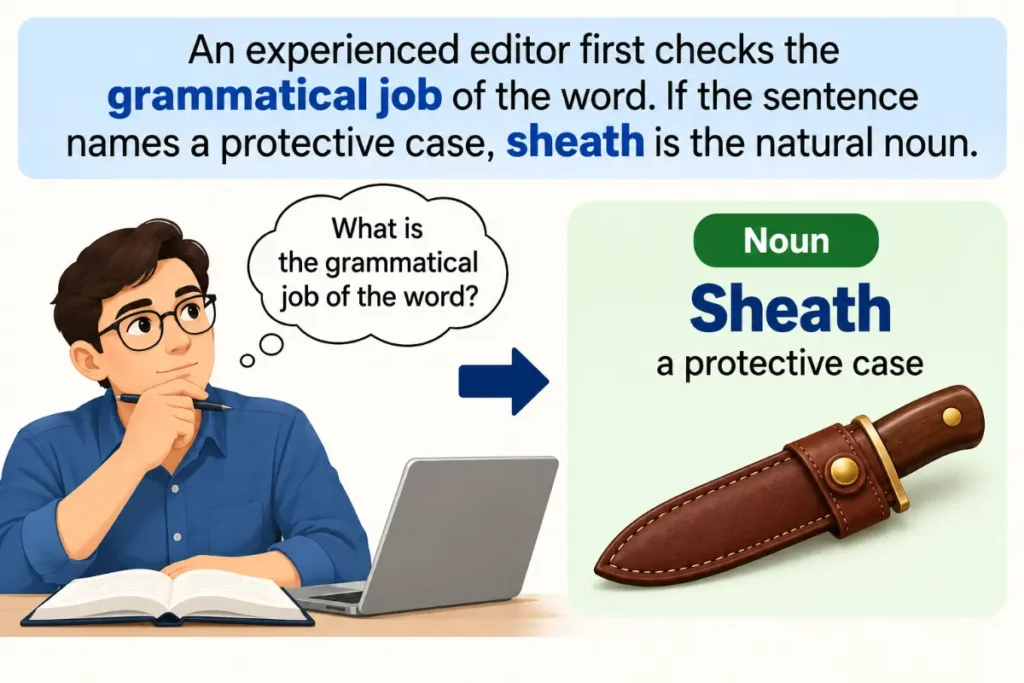
An experienced editor first checks the grammatical job of the word. If the sentence names a protective case, sheath is the natural noun. If the sentence describes the action of putting something inside that case or covering it with protective material, sheathe is the appropriate verb. The spelling difference is small, but the grammatical difference is clear. Editors also look at register because the weapon sense of sheathe can sound literary in ordinary American conversation.
A Simple Test for Writers.
When you’re unsure, ask one question.
Am I naming the covering or describing the action.
If you’re naming the covering, use sheath.
If you’re describing the action, use sheathe.
Try the test with these examples.
- The knife is in the ___.
The answer is sheath.
- He ___ the knife.
The answer is sheathed.
This test works because it focuses on grammar and meaning at the same time.
Many readers also check Stellar vs Steller: Meaning, Spelling, and Usage.
Conclusion.
The simplest way to remember sheath vs sheathe is to focus on the grammatical role. Sheath is the noun for a close fitting protective covering. Sheathe is the verb for putting something into that covering or covering something with protective material. The words share the same historical family, but they have different jobs in a sentence.
If you can replace the word with covering, choose sheath. If you can replace it with put inside or cover with, choose sheathe. That quick test will prevent most spelling and usage mistakes.
FAQs
Is sheath a real word?
Yes. Sheath is a standard English noun. It refers to a close fitting protective covering such as the case around a knife blade. It can also describe protective layers around cables, nerves, plants, and other structures.
Is sheathe a real word?
Yes. Sheathe is a standard English verb. It means to put something such as a knife or sword into a sheath. It can also mean to cover something with a protective material.
Which form should I use for a knife covering?
Use sheath when you mean the covering itself. For example, you can say that a knife is stored in a leather sheath. If you mean the action of putting the knife into that covering, use sheathe.
How do you pronounce sheath?
In American English, sheath is pronounced /ʃiθ/. It has one syllable and ends with the unvoiced th sound. That is the same general final sound found in words such as think.
How do you pronounce sheathe?
In American English, sheathe is pronounced /ʃið/. It has one syllable and ends with a voiced th sound. The main difference from the noun is the final consonant sound.
Can sheathe describe covering something besides a weapon?
Yes. The verb can describe covering something with a protective material. You can sheathe a cable in plastic or describe a building as sheathed in metal. This broader use often appears in technical or descriptive writing.
Why are these two words so easy to confuse?
They share nearly the same spelling and come from the same historical word family. The main difference is the final letter and the grammatical function. Sheath names a covering, while sheathe describes an action involving that covering.
Is sheathe appropriate in formal writing?
Yes. Sheathe is a standard English verb and works well in formal writing. It can sound literary when used specifically for putting a sword or knife into its covering. In technical writing, the broader meaning of covering something with protective material can sound completely natural.