
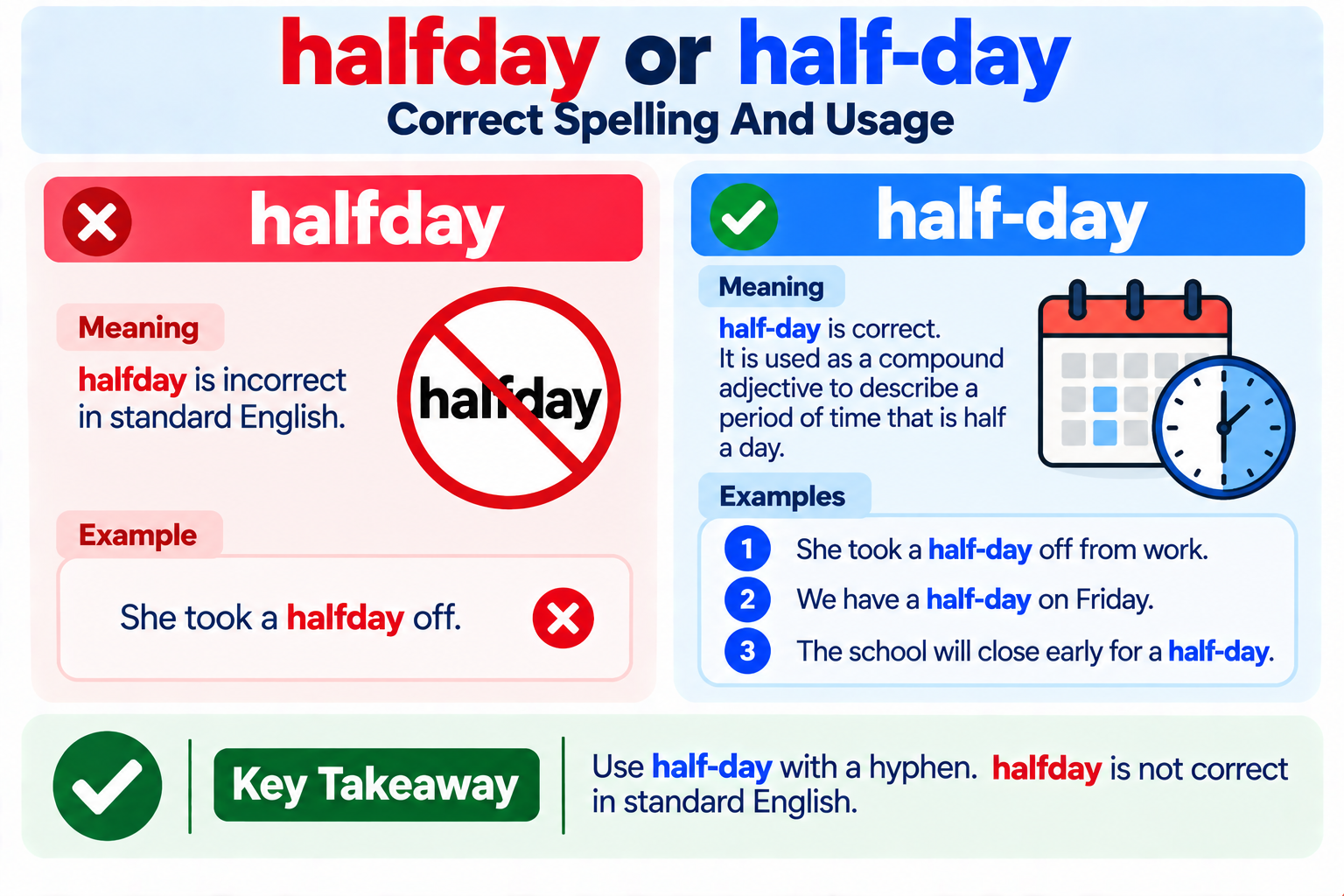
If you’re unsure about halfday or half-day, the answer depends on how you use the expression. Halfday is generally not the standard form. Use half day when the phrase functions as a noun and half-day when it works as a compound adjective before another noun. For example, you can say, “I only work a half day on Friday,” but “I attended a half-day workshop.”
The confusion comes from a small spelling detail that changes with sentence structure. English often uses a space when two words form an ordinary noun phrase and a hyphen when those words work together as a modifier before another noun. That pattern can feel inconsistent until you see it in real sentences.
This guide explains the difference in plain English. You’ll learn what each form means, how native speakers use it, when the hyphen belongs, common mistakes, pronunciation, regional usage, grammar rules, and practical examples for school, work, email, and everyday conversation.
You may also want to read Manuel vs Manual Correct Spelling Meaning and Usage.
Quick Definition
Use half day as a noun phrase when you mean part of a day. Use half-day as a compound adjective before a noun when the two words work together to describe something lasting half a day. Halfday as one word is generally nonstandard in ordinary English.
Quick Answer
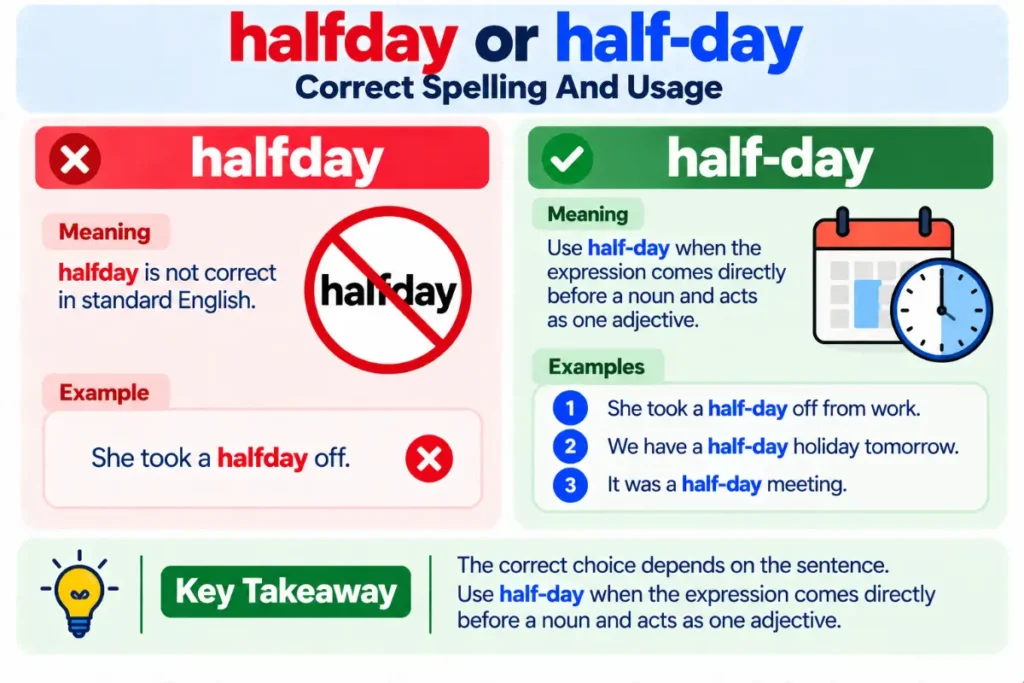
The standard forms are half day and half-day. They are not simply two spellings of the same construction.
Use half day when the phrase names a period of time. Use half-day when it describes a noun that follows it.
For example:
- I took a half day off work.
- We attended a half-day training session.
The one word form halfday is generally not used as the standard spelling in edited English.
Comparison Table
| Form | Meaning | Part of Speech | Origin | Usage Frequency | Formality | Common Contexts | Example |
|---|---|---|---|---|---|---|---|
| half day | Half of a day or a working day lasting part of a day | Noun phrase | Combination of half and day | Common | Neutral | Work schedules, school, appointments, time off | I took a half day off. |
| half-day | Lasting for half a day or relating to a half day | Compound adjective and noun in dictionary usage | Combination of half and day | Common | Neutral | Workshops, sessions, classes, events | We joined a half-day workshop. |
| halfday | Usually intended to mean half day or half-day | Nonstandard form in ordinary English | Modern spelling error or informal compression | Uncommon in edited writing | Informal and nonstandard | Typing errors and unedited text | Avoid halfday in formal writing. |
Oxford lists half-day as a noun for a day when people work only in the morning or afternoon and also uses it in expressions such as a half-day workshop. The Oxford American entry also gives half day as a noun form. Cambridge similarly distinguishes the noun half day from the adjective half-day.
Meaning and Definition
Meaning of halfday
Halfday is generally not the standard form you should choose in edited American English.
People may type it because they see the expression often and assume that two closely connected words can be combined into one. English does have many compounds that eventually become one word, so the assumption is understandable. However, standard dictionaries generally present this expression as half day or half-day, depending on its grammatical role.
You may encounter the one word version in informal online writing, internal notes, user generated content, or quick messages. Its appearance in those places doesn’t make it the preferred standard form.
If you’re writing a school assignment, business email, website copy, report, application, or other polished material, choose the spaced or hyphenated form that fits the sentence.
Meaning of half day
Half day works mainly as a noun phrase. It refers to a period that covers half of a day or to a day during which someone works or attends school for only part of the normal day.
For example:
I only have a half day at school today.
She works a half day on Fridays.
We spent half the day at the museum.
In these sentences, the expression identifies a period of time. It doesn’t directly modify another noun.
Cambridge defines half day as a noun for a day when people work only in the morning or afternoon. Oxford’s American dictionary gives the same basic noun usage.
Meaning of half-day
Half-day commonly works as a compound adjective before a noun. It describes something that lasts for half a day.
Consider these examples:
We booked a half-day tour.
She attended a half-day class.
The company held a half-day meeting.
The hyphen helps the reader see that half and day belong together as one descriptive unit before the noun.
Oxford gives a half-day workshop as an example. Cambridge also identifies half-day as an adjective used before a noun to describe something lasting a morning or afternoon rather than a full day.
Key Differences Explained
- Spelling. The standard noun phrase is usually half day. The compound modifier is commonly half-day. The one word form halfday is generally not standard.
- Grammar. Half day functions as a noun phrase. Half-day commonly functions as a compound adjective before a noun.
- Meaning. Both standard forms relate to half of a day. The main difference comes from how the phrase works in the sentence.
- Pronunciation. Both forms are normally pronounced in essentially the same way. The spelling difference usually does not create a major pronunciation difference.
- Formality. Both standard forms work in casual and formal writing. The one word form should be avoided in polished writing.
- Context. Use half day for a period of time. Use half-day when the phrase directly describes something.
- Punctuation. The hyphen is useful when the two words combine before a noun to form one descriptive unit.
- Regional usage. American and British English both recognize the expression. Dictionary presentation can vary slightly in spacing and labeling, but the basic distinction remains clear.
Which Form Is Correct?
There isn’t one single answer for every sentence because half day and half-day have different grammatical jobs.
Use half day when you are talking about a period of time as a noun phrase.
Example:
I requested a half day off.
Use half-day when the expression comes before another noun and describes that noun.
Example:
I requested a half-day leave period.
The second example sounds less natural in everyday American English, so a more natural sentence would be:
I requested a half-day leave.
You can also avoid the compound altogether:
I requested leave for half a day.
The important point is that the hyphen isn’t there because the phrase is always supposed to contain one. It appears because the words are working together as a compound modifier before a noun.
This follows a broader English punctuation pattern. Compound modifiers placed before nouns are often hyphenated when the hyphen helps readers understand which words belong together.
The one word form is the easiest choice to eliminate. Standard dictionary entries use half day and half-day rather than treating halfday as the ordinary modern form.
Sentence Examples
Here are natural examples showing how the standard forms work.
- I only work a half day on Fridays.
- We spent half the day cleaning the house.
- She took a half day off to attend her appointment.
- The students have a half day of classes tomorrow.
- I’ll be at the office for a half day.
- We signed up for a half-day workshop.
- The company arranged a half-day training session.
- They planned a half-day tour of the city.
- She joined a half-day photography class.
- The school organized a half-day activity for the students.
The difference becomes clearer when you compare the position of the phrase.
Noun phrase:
We have a half day today.
Compound adjective:
We have a half-day schedule today.
The first expression names a period. The second describes the schedule.
Here are examples of the nonstandard one word form so you can recognize the mistake during proofreading.
- I work a halfday on Friday.
- We attended a halfday workshop.
- She requested a halfday off.
- The school has a halfday tomorrow.
- They planned a halfday tour.
In polished writing, change these to half day or half-day based on the sentence.
Common Mistakes and Misspellings
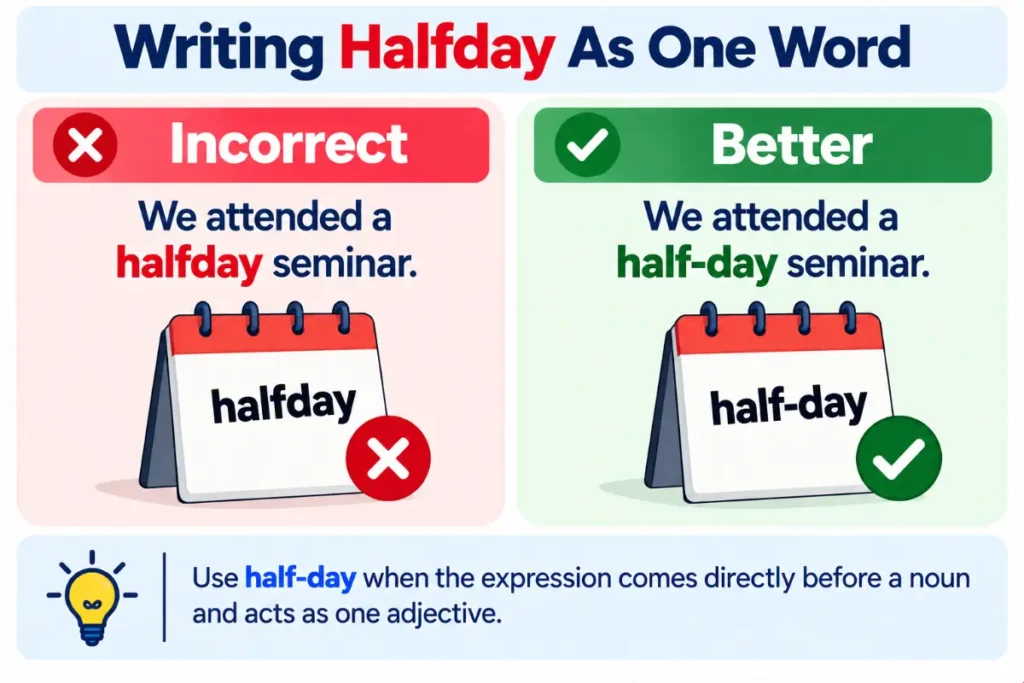
Writing halfday as one word
Incorrect in standard usage:
The company offers a halfday training course.
Better:
The company offers a half-day training course.
The problem is that the two words have not become a standard single word in ordinary English.
Using a hyphen in every situation
Some writers learn that the expression can take a hyphen and then use it everywhere.
For example:
I worked a half-day yesterday.
This isn’t necessarily impossible, but half day is the more straightforward noun phrase when you mean a period of time. The clearest version is:
I worked a half day yesterday.
The hyphen is most useful when the phrase works as a compound modifier before a noun.
Removing the hyphen before a noun
Consider:
We attended a half day workshop.
In this construction, half-day makes the relationship between the words clearer.
Better:
We attended a half-day workshop.
The two words work together to describe the workshop.
Confusing half day with half a day
These expressions can overlap in meaning, but they don’t always have the same natural rhythm.
I worked a half day.
I worked for half a day.
Both can be correct. The first treats a half day as a noun phrase. The second uses half a day as a time expression.
Treating every compound as a permanent compound
English spelling changes over time. Some combinations remain open phrases. Others become hyphenated or eventually become single words. You shouldn’t assume that two words must become one simply because they appear together often.
That is why halfday shouldn’t be created just because you see the phrase frequently.
Pronunciation Guide
The pronunciation of the standard forms is straightforward.
Half day is pronounced approximately:
haf day
The word half normally has a pronounced f sound followed by the long a sound in day.
In American English, the phrase is commonly pronounced as two clear words:
half day
The hyphen in half-day usually doesn’t create a special new sound. It mainly shows that the two words function together as a compound modifier.
You can think of the spoken forms like this:
- Half day. Two words with normal phrase stress.
- Half-day. Two spoken words working together as one modifier.
- Halfday. If someone writes this nonstandard form, they normally intend the same pronunciation.
The key lesson is that pronunciation won’t reliably tell you which written form to choose. You need to look at the grammar and position of the expression.
Still confused? Compare Capital or Capitol Which One Is Correct 2026.
Etymology and Word Origin
The expression combines two ordinary English words.
Half comes from Old English half, meaning one of two equal parts. Day comes from Old English dæg, referring to the period of daylight and later to the broader twenty four hour period.
The modern expression developed naturally from these basic words. There is no need to treat half-day as a completely separate vocabulary item with an unrelated origin.
The interesting part is its spelling development. English often combines common words into compounds, but compound spelling does not follow one universal rule. Some compounds remain open. Some use a hyphen. Others eventually become closed compounds.
That is why knowing the grammar is more useful than trying to memorize one universal rule for every compound expression.
In modern dictionary usage, the expression appears in both spaced and hyphenated forms depending on grammatical function. Oxford lists half-day while its American dictionary also identifies half day as a noun. Cambridge explicitly distinguishes the noun half day from the adjective half-day.
Regional Usage
American English
American English commonly uses half day as a noun phrase and half-day as a compound adjective.
You might write:
I’m taking a half day off.
You might also write:
I’m attending a half-day seminar.
This distinction fits normal American editing practice because the grammatical function determines the punctuation.
The one word form halfday is not the standard choice for polished American English.
British English
British English uses the same basic distinction. Cambridge gives half day as a noun and half-day as an adjective before a noun. Oxford also presents half-day in its learner dictionary and gives examples such as a half-day workshop.
British writers may encounter slightly different editorial preferences in individual publications, but the one word form is not the normal standard spelling.
Australian English
Australian English generally follows the same compound spelling principles. You can use half day when the expression functions as a noun and half-day when it modifies a following noun.
There is no major Australian spelling rule that turns the phrase into halfday.
Canadian English
Canadian English also follows the broader English pattern. Writers can use the open noun phrase and the hyphenated compound modifier according to sentence structure.
For professional or academic writing, the safest approach is to identify the grammatical role first and then choose the form that matches it.
Grammar Rules and Part of Speech
The grammar becomes much easier once you ask one simple question.
Is the expression naming a period or describing something?
If it names a period, use half day.
Example:
I took a half day off.
Here a half day acts as a noun phrase. It identifies the amount of time taken away from work.
If it describes a following noun, use half-day.
Example:
I attended a half-day course.
Here half-day describes the course. The two words work together as one compound modifier.
This distinction appears in many other English expressions too.
Consider:
A full day.
A full-day course.
A half day.
A half-day course.
The pattern is easy to see. When the expression stands on its own as a noun phrase, the words can remain separate. When they work together directly before another noun, the hyphen helps join them into a single modifier.
Before a noun
Use the hyphenated form when the phrase modifies a noun.
A half-day workshop.
A half-day class.
A half-day meeting.
A half-day tour.
A half-day program.
The hyphen tells the reader that half and day belong together.
After a linking verb
When the expression comes after a linking verb and acts as a description, the hyphen may not be needed in the same way.
The workshop lasted half a day.
The class was only half a day long.
The session lasted half a day.
These sentences use a different grammatical structure.
With time off
In ordinary American English, these are natural:
I took a half day off.
I took half a day off.
The first treats a half day as a noun phrase. The second expresses duration.
You may also see:
I took a half-day off.
Some style systems accept this usage, but if you want the clearest distinction for general American writing, use the open form when the phrase functions as the noun.
With numbers and schedules
You can also express the idea without the compound:
The meeting lasts three hours.
The class runs from 9 a.m. to noon.
The office is open for half a day.
Sometimes the simplest wording is the strongest wording.
Real Life Usage Examples
Daily Conversation
People use the expression casually when discussing work, school, appointments, and plans.
I only have a half day today, so I’ll be home early.
We spent half the day walking around downtown.
These sentences sound natural because the expression refers to a period of time.
Email and Workplace Communication
Professional messages often use both forms.
I’ll be taking a half day off on Friday.
We’ve scheduled a half-day training session for new employees.
The first sentence names time away from work. The second describes the type of training session.
Academic Writing
Academic writing tends to favor precise descriptions.
The students completed a half-day laboratory session.
The researchers spent half a day collecting observations.
The first example uses the compound adjective. The second uses the noun phrase.
News and Journalism
News writing may describe shortened schedules or events.
The school will operate for a half day on Friday.
Officials attended a half-day meeting before the announcement.
The choice depends on the structure of the sentence rather than the subject.
Literature and Storytelling
Narrative writing can use the expression naturally when describing time.
We walked for half a day before reaching the village.
By noon, the group had completed its half-day journey.
The open form works well when the writer focuses on duration. The hyphenated form works when the phrase modifies a noun.
Related and Confused Terms
Half a day
This is a common time expression meaning one half of a day.
The trip lasted half a day.
It often sounds very natural when describing duration.
Half day
This works as a noun phrase.
I took a half day off.
It often refers to a shortened work or school day.
Half-day
This commonly works as a compound adjective.
We booked a half-day tour.
It describes something that lasts for half a day.
Full day
This is the natural open form when used as a noun phrase.
We spent a full day there.
Full-day
This works as a compound modifier.
We attended a full-day conference.
Half time
This expression has several meanings depending on context. In sports it can refer to the break between two parts of a game.
The players returned after half time.
It shouldn’t be treated as an automatic synonym for half day.
Part day
This can describe a period that covers only part of a day, but it is less common in ordinary conversation than half day.
Part time
Part time describes work or activity performed for less than a full schedule.
She works part time.
This is different from saying she works a half day.
How to Remember the Difference
A simple memory trick can save you from most mistakes.
Think about the word that comes after the expression.
If nothing follows it and you are naming the period, use half day.
I’m working a half day.
If a noun follows and the expression describes that noun, use half-day.
I’m attending a half-day workshop.
You can remember it as:
Time period equals half day.
Description before a noun equals half-day.
This isn’t an absolute rule for every style guide or every sentence because English punctuation has exceptions. Still, it gives you a reliable starting point for ordinary writing.
Another useful trick is to replace the phrase with morning or afternoon.
I’m attending a morning workshop.
I’m attending a half-day workshop.
Both expressions describe the workshop.
But:
I’m working a morning.
That doesn’t carry the same meaning as:
I’m working a half day.
The grammar becomes clearer when you focus on the job the phrase performs.
Why Halfday Looks Tempting
There is a good reason people write halfday even though it is not the standard form.
English contains many closed compounds. Words such as bedroom, notebook, classroom, and weekend are written as single words. That can make writers assume that any frequently used combination should eventually become one word.
But English compounds develop differently. Frequency alone doesn’t determine spelling.
Some remain open.
Ice cream.
High school.
Some become hyphenated in particular grammatical positions.
Half-day.
Others become closed compounds.
Weekend.
That means you can’t safely invent a closed form just because the meaning feels obvious.
The spelling also becomes confusing because people often type quickly. When two words appear together again and again, the space may disappear during fast typing. Spellcheckers may catch the mistake, but they aren’t a substitute for understanding the structure.
Half Day Versus Half-Day In Professional Writing
Professional writing rewards clarity. If you’re preparing an email, schedule, announcement, brochure, report, or training document, choose the form based on grammar rather than personal preference.
For example:
The office will remain open for a half day.
This is clear and natural.
Now compare:
The office will offer a half-day training program.
Here half-day modifies training program, so the hyphen makes the compound relationship clear.
You could also rewrite the sentence:
The office will offer training for half a day.
This version avoids the compound completely.
That can be useful when you’re editing for a broad audience. If a sentence feels awkward, you don’t always need to fight with punctuation. Sometimes rewriting the sentence produces a cleaner result.
Expert Editor Insight
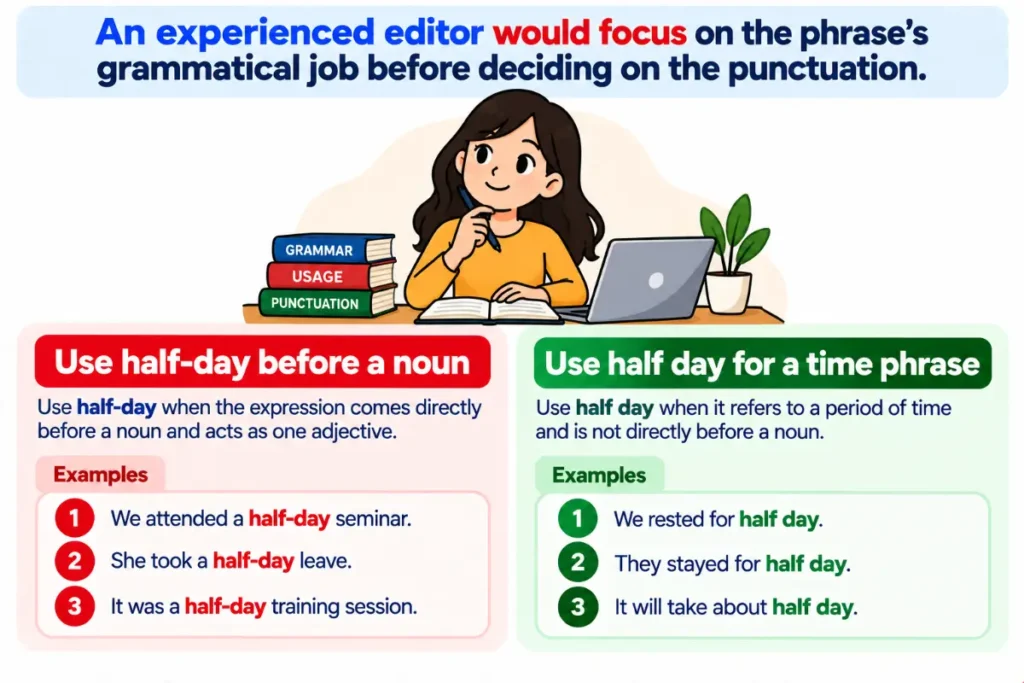
An experienced editor usually looks at the phrase around half and day instead of memorizing a single spelling. The key question is grammatical function. If the expression names a period, half day works naturally. If it acts as a compound modifier before a noun, half-day is the clearer standard choice. Spellcheckers may flag halfday, but a grammar tool may not fully explain why the other two forms differ. The best editing habit is to check the words immediately after the phrase and decide if you are naming time or describing a noun.
Need another quick comparison? Read orientated vs oriented Which Form Should You Use.
Conclusion
Halfday or half-day can look like a simple spelling choice, but the standard answer depends on sentence structure. Use half day when you’re naming a period of time and half-day when the expression works as a compound modifier before a noun. Avoid the one word form halfday in polished English.
The easiest examples are “I took a half day off” and “I attended a half-day workshop.” The first uses a noun phrase while the second uses a compound adjective. Once you see that grammatical difference, the spelling becomes much easier to choose.
For editing, remember one simple rule. Name the time with half day and describe something with half-day. That small distinction will keep your writing clear and natural.
FAQs
Is halfday a real word?
Halfday is not the standard form used in ordinary edited English. Writers normally use half day as a noun phrase or half-day as a compound modifier before a noun. You may encounter the one word form in informal typing or unedited online text, but it is best avoided in school, business, academic, and professional writing.
Is half day or half-day correct?
Both can be correct because they serve different grammatical roles. Use half day when you mean a period of time, as in “I worked a half day.” Use half-day when the expression describes a noun, as in “I attended a half-day workshop.” The correct choice depends on the sentence structure.
Should I write half day off or half-day off?
For general American English, a half day off is a clear and natural choice when the phrase functions as the noun. You can also say half a day off. If you are describing another noun directly, the hyphenated form becomes useful, such as a half-day training session.
Is half-day always hyphenated?
No. The hyphen is mainly useful when the two words work together as a compound modifier before a noun. For example, write a half-day workshop. When you are simply talking about a period of time, half day or half a day is usually more appropriate.
How do you pronounce half day?
Half day is pronounced much like the two separate words half and day. The hyphen in half-day normally does not change the pronunciation. It mainly shows the grammatical relationship between the words. In natural American speech, the phrase sounds like haf day, with the usual pronunciation of each word.
What does half-day mean?
Half-day generally means lasting for half of a day or relating to a period that covers only part of a day. For example, a half-day class lasts for a morning or afternoon rather than a full day. The expression can also refer to a day during which someone works for only part of the normal schedule.
Can I use half-day in formal writing?
Yes. Half-day is appropriate in formal writing when it functions as a compound modifier. You can write about a half-day workshop, half-day course, or half-day meeting. For a noun phrase referring to time, use half day or half a day based on the sentence. The one word form should generally be avoided.
What is the easiest way to remember the spelling?
Focus on the grammar rather than trying to memorize three spellings. If you are naming a period, use half day. If the expression describes a noun that follows it, use half-day. Avoid halfday in standard writing. This simple distinction will handle most situations you’ll encounter at work, school, or in everyday communication.