
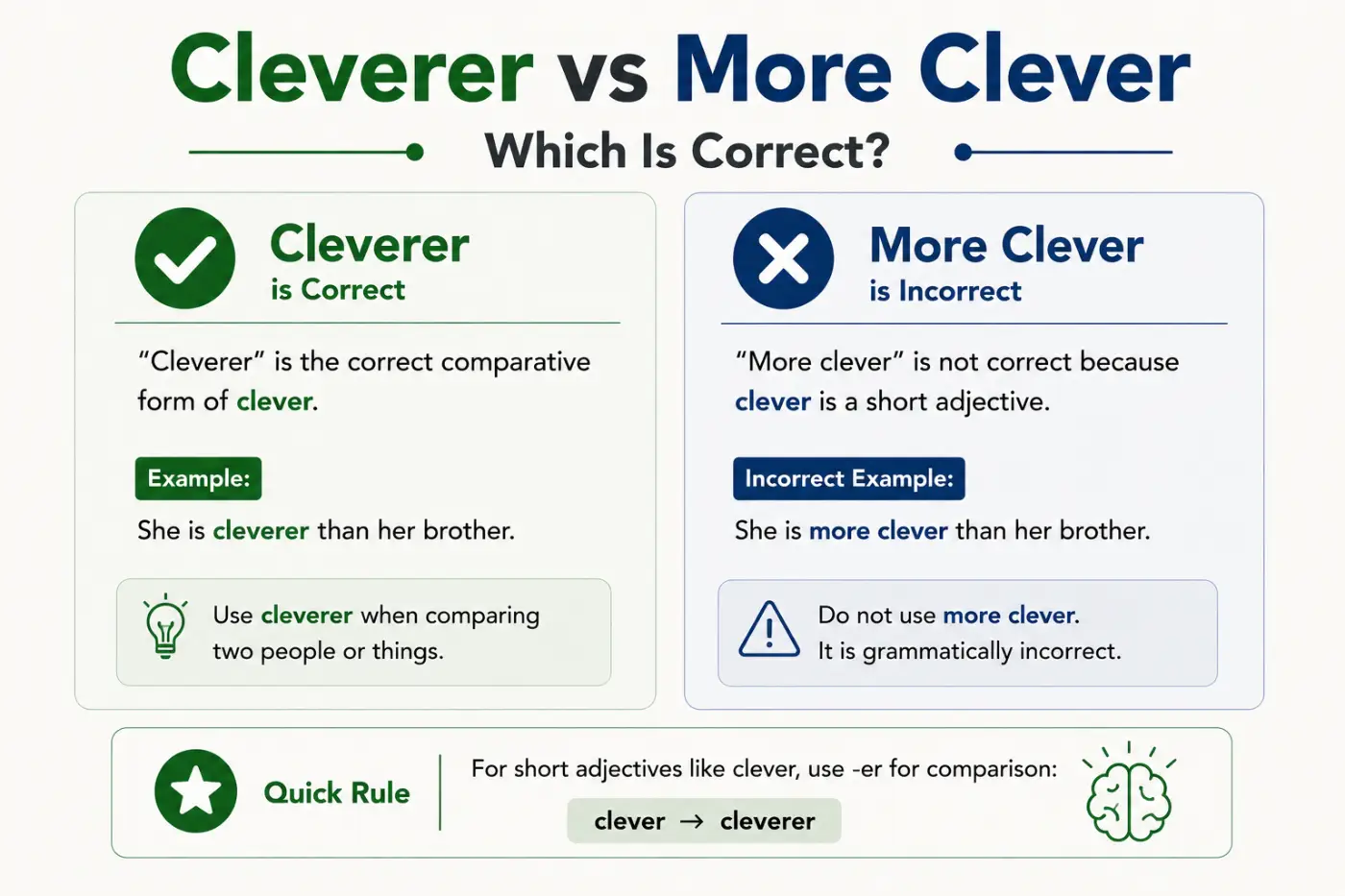
If you’re comparing two people or ideas and want to say that one has more intelligence or skill, you may pause over cleverer vs more clever. The good news is that both forms are grammatically acceptable. However, cleverer is the more direct comparative form because clever can take the er ending. More clever is also standard and can sound especially natural in some sentences and contexts.
The confusion comes from a useful feature of English grammar. Some adjectives can form their comparative with er while others normally use more. Clever sits in a flexible middle group. It has two syllables, yet major dictionaries and grammar references recognize cleverer as well as more clever.
That gives you more than one correct choice. The real skill lies in knowing how the two forms work and choosing the version that fits your sentence. You’ll learn the grammar rule behind the forms, how Americans and British speakers use them, how to pronounce them, which patterns sound most natural, and how to avoid common comparative mistakes.
Many readers also check one-third or one third Correct Spelling and Usage.
Quick Definition
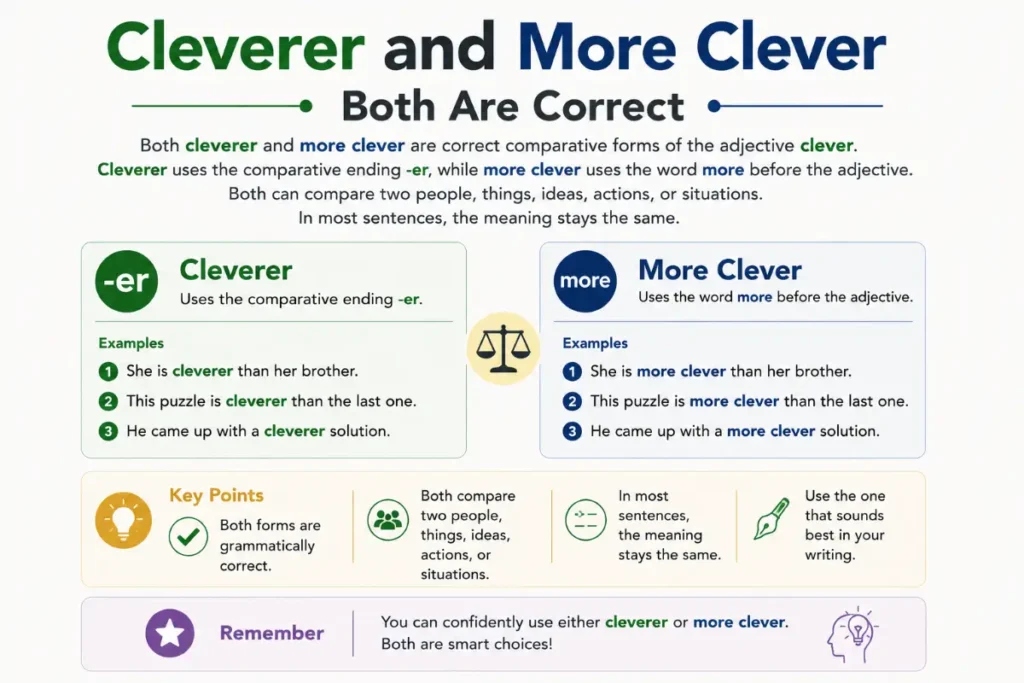
Cleverer and more clever are both correct comparative forms of clever. Cleverer uses the er comparative ending, while more clever places more before the adjective. Dictionaries recognize both forms, although cleverer follows the traditional short comparative pattern more directly. Your choice can depend on sentence rhythm, emphasis, and personal style.
Quick Answer
Both forms are correct. Cleverer is the standard er comparative of clever, while more clever is an accepted alternative.
For most simple comparisons, cleverer is a natural choice.
She is cleverer than her brother.
More clever can also work.
She is more clever than her brother.
You don’t need to treat one as a spelling mistake. The difference is mainly grammatical style and sentence flow rather than correctness.
Comparison Table
| Form | Meaning | Part of Speech | Origin | Usage Frequency | Formality | Common Contexts | Example |
|---|---|---|---|---|---|---|---|
| Cleverer | Having a higher degree of intelligence or skill | Comparative adjective | From clever plus the comparative ending er | Common | Neutral | Conversation, school writing, general prose | Maya is cleverer than Tom. |
| More clever | Having a higher degree of intelligence or skill | Comparative adjective phrase | More plus clever | Common but generally less direct | Neutral | Conversation, descriptive writing, careful comparisons | This solution is more clever than the first one. |
Meaning and Definition
Meaning of Clever
Clever is an adjective. It can describe someone who learns and understands things quickly. It can also describe an idea, plan, method, tool, design, or action that shows intelligence or skill. Cambridge gives both intelligence and effective design among its main meanings.
For example, you might say:
She is a clever student.
That sentence describes her ability to understand and learn.
You can also say:
That was a clever solution.
Here clever describes the quality of the solution rather than the intelligence of a person.
This distinction matters because the comparative can describe people, ideas, decisions, strategies, designs, and many other things.
Meaning of Cleverer
Cleverer is the comparative form of clever. It means more clever than another person or thing.
For example:
James is cleverer than Mark.
The sentence compares James with Mark and says that James shows a greater degree of cleverness.
The comparison doesn’t necessarily mean James is highly intelligent in every area. It only makes a relative comparison. He may be better at solving puzzles, understanding instructions, designing solutions, or thinking quickly.
Meaning of More Clever
More clever has the same basic comparative meaning. It also indicates a higher degree of cleverness.
For example:
This plan is more clever than the original idea.
The meaning is essentially the same as:
This plan is cleverer than the original idea.
The difference is the grammatical construction. One uses the er ending while the other uses more before the adjective.
Key Differences Explained
- The grammatical structure differs. Cleverer combines the adjective with the comparative ending er. More clever uses the separate comparative word more.
- The basic meaning stays the same. Both forms compare two people or things based on cleverness.
- Cleverer is more compact. It turns the adjective into a single comparative word. This often makes simple comparisons sound direct.
- More clever can feel more deliberate. Some speakers prefer it because the comparison is visually and rhythmically clear.
- Neither form is automatically wrong. Major English references recognize both patterns for clever.
- The choice can depend on context. A short everyday sentence may sound especially natural with cleverer. A sentence with several modifiers may flow better with more clever.
- Pronunciation changes slightly. Cleverer adds another syllable to the word. More clever keeps the adjective unchanged and adds the separate word more.
- The forms should not be combined. Standard English does not normally use more cleverer because that applies two comparative markers to the same adjective.
Which Form Is Correct?
Both cleverer and more clever are correct.
That answer may surprise people because English learners often learn a simple rule that short adjectives take er while longer adjectives take more. The rule is useful but it isn’t absolute.
Clever is a good example of why English comparative formation requires some flexibility. It has two syllables, but it can take the er ending. Cambridge’s grammar guidance specifically includes clever among two syllable adjectives that can form comparatives with er. Oxford lists cleverer as the comparative and also states that more clever can be used.
The important point is that you shouldn’t treat more clever as an error simply because cleverer exists. At the same time, you shouldn’t assume that more is required simply because clever has two syllables.
A useful practical rule is this. Use cleverer when you want the shorter and more traditional comparative pattern. Use more clever when it produces a smoother sentence or better matches the tone you want.
For example:
My sister is cleverer than I am.
My sister is more clever than I am.
Both sentences are grammatical.
The first is shorter. The second places stronger attention on the degree word more.
Why Can A Two Syllable Adjective Take Er?
This is where the grammar becomes interesting.
English does not have one perfectly rigid rule that determines comparative formation from syllable count alone. Many one syllable adjectives use er.
Tall becomes taller.
Fast becomes faster.
Small becomes smaller.
Some two syllable adjectives also use er. Cambridge specifically gives examples such as cleverer, quieter, narrower, and simpler.
Other two syllable adjectives can favor more.
More useful is natural.
More careful is natural.
More complicated is natural.
The difference often relates to the sound and history of the adjective. English speakers tend to prefer forms that are easy to pronounce and easy to process. Some two syllable adjectives have become established with both patterns.
Clever belongs to this flexible group.
That’s why a rigid rule such as all two syllable adjectives must use more doesn’t work.
Sentence Examples
Here are natural examples showing how the comparative forms work.
- My brother is cleverer than me at solving puzzles.
- Sarah came up with a cleverer way to organize the files.
- This student seems cleverer than he first appeared.
- The second plan is cleverer because it saves both time and money.
- Her answer was cleverer than mine.
- The new design is more clever than the original version.
- I think your solution is more clever than the one we discussed yesterday.
- The advertisement uses a more clever approach to attract attention.
- His explanation was more clever than I expected.
- The latest version is more clever in the way it handles difficult problems.
Notice that the meaning stays almost the same in these pairs.
The new plan is cleverer than the old one.
The new plan is more clever than the old one.
The choice doesn’t change the basic comparison. It changes the structure and sometimes the rhythm of the sentence.
Common Comparative Mistakes
English learners often make comparative mistakes because several grammar patterns look similar. Here are the most useful ones to watch.
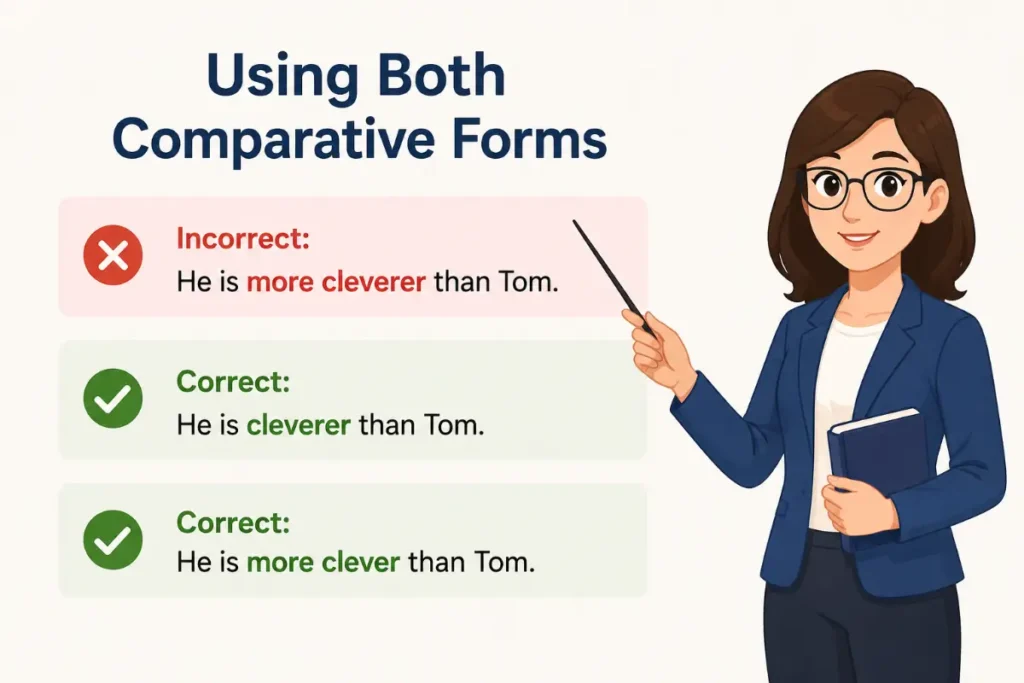
- More cleverer.
Incorrect in standard usage.
Correct:
She is cleverer than her brother.
Or:
She is more clever than her brother.
The problem is that more and er are both comparative markers. Using both together is unnecessary.
- Most cleverer.
This creates the same problem in the superlative. Use cleverest or most clever instead.
- Clever than.
The adjective needs a comparative form when you directly compare two things.
Incorrect:
She is clever than me.
Correct:
She is cleverer than me.
Or:
She is more clever than me.
- More clever than to.
Some writers mix comparative structures with other patterns.
A clean comparison is:
He is cleverer than his brother.
The word than introduces the second side of the comparison.
- More cleverest.
This incorrectly combines a superlative marker with the more construction. Use cleverest or most clever instead.
These errors are easy to catch once you remember that comparative English generally needs one clear comparative structure rather than two stacked together.
Pronunciation Guide
Clever is commonly pronounced with two syllables.
In American English the pronunciation is approximately:
KLEV er
The IPA is /ˈklɛvər/. Cambridge gives the American pronunciation with stress on the first syllable.
Cleverer adds another syllable.
A simple pronunciation guide is:
KLEV er er
The exact vowel quality can vary in natural speech. The first syllable carries the main stress.
More clever is different because more remains a separate word.
You can say:
MORE KLEV er
The pronunciation difference can influence which form feels comfortable. Some speakers find cleverer easy and natural. Others may prefer more clever because the separate word makes the comparison easier to say.
Neither pronunciation represents a different meaning.
One useful tip is to say the entire sentence aloud. If one version feels smoother, that can help you choose between the two forms.
Etymology and Word Origin
The history of clever helps explain why English treats the word in a somewhat flexible way.
Oxford traces clever to Middle English. Its earliest recorded sense was related to being quick to catch or grasp something. The word may have connections with Dutch or Low German. Later, its meaning developed toward manual skill and then toward mental ability. Oxford notes that the sense connected with mental agility dates from the early eighteenth century.
Today clever has several connected meanings. It can describe intelligence, skill, effective design, or a smart solution.
The word’s long development also reminds us why English grammar cannot always be reduced to one modern formula. Comparative forms often reflect patterns that developed over centuries.
Cleverer has become an established comparative form, while more clever developed as an alternative construction using the general comparative word more.
Need another quick comparison? Read seperate or separate Correct Spelling and Usage Guide.
Regional Usage
American English
Both forms are understood in American English. Cleverer is a standard comparative and appears naturally in ordinary comparisons. More clever is also accepted and may sound comfortable when the writer wants to emphasize the degree of cleverness.
American English often favors smart for people when the intended meaning is intelligence. Cambridge notes that smart is especially associated with North American English. Still, clever remains a normal English adjective in the United States.
For example:
She is smarter than her brother.
That sentence may sound especially natural in American conversation when the intended meaning is intelligence.
Clever can still be used:
She is cleverer than her brother.
Both constructions are grammatically sound.
British English
Both comparative forms are also used in British English. Clever has a particularly strong traditional presence in British English and can describe intelligence, skill, or a smart action. Oxford identifies cleverer as the comparative while also allowing more clever.
British speakers may also use clever in ways that sound slightly different from American usage. In some contexts it can suggest someone is trying to be too smart or is being annoyingly self confident.
For example:
Don’t get clever with me.
That meaning is different from simply saying someone is intelligent.
Australian English
Australian English generally follows the same broad comparative patterns. Both cleverer and more clever can be understood and used. There is no major Australian spelling rule that makes one of these forms automatically incorrect.
The safest approach is to follow the normal comparative structure and choose the form that fits the sentence naturally.
Canadian English
Canadian English also recognizes both patterns. There is no special Canadian rule that requires speakers to reject one form.
In formal Canadian writing the writer can use cleverer or more clever depending on sentence style and context. The important point is to avoid double comparison such as more cleverer.
Grammar Rules and Part of Speech
Clever is an adjective.
Cleverer is a comparative adjective.
More clever is a comparative adjective phrase made from more and the base adjective clever.
The comparative form normally compares two people or things.
For example:
Anna is cleverer than Kate.
The structure is:
Subject + comparative adjective + than + comparison.
The same structure works with more clever.
Anna is more clever than Kate.
The word than introduces the second person or thing in the comparison. Cambridge explains that comparative adjectives are used to compare one person or thing with another and commonly appear with than when the second side is stated.
You can also use a comparative without explicitly naming the second side.
I’m feeling cleverer today.
The listener understands that you mean cleverer than before or cleverer than you were previously.
More clever can work the same way.
His latest idea is more clever.
The comparison may be understood from the surrounding context.
Comparative Intensifiers
You can strengthen a comparative with words such as much, far, a lot, and even.
For example:
She is much cleverer than I expected.
This solution is far more clever than the first one.
Cambridge notes that comparative adjectives can be strengthened with words such as much, a lot, far, and even.
You should not write:
She is much more cleverer than I expected.
That sentence stacks comparative forms in a way standard English normally avoids.
Instead choose:
She is much cleverer than I expected.
Or:
She is much more clever than I expected.
Comparative Patterns Without Than
Comparatives don’t always need than.
For example:
The older students became cleverer with practice.
You can also say:
The design became more clever over time.
The comparison is understood from the context.
Repeated Comparatives
English can repeat a comparative to show gradual change.
The children are getting cleverer and cleverer.
You can also use:
The children are becoming more and more clever.
Both structures are possible. Cambridge recognizes the pattern of repeating an er comparative and the alternative more and more structure for showing an increasing degree.
Real Life Usage Examples
Daily Conversation
In everyday speech, cleverer can sound short and natural.
- I think Mia is cleverer than I am at math.
- That was a cleverer way to handle the problem.
More clever also works naturally.
- Your idea is more clever than mine.
- That was more clever than I expected.
The choice often comes down to rhythm rather than meaning.
Email And Workplace Communication
Professional writing may use either form.
- The revised process is cleverer because it removes an unnecessary step.
- We need a more clever solution if we want to reduce costs without reducing quality.
The second example uses more clever because the phrase has a deliberate descriptive feel. Still, cleverer would also be grammatically possible.
Academic Writing
Academic writing tends to value precise comparisons.
- The second method is cleverer in its use of limited resources.
- The revised model offers a more clever approach to the same problem.
In academic work, clarity matters more than forcing one comparative pattern.
If clever feels too informal for the specific academic subject, a writer might choose precise alternatives such as more efficient, more effective, or more sophisticated.
News And Journalism
News writing can use either structure when the context calls for it.
- The team developed a cleverer way to manage the shortage.
- Analysts described the revised strategy as more clever than the original plan.
Journalists often choose wording based on sentence rhythm and the exact shade of meaning.
Literature And Storytelling
Narrative writing has more freedom to choose a form that fits the voice of the character or narrator.
- The fox was cleverer than the farmer expected.
- Her second plan was more clever than anyone in the room realized.
The difference can be subtle. Cleverer may feel quicker and more direct. More clever can place a little more weight on the quality being compared.
Related And Confused Terms
Several words sit close to clever in meaning. Knowing the differences can help you choose a better word instead of repeating clever throughout your writing.
- Smart. In American English smart commonly describes intelligence. It can also describe a sensible or effective decision.
- Intelligent. This is a broad and neutral word for mental ability. It often sounds more formal than clever.
- Bright. Bright can describe someone who learns quickly. It is common when talking about students and young people.
- Sharp. Sharp can describe someone who notices things quickly and thinks clearly.
- Brilliant. Brilliant can express a very high degree of intelligence or skill. It can also describe an excellent idea.
- Skillful. Skillful focuses more on ability and technique than general intelligence.
- Witty. Witty describes someone who uses intelligence and humor effectively. It is not simply another word for intelligent.
- Crafty. Crafty can suggest cleverness combined with trickery. It may have a negative tone depending on context.
These words overlap, but they aren’t perfect substitutes. A clever idea may be smart or ingenious, but a clever person isn’t necessarily witty or crafty.
Cleverer And Smarter
American readers may notice another common comparison.
She is cleverer than her brother.
She is smarter than her brother.
Both can describe greater intelligence, but smart is especially common in American English. Cambridge identifies smart as especially North American while describing clever as a word that can refer to quick understanding and skill.
This matters if you’re writing specifically for a US audience. Clever is still perfectly understandable and correct, but smart may sound more conversational in many American contexts.
For example:
That was a smart move.
This is very natural in American English.
That was a clever move.
This is also correct, but the tone can shift slightly depending on context.
Cleverer And Cleverest
The comparative and superlative forms serve different jobs.
Cleverer compares two people or things.
John is cleverer than Mark.
Cleverest identifies the highest degree within a group.
John is the cleverest student in the class.
Oxford lists cleverer as the comparative and cleverest as the superlative.
You can also use more clever and most clever.
John is more clever than Mark.
John is the most clever student in the class.
However, cleverer and cleverest give you a compact traditional pattern that many speakers find natural.
Why More Clever Is Still Correct
Some writers have learned the rule that two syllable adjectives should always use more. That rule is too broad.
English has several two syllable adjectives that can use er. Cambridge gives clever as one of its examples.
This is why you should not correct a sentence simply because it says more clever.
Consider:
This is a more clever solution.
There is nothing grammatically wrong with it.
Now consider:
This is a cleverer solution.
That is also correct.
The best choice depends on the sentence.
A good editor listens to the whole sentence rather than applying a mechanical rule to one word.
When Cleverer Sounds More Natural
Cleverer often works especially well when the sentence is short and the comparison is direct.
She is cleverer than me.
That solution is cleverer.
His idea was cleverer.
The compact comparative keeps these sentences moving.
It can also work well when the sentence already contains several words. Using the shorter comparative can prevent the sentence from becoming heavy.
For example:
The revised plan is cleverer than the original.
The structure is simple and easy to process.
When More Clever Can Sound Better
More clever can work well when the adjective is modified or when the sentence has a particular rhythm.
For example:
This is a much more clever way to solve the problem.
The construction is natural because more is already part of a larger comparative phrase.
Another example is:
The new design is far more clever than the old one.
This pattern sounds smooth and gives the comparative phrase a clear shape.
Still, cleverer can also appear in similar sentences:
The new design is far cleverer than the old one.
So this isn’t a strict rule. It’s a matter of style and sentence flow.
What Professional Editors Look For
An experienced editor does not treat every variation as an error. The first question is grammar. Is the form accepted in standard English? The second question is context. Does the word express the intended meaning? The third question is rhythm. Does the sentence sound natural? The fourth question is consistency. Has the writer made a deliberate choice rather than switching forms randomly? For this particular adjective both comparative patterns are legitimate.
An editor therefore has no reason to mark one form as automatically wrong. The bigger mistake is usually more cleverer. That construction combines two comparative markers and should be corrected. Another useful editing tip is to avoid changing a correct sentence simply because another version feels more familiar. Good editing improves clarity. It does not erase valid English variation.
Expert Editor Insight
An experienced editor wouldn’t automatically change more clever to cleverer or cleverer to more clever. Both are established comparative forms. The editor would first check the sentence around the adjective, the intended tone, and the rhythm of the prose. Grammar tools may suggest one form based on their style rules, but a suggestion is not the same as a grammatical correction. The best editing tip is simple: read the full sentence aloud and choose the comparative that sounds clear without forcing the wording.
A related grammar guide is treet vs treat Correct Spelling Meaning And Usage.
Conclusion
Cleverer vs more clever doesn’t have a simple right or wrong answer because both forms are standard English. Cleverer uses the er comparative ending and gives you a short direct comparison. More clever uses more before the adjective and carries the same basic meaning. Major English references recognize both patterns.
For everyday comparisons, cleverer is a natural and compact choice. More clever also works and can fit the rhythm of a sentence better, especially when the comparative phrase needs extra emphasis. Neither form should be treated as a spelling mistake.
The easiest editing tip is to remember that clever belongs to the flexible group of two syllable adjectives that can use er. Choose one comparative structure and never write more cleverer. Read the sentence aloud and let clarity guide the final choice.
FAQs
Is cleverer grammatically correct?
Yes. Cleverer is a standard comparative form of clever. Major grammar and dictionary references recognize it. Cambridge specifically lists cleverer among two syllable adjectives that can take the er comparative ending, while Oxford gives cleverer as the comparative form. You can use it to compare two people, ideas, actions, plans, designs, or other things.
Is more clever grammatically correct?
Yes. More clever is also a recognized comparative construction. Oxford specifically states that more clever can be used alongside cleverer. The phrase means the same basic thing as cleverer and can describe a greater degree of intelligence, skill, or effectiveness. You don’t need to treat it as an error simply because the shorter comparative form also exists.
Which form should I use in American English?
American English accepts both forms. Cleverer is concise and follows the common er comparative pattern. More clever is also natural in many sentences. If you want a simple everyday comparison, cleverer is an easy choice. If more clever fits the rhythm or emphasis of your sentence better, you can use it without worrying that it is grammatically wrong.
How do you pronounce cleverer?
Cleverer is pronounced with three syllables in normal speech. A simple guide is KLEV er er. The first syllable receives the main stress. American English commonly pronounces clever as /ˈklɛvər/, and adding the comparative ending creates the longer form. Say it naturally rather than stressing every syllable separately.
Can I say more cleverer?
No. Standard English normally avoids combining more with an er comparative ending on the same adjective. Choose one structure instead. You can say She is cleverer than her brother or She is more clever than her brother. More cleverer incorrectly stacks two comparative markers and should be avoided in careful writing.
Is cleverer more formal than more clever?
Neither form is inherently formal. Both belong to ordinary standard English. Cleverer can feel more compact because it uses the established er ending. More clever can sometimes feel more deliberate because the comparative word more is clearly separated from the adjective. In formal writing, choose the form that gives your sentence the clearest and most natural rhythm.
Why can clever take the er ending?
Clever is a two syllable adjective that belongs to a group of adjectives capable of taking the er comparative ending. English comparative rules depend on more than syllable count alone. Cambridge specifically includes clever among two syllable adjectives that can use er. Oxford also recognizes cleverer as the comparative form.
What is the easiest way to remember the rule?
Remember that clever has two accepted comparative patterns. You can add er to create cleverer or use more before the adjective to create more clever. Never combine both forms. If you’re unsure, write the complete sentence aloud. The version that sounds smooth and clearly expresses the comparison will usually be the better choice.