
If you’ve searched for leary or leery, you’re probably trying to figure out which spelling is correct or if both words are legitimate English words. The confusion is understandable because they look almost identical, sound similar in everyday speech, and often appear in informal writing across the internet. Many people assume they are simply American and British spellings of the same word, while others believe one is a typo.
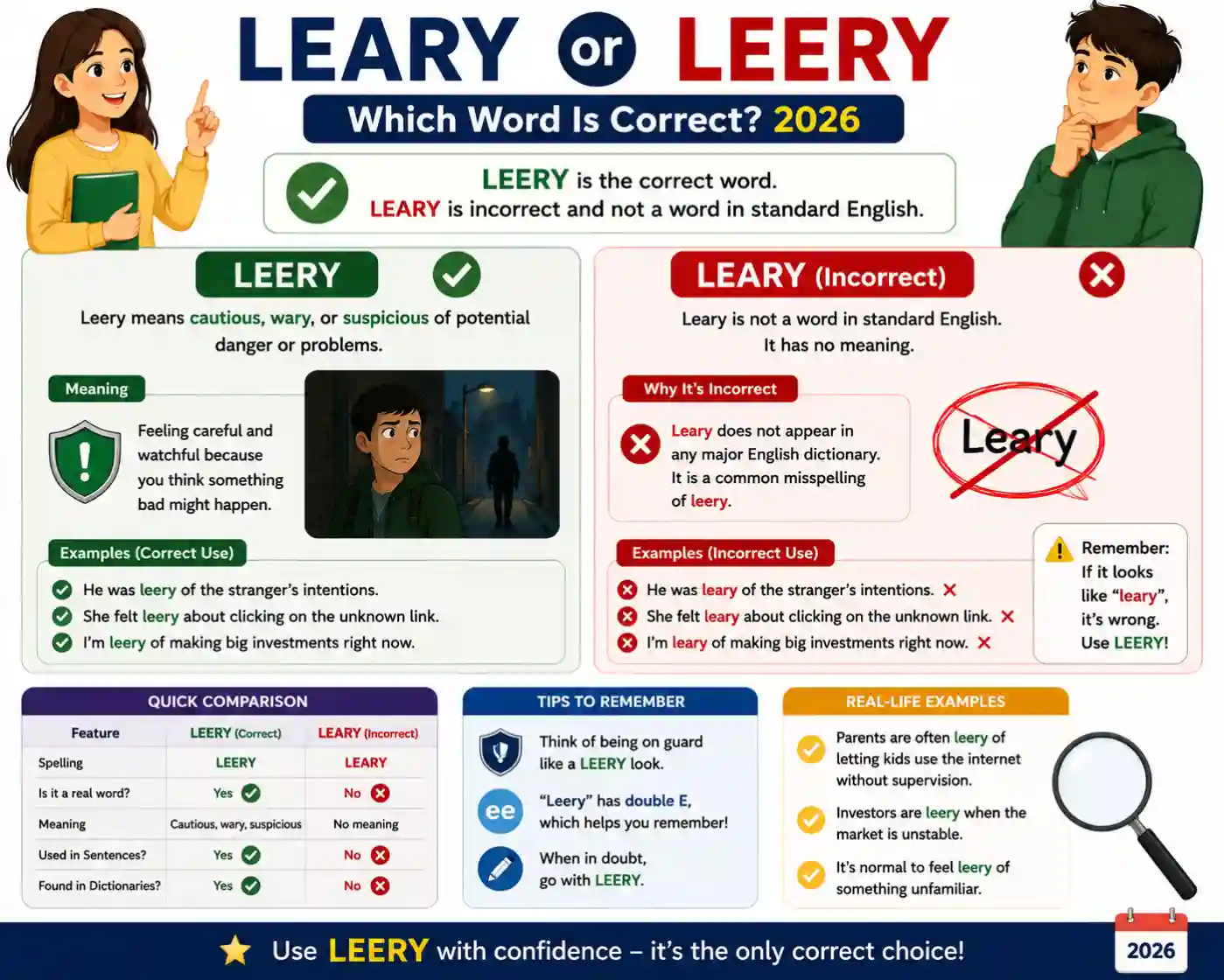
The short answer is simple. Leery is the standard English word recognized by major dictionaries. Leary is usually a misspelling of leery, although it occasionally appears as a surname or proper noun. If you want to describe someone who is cautious, suspicious, or reluctant to trust something, leery is almost always the correct choice.
In this guide, you’ll learn the meaning of each term, why the confusion exists, how native English speakers actually use leery, pronunciation tips, grammar rules, regional usage, sentence examples, common mistakes, and expert editing advice. By the end, you’ll know exactly which spelling belongs in your writing.
Learn the difference in In Route vs En Route Which Is Correct.
Quick Definition
Leery is an adjective that means cautious, suspicious, or unwilling to trust someone or something. Leary is generally not an accepted English word in this context and is almost always a spelling mistake. If you’re writing about caution or suspicion, use leery.
Quick Answer
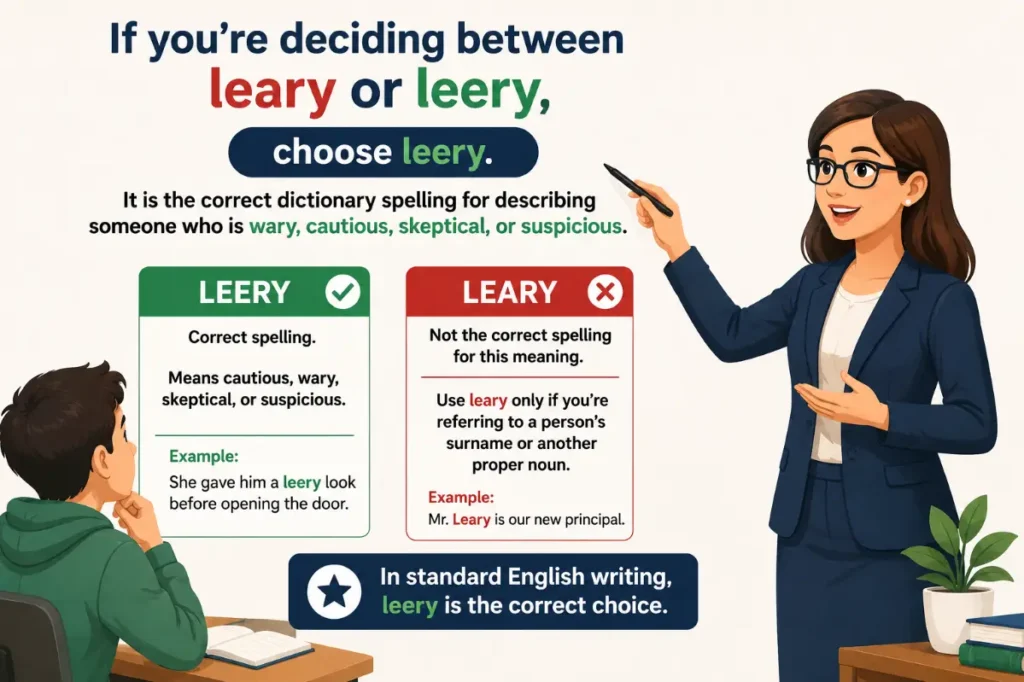
If you’re deciding between leary or leery, choose leery. It is the correct dictionary spelling for describing someone who is wary, cautious, skeptical, or suspicious. Use leary only if you’re referring to a person’s surname or another proper noun. In standard English writing, leery is the correct choice.
Leary or Leery Comparison Table
| Feature | Leery | Leary |
|---|---|---|
| Correct standard spelling | Yes | Usually no |
| Part of speech | Adjective | Usually a proper noun or misspelling |
| Meaning | Cautious, suspicious, wary | No standard adjective meaning |
| Dictionary status | Recognized by major dictionaries | Not recognized as the adjective |
| Usage frequency | Very common | Rare outside names |
| Formality | Neutral | Not appropriate in standard writing |
| Typical contexts | Conversation, journalism, business, academic writing | Personal names, accidental misspellings |
| Example | I am leery of online scams. | Mr. Leary gave the presentation. |
Meaning of Leery
Leery is an adjective that describes someone who feels cautious because they suspect danger, dishonesty, uncertainty, or risk. A leery person is careful before trusting people, accepting offers, or making decisions. Common ideas associated with leery include:
- Being suspicious.
- Feeling cautious.
- Avoiding unnecessary risks.
- Questioning someone’s intentions.
- Hesitating before acting.
Although leery often suggests distrust, it does not always imply fear. Someone can simply be careful because past experience has taught them to think before acting.
Examples include:
- She was leery of clicking unfamiliar links.
- Investors remained leery after the market declined.
- Many customers are leery of unrealistic discounts.
- I’m leery about signing a contract without reading it.
- Travelers became leery after hearing the weather forecast.
Etymology of Leery
The exact origin of leery is uncertain, but linguists generally trace it to nineteenth-century English. Some researchers connect it to older British slang related to alertness, cleverness, or watchfulness. Over time, the meaning shifted toward caution and suspicion, which remains its primary meaning today.
Meaning of Leary
When used outside proper names, leary is generally considered a misspelling of leery. However, Leary does exist as:
- A family name.
- A place name.
- Part of business or organization names.
For example:
- Timothy Leary was a well-known American writer and psychologist.
- Ms. Leary joined the meeting.
- The Leary family has lived there for generations.
In these examples, Leary functions as a proper noun rather than an adjective.
Leary or Leery Key Differences
Although only one letter separates these spellings, they serve very different purposes.
Meaning
Leery expresses caution or suspicion. Leary does not carry this meaning in standard English.
Grammar
Leery is an adjective. Leary is usually a proper noun.
Dictionary Recognition
Major English dictionaries include leery. They do not list leary as the adjective meaning cautious.
Usage
Professional writers, editors, journalists, teachers, and publishers use leery. Using leary instead often signals a spelling error.
Writing Quality
Correct spelling improves clarity and credibility. Readers expect standard English spelling in professional communication, academic writing, and published content.
Which One Is Correct
The correct spelling is leery.
If your sentence means cautious, suspicious, doubtful, or unwilling to trust, leery is the only standard choice.
Correct:
- She is leery of strangers.
- They remain leery about investing.
- We are leery of unrealistic promises.
Incorrect:
- She is leary of strangers.
- They became leary after the incident.
- We were leary of fake emails.
Unless Leary refers to a person’s name, the spelling should almost always be leery.
Why People Confuse Leary and Leery
Several factors contribute to the confusion.
- The spellings differ by only one letter.
- Both are pronounced similarly in many accents.
- Spell checkers may overlook the mistake if Leary is recognized as a surname.
- Many websites repeat incorrect spellings.
- Social media posts often spread informal spelling without editorial review.
Professional editors always verify the intended meaning before accepting Leary in a sentence.
Pronunciation Guide
Leery
IPA: /ˈlɪri/
Syllables: leer • y
It is commonly pronounced as:
LEER ee
Common Pronunciation Mistakes
- Saying it like Larry.
- Stressing the second syllable.
- Confusing it with wary even though their meanings overlap.
Grammar Rules
Understanding the grammar behind leery helps you use it naturally.
Part of Speech
Leery is an adjective.
Examples:
- She became leery.
- They remained leery.
- We felt leery.
Comparative Form
More leery.
Example:
She became more leery after the experience.
Superlative Form
Most leery.
Example:
He was the most leery member of the group.
Unlike verbs, adjectives like leery do not change for tense. Instead, the surrounding verbs indicate time.
Examples:
- I am leery.
- I was leery.
- I have been leery.
A related grammar guide is infront or in front Correct Spelling Meaning and Usage.
Expert Language Insight
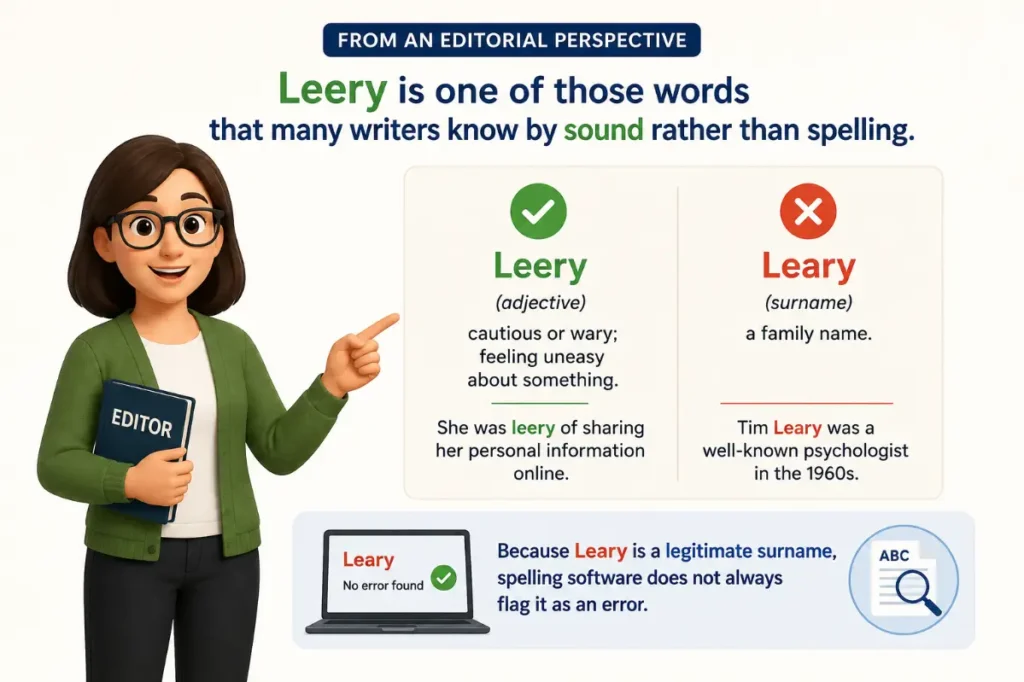
From an editorial perspective, leery is one of those words that many writers know by sound rather than spelling. Because Leary is a legitimate surname, spelling software does not always flag it as an error. Human editors catch the mistake by looking at the sentence’s meaning rather than relying only on spell checking. Native speakers naturally use leery in situations involving caution, skepticism, uncertainty, or distrust. It often appears alongside words such as wary, hesitant, suspicious, careful, skeptical, and guarded. Although these words share similar meanings, leery usually suggests that caution comes from experience or intuition rather than outright fear.
Leary or Leery Examples in Sentences
Seeing words in context is one of the fastest ways to remember the correct spelling. The examples below show how leery functions naturally in everyday English. They also demonstrate the limited situations where Leary is appropriate as a proper noun.
10 Examples Using Leery
- I am leery of giving my credit card information to unfamiliar websites.
- She became leery after receiving several suspicious phone calls.
- Many travelers are leery of booking flights during severe weather.
- The manager was leery of promises that sounded too good to be true.
- Investors remained leery despite positive market reports.
- Parents are often leery about letting young children use social media without supervision.
- We were leery of signing the agreement before reading the fine print.
- Customers have grown leery of fake online reviews.
- He looked leery when the stranger offered unexpected help.
- After her previous experience, she stayed leery of risky investments.
10 Examples Using Leary
These examples use Leary correctly as a proper noun rather than an adjective.
- Professor Leary delivered today’s lecture.
- Ms. Leary welcomed the new employees.
- The award was presented to Dr. Leary.
- I received an email from Michael Leary yesterday.
- The Leary family has lived in the neighborhood for decades.
- Officer Leary responded to the emergency call.
- Sarah Leary published her latest research this year.
- The meeting included representatives from the Leary Foundation.
- Judge Leary announced the court’s decision.
- We interviewed Mr. Leary about the project.
These examples highlight an important distinction. When referring to caution or suspicion, use leery. When referring to a person’s name, use Leary.
Common Mistakes With Leary or Leery
Because the two spellings differ by only one letter, writers frequently mix them up. Understanding the most common errors can help you avoid them.
Mistake 1 Using Leary Instead of Leery
Incorrect:
She was leary of strangers.
Correct:
She was leery of strangers.
This is by far the most common mistake.
Mistake 2 Assuming They Are American and British Variants
Unlike words such as color and colour or center and centre, leary and leery are not regional spelling variants. English speakers in the United States, the United Kingdom, Canada, and Australia all use leery when describing someone who is cautious or suspicious.
Mistake 3 Trusting Spell Check Too Much
Some spelling tools recognize Leary because it is a surname. That means the software may not flag it even when it is incorrect in your sentence. Always check the meaning instead of relying entirely on automated proofreading.
Mistake 4 Confusing Leery With Similar Words
Many learners confuse leery with related adjectives because they all express some degree of caution.
Examples include:
- Wary.
- Skeptical.
- Suspicious.
- Guarded.
- Hesitant.
Although these words overlap, they are not perfect substitutes in every context.
Mistake 5 Capitalizing Leery
Incorrect:
The customer was Leery of the advertisement.
Correct:
The customer was leery of the advertisement.
Only capitalize Leary when it is part of a proper noun.
Etymology and Word Origin
The history of leery is interesting because its exact origin is not completely certain. Language historians generally agree that it developed during the nineteenth century and was first associated with alertness, cleverness, or watchfulness in British slang. As English evolved, the meaning gradually shifted toward caution and suspicion. Instead of describing someone who was merely alert, the word came to describe someone who was careful because they sensed possible danger or dishonesty.
Today, leery almost always means:
- Cautious.
- Suspicious.
- Careful before trusting.
- Reluctant to take unnecessary risks.
By contrast, Leary developed independently as an Irish surname. It comes from the Irish family name Ó Laoghaire, meaning “descendant of Laoghaire.” The similarity in spelling between the surname and the adjective is simply a coincidence.
Regional Usage of Leary or Leery
One question many learners ask is if different English-speaking countries prefer different spellings. The answer is straightforward.
American English
American English uses leery as the standard adjective.
Examples:
- Consumers are leery of online scams.
- Drivers became leery after the storm.
Canadian English
Canadian English follows the same standard spelling. Professional writing consistently uses leery.
Australian English
Australian English likewise uses leery for the adjective. Although everyday vocabulary differs across regions, the spelling does not.
Regional Preference Summary
| Region | Preferred Adjective |
|---|---|
| United States | Leery |
| United Kingdom | Leery |
| Canada | Leery |
| Australia | Leery |
Unlike many English spelling differences, there is no regional split between leary and leery.
Real Life Usage Examples
Understanding how a word appears in authentic situations makes it easier to use naturally.
Daily Conversation
“I’ve become leery of answering unknown phone numbers.”
“We’re leery about buying a used car without an inspection.”
Professional Communication
“Our legal team is leery of signing the agreement until all revisions are complete.”
“The finance department remains leery of unexpected investment opportunities.”
Academic Writing
“Researchers remain leery of drawing conclusions from a limited data set.”
“Scholars are leery of unsupported historical claims.”
Journalism
“Residents are leery after several reports of online fraud.”
“Experts remain leery despite encouraging economic indicators.”
Literature
Novelists often use leery to reveal a character’s emotional state without lengthy explanation.
For example:
“The traveler gave the empty road a leery glance before continuing.”
A single adjective immediately communicates caution, uncertainty, and quiet suspicion.
Related Words and Confused Terms
Expanding your vocabulary helps you choose the most precise word for each situation.
Synonyms of Leery
- Wary.
- Suspicious.
- Skeptical.
- Guarded.
- Careful.
- Hesitant.
- Doubtful.
- Distrustful.
- Cautious.
- Alert.
Each synonym carries a slightly different shade of meaning. For example, wary often emphasizes careful observation, while skeptical focuses more on doubting claims or evidence.
Antonyms of Leery
- Trusting.
- Confident.
- Fearless.
- Certain.
- Unconcerned.
- Carefree.
- Relaxed.
- Unsuspicious.
Commonly Confused Words
Because leery is associated with caution, writers sometimes confuse it with several similar words.
Leery vs Wary
Both describe caution. Wary often emphasizes careful observation before acting. Leery usually suggests suspicion based on experience or instinct.
Leery vs Skeptical
Skeptical refers to doubting the truth or accuracy of a claim. Leery focuses more on being cautious about people, situations, or actions.
Leery vs Hesitant
A hesitant person delays acting because of uncertainty. A leery person delays because they suspect possible problems.
Leery vs Suspicious
Someone who is suspicious may actively believe something is dishonest. Someone who is leery simply exercises caution before trusting. Here is the final section of the article.
Leary or Leery Grammar Rules
Using leery correctly becomes much easier once you understand its grammatical role.
Leery Is an Adjective
The word leery describes a person, group, or thing that is cautious or suspicious.
Examples:
- She is leery of strangers.
- They became leery after the incident.
- We remain leery of unrealistic promises.
Because it is an adjective, leery commonly follows linking verbs such as:
- Be.
- Become.
- Feel.
- Look.
- Seem.
- Remain.
- Stay.
- Appear.
Examples:
- He looks leery.
- They remained leery throughout the negotiation.
- She became leery after reading the contract.
Using Leery Before a Noun
Although leery most often appears after a linking verb, it can also come before a noun.
Examples:
- A leery customer asked several questions.
- The leery investor delayed making a decision.
- Her leery expression revealed her doubts.
Comparative and Superlative Forms
Like many adjectives with two syllables, leery usually forms comparisons with more and most.
Examples:
- She became more leery after losing money.
- He was the most leery member of the committee.
- Investors grew more leery as uncertainty increased.
Common Sentence Patterns
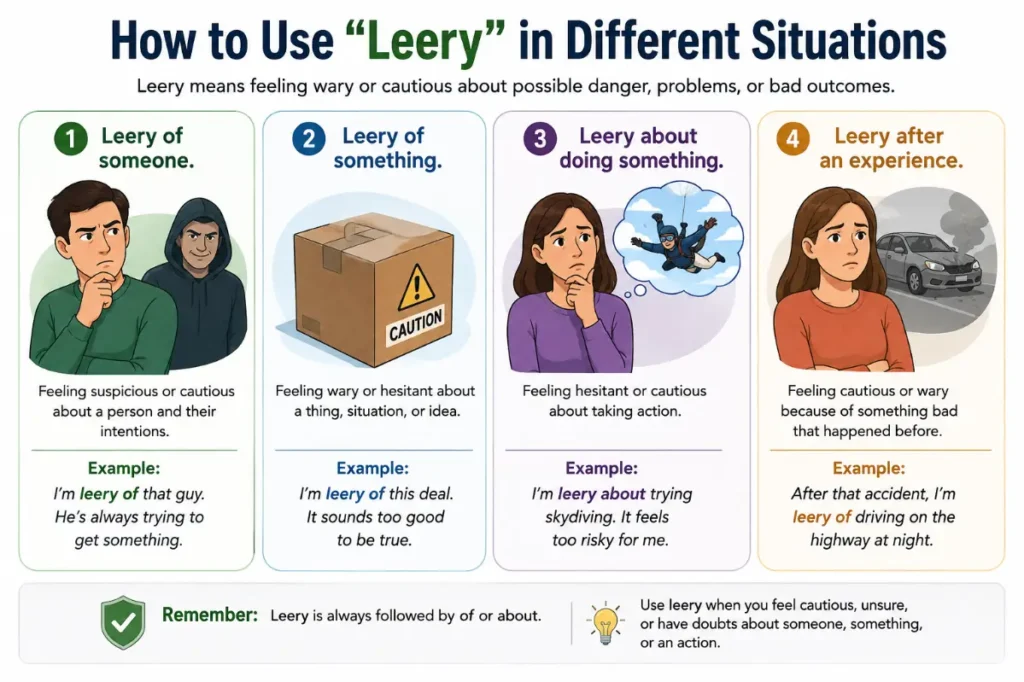
Native speakers frequently use these structures.
- Leery of someone.
- Leery of something.
- Leery about doing something.
- Leery after an experience.
Examples:
- I’m leery of online scams.
- She’s leery about accepting the offer.
- They became leery after the accident.
Using these patterns makes your writing sound natural and idiomatic.
Leary or Leery Expert Language Insight
Professional editors rarely need to think twice about this pair because only one spelling fits standard English. When editing manuscripts, news articles, business reports, or academic papers, editors routinely replace leary with leery unless the word refers to a person’s surname. This mistake is surprisingly common because many people learn the word by hearing it in conversation rather than seeing it in print. Another reason the confusion persists is that spelling software may not catch the error. Since Leary is a legitimate family name, automatic spell checkers often treat it as correct. Experienced editors always evaluate a word in context instead of relying solely on software.
Still confused? Compare well-known vs well known Which Form Is Correct.
Conclusion
If you’re deciding between leary or leery, the answer is straightforward. Leery is the correct English adjective for describing someone who is cautious, suspicious, hesitant, or unwilling to trust a person or situation. Leary is generally not an alternative spelling. It is most commonly a surname or another proper noun.
Remember this simple rule. If the sentence means careful, wary, or suspicious, choose leery. If you’re referring to a person’s family name, Leary is appropriate.
Learning this distinction improves more than your spelling. It also strengthens the clarity and professionalism of your writing. Small details like choosing the correct word help readers trust your work, especially in academic papers, business communication, journalism, and online content.
Frequently Asked Question
Is leary a real English word?
Leary is a real word only as a proper noun, such as a surname. It is not the standard English adjective meaning cautious or suspicious. If you are describing someone’s attitude, leery is the correct spelling.
Which is correct leary or leery?
Leery is the correct spelling when you mean cautious, skeptical, or suspicious. Leary is generally a misspelling in this context unless it refers to a person’s name.
What does leery mean?
Leery means cautious, wary, suspicious, or reluctant to trust someone or something. It often describes a person who has concerns because of past experience or possible risk.
Is leery the same as wary?
The two words are very similar, but they are not identical. Wary emphasizes careful attention to possible danger, while leery often suggests suspicion or hesitation based on instinct or previous experience.
How do you pronounce leery?
Leery is pronounced LEER ee.
IPA: /ˈlɪri/
The first syllable receives the primary stress.
Can I use leery in formal writing?
Yes. Leery is appropriate in formal, academic, journalistic, and professional writing when it accurately describes caution or suspicion. It is recognized by major English dictionaries and style guides.
Why do people spell leery as leary?
The mistake usually happens because the words sound similar in conversation. In addition, Leary is a common surname, so spell check programs do not always identify the error.
Is leery used in British English?
Yes. Leery is understood and accepted in British English, American English, Canadian English, and Australian English. The spelling remains the same across these major varieties of English.