
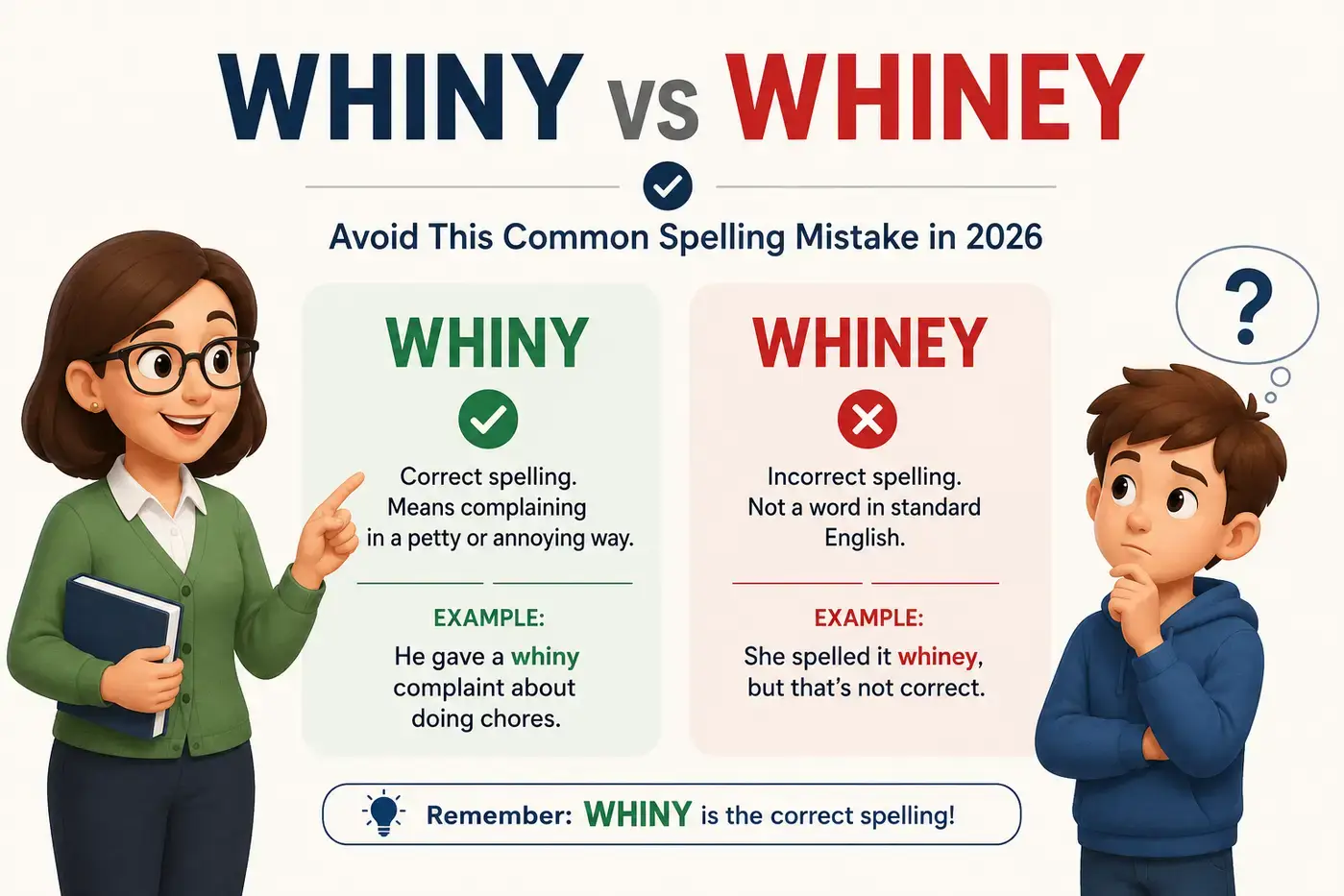
If you’ve searched for whiny vs whiney you’re probably trying to figure out which spelling is correct. The short answer is simple. Whiny is the standard and widely accepted spelling in modern English. Whiney does appear from time to time but most dictionaries either list it as a less common variant or do not recognize it as the preferred form.
The confusion is easy to understand. Since the adjective comes from the verb whine many people naturally assume adding a y should create whiney. English does not always follow predictable spelling patterns though. In this case whiny became the accepted spelling through common usage and editorial standards.
You’ll see whiny in newspapers books magazines business writing classrooms and everyday conversations across the United States. Professional editors and style guides almost always recommend this version because it looks familiar and reads naturally to native speakers. This guide explains the difference between whiny and whiney. You’ll learn which spelling to use why the confusion exists how each word is pronounced where they appear in real life and how to avoid common mistakes in your own writing.
You may also want to read Seal Vs Seel Which Is Correct Meaning Differences And Examples.
Quick Definition
Whiny is the correct and preferred spelling in American and British English. It describes someone who complains in an annoying or childish way. Whiney is an uncommon spelling variant that appears occasionally but is rarely recommended in professional writing or by major dictionaries.
Whiny vs Whiney Quick Answer
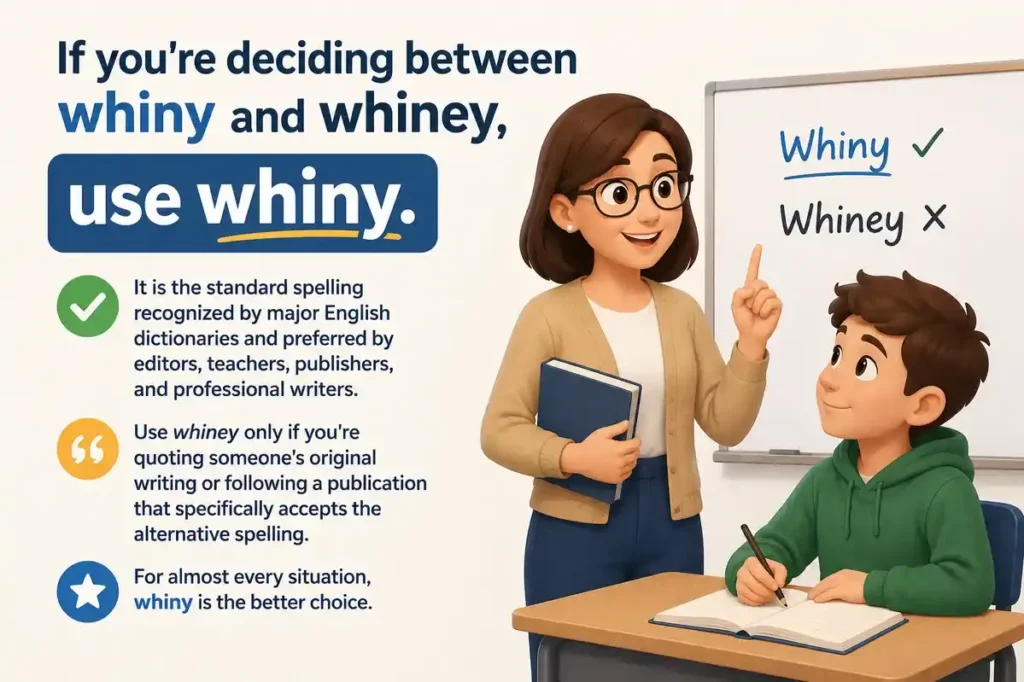
If you’re deciding between whiny and whiney use whiny. It is the standard spelling recognized by major English dictionaries and preferred by editors teachers publishers and professional writers. Use whiney only if you’re quoting someone’s original writing or following a publication that specifically accepts the alternative spelling. For almost every situation whiny is the better choice.
Whiny vs Whiney Comparison Table
| Feature | Whiny | Whiney |
|---|---|---|
| Correct spelling | Yes | Usually no |
| Meaning | Complaining in an annoying way | Same intended meaning |
| Part of speech | Adjective | Adjective |
| Derived from | Whine | Whine |
| Dictionary status | Standard spelling | Less common variant in some sources |
| Usage frequency | Very common | Rare |
| Formality | Suitable for informal and general writing | Not recommended in most edited writing |
| Common contexts | Conversation media books blogs social media | Occasional personal writing or informal posts |
| Preferred by editors | Yes | No |
| Best choice | Yes | No |
Meaning Of Whiny
Whiny is an adjective used to describe a person voice attitude or behavior that involves constant complaining or expressing dissatisfaction in an irritating way. It usually suggests that someone complains too much about small problems or reacts in a childish manner.
Examples include.
- A whiny child who refuses to finish dinner.
- A whiny customer who complains about every little detail.
- A whiny tone that makes listeners lose interest.
The word often carries a negative meaning because it describes behavior that most people find unpleasant.
Etymology Of Whiny
Whiny comes from the verb whine which means to complain repeatedly or make a high pitched complaining sound. The adjective developed naturally in English to describe someone who often whines. Over time whiny became the accepted spelling through widespread use in newspapers books and dictionaries. Today it is the form most native English speakers recognize immediately.
Meaning Of Whiney
Whiney is an alternative spelling that appears occasionally in personal writing online discussions and older publications. Its intended meaning is exactly the same as whiny. Someone described as whiney complains frequently or speaks in an annoying complaining voice. Even though some people use this spelling it is far less common. Professional editors usually replace whiney with whiny because readers expect the standard spelling. For that reason whiney is best viewed as a nonstandard or secondary variant rather than the preferred form.
Whiny vs Whiney Key Differences
At first glance these spellings look almost identical. Their meanings are also the same. The real difference lies in acceptance and frequency of use.
Spelling Difference
Whiny is the accepted standard spelling.
Whiney is an uncommon alternative.
Meaning Difference
There is no difference in meaning. Both words describe someone who complains excessively or speaks in an irritating complaining manner.
Tone Difference
The tone stays the same. Both spellings carry a mildly negative meaning and often describe childish or irritating behavior.
Grammar Difference
Both function as adjectives.
For example.
- The whiny neighbor complained again.
- The whiney neighbor complained again.
Only the first sentence follows modern editorial standards.
Context Difference
Use whiny in.
- School assignments.
- Business communication.
- Books.
- Journalism.
- Websites.
- Professional emails.
- Academic writing.
You might encounter whiney in.
- Personal blogs.
- Online comments.
- Social media posts.
- Informal messages.
- Older user generated content.
Which One Is Correct
The answer is clear. Whiny is the correct spelling for modern English. Major dictionaries style guides publishers and editors consistently recommend whiny because it is the standard form readers expect. Although whiney occasionally appears online its limited use does not make it the preferred spelling. If you’re writing for school work publishing blogging or professional communication always choose whiny. It looks natural sounds familiar and matches current English usage.
Examples In Sentences
Whiny Examples
- The little boy became whiny after missing his afternoon nap.
- Her whiny voice made it difficult to take the complaint seriously.
- Nobody enjoys listening to a whiny coworker all day.
- The movie character sounded whiny instead of confident.
- Stop being so whiny and focus on solving the problem.
- His whiny attitude annoyed everyone during the meeting.
- The coach told the team that hard work beats whiny excuses.
- She laughed at her own whiny reaction once she calmed down.
- Reviewers criticized the actor for giving the character a whiny personality.
- Even adults can sound whiny after a long stressful day.
Whiney Examples
- Some older blog posts describe the child as whiney.
- The online comment called the speaker whiney instead of confident.
- A few writers still use the spelling whiney in casual writing.
- The forum member described his dog as whiney during thunderstorms.
- She accidentally typed whiney before correcting the spelling.
- The caption used whiney but readers suggested changing it.
- The email included the word whiney because of autocorrect.
- You may still find whiney in older discussions online.
- The writer chose whiney even though editors preferred whiny.
- Modern style guides generally recommend replacing whiney with whiny.
You may also want to read cacoon or cocoon Which Spelling Is Correct.
whiny vs whiney Common Mistakes
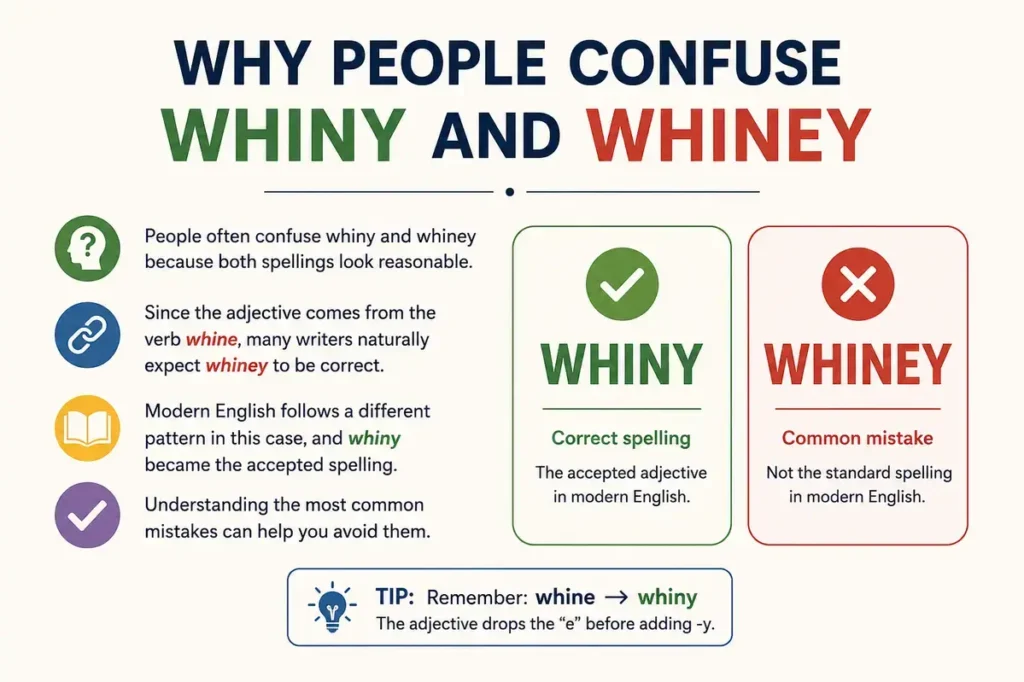
People often confuse whiny and whiney because both spellings look reasonable. Since the adjective comes from the verb whine many writers naturally expect whiney to be correct. Modern English follows a different pattern in this case, and whiny became the accepted spelling. Understanding the most common mistakes can help you avoid them.
Using Whiney In Professional Writing
This is the mistake editors notice most often. Many people write whiney in emails, articles, reports, or school assignments because they assume it follows the spelling of the verb whine. Professional publications almost always use whiny instead.
Assuming Both Spellings Are Equally Common
Some websites claim both forms are equally correct. That is misleading. While whiney does appear occasionally, whiny is far more common in books, newspapers, magazines, educational materials, and edited publications.
Trusting Autocorrect Or Spell Check
Some older spell check tools or custom dictionaries may not flag whiney. That does not make it the preferred spelling. When writing for a broad audience, choose whiny.
Thinking The Meaning Changes
The spelling changes.
The meaning does not.
Both words describe someone who complains too much or has an annoying complaining tone.
Overusing The Word
Another common mistake has nothing to do with spelling. Calling someone whiny too often can make your writing repetitive and less engaging. Mix in related words when they fit the context.
Examples include.
- Complaining.
- Grumbling.
- Fussy.
- Moody.
- Irritable.
- Petulant.
Using a variety of words makes your writing sound more natural.
Pronunciation Guide
The pronunciation stays the same for both spellings.
Whiny
IPA
American English
/ˈwaɪni/
Syllable Breakdown
Whi.
Ny.
The first syllable receives the stress.
It sounds like WHY nee.
Whiney
IPA
American English
/ˈwaɪni/
The pronunciation is identical because both spellings represent the same spoken word.
Common Pronunciation Mistakes
- Saying the first syllable like win instead of whine.
- Stressing the second syllable.
- Pronouncing the ending as nay.
Native speakers place the stress on the first syllable and say it smoothly.
Etymology And Word Origin
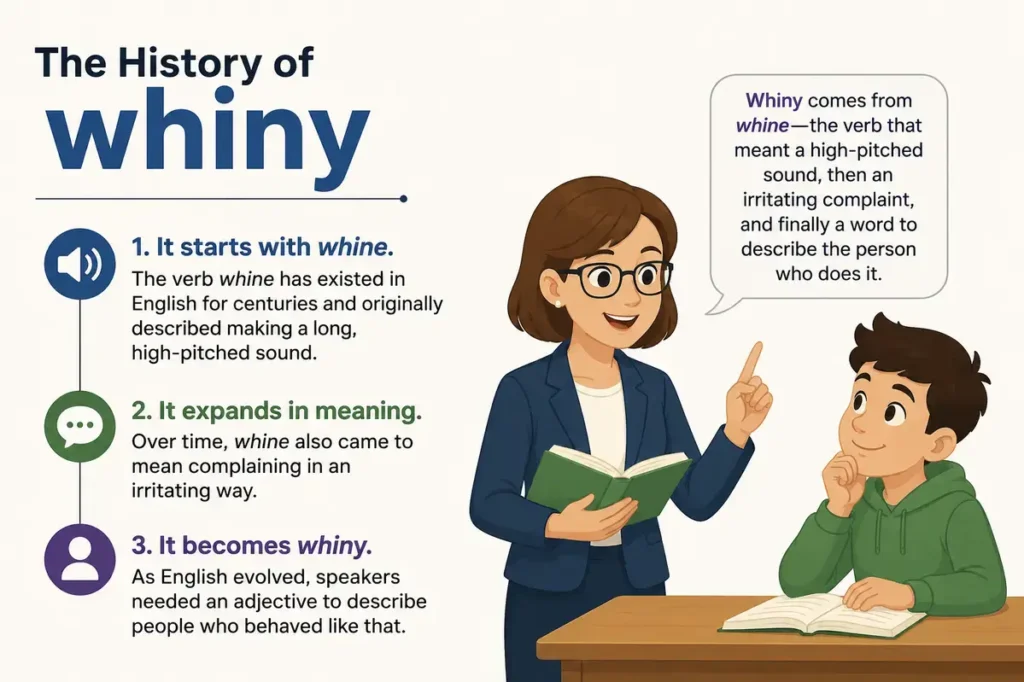
The history of whiny begins with the verb whine. The verb has existed in English for centuries and originally described making a long high pitched sound. Later it also came to mean complaining in an irritating way. As English evolved, speakers needed an adjective to describe people who behaved like that.
The adjective whiny gradually became the accepted form. Although whiney appeared from time to time, publishers, editors, and dictionary makers consistently favored whiny. That preference helped establish today’s standard spelling.
English contains many adjectives that do not follow a perfectly predictable spelling pattern. This is one example. Language often develops through common usage instead of strict rules. That is why reading widely helps you recognize standard forms naturally.
Regional Usage
One reason whiny is easy to remember is that English speakers around the world generally agree on the preferred spelling.
American English
American English strongly favors whiny. It appears in newspapers, novels, magazines, websites, classrooms, and everyday conversation. The spelling whiney is uncommon.
British English
British English also prefers whiny. Major British dictionaries list it as the standard adjective. Readers in the United Kingdom expect this spelling in published writing.
Canadian English
Canadian English follows the same pattern. Professional writers, journalists, teachers, and editors almost always choose whiny.
Australian English
Australian English also recognizes whiny as the standard spelling. The alternative form appears occasionally in informal online writing but remains uncommon.
Regional Preference
There is no meaningful regional difference. Across the United States, Canada, the United Kingdom, and Australia, whiny remains the spelling readers recognize most easily.
Grammar Rules
Understanding how whiny works in a sentence makes it easier to use correctly.
Part Of Speech
Whiny is an adjective.
It describes a noun.
Examples.
- A whiny child.
- A whiny customer.
- A whiny voice.
- A whiny complaint.
Comparative Form
Use whinier when comparing two people or things.
Examples.
- My younger brother is whinier than I remember.
- Today’s meeting was whinier than yesterday’s.
Superlative Form
Use whiniest when describing the highest degree.
Examples.
- That was the whiniest review I have ever read.
- He became the whiniest contestant on the show.
Common Sentence Patterns
Adjective before a noun. The whiny toddler wanted another toy. Linking verb plus adjective. The customer became whiny after waiting too long. Adverb plus adjective. She sounded unusually whiny this morning. These patterns appear naturally in everyday English.
Real Life Usage Examples
Seeing whiny in different situations helps you understand how native speakers actually use it.
Daily Conversation
Parents often say. Stop being so whiny and tell me what happened. Friends might joke. You sound a little whiny today.
Professional Communication
Managers usually avoid calling someone whiny directly because it sounds personal. Instead they may write. The feedback focused more on complaints than solutions. This sounds more professional while expressing a similar idea.
Academic Writing
Researchers rarely use whiny because it is informal. Instead they choose words like.
- Complaining.
- Dissatisfied.
- Critical.
- Negative.
Those terms fit academic writing better.
Literature
Novelists often use whiny to describe dialogue or personality.
Example.
The prince came across as whiny despite his good intentions. The adjective quickly helps readers imagine the character.
Media And Entertainment
Movie reviews, television recaps, podcasts, and social media frequently use whiny.
Examples include.
- The main character felt too whiny.
- Critics called the dialogue whiny.
- Fans thought the sequel made the hero sound whiny.
Because the word is simple and expressive, it remains popular in modern English.
Related Words And Confused Terms
If you’re searching for whiny vs whiney, you may also come across similar words that describe complaining, negativity, or emotional behavior. Some have similar meanings, while others carry a different tone.
Words Related To Whiny
- Complaining.
- Grumbling.
- Fussy.
- Petulant.
- Cranky.
- Moody.
- Irritable.
- Sulky.
- Gripey.
- Nagging.
Synonyms
The best synonym depends on the situation.
- Complaining.
- Petulant.
- Fretful.
- Cross.
- Peevish.
- Grumbling.
- Querulous.
- Irritable.
Words With Different Meanings
These words are sometimes confused with whiny, but they are not the same.
- Whining. The present participle of the verb whine.
- Whiner. A person who complains frequently.
- Whingeing. A common British English word for complaining.
- Complainer. Someone who regularly expresses dissatisfaction.
- Moaning. Complaining or expressing annoyance, especially in British English.
Commonly Confused Spellings
- Whiny. The preferred spelling.
- Whiney. An uncommon variant.
- Whinny. The sound a horse makes. This word has nothing to do with complaining.
- Winey. Describes something that tastes or smells like wine.
These look similar, but each has a different meaning.
whiny vs whiney Expert Language Insight
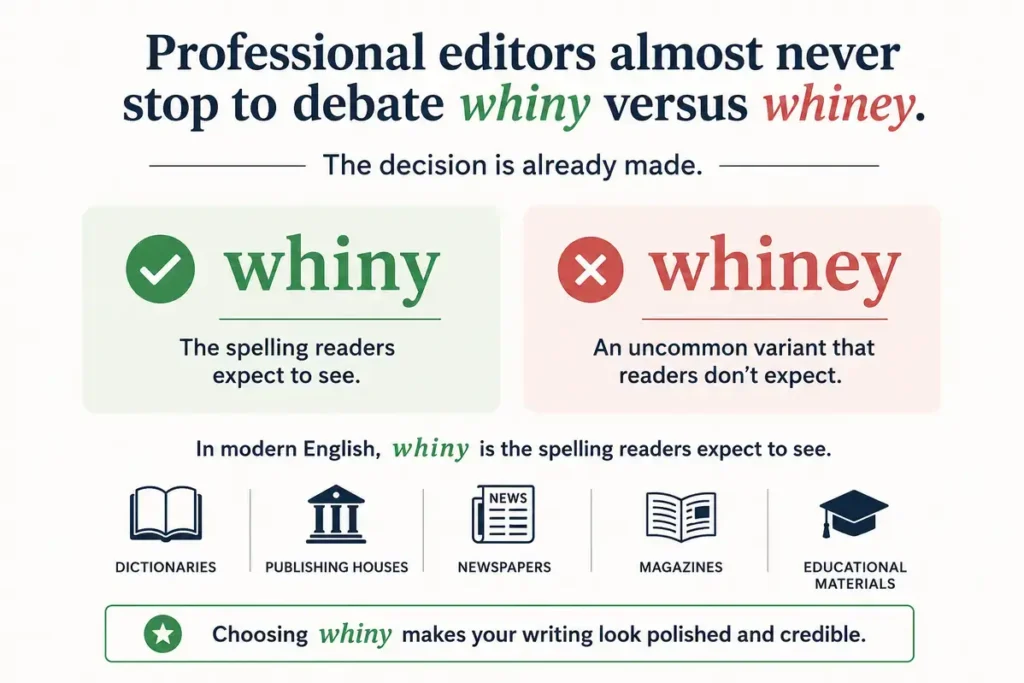
Professional editors almost never stop to debate whiny versus whiney. The decision is already made. In modern English, whiny is the spelling readers expect to see. It appears consistently in dictionaries, publishing houses, newspapers, magazines, and educational materials. Choosing whiny makes your writing look polished and credible.
The alternative spelling whiney survives mainly because English spelling is not always predictable. People naturally connect it to the verb whine and assume the adjective should keep the final e. That assumption makes sense, but language often follows usage more than logic. Native speakers rarely notice the spelling because they recognize whiny immediately. If they see whiney, many assume it is a typing mistake or an unfamiliar variant.
Another point worth remembering is tone. Calling someone whiny is usually a criticism. It suggests the person complains too much or reacts to small problems in an exaggerated way. Because of that, use the word thoughtfully, especially in professional communication.
Instead of writing. The client was whiny. You could write. The client expressed repeated concerns about the project. The second version sounds more respectful and professional while communicating the same general idea. As an editor, the advice is simple. Use whiny in every form of modern writing unless you are quoting an original source that uses whiney.
Frequently Asked Questions
Is Whiny Or Whiney Correct?
Whiny is the correct and preferred spelling. It is recognized by major dictionaries and used by professional writers, editors, teachers, and publishers. Whiney appears occasionally but is not the standard choice for modern English.
Why Do People Spell It Whiney?
Many people assume the adjective should keep the final e from the verb whine. That seems logical, but English spelling often develops through common usage. Over time, whiny became the accepted standard.
Do Whiny And Whiney Mean Different Things?
No.
Both spellings describe someone who complains frequently or speaks in an annoying complaining tone. The difference is spelling, not meaning.
Is Whiney A Real Word?
Some dictionaries list whiney as a less common spelling variant, while others do not include it. Even when it appears, whiny remains the recommended spelling for nearly all writing.
Which Spelling Should I Use In School Or At Work?
Always choose whiny. It matches modern dictionary recommendations and professional editorial standards. Teachers, employers, and publishers expect this spelling.
How Do You Pronounce Whiny?
Whiny is pronounced /ˈwaɪni/.
It has two syllables with stress on the first syllable.
It sounds like WHY nee.
Is Whiny Informal?
Yes.
Whiny is an informal adjective. It works well in conversation, fiction, blogs, reviews, and everyday writing. In formal reports or academic papers, more precise words like complaining, dissatisfied, or petulant may fit better.
What Is The Difference Between Whiny And Whining?
Whiny is an adjective that describes a person, voice, or attitude. Whining is the present participle of the verb whine.
Examples.
- The whiny child refused to listen.
- The child kept whining about the weather.
Still confused? Compare Bearable vs Bareable Which Is Correct? 2026.
Conclusion
The choice between whiny vs whiney is much simpler than it first appears.
Whiny is the standard spelling used throughout American English and other major varieties of English. It is the version you’ll find in respected dictionaries, professional publications, classrooms, and everyday writing.
Whiney shares the same meaning, but it is uncommon and generally avoided in edited content. Most readers expect whiny, and using it helps your writing look polished and accurate.
If you remember one rule, make it this. Use whiny for school assignments, work emails, articles, books, blogs, and professional communication. Reserve whiney only when quoting a source that originally uses that spelling. Making this small spelling choice improves clarity, builds credibility, and helps your writing match modern English standards.