
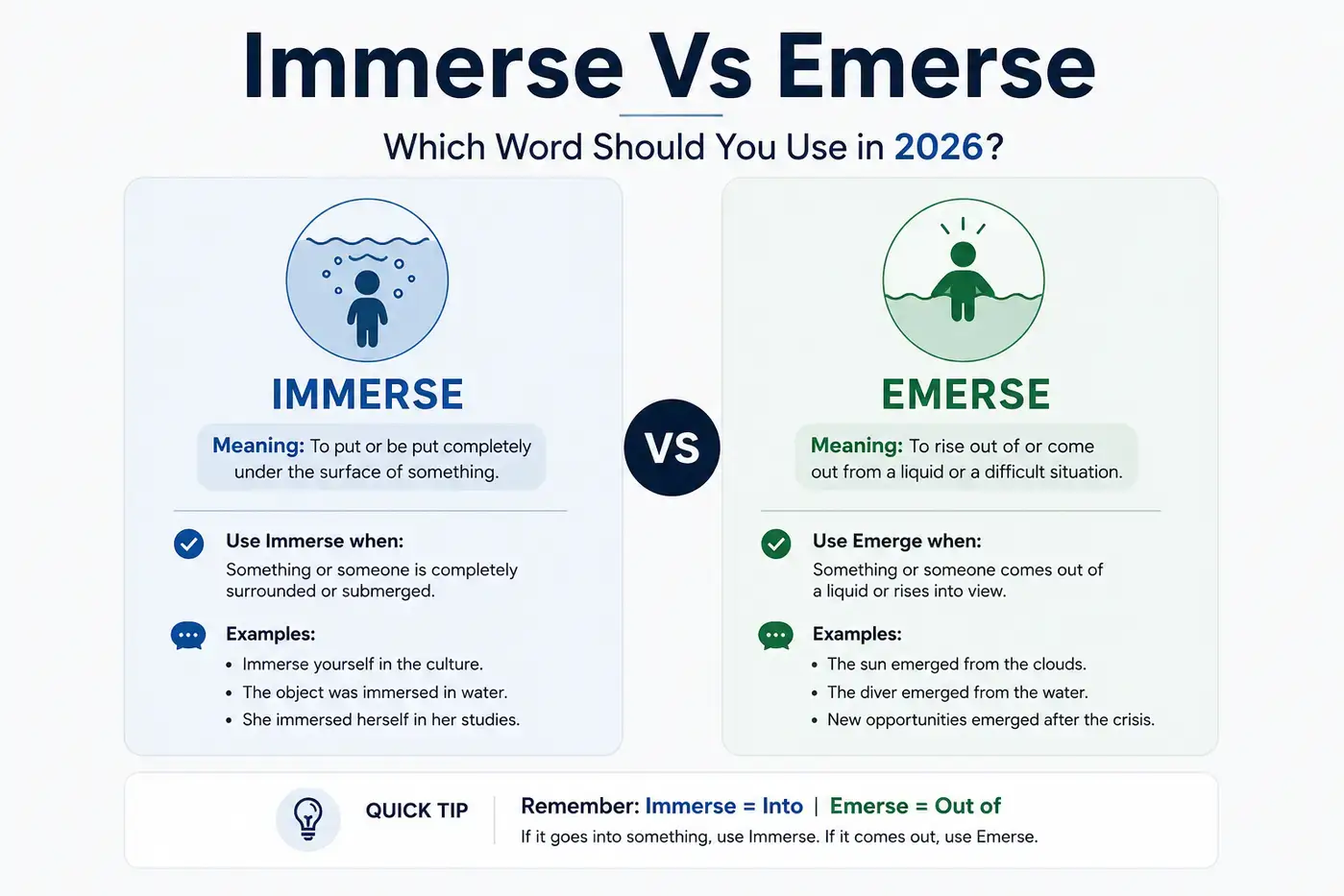
If you searched for immerse vs emerse you’re probably trying to figure out which word is correct and when to use it. At first glance they look almost identical. They even share the same Latin roots. That similarity makes them easy to mix up especially if you have seen both words in books scientific articles or online discussions.
The short answer is that immerse is the word most people need. It is a common English verb that means to put something completely into a liquid or to become deeply involved in an activity experience or subject. Emerse is also a real English word but it is extremely rare. It appears mainly in biology botany and environmental science to describe plants or organisms that rise above the surface of water.
The confusion comes from their spelling and opposite meanings. One describes going into something while the other describes coming out of it. Knowing that simple contrast makes it much easier to choose the right word. This guide explains the meaning pronunciation grammar usage history and differences between immerse and emerse. You will also see real examples expert writing tips and practical advice so you can use the correct word with confidence.
A related grammar guide is Setup vs Set Up Explained Clearly.
Quick Definition
Immerse is the correct choice in almost every everyday situation. It means to place something completely in a liquid or to become deeply involved in an activity. Emerse is a rare adjective used mainly in scientific writing to describe plants or organisms that grow or extend above the water’s surface.
Quick Answer
If you are deciding between immerse and emerse use immerse unless you are writing about botany aquatic biology or environmental science.
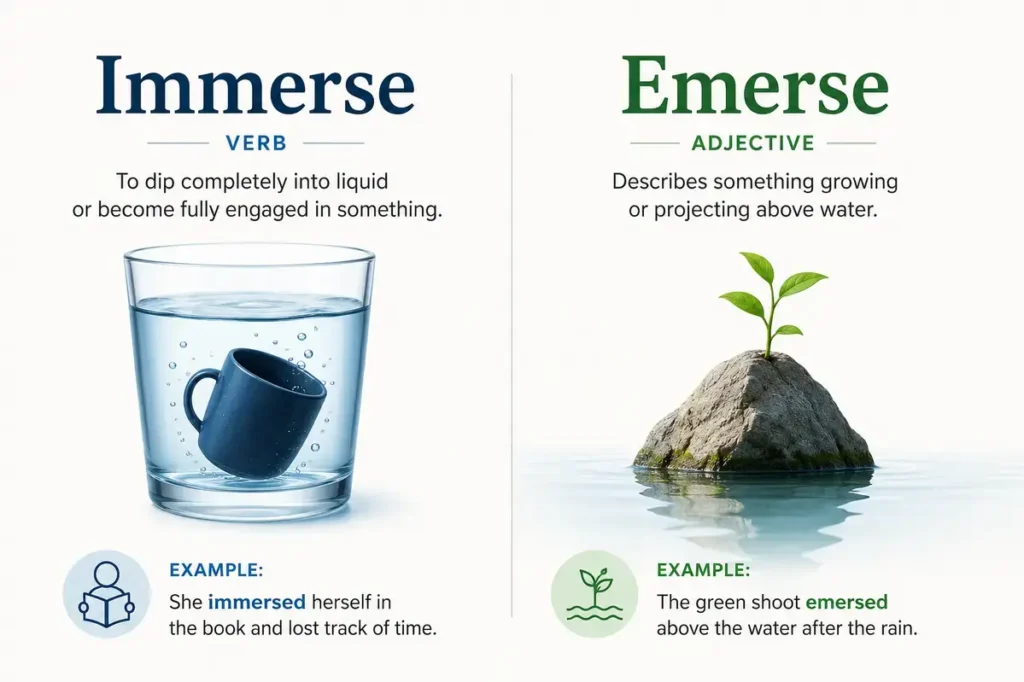
- Immerse is a common verb that means to dip completely into liquid or become fully engaged in something.
- Emerse is a rare adjective that describes something growing or projecting above water.
For everyday English academic essays business writing creative writing and casual conversation immerse is almost always the correct word.
Immerse Vs Emerse Comparison Table
| Feature | Immerse | Emerse |
|---|---|---|
| Correct everyday word | Yes | No in most situations |
| Part of speech | Verb | Adjective |
| Basic meaning | To put into liquid or become deeply involved | Rising above water or growing above the water surface |
| Origin | Latin immergere meaning to plunge into | Latin emersus meaning risen out of water |
| Usage frequency | Very common | Very rare |
| Formality | Standard English | Mostly scientific and technical |
| Common contexts | Reading learning games culture cooking chemistry emotions | Botany ecology aquatic plants wetlands |
| Figurative meaning | Yes | No |
| Used in daily conversation | Very often | Almost never |
| Example | I immersed myself in the novel. | The pond contains emerse vegetation. |
Meaning Of Immerse
Immerse is a verb with both literal and figurative meanings. It is widely used in American English and appears in everyday conversation literature journalism education and professional writing.
Definition
The most common meaning of immerse is to place something completely into a liquid. Examples include dipping food into water placing laboratory equipment into a solution or lowering an object beneath the surface. The word also means becoming completely absorbed in an activity idea culture or experience. Someone can immerse themselves in a language a book music history or a new career.
Everyday Usage
Native speakers frequently use immerse in situations like these.
- Learning a new language.
- Reading an exciting novel.
- Studying history.
- Exploring another culture.
- Playing an immersive video game.
- Conducting scientific experiments.
- Cooking and food preparation.
The figurative meaning is actually more common than the literal one.
For example.
- She immersed herself in French literature.
- We immersed the vegetables in ice water.
- He immersed himself in learning computer programming.
- Tourists immersed themselves in local traditions.
Etymology Of Immerse
The word comes from the Latin verb immergere. The root combines two ideas.
- In meaning into.
- Mergere meaning to dip plunge or sink.
English adopted the word during the fifteenth century. Its meaning has remained remarkably consistent for hundreds of years. Today immerse appears in both physical and metaphorical contexts making it one of the most flexible verbs in modern English.
Meaning Of Emerse
Unlike immerse emerse is not a common word. Many native English speakers never encounter it outside scientific publications.
Definition
Emerse is an adjective that describes something growing emerging or extending above the surface of water after being rooted or associated with an aquatic environment. The word is especially common in botany. Scientists use it to describe aquatic plants whose leaves flowers or stems rise above the water.
Scientific Context
You may find emerse in fields such as.
- Botany.
- Ecology.
- Wetland research.
- Environmental science.
- Aquatic biology.
Examples include scientific descriptions of marsh plants reeds cattails and aquatic grasses.
Examples
- The emerse leaves remained above the pond throughout the summer.
- Researchers observed several emerse species along the shoreline.
- The plant develops emerse foliage during dry seasons.
- Emerse vegetation provides shelter for wildlife.
Outside scientific writing these sentences rarely appear.
Etymology Of Emerse
Emerse comes from the Latin word emersus which means risen out dipped out or lifted above water. Its meaning has stayed highly specialized. Unlike immerse it never developed a common figurative meaning.
Immerse or Emerse Key Differences
Although these words differ by only one letter their meanings belong to completely different contexts.
Meaning
Immerse means to place something into a liquid or become deeply involved.
Emerse describes something extending above water.
Part Of Speech
Immerse is mainly a verb.
Emerse is an adjective.
Everyday Use
Immerse appears in daily conversation education business journalism entertainment and literature.
Emerse appears mostly in scientific journals textbooks and botanical descriptions.
Figurative Meaning
Immerse often has a figurative meaning.
People immerse themselves in music cultures hobbies studies and experiences.
Emerse does not have a figurative meaning in standard English.
Frequency
Immerse is extremely common.
Emerse is exceptionally rare.
Many dictionaries include it but most English learners never need to use it.
Which One Is Correct
For almost every writer the correct choice is immerse.
Use immerse if you mean.
- Putting something into liquid.
- Becoming deeply involved.
- Focusing completely on an activity.
- Absorbing yourself in a subject.
- Entering a new culture or experience.
Use emerse only when discussing aquatic plants environmental science ecology or related scientific topics.
If you are writing an email blog school assignment business report novel article or social media post immerse is almost certainly the right word.
Examples In Sentences
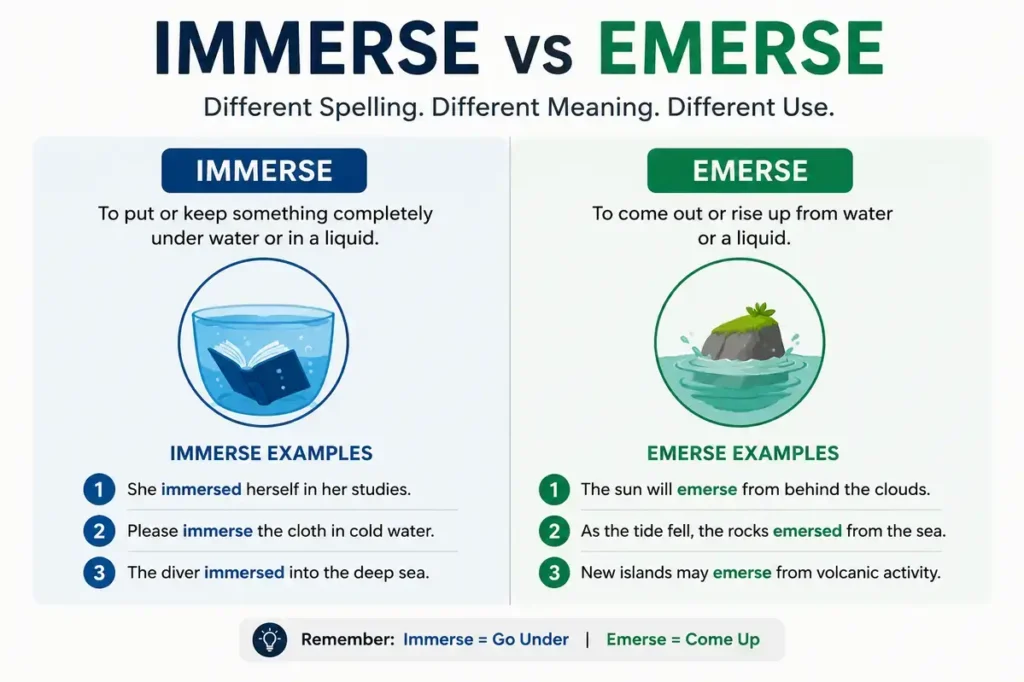
Immerse Examples
- I immersed the flowers in fresh water to keep them healthy.
- She immersed herself in American history before the exam.
- The documentary immersed viewers in the world of deep sea exploration.
- We immersed the fabric in warm dye for several hours.
- Children learn faster when they immerse themselves in real conversations.
- He immersed himself in the local culture during his vacation.
- The chef immersed the vegetables in cold water after boiling them.
- Reading every day helped her immerse herself in the language.
- Good teachers immerse students in hands on learning.
- The museum experience immersed visitors in ancient civilization.
Emerse Examples
- The emerse stems remained above the waterline all year.
- Scientists recorded several emerse aquatic plants near the marsh.
- The emerse leaves absorbed more sunlight during the dry season.
- Researchers compared submerged and emerse vegetation.
- The wetland supports many emerse plant species.
- The emerse shoots continued growing after the water receded.
- Ecologists documented changes in emerse habitats.
- The emerse roots adapted to seasonal flooding.
- The pond contained both submerged and emerse plants.
- Field guides often classify vegetation as submerged floating or emerse.
Need another quick comparison? Read Analyze or Analyse Which Spelling Is Correct..
Common Mistakes
The confusion around immerse or emerse usually comes from their similar spelling. Since both words share Latin roots, many people assume they are interchangeable. They are not.
Here are the mistakes editors see most often.
Using Emerse Instead Of Immerse
This is by far the most common error.
People sometimes write emerse when they actually mean becoming deeply involved in something.
Incorrect.
I want to emerse myself in Spanish before my trip.
Correct.
I want to immerse myself in Spanish before my trip.
The verb you need is immerse because you’re talking about becoming fully engaged in learning a language.
Assuming Emerse Is A Misspelling
Interestingly, the opposite mistake also happens. Some writers think emerse is simply a typo. It is a real English word. It just belongs to a specialized scientific vocabulary. If you’re reading research papers about wetlands, aquatic plants or freshwater ecosystems, you’ll see it used correctly.
Confusing Opposite Meanings
These words point in opposite directions.
- Immerse means to go into something.
- Emerse means to rise above something, usually water.
Remembering this simple contrast makes the choice much easier.
Using Emerse In Everyday Writing
Native English speakers almost never use emerse in ordinary conversation.
Sentences like these sound unnatural.
Incorrect.
I was emerse in the movie.
Correct.
I was immersed in the movie.
Forgetting The Past Participle
Another common mistake involves grammar.
Incorrect.
She was immerse in her work.
Correct.
She was immersed in her work.
After forms of be, you normally need the past participle immersed.
Pronunciation Guide
Although the words look similar, their pronunciation is slightly different.
Immerse
IPA
American English.
/ɪˈmɝːs/
Syllable Breakdown
Im.
Merse.
The stress falls on the second syllable.
Common Pronunciation Mistakes
- Stressing the first syllable.
- Pronouncing the final sound like mers with an extra vowel.
- Saying immerce instead of immerse.
A natural American pronunciation sounds like ih MURSS.
Emerse
IPA
American English.
/ɪˈmɝːs/
Interestingly, emerse is pronounced almost exactly the same as immerse. The spelling changes but the pronunciation remains nearly identical in standard American English.
Syllable Breakdown
E.
Merse.
The second syllable receives the stress.
Why The Words Sound Alike
English contains many words that developed from related Latin roots. As pronunciation changed over centuries, several words ended up sounding alike even though their meanings became very different.
Etymology And Word Origin
Understanding the history of these words makes their meanings much easier to remember.
Origin Of Immerse
Immerse comes from the Latin verb immergere.
It combines two Latin elements.
- In meaning into.
- Mergere meaning to dip, plunge or sink.
The original meaning was literally to place something beneath the surface of water. As English evolved, writers began using the word figuratively. Today people can immerse themselves in books, music, cultures, careers, research and countless other experiences. The figurative meaning has become just as common as the literal one.
Origin Of Emerse
Emerse comes from the Latin adjective emersus. It means risen out, lifted from or emerging above water. Scientists adopted the word because it describes aquatic plants with remarkable precision. A plant may spend part of its life underwater before developing leaves or stems that rise into the air. That is an emerse plant. Unlike immerse, the meaning stayed technical instead of expanding into everyday English.
How The Meanings Changed
Although both words share the same Latin root, they moved in different directions.
Immerse became part of common English because people frequently describe becoming deeply involved in activities.
Emerse remained a scientific term because very few situations require such a specific description.
That difference explains why one word appears everywhere while the other appears mainly in textbooks and research papers.
Regional Usage
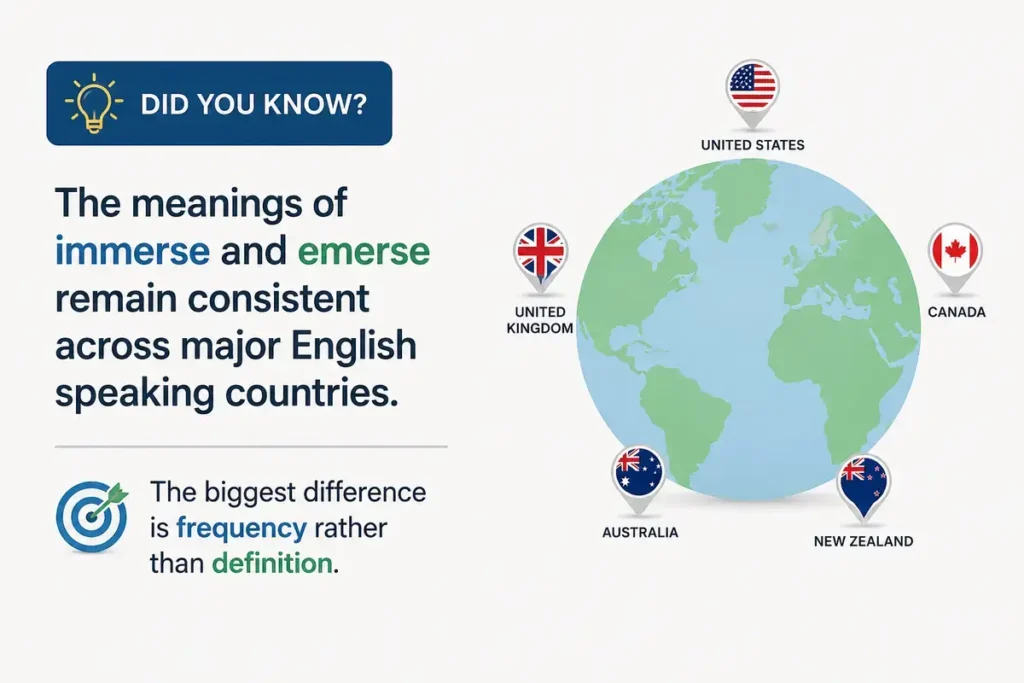
One interesting fact about immerse and emerse is that their meanings remain consistent across major English speaking countries. The biggest difference is frequency rather than definition.
American English
American English uses immerse every day. People commonly talk about immersing themselves in books, cultures, games, work or education. Emerse appears almost exclusively in scientific publications, university textbooks and environmental research.
British English
British English follows the same pattern. Immerse is common in newspapers, literature and everyday conversation. Emerse remains limited to botanical and ecological writing.
Canadian English
Canadian English also treats immerse as the standard everyday word. Researchers studying wetlands, lakes and freshwater ecosystems sometimes use emerse, especially in scientific journals.
Australian English
Australia has extensive wetland and marine research, so scientists may use emerse more often than the general public. Outside scientific communities, however, most Australians rarely encounter the word.
Regional Preference
There is no spelling difference between American, British, Canadian and Australian English. Unlike words such as color and colour, both immerse and emerse keep the same spelling everywhere. The only real difference is how often people see them.
Grammar Rules
Understanding grammar helps you choose the right form naturally.
Immerse As A Verb
Immerse is a regular verb.
Its forms are straightforward.
- Base form. Immerse.
- Third person singular. Immerses.
- Present participle. Immersing.
- Past tense. Immersed.
- Past participle. Immersed.
Examples.
She immerses herself in every project.
They are immersing the samples in water.
We immersed the metal in the solution.
The students were immersed in discussion.
Emerse As An Adjective
Emerse functions as an adjective.
It describes a noun.
Examples.
Emerse vegetation.
Emerse aquatic plants.
Because it is an adjective, it does not change into different verb forms. You would not normally write emersed, emersing or emerses in standard English.
Common Sentence Patterns
With immerse. Subject plus immerse plus object. The scientist immersed the specimen in water. Subject plus be plus immersed plus prepositional phrase. She was immersed in her studies.
With emerse.
Adjective plus noun.
Emerse vegetation covered the shoreline. The adjective comes before the noun it describes.
Passive Voice
The passive form of immerse appears frequently.
Examples.
The equipment was immersed in clean water.
The artifacts were immersed for preservation.
These constructions are common in scientific and technical writing.
Real Life Usage Examples
Seeing these words in authentic situations helps you remember them.
Daily Conversation
People regularly say things like these. I want to immerse myself in Italian before our vacation. She became immersed in the mystery novel. Nobody says they became emerse in a book or conversation.
Academic Writing
Education researchers often encourage students to immerse themselves in learning. Language teachers recommend immersive experiences because they improve fluency more quickly. Environmental science textbooks describe emerse aquatic vegetation growing along rivers, marshes and ponds.
Professional Communication
Companies sometimes encourage employees to immerse themselves in customer feedback or product training. Scientists may write about emerse plant communities when documenting changes in wetlands. Each word fits naturally within its own field.
Literature
Novelists frequently describe characters becoming immersed in memories, emotions or adventures. That figurative use creates vivid imagery because readers immediately understand the feeling of complete involvement. Emerse almost never appears in novels unless the story involves biology, ecology or scientific research.
Media
News articles often mention immersive learning, immersive technology and immersive experiences. Science magazines discussing wetlands or aquatic ecosystems occasionally mention emerse vegetation.
This difference reflects modern English usage.
Immerse belongs to everyday language.
Emerse belongs to specialized scientific vocabulary.
Related Words And Confused Terms
If you searched for immerse or emerse, you may also come across similar words. Some share the same Latin root, while others have related meanings. Knowing the differences helps you avoid common writing mistakes.
Words Related To Immerse
- Immersion.
- Immersed.
- Immersing.
- Submerge.
- Dip.
- Soak.
- Plunge.
- Engage.
- Absorb.
- Involve.
These words often appear in discussions about learning, reading, technology, virtual reality, education, travel and personal experiences.
Words Related To Emerse
- Emergent.
- Emerging.
- Aquatic.
- Submerged.
- Wetland.
- Marsh.
- Riparian.
- Vegetation.
- Ecology.
- Botanical.
These terms appear mainly in biology, ecology and environmental science.
Commonly Confused Words
People also confuse immerse with several other English words.
- Immerse and Submerge.
Both involve placing something into water. Submerge usually focuses on going below the surface. Immerse often suggests complete coverage or deep involvement.
- Immerse and Engage.
You can engage in an activity without giving it your full attention. If you immerse yourself, you become completely absorbed.
- Emerse and Emerge.
These words look similar but are not the same.
Emerge is a common verb that means to come out, appear or become visible.
Example.
The sun emerged from behind the clouds.
Emerse is an adjective describing aquatic plants or organisms that extend above the water.
This is another reason people mix them up.
Expert Language Insight
From an editor’s perspective, this is one of those word pairs that looks more confusing than it actually is. if your audience includes general readers, business professionals, students or casual English learners, immerse is almost always the word you need. Native English speakers regularly use expressions like these.
- Immerse yourself in a new culture.
- Immerse yourself in the story.
- Become immersed in your work.
- Immerse the object in water.
These sound completely natural.
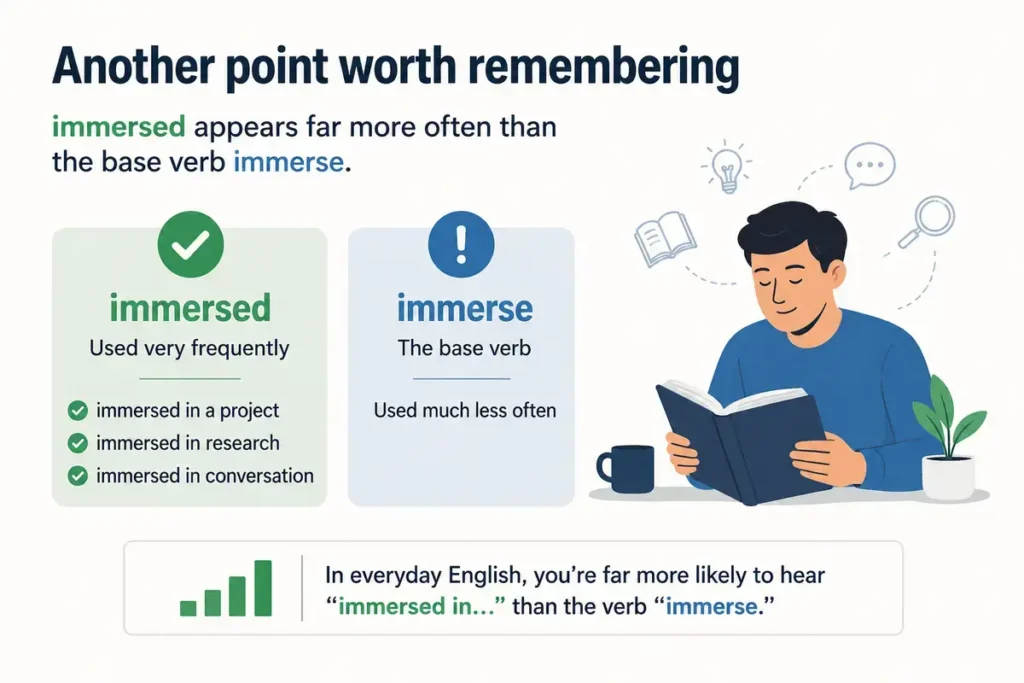
By contrast, most native speakers have never used emerse in everyday conversation. Even experienced writers rarely encounter it outside scientific publications. Another point worth remembering is that immersed appears far more often than the base verb immerse. English speakers naturally say someone was immersed in a project, immersed in research or immersed in conversation.
That pattern makes your writing sound more fluent. If you are writing for a broad audience, replacing immerse with emerse is almost always an error. Unless your topic involves aquatic plants or environmental science, stick with immerse. That simple choice will make your writing clearer and more natural.
Frequently Asked Questions
Is immerse or emerse the correct spelling?
Immerse is the correct word in almost every everyday situation. It means to place something completely into a liquid or become deeply involved in an activity. Emerse is also a real English word, but it is a specialized scientific adjective used mainly in botany and ecology.
Is emerse a real English word?
Yes. Emerse is a legitimate English word found in many dictionaries. It describes aquatic plants or organisms that grow or extend above the surface of the water. Outside scientific writing, it is rarely used.
What is the difference between immerse and emerse?
The difference is simple. Immerse means to go into something or become deeply involved. Emerse describes something that rises above water. One is a common verb used every day. The other is a rare adjective used in scientific fields.
Can I say I am emerse in my work?
No. The correct expression is immersed in my work. Native English speakers use immersed to describe complete focus or deep involvement. Using emerse in this sentence is grammatically incorrect.
How do you pronounce immerse?
In American English, immerse is pronounced /ɪˈmɝːs/. It has two syllables with the stress on the second syllable. The pronunciation sounds like ih MURSS.
Why do people confuse immerse and emerse?
The words differ by only one letter and share the same Latin roots. They also sound very similar when spoken. Since emerse is uncommon, many people assume it is another form of immerse, even though their meanings are completely different.
Is immerse used in figurative writing?
Yes. In fact, figurative use is extremely common. People immerse themselves in books, music, cultures, hobbies, education and work. This figurative meaning appears regularly in everyday English and professional writing.
Is emerse used outside biology?
Very rarely. Most examples appear in botany, aquatic ecology, wetland research and environmental science. Outside those fields, native English speakers almost never use emerse.
Need another quick comparison? Read tonite or tonight Which Spelling Is Correct.
Conclusion
The answer is straightforward. When comparing immerse vs emerse, immerse is the correct choice for almost every situation.
Use immerse when you mean placing something into a liquid or becoming completely absorbed in an activity, subject or experience. It is common, versatile and familiar to every native English speaker.
Use emerse only in specialized scientific contexts. It describes aquatic plants or organisms that grow above the surface of the water. Unless you are writing about botany, ecology or environmental science, you will probably never need it.
Remember one simple idea.
Immerse goes into.
Emerse comes out.
That mental picture makes the difference easy to remember and helps you choose the right word every time.