
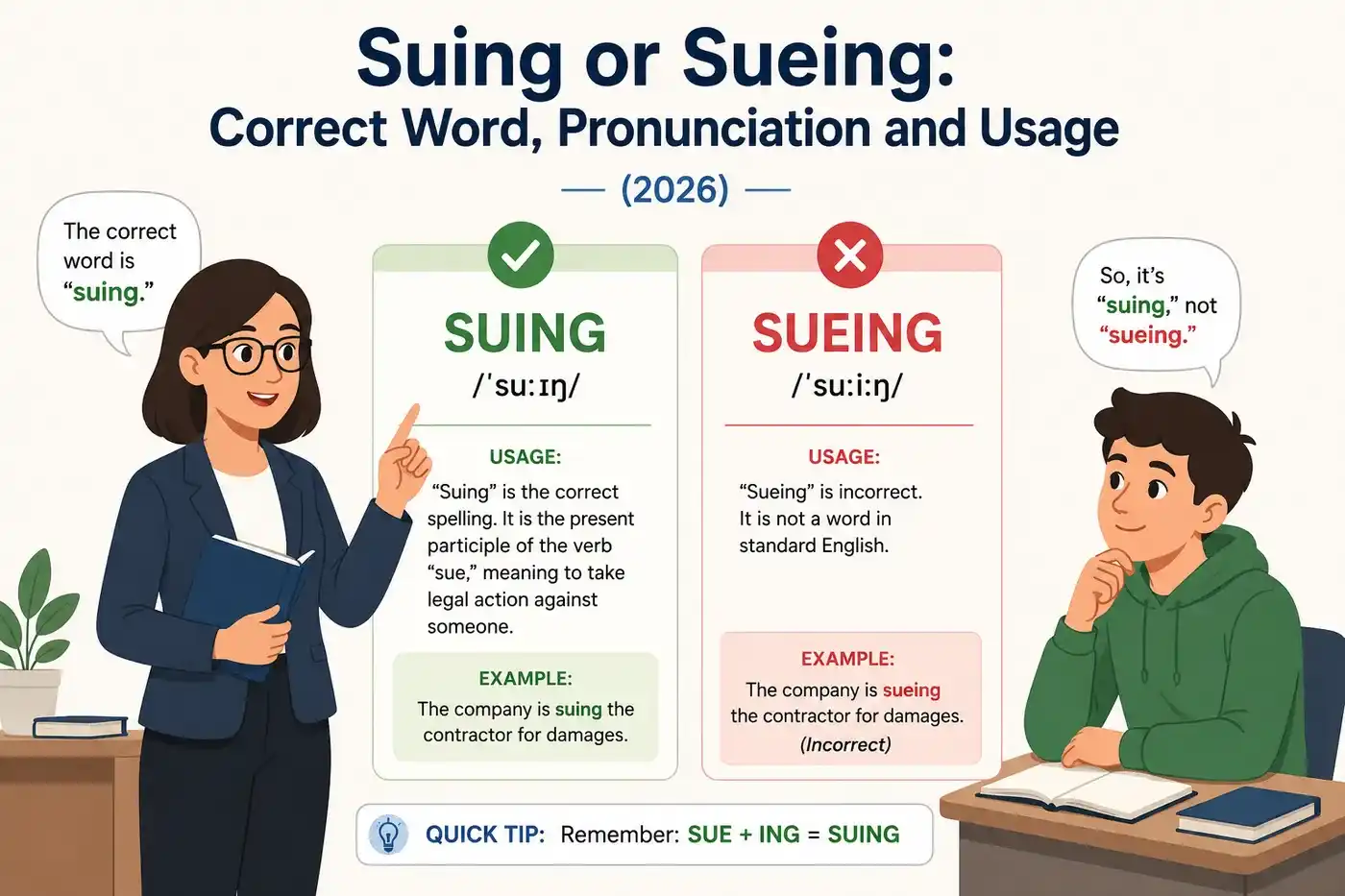
If you’ve searched for suing or sueing you’re probably trying to figure out which spelling is correct. It’s a common question because the verb sue ends with the letter e, yet its ing form drops that final letter. At first glance, sueing looks logical. In standard English, though, it isn’t the correct spelling.
The correct form is suing.
This confusion comes from one of the most common spelling rules in English. Many verbs that end in a silent e drop that letter before adding ing. Since sue already ends in e, many writers naturally assume they should keep it to preserve the pronunciation. English doesn’t work that way in this case, and dictionaries recognize only suing as the standard spelling.
This guide explains the difference between suing and sueing, why one spelling is correct, how the grammar rule works, and how native English speakers use the word in everyday conversation, legal writing, business communication, and the media. You’ll also find pronunciation tips, real examples, common mistakes, and expert language advice to help you remember the correct spelling every time.
A related grammar guide is Passtime or Pastime Which Is Correct? 2026.
Quick Definition
Suing is the correct present participle and gerund of the verb sue. Sueing is a misspelling and isn’t accepted in standard English. The final e in sue is dropped before adding ing, following a common English spelling rule used with many verbs ending in silent e.
Search Intent
People searching for suing or sueing are mainly looking for the correct spelling. Many also want a simple grammar explanation, pronunciation guidance, and examples that show the correct form in real sentences.
Quick Answer
The correct spelling is suing. Use suing anytime you need the ing form of sue.
Correct.
- She is suing the company.
- They are suing their landlord.
- He regrets suing his former business partner.
Incorrect.
- She is sueing the company.
- They are sueing their landlord.
- He kept sueing everyone.
If you write sueing, spell checkers, dictionaries, teachers, editors, and legal professionals will treat it as an error.
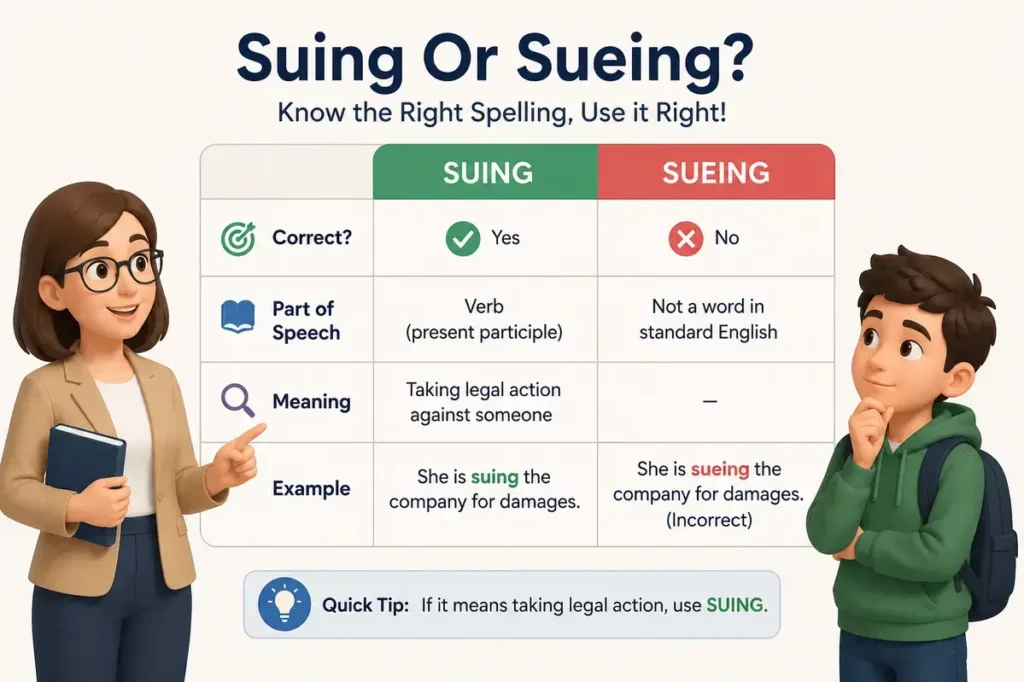
Suing Or Sueing Comparison Table
| Feature | Suing | Sueing |
|---|---|---|
| Correct spelling | Yes | No |
| Dictionary entry | Yes | No |
| Meaning | Taking legal action against someone | Misspelling of suing |
| Part of speech | Present participle and gerund | Not a standard English word |
| Grammar status | Correct | Incorrect |
| Origin | From the verb sue | Formed by applying the wrong spelling pattern |
| Usage frequency | Very common | Extremely rare except as an error |
| Formal writing | Accepted | Never accepted |
| Legal writing | Standard | Incorrect |
| Academic writing | Standard | Incorrect |
| Professional communication | Standard | Incorrect |
| Example | She is suing the contractor. | She is sueing the contractor. Incorrect. |
Meaning Of Suing
Suing is the present participle and gerund of the verb sue. It means taking legal action against a person, business, organization, or government through a court of law. You can also think of it as officially asking a court to resolve a legal dispute. Examples include contract disputes, personal injury claims, property disagreements, copyright issues, workplace conflicts, and consumer complaints.
Definition
To begin or continue legal action against another party.
Part Of Speech
Verb.
Present participle.
Gerund.
Etymology
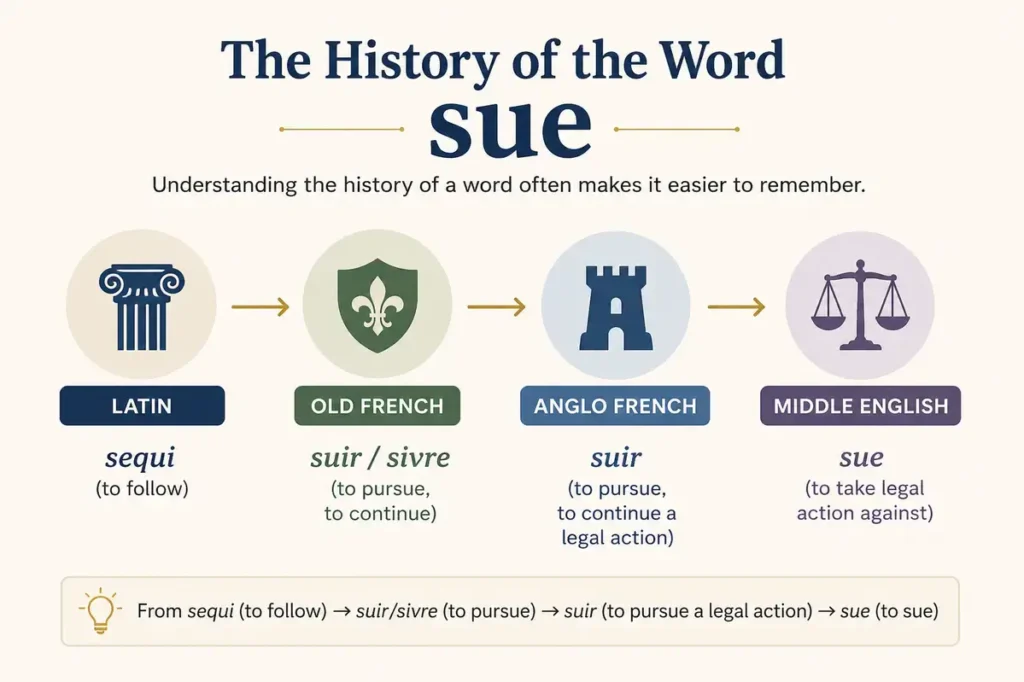
The verb sue comes from Anglo French and Old French forms related to pursuing a legal claim. Its deeper roots trace back to the Latin verb sequi, meaning to follow or pursue. Over centuries, the meaning narrowed to pursuing justice through the legal system.
Common Contexts
- Civil lawsuits.
- Employment disputes.
- Business disagreements.
- Medical malpractice cases.
- Intellectual property claims.
- Consumer protection cases.
- Family law matters.
- Contract disputes.
Example Sentences
- She is suing the manufacturer after the accident.
- Several customers are suing the company together.
- The athlete avoided suing the newspaper.
- They discussed suing the contractor for breach of contract.
- He admitted that suing wasn’t his first choice.
Meaning Of Sueing
Sueing is not a standard English word. People create this spelling because they assume the final e should stay before adding ing. That assumption makes sense at first. Many English spelling rules can feel inconsistent. In this case, though, dictionaries and style guides agree that suing is the only correct spelling.
Why People Write Sueing
Several factors cause this mistake.
- The base word ends with e.
- Writers want to preserve the pronunciation.
- Some verbs follow different spelling patterns.
- English spelling isn’t always predictable.
- Autocorrect doesn’t always catch every typing mistake immediately.
Although sueing appears in online comments, forums, and social media posts, those examples don’t make it correct. Professional editors treat it as a spelling mistake.
Suing Or Sueing Key Differences
Understanding the difference is simple once you know the spelling rule.
Spelling
Suing follows standard English spelling.
Sueing does not.
Dictionary Recognition
Every major English dictionary lists suing.
You won’t find sueing as an accepted spelling.
Grammar
Suing is the proper ing form of sue.
Sueing breaks the normal spelling rule for verbs ending in silent e.
Usage
Native speakers, lawyers, journalists, professors, and professional writers all use suing. Sueing mainly appears because of typing errors or spelling confusion.
Professional Acceptance
Legal documents always use suing.
Academic papers use suing.
Business writing uses suing.
News organizations use suing.
Suing Or Sueing Which One Is Correct
The answer is easy.
Suing is correct.
Sueing is incorrect.
The reason comes from a standard English spelling rule.
When most verbs end in a silent e, you remove the final e before adding ing.
Examples include.
- Make becomes making.
- Bake becomes baking.
- Write becomes writing.
- Drive becomes driving.
- Love becomes loving.
- Sue becomes suing.
Once you remember that rule, the spelling becomes much easier.
Examples In Sentences
Suing Examples
- She is suing her insurance company after the claim was denied.
- The employee is suing the employer for unpaid wages.
- They’re suing the builder for poor workmanship.
- Several investors are suing the corporation over financial losses.
- He spent months suing the company for breach of contract.
- She’s considering suing the neighbor for property damage.
- The artist avoided suing the small business after reaching an agreement.
- Parents are suing the school district over safety concerns.
- The author is suing the publisher for copyright infringement.
- Nobody expected the family to begin suing so quickly.
Sueing Examples
The following examples show incorrect usage.
- She is sueing the company. Incorrect.
- They started sueing last month. Incorrect.
- He kept sueing every former client. Incorrect.
- We heard she’s sueing her employer. Incorrect.
- The newspaper reported he was sueing the city. Incorrect.
- They’re sueing the contractor over delays. Incorrect.
- She admitted to sueing the business. Incorrect.
- Investors began sueing the corporation. Incorrect.
- The customer discussed sueing the retailer. Incorrect.
- He’s thinking about sueing his landlord. Incorrect.
A related grammar guide is Pricy or Pricey Meaning, Usage and Correct Spelling (2026).
Common Mistakes
Even experienced writers sometimes pause before spelling suing. The base verb ends with the letter e, so it’s easy to think that sueing looks right. That extra letter is the source of almost every mistake.
Keeping The Final E
The most common error is writing sueing instead of suing.
Incorrect.
- She is sueing the company.
Correct.
- She is suing the company.
The final e is dropped before adding ing.
Assuming Every Word Keeps The Final E
Some learners notice words like agreeing or seeing and expect sueing to follow the same pattern. Those words are different because the final e is part of a double vowel. Removing one of those letters would change the pronunciation and spelling completely.
Compare these examples.
- Agree becomes agreeing.
- See becomes seeing.
- Flee becomes fleeing.
- Sue becomes suing.
Each word follows its own spelling pattern.
Confusing Suing With Sewing
These words look similar but have completely different meanings. Suing means taking legal action. Sewing means joining fabric with a needle and thread.
Examples.
- She’s suing the landlord over property damage.
- She’s sewing a new dress for the wedding.
Mixing them up can completely change the meaning of a sentence.
Thinking Sueing Is An Accepted Alternative
Some English words have two accepted spellings. This is not one of them. There is only one standard spelling.
- Suing. Correct.
- Sueing. Incorrect.
Every major dictionary and style guide supports this spelling.
Trusting Every Online Example
Search engines sometimes display pages that contain spelling mistakes. Social media posts and discussion forums also include many typing errors. Seeing sueing online does not make it correct. When in doubt, rely on respected dictionaries and trusted language references instead of random internet posts.
Pronunciation Guide
Pronunciation often causes the spelling confusion because both spellings would sound almost the same.
Suing
IPA
American English.
/ˈsuːɪŋ/
British English.
/ˈsuːɪŋ/
Syllable Breakdown
Su.
Ing.
The word has two syllables.
Stress falls on the first syllable.
It sounds like SOO ing.
Common Pronunciation Mistakes
- Saying it as one syllable.
- Adding an extra vowel after su.
- Stressing the second syllable instead of the first.
- Pronouncing it like sewing.
Listening to native speakers helps reinforce both the pronunciation and the correct spelling.
Suing or Sueing Etymology And Word Origin
Understanding the history of a word often makes it easier to remember. The verb sue entered Middle English through Anglo French from the Old French word suir or sivre, which meant to pursue or continue a legal action. Its deeper origin comes from the Latin verb sequi, meaning to follow.
Originally, someone who sued another person literally pursued a legal claim through the courts. As English developed, the legal meaning became the standard definition we use today. The present participle suing formed naturally by applying the standard spelling rule for verbs ending in a silent e. Although English spelling has changed over the centuries, suing has remained the accepted form in modern dictionaries and legal writing.
Regional Usage
One helpful fact is that there is no regional disagreement about this spelling. English speakers around the world use suing.
American English
American English always uses suing. Examples appear in court documents, newspapers, legal websites, business publications, and everyday conversation.
British English
British English also uses suing. The spelling remains exactly the same in legal and general writing.
Canadian English
Canadian English follows the same rule. Law firms, courts, universities, and news organizations all write suing.
Australian English
Australian English also accepts only suing. The incorrect spelling sueing does not appear in professional Australian writing.
Regional Preference
Unlike words such as color and colour, there is no spelling difference here. Every major variety of English agrees that suing is correct.
Grammar Rules
The grammar behind suing is simple once you know the spelling rule.
Parts Of Speech
Sue is a verb.
Suing can function as a present participle.
Example.
- She’s suing the manufacturer.
It can also function as a gerund.
Example.
- Suing isn’t always the best solution.
Present Continuous Tense
One of the most common uses is the present continuous tense.
Examples.
- They’re suing the landlord.
- She’s suing the company.
- We’re suing the supplier.
Gerund Usage
A gerund acts like a noun.
Examples.
- Suing can become expensive.
- Suing should be the last option.
- Suing requires careful preparation.
Common Sentence Structures
Subject plus helping verb plus suing.
- He is suing the contractor.
- They are suing the manufacturer.
Verb plus object.
- She considered suing the business.
- We discussed suing the developer.
Gerund plus verb.
- Suing takes time.
- Suing demands strong evidence.
Similar Verbs Following The Same Rule
Many verbs ending in silent e follow this pattern.
- Make becomes making.
- Bake becomes baking.
- Drive becomes driving.
- Love becomes loving.
- Smile becomes smiling.
- Move becomes moving.
- Hope becomes hoping.
- Save becomes saving.
- Sue becomes suing.
Learning these together makes the rule easier to remember.
Real Life Usage Examples
Seeing the word in different situations helps build confidence.
Daily Conversation
People may say.
- She’s suing her former employer.
- They’re suing because of the property damage.
- He talked about suing the company.
Academic Writing
Law students often write sentences like these.
- The plaintiff is suing for breach of contract.
- The case examines the legal consequences of suing a corporation.
Professional Communication
Business professionals may write.
- The client is considering suing the supplier.
- Our attorney advised against suing at this stage.
- The company avoided suing after reaching a settlement.
Literature
Novelists sometimes use suing to build conflict between characters.
Example.
- She never imagined suing her own brother, but the inheritance dispute left her with no other choice.
Media
News reports frequently use the word.
Examples.
- The actor is suing a tabloid for defamation.
- Several residents are suing the city after the flooding.
- Consumers are suing the manufacturer over the defective product.
Across newspapers, television, podcasts, and online news, suing remains the only accepted spelling.
Related Words And Confused Terms
People searching for suing or sueing often look for similar legal and grammar terms. Learning these related words helps you understand how suing fits into everyday English and legal writing.
Legal Terms Related To Suing
- Sue.
- Lawsuit.
- Plaintiff.
- Defendant.
- Litigation.
- Legal action.
- Court case.
- Claim.
- Settlement.
- Damages.
- Attorney.
- Complaint.
- Civil case.
- File a lawsuit.
- Legal dispute.
These words frequently appear together in legal documents, news reports, and court proceedings.
Grammar Terms Related To Suing
- Verb.
- Present participle.
- Gerund.
- Infinitive.
- Present continuous tense.
- Silent e rule.
- Spelling rule.
- Word formation.
- English grammar.
- Irregular spelling patterns.
Understanding these grammar concepts makes it easier to remember why suing is correct.
Commonly Confused Words
Several English words create similar spelling confusion.
- Suing and sewing.
- Dying and dieing.
- Lying and lieing.
- Hoping and hopeing.
- Making and makeing.
- Coming and comeing.
Most of these incorrect forms appear because writers try to keep the final e before adding ing. Standard English usually drops the silent e, though a few verbs follow different patterns.
Expert Language Insight
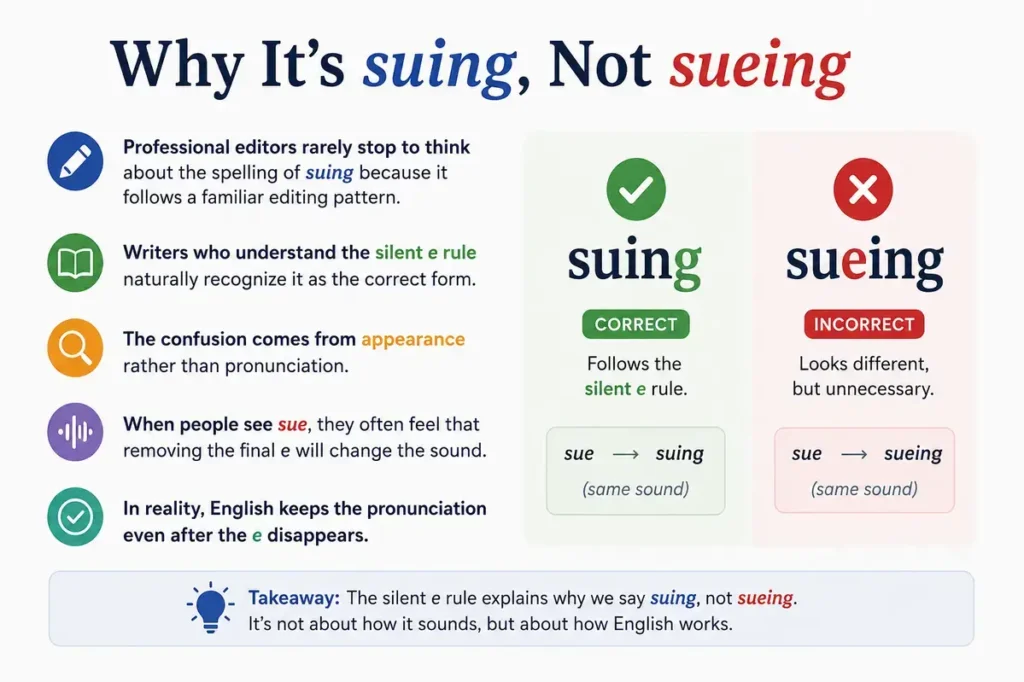
Professional editors rarely stop to think about the spelling of suing because it follows a familiar editing pattern. Writers who understand the silent e rule naturally recognize it as the correct form. The confusion comes from appearance rather than pronunciation. When people see sue, they often feel that removing the final e will change the sound. In reality, English keeps the pronunciation even after the e disappears.
Another reason this mistake appears online is that legal vocabulary is not part of everyone’s daily conversation. Someone might write the word only once every few years. That makes it easy to second guess the spelling. Native English speakers almost never notice the spelling because they have seen suing in newspapers, court cases, legal dramas, business articles, and official documents throughout their lives.
If you write professionally, remember one simple rule. Drop the silent e before adding ing unless the word follows a recognized exception. That single rule will help you spell hundreds of English words correctly.
Frequently Asked Questions
Is suing or sueing correct?
Suing is the correct spelling. Sueing is a misspelling and is not accepted in standard English. The verb sue drops its final silent e before adding ing, following a common English spelling rule.
Why is suing spelled without the letter e?
English spelling usually removes a silent e before adding ing. The word sue follows this rule, so it becomes suing. Although sueing may seem logical, it is not recognized by dictionaries or style guides.
Is sueing ever correct?
No. Modern English accepts only suing. You may occasionally see sueing in online comments or unedited writing, but it is treated as a spelling mistake in academic, professional, and legal contexts.
How do you use suing in a sentence?
You can use suing as a present participle or a gerund.
Examples.
- She’s suing the contractor for breach of contract.
- Suing isn’t always the best solution.
- They’re suing the company after the accident.
What part of speech is suing?
Suing comes from the verb sue. It functions as a present participle in continuous verb tenses and as a gerund when it acts like a noun.
Examples.
- He’s suing the manufacturer.
- Suing can become expensive.
Do British and American English spell it differently?
No. American English, British English, Canadian English, and Australian English all use the spelling suing. There are no regional spelling differences for this word.
Why do so many people write sueing?
The mistake happens because people assume the final e should remain before adding ing. Since sue ends with e, the incorrect spelling looks reasonable at first glance. Learning the silent e rule helps eliminate this mistake.
How can I remember the correct spelling?
Think of other common verbs.
- Make becomes making.
- Bake becomes baking.
- Hope becomes hoping.
- Save becomes saving.
- Sue becomes suing.
Remembering this pattern makes the correct spelling much easier to recall.
Many readers also check Grately vs Greatly Which Is Correct and Why It Matters in 2026.
Conclusion
The answer is simple.
Suing is the correct spelling.
Sueing is always considered a misspelling in standard English.
The confusion comes from the silent e at the end of sue, but the grammar rule is consistent. Like many English verbs ending in a silent e, the final letter is dropped before adding ing. If you’re writing an email, preparing legal documents, completing schoolwork, or creating professional content, always choose suing. It is the form recognized by dictionaries, style guides, courts, publishers, and native English speakers. Once you remember the silent e rule, you’ll avoid this mistake not only with suing but with many other English verbs as well.