
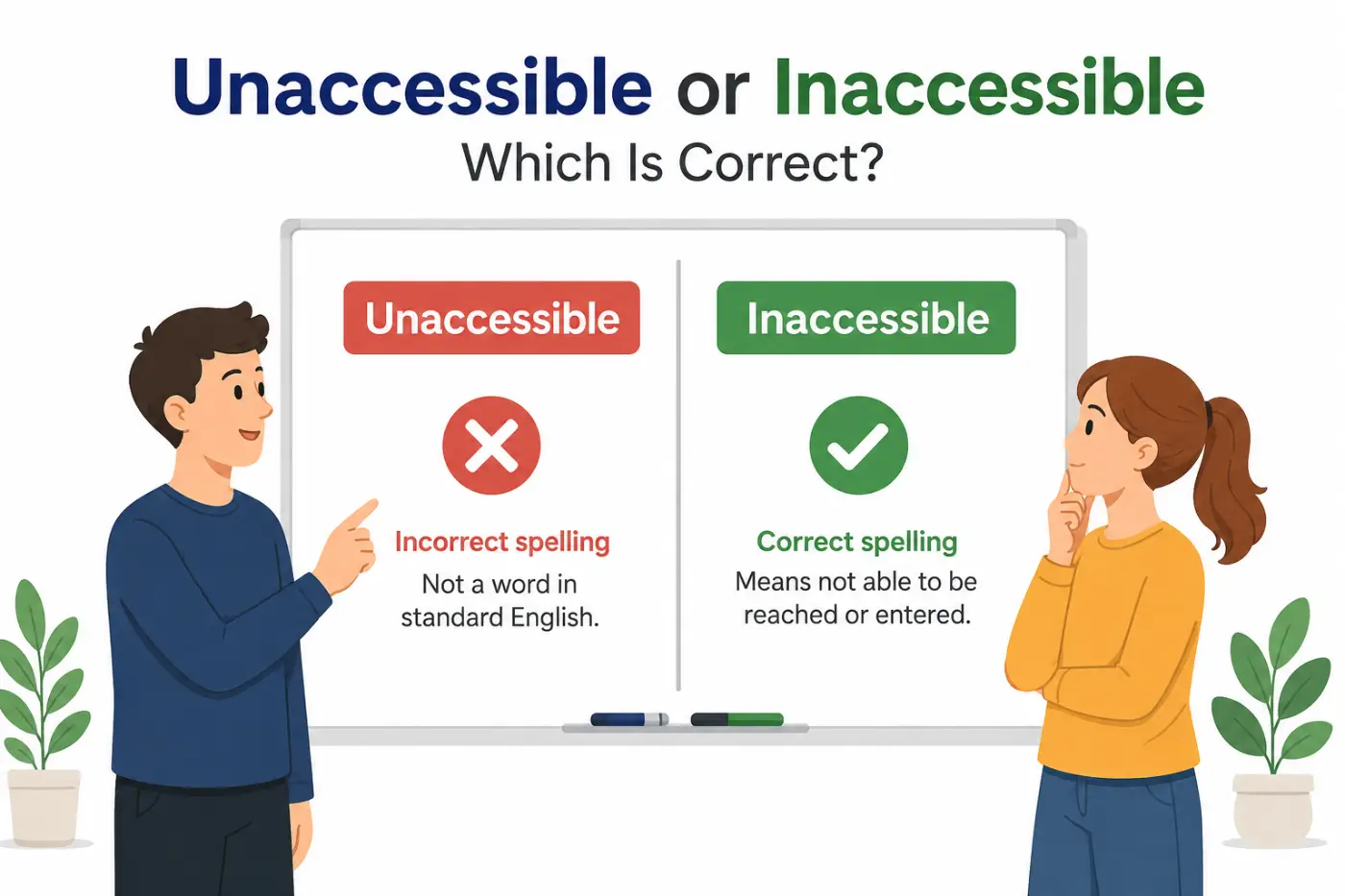
The correct spelling in standard English is Unaccessible or Inaccessible, and the preferred choice is inaccessible. If you mean something that cannot be reached, entered, obtained, or used, you should use inaccessible. Although unaccessible appears occasionally, it is uncommon and generally not recommended in modern writing. Both spellings may look correct because English uses different negative prefixes to create words with opposite meanings.
The confusion becomes easier to understand when you look at the word accessible. It means easy to reach, enter, obtain, or understand. Adding a negative prefix reverses that meaning. In this case, inaccessible is the established form used in everyday communication, professional writing, and academic work.
Using the standard spelling makes your writing clearer and more polished. It also prevents readers from pausing over an unusual word choice. This guide explains the difference between unaccessible and inaccessible, shows how to use the correct form in sentences, and covers its pronunciation, grammar, word origin, related terms, and common mistakes.
You may also want to read Imply vs Infer The Difference Explained.
Quick Answer
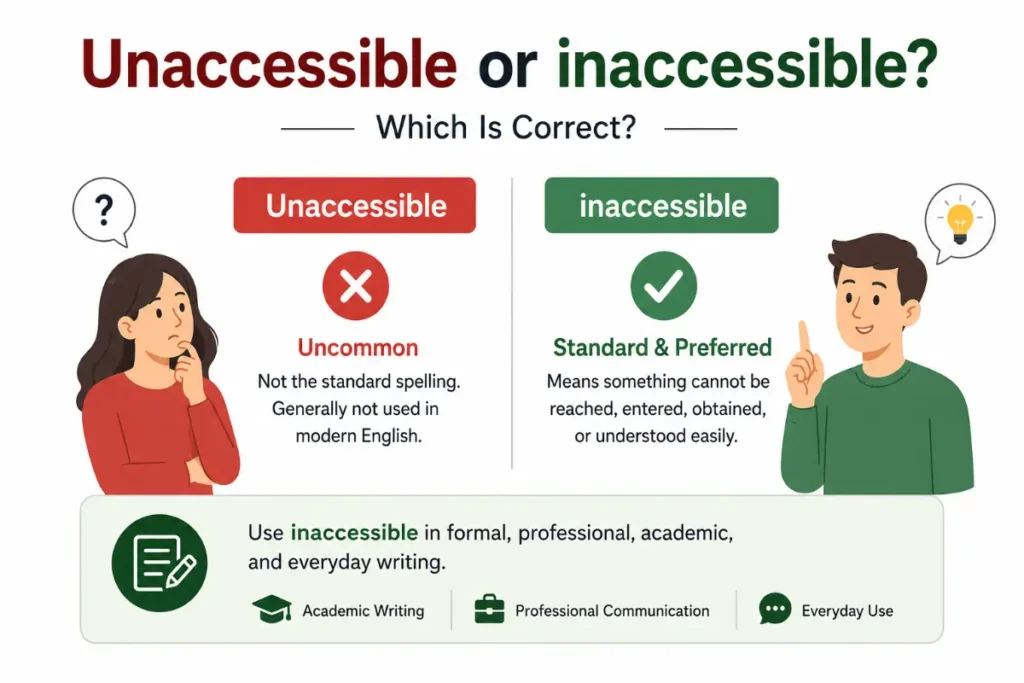
Inaccessible is the standard and preferred spelling when describing something that cannot be reached, entered, obtained, or understood. Unaccessible is a rare alternative, but it is generally avoided in modern standard English. For everyday communication, schoolwork, business writing, and formal documents, choose inaccessible.
Comparison Table
| Feature | Inaccessible | Unaccessible |
|---|---|---|
| Standard usage | Preferred standard form | Rare and generally nonstandard |
| Meaning | Not accessible or difficult to reach or use | Intended to mean not accessible |
| Part of speech | Adjective | Adjective |
| Word structure | In + accessible | Un + accessible |
| Prefix | In | Un |
| Formality | Appropriate in formal and informal writing | Usually avoided in edited writing |
| Common contexts | Buildings, websites, information, places, services | Rare or unusual usage |
| Example | The road became inaccessible after the storm. | Avoid this spelling in standard writing. |
Meaning and Definition
What Does Inaccessible Mean?
Inaccessible is an adjective that describes something that cannot be reached, entered, obtained, used, or easily understood. It is the opposite of accessible.
The word can describe a physical place, such as a mountain road blocked by snow. It can also describe digital services, private information, public facilities, or difficult language. The exact meaning depends on the noun it describes.
For example:
- A locked building may be inaccessible to visitors.
- A damaged website may be inaccessible to users.
- A remote village may be inaccessible during heavy rain.
- A complicated report may be inaccessible to readers without technical knowledge.
- Private records may be inaccessible to people without permission.
Notice that the word does not always mean completely impossible to reach. Sometimes it means difficult to reach, unavailable to certain people, or not easy to understand. A mountain village may be inaccessible during winter but reachable during summer. A website may be inaccessible to people using certain devices or assistive technologies.
The adjective often describes a condition caused by a barrier. That barrier might be physical, technical, financial, legal, or related to communication.
What Does Unaccessible Mean?
Unaccessible is a rare form intended to express the opposite of accessible. However, it is not the usual spelling in modern standard English. Most dictionaries and edited writing favor inaccessible for this meaning.
The form may appear in older texts, unusual wording, or writing produced by someone who applies the prefix un to accessible. English speakers know that un often creates opposites, as in unhappy, unfair, and unclear. This pattern can make unaccessible seem logical, but familiar word formation does not always determine the established spelling of a particular word.
For example, a writer might produce a sentence such as:
Unaccessible: The entrance was unaccessible to visitors.
Preferred: The entrance was inaccessible to visitors.
The intended meaning is clear in the first sentence, but the second uses the standard form. In professional, academic, and everyday writing, choose inaccessible to avoid distracting readers or appearing to use a spelling error.
What Does Accessible Mean?
Accessible is the base adjective from which the negative form is created. It means easy to reach, enter, use, obtain, or understand.
The word has several important uses:
- Physical access: The library is accessible from the main street.
- Digital access: The website is accessible on mobile devices.
- Information access: The records are accessible to authorized staff.
- Financial access: The service is accessible to families with limited budgets.
- Clear communication: The teacher makes difficult ideas accessible to beginners.
Understanding the base word makes the negative form easier to remember. If something is accessible, people can reach or use it. If it is inaccessible, a barrier prevents or limits that access.
Key Differences Explained
1. Spelling
The most important difference is the prefix.
Inaccessible uses the prefix in before accessible. Unaccessible uses un instead. Both in and un can express a negative meaning in English, but they are not freely interchangeable in every word.
For this adjective, inaccessible is the established spelling. The extra u in the alternative form is the reason many writers hesitate. They recognize the common prefix un and assume it must be correct here.
Remember the standard spelling as:
In + accessible = inaccessible.
The word begins with in, not un.
2. Meaning
Both forms are intended to communicate the idea of something that is not accessible. However, the preferred form is the one readers expect to see in standard writing.
Inaccessible can describe something that cannot be reached, entered, used, obtained, or understood. The meaning changes slightly according to context.
For example, an inaccessible road is difficult or impossible to travel along. Inaccessible information may be unavailable to certain people. An inaccessible explanation may be too difficult for its intended audience to understand.
3. Grammar
Both forms are adjectives, so they can describe nouns or follow linking verbs. However, the standard form should be used in normal writing.
Examples:
- The building is inaccessible.
- The website became inaccessible after the update.
- The information remains inaccessible to the public.
- The remote area was inaccessible during the storm.
The adjective can appear before a noun or after a linking verb such as is, became, remained, or seemed.
4. Part of Speech
Inaccessible is an adjective. It does not normally function as a noun or verb.
You can use it to describe:
- A place.
- A building.
- A website.
- A document.
- A service.
- A system.
- An explanation.
- A person who is difficult to approach.
For example, in the sentence The remote cabin was inaccessible, the adjective describes the cabin’s condition.
5. Pronunciation
The standard form has five syllables in its common pronunciation: in-ac-ces-si-ble. The first syllable begins with the short i sound. The word has stress on the third syllable, the same main stress found in accessible.
The rare alternative is generally pronounced in a similar way, but its spelling is not the preferred choice. Pronunciation alone will not help you identify which prefix belongs in the standard written form.
6. Formality
Inaccessible is appropriate in every type of writing. You can use it in a text message, school assignment, business report, government document, or academic paper.
Unaccessible is unusual enough to distract readers in edited writing. Even if the intended meaning is clear, a reader may assume it is a spelling mistake. Choosing the standard form keeps your message professional and easy to read.
7. Context
The preferred adjective works across many subjects. It can describe a physical barrier, a technical problem, a lack of permission, or difficult information.
For example:
- Physical: The bridge became inaccessible after the flood.
- Digital: The online portal was inaccessible during maintenance.
- Legal: The sealed records were inaccessible to the public.
- Educational: The textbook was inaccessible to younger students because of its complex language.
- Social: His distant manner made him seem inaccessible.
These examples show why the word is useful beyond describing places that people cannot enter.
8. Regional Usage
There is no major spelling difference between American, British, Canadian, and Australian English for this word. Inaccessible is the standard choice across these varieties.
The uncommon alternative does not become the preferred form in another major English variety. If you are writing for an international audience, inaccessible is the safest choice.
Which Form Is Correct?
Inaccessible is the correct and preferred spelling in standard modern English. The form unaccessible is rare and generally not recommended in edited writing.
The reason is established usage. English has several negative prefixes, including in, un, im, ir, and il. These prefixes do not work as interchangeable choices for every adjective. For example, we write incorrect, unhappy, impossible, irregular, and illegal. The correct form depends on the word’s history and accepted spelling.
The same principle applies here. Although unaccessible may seem logical because un often creates opposites, inaccessible is the established form.
Use these examples as a guide:
- Correct: The mountain path became inaccessible after the snowfall.
- Correct: The website is inaccessible without a valid password.
- Correct: The report contains information that is inaccessible to most readers.
- Correct: The building was inaccessible to people using wheelchairs.
- Correct: The remote island remains inaccessible during the winter months.
A useful editing habit is to check the whole word rather than choosing a prefix based only on a familiar spelling pattern. English word formation includes many exceptions and established forms that cannot be predicted by one simple rule.
Sentence Examples
Here are ten natural examples showing how to use the preferred spelling in different situations.
- Everyday conversation: The beach is inaccessible today because the road is flooded.
- Text message: The website is still inaccessible, so I cannot submit the form.
- Workplace communication: The shared folder became inaccessible after the system update.
- School: Some sections of the textbook are inaccessible to younger students.
- Academic writing: The study examines why certain public services remain inaccessible to rural communities.
- Formal writing: The restricted documents are inaccessible without written authorization.
- Social situations: His serious expression made him seem distant and inaccessible.
- Online communication: The video is inaccessible in some countries because of regional restrictions.
- Public transportation: The station became inaccessible after the elevator stopped working.
- Travel: Heavy snowfall made the mountain village inaccessible for several days.
Each sentence uses the adjective to describe a barrier. The barrier may prevent physical movement, limit access to information, or make a person or idea difficult to approach.
Five Examples of the Uncommon Form
The following sentences show how the rare spelling may appear. They are included to demonstrate the form, not to recommend it.
- Unaccessible: The road was unaccessible after the storm.
- Unaccessible: The website became unaccessible during maintenance.
- Unaccessible: The private records were unaccessible to visitors.
- Unaccessible: The building was unaccessible to wheelchair users.
- Unaccessible: The information remained unaccessible to the public.
In standard edited writing, replace each occurrence with inaccessible. The change improves spelling without changing the intended meaning.
Common Mistakes and Misspellings
The most common problem is choosing the wrong negative prefix. Other errors happen when writers confuse the adjective with related words or use it in the wrong grammatical form.
1. Writing Unaccessible Instead of Inaccessible
Incorrect: The entrance was unaccessible to visitors.
Correct: The entrance was inaccessible to visitors.
The mistake happens because un is a familiar negative prefix. Writers may apply it automatically to accessible, but the established spelling uses in. Remember the complete word rather than trying to build it from a general prefix rule.
2. Confusing Inaccessible With Accessible
Incorrect: The building is accessible to visitors, so nobody can enter.
Correct: The building is inaccessible to visitors, so nobody can enter.
The two words have opposite meanings. Accessible means people can reach or use something. Inaccessible means a barrier prevents or limits that access. Leaving out the negative prefix can reverse the entire message.
3. Using Inaccessibility as an Adjective
Incorrect: The inaccessibility road caused delays.
Correct: The inaccessible road caused delays.
Inaccessibility is a noun, while inaccessible is an adjective. Use the adjective to describe a road, building, or service. Use the noun to name the condition of being difficult or impossible to access.
4. Confusing Inaccessible With Unavailable
Incorrect: The office was inaccessible because it had no appointments available.
Better: The office had no appointments available.
These words can overlap in some situations, but they do not mean exactly the same thing. Inaccessible usually describes a barrier to reaching, entering, using, or understanding something. Unavailable means something cannot be obtained or used at that time.
5. Using Inaccessible When You Mean Unclear
Incorrect: The instructions are inaccessible because the sentence is confusing.
Possible correction: The instructions are unclear because the sentence is confusing.
Inaccessible can describe information that is too difficult for a particular audience to understand, but unclear is often more direct when the problem is confusing wording. Choose the word that identifies the real issue.
A Quick Way to Avoid These Errors
Before using the adjective, check what you want to describe. If something cannot be reached, entered, used, obtained, or understood, inaccessible is usually suitable. If something is simply confusing, unavailable, or unsuitable, a more specific word may communicate your meaning better.
Pronunciation Guide
How Do You Pronounce Inaccessible?
The common American English pronunciation is:
IPA: /ˌɪn.ækˈsɛs.ə.bəl/
The word has five syllables:
In + ac + cess + i + ble.
The main stress falls on the third syllable, cess. The beginning sounds like in, followed by the sound in access, and then the ending sounds like uh-bul.
A simple pronunciation guide is:
in-ak-SES-uh-bul.
Say the word slowly at first, then join the syllables together. The main stress should remain on SES rather than the first syllable.
Common Pronunciation Mistakes
- Putting the main stress on the first syllable. The main stress belongs on the third syllable.
- Leaving out a syllable. The word has five syllables in its common pronunciation.
- Pronouncing the middle too quickly. The access portion should remain clear.
- Adding an extra sound before the final syllable. Keep the ending smooth and natural.
Is the Pronunciation Different in British English?
The basic pronunciation is similar in British English, although vowel sounds and the final syllable may vary by accent. The spelling remains inaccessible in both American and British English.
For another common grammar confusion, see Soo vs So Which Spelling Is Correct.
Etymology and Word Origin
The word inaccessible is formed from the negative prefix in and the adjective accessible. Understanding these parts helps explain its meaning.
The Origin of Accessible
Accessible entered English through French, with roots in Latin accessibilis. This Latin form is related to accedere, meaning to approach or come near. The idea of reaching or approaching something remains central to the modern meaning.
Today, accessible describes something that can be reached, entered, obtained, or understood. Its meaning has expanded beyond physical places to include information, technology, services, and communication.
The Origin of the Prefix In
The prefix in comes from Latin and can express a negative meaning in words such as incorrect and incomplete. Inaccessible follows this negative pattern, reversing the positive meaning of accessible.
The prefix may appear in different forms in English. For example, it changes to im in impossible, ir in irregular, and il in illegal. These changes reflect established word forms and sound patterns.
Why the Word Uses In
English does not allow writers to choose any negative prefix they like. Some combinations became established through the history of the language, while others remained rare or unusual.
The accepted form is inaccessible. Its spelling is not based on a rule that every word beginning with a vowel must use in, nor does it mean un is always wrong. It is simply the established form for this particular adjective.
Regional Usage
American English
In American English, inaccessible is the standard spelling. It appears in everyday communication, public information, technology, education, and professional writing.
Examples include:
- The highway is inaccessible because of road construction.
- The online service became inaccessible after the security update.
American writers should use this form in school assignments, business documents, and formal publications. The rare alternative is generally treated as a spelling error or an unusual variant.
British English
British English also uses inaccessible as the standard form. The spelling does not change to unaccessible in British writing.
The word appears in discussions about public buildings, transport, digital services, information, and communication. The basic meaning and grammatical use are the same as in American English.
Australian English
Australian English follows the same spelling convention. Inaccessible is used to describe places, facilities, websites, services, and information that people cannot easily reach or use.
There is no important regional spelling distinction for this adjective.
Canadian English
Canadian English also uses inaccessible. Writers do not need a separate Canadian spelling, and the meaning remains the same.
For international writing, inaccessible is the reliable choice across these major varieties of English.
Formal and Informal Usage
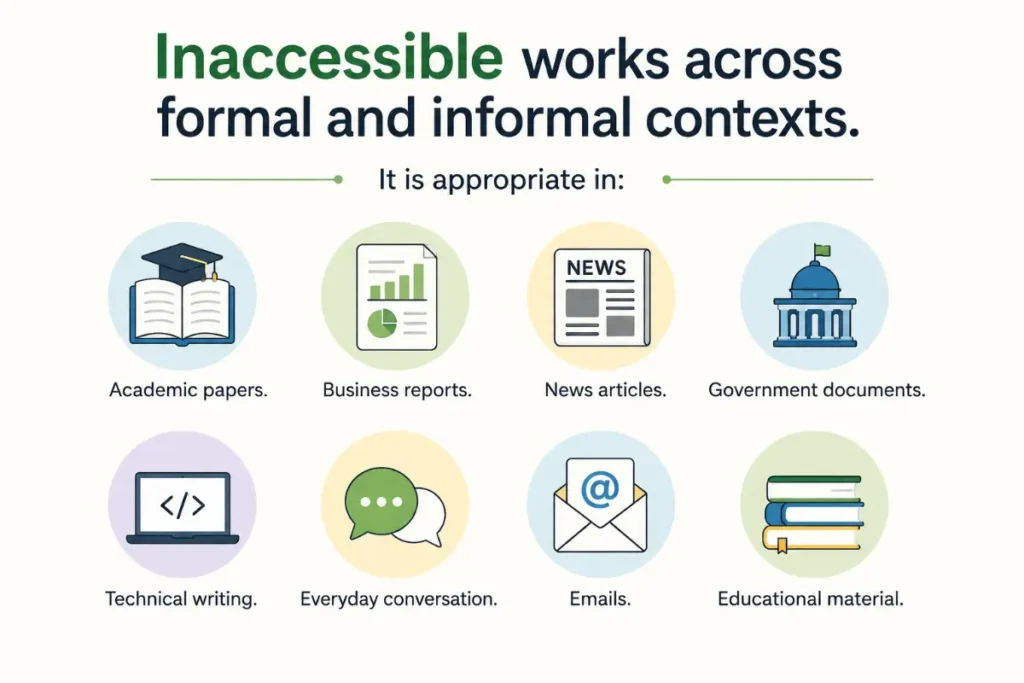
Inaccessible works across formal and informal contexts.
It is appropriate in:
- Academic papers.
- Business reports.
- News articles.
- Government documents.
- Technical writing.
- Everyday conversation.
- Emails.
- Educational material.
Grammar Rules and Part of Speech
Inaccessible as an Adjective
Inaccessible is an adjective. Its job is to describe a noun by explaining that something cannot be reached, entered, used, obtained, or understood.
It can appear before a noun:
- The inaccessible road was closed to traffic.
- The inaccessible website frustrated customers.
- The inaccessible document required special permission.
It can also appear after a linking verb:
- The road became inaccessible.
- The records remain inaccessible.
- The service seems inaccessible to older users.
In both positions, the word describes a condition or quality.
Using Inaccessible With Prepositions
The adjective often appears with the preposition to when you identify who cannot reach or use something.
Examples:
- The building is inaccessible to wheelchair users.
- The records are inaccessible to the public.
- The information is inaccessible to beginners.
- The service became inaccessible to customers.
You can also use phrases such as inaccessible by road or inaccessible during winter. These expressions explain the reason or condition that prevents access.
Comparative and Superlative Forms
The adjective can be used in comparative and superlative structures. Because it is a relatively long word, writers commonly use more and most.
Examples:
- The northern route is more inaccessible than the southern route.
- The remote village is one of the most inaccessible places in the region.
In everyday writing, you may find it more natural to rewrite a sentence rather than use a long comparison. For example, “The northern route is harder to reach” is shorter and easier to understand.
The Noun Form Inaccessibility
Inaccessibility is the noun form. It names the condition or quality of being inaccessible.
Examples:
- The inaccessibility of the building created problems for visitors.
- The report examines the inaccessibility of online public services.
- Poor road conditions contributed to the area’s inaccessibility.
Do not use the noun when you need an adjective. Write “an inaccessible building,” not “an inaccessibility building.”
The Adverb Form Inaccessibly
Inaccessibly is the adverb form, although it is much less common. It describes an action or condition performed in a way that is difficult to access or understand.
For example, “The information was presented inaccessibly” means the information was presented in a way that made it hard to understand or use. In many situations, a clearer expression such as presented in a way that was difficult to understand will sound more natural.
Formal and Informal Usage
The adjective is suitable for both formal and informal writing. You can use it in a casual message about a blocked road or in a technical report about a digital service.
In formal writing, be specific about the type of access involved. Instead of saying a service is inaccessible, explain if users cannot enter the building, open the website, obtain the information, or understand the instructions. This gives readers a clearer picture of the problem.
Real Life Usage Examples
Daily Conversation
In conversation, the word often describes places or services that people cannot reach or use.
- The park is inaccessible because the main entrance is closed.
- The cabin becomes inaccessible when the snow gets too deep.
These sentences use the adjective naturally without adding technical language. The first describes a temporary barrier, while the second describes a seasonal problem.
Email and Workplace Communication
In professional messages, the word can explain why a person cannot open a file, enter a system, or use a service.
- The shared folder is currently inaccessible to our department.
- Please let us know when the building entrance will no longer be inaccessible to visitors.
The second sentence is grammatically correct but can be simplified for clarity: Please let us know when visitors will be able to use the building entrance again.
Academic Writing
Academic writers use the term to discuss access to information, education, services, and research materials.
- The study examines factors that make health services inaccessible to rural communities.
- Complex technical language can make research findings inaccessible to the general public.
These examples show how the word can describe both practical barriers and communication problems.
News and Journalism
News reports may use the adjective when describing transport problems, damaged infrastructure, or restrictions on public access.
- Flooding left several roads inaccessible to emergency crews.
- Officials said the damaged bridge would remain inaccessible until repairs were complete.
The word helps summarize a situation in which people cannot safely reach or use a place.
Literature and Storytelling
In storytelling, the adjective can describe a remote location or a person who is difficult to approach.
- The old castle stood on an inaccessible cliff above the sea.
- Years of silence had made him seem emotionally inaccessible to his family.
The second example uses the word in a figurative sense. It describes a person who is difficult to understand or connect with rather than someone who cannot be physically reached.
Related and Confused Terms
These eight related words can help you describe different types of barriers more accurately.
1. Accessible
Accessible is the opposite of inaccessible. It describes something that can be reached, entered, used, obtained, or understood.
Example: The library is accessible by public transportation.
2. Inaccessibility
Inaccessibility is the noun form. It describes the condition of being difficult or impossible to access.
Example: The report discusses the inaccessibility of public buildings.
3. Unavailable
Unavailable means something cannot be obtained or used at a particular time. It does not always mean that something is physically or technically inaccessible.
Example: The service is unavailable until Monday.
4. Unreachable
Unreachable describes something or someone that cannot be reached. It often refers to physical distance, communication, or contact.
Example: The island was unreachable during the storm.
5. Unattainable
Unattainable means something cannot be achieved or obtained, often because it is beyond someone’s current ability or resources.
Example: The target seemed unattainable without additional funding.
6. Incomprehensible
Incomprehensible describes something that is impossible or very difficult to understand. It is useful when discussing confusing language or complex ideas.
Example: The technical explanation was incomprehensible to new students.
7. Restricted
Restricted means access, use, or movement is limited by rules, conditions, or permission.
Example: The records are restricted to authorized employees.
8. Impassable
Impassable describes a road, path, or route that cannot be traveled along.
Example: Heavy rain made the road impassable.
Choosing the Most Accurate Word
These terms are related, but they are not exact substitutes. A website may be inaccessible because it does not load. A service may be unavailable because it is temporarily closed. A road may be impassable because debris blocks it.
Choosing the specific word helps readers understand the actual barrier. If you mean that something cannot be reached or used, inaccessible is a strong general choice. If you know the exact problem, a more specific term may communicate it better.
Expert Editor Insight
An experienced editor will usually replace unaccessible with inaccessible in standard writing because the latter is the established form readers expect. The confusion is understandable: un is a common negative prefix, and it appears in many familiar adjectives. However, prefixes do not combine freely with every word. Spelling tools may flag the rare form, but automated suggestions cannot always explain the reason. A useful editing tip is to learn the full spelling as one unit: inaccessible. Then check whether you need the adjective, the noun inaccessibility, or the opposite adjective accessible. This simple habit prevents both spelling and word form errors.
Key Takeaways
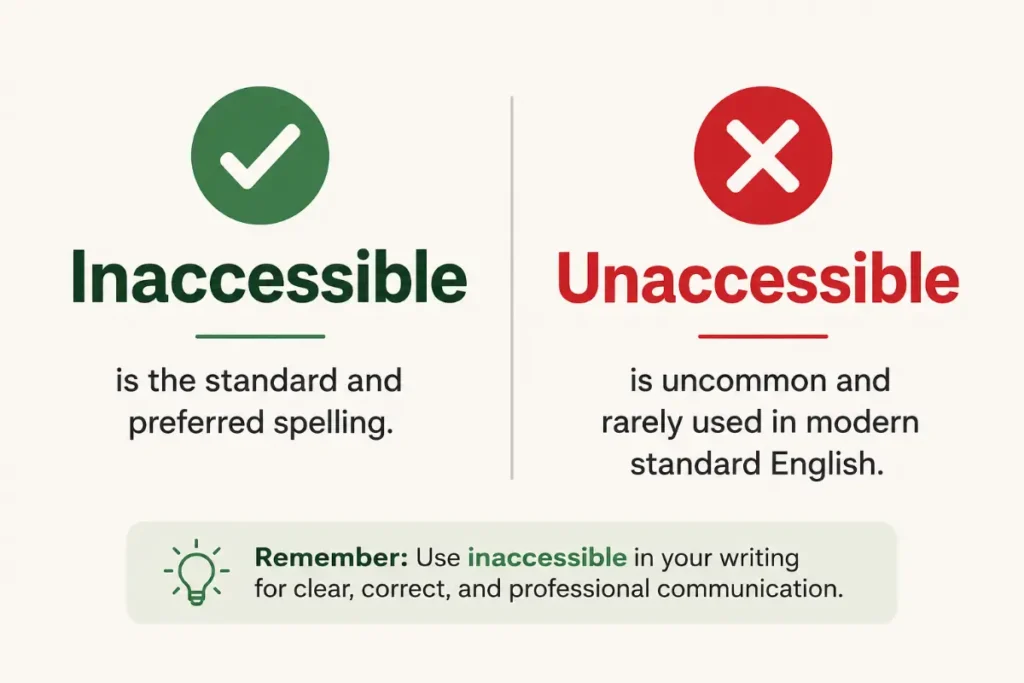
- Inaccessible is the standard and preferred spelling.
- Unaccessible is uncommon and rarely used in modern standard English.
- Inaccessible can describe something that’s difficult or impossible to reach, enter, obtain, or understand.
- Use inaccessible in formal, academic, professional, and everyday writing.
- When you’re unsure which form to use, choose inaccessible.
A related grammar guide is Its vs It’s: Meaning and Correct Usage Explained.
Conclusion
The correct choice in standard English is inaccessible, not unaccessible. Although the uncommon form may look logical because un often creates negative words, inaccessible is the established spelling used in modern writing. It describes something that cannot be reached, entered, obtained, used, or easily understood. The adjective works in everyday conversation, academic papers, workplace messages, and formal documents.
To remember the spelling, learn inaccessible as one complete word rather than building it from a familiar prefix. Also remember the related noun inaccessibility and the opposite adjective accessible. These forms will help you write clearly and choose the right word for the situation.
FAQs
Is Unaccessible a Real Word?
Unaccessible does appear in some English texts, but it is rare and generally not preferred in modern standard writing. Most writers should use inaccessible to mean something cannot be reached, entered, used, or understood. If you are writing an essay, business document, article, or formal message, choose the established spelling.
Which Is Correct Inaccessible or Unaccessible?
Inaccessible is the standard and preferred spelling. Unaccessible is an uncommon alternative that most editors would replace with inaccessible. The correct form uses the negative prefix in before accessible. For clear and professional writing, remember the spelling as one complete word rather than choosing a prefix based on a general pattern.
What Does Inaccessible Mean?
Inaccessible describes something that cannot be reached, entered, obtained, used, or easily understood. It can refer to a physical place, a website, a service, private information, or difficult language. For example, a road blocked by flooding may be inaccessible, while a complex report may be inaccessible to readers without specialist knowledge.
Why Is It Inaccessible Instead of Unaccessible?
English uses several negative prefixes, and they do not work as interchangeable choices for every word. Although un commonly creates opposites, the established form of this adjective uses in. This is a matter of accepted word formation and usage. That is why inaccessible is preferred in standard modern English.
How Do You Pronounce Inaccessible?
Inaccessible is commonly pronounced /ˌɪn.ækˈsɛs.ə.bəl/ in American English. It has five syllables, with the main stress on the third syllable. A simple guide is in-ak-SES-uh-bul. Say each part slowly at first, then join the syllables into one smooth word.
What Is the Noun Form of Inaccessible?
The noun form is inaccessibility. It describes the condition of being difficult or impossible to reach, enter, use, obtain, or understand. For example, the sentence The inaccessibility of the building created problems for visitors uses the noun correctly. Use inaccessible when describing a noun, as in an inaccessible building.
Is Inaccessible the Same as Unavailable?
No. Inaccessible means something cannot be reached, entered, used, or understood. Unavailable means something cannot be obtained or used at a particular time. A website may be inaccessible because of a technical barrier, while a product may be unavailable because it is out of stock. The best word depends on the actual problem.
Is Inaccessible Appropriate in Formal Writing?
Yes. Inaccessible is a standard adjective that works in academic writing, business communication, reports, government documents, and everyday messages. It is useful when discussing physical access, digital services, information, and communication. For the clearest writing, explain what prevents access instead of relying on the adjective alone when more detail is needed.