
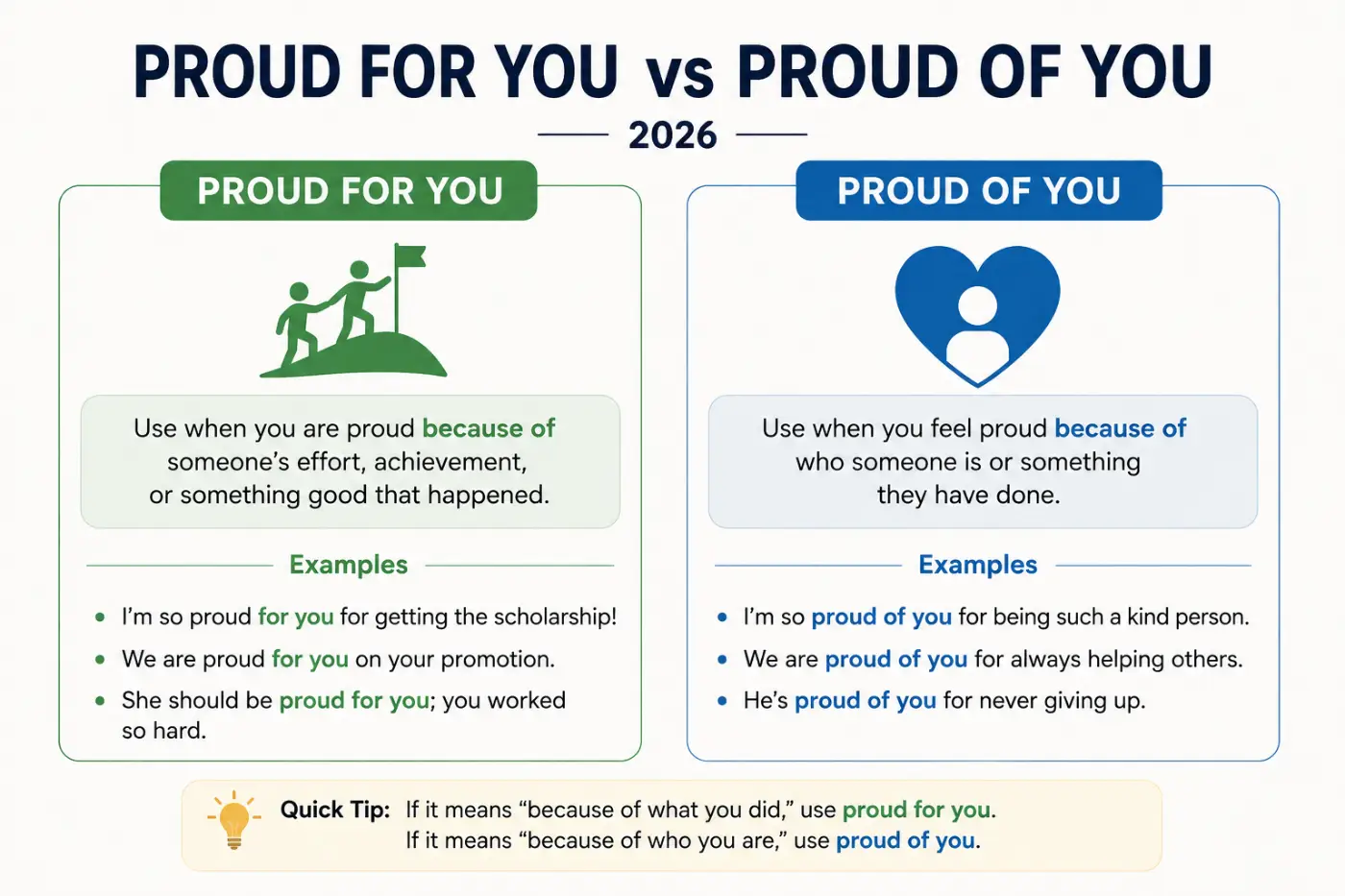
Choosing between Proud for You vs Proud of You can feel confusing because both expressions seem to communicate happiness about someone’s success. However, proud of you is the standard and natural expression when you want to tell someone that you admire their achievement, effort, or personal growth. Proud for you is sometimes used in casual speech, but it does not normally replace the established phrase.
The difference comes from how the prepositions of and for work with the adjective proud. When you say you are proud of someone, you express admiration or respect for that person and what they have done. When you say you are proud for someone, you may be trying to express happiness on their behalf, but the wording can sound unusual to many English speakers.
This distinction matters in everyday conversations, congratulation messages, social media posts, and professional writing. Understanding the grammar will help you choose the natural expression and communicate your feelings clearly without sounding awkward.
Learn the difference in Set or Sit Which Word Is Correct.
Quick Answer
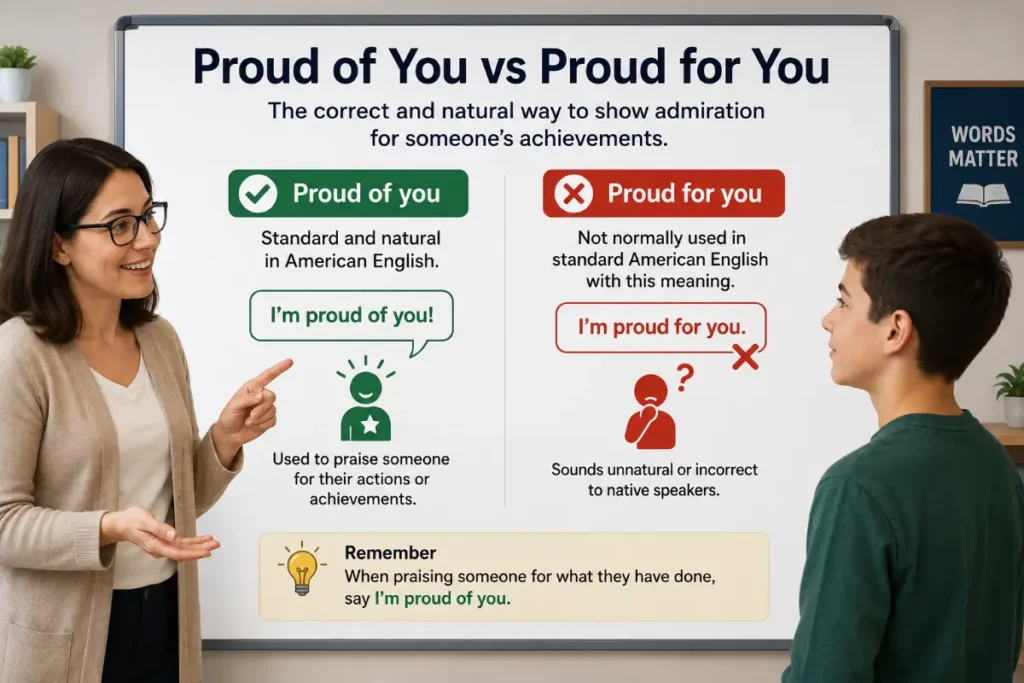
Proud of you is the standard expression when you admire someone or feel pleased about their achievement, effort, or progress. Proud for you is less common and may sound unnatural in this meaning. If you want to express happiness on someone’s behalf, happy for you is usually the better choice.
Comparison Table
| Feature | Proud of You | Proud for You |
|---|---|---|
| Meaning | Feeling admiration or satisfaction because of someone’s actions or qualities | Intended to express pride or happiness on someone’s behalf |
| Standard usage | Common and established | Less common and context dependent |
| Grammar | Proud + of + person | Proud + for + person |
| Naturalness | Natural in everyday and formal English | Can sound unusual to many speakers |
| Emotional focus | Admiration, respect, achievement, personal growth | Intended happiness for another person’s success |
| Common contexts | Family, friendships, school, work, personal milestones | Informal or individual speech patterns |
| Example | I am proud of you for finishing your degree. | I feel proud for you, though happy for you sounds more natural. |
| Better alternative | Proud of what you have achieved | Happy for you |
Meaning and Definition
What Does Proud of You Mean?
Proud of you means feeling admiration, respect, or satisfaction because of someone’s actions, qualities, achievements, or personal growth. It is a common way to recognize another person’s effort and let them know that their progress matters to you.
For example, a parent may tell a child they are proud of them after they finish school. A friend may say it after someone reaches a difficult goal. A manager may use the expression to recognize an employee’s hard work or improvement.
The phrase can express pride for major achievements, but it does not have to involve something extraordinary. You can be proud of someone for showing courage, keeping a promise, learning from a mistake, or continuing to work toward a goal.
Common examples include:
- I am proud of you for working so hard.
- We are proud of you for completing your training.
- Your family is proud of you.
- I am proud of how far you have come.
- She said she was proud of her daughter.
The expression can communicate deep affection, encouragement, respect, or appreciation. Its meaning depends on the relationship and the situation.
What Does Proud for You Mean?
Proud for you is a less common expression that some speakers use to express happiness or pride on another person’s behalf. It may be intended to show that someone feels pleased about another person’s good news or success.
For example, someone might say, I am so proud for you after hearing that a friend has received a promotion. The speaker probably wants to express warmth and happiness, but many English speakers would find I am so happy for you more natural in that situation.
The phrase is not a standard substitute for proud of you. It can appear in informal speech, personal messages, or individual language patterns, but it is usually better to choose a more established expression.
Consider these alternatives:
- Less natural: I am proud for you.
- More natural: I am proud of you.
- More natural when sharing someone’s happiness: I am happy for you.
- More specific: I am proud of what you have achieved.
- More encouraging: You should be proud of yourself.
The key is to decide what feeling you want to express. If you admire someone’s effort or achievement, use proud of you. If you simply share their happiness, use happy for you.
What Does It Mean to Be Proud of Someone?
Being proud of someone means recognizing something about that person that makes you feel admiration, respect, or satisfaction. It may be their success, but it can also be their character, effort, kindness, courage, or determination.
For example, you may feel proud of a friend who has overcome a difficult period. Their achievement may not involve a prize, promotion, or public recognition. Their willingness to keep going may be enough to make you admire them.
The expression can also refer to a person’s development. A teacher might be proud of a student who has become more confident. A parent might be proud of a child who has learned to take responsibility. In these cases, the feeling comes from observing positive change.
What Does It Mean to Be Happy for Someone?
Being happy for someone means sharing their joy or feeling pleased because something good has happened to them. It focuses on their happiness rather than your admiration of their actions.
For example, your friend gets a new job. You may say, I am happy for you because you know how much the opportunity means to them. You can also be proud of them if you admire the effort they made to earn the position.
The two feelings can exist at the same time. You can be happy for someone’s success and proud of the hard work that helped them achieve it.
Key Differences Explained
1. The Difference in Meaning
The main difference is the feeling you want to communicate.
Proud of you expresses admiration or respect. It tells someone that you value their actions, character, effort, or achievement.
Happy for you expresses shared happiness. It tells someone that their good news makes you feel pleased.
For example:
- I am proud of you for completing your degree.
- I am happy for you because you got into your dream college.
The first sentence highlights the person’s effort and accomplishment. The second shares their excitement about a positive event.
2. The Difference in Grammar
The adjective proud commonly takes the preposition of when it identifies the person or thing that causes the feeling of pride.
Examples include:
- Proud of my daughter.
- Proud of your progress.
- Proud of our team.
- Proud of what we achieved.
The preposition for has other functions. It can express support, benefit, purpose, or a reason, but it is not the usual preposition in the standard expression of admiration.
For example, I am proud of you for helping your neighbor is natural. Here, the first of connects pride to the person, while for introduces the action that explains the reason for that pride.
3. The Difference in Emotional Focus
The standard expression focuses on the person or something associated with them. It can recognize both the result and the effort behind it.
The phrase happy for you focuses more directly on sharing another person’s good feelings. It does not necessarily suggest that the speaker has evaluated the person’s actions or feels admiration.
Compare these examples:
- I am proud of you for standing up for yourself.
- I am happy for you because you finally found a job you love.
The first expresses respect for someone’s courage. The second expresses happiness about a positive change in their life.
4. The Difference in Formality
Proud of you works in casual, professional, and formal communication. It can appear in a family conversation, a graduation speech, a personal letter, or a workplace message.
Proud for you is less established and may sound awkward in standard written English. It is better to avoid it in formal writing, professional messages, and carefully edited content.
If you want a warm but professional message, you can write:
- I am proud of your progress.
- Your dedication is impressive.
- Congratulations on this achievement.
- You have every reason to feel proud.
These options sound natural and communicate appreciation without using an unusual phrase.
5. The Difference in Context
The right expression depends on the situation.
Use proud of you when someone has:
- Completed a difficult task.
- Reached a personal goal.
- Shown courage or kindness.
- Made positive changes.
- Worked hard to improve.
- Overcome a challenge.
Use happy for you when someone has:
- Received good news.
- Found a new job.
- Started a relationship.
- Bought a home.
- Won an award.
- Received an opportunity they wanted.
You can combine both feelings in one message. For example, I am so happy for you, and I am proud of everything you did to get here. This sounds natural because each expression has a clear purpose.
6. The Difference in Everyday Speech
In everyday American English, people commonly say I am proud of you to express admiration and encouragement. Parents, friends, teachers, partners, and coworkers use it in different situations.
People also commonly say I am happy for you when someone shares good news. The phrase is warm, direct, and easy to understand.
Although you may hear proud for you in casual conversation, it is not the usual choice for this meaning. Some speakers may use it as a personal expression, but it is safer to follow the more established patterns.
7. The Difference in Regional Usage
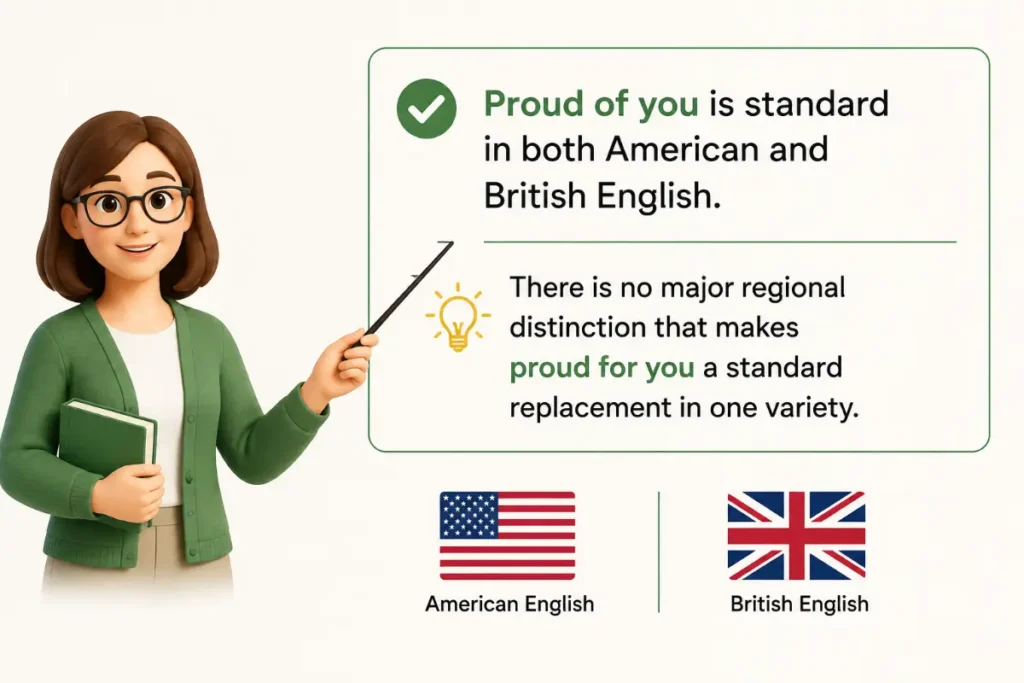
There is no major spelling difference between American and British English in these phrases. Both varieties commonly use proud of you and happy for you.
The less common wording may appear in individual speech patterns across different regions, but it is not a standard regional replacement for the usual expression. The same basic guidance applies in American, British, Canadian, and Australian English.
Which Expression Is Correct?
Proud of you is the standard and preferred expression when you want to tell someone that you admire them or feel pleased about their effort, behavior, or achievements.
The reason is grammatical. The adjective proud commonly takes of to identify the person, quality, action, or achievement that causes the feeling.
For example:
- I am proud of you.
- She is proud of her son.
- We are proud of our team.
- He is proud of his progress.
- They are proud of what they have accomplished.
The expression proud for you is less common and can sound unnatural in standard English. If your intention is to share someone’s happiness, choose happy for you instead.
You can remember the distinction with two simple patterns:
- Proud of someone means you admire them.
- Happy for someone means you share their happiness.
This is a useful guide for everyday conversations, personal messages, and formal writing.
Sentence Examples
The following examples show how to use the standard expression naturally in different situations.
Ten Examples Using Proud of You
- Everyday conversation: I am proud of you for never giving up on your dream.
- Text message: Just wanted to say I am proud of you and everything you have achieved.
- Family: Your father would be proud of you for the person you have become.
- School: Your hard work this semester has made your teachers proud of you.
- Workplace: I am proud of you for handling that difficult project so well.
- Graduation: We are incredibly proud of you for completing your degree.
- Friendship: I am proud of you for having the courage to start again.
- Social media: So proud of you for reaching this milestone.
- Personal growth: I am proud of you for learning to believe in yourself.
- Formal message: Please know that the entire team is proud of you and your contribution.
These examples show that the phrase can express more than admiration for a major success. It can also recognize effort, courage, responsibility, and personal growth.
Five Examples Using Happy for You
Use these examples when you want to express shared happiness rather than admiration.
- I am so happy for you and your new job.
- We are happy for you because you finally found a home you love.
- I am genuinely happy for you and your recent success.
- Everyone is happy for you after hearing your wonderful news.
- I am happy for you because this opportunity means so much to you.
These sentences are useful alternatives when the main feeling is happiness about someone else’s good news.
Examples Showing the Less Natural Form
The following examples show how the less common wording can sound awkward in standard English.
- Less natural: I am proud for you because you passed the exam.
- Better: I am proud of you because you passed the exam.
- Less natural: My parents are proud for me.
- Better: My parents are proud of me.
- Less natural: We are proud for our daughter.
- Better: We are proud of our daughter.
If the intended meaning is shared happiness, use happy for:
- I am happy for you because you passed the exam.
- My parents are happy for me.
- We are happy for our daughter.
The choice depends on the feeling you want to express, not simply on which phrase sounds more emotional.
Common Mistakes and Usage Problems
1. Using For Instead of Of
Incorrect or less natural: I am proud for you.
Correct: I am proud of you.
This is the main confusion. Speakers may choose for because it often appears in expressions about another person’s benefit or happiness. However, the usual grammatical pattern for expressing admiration is proud of someone.
2. Confusing Proud Of You With Happy For You
Incorrect for the intended meaning: I am proud for you because you got your dream job.
More natural: I am happy for you because you got your dream job.
Also correct: I am proud of you for working so hard to get that job.
The first improved sentence shares happiness. The second recognizes the effort behind the achievement.
3. Leaving Out the Preposition
Incorrect: I am proud you.
Correct: I am proud of you.
In this expression, of connects the adjective to the person or thing that inspires pride. Leaving it out makes the sentence incomplete in standard English.
4. Using Proud Of When You Mean Proud About an Event
Sometimes writers use proud of when they want to describe happiness about a situation rather than admiration for a person or achievement.
Awkward: I am proud of your good news.
More natural: I am happy about your good news.
You can be proud of the person who received the news, but happy about is often more suitable when the focus is the news itself.
5. Using Proud For in Formal Messages
Less natural: We are proud for you and your excellent work.
Better: We are proud of you and your excellent work.
In a professional message, the established expression sounds more polished. If you want to congratulate someone without expressing personal pride, write Congratulations on your excellent work or Your work deserves recognition.
A Simple Way to Avoid These Mistakes
Before choosing a preposition, identify the feeling behind your sentence.
- Are you expressing admiration for a person? Use proud of.
- Are you sharing someone’s happiness? Use happy for.
- Are you pleased about an event? Use happy about.
- Are you recognizing someone’s achievement? Use proud of or proud of what they achieved.
This small check can help you choose a natural expression without overthinking the grammar.
Pronunciation Guide
How Do You Pronounce Proud?
The word proud is pronounced /praʊd/ in American English. It has one syllable and contains the same vowel sound heard in out, loud, and cloud.
You can break it down into three sounds:
- /p/ as in pen.
- /r/ as in red.
- /aʊd/ as in loud.
The stress falls on the only syllable. Avoid adding an extra vowel or stretching the word into two syllables.
How Do You Pronounce Of?
The preposition of is commonly pronounced /əv/ in connected American speech. Its vowel is often reduced because the word is usually unstressed.
In careful speech, the pronunciation may be clearer, but it still normally sounds like a short, unstressed word. The final consonant is a voiced /v/, not an /f/.
How Do You Pronounce You?
You is pronounced /juː/ in American English. It has one syllable and uses the long u sound.
In the full expression, the main stress usually falls on proud or on the word that carries the most emotional weight.
Pronouncing the Full Expression
The phrase proud of you can sound connected in natural speech. The words flow together rather than being pronounced as three separate, equally stressed parts.
A simple pronunciation guide is:
Proud of you: PROWD uhv yoo.
The phrase happy for you has a different rhythm, but it is also easy to pronounce:
Happy for you: HAP ee fer yoo.
Clear pronunciation helps your message sound natural, especially when you are speaking with warmth or encouragement.
Need another quick comparison? Read Imply vs Infer The Difference Explained.
Etymology and Word Origin
The Origin of Proud
The word proud entered English through Old French, with roots in earlier Germanic forms. Its meaning developed around ideas of being distinguished, having a high opinion of oneself, and feeling satisfaction or honor.
Modern English uses the word in both positive and negative ways. A person may be proud of an achievement in a positive sense, but excessive pride can also suggest arrogance or an inflated opinion of oneself.
In the expression proud of you, the meaning is usually positive. It describes admiration, satisfaction, or respect for someone’s actions or qualities.
The Origin of Of
Of comes from Old English of, a preposition with a long history in the language. It has developed many uses, including showing relationships, possession, origin, material, and connection.
In proud of you, it links the feeling of pride to the person who inspires it. Similar patterns appear in expressions such as afraid of spiders, fond of music, and aware of the problem.
The Origin of For
For also comes from Old English and has several meanings. It can show purpose, benefit, support, reason, or intended recipient.
For example, a gift for you identifies the person receiving a gift. Happy for you expresses happiness on someone’s behalf. However, the fact that for works in these expressions does not mean it is the usual preposition after every adjective.
The history of these words helps explain their different roles, but modern grammar and common usage provide the best guide for choosing between them.
Regional Usage
American English
In American English, proud of you is the normal expression for showing admiration or satisfaction about someone’s actions, achievements, or growth. It is common in family conversations, friendships, school settings, and professional messages.
Happy for you is the natural expression for sharing someone’s happiness. The less common phrase may appear in informal speech, but it is not the usual choice in standard American English.
British English
British English follows the same basic pattern. Speakers commonly say proud of you when expressing admiration and happy for you when sharing someone’s good news.
There is no major British grammar rule that makes proud for you the preferred expression. The distinction remains the same as in American English.
Australian English
Australian English also uses proud of you and happy for you in their standard meanings. These phrases are familiar in everyday conversations, personal messages, and formal communication.
Canadian English
Canadian English follows the same general pattern. Proud of you expresses admiration, while happy for you communicates shared happiness. There is no major regional difference that changes the standard usage.
Across these varieties, the choice depends on meaning rather than location.
Grammar Rules and Part of Speech
Proud Is an Adjective
The word proud is an adjective. It describes how someone feels about a person, action, achievement, quality, or group.
It commonly follows linking verbs such as be, feel, and seem.
Examples:
- I am proud of you.
- She feels proud of her daughter.
- They seem proud of their progress.
- We were proud of the final result.
In each sentence, the adjective describes a feeling or state.
Proud of + Person or Thing
The standard pattern is:
Proud + of + noun or pronoun.
Examples:
- Proud of my family.
- Proud of your work.
- Proud of our team.
- Proud of herself.
- Proud of what we achieved.
The noun or pronoun after of identifies the person or thing that causes the feeling of pride.
Proud of + Action
You can also use a gerund after of when referring to an action.
Examples:
- I am proud of helping my community.
- She is proud of completing her training.
- They are proud of supporting their local school.
A gerund is a verb form ending in ing that functions as a noun. In these examples, the actions are the reason for the feeling of pride.
You can also use a noun phrase to describe the achievement:
- I am proud of your progress.
- We are proud of her success.
- He is proud of the work he completed.
Proud of Someone for Doing Something
This is an especially useful structure because it explains both the person and the reason for the pride.
The pattern is:
Proud of + person + for + action.
Examples:
- I am proud of you for telling the truth.
- She is proud of her son for working hard.
- We are proud of the team for finishing the project.
- They are proud of their daughter for standing up for herself.
The two prepositions have different jobs. Of identifies the person, while for introduces the reason.
This pattern is a good example of why the two prepositions cannot simply be exchanged.
Proud That + Clause
You can also follow proud with a clause beginning with that.
Examples:
- I am proud that you kept trying.
- She is proud that her students improved.
- We are proud that the project helped local families.
This structure allows you to express pride in a complete action or result without using of directly before a person.
Punctuation and Sentence Position
The phrase can appear at the beginning, middle, or end of a sentence.
Examples:
- I am proud of you.
- We are, without a doubt, proud of your progress.
- Proud of you for everything you have achieved.
The third example is a sentence fragment, but it can work naturally in a text message, greeting card, caption, or informal note. In formal writing, use a complete sentence.
Real Life Usage Examples
Daily Conversation
People often use the expression to encourage someone or recognize a personal achievement.
- I am proud of you for getting through such a difficult week.
- You should be proud of yourself for trying again.
The first expresses admiration from one person to another. The second encourages someone to recognize their own effort.
Email and Workplace Communication
In professional settings, the phrase can recognize an employee’s effort or a team’s success. However, it should match the relationship and tone of the workplace.
- I am proud of you for taking responsibility and guiding the project to completion.
- The entire department is proud of your dedication and consistent work.
For a more neutral business tone, you might write Your contribution is greatly appreciated or Congratulations on this achievement. These options recognize success without making the message overly personal.
Academic Writing
In academic settings, teachers and mentors may use the phrase when recognizing a student’s development. It is more common in personal feedback than in formal research writing.
- I am proud of you for improving your writing skills this semester.
- Your progress shows how much effort you have put into your studies.
In an academic report, a more objective sentence may be appropriate, such as The student demonstrated significant progress during the term.
News and Journalism
Journalists usually report pride through direct quotations or descriptions of public reactions. The phrase may appear in interviews, profiles, or stories about achievements.
- The coach said she was proud of the players after their strong performance.
- The graduate’s parents said they were proud of her determination.
These examples report what people said rather than presenting the phrase as the journalist’s personal opinion.
Literature and Storytelling
In stories, the expression can show affection, approval, or a meaningful change in a relationship.
- His father smiled and said he was proud of the man his son had become.
- She wanted her grandmother to know that she was proud of herself.
The phrase can carry strong emotional meaning because it often connects personal effort with recognition from someone important.
Related and Confused Terms
1. Happy for You
This is the closest alternative when you want to share someone’s happiness. It focuses on their good news rather than your admiration for their character or effort.
Example: I am happy for you because you got the job you wanted.
2. Proud of Yourself
This expression describes the pride someone feels in their own actions, qualities, or progress.
Example: You should be proud of yourself for completing the course.
It encourages personal confidence and self recognition.
3. Proud of Someone
This is the general expression used to show admiration or satisfaction about another person.
Example: Her parents are proud of her.
It can refer to achievements, behavior, character, or personal development.
4. Glad for You
Glad for you is an informal way to express happiness about someone’s good news. It is close in meaning to happy for you.
Example: I am glad for you and your new opportunity.
5. Impressed by You
This expression emphasizes admiration for someone’s skill, ability, effort, or performance.
Example: I am impressed by how calmly you handled the situation.
It is useful when you want to recognize something specific.
6. Congratulations
Congratulations is used to recognize a success, achievement, or positive event. It does not necessarily express personal pride.
Example: Congratulations on completing your degree.
It is suitable for professional messages, cards, and public announcements.
7. Admire You
To admire someone means to respect or value their qualities, actions, or abilities.
Example: I admire you for staying honest during a difficult situation.
This expression focuses more directly on respect than on the feeling of pride.
8. Proud of Your Achievement
This expression identifies the specific reason for the pride. It is useful when you want to recognize a particular result.
Example: I am proud of your achievement and the hard work behind it.
It can sound more specific than simply saying I am proud of you.
Expert Editor Insight
An experienced editor looks at the meaning of the whole sentence rather than treating of and for as interchangeable. Native English speakers generally use proud of you to express admiration and happy for you to share another person’s happiness. The confusion occurs because for appears naturally in many expressions about support and benefit. Grammar tools may not flag the less common phrase because the words themselves are spelled correctly. A useful editing tip is to check the feeling first: admiration calls for proud of, while shared happiness usually calls for happy for.
Key Takeaways
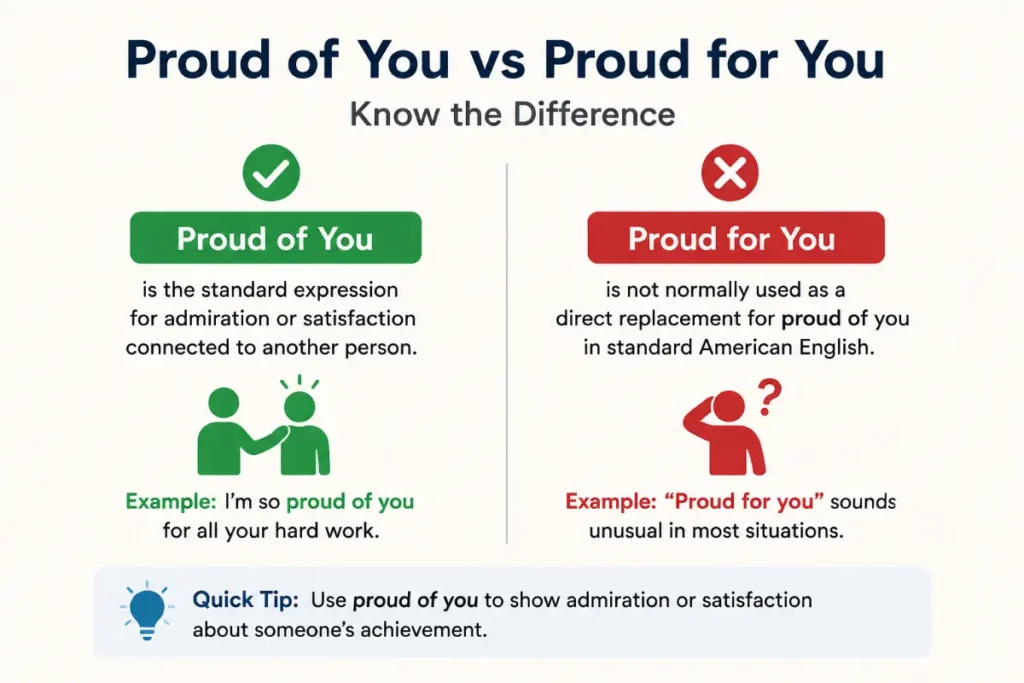
- Proud of you is the standard expression for admiration or satisfaction connected to another person.
- Proud for you is not normally used as a direct replacement for proud of you in standard American English.
- Happy for you is the natural expression when you want to celebrate someone else’s good fortune.
- Proud of you for doing something is a useful structure that explains the reason for the speaker’s pride.
- A proud moment for you is correct because for has a different grammatical function in that structure.
- The preposition of is part of the established collocation proud of.
- The same pattern works with people things achievements and reflexive pronouns.
- The phrase works in casual professional educational family and formal settings.
- American and British English both commonly use proud of you.
- If you want natural everyday English the safest choice is simple: I’m proud of you.
Many readers also check Coachs or Coaches Which Spelling Is Correct.
Conclusion
The difference between Proud for You vs Proud of You comes down to standard grammar and the feeling you want to express. Proud of you is the natural choice when you admire someone’s effort, character, success, or personal growth. Happy for you is better when you want to share their happiness about good news.
The less common wording may appear in casual speech, but it is not the preferred expression in standard English. Remember this simple editing tip: use of after proud and for after happy when speaking about another person’s success. This will help your messages sound warm and natural.
FAQs
Is Proud for You Grammatically Correct?
The phrase can appear in informal speech, but it is not the usual standard expression for telling someone you admire them. Most English speakers would choose proud of you for admiration or happy for you to share someone’s happiness. In carefully edited writing, these established expressions are safer and more natural choices.
Should I Say Proud of You or Proud for You?
Say proud of you when you admire someone’s effort, character, achievement, or progress. Use happy for you when you want to share their excitement about good news. The phrase proud for you is less common and may sound awkward, so it is generally best to avoid it in standard English.
Can I Say I Am Proud of You for Your Success?
Yes. This is a natural and grammatically correct sentence. The preposition of identifies the person who inspires pride, while for introduces the reason. For example, I am proud of you for working so hard to achieve your goal clearly expresses admiration for both the person and their effort.
What Is the Difference Between Proud of You and Happy for You?
Proud of you expresses admiration or respect for someone’s actions, qualities, or achievements. Happy for you means you feel pleased because something good has happened to them. You can use both expressions together when you want to recognize someone’s hard work and share their happiness about the result.
Can I Use Proud for You in a Text Message?
You may see it in casual messages, but proud of you is more natural when praising someone. If you are responding to good news, happy for you is usually the better choice. For example, you could write, So proud of you for finishing your degree or So happy for you about your new job.
Is Proud of You Appropriate in Professional Writing?
Yes, it can be appropriate in professional writing when the relationship allows a personal and supportive tone. A manager may use it to recognize an employee’s growth or effort. In more formal business communication, phrases such as Your work deserves recognition or Congratulations on this achievement may sound more neutral.
Why Do People Confuse Of and For in This Expression?
People confuse the prepositions because both can connect feelings to other people. English uses for in phrases such as happy for you and a gift for you, while proud commonly takes of. Learning the full expressions instead of translating each preposition separately makes the correct choice easier.
What Is Another Way to Say Proud of You?
You can say I admire you, I respect what you have done, You should be proud of yourself, or Your hard work has paid off. The best alternative depends on your message. If you want to congratulate someone, Congratulations on your achievement is also a natural and widely understood choice.