
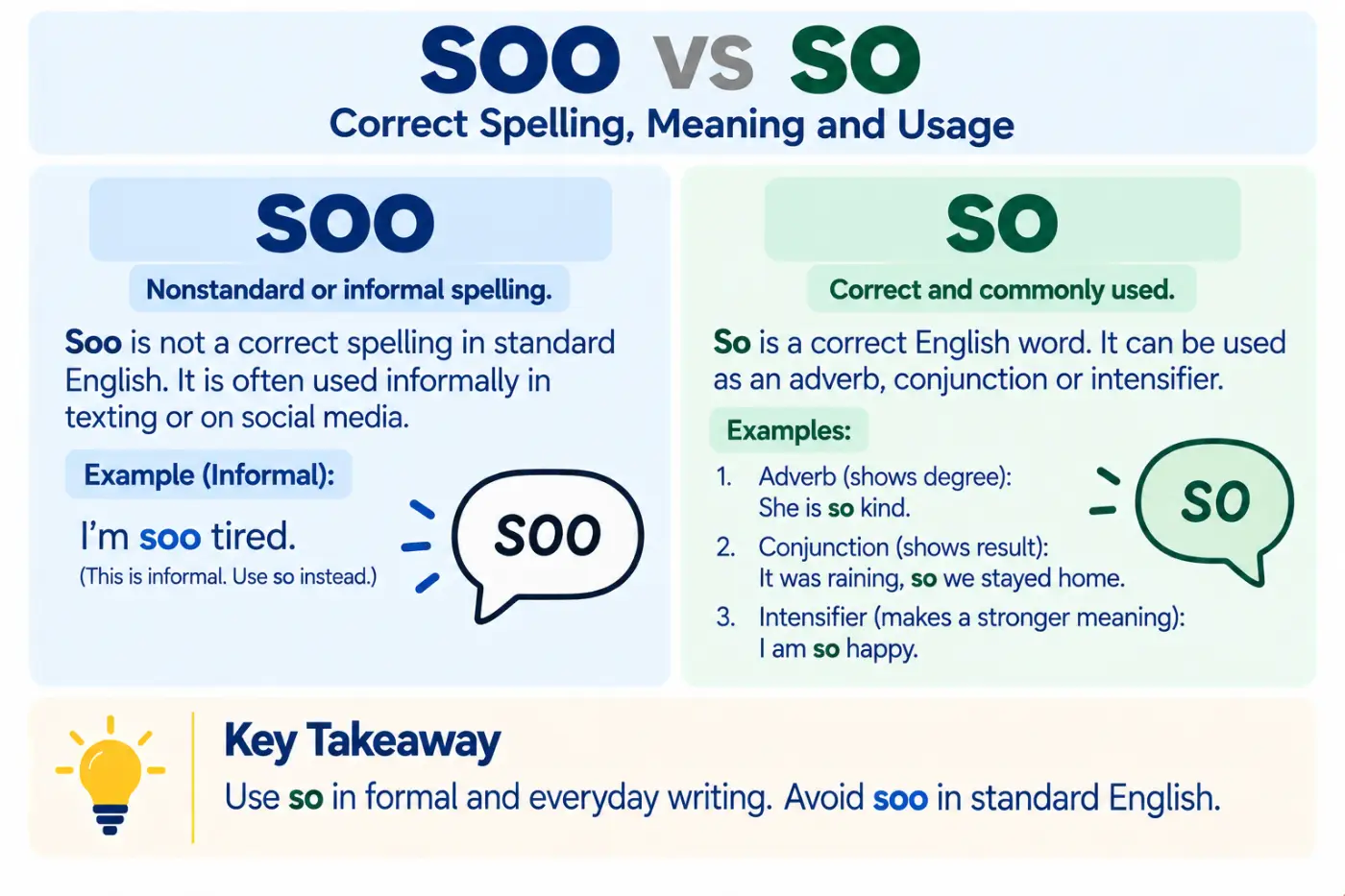
The soo vs so confusion often arises when people want to express a high degree, show a result, introduce a comparison, or agree with someone. The correct spelling in standard English is so. It is the word you should use in school assignments, professional emails, and everyday writing. Soo is not the standard spelling of this common English word, although it can appear in informal messages, names, and specialized contexts.
The confusion often starts with pronunciation. People sometimes stretch the sound of so when speaking to show excitement, surprise, frustration, or emphasis. In a text message, they may write soo to represent that longer sound. This can work as a playful style choice, but it does not make the extra letter part of standard spelling.
Understanding this difference helps you choose the right form in formal and informal writing. You will also learn how so works as an adverb and conjunction, explore common expressions and sentence patterns, and see examples that make the correct spelling easier to remember.
You may also want to read Lead vs Led Which Spelling Is Correct.
Quick Answer
So is the standard English spelling. It can mean very, to that degree, in this way, or as a result, depending on the sentence. Soo is generally a nonstandard or playful spelling used to stretch the sound in informal writing. Use so in schoolwork, professional communication, and standard written English.
Comparison Table
| Feature | So | Soo |
|---|---|---|
| Standard spelling | Yes | No, not for the common English word |
| Main use | Expresses degree, result, manner, or agreement | Informal sound stretching or specialized use |
| Part of speech | Adverb, conjunction, and other grammatical uses | Usually a stylized spelling in casual messages |
| Pronunciation | /soʊ/ | Often intended to represent an extended /soʊ/ sound |
| Formality | Suitable for formal and informal writing | Informal and nonstandard for ordinary use |
| Common contexts | Essays, emails, conversations, reports, and messages | Text messages, playful posts, and expressive writing |
| Example | The movie was so good. | That was sooo funny. |
| Editing advice | Use in standard writing | Replace with so unless the spelling is intentional |
Meaning and Definition
What Does So Mean?
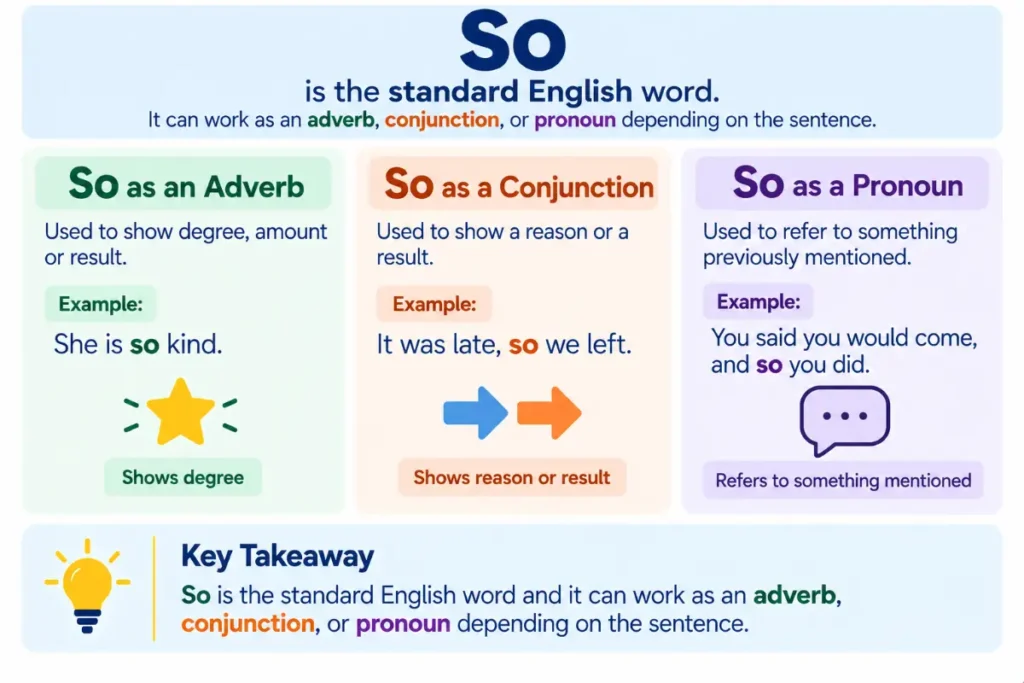
So is a standard English word with several meanings. Its exact function depends on the sentence. It can show degree, explain a result, introduce a purpose, describe a manner, or express agreement.
The most familiar use appears when so means very or to a high degree. For example, in the sentence The weather is so cold, the word strengthens the adjective cold. It tells the reader that the temperature feels extremely low.
The word can also connect an action with its result. In I missed the bus, so I walked home, it introduces the result of missing the bus. In another sentence, You should speak slowly so everyone can understand, it introduces a purpose.
Common uses include:
- Showing degree: The coffee is so hot.
- Showing a result: It was raining, so we stayed inside.
- Showing purpose: Save the file so you can find it later.
- Showing manner: Do it just so.
- Expressing agreement: I think so.
- Replacing an earlier statement: If you say so.
Because it has several grammatical functions, so appears in many kinds of English writing. It is useful in casual conversations, academic work, business emails, news reports, and formal documents.
What Does Soo Mean?
Soo is not the standard spelling of the common English word so. In ordinary writing, adding another o does not create a separate standard form with the same meanings as so.
However, the spelling can appear in certain situations. People sometimes use soo in text messages or online posts to make a word look longer or more expressive. For example, someone might write I am soo excited to show how strongly they feel. The standard spelling remains so, but the extra letter gives the message a playful tone.
The form may also appear as:
- A personal name or surname.
- A place name or part of a proper name.
- A stylized brand or username.
- An intentional spelling in creative writing.
- A representation of an extended sound in informal communication.
These uses do not make soo a standard replacement for so. Proper names follow their own spelling conventions, and creative writing may use nonstandard forms to represent a character’s voice.
Is Soo a Real Word?
The answer depends on what you mean by a real word. Soo can appear as a name, a proper noun, or an intentional informal spelling. However, it is not the standard spelling of the everyday English word used in sentences such as She is so happy or I was so tired.
If you see soo in a text message, the writer probably wants to add emphasis. If you are writing an essay, report, email, or other standard document, use so instead.
Key Differences Explained
1. Spelling
The main spelling difference is the number of o letters. Standard English uses one o in so. The extra o in soo is usually an informal spelling choice rather than a recognized alternative for the common word.
Compare these examples:
- Standard: I am so happy today.
- Nonstandard: I am soo happy today.
The second sentence may be understood in a casual message, but the first is the correct choice for standard writing.
2. Meaning
So has several established meanings. It can express a high degree, connect a cause with a result, introduce a purpose, or refer to something already mentioned.
Soo does not normally have a separate standard meaning in these situations. In casual writing, it usually communicates the same idea as so but adds visual emphasis. The reader understands the intended meaning from context.
3. Grammar
So has clear grammatical roles. It can work as an adverb, a conjunction, and a proform that stands in for an earlier idea.
For example:
- Adverb: The room was so quiet.
- Conjunction: I was tired, so I went to bed.
- Proform: I hope so.
Soo does not normally function as a standard grammatical replacement in these patterns. Writing I hope soo or I was soo tired may be understood online, but it is not appropriate in formal or edited English.
4. Pronunciation
The standard pronunciation of so is /soʊ/ in American English. It has one syllable and a long o sound.
The informal spelling soo often tries to show that the speaker is holding the vowel longer. However, the standard word does not need extra letters to represent emphasis. In speech, you can stretch the sound of so without changing its spelling.
5. Formality
So works in both formal and informal writing. You can use it in an academic essay, a workplace email, a conversation, or a text message.
Soo is usually limited to informal communication, playful writing, and proper names. An editor would normally change it to so in standard prose unless the extra letters serve a clear creative purpose.
6. Context
The context helps explain why someone might choose the nonstandard form. In a casual message, a writer may want to sound excited or dramatic. In a school assignment, the same spelling may look like a typing mistake.
For example, That was so nice is suitable for almost any setting. That was soo nice may work in a friendly text, but it would look out of place in a formal letter.
7. Regional Usage
The standard spelling is the same in American, British, Canadian, and Australian English. There is no major regional spelling rule that makes soo correct in place of so.
People in different regions may stretch vowel sounds in speech or use playful spellings online. Those habits reflect personal style and informal communication rather than a regional standard.
8. Standard Versus Nonstandard Usage
So is the standard form. It appears in dictionaries as an established English word and has several recognized grammatical uses.
Soo is generally nonstandard when used to replace so. It may still be appropriate as a name, brand, username, or deliberate creative spelling. The purpose and setting determine whether it belongs in a particular sentence.
Which Form Is Correct?
So is the correct spelling for standard English. It is the established word used to express degree, result, purpose, manner, and agreement. Soo is not the standard alternative, even though people sometimes use it in informal messages to make the vowel sound appear longer.
The reason is simple: English spelling does not normally require an extra letter just because a speaker stretches a sound for emphasis. A person can say so with excitement, frustration, or surprise while keeping the same spelling.
Consider these examples:
- Correct: The food was so delicious.
- Nonstandard: The food was soo delicious.
- Correct: I was tired, so I went home.
- Nonstandard: I was tired, soo I went home.
- Correct: I think so.
- Nonstandard: I think soo.
In each pair, the standard spelling uses one o. The extra letter in the informal version does not add a new grammatical meaning.
If you are writing dialogue, a social media caption, or a playful text, you may choose a stretched spelling to show emotion. For ordinary writing, use the established form. This keeps your message clear and prevents readers from mistaking an expressive spelling for an error.
Sentence Examples
The following examples show how to use the standard form in everyday and professional situations.
Ten Natural Examples Using So
- Everyday conversation: I am so glad you came to visit.
- Text message: I was so busy yesterday that I forgot to reply.
- Workplace communication: The deadline is approaching, so we need to finish the report today.
- School: The teacher explained the lesson so clearly that everyone understood it.
- Academic writing: The sample size was small, so the results should be interpreted with care.
- Formal writing: Please submit the completed form so that your application can be reviewed.
- Social situations: The music was so loud that we could barely hear each other.
- Online communication: I enjoyed the tutorial so much that I watched it twice.
- Daily routine: I woke up early, so I had time to make breakfast.
- Personal opinion: I think so, but I would like to check the details first.
These sentences show that so can strengthen an adjective, connect ideas, explain a purpose, and express a thought. Its function changes with the sentence, but its standard spelling stays the same.
Five Examples of Informal Nonstandard Use
The following examples show how people may use the extra letter in casual writing. They are included to explain the style, not to recommend it for standard English.
- I am soo excited for the concert.
- That puppy is soo cute.
- You are soo funny.
- I missed you soo much.
- This cake is soo good.
In each example, the writer is stretching the sound for emphasis. In edited writing, use so instead. If you want a stronger effect, choose an expression such as very, extremely, or really, depending on the sentence.
How to Rewrite Informal Messages
You do not always need to remove emotion when correcting an informal spelling. You can keep the sentence lively while using standard spelling.
| Informal version | Standard version |
|---|---|
| I am soo happy. | I am so happy. |
| That was soo funny. | That was so funny. |
| I love this soo much. | I love this so much. |
| You are soo kind. | You are so kind. |
| It is soo cold today. | It is so cold today. |
The corrected sentences still communicate excitement, affection, and strong feelings. The difference is that they follow standard spelling.
Common Mistakes and Misspellings
People often write the extra letter because they want to show a longer sound. Other errors happen when they confuse so with similar looking or related expressions.
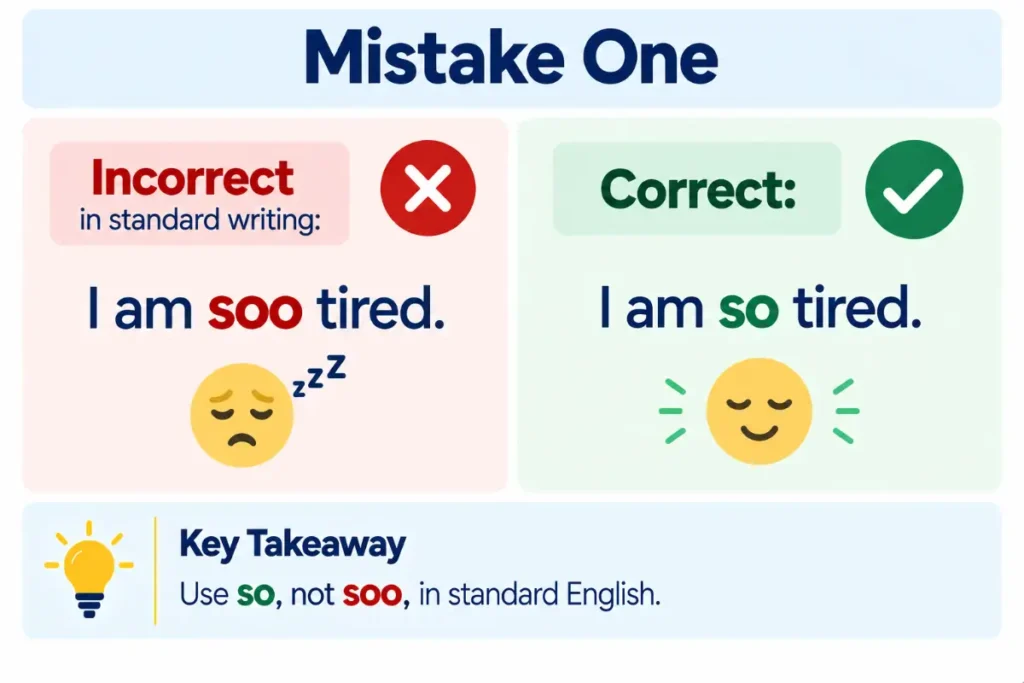
1. Writing Soo in Formal Sentences
Incorrect: The lecture was soo interesting.
Correct: The lecture was so interesting.
The writer may be trying to add emphasis, but the extra letter is not part of standard spelling. Use the standard form in essays, reports, professional emails, and schoolwork.
2. Adding an Extra O Before a Result
Incorrect: It was late, soo we called a taxi.
Correct: It was late, so we called a taxi.
Here, the word connects the reason with the result. The correct conjunction has one o. Adding another letter does not change the grammatical function.
3. Confusing So With Sew
Incorrect: I am sew tired.
Correct: I am so tired.
Sew is a verb that means to join material with stitches. So can express degree or result. The words sound similar in many accents, but their meanings and spellings are different.
4. Confusing So With Sow
Incorrect: I was sow happy to see you.
Correct: I was so happy to see you.
Sow can refer to planting seeds or to an adult female pig. So has a different meaning and grammatical role. Read the sentence carefully to make sure you have chosen the word that fits.
5. Using So Much and So Many Incorrectly
Incorrect: There were so much people at the event.
Correct: There were so many people at the event.
The problem here is not spelling. It is the choice between much and many. Use so much with uncountable nouns and so many with plural countable nouns. For example, so much water and so many books are correct.
A Simple Way to Avoid These Errors
Before submitting your writing, check the sentence rather than looking at the word alone. Ask yourself if you are expressing degree, result, purpose, or agreement. If you are, the standard spelling is so. If you are using a different word such as sew or sow, make sure its meaning fits the sentence.
For another common grammar confusion, see former vs latter Explained With Clear Examples.
Pronunciation Guide
How Do You Pronounce So?
In American English, so is pronounced /soʊ/. It has one syllable and uses the long o sound, similar to the vowel in go, no, and show.
You can break the pronunciation into a single sound unit:
- Word: so.
- IPA: /soʊ/.
- Syllables: One.
- Stress: The only syllable receives the stress.
- Easy guide: Soh.
The vowel moves slightly as you say it, which is why the IPA uses two symbols to represent the sound. This does not mean the word has two syllables.
How Is Soo Pronounced?
When people write soo informally, they usually intend the same basic vowel sound as so, but with a longer or more dramatic delivery. The spelling suggests that the speaker is holding the sound to show emotion.
There is no separate standard pronunciation rule that makes soo the correct form of the common English word. The extra letter is a visual choice used by some writers in casual messages.
Common Pronunciation Mistakes
Some learners may confuse the long o sound with the vowel sounds in similar looking words. Others may think the word needs extra letters when they stretch it in speech.
Remember that pronunciation and spelling do not always match letter for letter. You can hold the sound longer while speaking, but the standard spelling remains so.
Etymology and Word Origin
The word so has a long history in English. It developed from Old English swā, which was used with meanings connected to in this way, to that extent, or in such a manner. Related forms also appear in older Germanic languages.
Over time, the word gained several uses. It came to express degree, manner, result, and other relationships between ideas. These meanings remain part of modern English.
The informal spelling soo does not represent a separate historical development of the common word. In most casual messages, it is simply a stylized version of the established spelling. The extra o is used to suggest a longer sound or stronger feeling.
Word history can help explain why so has several meanings, but you do not need to study its older forms to use it correctly. The most useful rule is to remember the standard spelling and recognize the context in which the word appears.
Regional Usage
American English
In American English, so is the standard spelling. It appears in everyday expressions such as so good, so far, so much, and I think so. It is also common in academic and professional writing.
Soo may appear in text messages, social media captions, and informal conversations. It is usually an expressive spelling rather than a standard alternative. In edited American English, use one o.
British English
British English uses the same standard spelling and basic meanings. Speakers use so to express degree, result, purpose, and agreement. The informal spelling soo may appear in online communication, but it is not the standard replacement.
There is no meaningful British spelling difference for this word. The choice follows the same general rule used in American English.
Australian English
Australian English also uses so as the standard spelling. The word appears in casual speech, formal writing, and common expressions. An extra o may be used for emphasis in informal messages, but it does not change the standard spelling.
Canadian English
Canadian English follows the same spelling convention. Use so in school assignments, workplace documents, emails, and other standard writing. The extra letter is generally a stylistic choice in casual communication.
Across these English varieties, the spelling rule remains consistent. Regional accents may affect pronunciation, but they do not make soo the standard form.
Grammar Rules and Part of Speech
So has several grammatical roles. Understanding them helps you use it correctly and avoid mistakes that have nothing to do with spelling.
So as an Adverb
An adverb can modify an adjective, another adverb, or a verb. So often works as an intensifier, meaning it strengthens the word that follows.
Examples:
- The room was so cold.
- She speaks so clearly.
- I am so proud of your progress.
- The children were so excited.
In these sentences, so increases the strength of the description. It does not usually stand alone as the main verb or noun.
So as a Conjunction
So can connect two clauses and show that one event leads to another. In this use, it often means as a result or for that reason.
Examples:
- I forgot my umbrella, so I got wet.
- The road was closed, so we took another route.
- She studied hard, so she passed the exam.
- The store was busy, so we waited outside.
When so joins two independent clauses, a comma commonly appears before it. The comma helps separate the two complete thoughts.
So to Introduce Purpose
So can also introduce a purpose, often in the expression so that. It explains why someone does something.
Examples:
- I saved the document so that I could edit it later.
- Speak slowly so everyone can understand.
- She left early so she could catch the train.
- We moved the table so that there would be more space.
In everyday English, speakers often leave out that when the meaning remains clear. Both I called so that you would know and I called so you would know are correct.
So as a Proform
A proform is a word that stands in for an earlier idea. So can replace a statement or thought that has already been mentioned.
Examples:
- I think so.
- I hope so.
- If so, please let me know.
- The manager said so.
In these sentences, so refers to something understood from the surrounding conversation. For example, I think so may mean I think that the meeting is tomorrow.
So at the Beginning of a Sentence
So can begin a sentence, especially in conversation and informal writing. It may introduce a result, connect with an earlier point, or help a speaker move to a new topic.
Examples:
- So, what time should we leave?
- So, we decided to try again.
- So, the main problem is the cost.
In formal writing, avoid starting every paragraph with so. Repeated use can make the writing sound casual or repetitive. Use it when the connection between ideas is clear and useful.
So Much and So Many
These expressions show a high degree or quantity, but they do not work with the same types of nouns.
Use so much with uncountable nouns:
- So much water.
- So much information.
- So much work.
- So much time.
Use so many with plural countable nouns:
- So many books.
- So many people.
- So many questions.
- So many opportunities.
For example, There was so much traffic is correct because traffic is uncountable in this sense. There were so many cars is correct because cars are countable.
So and Such
So and such both add emphasis, but they follow different grammar patterns.
Use so before an adjective or adverb:
- So beautiful.
- So quickly.
- So interesting.
Use such before a noun phrase:
- Such a beautiful day.
- Such an interesting book.
- Such kind people.
Compare these examples:
- The movie was so interesting.
- It was such an interesting movie.
Both sentences express strong feeling, but their structures differ. This is a common grammar point for English learners.
Real Life Usage Examples
Daily Conversation
In daily speech, so often adds emphasis or connects events.
- I was so tired after the long drive that I went straight to bed.
- We had extra time, so we stopped for coffee.
The first example strengthens the description of tiredness. The second shows the result of having extra time.
Email and Workplace Communication
In professional communication, the word can connect actions, explain a reason, or introduce a purpose.
- I have attached the updated file so you can review the changes.
- The client requested several updates, so we have moved the delivery date.
These sentences are direct and easy to understand. The word helps explain how one part of the message relates to another.
Academic Writing
Academic writing uses so to show results and relationships between ideas. Writers should make sure the connection is clear and avoid using the word too often when a more precise transition would help.
- The temperature increased, so the reaction occurred more quickly.
- The sample contained very few participants, so the results cannot represent the wider population.
In a formal paper, you might replace repeated uses of so with therefore, consequently, or as a result. The best option depends on the relationship between the ideas.
News and Journalism
News writing often uses so to explain the result of an event or decision. It can also appear in reported speech.
- The city received heavy rainfall, so several roads were closed.
- Officials said the repairs would take several weeks, so residents were advised to plan alternative routes.
The word makes the cause and result easy to follow. In more formal reports, writers may use as a result or therefore when that creates a smoother sentence.
Literature and Storytelling
In stories, so can strengthen descriptions, connect events, and reflect a character’s natural speech.
- The night was so quiet that Mara could hear the leaves moving outside.
- He had lost the map, so he followed the river toward the village.
These uses help create a clear flow between descriptions and actions. In dialogue, so can also make a character sound thoughtful, uncertain, excited, or surprised.
Related and Confused Terms
These eight expressions are closely related to the meaning and grammar of so. Learning the differences can help you avoid common mistakes.
1. Too
Too can mean more than needed or also. It often expresses excess, as in The coffee is too hot to drink. It can also mean also, as in I want to come too. So usually expresses degree or result, not the same meanings.
2. Very
Very strengthens an adjective or adverb. For example, The room is very cold. So can serve a similar purpose, as in The room is so cold. However, so often carries a stronger emotional or contextual effect, especially when followed by a result clause.
3. Such
Such adds emphasis before a noun phrase. You might say It was such a good meal. So usually appears before an adjective or adverb, as in The meal was so good. The words can express similar feelings but follow different grammar patterns.
4. Therefore
Therefore introduces a result or conclusion. It is often more formal than so. For example, The evidence was incomplete; therefore, the case remained unresolved. In everyday writing, so may express the same connection more simply.
5. Thus
Thus can mean in this way or as a result. It often appears in formal, academic, or technical writing. For example, The two values were equal, thus producing the same result. In many everyday sentences, so sounds more natural.
6. Hence
Hence means for this reason or as a result. It often appears in formal writing and may sound less conversational than so. For example, The road was blocked, hence the delay. The expression is concise, but it does not replace every use of so.
7. Sew
Sew is a verb that means to join fabric or material using a needle and thread. For example, She learned to sew a button onto her shirt. It sounds similar to so in many accents, but its meaning is completely different.
8. Sow
Sow is a verb meaning to plant seeds. It can also refer to a female pig. For example, Farmers sow seeds in the spring. It is not interchangeable with so, even though the words may sound similar in speech.
Expert Editor Insight
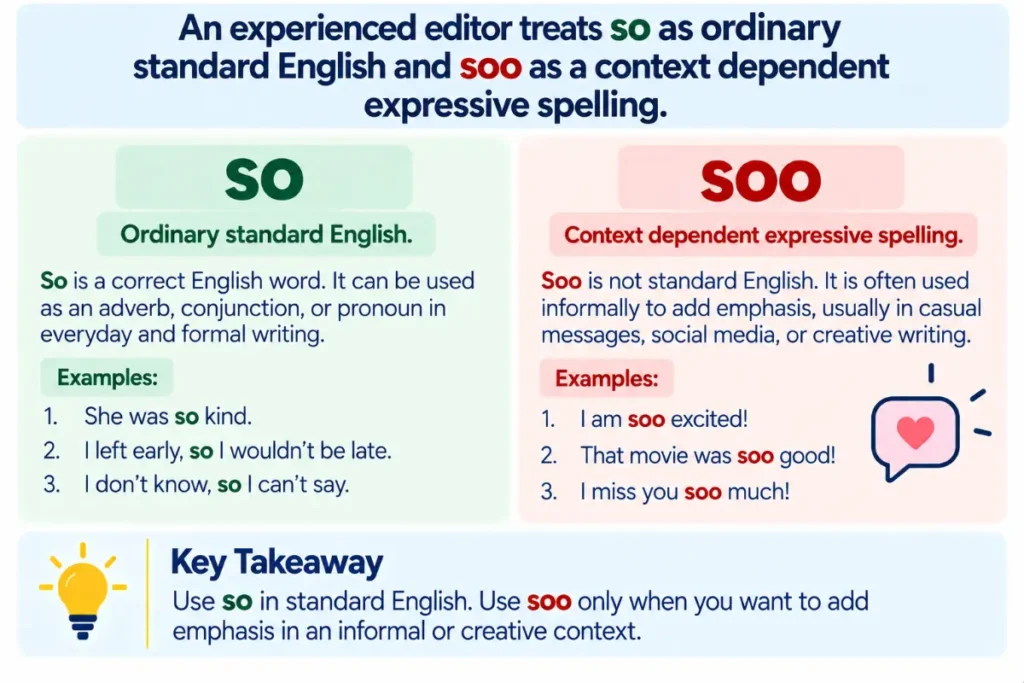
An experienced editor treats so as a standard word and soo as an intentional style choice only when the context supports it. Native English speakers may stretch the vowel in conversation, then use extra letters in a text to show excitement or strong feeling. That does not make the extra letter suitable for edited prose. Spelling tools may flag soo as a possible error, although they may not catch every context. A useful editing tip is to read the sentence without the extra letter. If the meaning stays the same, use the standard spelling unless you deliberately want an informal voice.
You may also want to read Assume vs Presume vs Infer Meaning and Usage.
Conclusion
The difference between soo and so is mainly a matter of standard spelling and informal style. So is the correct form for everyday English, academic assignments, professional emails, and formal documents. The extra letter in soo is usually added to stretch the sound or express emotion in casual messages, not to create a standard alternative.
To remember the rule, think of the regular word as the one you use in edited writing. You can add emphasis through your sentence or word choice without changing its spelling. When in doubt, choose so with one o.
FAQs
Is Soo a Correct English Word?
Soo is not the standard spelling of the common English word so. It may appear as a personal name, place name, brand, username, or playful spelling in casual messages. If you want to express degree, result, purpose, or agreement in standard English, use so with one o.
What Does So Mean in English?
So has several meanings. It can express a high degree, as in so happy, show a result, as in I was tired, so I went home, or introduce a purpose, as in Save the file so you can find it later. It can also express agreement in phrases such as I think so.
Why Do People Write Soo Instead of So?
People often write soo because they want to show a longer vowel sound or stronger emotion. In a text message, That was soo funny may look more expressive than That was so funny. The extra letter is a stylistic choice, not a standard spelling rule. Use the regular form in formal and edited writing.
Is Soo Ever Acceptable in Text Messages?
Yes, soo can be used intentionally in casual text messages, social media posts, or playful conversations. It may help show excitement, surprise, or affection. However, it is not standard spelling. If you are writing to a teacher, employer, customer, or professional contact, the regular form is the safer choice.
How Do You Pronounce So?
In American English, so is pronounced /soʊ/. It has one syllable and uses the long o sound found in words such as go and show. You can stretch the sound when speaking for emphasis, but you do not need to add another letter when writing the standard word.
Can So Start a Sentence?
Yes, so can begin a sentence. It may introduce a result, connect with an earlier idea, or signal a change in topic. For example, So, we decided to leave early is correct. In formal writing, use this opening carefully and avoid beginning too many sentences with the same word.
What Is the Difference Between So and Too?
So usually expresses degree or introduces a result, while too can mean more than necessary or also. For example, The soup is so hot describes its degree of heat. The soup is too hot means it is hotter than desired or suitable. I want some too means I also want some.
Is So Appropriate in Formal Writing?
Yes, so is a standard English word and can appear in formal writing. It works as an adverb, conjunction, and proform. However, in academic or professional documents, you may sometimes choose therefore, consequently, or as a result to express a conclusion more precisely. The best choice depends on the sentence and intended tone.