
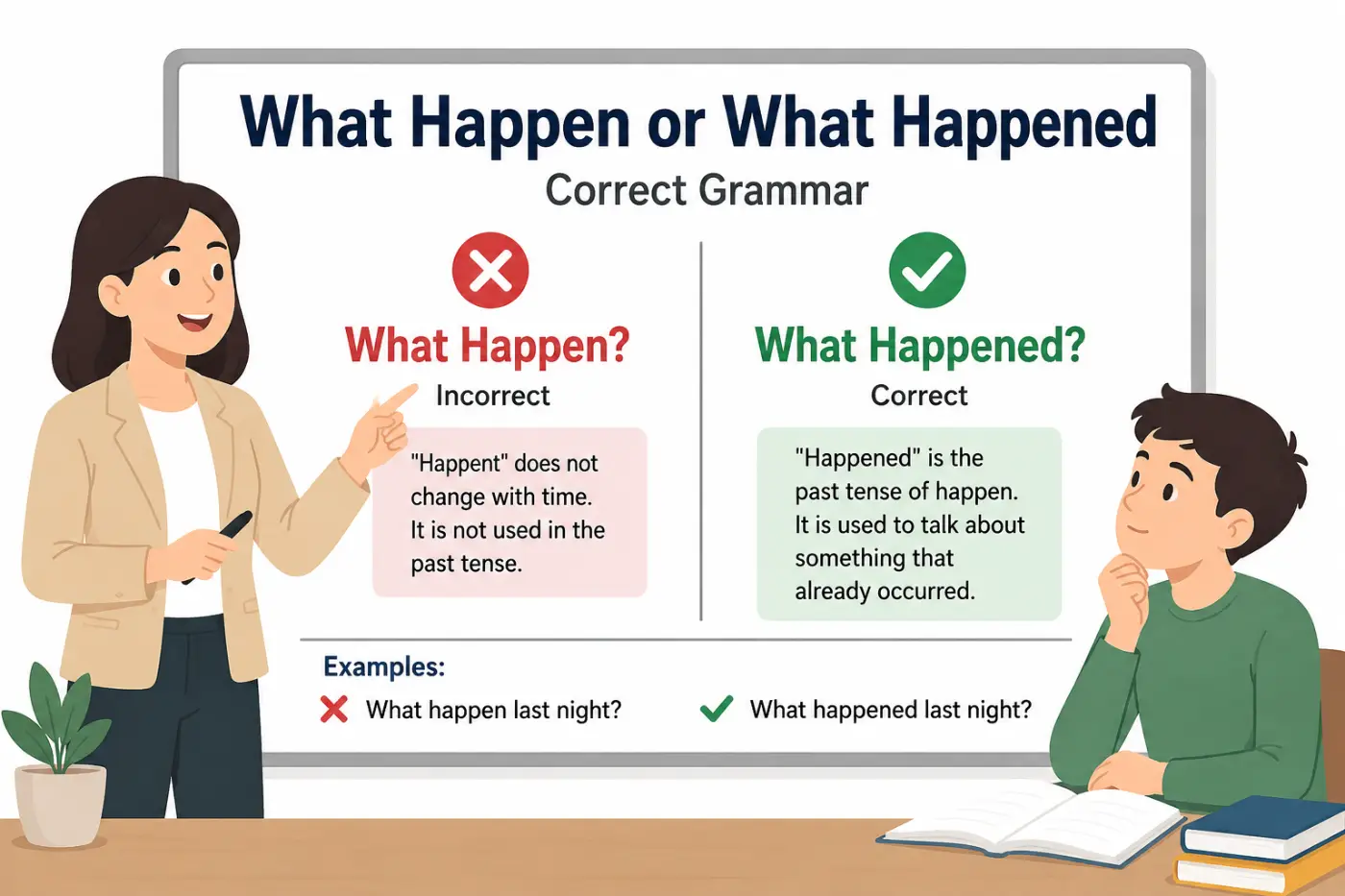
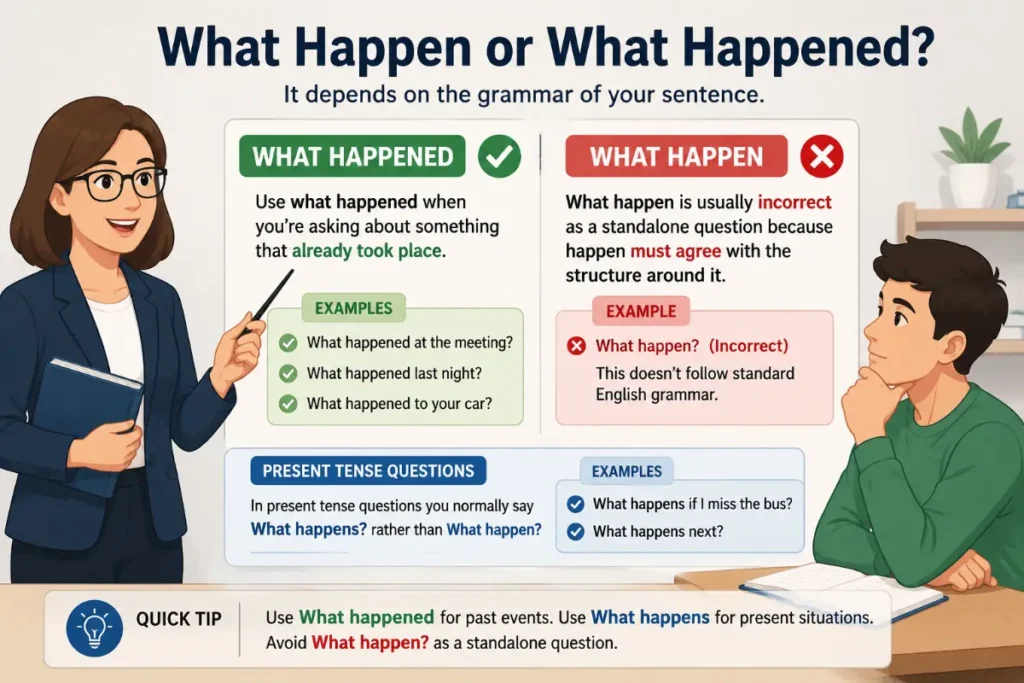
Choosing between What happen vs What happened can be confusing, especially when you are asking someone about an event. The correct expression in most questions about something that already took place is What happened. The word happened is the past tense of happen, so it tells the reader or listener that an event occurred before now.
However, What happen is not always grammatically wrong. It can appear in questions that use an auxiliary verb such as do, does, or did, and it can also appear in certain statements about general events. For example, What did happen? is grammatically possible, but What did happened? is incorrect because did already carries the past tense.
The key is to understand how English forms questions and how helping verbs affect the main verb. This guide explains the difference, shows the correct sentence patterns, and gives practical examples for conversations, messages, schoolwork, and professional writing. You will also learn how to avoid common tense mistakes and choose the right form naturally.
Still confused? Compare Council vs Counsel Which Word Should You Use.
Quick Answer
What happened is the correct expression when asking about an event that occurred in the past. Happen is the base form, while happened is the simple past form. You can also use happen after helping verbs such as do, does, and did, but after did, the main verb must remain in its base form.
Comparison Table
| Feature | Happen | Happened |
|---|---|---|
| Word form | Base form | Simple past and past participle |
| Main meaning | Occur or take place | Occurred or took place |
| Part of speech | Verb | Verb form |
| Time reference | Present, future, or general events | Completed past events |
| Common question | What will happen? | What happened? |
| With do | What do you think will happen? | Not used after do to express past tense |
| With does | What happens next? | Not used after does |
| With did | What did happen? | What happened? |
| Formality | Standard English | Standard English |
| Example | What might happen tomorrow? | What happened yesterday? |
Meaning and Definition
What Does Happen Mean?
Happen is a verb that means to take place, occur, or come about. It describes an event, action, or situation that takes place, often without focusing on the person or thing that caused it.
For example, a meeting can happen at noon, an accident can happen on a busy road, or an unexpected change can happen during a project. The word can describe ordinary events, planned activities, sudden situations, and unexpected experiences.
Happen is the base form of the verb. It is used in several grammatical patterns, including:
- What will happen next?
- What can happen during a storm?
- What might happen if we leave early?
- What did happen at the meeting?
- Accidents happen when people ignore safety rules.
- These changes happen over time.
The form also appears after modal verbs such as can, could, may, might, should, and will. These helping verbs are followed by the base form of the main verb.
For example, say What might happen? rather than What might happened? The modal verb already provides the grammatical information needed for the sentence, so the main verb stays in its base form.
What Does Happened Mean?
Happened is the simple past form and past participle of happen. It describes an event that took place before the present moment.
For example, if a power outage occurred last night, you can say The power outage happened last night. If someone asks about an earlier event, you can ask What happened?
The word is common in questions and statements about completed events. It can refer to something that happened seconds ago, yesterday, several years ago, or at any other point in the past.
Examples include:
- What happened after the meeting?
- The accident happened near the school.
- Something unusual happened this morning.
- I do not know what happened.
- The same problem happened last year.
Happened is also the past participle used with helping verbs such as has, have, and had.
For example:
- Something has happened.
- Several changes have happened recently.
- The same thing had happened before.
The helping verb determines the tense or time relationship, while happened supplies the past participle form.
Is Happen Incorrect?
No. Happen is a standard English verb. It is not a misspelling or an incorrect form. The problem occurs when writers use it in a sentence that requires the simple past tense.
For example:
Incorrect: What happen yesterday?
Correct: What happened yesterday?
The word yesterday places the event in the past, so the simple past form is needed. However, happen is correct in a question such as What will happen tomorrow? because will is followed by the base form.
Is Happened Always Correct?
No. Happened is correct when the sentence requires a past form, but it should not normally follow helping verbs that already carry the past tense.
Incorrect: What did happened?
Correct: What did happen?
In the incorrect sentence, did already marks the question as past tense. Adding the past form happened creates a tense error. The same rule applies to other regular and irregular verbs.
Key Differences Explained
1. Verb Tense
The most important difference is tense. Happen is the base form, while happened is the simple past form and past participle.
Compare these sentences:
- What happens after the alarm rings?
- What happened after the alarm rang?
The first asks about a general or expected sequence of events. The second asks about an event that already occurred. The verb form helps readers understand the time being discussed.
2. Present and General Events
Use happen when describing events that occur regularly, generally, or under certain conditions. For example, Mistakes happen when people rush through their work.
You can also use happens with a third person singular subject. For example, What happens next? The s ending is needed because the subject is what, which takes a singular verb in this question pattern.
3. Past Events
Use happened when asking about or describing an event that took place in the past.
Examples:
- What happened at school yesterday?
- The meeting happened earlier than expected.
- Something strange happened during the trip.
The past form is also natural when the time is clear from the conversation, even if the sentence does not include a specific time expression.
4. Questions With Helping Verbs
English questions often use helping verbs to form tense, mood, or emphasis. When a helping verb such as do, does, or did appears, the main verb usually returns to its base form.
Examples:
- What do you think will happen?
- What does happen when the temperature drops?
- What did happen after everyone left?
The third example is grammatically correct because did carries the past tense and happen remains in its base form. The question often uses this structure for emphasis or contrast.
5. Questions Without Helping Verbs
A question can use happened directly without an additional helping verb.
For example:
What happened?
This is a complete and natural question. You do not need to add did because the past tense is already shown by happened.
The same structure works with additional information:
- What happened to your phone?
- What happened during the interview?
- What happened after the lights went out?
6. Formal and Informal Usage
Both forms are standard in formal and informal English. The difference is grammatical rather than stylistic.
You can ask What happened? in a casual text message, a business meeting, a news interview, or an academic discussion. You can use happen in formal writing to discuss general events or possible outcomes.
For example, A similar problem may happen during the next stage of testing is grammatically correct. So is The problem happened during the first stage of testing.
7. Pronunciation
Happen is pronounced /ˈhæpən/ in American English. Happened is pronounced /ˈhæpənd/. Both words have two syllables and stress the first syllable.
The final sound changes slightly because happened includes the past tense ending. In normal speech, the ending is short, but it must remain clear enough to distinguish the past form in careful pronunciation.
8. Standard Usage
Both forms are standard English. The correct choice depends on the sentence structure and the time being described.
What happen? is generally incorrect as a standalone question about a completed event. What happened? is correct. However, What can happen? and What will happen? are also correct because the helping verbs are followed by the base form.
Which Form Is Correct?
For a direct question about an event that already occurred, What happened? is correct. The word happened marks the event as past, and the sentence does not need an additional helping verb.
The base form happen is correct after modal verbs and in questions formed with do or does. It is also used for general statements and future possibilities.
Compare these examples:
| Incorrect or Correct | Better Form | Reason |
|---|---|---|
| What happen yesterday? | What happened yesterday? | Yesterday signals the past. |
| What did happened? | What did happen? | Did takes the past tense. |
| What will happened? | What will happen? | Will takes the base form. |
| What can happened? | What can happen? | Can takes the base form. |
| What happens next? | Correct as written | Happens describes a present or general event. |
| What has happened? | Correct as written | Has takes the past participle. |
The important grammar rule is that English normally marks the past tense only once in a simple question. If did is present, use happen. If did is absent and the verb itself carries the past tense, use happened.
Sentence Examples
The following examples show how the two forms work in everyday and professional communication.
Ten Natural Examples Using Happen and Happened
- Everyday conversation: What happened to your new laptop?
- Text message: Hey, what happened last night? You left early.
- Workplace communication: What happened during the client meeting yesterday?
- School: The teacher explained what happened during the science experiment.
- Academic writing: The researchers examined what happened when the temperature increased.
- Formal writing: The report describes what happened before the policy changed.
- Social situations: I heard there was a problem at the party. What happened?
- Online communication: Does anyone know what happened to the website?
- Future possibility: What will happen if we miss the deadline?
- General situation: These mistakes happen when instructions are unclear.
These examples show that the right form depends on time and sentence structure. Past questions use happened, while questions about future possibilities and general situations use happen or happens with the appropriate helping verb or subject.
Five Examples of Common Incorrect Forms
The following examples show mistakes to avoid.
1. Incorrect: What happen yesterday?
Correct: What happened yesterday?
2. Incorrect: What did happened at work?
Correct: What did happen at work?
3. Incorrect: What will happened tomorrow?
Correct: What will happen tomorrow?
4. Incorrect: What can happened during the test?
Correct: What can happen during the test?
5. Incorrect: What has happen since Monday?
Correct: What has happened since Monday?
The mistakes occur because the verb form does not match the helping verb or time reference. Learning the main patterns makes these errors much easier to spot.
Common Mistakes and Grammar Problems
1. Using the Base Form for a Past Event
Incorrect: What happen at the airport yesterday?
Correct: What happened at the airport yesterday?
The word yesterday clearly places the event in the past. The main verb must therefore use its past form. This mistake often occurs when writers forget to add the regular past tense ending.
2. Adding the Past Ending After Did
Incorrect: What did happened to the car?
Correct: What did happen to the car?
Did is already the past tense helping verb. The main verb must stay in its base form. This is one of the most common errors in English questions and applies to regular and irregular verbs alike.
For example:
Incorrect: Did you went home?
Correct: Did you go home?
The same pattern applies to happen.
3. Using the Past Form After Will
Incorrect: What will happened next?
Correct: What will happen next?
Will is a modal verb, and modal verbs are followed by the base form of the main verb. The same rule applies to can, could, should, may, and might.
Examples:
- What should happen next?
- What might happen during the storm?
- What can happen if the system fails?
4. Forgetting the Past Participle After Has or Have
Incorrect: What has happen to the files?
Correct: What has happened to the files?
Has and have require the past participle in the present perfect tense. Happened is the past participle of this regular verb, so it must follow these helping verbs.
Other examples include:
- Something has happened.
- Several things have happened.
- Nothing unusual has happened today.
5. Confusing Happens With Happened
Incorrect: What happened every time you press this button?
Correct: What happens every time you press this button?
The phrase every time describes a repeated or general event. The present tense is more suitable because the question asks about a regular result, not one completed event.
However, if you are talking about a specific event in the past, happened is correct:
What happened when you pressed the button yesterday?
Questions With Can Will And Other Modals
Modal verbs make the pattern especially easy.
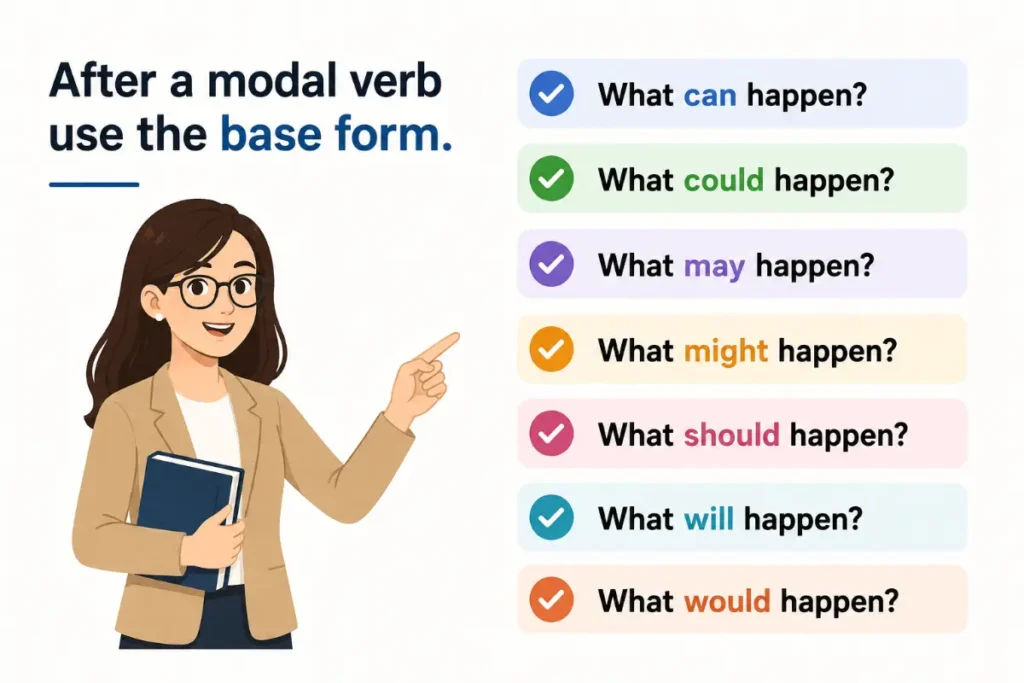
After a modal verb use the base form.
- What can happen?
- What could happen?
- What may happen?
- What might happen?
- What should happen?
- What will happen?
- What would happen?
A Quick Way to Avoid These Errors
Before choosing a verb form, check the helping verb and time expression.
- If the question refers to a completed past event without did, use happened.
- If the question contains did, use happen.
- If the question contains will, can, could, should, may, or might, use happen.
- If the question contains has, have, or had, use happened.
- If the question describes a regular event, use happen or happens according to the subject.
This simple check can prevent most tense errors.
Many readers also check Goodbye or Good Bye hich Spelling Is Correct?.
Pronunciation Guide
How Do You Pronounce Happen?
The American English pronunciation of happen is /ˈhæpən/. It has two syllables: HAP and en. The stress falls on the first syllable, which contains the short a sound heard in words such as cat and map.
A simple pronunciation guide is HAP en. The second syllable is short and unstressed. Avoid placing equal stress on both parts of the word.
How Do You Pronounce Happened?
Happened is pronounced /ˈhæpənd/ in American English. It also has two syllables, with stress on the first syllable.
The ending is pronounced as a /d/ sound after the /n/. The past tense ending in happened does not create an extra syllable. It remains a two syllable word.
Common Pronunciation Mistakes
Some speakers may pronounce the past tense ending too strongly or add an unnecessary syllable. Others may not pronounce the final /d/ clearly in careful speech.
For natural pronunciation, keep the first syllable strong and let the ending remain short. The difference between the two forms is mainly the final consonant sound.
Etymology and Word Origin
Happen developed from Middle English and is linked to Old Norse happ, meaning chance, luck, or fortune. The verb came to describe events that occur or take place, often without emphasizing a particular cause or person responsible.
Over time, the word became a common part of modern English. Its meaning expanded to cover planned and unplanned events, ordinary experiences, sudden changes, and unexpected situations.
Happened is formed by adding the regular past tense ending to happen. The same ending creates the past forms of many English verbs, such as opened, called, and started.
Because happen is a regular verb, its past tense and past participle have the same written form. That makes the basic pattern easier to learn:
- Base form: happen.
- Simple past: happened.
- Past participle: happened.
You do not need to memorize the historical origin to use the word correctly. The most useful point is that happened follows the regular English pattern for forming the past tense.
Regional Usage
American English
In American English, both happen and happened are standard. Speakers use What happened? to ask about past events and What happens? to ask about present or repeated events.
The same tense rules apply in everyday speech, school assignments, business writing, and formal documents. There is no special American spelling difference between the two forms.
British English
British English follows the same grammatical distinction. What happened? asks about a past event, while What happens? usually asks about a present or general event.
The spelling and verb forms are the same in British and American English. Accent differences may affect pronunciation, but not the basic grammar rule.
Australian English
Australian English uses the same forms and follows the same tense patterns. Speakers use happen for general or possible events and happened for completed past events.
There is no major regional difference that changes the correct choice.
Canadian English
Canadian English also follows the standard pattern. What happened? is used for a past event, while What will happen? refers to a future possibility.
Across these varieties, the difference is grammatical rather than regional. You can use the same rules for a broad English speaking audience.
Grammar Rules and Part of Speech
Happen is an intransitive verb. This means it does not normally take a direct object. An event happens, a problem happens, or something happens to someone. You can add extra information about the time, place, or circumstances, but you do not usually say that someone happens something.
For example:
Correct: The accident happened near the station.
Incorrect: The driver happened the accident.
The subject of the verb is the event or situation that takes place. A person or object may be affected by it, but that does not make the verb transitive.
Simple Present Tense
Use happen or happens to describe general events, repeated situations, and facts.
Examples:
- Accidents happen.
- Mistakes happen during busy periods.
- What happens after the final test?
- The same problem happens every winter.
Use happens with a third person singular subject, such as he, she, it, or a singular noun.
Simple Past Tense
Use happened for completed events in the past.
Examples:
- What happened last night?
- The meeting happened earlier than planned.
- Several unexpected things happened during the trip.
The past form stays the same for all subjects. You say I happened, she happened, and they happened when the verb is used with a subject that makes sense.
Questions With Do and Does
Do and does help form questions in the present simple tense. After either helping verb, use the base form happen.
Examples:
- What do you think will happen?
- What does happen when the power goes out?
- Do these changes happen often?
Do not add an s to happen after does. The helping verb already carries the third person singular marking.
Incorrect: What does happens next?
Correct: What does happen next?
Questions With Did
Did forms simple past questions. The main verb stays in its base form.
Examples:
- What did happen after the alarm sounded?
- Did anything happen while I was away?
- Why did this happen?
In ordinary conversation, What happened? is usually more natural than What did happen? The version with did often adds emphasis, expresses surprise, or challenges an earlier statement.
Questions With Modal Verbs
Modal verbs include will, would, can, could, may, might, shall, should, and must. They are followed by the base form of the main verb.
Examples:
- What will happen next?
- What could happen if we wait?
- What might happen during the test?
- What should happen after approval?
Do not use happened directly after these modal verbs.
Incorrect: What might happened?
Correct: What might happen?
Present Perfect and Past Perfect
Use has or have with happened to form the present perfect tense. This structure connects a past event to the present.
Examples:
- What has happened to the schedule?
- Several changes have happened since the launch.
Use had with happened to form the past perfect tense. It describes an event that occurred before another past event.
Example: The meeting had happened before I arrived.
Sentence Position and Punctuation
The word can appear in direct questions, indirect questions, and statements.
Direct question: What happened after the call?
Indirect question: I wonder what happened after the call.
Statement: Something unexpected happened after the call.
Use a question mark for a direct question. Use a period for an indirect question or a statement. Notice that an indirect question does not use the same word order as a direct question.
Real Life Usage Examples
Daily Conversation
People use the past form when asking about something they noticed or heard about.
- What happened to your hand?
- I heard you had a difficult day. What happened?
The questions are direct and natural. They do not need a helping verb because the past tense is already shown by the verb.
Email and Workplace Communication
In workplace messages, the correct form depends on the time being discussed.
- Could you explain what happened during the system update?
- Please let me know what happens after the application is submitted.
The first asks for an account of a completed event. The second asks about a process or expected result.
Academic Writing
Academic writing uses both forms to describe past observations and general processes.
- The researchers recorded what happened during the experiment.
- The paper explains what happens when the sample is exposed to heat.
The first sentence reports a completed study event. The second describes a general process or finding.
News and Journalism
News reports often use the past tense to describe events that have already occurred.
- Officials are investigating what happened during the power outage.
- The report explains what happened before the road was closed.
For ongoing events, a writer may use happen or happens to discuss future outcomes or repeated conditions.
Literature and Storytelling
Stories use the past tense to describe events in a sequence.
- No one understood what happened after the lights went out.
- She could not explain what had happened before sunrise.
The second sentence uses the past perfect because the event occurred before another point in the past. This tense helps readers follow the order of events.
Related and Confused Terms
Understanding these eight related terms can help you make better tense choices.
1. Occur
Occur means to take place or happen. It often sounds more formal than happen and is common in academic, scientific, and professional writing.
Example: The error occurred during the final stage of testing.
2. Take Place
Take place means to happen or occur, often as part of a planned event.
Example: The ceremony will take place on Friday.
It is especially common when describing meetings, events, performances, and organized activities.
3. Transpire
Transpire can mean to occur or become known. It often appears in formal writing, though it can sound unnecessarily formal in everyday conversation.
Example: Several unexpected events transpired during the investigation.
For simple writing, happen is usually clearer.
4. Take Effect
Take effect means to begin producing a result or becoming active. It does not mean exactly the same thing as happen.
Example: The new policy will take effect next month.
Use it when a rule, decision, or change becomes active.
5. Develop
Develop means to grow, change, or progress over time. It can describe how a situation begins or changes.
Example: A serious problem developed during the project.
This word focuses on the process of change rather than simply stating that an event occurred.
6. Arise
Arise means to appear or begin, often when referring to a problem, need, or opportunity.
Example: Questions may arise during the review.
It is useful when an issue emerges and needs attention.
7. Has Happened
Has happened is a present perfect expression. It describes an event that occurred in the past but has a connection to the present.
Example: Something has happened to the delivery schedule.
It is different from simple past happened because it connects the event to the current situation.
8. Had Happened
Had happened is the past perfect form. Use it when one past event occurred before another past event.
Example: The train had left before we reached the station.
This structure helps make the order of past events clear.
Expert Editor Insight
A professional editor checks the time reference and helping verb before changing the form. Native speakers commonly use What happened? as a complete question about a past event, while happen appears after modal verbs and in present or general statements. The confusion often comes from adding a past ending after did or forgetting the ending when a past event is being discussed. Grammar tools can flag these mistakes, but they may not understand the intended time in every sentence. A useful editing tip is to circle the helping verb first. If the sentence contains did, use happen; if it contains no past helping verb and asks about a completed event, happened is usually the right form.
Key Takeaways
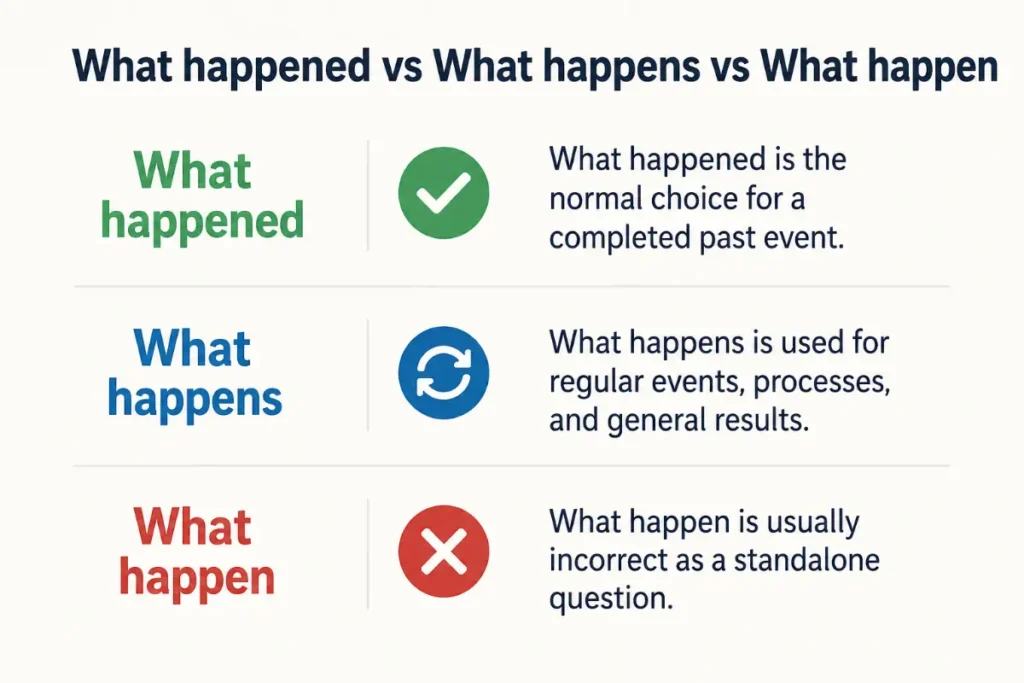
- What happened is the normal choice for a completed past event.
- What happens is used for regular events processes and general results.
- What happen is usually incorrect as a standalone question.
- Happen is correct after modal verbs such as will can could might and should.
- After did the main verb stays in its base form.
- What happened is usually neutral while what did happen can add emphasis.
- Tense depends on the meaning and structure of the whole sentence.
- The easiest way to choose the form is to identify the timeline and any auxiliary or modal verb.
You may also want to read Mantel vs Mantle: Meaning, Spelling and Usage.
Conclusion
The difference between What Happen or What Happened comes down to verb tense and sentence structure. Use happened when asking about an event that already took place. Use happen after helping verbs such as did, will, can, and might, and use it for general or possible events.
Remember that did already marks the past tense, so the main verb must stay in its base form. A simple editing trick is to check the helping verb before choosing the ending. With this rule in mind, you can form clear questions and avoid common tense mistakes in both conversation and writing.
FAQs
Is What Happen Grammatically Correct?
What happen? is generally incorrect as a standalone question about a past event. The natural form is What happened? However, happen is correct after helping verbs such as can, will, and did. For example, What will happen next? and What did happen? are both grammatically correct because the helping verb controls the tense.
What Is the Difference Between Happen and Happened?
Happen is the base form of the verb and is used for general events, present situations, and future possibilities. Happened is the simple past form and past participle. Use it for completed past events or after has, have, and had. For example, What will happen? refers to the future, while What happened? asks about the past.
Should I Say What Happen Yesterday or What Happened Yesterday?
Say What happened yesterday? because yesterday places the event in the past. The simple past form is needed to show that the event already took place. Happen would be incorrect in this sentence because there is no helping verb such as did to carry the past tense.
Is What Did Happened Correct?
No. The correct form is What did happen? The helping verb did already marks the question as past tense, so the main verb must remain in its base form. This rule applies to other verbs too. For example, say Did you go? rather than Did you went?
Can I Say What Will Happened?
No. Say What will happen? The modal verb will must be followed by the base form of the main verb. Happened is a past form, so it cannot normally follow will. The same rule applies to can, could, may, might, should, and other modal verbs.
How Do You Pronounce Happen and Happened?
Happen is pronounced /ˈhæpən/, while happened is pronounced /ˈhæpənd/ in American English. Both have two syllables, and the stress falls on the first syllable. The main difference is the final /d/ sound in the past form. The ending does not add another syllable.
What Is the Past Tense of Happen?
The past tense of happen is happened. It is a regular verb, so you form the past tense by adding ed. The same form is also used as the past participle. For example, The accident happened yesterday uses the simple past, while Something has happened uses the present perfect.
Can I Use Happened in Formal Writing?
Yes. Happened is a standard verb form and is suitable for formal writing, reports, academic work, and professional communication. You can use it to describe completed events. In more technical writing, occur or take place may sometimes sound more precise, but happened is not informal or incorrect.