

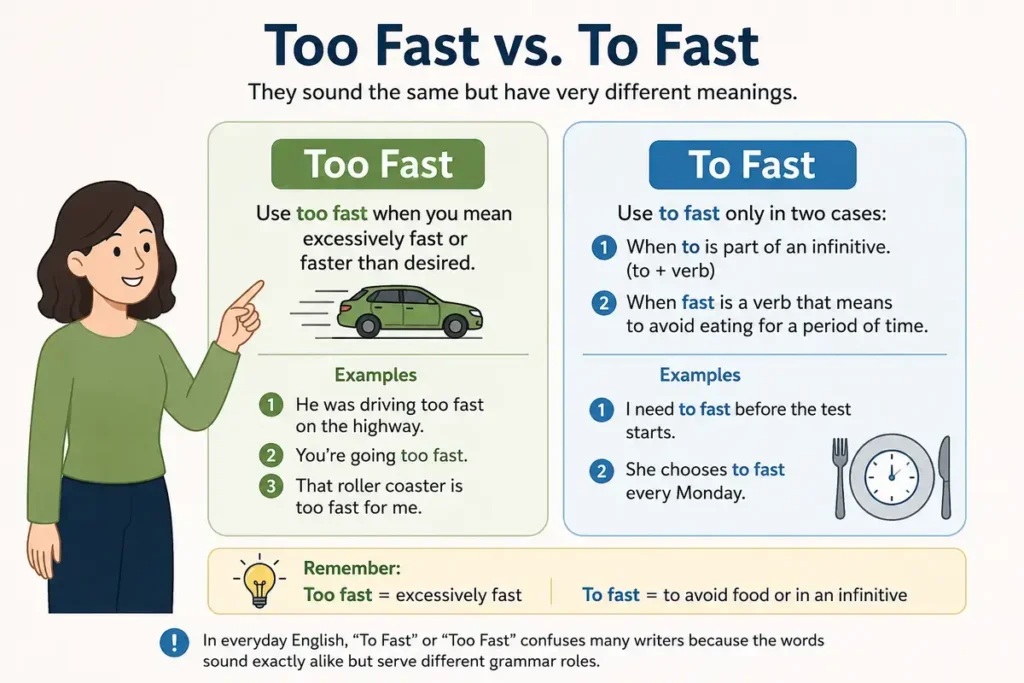
If you have ever wondered whether to write “to fast” or “too fast,” the answer depends on what you want to say. Both expressions are correct English, but they have different meanings. “Too fast” means moving or happening at a speed that is greater than is wanted, safe, or suitable. “To fast” means to abstain from food, usually for a period of time, or it can appear when the word “fast” is used after the preposition “to” in a sentence.
The confusion happens because “to” and “too” sound almost identical in everyday speech. However, their spelling and grammar are different. “To” commonly introduces an infinitive verb, as in “to run,” or shows direction, as in “go to school.” “Too” means “also” or “more than necessary,” as in “too tired” or “too fast.”
Knowing this difference helps you write clearly in text messages, school assignments, emails, reports, and everyday conversations. Once you understand what each word does, choosing the correct expression becomes much easier.
A related grammar guide is Who vs Whom Explained With Simple Grammar Rules.
Quick Answer
“Too fast” is correct when you mean that something is moving or happening at an excessive speed. For example, “The car was driving too fast.” “To fast” is also grammatically possible, but it usually relates to the verb “fast,” which means to abstain from food, or to a sentence structure in which “to” introduces an infinitive. The correct choice depends on the intended meaning.
Comparison Table for To Fast or Too Fast
| Expression | Meaning | Part of Speech | Common Context | Example |
|---|---|---|---|---|
| Too fast | Faster than desired or appropriate | “Too” is an adverb modifying “fast.” “Fast” is an adverb or adjective. | Speed, movement, speech, progress | You are driving too fast. |
| To fast | To abstain from food | “To” introduces the infinitive verb “fast.” | Religious practice, health discussions, fasting routines | She plans to fast tomorrow. |
| To move fast | To move at a high speed | “To” introduces the verb “move.” “Fast” describes the movement. | Instructions and descriptions | He wants to move fast. |
| Too quickly | More quickly than is appropriate | “Too” modifies the adverb “quickly.” | Actions, decisions, speech | You answered too quickly. |
| Fast enough | At a sufficient speed | “Fast” is an adverb or adjective, and “enough” indicates sufficiency. | Performance, travel, tasks | The computer runs fast enough. |
The key difference is meaning. “Too fast” describes excessive speed, while “to fast” usually refers to abstaining from food. Both can be correct, but they are not interchangeable.
Meaning and Definition
What Does Too Fast Mean
“Too fast” means at a speed that exceeds what is needed, safe, comfortable, or appropriate for a situation. The word “too” adds the idea of excess. It suggests that the speed is not simply high but higher than it should be.
For example, if someone says, “You are walking too fast,” they mean the other person is walking faster than they can comfortably follow. In “The train is moving too fast,” the speaker may be concerned that its speed is unsafe or unsuitable.
The phrase can describe more than physical movement. People use it for speech, learning, work, change, and emotional experiences. A person may speak too fast for listeners to understand, learn too fast for a beginner’s comfort, or make decisions too fast without enough thought.
Here are a few examples.
- The cyclist was going too fast around the corner.
- You are speaking too fast for me to understand.
- The project is moving too fast for the new team.
- The child is growing up too fast.
- I think we made the decision too fast.
In each sentence, “too” communicates that the speed is excessive for the situation.
What Does To Fast Mean
“To fast” is a valid English construction when “to” introduces the verb “fast.” As a verb, “fast” means to go without food for a period of time, often for religious, cultural, or personal reasons.
For example, “I plan to fast tomorrow” means the speaker plans to abstain from food tomorrow. The word “to” is part of the infinitive verb phrase “to fast.” It does not mean “excessively.”
The verb “fast” can appear in several grammatical forms.
- I want to fast tomorrow.
- She decided to fast during the day.
- They agreed to fast for a religious observance.
- He needs to fast before the medical test, following his clinician’s instructions.
- We were asked to fast before the procedure.
The exact reason for fasting depends on the context. In religious settings, fasting may involve spiritual discipline or worship. In medical settings, a clinician may instruct a patient not to eat for a set period before a test or procedure.
However, if you want to describe a car, person, animal, or process moving at excessive speed, “to fast” is not the correct substitute for “too fast.”
Why the Two Expressions Are Confused
The main reason is pronunciation. In many varieties of English, “to” and “too” sound alike when spoken naturally. This makes them homophones, which are words that share a pronunciation but have different spellings or meanings.
Because the words sound alike, writers sometimes select the wrong one while typing quickly. Spellcheckers may not catch the error because both words are real English words. A sentence such as “The car is going to fast” contains recognizable words, but it does not express the intended meaning correctly.
Grammar and context provide the solution. Ask yourself what you want to communicate. If you mean “at an excessive speed,” choose “too fast.” If you mean “to abstain from food,” choose “to fast.”
Key Differences Explained
Spelling
The words differ by one extra letter. “To” has two letters, while “too” has three. The extra letter in “too” can help you remember that the word often adds an extra amount or degree.
For example, “too fast” suggests more speed than is appropriate. The word “to” does not carry this meaning by itself.
Compare these sentences.
- The runner wants to fast before the race. This refers to abstaining from food.
- The runner is running too fast. This refers to excessive speed.
- I need to go to work. This shows direction or destination.
- The music is too loud. This expresses an excessive level.
The correct spelling depends on the function of the word, not simply on how it sounds.
Meaning
“Too fast” expresses excess. It usually suggests that a speed creates a problem or goes beyond an acceptable limit.
“To fast” introduces an action related to abstaining from food. It may describe a plan, intention, request, or obligation.
Consider the difference between “She wants to fast” and “She is walking too fast.” The first sentence is about not eating for a period of time. The second is about walking at an excessive speed. Replacing one expression with the other changes the meaning completely.
Grammar
“To” has several common functions. It can introduce an infinitive verb, as in “to read,” “to eat,” or “to fast.” It can also act as a preposition, as in “go to school” or “send it to her.”
“Too” is an adverb. It commonly means “also” or “more than necessary.” In the phrase “too fast,” it modifies “fast” and indicates excessive speed.
Examples include “I want to run,” “I run too fast,” and “I want to run too.” The final sentence uses “too” to mean “also,” showing that its meaning can change with the context.
Pronunciation
In most American English speech, “to” and “too” have the same pronunciation when stressed or pronounced with a full vowel. Both are commonly pronounced /tuː/. In unstressed speech, “to” often reduces to /tə/, as in “to go.”
“Fast” is pronounced /fæst/ in American English. The complete phrase “too fast” is commonly pronounced /tuː fæst/ when the first word is stressed. Since sound alone may not reveal the intended spelling, readers and writers must rely on meaning and grammar.
Formality
Both expressions can appear in formal and informal English when used correctly.
“Too fast” works in everyday conversation, workplace communication, academic writing, and news reporting. For example, “The vehicle was traveling too fast for the road conditions” is suitable for a formal report.
“To fast” can also be appropriate in formal writing when discussing fasting. For example, “Participants were instructed to fast before the scheduled procedure” describes a specific requirement. Neither expression is inherently informal.
Context and Regional Usage
The distinction between “to” and “too” remains consistent in American, British, Canadian, and Australian English. There is no standard regional spelling rule that makes “to fast” mean excessive speed in one of these varieties.
Differences may occur in accent and pronunciation, but the grammatical distinction remains the same. Writers in all four varieties should use “too fast” for excessive speed and “to fast” when the infinitive verb is intended.
Which Form Is Correct
The correct form depends on the sentence. If you are describing a person or thing moving at a speed that is excessive, use “too fast.” If you are talking about abstaining from food, use “to fast.”
The reason is grammatical. “Too” is an adverb that can express excess, while “to” commonly introduces an infinitive verb or indicates direction. English spelling preserves this distinction even though the two words can sound alike.
A useful way to check your writing is to replace “too” with “excessively.” If the sentence keeps its intended meaning, “too” is probably the right choice.
For example, “The car is going too fast” can be understood as “The car is going excessively fast.” The sentence “I plan to fast tomorrow” cannot be rewritten as “I plan excessively fast tomorrow” without changing its meaning and breaking its grammar.
Another helpful check is to identify the verb. If “fast” means abstaining from food, “to fast” may be correct. If “fast” describes how quickly something moves, “too fast” expresses an excessive degree.
Ten Natural Example Sentences
The following examples show how the expressions work in everyday and professional situations. Most focus on “too fast” because it is the phrase people usually intend when comparing these spellings.
- Everyday conversation: You are walking too fast, so please slow down.
- Driving: The driver was going too fast for the narrow street.
- Text message: I watched the video, but the speaker talked too fast for me to follow.
- Workplace communication: The team is moving too fast, and we need more time to review the plan.
- School: The teacher explained the new topic too fast for some students to understand.
- Academic writing: The results changed too fast to support a reliable conclusion from the available observations.
- Formal writing: The vehicle was traveling too fast for the road and weather conditions.
- Social situations: The conversation moved too fast, and I did not have a chance to respond.
- Technology: My old laptop runs too slowly, but the new computer processes these files fast enough.
- Fasting: She decided to fast during the day as part of a religious observance.
The first nine examples demonstrate speed or rate, although the ninth also shows how “fast enough” expresses a sufficient speed. The tenth uses “to fast” with the verb meaning to abstain from food.
Common Mistakes and Misspellings
Using To Instead of Too
Incorrect: The car is going to fast.
Correct: The car is going too fast.
The mistake happens because “to” and “too” sound alike. In the corrected sentence, “too” modifies “fast” and shows that the car’s speed is excessive. The original wording does not correctly express that meaning.
Using Too Instead of To Before a Verb
Incorrect: I want too leave now.
Correct: I want to leave now.
The word “to” introduces the infinitive verb “leave.” “Too” does not perform that grammatical function in this sentence. Remember that common infinitive phrases include “to go,” “to read,” “to eat,” and “to fast.”
Confusing Too With Also
Incorrect: I want to come to.
Correct: I want to come too.
In the corrected sentence, “too” means “also.” The speaker wants to come in addition to someone else. The word “to” normally needs a destination, object, or suitable grammatical structure when used as a preposition, so the final “to” does not express the intended meaning here.
Adding Too Before Fast Without an Excessive Meaning
Potentially incorrect for the intended meaning: The athlete runs too fast, meaning the athlete runs quickly.
Better: The athlete runs fast.
“Too fast” normally suggests that the speed is excessive for the situation. If you only want to say that an athlete has a high speed, “runs fast” is more suitable. Use “too fast” when the speed goes beyond a useful, safe, or desired level.
Confusing To Fast With Fasting Instructions
Incorrect: The car needs to fast to reach the destination sooner.
Correct: The car needs to move faster to reach the destination sooner.
The verb “fast” can mean abstaining from food, but it does not normally mean driving quickly in this construction. Use “move faster,” “drive faster,” or “travel faster” to describe increased speed.
Pronunciation Guide
The words “to” and “too” are often pronounced alike in English. This is one reason people confuse them in writing.
| Word or Phrase | IPA | Simple Guide | Syllables |
|---|---|---|---|
| To | /tuː/ when stressed; often /tə/ when unstressed | Too or tuh | One |
| Too | /tuː/ | Too | One |
| Fast | /fæst/ | Fast, with the vowel in “cat” | One |
| Too fast | /tuː fæst/ | Too fast | Two |
| To fast | /tuː fæst/ when “to” is stressed | To fast | Two |
In the phrase “too fast,” the word “too” may receive extra stress when a speaker wants to emphasize that the speed is excessive. For example, “You are going TOO fast” makes the warning stronger.
In ordinary conversation, however, stress varies with the sentence. The phrase may be spoken quickly, and “to” may be reduced in other grammatical structures. Since pronunciation does not reliably distinguish the spellings, the best approach is to identify the intended meaning before writing.
Many readers also check excelerate or accelerate Correct Spelling and Meaning.
Etymology and Word Origin
The history of “to” and “too” helps explain why their spellings differ, although you do not need to memorize their history to use them correctly.
“To” comes from an Old English preposition that developed from earlier Germanic forms. Over time, it continued to serve as a marker of direction, purpose, and the infinitive verb construction used in modern English.
“Too” developed historically from forms associated with the meaning “in addition” or “also.” Its spelling became distinct from “to,” helping readers identify the difference between the two functions. In modern English, “too” can mean “also,” as in “I want to come too,” or “excessively,” as in “too fast.”
The word “fast,” when used as an adjective or adverb meaning quick, also has Old English roots. English has used it for a long time to describe speed, firmness, and related ideas. As a verb, “fast” meaning to abstain from food has a separate established history in English and is associated with religious and personal practices.
The modern expressions reflect these different grammatical roles. “Too fast” combines an adverb of degree with a word describing speed. “To fast” uses an infinitive marker with a verb meaning to abstain from food.
Regional Usage
American English
In American English, “too fast” is the standard expression for excessive speed. You may hear it in warnings such as “You’re driving too fast” or comments such as “That movie went by too fast.”
“To fast” is standard when the sentence uses “fast” as a verb meaning to abstain from food. For example, “I was told to fast before the test” is a natural sentence. The distinction depends on grammar and meaning, not regional spelling.
British English
British English uses the same distinction. “Too fast” describes excessive speed, while “to fast” can refer to abstaining from food. Differences in accent may affect the exact sound of words, but they do not change the standard spelling rule.
For example, a British writer might say, “The train was traveling too fast,” or “She decided to fast during the day.” Both expressions are correct in their intended contexts.
Australian English
Australian English follows the same standard usage. Writers use “too fast” for excessive speed and “to fast” when the verb refers to abstaining from food.
The words may sound slightly different across speakers because of accent and speaking style. However, Australian spelling does not replace “too” with “to” to express excessive speed.
Canadian English
Canadian English also follows the same distinction. “Too fast” describes a speed that is greater than appropriate, while “to fast” introduces the verb related to abstaining from food.
The rule remains consistent across standard English varieties. If a sentence describes something moving faster than it should, use “too fast.”
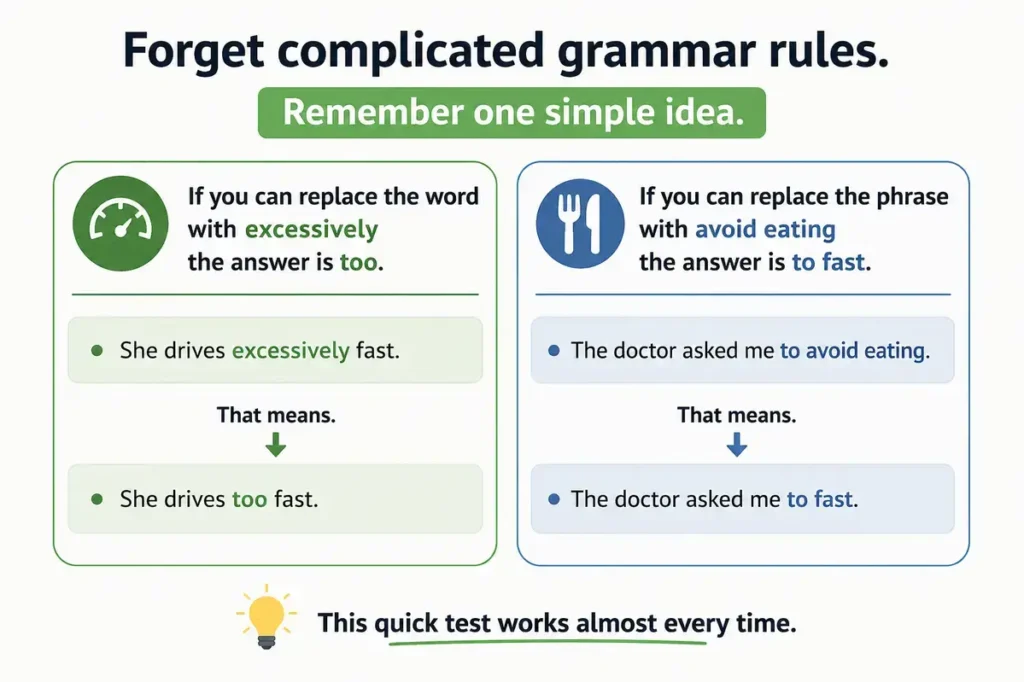
Memory Trick That Actually Works
Forget complicated grammar rules.
Remember one simple idea.
If you can replace the word with excessively the answer is too.
She drives excessively fast.
Grammar Rules and Part of Speech
Understanding the role of each word is the most reliable way to choose the right expression.
How To Functions in a Sentence
“To” is commonly used as a preposition or as an infinitive marker.
As a preposition, it can indicate direction, destination, or a relationship.
- We went to the library.
- She sent a message to her teacher.
- The road leads to the town.
As an infinitive marker, “to” appears before a base form of a verb.
- I want to learn.
- They need to leave.
- He plans to fast tomorrow.
In the last sentence, “fast” is a verb. The phrase does not describe excessive speed.
How Too Functions in a Sentence
“Too” is an adverb with two common meanings.
The first is “also.”
- I want to join too.
- She likes the book too.
- We are coming too.
The second is “more than necessary or desirable.”
- The soup is too hot.
- The room is too small.
- The car is going too fast.
When “too” appears before an adjective or adverb, it often indicates an excessive degree. This is the grammatical pattern used in “too fast.”
Common Patterns With Too
A useful structure is “too + adjective.”
Examples include “too expensive,” “too loud,” and “too difficult.” The word “too” modifies the adjective and indicates that the quality has reached an excessive level.
Another common structure is “too + adverb.”
Examples include “too slowly,” “too carelessly,” and “too fast.” In these phrases, “too” modifies an adverb that describes how an action occurs.
You can also use “too + adjective or adverb + to + verb.”
For example, “The road is too narrow to pass safely” describes a limitation. In “He was too tired to continue,” the phrase explains why the person could not continue. Notice that the first “too” expresses excess, while the later “to” introduces the infinitive “continue.”
Punctuation and Sentence Position
Neither “to fast” nor “too fast” requires special punctuation. The phrase follows the normal punctuation rules of the sentence in which it appears.
For example, “The car is going too fast” is a complete sentence. “Because the car was going too fast” is a dependent clause that needs a main clause to complete the thought, as in “Because the car was going too fast, the driver lost control.”
You can also begin a sentence with a phrase containing “too fast,” although it is often more natural to place it after the verb.
For example, “Too fast for the conditions, the vehicle became difficult to control” is grammatically possible, though a simpler sentence may be clearer for everyday writing.
Real Life Usage Examples
Daily Conversation
People often use “too fast” when asking someone to slow down or explaining that something is difficult to follow.
- “Could you speak more slowly? You’re talking too fast.”
- “I tried to keep up, but everyone was walking too fast.”
These examples sound natural because the phrase identifies a speed that creates a problem for the speaker.
Email and Workplace Communication
In professional settings, the phrase can describe a pace of work that affects quality, understanding, or safety.
- “The project is progressing too fast for the team to review every change carefully.”
- “The presentation moved too fast, so I would appreciate a copy of the slides.”
The wording is direct but not rude. If you need a softer tone, you can say, “The presentation moved a little quickly for me to take detailed notes.”
Academic Writing
Academic writing often uses “too fast” when describing a rate that prevents accurate observation or analysis. The phrase is not limited to casual speech, although a more precise technical term may sometimes be better.
- “The reaction occurred too fast for the available equipment to record every stage.”
- “The population changed too fast for the model to reflect the latest conditions.”
In research writing, make sure the claim is supported by the evidence. If the actual concern is measurement accuracy, explain that limitation rather than relying on the phrase alone.
News and Journalism
News reports may use “too fast” when discussing driving, weather events, rapid changes, or developments that exceed a safe or expected rate.
- “Officials said the vehicle was traveling too fast for the wet road.”
- “The neighborhood has changed too fast for some long term residents to keep up with rising costs.”
The first example describes speed in a safety context. The second uses the phrase figuratively to describe rapid social and economic change.
Literature and Storytelling
In stories, “too fast” can describe physical movement or the pace of events. Writers use it to show urgency, surprise, fear, or a character’s feeling that life is moving beyond their control.
- “The horse raced too fast down the hill, and the rider struggled to hold the reins.”
- “The summer passed too fast, leaving the children wishing for one more day together.”
In both examples, the phrase adds a sense that the speed is greater than the character wants or can manage.
Related and Confused Terms
Several English words and expressions are connected to this topic. Learning their differences can help you write more accurately.
To
“To” is used to show direction, destination, or an infinitive verb. Examples include “go to school” and “to read.” It does not mean “excessively.”
Too
“Too” means “also” or “more than necessary.” In “I want to go too,” it means “also.” In “The road is too narrow,” it expresses an excessive degree.
Two
“Two” is the number 2. It sounds like “to” and “too” in many English accents, but its meaning is numerical. For example, “I have two books.”
Fast
“Fast” can be an adjective or adverb describing speed. “A fast car” uses it as an adjective, while “The car moves fast” uses it as an adverb. It can also function as a verb meaning to abstain from food.
Faster
“Faster” is the comparative form of “fast.” It compares speed between people, objects, or actions. For example, “This train is faster than the old one.” Unlike “too fast,” it does not automatically suggest that the speed is excessive.
Too Quickly
“Too quickly” has a meaning similar to “too fast.” It often describes an action performed at an excessive rate. For example, “She made the decision too quickly” suggests that she did not take enough time to consider the choice.
Fast Enough
“Fast enough” means moving or operating at a sufficient speed. It does not imply excess. For example, “The internet connection is fast enough for video calls” means its speed meets the user’s needs.
Very Fast
“Very fast” emphasizes a high degree of speed without necessarily suggesting a problem. Compare “The car is very fast” with “The car is too fast for this road.” The first praises or describes speed, while the second suggests that the speed is inappropriate.
Expert Editor Insight
An experienced English editor looks at meaning and sentence structure rather than relying on sound alone. Since “to,” “too,” and “two” are often pronounced alike, even a confident writer can choose the wrong spelling while typing quickly. Grammar tools may miss the error because each word is valid English. A useful editing habit is to pause at every occurrence and ask what the word is doing. If it means “excessively,” use “too.” If it introduces an infinitive verb or shows direction, “to” is usually the right choice. If it represents the number 2, write “two.”
Key Takeaways
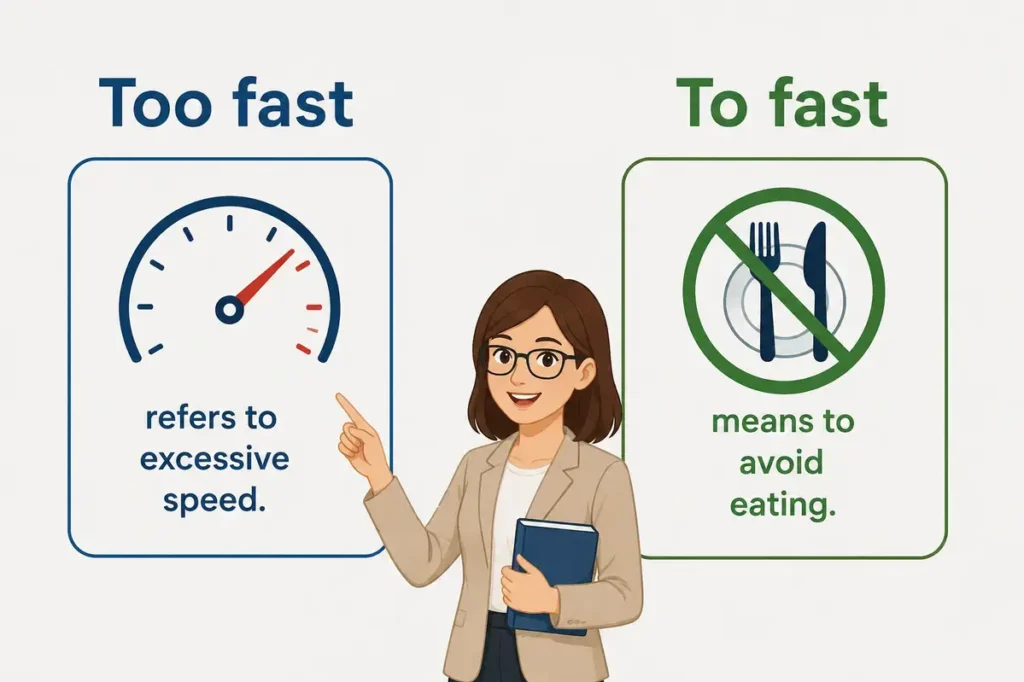
- Too fast refers to excessive speed.
- To fast means to avoid eating.
- The expressions sound identical but have different grammar functions.
- Most everyday situations require too fast.
- Medical and religious contexts often require to fast.
- Replace too with excessively as a quick grammar check.
- Replace to fast with avoid eating to confirm the meaning.
- Focus on the meaning of the sentence instead of the sound of the words.
Learn the difference in Mute Point or Moot Point Which Is Correct.
Conclusion
The choice between To Fast or Too Fast depends on what you want to communicate. Use “too fast” when something moves, speaks, or changes at an excessive speed. Use “to fast” when you mean to abstain from food, as in “She plans to fast tomorrow.” The two expressions can sound alike, but their meanings and grammatical roles are different.
To remember the rule, replace “too” with “excessively” when checking a sentence about speed. If the sentence keeps its intended meaning, “too” is likely correct. For other uses, check the role of “to” in the sentence before choosing the spelling.
FAQs
Is To Fast Incorrect English?
No. “To fast” is correct when “fast” is used as a verb meaning to abstain from food. For example, “The doctor instructed him to fast before the test” is grammatically correct. However, if you want to describe a car or person moving at excessive speed, use “too fast.” The two expressions have different meanings and grammatical functions.
What Does Too Fast Mean?
“Too fast” means moving, speaking, changing, or happening at a speed that is greater than appropriate or desired. For example, “The driver was going too fast” suggests the speed was excessive for the road or conditions. The phrase can describe physical speed, speech, work, learning, and changes in everyday life.
Which Is Correct To Fast or Too Fast?
Both can be correct, depending on what you mean. Use “too fast” to describe excessive speed, as in “You are driving too fast.” Use “to fast” when the verb means to abstain from food, as in “I need to fast before the procedure.” The surrounding sentence determines the correct spelling.
How Do You Pronounce Too Fast?
“Too fast” is commonly pronounced /tuː fæst/ in American English. It has two syllables, with “too” sounding like “two” and “fast” rhyming with “last” in many American accents. The phrase “to fast” can sound identical, so pronunciation alone cannot reliably tell you which spelling belongs in a sentence.
Can Too Fast Start a Sentence?
Yes. A sentence can begin with “too fast” when the phrase is part of a larger grammatical structure. For example, “Too fast for the driver to react, the vehicle crossed the intersection” is possible, although it may sound formal or compressed. In everyday writing, “The vehicle was going too fast for the driver to react” is usually clearer.
What Is a Synonym for Too Fast?
Useful alternatives include “too quickly,” “at an excessive speed,” “faster than is safe,” and “faster than necessary.” The best option depends on context. For example, “The car was traveling at an excessive speed” suits a formal report, while “You are talking too quickly” sounds natural in conversation.
Why Do People Confuse To and Too?
People confuse the words because they often sound alike in spoken English. They also appear in common phrases and are frequently typed quickly in texts, emails, and online posts. Since both spellings are real words, basic spelling tools may not identify the wrong choice. Understanding the grammar and intended meaning is the most reliable way to avoid the mistake.
Is Too Fast Appropriate in Formal Writing?
Yes. “Too fast” is acceptable in formal writing when it accurately describes an excessive rate or speed. For example, “The vehicle was traveling too fast for the road conditions” is clear and suitable for a report. In technical or academic writing, you may choose a more precise phrase, such as “at an unsafe speed,” when it better expresses the intended meaning.