
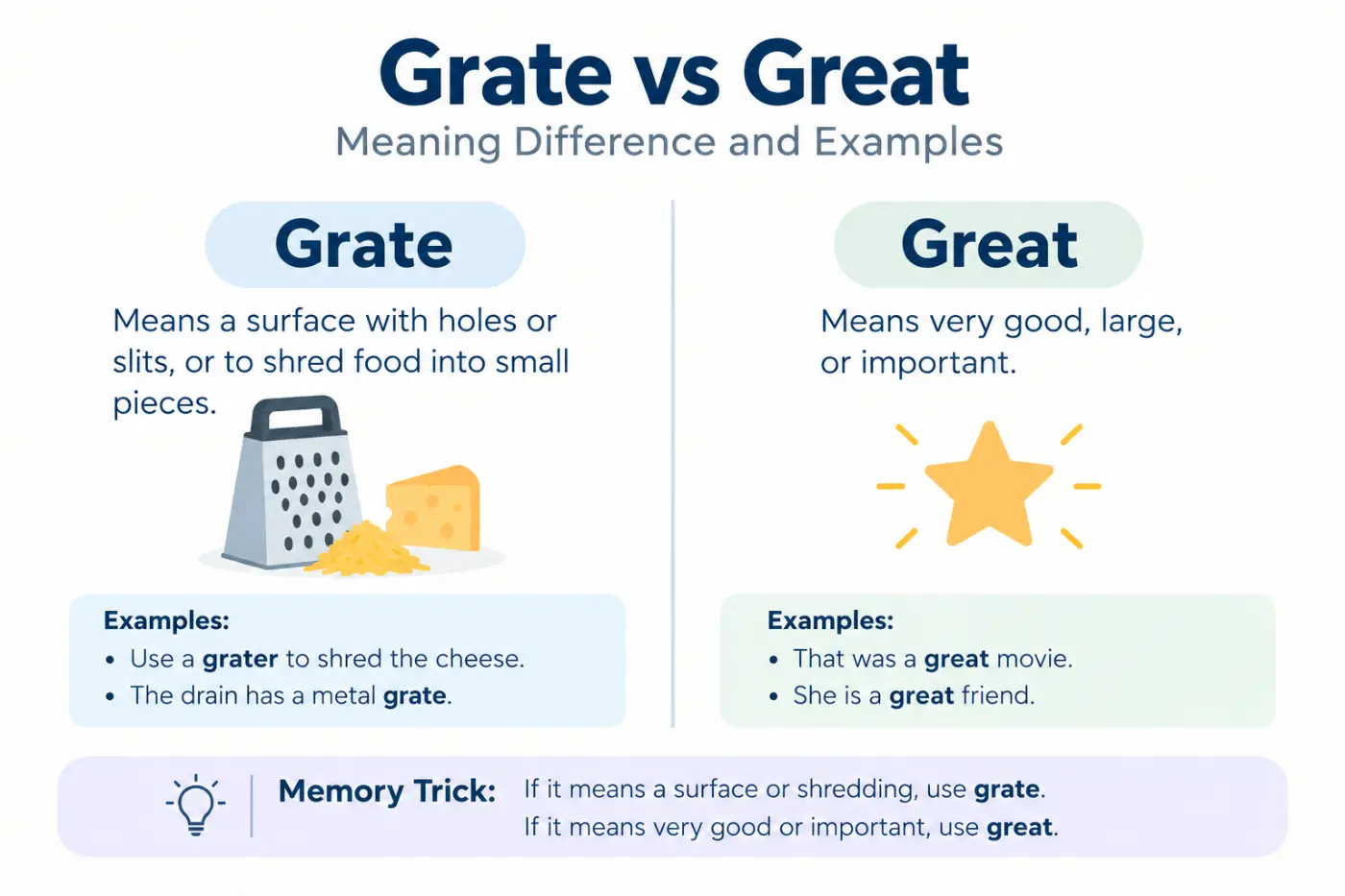
The confusion between grate or great is easy to understand. Both words sound exactly alike in standard American English, but their meanings are completely different. The right choice depends on what you want to say.
Use grate when you mean to shred food into small pieces, scrape a surface, or make an irritating sound. Use great when you mean excellent, wonderful, important, large, or impressive. For example, you grate cheese before adding it to pasta, but you have a great meal when the food tastes wonderful.
Because these words share the same pronunciation, you cannot rely on sound alone to spell them correctly. You need to understand the meaning of the sentence. This distinction matters in text messages, school assignments, work emails, recipes, and formal writing.
The good news is that a simple memory trick can help you choose the right spelling every time. Once you understand their meanings and grammatical roles, you can avoid this common mistake without second guessing yourself.
Learn the difference in Troubleshooted or Troubleshot Correct Usage Guide.
Quick Answer
Both spellings are correct, but they serve different purposes. Grate is a verb meaning to shred, scrape, or make an irritating sound, and it can also refer to a metal grid or framework. Great is usually an adjective meaning excellent, remarkable, large, or important. Choose the word that matches your intended meaning.
Comparison Table
| Feature | Grate | Great |
|---|---|---|
| Main meaning | Shred, scrape, or irritate | Excellent, impressive, or important |
| Part of speech | Verb or noun | Mainly adjective; also a noun in some contexts |
| Pronunciation | /ɡreɪt/ | /ɡreɪt/ |
| Common context | Cooking, surfaces, sounds, metal grids | Praise, quality, size, achievement |
| Example | Grate the cheddar into a bowl. | That was a great performance. |
| Formality | Standard English | Standard English |
| Regional usage | Standard in American and British English | Standard in American and British English |
| Spelling clue | Think of a grater used for food | Think of greatness or something excellent |
Meaning and Definition
What Does Grate Mean
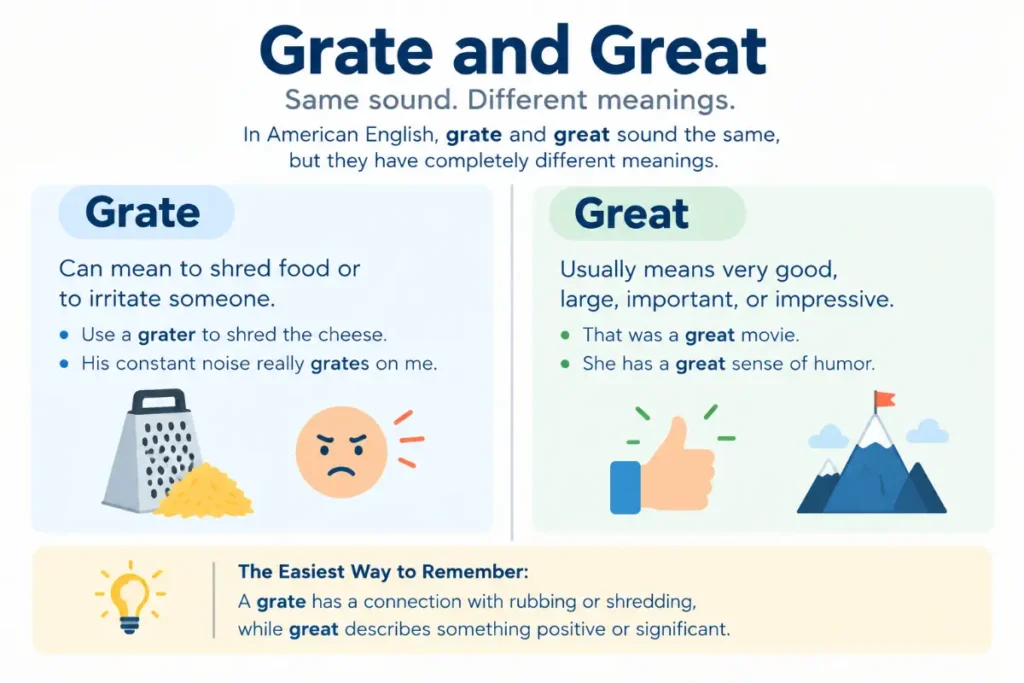
Grate has several meanings, depending on how you use it in a sentence. Most commonly, it describes rubbing food against a rough surface so that it breaks into small pieces. It can also describe scraping, producing a harsh sound, or annoying someone.
As a verb, it often appears in cooking instructions. For example, a recipe might tell you to grate fresh Parmesan over a bowl of soup. You use a grater to turn a block of cheese into small shreds.
The word also describes unpleasant sounds or feelings. A loud alarm can grate on your nerves, and metal dragged across a rough surface can produce a grating noise. In these examples, the word suggests friction or irritation.
As a noun, a grate can be a metal frame or grid that allows air, water, or other materials to pass through. You might see a floor grate covering a drain or a fireplace grate holding burning logs.
What Does Great Mean
Great usually describes something very good, impressive, important, or remarkable. It is an adjective that adds praise or emphasizes the value, size, or influence of a person, thing, or event.
For example, you might call a teacher great because they explain difficult ideas clearly. You could also describe a concert as great, a discovery as great, or a historical figure as great because of their influence.
The word can describe size or degree as well. A great distance is a long distance, while a great deal of effort means a large amount of effort. These uses don’t always express praise.
Great also appears as a noun in some established expressions. In historical writing, the phrase the greats refers to highly admired or influential people in a particular field, such as the greats of jazz.
Why Both Words Exist
English contains many words that share a pronunciation but have different spellings and meanings. Linguists call these words homophones. The pair discussed here is a classic example because both words use the same vowel sound and end with the same consonant sound.
Their shared pronunciation makes them easy to confuse when writing quickly. However, their spelling reflects different word histories and meanings. The best way to distinguish them is to connect each spelling with a familiar example rather than trying to hear a difference that doesn’t exist.
Key Differences Explained
Spelling and Meaning
The main difference lies in meaning, not pronunciation. Grate refers to rubbing, scraping, or irritating, while great describes something excellent, remarkable, or substantial.
Consider these two sentences.
- Please grate the carrots before adding them to the salad.
- The carrots from our garden taste great.
The first sentence describes an action. The second expresses a positive opinion about the food. Both sentences sound natural, but switching the spellings would change the meaning or create an error.
Grammar and Part of Speech
Grate works mainly as a verb when describing an action. It can also function as a noun when referring to a metal grid. Great works mainly as an adjective, modifying a noun or following a linking verb.
For example, you can grate an apple, but you can also grate on someone’s nerves. You can have a great idea, a great opportunity, or a great time. These patterns help you identify the intended word before you finish writing.
Pronunciation
Both words have the same standard pronunciation in American English. They begin with the sound /ɡ/, contain the long A sound heard in day, and end with /t/.
Because neither word has a distinct spoken form, listening alone won’t help you choose the spelling. Instead, focus on the sentence’s meaning and grammatical structure.
Formality and Context
Both words belong to standard English and work in formal and informal situations. Grate appears in recipes, technical descriptions, and writing about sounds or irritation. Great appears in conversations, reviews, reports, academic writing, and descriptions of achievement.
For formal writing, the main concern is precision. Calling a research result great may be suitable in an informal discussion, but describing it as significant, valuable, or influential may communicate the intended meaning more precisely in an academic paper.
Regional Usage
American, British, Australian, and Canadian English use both spellings with the same basic meanings. Neither word has a regional spelling variant that changes the distinction.
The pronunciation also remains the same in many mainstream accents, although individual accents can affect vowel quality. These accent differences don’t create a spelling rule that allows the words to replace one another.
Which Form Is Correct
Both forms are correct. Neither is a misspelling when you use it according to its established meaning.
Choose grate when describing shredding, scraping, an irritating sound, or a metal grid. Choose great when describing excellence, importance, size, or a high degree of something.
The grammatical role offers another useful clue. If the word describes a person, object, experience, or achievement as excellent, great is usually the right choice. If it describes an action performed with a grater or an unpleasant friction sound, grate is likely correct.
Standard dictionaries recognize both as separate words. Their identical pronunciation does not make them interchangeable. English spelling often preserves distinctions in meaning even when spoken language doesn’t reveal them.
Sentence Examples
The following examples show how each spelling works in natural American English.
Ten Examples Using Both Words Correctly
- Please grate the fresh cheddar before you put the casserole in the oven.
- We had a great time exploring the national park last weekend.
- The constant buzzing from the old light fixture began to grate on my nerves.
- She came up with a great solution to the scheduling problem.
- Add grated ginger to the sauce for a little extra flavor.
- His presentation was great because he explained every point clearly.
- The worker lifted the metal grate to inspect the drain below.
- My manager said I had done a great job on the new report.
- The sound of the chair scraping across the floor can grate on anyone who hears it.
- That was a great opportunity to learn from an experienced team.
These examples demonstrate that the words fit different grammatical patterns. One describes an action, a structure, or irritation. The other expresses quality, importance, or degree.
Five Examples of the Common Mistake
The following sentences contain an incorrect spelling for the intended meaning. The correction appears after each example.
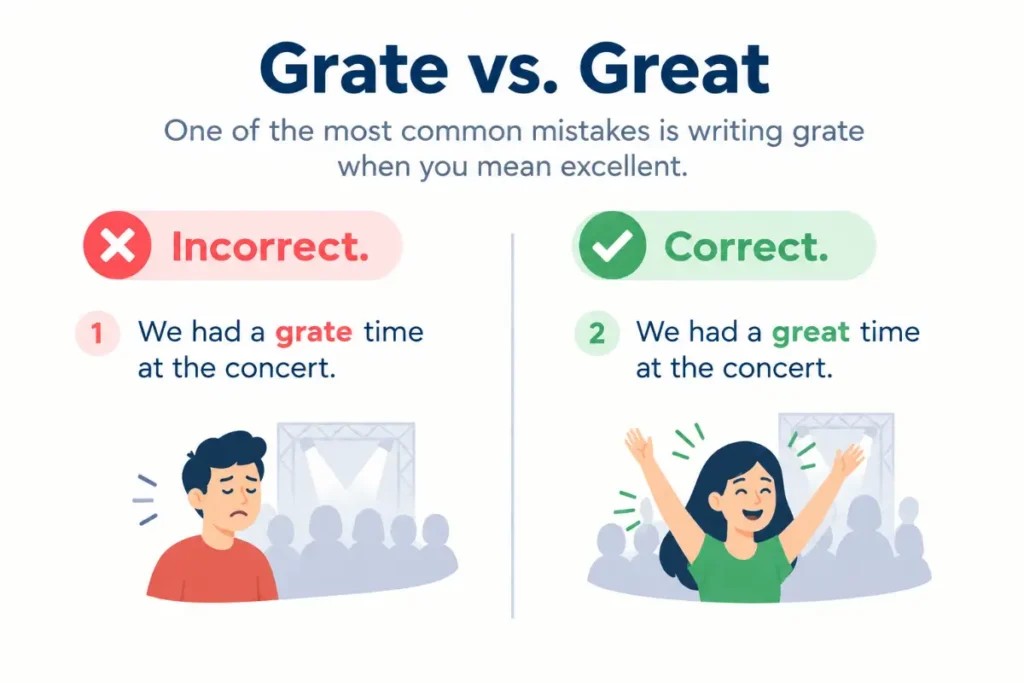
- Incorrect: You did a grate job on the presentation. Correct: You did a great job on the presentation. The sentence praises someone’s work.
- Incorrect: Can you great the cheese for the pizza. Correct: Can you grate the cheese for the pizza. The sentence asks someone to shred cheese.
- Incorrect: We had a grate vacation in Florida. Correct: We had a great vacation in Florida. The speaker describes a positive experience.
- Incorrect: This noise is starting to great on my nerves. Correct: This noise is starting to grate on my nerves. The phrase describes irritation.
- Incorrect: That was a grate idea for the school project. Correct: That was a great idea for the school project. The adjective expresses approval.
Common Mistakes and Misspellings
These errors often happen because people type what they hear or rely on familiar spelling patterns. The following distinctions help prevent them.
1. Using grate instead of great in praise. The phrase “You did a grate job” is incorrect when you want to compliment someone. Use great because it describes the quality of the work.
2. Using great instead of grate in cooking. A recipe that says “great the lemon zest” contains a spelling error. The intended verb is grate because it describes rubbing the lemon against a grater.
3. Confusing grating with greatness. Grating often describes an irritating sound or action, while greatness refers to exceptional quality or achievement. The endings provide useful clues about meaning.
4. Assuming identical pronunciation means identical usage. Homophones can sound alike while following different grammatical patterns. Always consider the sentence rather than choosing a spelling based on sound alone.
5. Trusting autocorrect without checking the sentence. A spelling tool may accept both words because each is valid English. It might not recognize that the selected word conflicts with your intended meaning. Read the full sentence after correcting a spelling suggestion.
A useful habit is to pause when either spelling appears in a sentence about praise, food preparation, irritation, or physical structures. Those contexts usually make the correct choice clear.
Pronunciation Guide
Both words are pronounced /ɡreɪt/ in the International Phonetic Alphabet, or IPA. They contain one syllable, and neither word carries a separate stress pattern because each consists of a single syllable.
You can break the sound into three parts.
- /ɡ/ is the opening sound in go.
- /reɪ/ contains the vowel sound heard in day.
- /t/ is the final sound in top.
Put the sounds together to pronounce both words as one syllable. The pronunciation is the same in standard American English.
Common Pronunciation Errors
Some English learners may pronounce the vowel too briefly or add an extra syllable. Others may expect the spelling difference to produce a different sound. Neither word needs an extra syllable, and the spelling alone doesn’t change its standard pronunciation.
For spelling practice, say the word aloud, then identify its meaning. If you are talking about a wonderful experience, write great. If you are describing the action of shredding vegetables, write grate.
Need another quick comparison? Read Sheath vs Sheathe and How to Use Each Word..
Etymology and Word Origin
The two words have different historical backgrounds, which helps explain why their spellings and meanings remain distinct.
The Origin of Grate
The verb grate entered English through older French forms associated with rubbing or scraping. Its history is connected to Latin words related to scratching and rubbing. Over time, English developed several uses linked to friction, including shredding food, producing a harsh sound, and causing irritation.
The noun grate developed around the idea of a framework or grid. A metal grid can cover an opening while allowing air or water to pass through. Although the noun and verb have related forms in English, their functions depend on the sentence.
The Origin of Great
Great comes from Old English, where the related form meant large, thick, or substantial. Its meaning developed over time to include importance, excellence, power, and distinction.
That history explains why great still describes physical size in expressions such as a great distance and importance in phrases such as a great achievement. It can also express approval in everyday speech, as in “That sounds great.”
The words therefore developed through different historical paths, even though modern English pronounces them alike. Their shared sound is a feature of the language, not evidence that they have the same origin or meaning.
Regional Usage
American English
Both words are standard in the United States. Great is common in everyday praise, as in “Great work” or “That sounds great.” Grate appears frequently in recipes and expressions such as “grate the cheese” and “the noise grates on me.”
American writers should choose the spelling based on meaning. There is no special US rule that changes one word into the other.
British English
British English uses both words with the same core meanings. A British recipe might ask you to grate a carrot, while a person might describe a concert as great.
Some accents pronounce the vowel differently from other accents, but the two words remain homophones for many British speakers. The spelling distinction stays the same.
Australian English
Australian English also recognizes both forms. Grate is common in cooking instructions and descriptions of irritating sounds. Great appears in praise, everyday conversation, and descriptions of important achievements.
The difference is semantic rather than regional. Australian writers don’t need a separate spelling rule for this pair.
Canadian English
Canadian English follows the same distinction. Both forms are standard, and their meanings match those used in American and British English.
For Canadian writers, the best approach is to consider the intended meaning and the word’s role in the sentence. Regional spelling conventions don’t affect this particular choice.
Grammar Rules and Part of Speech
Understanding the grammatical role of each word makes the spelling easier to remember. The verb and noun forms of grate behave differently from the adjective great.
How to Use Grate as a Verb
The verb grate describes an action or effect. It commonly appears in these patterns.
- Grate plus an object. “Grate the carrots before adding them to the soup.” The object tells you what is being shredded.
- Grate on plus a person. “His constant complaints grate on me.” This pattern describes irritation.
- Grate against plus a surface. “The metal edge grated against the concrete.” This construction describes friction or a harsh sound.
The verb changes form according to tense and grammatical context. You can write grate, grates, grated, or grating. For example, “She grates fresh nutmeg” uses the present tense, while “She grated fresh nutmeg” describes a completed action.
How to Use Grate as a Noun
As a noun, grate usually refers to a framework made of bars or a grid. It can appear as the subject or object of a sentence.
For example, “The drain grate needs cleaning” uses the noun as the subject’s modifier. In “Leaves covered the grate,” the word functions as the object of the verb.
Don’t confuse the noun grate with the tool called a grater. A grate is generally the grid or framework, while a grater is the implement used to shred food.
How to Use Great as an Adjective
Great usually appears before a noun or after a linking verb.
- Before a noun. “She gave a great speech.” The adjective describes the speech.
- After a linking verb. “The speech was great.” The adjective describes the subject.
- With a quantity or degree. “They made a great deal of progress.” The phrase indicates a large amount.
Great can describe quality, size, importance, intensity, or degree. The surrounding words help you understand which meaning applies.
Grammar and Punctuation
Neither word requires special punctuation. Use the normal rules of English sentence structure, capitalization, and punctuation.
Capitalize Great only when it appears at the start of a sentence or forms part of a proper name or established title. Grate follows the same capitalization rules. Neither word needs italics or quotation marks simply because you are using it.
In formal writing, choose the form that matches your intended meaning and make sure the surrounding grammar supports it.
Real Life Usage Examples
Different situations make the contrast easier to remember. The examples below show how the words appear in everyday communication and more formal writing.
Daily Conversation
- “Could you grate some fresh cheese for the tacos?” The speaker asks for a specific kitchen action.
- “That new restaurant was great.” The speaker gives a positive opinion about the experience.
Email and Workplace Communication
- “You did a great job organizing the client meeting.” The adjective praises someone’s work.
- “Please grate the sample material into smaller pieces before testing it.” The verb describes a physical process, although a technical workplace may use a more precise term depending on the material and equipment.
Academic Writing
- “The historian described the leader as a great influence on national policy.” The adjective communicates importance.
- “The friction produced a grating sound during the experiment.” The related form grating describes the sound produced by friction.
In academic writing, great can sometimes sound vague. Words such as significant, influential, substantial, or exceptional may express the intended meaning more precisely.
News and Journalism
- “The team delivered a great performance in the final match.” The adjective conveys praise.
- “Residents reported that the metal cover began to grate against the pavement during strong winds.” The verb describes repeated friction.
Journalists should favor precise descriptions over general praise when the facts support a more specific statement.
Literature and Storytelling
- “She believed that even a great hero could make a serious mistake.” The adjective describes the hero’s stature or importance.
- “The rusty gate grated against the stone wall as the wind pushed it open.” The verb helps readers imagine a harsh scraping sound.
These examples show that context determines the correct spelling. The words can appear in the same kind of writing while serving very different purposes.
Related and Confused Terms
Several related words can help you remember the distinction and choose more precise language.
- Grater. A kitchen tool with a rough or perforated surface used to shred food. A grater helps you perform the action described by the verb grate.
- Grating. This can describe the act of scraping or a harsh sound. It can also describe something irritating, as in “a grating voice.”
- Greatness. A noun that refers to exceptional quality, achievement, or importance. It shares its word family with great.
- Excellent. A synonym for great when describing very high quality. It often works well in professional and academic writing.
- Wonderful. A positive adjective that expresses delight or admiration. It is often interchangeable with great in casual conversation.
- Significant. An adjective that means important or meaningful. It can replace great when a formal context requires a more precise description.
- Grill. A device or surface used for cooking food with direct heat. A grill and a grater serve different purposes, even though both may appear in kitchen instructions.
- Homophone. A word that sounds like another word but has a different meaning and often a different spelling. Great and grate are homophones in standard American English.
These terms aren’t all synonyms. Some belong to the same word family, some describe related objects or ideas, and others explain the linguistic relationship between the two spellings.
Expert Editor Insight
An experienced editor checks meaning before correcting spelling. A spellchecker may accept both forms because each is a legitimate English word, so the software might miss an error such as “a grate idea.” The most reliable fix is to read the entire sentence and ask what the word needs to communicate. If the sentence praises an idea, great fits. If it describes shredding food or creating friction, grate is the better choice. Context is the deciding factor.
Key Takeaways
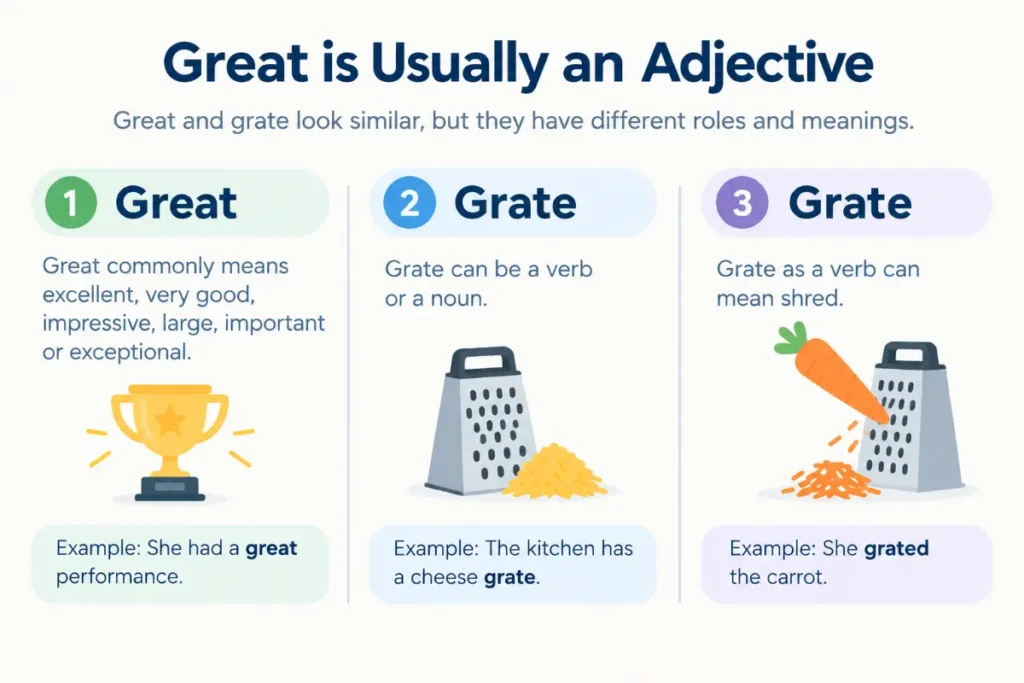
- Great is usually an adjective.
- Great commonly means excellent very good impressive large important or exceptional.
- Grate can be a verb or a noun.
- Grate as a verb can mean shred.
- Grate as a verb can mean irritate.
- Grate as a noun can mean a metal framework that covers or supports an opening.
- Grate and great are normally pronounced the same in American English.
- Context determines which spelling makes sense.
- Use great for positive descriptions such as great job and great idea.
- Use grate for actions such as grate the cheese and expressions such as grate on my nerves.
Need another quick comparison? Read Cubical vs Cubicle Meaning Difference and Correct Usage.
Conclusion
Grate or great comes down to meaning, not sound. Both are correct English words, but they serve different purposes. Use grate when describing shredding food, scraping a surface, producing an irritating sound, or referring to a metal grid. Use great when describing excellence, importance, size, or a positive experience.
Remember this simple trick. A grater helps you grate cheese, while a great meal is one you enjoy. That small connection can help you choose the right spelling in everyday conversation, schoolwork, and professional writing. When you’re unsure, reread the sentence and focus on the meaning you want to express.
FAQs
Is grate a real word?
Yes. Grate is a standard English word that can function as a verb or a noun. As a verb, it means to shred food, scrape a surface, or cause irritation. As a noun, it usually refers to a metal grid or framework. The word isn’t incorrect by itself. The mistake happens when someone uses it in place of great.
What does great mean?
Great usually means excellent, impressive, important, or substantial. You can describe a great meal, a great teacher, or a great achievement. It can also describe a large amount or degree, as in a great deal of work. The exact meaning depends on the sentence, but the word generally emphasizes quality, importance, size, or intensity.
Which spelling is correct for praise?
Great is the correct spelling when you want to praise a person, idea, experience, or achievement. For example, write “You did a great job” instead of “You did a grate job.” Both words sound alike, so focus on the intended meaning. If you’re expressing approval or admiration, great is usually the right choice.
How do you pronounce these two words?
Both words have the same pronunciation in standard American English. Their IPA transcription is /ɡreɪt/, and each word contains one syllable. Start with the sound in go, add the vowel sound in day, and finish with the sound in top. Since the spoken forms match, use meaning and grammar to determine the spelling.
Can great start a sentence?
Yes. Great can start a sentence when it functions as an adjective or an informal expression. For example, “Great results require patience” uses the adjective before a noun. “Great, I’ll see you tomorrow” uses the word as an expression of approval. Capitalize it at the beginning of the sentence, just as you would with other words.
What is a synonym for great?
Useful synonyms include excellent, wonderful, outstanding, impressive, and exceptional. The best choice depends on context. Excellent works well when describing quality, while significant emphasizes importance. Outstanding often suggests performance that stands above the rest. In formal writing, a precise synonym may communicate your meaning more clearly than the general word great.
Why do people confuse grate and great?
People confuse these spellings because they sound identical in standard American English. Fast typing, autocorrect, and unfamiliarity with their meanings can make the error more likely. Both forms also appear in common situations, from cooking instructions to casual compliments. Learning one clear example for each word makes the distinction easier to remember.
Is great appropriate in formal writing?
Yes. Great is a standard English word and can appear in formal writing. However, it may sound vague when you need to describe a specific finding, achievement, or result. Depending on the context, words such as significant, exceptional, or influential may communicate the point more precisely. Choose the term that best reflects the evidence and intended meaning.