
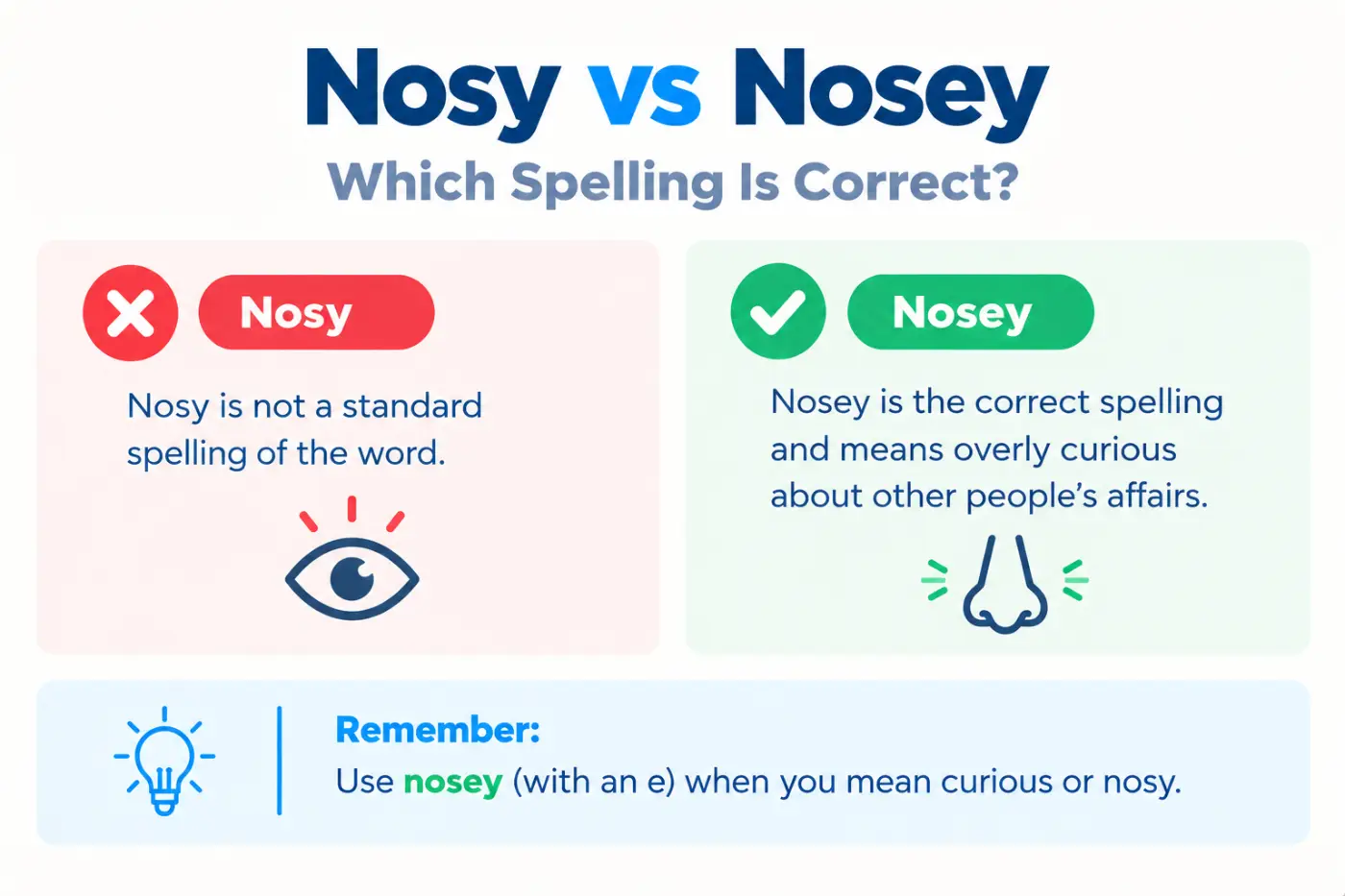
Have you ever paused while writing a sentence and wondered if you should spell the word nosy or nosey? Both spellings look right, and both appear in English dictionaries. The good news is that both forms are correct, but nosy is the preferred choice in American English.
The word describes someone who takes too much interest in other people’s private lives. A nosy neighbor might ask personal questions, read a message that isn’t meant for them, or keep track of everyone else’s business. Although curiosity can be a good thing, being overly curious about private matters can cross a line.
The confusion comes from the word nose. Adding the letter e before the y makes the second spelling look more closely related to the original word. However, English spelling doesn’t always follow a single pattern. Both versions have an established place in modern usage, so you don’t need to treat one as a simple typo.
The best choice depends on your audience and writing style. This guide explains the meaning, spelling, pronunciation, grammar, and regional usage of both forms, with practical examples to help you choose the right one.
Need another quick comparison? Read convertor vs converter Which Form Is Correct.
Quick Answer
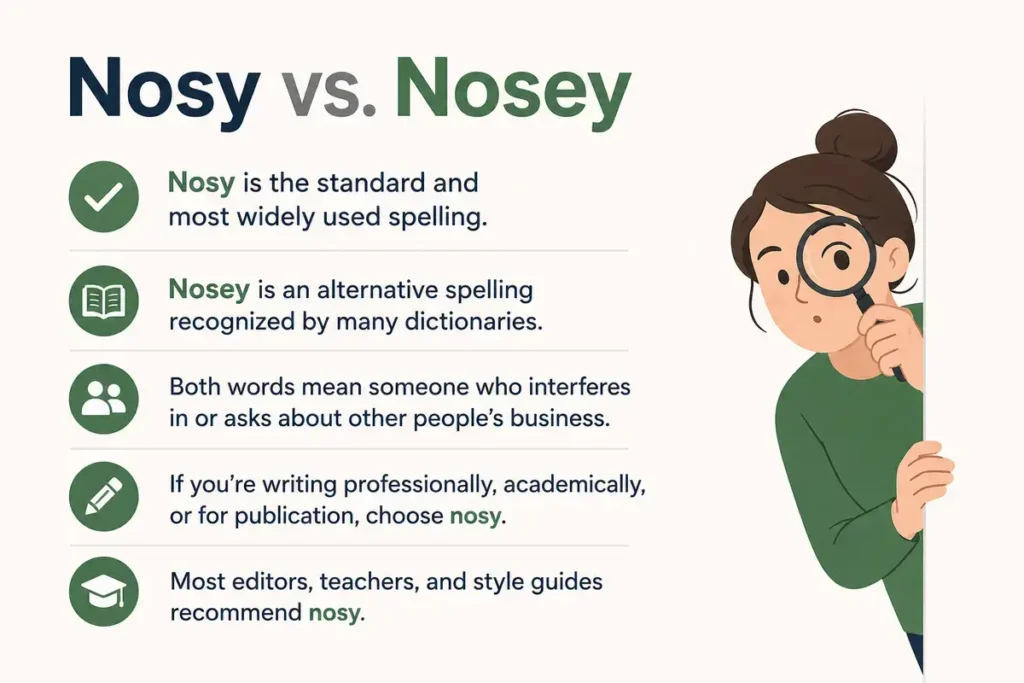
Both nosy and nosey are accepted English spellings of the same word. They describe someone who shows too much interest in other people’s private affairs. American writers generally prefer nosy, while nosey is also widely recognized, including in British English. The two forms have the same meaning and pronunciation, so the main difference is spelling preference rather than grammar or meaning.
What Is the Difference Between Nosy and Nosey
The difference is one letter. The shorter form drops the e from nose before adding y, while the longer form keeps it. Neither spelling creates a different meaning, and both can describe intrusive curiosity.
In American writing, nosy is the safer default. It is the form listed as the main entry by major American dictionaries, with nosey recognized as a variant. Oxford and Cambridge also recognize both spellings.
Consider these sentences.
- My nosy neighbor always asks who visits my house.
- My nosey neighbor always asks who visits my house.
Both sentences communicate the same idea. The first follows the spelling preference most familiar to American readers. The second is also understandable and accepted.
The distinction matters most when you need to follow a style guide, maintain consistency, or write for a specific audience. If you’re writing a school paper, business email, news article, or American website, choose nosy unless your organization has a different spelling preference.
Comparison Table
| Feature | Nosy | Nosey |
|---|---|---|
| Correct spelling | Yes | Yes |
| Meaning | Too curious about other people’s affairs | Same meaning |
| Part of speech | Adjective | Adjective |
| Pronunciation | /ˈnoʊzi/ in American English | /ˈnoʊzi/ in American English |
| American usage | Preferred spelling | Accepted variant |
| British usage | Accepted spelling | Accepted variant and common alternative |
| Formality | Informal and often disapproving | Informal and often disapproving |
| Example | That was a nosy question. | That was a nosey question. |
The key point is simple. Both forms work, but you should choose one and use it consistently throughout your writing.
Meaning and Definition
What Does Nosy Mean
Nosy is an adjective that describes a person who takes too much interest in matters that don’t concern them. It often refers to someone who asks personal questions, watches other people’s activities, or tries to learn private information without a good reason.
For example, a neighbor who repeatedly asks about your income, relationships, or family problems may seem nosy. A coworker who reads confidential messages over your shoulder may also be acting nosy.
The word usually carries a negative tone. It suggests that someone’s curiosity has gone beyond normal interest and started to invade another person’s privacy.
However, the meaning can depend on context. Friends may jokingly call one another nosy when they ask about a surprise party or a new relationship. In that situation, the word may sound playful rather than harsh.
What Does Nosey Mean
Nosey has the same meaning as nosy. It describes excessive curiosity about other people’s personal lives or business.
For example, you could write, My cousin is so nosey that she asks about every conversation she overhears. The sentence means exactly the same thing as it would with the shorter spelling.
Nosey isn’t simply a spelling error. Major dictionaries recognize it as an alternative form, so marking every instance as incorrect would be too strict. Still, writers in the United States generally favor nosy, especially in edited content.
Is It Always an Insult
Not necessarily. The word often expresses criticism, but the speaker’s tone and the situation matter.
Imagine a friend asks you several questions about a date you went on. You might smile and say, You’re being nosy. Your friend will probably understand that you’re teasing them.
Now imagine a coworker keeps asking about your salary after you’ve declined to discuss it. Calling that person nosy communicates a more serious concern about personal boundaries.
The word describes behavior, not necessarily a person’s entire character. Someone may ask an intrusive question once without being habitually nosy. In careful writing, describe the behavior you observed instead of making a sweeping judgment about the person.
Which Spelling Should You Use
Use nosy as your default spelling in American English. It is concise, widely recognized, and appropriate for everyday writing, school assignments, workplace messages, and most published material.
Nosey is also a legitimate spelling. You can use it when it matches the style of a publication, the wording of an established name, or your preferred spelling convention. The important point is not to confuse a less preferred variant with a spelling that has no standing in English.
A practical rule helps.
- For American English, choose nosy unless a style guide tells you otherwise.
- For British English, either spelling is understood. Follow the preference of your publisher or organization.
- For a quotation or an official name, preserve the original spelling.
- For any document with repeated uses of the word, keep the spelling consistent.
This approach removes the guesswork. You don’t need to correct someone automatically just because they use the longer form.
Ten Natural Example Sentences
These examples show how the word fits into everyday conversation, work, school, and other situations. The shorter spelling appears throughout because it is the preferred choice for American readers.
- My neighbor is so nosy that she knows when everyone on the block leaves for work.
- Stop being nosy and let your sister explain the surprise when she’s ready.
- The new employee felt uncomfortable when a coworker asked nosy questions about her salary.
- I don’t mean to be nosy, but are you planning to move soon?
- The teacher reminded the students not to read anyone else’s private messages because curiosity doesn’t excuse nosy behavior.
- His nosy questions during the meeting made the client reluctant to share more details.
- She ignored the nosy comments on social media and focused on her own plans.
- The reporter avoided nosy questions that had no connection to the public interest.
- A nosy character in the novel discovers a secret that changes the entire story.
- Please don’t be nosy about your friend’s personal life if they aren’t ready to talk about it.
Each sentence uses the adjective to describe a person, a question, a comment, or a type of behavior. Notice that the word can appear before a noun, as in nosy questions, or after a linking verb, as in you’re being nosy.
Common Spelling Mistakes
The spelling difference is easy to manage once you know that both versions exist. However, several related mistakes can cause confusion.
1. Treating nosey as completely incorrect. This is the most common misunderstanding. Nosey is an accepted variant, though nosy is the preferred American spelling. Write nosy neighbor in standard American prose unless you have a reason to retain the alternative.
2. Switching between spellings in one document. Using nosy in one paragraph and nosey in the next can make an article look poorly edited. Choose one form at the beginning and apply it consistently.
3. Confusing nosy with the noun nose. A nose is the part of the face used for breathing and smelling. Nosy describes intrusive curiosity. For example, She has a small nose describes appearance, while She is nosy describes behavior.
4. Using the wrong comparative form. The usual comparative is nosier, as in My neighbor is nosier than yours. The superlative is nosiest, as in He is the nosiest person in our office. These forms follow the normal spelling pattern for adjectives ending in y.
5. Assuming pronunciation changes with spelling. Both spellings have the same standard pronunciation. The extra e in nosey doesn’t create another syllable or change the vowel sound.
A useful editing habit is to check the whole sentence rather than focus on the spelling alone. Ask yourself if the word describes unwanted curiosity, then make sure your chosen spelling stays consistent.
Learn the difference in Tie vs Tye Correct Spelling and Usage.
Pronunciation Guide
Both forms sound alike. In American English, the International Phonetic Alphabet represents the pronunciation as /ˈnoʊzi/. In British English, a common transcription is /ˈnəʊzi/. The difference reflects the usual regional pronunciation of the vowel in words such as no and nose.
The word has two syllables. The stress falls on the first syllable, and the final syllable sounds like the ending in easy.
- Syllable breakdown. No sy.
- Easy pronunciation guide. NOH zee in American English.
- Stress pattern. Emphasize the first syllable.
- Common mistake. Don’t pronounce the added e in nosey as a separate sound.
You can use the same pronunciation for either spelling. The choice between them is a writing decision, not a speaking decision.
Etymology and Word Origin
The history of the word helps explain why both spellings look natural.
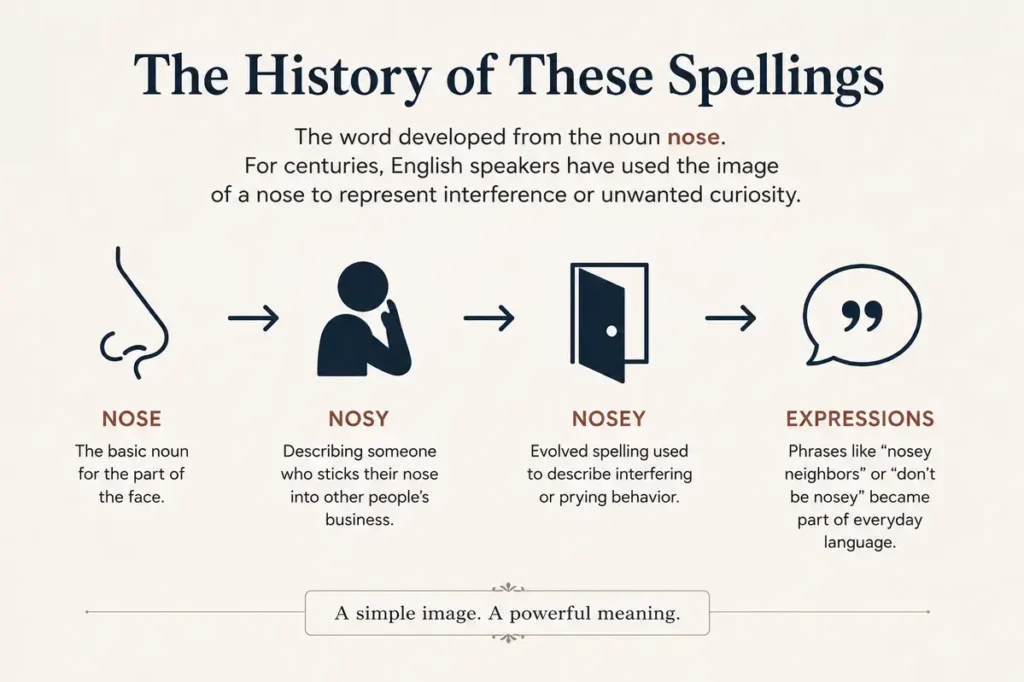
Nosy developed from nose plus the adjective forming suffix y. This suffix appears in many English words, including rainy, muddy, and messy. It helps turn a noun or another word into an adjective that describes a quality or condition.
The older sense of nosy referred to having a prominent or noticeable nose. Over time, the word developed the figurative meaning associated with excessive curiosity. Historical word records trace this sense of intrusive interest to the late nineteenth century.
The meaning follows a familiar pattern in English. A body part can become a metaphor for behavior. Someone who sticks their nose into another person’s business tries to involve themselves in matters that aren’t theirs to manage.
The spelling variation also makes sense in this history. The word comes from nose, so some writers preserve the e when forming nosey. Others use the shorter spelling nosy. Both forms remain recognizable in modern English.
You don’t need to memorize the full history to use the word correctly. Just remember that its meaning has moved beyond physical appearance and now commonly describes intrusive curiosity.
Regional Usage
The two spellings are accepted in several varieties of English. The main practical difference is the spelling preference of your audience.
American English
In the United States, nosy is the preferred spelling. American dictionaries recognize nosey as a variant, but the shorter form is a reliable choice for edited writing.
Use nosy in schoolwork, professional emails, articles, and everyday messages. For example, The nosy neighbor asked why we were selling the house sounds natural in American English.
Nosey isn’t automatically wrong in the United States. If someone writes it in a text message or personal note, readers will generally understand it. Still, nosy is the better default when you want to follow common American editorial practice.
British English
British English also recognizes both forms. Dictionaries record nosy and nosey as alternatives, and British readers understand the meaning of each.
The expression nosey parker is also associated with British English. It refers to a person who takes too much interest in other people’s affairs. Both nosey parker and nosy parker appear in usage, so consistency remains the best guide.
Australian English
Both spellings are understandable to Australian readers because they belong to established English usage. There is no strong meaning distinction between them. For a publication aimed at Australian readers, follow its house style rather than assume that the longer spelling is required.
Canadian English
Canadian English recognizes both forms as well. For most Canadian writing, nosy is a straightforward choice, especially when the publication follows North American spelling preferences. A local style guide should take priority if it specifies another form.
Across all four varieties, the basic meaning stays the same. The safest choice is to use the spelling that fits your audience and apply it consistently.
Grammar Rules and Part of Speech
The word is mainly used as an adjective. It describes a person, question, habit, comment, or action associated with excessive curiosity.
How to Use It Before a Noun
An adjective can appear directly before the noun it describes.
- The nosy neighbor watched us unload the truck.
- She asked a nosy question about my relationship.
- We received several nosy comments about our plans.
In each example, the adjective gives more information about a noun. It tells readers what kind of neighbor, question, or comment the sentence describes.
How to Use It After a Linking Verb
The adjective can also follow linking verbs such as be, seem, and become.
- Your questions are getting nosy.
- He seemed nosy during the interview.
- The conversation became nosy and uncomfortable.
Here, the adjective describes the subject rather than appearing directly before a noun.
Comparative and Superlative Forms
The usual comparative form is nosier. Use it when comparing two people or behaviors. The superlative form is nosiest, which identifies the strongest example in a group.
- My older brother is nosier than I am.
- That was the nosiest question anyone asked all day.
- She became less nosy after we explained the situation.
You can also use more nosy and most nosy, although nosier and nosiest are the usual compact forms. Avoid forms such as nosyer or nosyest because they don’t follow the standard spelling pattern.
Related Adverb and Noun Forms
The adverb is nosily, which describes an action carried out in an intrusive way. The noun is nosiness, which refers to the habit or quality of being too curious about other people’s affairs.
For example, He nosily read the note on the desk describes an action. Her nosiness annoyed the entire group describes a behavior or personal quality.
These forms use the same basic word family. If you can recognize the adjective, the related forms become easier to understand.
Punctuation and Formality
The adjective doesn’t require special punctuation. Use it according to normal sentence rules, and capitalize it only when it begins a sentence or appears in a title that follows title case.
The word is informal and often disapproving. It’s perfectly natural in conversation and general writing, but formal documents may benefit from a more precise term. For example, an employee report could describe a question as intrusive rather than simply calling it nosy.
Real Life Usage Examples
The meaning stays consistent across settings, but the tone can change with the audience and purpose. A casual conversation allows more playful language, while professional or academic writing often calls for more precise wording.
Daily Conversation
People often use the word when someone asks too many personal questions or shows too much interest in another person’s affairs.
- You’re being nosy. I’ll tell you about the trip when I’m ready.
- My little brother is nosy and always wants to know what everyone is doing.
The first example sounds like a direct response to someone’s behavior. The second describes a familiar habit.
Email and Workplace Communication
At work, the term can describe uncomfortable questions or unwanted attention. However, it may sound judgmental in a message to a colleague or manager.
- Several employees felt uncomfortable with the nosy questions about their family circumstances.
- Please keep the discussion focused on the project and avoid questions that could seem intrusive.
The second example uses a more neutral alternative. This can be a better choice when you want to address a problem without creating unnecessary conflict.
Academic Writing
Academic writing usually benefits from clear descriptions of behavior rather than casual labels. The word can still appear when discussing language, social behavior, or a character’s actions.
- The novel portrays the nosy neighbor as a source of conflict within the community.
- The study examined how people respond to questions they perceive as nosy.
These sentences use the word to describe behavior and perception. In a research paper, the term should fit the subject and the tone of the discussion.
News and Journalism
Journalists may use the adjective in a feature story, an interview, or a description of everyday social behavior. Straight news reports often favor neutral terms unless the word appears in a quotation or clearly reflects the subject’s behavior.
- Residents complained about nosy neighbors who watched visitors entering the building.
- The columnist argued that intrusive questions can cross the line between public interest and private curiosity.
The second example shows how a more precise phrase can make a report sound less judgmental.
Literature and Storytelling
Writers can use the word to establish character traits, create humor, or build tension around a secret.
- The nosy shopkeeper noticed the stranger slipping a letter into his coat.
- Everyone in the village knew Martha was nosy, but her curiosity eventually helped solve the mystery.
In storytelling, the adjective quickly tells readers how a character behaves. It can also suggest that someone may uncover information that other characters want to keep private.
Related and Confused Terms
Several words describe curiosity or interference, but they don’t all carry the same meaning. Choosing the right one helps you express the level of interest or intrusion you have in mind.
1. Curious. A curious person wants to learn or understand something. The word is usually positive or neutral, unlike nosy, which often suggests a lack of respect for privacy.
2. Inquisitive. This describes someone who asks questions and seeks information. It can be positive in learning and research, but context can make it sound intrusive.
3. Prying. This term describes an attempt to uncover information that someone would rather keep private. It often carries a stronger negative tone.
4. Snoopy. This informal word describes someone who tries to discover other people’s private information. It is close in meaning to nosy and can suggest watching or investigating secretly.
5. Intrusive. This describes behavior that crosses personal boundaries. It can apply to questions, actions, interruptions, or unwanted attention.
6. Meddlesome. A meddlesome person interferes in other people’s affairs, often by trying to influence their decisions. The term emphasizes interference rather than curiosity alone.
7. Interfering. This describes someone who gets involved in matters that don’t concern them. It often suggests unwanted involvement or attempts to control a situation.
8. Discreet. This describes someone who respects privacy and knows when to avoid asking personal questions. It offers a useful contrast to nosy behavior.
The closest alternatives are prying and snoopy. Curious and inquisitive can be positive, so they aren’t always suitable replacements. Intrusive works well when you want to describe a behavior without labeling someone’s entire personality.
Expert Editor Insight
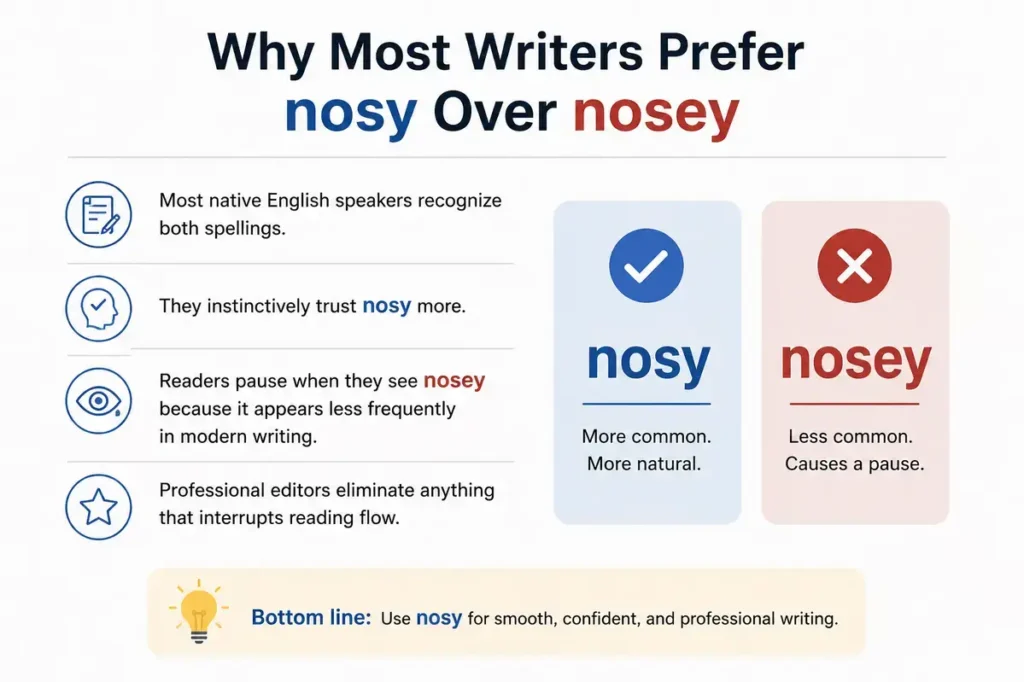
An experienced editor would treat both spellings as legitimate but would usually select nosy for American English. The extra e in nosey feels natural because readers recognize the noun nose, yet familiar spelling patterns don’t always determine the standard form of a derived word. Editing software may accept both forms or flag one according to its selected dictionary and language settings. A spelling warning alone doesn’t prove that a word is incorrect. The best editing practice is to check the intended meaning, confirm the audience’s spelling preference, and keep the chosen form consistent throughout the document.
Need another quick comparison? Read Breakroom or Break Room Which Spelling Is Correct.
Conclusion
The choice between nosy vs nosey comes down to spelling preference rather than meaning. Both forms are accepted in English, and both describe someone who takes too much interest in other people’s private affairs. However, nosy is the preferred spelling in American English and the most practical choice for everyday writing, school assignments, and professional content. Nosey remains a valid alternative, so you don’t need to treat it as a misspelling.
Remember this simple editing tip. If you’re writing for an American audience, choose nosy and use it consistently throughout your document. That small decision keeps your writing clear, polished, and easy to read.
FAQs
Is Nosey a Real Word?
Yes. Nosey is a recognized English spelling, not merely a typing error. It has the same meaning as nosy and describes someone who takes too much interest in other people’s private affairs. Major dictionaries recognize the longer form as a variant. In American English, however, nosy is generally the preferred spelling for standard edited writing.
What Does Nosy Mean?
Nosy describes someone who shows excessive interest in other people’s private lives or business. A nosy person might ask unwanted personal questions, listen to private conversations, or try to discover information that doesn’t concern them. The word usually sounds critical, although friends sometimes use it playfully. Its meaning depends on the situation and the speaker’s tone.
Which Spelling Should I Use in American English?
Choose nosy for most American English writing. It is the preferred spelling in American dictionaries and works well in school assignments, emails, articles, and everyday messages. Nosey remains an accepted variant, so you don’t need to treat it as a serious spelling error. If a publication or employer has a style guide, follow that guide consistently.
How Do You Pronounce Nosy and Nosey?
Both forms have the same pronunciation. In American English, the IPA transcription is /ˈnoʊzi/. The word has two syllables, with stress on the first. A simple pronunciation guide is NOH zee. British English commonly uses /ˈnəʊzi/, reflecting a regional difference in the vowel sound. The extra e in the longer spelling doesn’t change how the word sounds.
Is Nosy an Insult?
It can be. The word often criticizes someone for asking personal questions or interfering in private matters. However, friends and family members may use it jokingly when someone asks about a surprise or a new relationship. The tone, setting, and behavior all affect how the word comes across. In a sensitive workplace discussion, intrusive or overly personal may sound more neutral.
What Is a Good Synonym for Nosy?
Prying and snoopy are close synonyms when you want to describe unwanted curiosity. Inquisitive and curious are milder alternatives that can suggest a genuine desire to learn. Intrusive is useful for describing behavior that crosses personal boundaries, while meddlesome emphasizes interference in someone else’s affairs. Choose the word that best captures the behavior instead of treating every synonym as interchangeable.
Can Nosy Start a Sentence?
Yes. You can start a sentence with the adjective just as you can with other adjectives. For example, Nosy neighbors often notice changes in the community. The spelling doesn’t affect sentence position or grammar. You can also use the word before a noun or after a linking verb, as in That question seems nosy. Both positions are grammatically correct.
Is Nosy Appropriate for Formal Writing?
It depends on the purpose and audience. The word is widely understood, but its informal and often disapproving tone may not suit every professional or academic document. If you need neutral language, consider intrusive, overly personal, or inappropriate instead. In literary analysis or a discussion of everyday speech, nosy may be entirely suitable. Always choose wording that fits the context.