
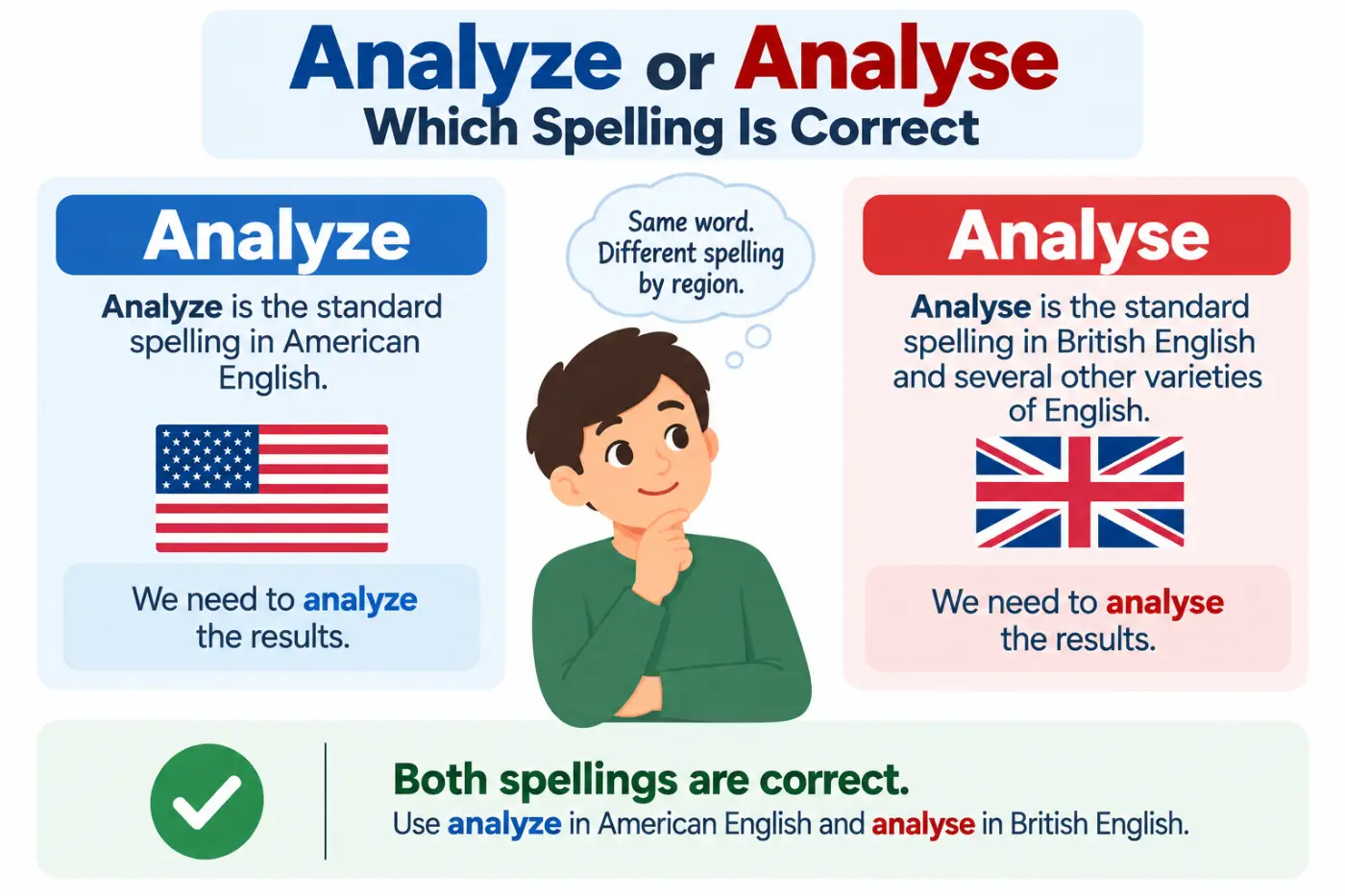
If you’ve ever wondered if you should write analyze or analyse, you’re not alone. Both spellings are correct, but the right choice depends on the type of English you’re using. American English uses analyze, while British English generally uses analyse.
The confusion comes from a common difference between American and British spelling. Some words that end in an unstressed sound use different letter patterns across these varieties of English. This difference doesn’t change the meaning of the word, its pronunciation in any major way, or its role in a sentence.
The easiest way to remember the rule is to connect the spelling to your audience. If you’re writing for an American reader, use analyze. If you’re following standard British English conventions, use analyse. Other English varieties may follow British spelling in many contexts, although individual style guides can differ.
Understanding this simple distinction will help you write clearer emails, school assignments, reports, articles, and professional documents. You’ll also learn how to use the word correctly, avoid related spelling mistakes, and keep your writing consistent from beginning to end.
Still confused? Compare ally vs allie Meaning Spelling and Usage.
Quick Answer.
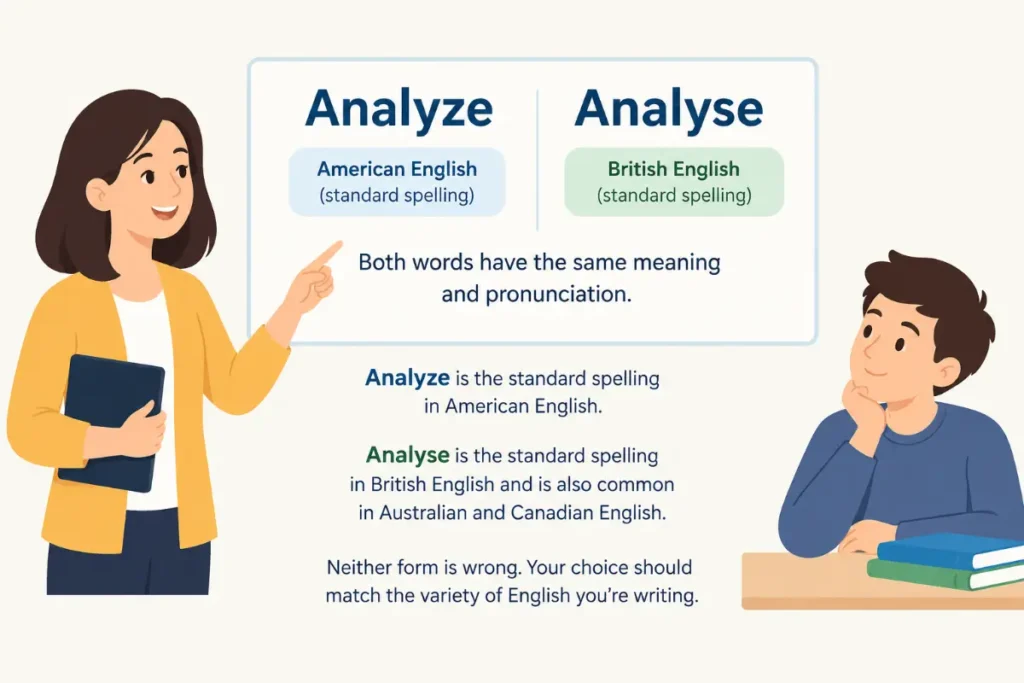
Analyze is the standard spelling in American English. Analyse is the standard spelling in British English. Both forms mean to examine something carefully, study its parts, or interpret information to reach a conclusion. Neither spelling is universally incorrect. Choose the form that matches your audience and follow the same convention throughout your document.
Featured Snippet Definition.
Analyze and analyse are two regional spellings of the same English verb. Both mean to examine information, evidence, data, or a situation carefully to understand its meaning. American English uses analyze, while British English generally uses analyse. The difference is spelling rather than meaning, and the two forms serve the same grammatical function.
Comparison Table.
| Feature | Analyze | Analyse |
|---|---|---|
| Standard spelling | American English | British English |
| Meaning | Examine carefully | Examine carefully |
| Part of speech | Verb | Verb |
| Pronunciation | /ˈænəˌlaɪz/ | /ˈænəlaɪz/ |
| Formality | Standard and formal | Standard and formal |
| Common contexts | US schools, offices, reports, research | UK schools, offices, reports, research |
| Related noun | Analysis | Analysis |
| Related adjective | Analytical | Analytical |
| Example | We need to analyze the results. | We need to analyse the results. |
The main difference is regional spelling. Both forms work in formal and informal writing, so your choice should depend on your intended audience and any style guide you need to follow.
Meaning and Definition.
The verb means to study something closely so you can understand its structure, purpose, causes, or meaning. You might examine a business report, interpret a poem, study a medical test result, or look for patterns in customer behavior.
The word often describes a process that goes beyond simply looking at information. You break a subject into parts, examine how those parts relate, and use what you learn to reach a reasoned conclusion.
For example, reading a sales report tells you what happened. Examining the figures to identify why sales dropped is a form of analysis.
The Meaning of Analyze.
In American English, analyze is the usual spelling. It appears in school assignments, scientific papers, business reports, news articles, and everyday conversations.
Consider this example.
The research team will analyze the survey results before making a recommendation.
Here, the team will examine the responses and use the findings to guide its decision. The verb describes a deliberate process of investigation.
The spelling follows the American convention of using the ending with z in this word and several related verbs, including organize and recognize.
The Meaning of Analyse.
In British English, analyse is the usual spelling. It has the same meaning and grammatical role as the American form.
Consider this example.
The research team will analyse the survey results before making a recommendation.
The sentence communicates exactly the same idea. Only the spelling changes.
The British form appears in educational materials, government documents, newspapers, academic work, and professional communication in the United Kingdom. It is also common in other English speaking regions that follow British spelling conventions.
Is Analyse an Incorrect Form.
No. Analyse is a legitimate English spelling, not a typo or a misspelling. It is the normal choice in standard British English.
Likewise, analyze is not an incorrect American version of a British word. Both forms belong to established English spelling systems.
Problems arise when a writer uses one convention inconsistently. For example, an American report might use analyze in one paragraph and organise in another. That mix can make the document look poorly edited, even though each word may be correct within a different regional system.
Key Differences Explained.
Spelling.
The clearest difference is the final part of the verb. American English uses analyze, with a z, while British English generally uses analyse, with an s.
This pattern also appears in several related words.
- American English uses organize, while British English commonly uses organise.
- American English uses recognize, while British English commonly uses recognise.
- American English uses criticize, while British English commonly uses criticise.
- American English uses apologize, while British English commonly uses apologise.
These examples show a broader spelling pattern, but English has exceptions. You shouldn’t assume that every word ending in a similar sound follows the same rule. Check a trusted dictionary or your chosen style guide when a spelling looks unfamiliar.
Meaning.
Both spellings express the same meaning. Neither form suggests a deeper, more detailed, or more scientific type of examination.
For example, an American researcher might analyze climate data, while a British researcher might analyse the same data. Their spelling choices don’t change their methods or findings.
Grammar.
Both forms function as verbs. They take the same sentence patterns and follow the same grammatical rules.
You can write that someone will analyze a problem, is analyzing a problem, or has analyzed a problem in American English. In British English, the corresponding forms are analyse, analysing, and analysed.
The underlying grammar stays the same. Only the spelling changes.
Pronunciation.
Both forms generally have the same pronunciation. The first syllable receives the main stress, and the ending sounds like the word eyes.
Regional accents can affect the exact vowel sounds, but the final s in the British spelling does not create a different word or meaning. The spelling difference is not a reliable guide to a major pronunciation difference.
Formality.
Both forms are appropriate for formal writing. You can use either one in a university paper, business report, professional email, or published article, provided it matches the spelling convention required for the document.
Using the British form in an American publication may look unusual to its readers. The reverse can happen in a British publication. That is a matter of regional style, not a difference in quality or correctness.
Regional Usage.
American English strongly favors analyze. British English generally favors analyse. Australian and New Zealand English commonly use analyse, while Canadian English can show variation depending on the word and the style guide.
Regional preferences aren’t absolute rules for every publisher or organization. Some international companies and academic journals use their own editorial standards, so follow those standards when they apply.
Which Spelling Should You Use.
Choose the spelling that matches your readers. If you’re writing for a US school, American company, or American publication, use analyze. If you’re writing for a UK audience and following British conventions, use analyse.
When a project provides a style guide, that guide should take priority over your personal preference. Consistency matters most when a document contains many related words with regional spelling differences.
For American Readers.
Use analyze in essays, work emails, reports, presentations, research summaries, and online content intended for a US audience.
For example, write, “We will analyze the customer feedback before updating the product.” This is the expected spelling in standard American English.
For British Readers.
Use analyse in the same situations when following standard British English.
For example, write, “We will analyse the customer feedback before updating the product.” The meaning remains identical, but the spelling fits the British convention.
For International Audiences.
Start by checking the publication’s spelling policy. An international organization might prefer American English, British English, or another established house style.
If no policy exists, consider your main audience and use one spelling system consistently. Avoid switching forms simply because your spellchecker suggests a different regional variant.
Sentence Examples.
The following ten examples show how the verb works in natural English. The first five use American spelling, and the remaining five use British spelling.
American English Examples.
- I need to analyze my monthly expenses before changing my budget.
- The students will analyze the poem and explain its main theme.
- Our team is analyzing customer feedback to improve the service.
- The doctor will analyze the test results before discussing the next steps.
- The journalist analyzed the public records to understand how the decision was made.
British English Examples.
- The students will analyse the poem and discuss its central message.
- We need to analyse the figures before presenting our findings.
- The committee is analysing the results of the public consultation.
- Researchers analysed the samples to identify possible patterns.
- She learned to analyse arguments carefully before forming an opinion.
Each example uses the verb to describe a careful examination of information, evidence, or ideas. The choice between the two spellings depends on the English variety used in the surrounding document.
Common Spelling Mistakes.
The difference between the two main forms is simple, but several related mistakes can cause confusion. Some involve regional spelling, while others involve grammar or word choice.
Mixing Regional Spellings.
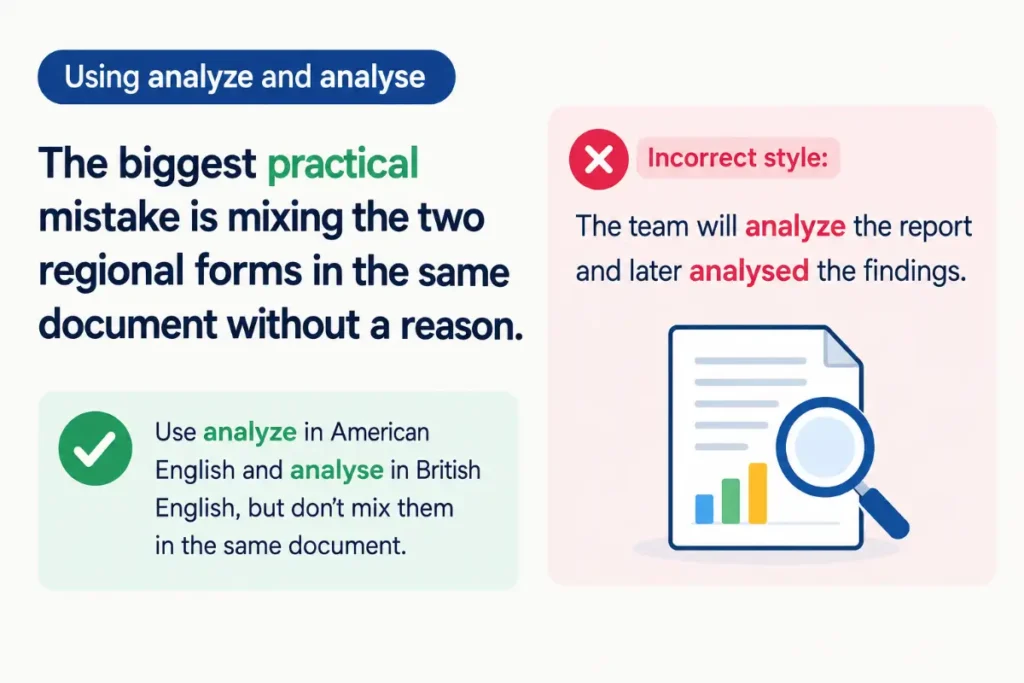
Incorrect for a consistent American style.
The company will analyse the results and organize a new meeting.
Correct American version.
The company will analyze the results and organize a new meeting.
Correct British version.
The company will analyse the results and organise a new meeting.
The first sentence mixes two regional conventions. Although readers will understand it, an editor may revise it to maintain a consistent style.
Confusing the Verb With the Noun.
Analyze and analyse are verbs. Analysis is the noun used to describe the process or result of examining something.
Incorrect.
We completed an analyze of the survey.
Correct.
We completed an analysis of the survey.
The noun analysis works in both American and British English. Its plural form is analyses, which can be confusing because it looks similar to the British verb spelling.
Using the Wrong Verb Ending.
The past tense and continuous forms need the correct endings.
American English uses analyzed and analyzing. British English commonly uses analysed and analysing.
For example, an American writer would say, “The team is analyzing the figures.” A British writer would usually say, “The team is analysing the figures.”
Both forms follow standard verb grammar. Choose the regional spelling before applying the ending.
Confusing Analysis and Analyses.
Analysis is the singular noun. Analyses is its plural form.
For example, “The analysis was detailed” refers to one examination. “The analyses were detailed” refers to multiple examinations.
The pronunciation also changes. Analysis ends with an ee sound, while analyses has a different final sound that resembles ease. This distinction matters in both major spelling systems.
Assuming One Form Is Always Wrong.
A common mistake is correcting the British form in a British document simply because a spellchecker uses American English.
For example, changing analyse to analyze in a UK report may create an unwanted style inconsistency. Before correcting a flagged word, check the language setting and the document’s intended audience.
A spelling tool can identify a possible issue, but it cannot always determine the right regional choice without context.
Learn the difference in faring or fairing Which One Is Correct.
Pronunciation Guide.
Both spellings usually have the same pronunciation. The main stress falls on the first syllable, and the final part sounds like the English word eyes.
- IPA. /ˈænəlaɪz/.
- Syllable breakdown. The word has three syllables: an, a, and lyze.
- Easy pronunciation guide. Say the first syllable like the beginning of the word animal, then add a short unstressed middle syllable and finish with a sound like eyes.
- Stress pattern. Put the strongest stress on the first syllable.
The exact vowel sounds may vary slightly across regional accents. However, the spelling difference between American and British English doesn’t normally signal a different pronunciation.
Common Pronunciation Errors.
Some speakers place too much stress on the final syllable or pronounce the middle vowel too strongly. Others assume the s in the British spelling must sound like the s in words such as basic. In this verb, the ending generally has a voiced z sound in both forms.
The easiest way to remember the pronunciation is to focus on the sound of the word rather than trying to pronounce each letter separately.
Etymology and Word Origin.
The word has a long history that connects modern English to ancient Greek. Understanding its roots helps explain why it refers to examining something by separating it into parts.
The English verb came through French and Latin, with its history ultimately linked to the Greek word analysis. That Greek term referred to loosening or breaking something apart, a sense that developed into the idea of examining the parts of a subject.
Over time, the word gained its familiar modern meaning. Today, it can describe studying a poem, examining financial records, investigating scientific evidence, or interpreting a person’s argument.
The American and British spellings developed as English spelling conventions grew apart. The spelling with z became standard in the United States, while the spelling with s remained common in British English. Both forms preserve the same core meaning and grammatical function.
The history also explains the related noun analysis. When you analyze something, you carry out an analysis. When you analyze several separate subjects or perform several separate examinations, you may refer to multiple analyses.
Regional Usage.
The two spellings are both standard, but their popularity depends on the English variety and the organization publishing the text.
American English.
American English uses analyze as the standard spelling. This form appears in US dictionaries, school materials, newspapers, professional documents, and academic publications.
The same general spelling pattern applies to words such as organize and recognize. However, individual words can have their own conventions, so don’t treat the pattern as a rule without exceptions.
For American readers, analyse may look unfamiliar or appear as a spelling error in software set to US English. It remains a valid British form.
British English.
British English generally uses analyse. The spelling is common in British education, journalism, government writing, and professional communication.
The related verbs organise, recognise, and criticise also commonly use s in British spelling. Some British publishers and organizations may adopt different conventions, so their style guides should take priority.
American spelling isn’t inherently incorrect in every British context. A publication that follows American English can use analyze consistently, even when its readers live in the United Kingdom.
Australian English.
Australian English generally follows the British spelling analyse. The form is widely used in Australian education, government communication, and professional writing.
Still, Australian organizations may set their own editorial rules. If you’re preparing a report for an employer or a publication, follow its stated style rather than relying only on a general regional preference.
Canadian English.
Canadian English includes features associated with both American and British spelling. For this verb, analyse is a common standard form, although organizational preferences can vary.
Canadian writers should check the spelling conventions used by their school, employer, publisher, or chosen dictionary. Consistency is more useful than assuming that every Canadian spelling must match either the United States or the United Kingdom.
Grammar Rules and Part of Speech.
The word is a regular verb. It describes the action of examining information, evidence, ideas, or objects to understand them more clearly.
Both spellings follow the same grammatical patterns. The regional difference remains in the written form.
How to Use the Verb in a Sentence.
The verb commonly takes a direct object. That object tells readers what someone is examining.
Examples include the following.
- The manager will analyze the report.
- The class analysed the speech.
- Researchers are analyzing the results.
- The committee has analysed the evidence.
You can also use the verb without a direct object when the subject of the examination is already clear from the context. For example, “We need more time to analyze” may work in a conversation where everyone knows what the team is studying. In most formal writing, naming the object makes the sentence clearer.
Verb Forms.
| Grammatical form | American English | British English |
|---|---|---|
| Base form | Analyze | Analyse |
| Third person singular | Analyzes | Analyses |
| Past tense | Analyzed | Analysed |
| Present participle | Analyzing | Analysing |
| Past participle | Analyzed | Analysed |
Pay special attention to the third person singular. In American English, analyzes is the verb form used with he, she, or it. In British English, analyses serves that role.
For example, “She analyzes the data” is standard American English. “She analyses the data” is standard British English.
Don’t confuse the British verb form analyses with the plural noun analyses. The spelling is the same, but grammar and sentence structure tell you the role each word plays.
Common Grammar Patterns.
The verb appears in several common structures.
- Analyze something. “The team analyzed the results.”
- Analyze something for something. “The lab analyzed the sample for signs of contamination.”
- Analyze how something works. “The engineer analyzed how the machine operates.”
- Analyze why something happened. “The researchers analyzed why attendance declined.”
- Analyze something to do something. “The company analyzed customer feedback to improve its service.”
These patterns help writers explain both the subject of an investigation and its purpose.
Formal and Informal Usage.
The verb works in both formal and informal settings. You can analyze a text message, a business plan, a political speech, or a scientific result.
The formality comes from the surrounding language and the context. In an academic paper, you might write, “The study analyzes the relationship between sleep and memory.” In everyday conversation, you might say, “Let’s analyze what went wrong.”
Both sentences use the verb correctly.
Punctuation and Capitalization.
The verb doesn’t need special punctuation. Use the usual rules for sentence structure, commas, and quotation marks.
The word is normally lowercase unless it starts a sentence or appears in a title where your chosen capitalization style requires an initial capital. Capitalization doesn’t change the spelling rule.
For example, “We will analyze the report” follows standard sentence capitalization. In a title, you might write “How to Analyze a Report” using title case.
Real Life Usage Examples.
The verb appears in everyday speech, professional communication, schoolwork, journalism, and storytelling. Its meaning stays consistent, although the type of material being examined changes with the situation.
Daily Conversation.
- “Can you help me analyze these expenses before I book the trip?”
- “We should analyze what happened before deciding what to do next.”
These examples show how the word can describe practical thinking. It doesn’t need to refer to complex mathematics or formal research.
Email and Workplace Communication.
- “I’ll analyze the latest sales figures and send you a summary by Friday.”
- “Could you analyse the customer feedback before our next planning meeting?”
The first sentence follows American spelling. The second follows British spelling. Both communicate a clear task and expected outcome.
Academic Writing.
- “This paper analyzes the themes of identity and belonging in the novel.”
- “The researchers analysed the survey responses to identify common patterns.”
Academic writing often uses the verb to describe how researchers examine evidence or how students interpret a text. Choose the spelling required by the institution or journal.
News and Journalism.
- “The report analyzes the effects of rising housing costs on local families.”
- “The newspaper analysed the figures before publishing its investigation.”
News writers use the word when they explain evidence, identify trends, or interpret events. It can signal that a report goes beyond repeating facts and examines what those facts reveal.
Literature and Storytelling.
- “Maya analyzed the letter again, searching for a clue she had missed.”
- “He began to analyse every word of their conversation.”
In storytelling, the verb can reveal a character’s thought process. It suggests that the person is looking for meaning, motives, or hidden connections rather than simply observing what happened.
Related and Confused Terms.
Several words share a close meaning with the verb, but they aren’t always interchangeable. Choosing the right one helps you explain exactly what kind of thinking or examination you mean.
1. Analysis. This is the noun for the process or result of examining something. You analyze a problem, then present your analysis.
2. Analyses. This is the plural form of analysis. It can also be the British English third person singular verb form. The sentence determines which meaning applies.
3. Examine. This means to inspect or study something carefully. It can describe a broad review without suggesting that you break a subject into smaller parts.
4. Evaluate. This means to judge the quality, value, effectiveness, or importance of something. Analysis can support an evaluation, but the two actions aren’t identical.
5. Interpret. This means to explain the meaning of information, behavior, evidence, or a work of art. Analysis may help you reach an interpretation.
6. Assess. This means to estimate or judge a situation, condition, or level of performance. An assessment often leads to a decision.
7. Investigate. This means to look into a question or event to discover facts. Investigation may include gathering evidence and analyzing it.
8. Break down. This is a more conversational expression that means to separate a subject into smaller parts to make it easier to understand. It often works well when explaining a complex idea to a general audience.
These alternatives add variety to your writing, but don’t replace the original verb automatically. For example, you might analyze survey results, evaluate a proposal, and interpret a pattern. Each verb describes a different part of the thinking process.
Expert Editor Insight.
An experienced editor looks at the audience before changing a regional spelling. The goal isn’t to make every document follow one universal version of English. It’s to make the writing correct and consistent for its intended readers. A spelling checker may flag the British form in an American document or the American form in a British document simply because of its language settings. Before accepting a correction, check the document’s style guide and review related words for consistency. A useful editing habit is to search for both spellings in a long document so you can catch accidental changes between regional conventions.
Key Takeaways
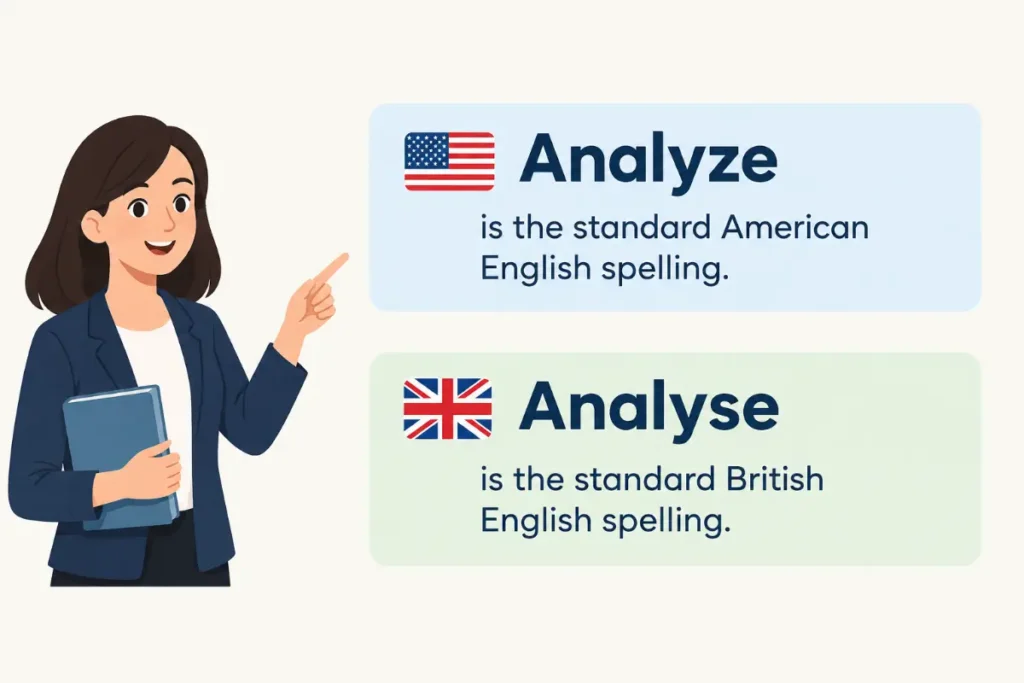
- Analyze is the standard American English spelling.
- Analyse is the standard British English spelling.
- Both forms have the same meaning.
- Both forms have essentially the same pronunciation.
- Analyze functions as a verb.
- The noun form is analysis in both varieties.
- American English uses analyzed and analyzing.
- British English uses analysed and analysing.
- The safest choice depends on your audience and style guide.
- Consistency matters more than personal preference.
Many readers also check Miss vs Missed Meaning Grammar and Usage 2026.
Conclusion.
Analyze or analyse comes down to regional spelling, not meaning. American English uses analyze, while British English generally uses analyse. Both are correct, and both work in formal and informal writing. They also follow the same grammatical rules and usually share the same pronunciation. To avoid mistakes, identify your audience before you start writing and follow the spelling conventions that suit it.
Remember that related words such as organize and organise follow a similar regional pattern. Before submitting a document, search for both spellings and correct any unintended inconsistencies. That simple editing habit will help your writing look polished, clear, and professional.
FAQs.
Is Analyse a Real Word?
Yes. Analyse is a standard English verb used in British English and other varieties that commonly follow British spelling conventions. It means to examine something carefully to understand its parts, meaning, or causes. The American spelling is analyze. Both forms are correct within their respective spelling systems, so you shouldn’t automatically treat the British form as an error.
What Does Analyze Mean?
Analyze means to examine information, evidence, an idea, or a situation carefully to understand it better. The process may involve identifying patterns, comparing details, finding causes, or drawing conclusions. For example, a student might analyze a poem to explain its themes, while a business might analyze sales figures to understand customer behavior. The British spelling is analyse.
Which Spelling Is Correct for American English?
Analyze is the standard spelling in American English. Use it in US school assignments, business reports, research papers, emails, and other writing intended for an American audience. The spelling with s is standard in British English. If you’re following a specific publication or employer’s style guide, use its preferred form and keep the spelling consistent throughout the document.
How Do You Pronounce Analyze and Analyse?
Both spellings generally share the same pronunciation, represented by the IPA form /ˈænəlaɪz/. The word has three syllables, with the main stress on the first. The final syllable sounds like eyes. Regional accents may affect the precise vowel sounds, but the difference between the American spelling and the British spelling doesn’t normally change the pronunciation.
Can Analyze Start a Sentence?
Yes. You can begin a sentence with the verb when the sentence structure supports it. For example, “Analyze the evidence before making a decision” is a direct instruction. You can also write, “Analyze the results carefully, and explain what they reveal.” In British English, use analyse in the same sentence structures. The spelling choice doesn’t change the grammar.
What Is a Synonym for Analyze?
Useful synonyms include examine, study, inspect, evaluate, assess, and investigate. The best choice depends on your intended meaning. Examine and study describe careful attention, while evaluate focuses on judging value or effectiveness. Investigate suggests looking into a question to discover facts. Analyze is especially useful when you want to describe examining parts of a subject to understand how they relate.
Why Do People Confuse Analyze and Analyse?
People confuse the two forms because American and British English developed different spelling conventions for several related words. Both spellings are legitimate, and both carry the same meaning. Spellcheckers can add to the confusion when their language settings don’t match the writer’s audience. Choosing a regional style at the start of a project helps prevent inconsistent spelling later.
Is Analyze Appropriate for Formal Writing?
Yes. Analyze is fully appropriate for formal writing in American English, including academic papers, scientific reports, business documents, and professional correspondence. Analyse is equally appropriate when following standard British English conventions. Neither form is more formal or more accurate by itself. The important point is to follow the spelling system required by your audience, institution, employer, or publisher.