
If you’ve seen both passtime and pastime, you’re not alone. The two spellings look similar, and it’s easy to assume they’re interchangeable. In reality, only one belongs in standard English.
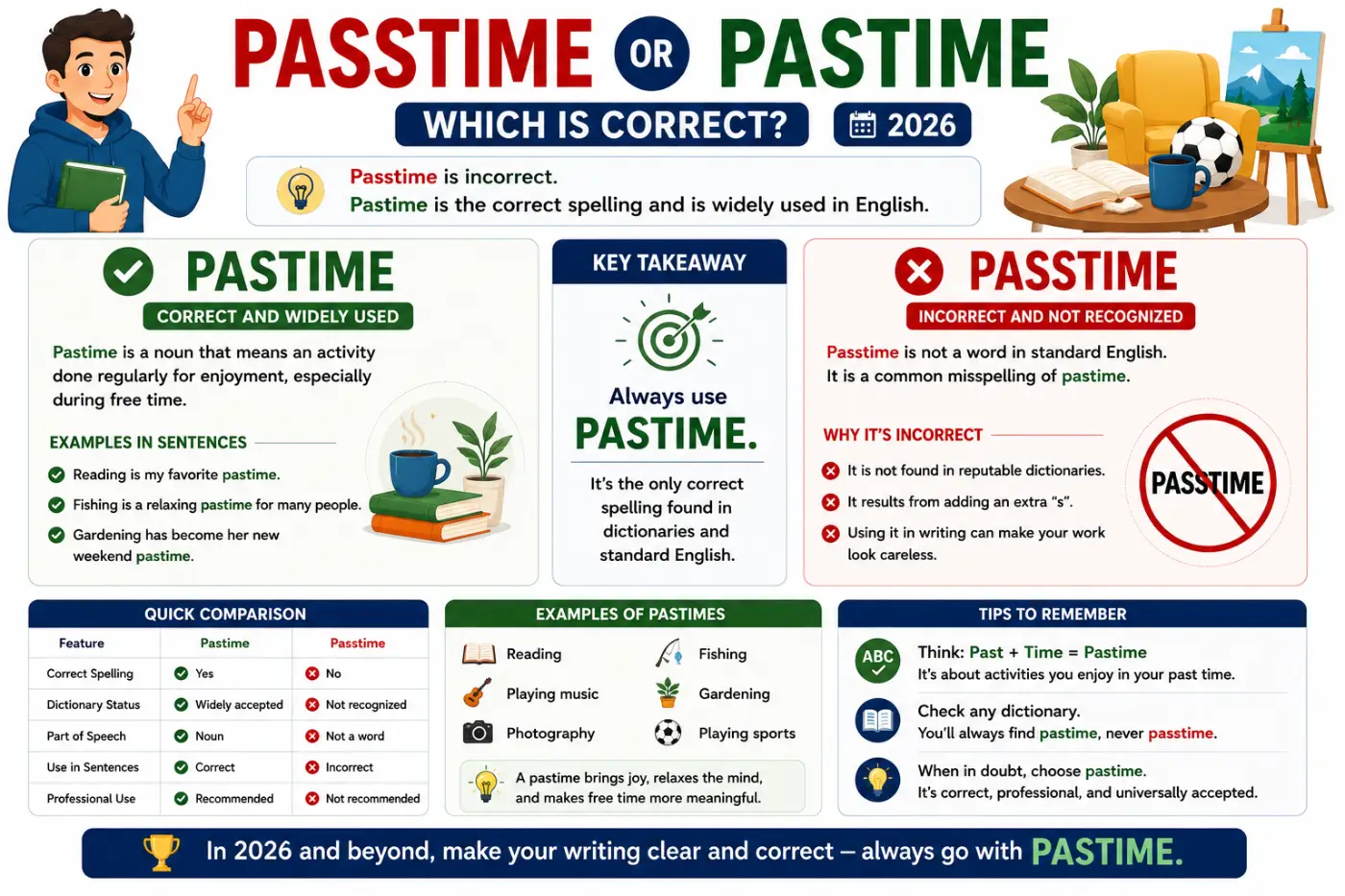
The correct spelling is pastime. It refers to a hobby, leisure activity, or something you enjoy doing in your free time. The spelling passtime is considered a misspelling and does not appear as a standard word in reputable English dictionaries.
The confusion usually comes from the phrase pass time, which is a verb phrase meaning to spend time doing something. Because pass time and pastime sound alike and are closely related in meaning, many people accidentally combine them into the incorrect form passtime.
A related grammar guide is Dysregulated vs Disregulated Which Spelling Is Correct 2026.
Quick Definition
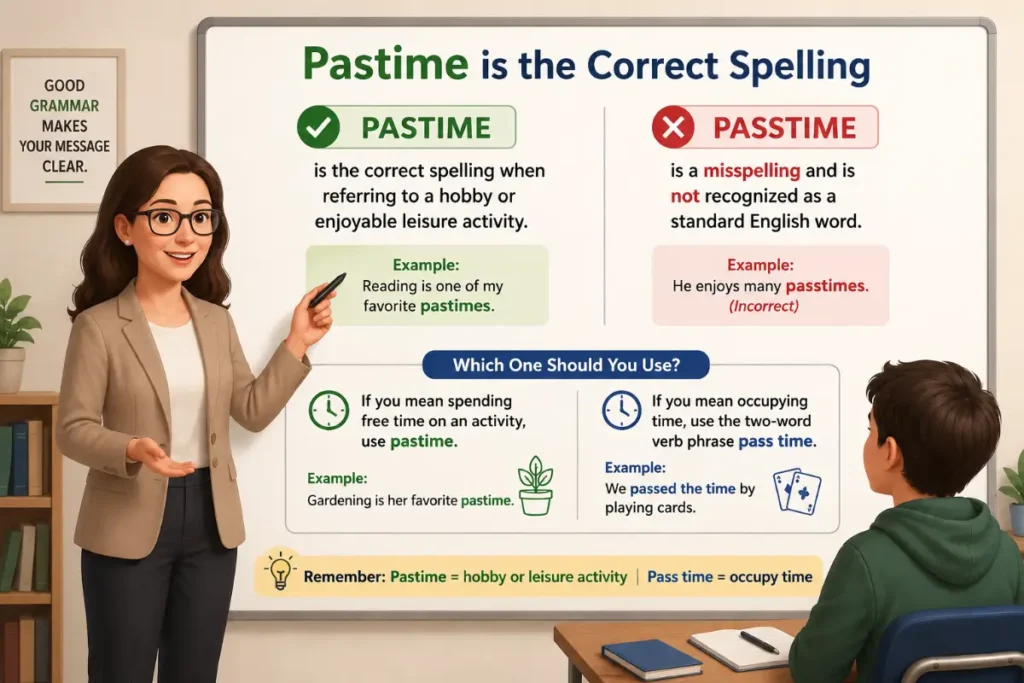
Pastime is the correct spelling when referring to a hobby or enjoyable leisure activity. Passtime is a misspelling and is not recognized as a standard English word. If you mean spending free time on an activity, use pastime. If you mean occupying time, use the two-word verb phrase pass time.
Quick Answer
The answer is simple.
- Pastime is the correct English noun.
- Passtime is incorrect.
- Pass time is a separate two-word verb phrase that means to spend or occupy time.
Examples.
- Reading is my favorite pastime.
- We played cards to pass time during the flight.
- ❌ Reading is my favorite passtime.
Passtime or Pastime Comparison Table
| Feature | Pastime | Passtime |
|---|---|---|
| Correct spelling | Yes | No |
| Meaning | A hobby or leisure activity | None in standard English |
| Part of speech | Noun | Not a recognized English word |
| Origin | Middle English from pass and time | Misspelling of pastime |
| Dictionary status | Standard English | Not listed as a standard entry |
| Usage frequency | Very common | Extremely rare except as an error |
| Formality | Suitable in all contexts | Incorrect in formal and informal writing |
| Common contexts | Hobbies, recreation, leisure | Typographical mistake |
| Example | Gardening is her favorite pastime. | ❌ Gardening is her favorite passtime. |
Meaning of Passtime or Pastime
What Does Pastime Mean
A pastime is an activity people enjoy during their free time. It usually refers to hobbies, recreation, entertainment, or relaxing interests rather than work or obligations. People often describe activities such as reading, painting, hiking, photography, gardening, cooking, fishing, or playing music as their favorite pastimes.
Examples include.
- Chess is a popular pastime around the world.
- Hiking became his favorite pastime after retirement.
- Photography is more than a pastime for her.
- Birdwatching is a peaceful pastime.
- Writing stories has always been my favorite pastime.
A pastime can be casual or deeply meaningful. Some hobbies stay enjoyable for years and even grow into successful careers.
What Does Passtime Mean
Passtime has no accepted meaning in standard English because it is not a legitimate word. Most examples found online are simply spelling mistakes where the writer intended to use pastime. Occasionally, someone mistakenly creates passtime by combining the words pass and time into one word. Standard English never joins them this way.
Correct forms include.
- pastime
- pass time
Incorrect form.
- passtime
Passtime or Pastime Key Differences
Although only one spelling is correct, understanding why the confusion happens makes it easier to remember.
Meaning
- Pastime means a hobby or leisure activity.
- Passtime has no accepted meaning.
Grammar
- Pastime functions as a noun.
- Passtime has no grammatical role because it is not a recognized word.
Dictionary Recognition
- Pastime appears in major English dictionaries.
- Passtime does not.
Professional Writing
Editors, teachers, publishers, and style guides all use pastime. Using passtime can make your writing appear careless because spell checkers and readers will recognize it as an error.
Why People Make the Mistake
Most spelling errors come from confusion with the phrase pass time.
Compare these examples.
Correct.
- Reading is my favorite pastime.
- We played games to pass time.
Incorrect.
- Reading is my favorite passtime.
- We played games to passtime.
The first sentence requires a noun. The second requires a verb phrase.
Which One Is Correct
The correct spelling is pastime. Use pastime whenever you’re talking about an enjoyable activity done during free time.
Examples include.
- Swimming is my favorite pastime.
- Painting became a relaxing pastime.
- Traveling is a rewarding pastime.
- Knitting is an enjoyable pastime.
- Reading has been a lifelong pastime.
Never replace it with passtime.
If your meaning is to occupy time rather than name a hobby, use pass time as two separate words.
Examples.
- We watched movies to pass time.
- She solved puzzles to pass time.
- They chatted to pass time before boarding.
- Children played outside to pass time.
- I read magazines to pass time at the airport.
A simple memory trick helps. If the word can be replaced with hobby, choose pastime. If the phrase can be replaced with spend time, choose pass time.
Passtime or Pastime Examples in Sentences
Ten Sentences Using Pastime
- Reading is my favorite pastime.
- Gardening became a relaxing pastime after retirement.
- Photography is an enjoyable pastime for many travelers.
- Cooking turned into a creative pastime during winter.
- Fishing remains a popular pastime in coastal towns.
- Drawing was her childhood pastime.
- Cycling is both healthy and a rewarding pastime.
- Music became more than a pastime for him.
- Watching classic films is a wonderful pastime.
- Collecting coins has been his lifelong pastime.
Ten Sentences Using Passtime
The following examples show incorrect usage because passtime is not a proper English word.
- ❌ Reading is my favorite passtime.
- ❌ Gardening became my passtime.
- ❌ Photography is an exciting passtime.
- ❌ Chess is a popular passtime.
- ❌ Fishing is his favorite passtime.
- ❌ Painting became her passtime.
- ❌ Hiking is an enjoyable passtime.
- ❌ Writing is a creative passtime.
- ❌ Running became my passtime.
- ❌ Birdwatching is a peaceful passtime.
Every sentence above becomes correct by replacing passtime with pastime.
Common Mistakes
Several mistakes appear repeatedly in emails, school assignments, blog posts, and social media.
Writing Passtime Instead of Pastime
This is by far the most common error.
Incorrect.
My favorite passtime is photography.
Correct.
My favorite pastime is photography.
Confusing Pastime With Pass Time
These expressions are related but not interchangeable.
Correct.
We played cards to pass time.
Correct.
Playing cards is a relaxing pastime.
The first describes an action. The second names the activity.
Treating Passtime as an Alternative Spelling
Unlike some American and British spelling differences, passtime is not an accepted regional variation. There is no English-speaking country where passtime is considered standard.
Passtime or Pastime Pronunciation Guide
Pastime
IPA in American English.
/ˈpæs.taɪm/
IPA in British English.
/ˈpɑːs.taɪm/
Syllable Breakdown
Past • time
Two syllables.
Common Pronunciation Mistakes
Because pastime contains the word past, some learners overemphasize the final t sound. Native speakers often pronounce it smoothly, making it sound close to pass-time, which contributes to the spelling confusion. In writing, however, pronunciation should never determine spelling. The correct noun remains pastime.
Etymology and Word Origin
Understanding where pastime comes from makes the spelling much easier to remember. The noun pastime developed in Middle English from the phrase pass time, which literally meant “to spend time.” Over time, English speakers began using the combined form pastime to refer not to the act of spending time but to the activity itself.
The evolution looked something like this.
- Pass time meant to spend or occupy time.
- People frequently talked about activities used to pass time.
- The activity eventually became known as a pastime.
- The one-word noun became the accepted spelling in Modern English.
Although the two expressions share the same historical roots, they now have different grammatical roles.
Compare them.
- We played chess to pass time. (Verb phrase.)
- Chess is my favorite pastime. (Noun.)
This pattern is common in English. Many compound words began as separate words before becoming a single noun.
For another common grammar confusion, see Tweek vs Tweak Which Spelling Is Correct?.
Passtime or Pastime Regional Usage
The good news is that there is no regional disagreement about the correct spelling.
American English
American English uses pastime exclusively when referring to a hobby or leisure activity.
Examples.
- Baseball is often called America’s favorite pastime.
- Hiking is a popular weekend pastime.
The spelling passtime is treated as an error.
British English
British English follows the same rule.
Examples.
- Gardening is a relaxing pastime.
- Reading remains a popular pastime across the country.
British dictionaries do not recognize passtime as a standard word.
Canadian English
Canadian English also uses pastime.
Examples.
- Ice fishing is a common winter pastime.
- Photography has become a rewarding pastime.
Again, passtime is considered a misspelling.
Australian English
Australian English follows the same convention.
Examples.
- Surfing is a favorite pastime along the coast.
- Camping is a popular family pastime.
The spelling remains pastime in all standard publications.
Regional Preference Summary
| Region | Correct Form | Accepted Alternative |
|---|---|---|
| United States | Pastime | None |
| United Kingdom | Pastime | None |
| Canada | Pastime | None |
| Australia | Pastime | None |
Unlike words such as color and colour or organize and organise, there is no accepted regional variation for pastime.
Passtime or Pastime Grammar Rules
Knowing the grammar behind these words prevents nearly every mistake.
Pastime Is a Noun
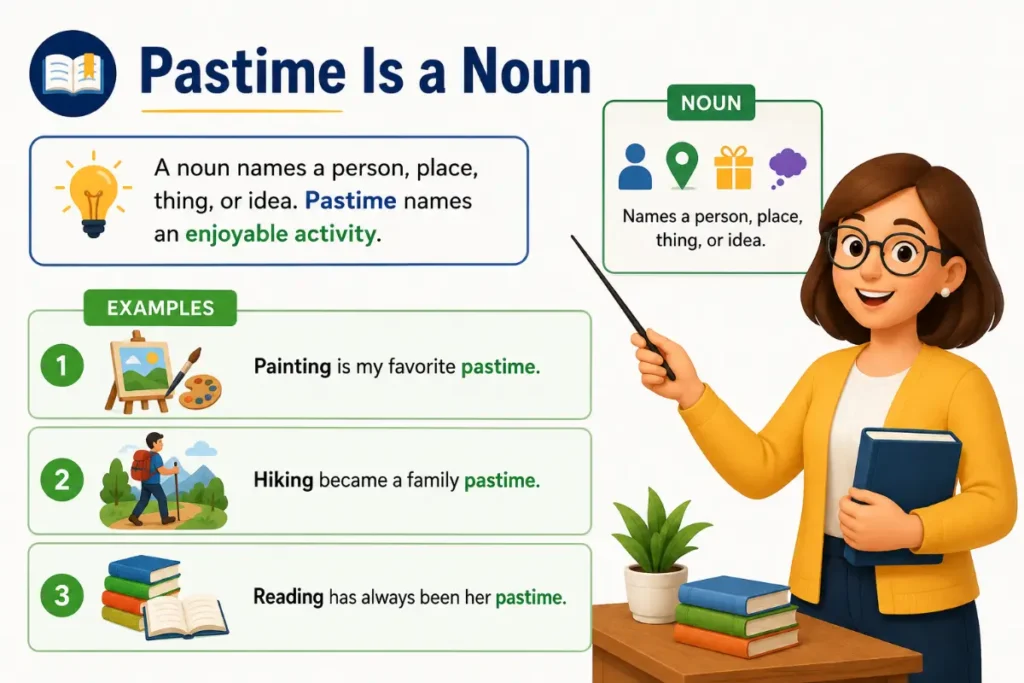
A noun names a person, place, thing, or idea. Pastime names an enjoyable activity.
Examples.
- Painting is my favorite pastime.
- Hiking became a family pastime.
- Reading has always been her pastime.
Because it is a noun, pastime can function as a subject, object, or complement in a sentence.
Examples.
- My favorite pastime is writing.
- Everyone enjoys a relaxing pastime.
- Photography became his pastime.
Pass Time Is a Verb Phrase
Pass is the verb.
Time is its object.
Together they mean to occupy or spend time.
Examples.
- We played cards to pass time.
- She listened to music to pass time.
- They talked to pass time during the delay.
Notice that pass changes with tense just like any other verb.
Present.
- I pass time by reading.
Past.
- We passed time playing board games.
Present perfect.
- They have passed time watching movies.
Future.
- She will pass time with a good novel.
Passtime Has No Grammatical Role
Since passtime is not a recognized English word, it cannot function as a noun, verb, adjective, or adverb. Whenever you see passtime, replace it with either pastime or pass time, depending on the meaning.
Plural Form
The plural of pastime is pastimes.
Examples.
- Outdoor pastimes are becoming more popular.
- They share several favorite pastimes.
- Reading and painting are enjoyable pastimes.
Never write passtimes because the singular form is already incorrect.
How to Decide Between Pastime and Pass Time
Many writers hesitate because both expressions relate to spending free time. Ask yourself one simple question. Are you naming the activity or describing the action? If you are naming the activity, use pastime.
Examples.
- Running is a healthy pastime.
- Cooking is a creative pastime.
- Birdwatching is a peaceful pastime.
If you are describing how someone spends time, use pass time.
Examples.
- We played games to pass time.
- She read magazines to pass time.
- They chatted to pass time while waiting.
A quick substitution test also helps. If you can replace the word with hobby, choose pastime. If you can replace the phrase with spend time, choose pass time.
Real Life Usage Examples
Daily Conversation
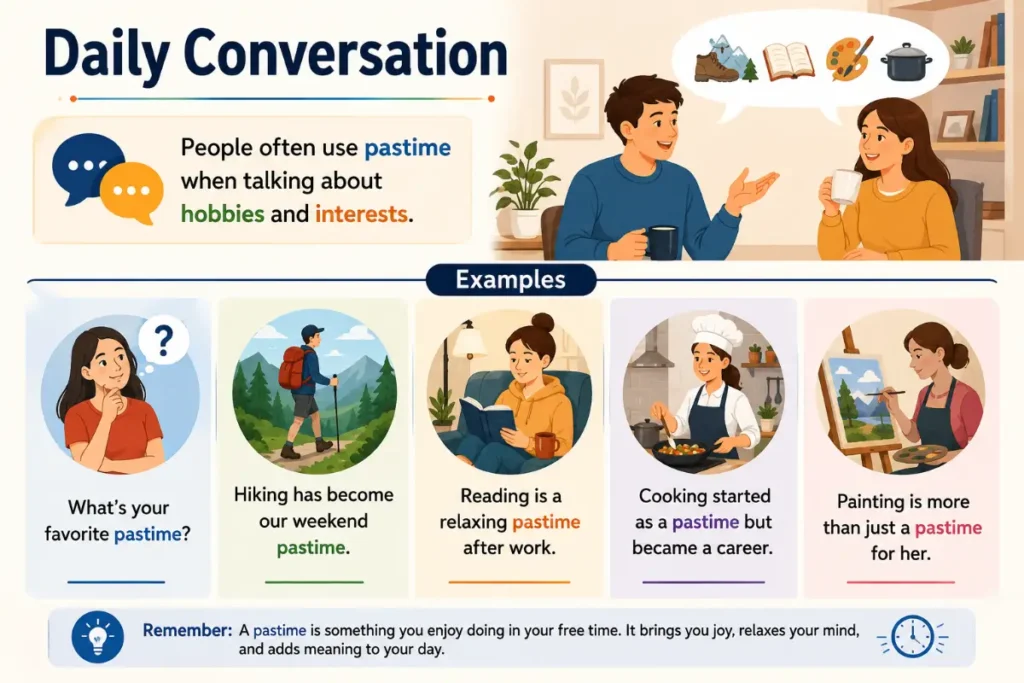
People often use pastime when talking about hobbies and interests.
Examples.
- What’s your favorite pastime?
- Hiking has become our weekend pastime.
- Reading is a relaxing pastime after work.
- Cooking started as a pastime but became a career.
- Painting is more than just a pastime for her.
Academic Writing
Teachers and researchers use pastime when discussing recreation, leisure, or social behavior.
Examples.
- Reading remains a popular pastime among teenagers.
- Outdoor pastimes encourage physical activity.
- Digital gaming has become a common pastime for young adults.
Professional Communication
The word sometimes appears in employee profiles, interviews, and biographies.
Examples.
- His favorite pastime is woodworking.
- Outside the office, her favorite pastime is photography.
- Cycling is one of his regular pastimes.
Literature
Authors frequently use pastime to add detail about characters.
Example.
The old sailor treated storytelling as his favorite pastime during long winter evenings.
Media and Journalism
Journalists often describe popular recreational activities using pastime.
Examples.
- Baseball is often called America’s favorite pastime.
- Hiking has become a popular pastime among young professionals.
- Gardening continues to grow as a relaxing pastime.
Passtime or Pastime in Popular Expressions
Several well-known expressions use pastime.
Favorite Pastime
Examples.
- Reading is my favorite pastime.
- Fishing became his favorite pastime after retirement.
National Pastime
This phrase refers to an activity strongly associated with a country.
Examples.
- Baseball is often called America’s national pastime.
- Cricket is widely viewed as a national pastime in several countries.
Leisure Pastime
Examples.
- Knitting is a relaxing leisure pastime.
- Birdwatching is an inexpensive leisure pastime.
Childhood Pastime
Examples.
- Flying kites was our favorite childhood pastime.
- Building treehouses became a memorable childhood pastime.
Related Words and Confused Terms
Many learners confuse pastime with other similar words or phrases. Understanding the differences improves both spelling and vocabulary.
| Word | Meaning | Difference From Pastime |
|---|---|---|
| Hobby | A regular activity done for enjoyment | Very similar, often interchangeable |
| Recreation | Activity done for relaxation or enjoyment | Broader and more formal |
| Leisure | Free time away from work | Refers to time rather than the activity |
| Avocation | A hobby pursued seriously outside work | More formal than pastime |
| Interest | Something that attracts attention | Can include hobbies but has a broader meaning |
| Diversion | Something that distracts or entertains | Often temporary |
| Entertainment | Something that amuses | Usually focuses on enjoyment provided by others |
| Pass time | Spend or occupy time | Verb phrase, not a noun |
| Passtime | Incorrect spelling | Should not be used |
Hobby Versus Pastime
Although the words are close in meaning, they are not always identical. A hobby usually involves regular practice, skill development, or long-term interest. A pastime simply refers to an enjoyable way to spend free time. Someone may solve crossword puzzles as a pastime without considering it a hobby.
Leisure Versus Pastime
Leisure refers to free time itself. Pastime refers to the activity done during that free time.
Examples.
- I enjoy plenty of leisure on weekends.
- Reading is my favorite pastime.
One describes available time. The other describes how that time is used.
Expert Language Insight
After years of editing articles, books, business documents, and academic writing, one mistake appears again and again. Writers accidentally create passtime because they mentally blend the noun pastime with the verb phrase pass time. Native English speakers almost never write passtime intentionally. It usually happens because both expressions sound nearly identical in everyday speech.
Professional editors use a simple rule.
- If the word names a hobby or leisure activity, write pastime.
- If the sentence describes spending time, write pass time.
- Never combine pass and time into passtime.
This distinction improves clarity and demonstrates a strong command of written English.
An Editor’s Proofreading Tip
When proofreading, replace the word mentally. If hobby fits naturally, use pastime.
Example.
Reading is my favorite hobby.
Reading is my favorite pastime.
If spend time fits naturally, use pass time.
Example.
We played cards to spend time.
We played cards to pass time.
This quick test works almost every time.
Memory Tricks to Remember the Correct Spelling
Simple memory devices can help you avoid this mistake permanently.
Trick One
Pastime equals hobby. If you are talking about a hobby, write pastime.
Trick Two
Pass time is an action. If someone is spending or occupying time, use the two-word phrase pass time.
Trick Three
Never write passtime. It is not accepted in standard English.
Trick Four
Read the sentence aloud. If you can replace the word with activity or hobby, choose pastime. If you can replace it with spend time, choose pass time.
Quick Practice Quiz
Choose the correct answer.
Question 1
Reading is my favorite _____.
A. passtime
B. pastime
C. pass time
Answer: B
Question 2
We played chess to _____ while waiting.
A. pastime
B. passtime
C. pass time
Answer: C
Question 3
Photography became a lifelong _____.
A. pastime
B. passtime
C. pass time
Answer: A
Question 4
The children told stories to _____ during the storm.
A. pastime
B. pass time
C. passtime
Answer: B
Question 5
Gardening is a peaceful _____.
A. pass time
B. passtime
C. pastime
Answer: C
If you answered all five correctly, you now understand the difference better than most English learners.
Still confused? Compare Missle or Missile Correct Spelling and Meaning.
Conclusion
The answer to passtime or pastime is straightforward. Pastime is the only correct spelling when you are talking about a hobby, leisure activity, or favorite way to spend free time. The form passtime is simply a misspelling and should not appear in formal or informal writing.
It is also important to distinguish pastime from the verb phrase pass time. Although they are closely related in meaning and pronunciation, they perform different grammatical functions. Pastime names the activity itself, while pass time describes the action of spending time.
Whenever you write, ask yourself one question. Are you naming a hobby or describing an action? If it is a hobby, choose pastime. If someone is spending time doing something, write pass time. Avoid passtime entirely.
Frequently Asked Questions
Is passtime a real word?
No. Passtime is not recognized as a standard English word. It is considered a spelling mistake. If you mean a hobby, write pastime. If you mean spending time, use the two-word phrase pass time.
Is pastime one word or two?
When referring to a hobby or leisure activity, pastime is always one word. The two-word form pass time is only used as a verb phrase that means to spend or occupy time.
What is the difference between pastime and pass time?
Pastime is a noun that names an enjoyable activity. Pass time is a verb phrase that describes the act of spending time. Although they share the same historical roots, they serve different grammatical purposes.
Why do people spell pastime as passtime?
The mistake happens because pastime and pass time are pronounced very similarly. Many writers combine the two forms into passtime, but standard English does not accept that spelling.
Is pastime used in American English?
Yes. Pastime is the standard spelling in American English. It is also the accepted form in British, Canadian, Australian, and other major varieties of English.
Can pastime be plural?
Yes. The plural form is pastimes. Examples include outdoor pastimes, family pastimes, and recreational pastimes. The form passtimes is incorrect because it is based on a misspelling.
Is pass time ever written as one word?
No. When used as a verb phrase, pass time always remains two separate words. Combining them into passtime creates a spelling error.
How can I remember the correct spelling?
Think of this simple rule. Pastime equals hobby. Pass time equals spend time. Once you remember this distinction, choosing the correct form becomes much easier.