
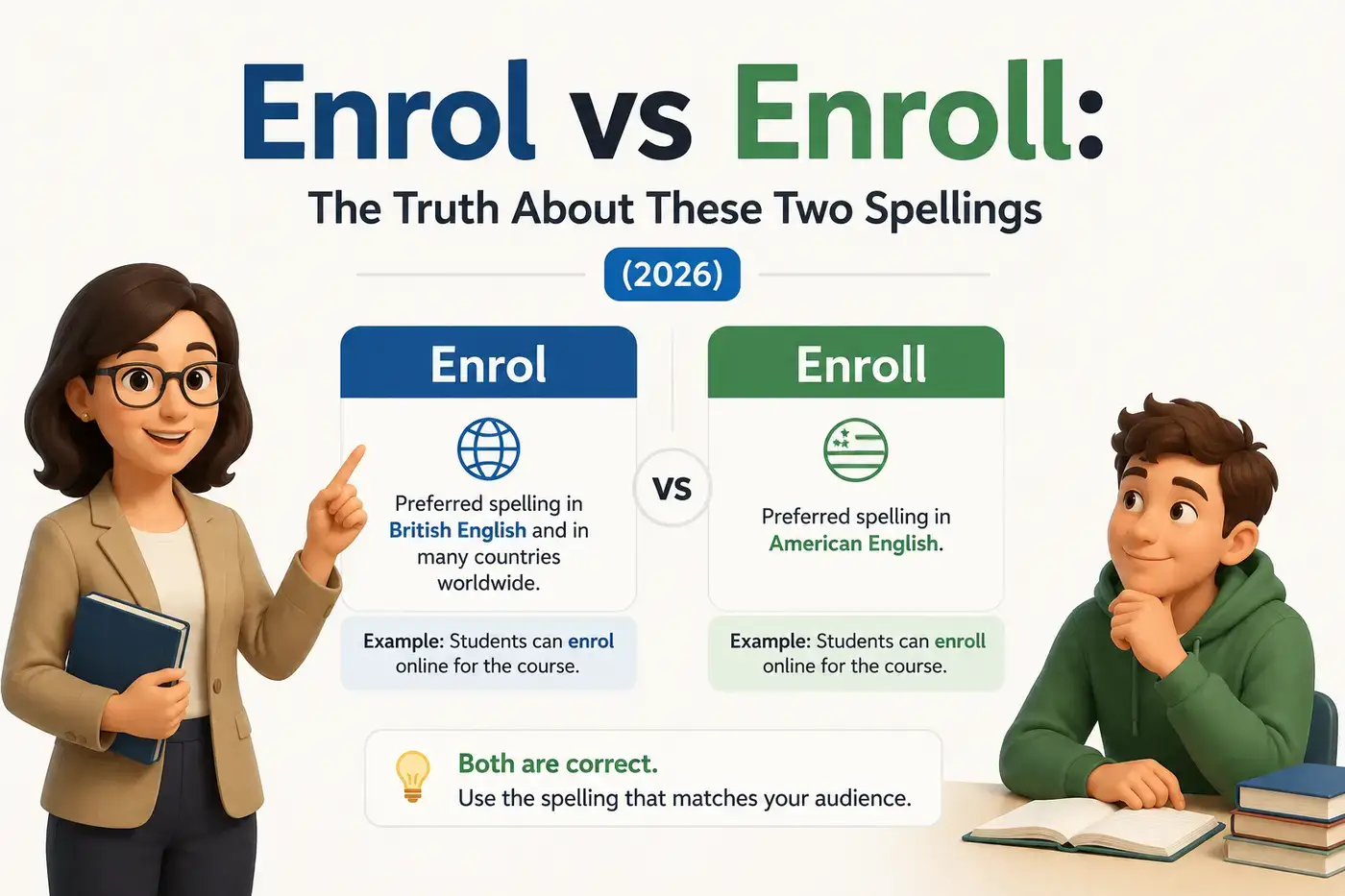
If you’ve searched for enrol or enroll you’re probably trying to figure out which spelling is correct. The good news is that both are correct. The right choice depends on the type of English you’re writing. This pair often causes confusion because the words have the same meaning and pronunciation. The only real difference is regional spelling.
In American English people almost always write enroll with a double l. In British English enrol is the standard spelling of the verb. Australian and Canadian English usually follow the British pattern for the verb while style guides can vary in some situations. This difference catches students writers job seekers teachers and professionals every day. You might see one spelling in a university application and another in an American college website. Both are correct when they match the regional style of the document.
This guide explains the meaning of each spelling how they developed when to use each one common grammar rules pronunciation real world examples and expert editing tips. By the end you’ll know exactly which spelling fits your audience and you’ll avoid one of the most common English spelling mix ups.
Still confused? Compare Bearable vs Bareable Which Is Correct? 2026.
Quick Definition
Enrol and enroll have the same meaning. Both mean to officially register or sign up for a course program school service or activity. Enroll is the preferred spelling in American English. Enrol is the standard spelling in British English and is widely used in Australia and many other English speaking countries.
Enrol vs Enroll Quick Answer
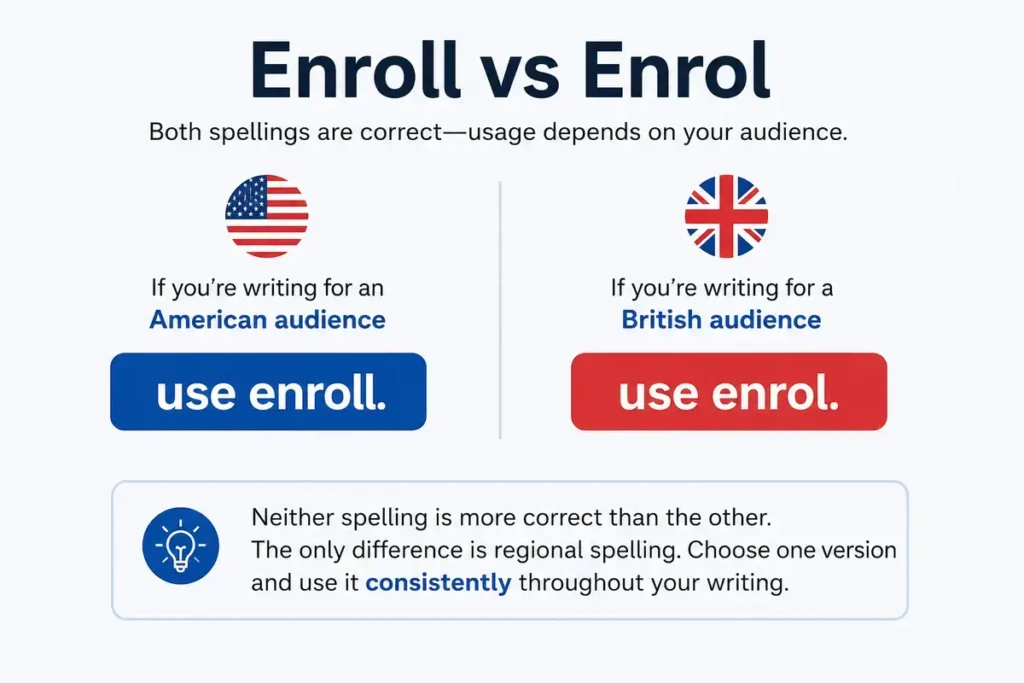
If you’re writing for an American audience use enroll.
If you’re writing for a British audience use enrol.
Neither spelling is more correct than the other. The only difference is regional spelling. Choose one version and use it consistently throughout your writing.
Enrol Or Enroll Comparison Table
| Feature | Enrol | Enroll |
|---|---|---|
| Correct spelling | Yes | Yes |
| Meaning | Register for a course program or service | Register for a course program or service |
| Part of speech | Verb | Verb |
| Origin | Same historical origin | Same historical origin |
| Preferred region | British English Australian English New Zealand English | American English |
| Usage frequency | Common outside the United States | Standard in the United States |
| Formality | Standard | Standard |
| Common contexts | Education healthcare government memberships | Education healthcare government memberships |
| Example | She will enrol in college next month. | She will enroll in college next month. |
Meaning Of Enrol
Enrol is a verb that means to officially register or sign up for something. People commonly use it when joining a school university training program healthcare plan military service or membership organization.
Examples include:
- Students can enrol in summer classes next week.
- She decided to enrol in an online marketing course.
- Thousands of people enrol in language programs every year.
The meaning stays the same in every English speaking country. Only the spelling changes from one region to another.
Etymology Of Enrol
The word comes from the Old French verb enroller which meant to record or enter a name on a roll or official list. That idea passed into Middle English and later became part of modern English. The original connection to official records still explains why the word means to register today.
Meaning Of Enroll
Enroll has exactly the same definition as enrol. It means to officially become part of a course organization service or program. American English simply adds another l before the ending.
Examples include:
- I plan to enroll in business school this fall.
- Parents must enroll their children before classes begin.
- Many employees enroll in the company’s retirement plan.
You’ll find this spelling in American universities government websites business documents and newspapers.
Etymology Of Enroll
Like enrol the American spelling comes from the same French and Middle English roots. The spelling changed over time because American English often doubles the final consonant before adding endings in words ending with a stressed syllable or following American spelling conventions. That development eventually made enroll the accepted standard in the United States.
Enrol vs Enroll Key Differences
Although the spellings look different their meanings are identical.
Meaning
There is no difference in meaning. Both words describe officially joining or registering for something.
Tone
Both spellings sound equally formal and professional. Neither sounds more modern more academic or more casual than the other.
Grammar
Both function as verbs. Their grammar rules remain exactly the same. The only change is the spelling used in different regions.
Regional Preference
American English prefers enroll.
British English prefers enrol.
Australian English generally uses enrol.
Canadian English often uses enrol although enroll also appears because of American influence.
Context
Both spellings appear in the same situations.
- Schools.
- Colleges.
- Universities.
- Online courses.
- Healthcare programs.
- Insurance plans.
- Military service.
- Membership organizations.
- Employee benefits.
- Government services.
The context never changes. Only the regional spelling does.
Which One Is Correct
Both spellings are correct The best choice depends on your audience.
Use enroll if your readers are in the United States or if you’re following American English style.
Use enrol if you’re writing for readers in the United Kingdom Australia New Zealand or organizations that follow British English conventions.
If you’re writing for an international audience pick one spelling and use it consistently throughout the document. Switching between the two makes your writing look careless even though both forms are correct. Professional editors look for consistency first. A document that mixes American and British spelling can distract readers and reduce credibility.
Examples In Sentences
Enrol Examples
- I want to enrol in a photography class this summer.
- Students must enrol before the registration deadline.
- She decided to enrol in a nursing program after graduation.
- You can enrol online in just a few minutes.
- Thousands of learners enrol in free courses every month.
- They hope to enrol their daughter in a private school.
- New employees can enrol in the health plan during orientation.
- Many volunteers enrol before the community project begins.
- He plans to enrol in evening classes while working full time.
- The university encourages international students to enrol early.
Enroll Examples
- I plan to enroll in computer science next semester.
- Parents should enroll their children before the school year starts.
- Many workers enroll in professional training programs.
- She decided to enroll in an online certification course.
- You can enroll through the company’s website.
- Thousands of students enroll in community colleges each year.
- He forgot to enroll before the deadline passed.
- They will enroll in the new fitness program next month.
- Employees can enroll in additional insurance coverage during open enrollment.
- The school allows students to enroll throughout the summer.
In every example the meaning stays exactly the same. The spelling simply reflects the regional style of English being used.
A related grammar guide is powerfull vs powerful Correct Spelling and Usage.
Common Mistakes
Even though enrol and enroll have the same meaning, people still make mistakes when using them. Most problems happen because writers mix American and British spelling in the same document.
Here are the mistakes editors see most often.
Mixing Regional Spellings
This is the most common mistake.
Incorrect.
I want to enrol in college because the university lets students enroll online.
Correct American English.
I want to enroll in college because the university lets students enroll online.
Correct British English.
I want to enrol in university because the university lets students enrol online.
Pick one spelling style and stick with it from beginning to end.
Assuming One Spelling Is Wrong
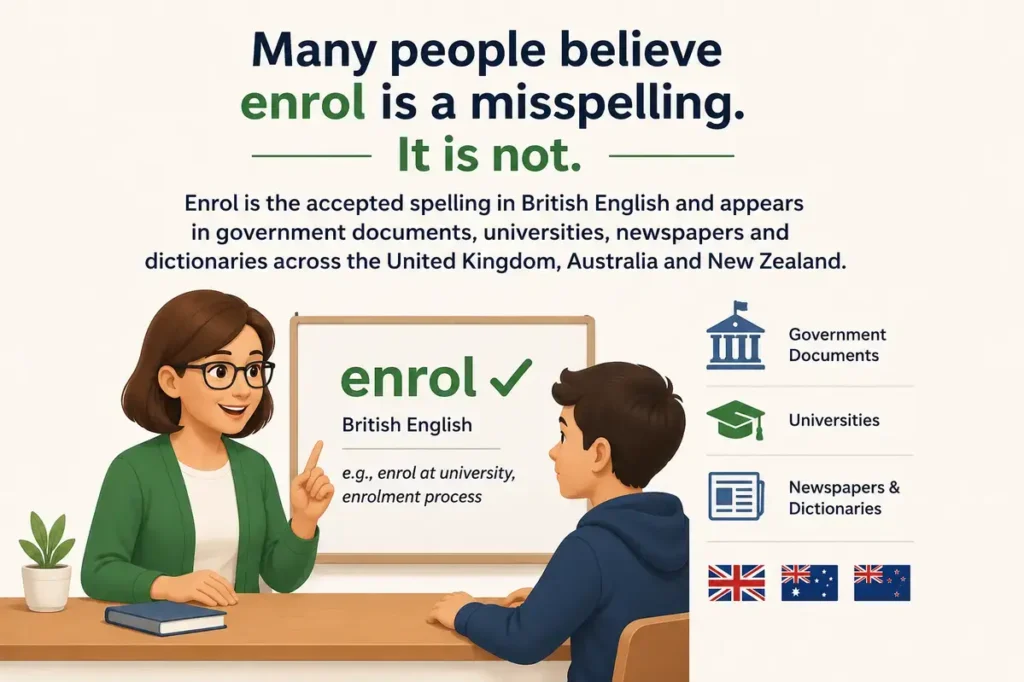
Many people believe enrol is a misspelling because they mainly read American websites. It is not. Enrol is the accepted spelling in British English and appears in government documents, universities, newspapers and dictionaries across the United Kingdom, Australia and New Zealand.
Confusing The Verb And The Noun
Another common mistake involves the noun forms.
American English.
Verb: enroll.
Noun: enrollment.
British English.
Verb: enrol.
Noun: enrolment.
Using enrollment with enrol or enrolment with enroll can make your writing look inconsistent.
Forgetting Your Audience
Think about who will read your writing. If you’re applying to a university in the United States, use American spelling. If you’re writing for a university in England or Australia, use British spelling. Matching your audience shows attention to detail.
Pronunciation Guide
One reason people confuse these spellings is that they sound exactly alike.
Enrol
IPA
British English.
/ɪnˈrəʊl/
American English speakers pronounce it almost the same.
Enroll
IPA
American English.
/ɪnˈroʊl/
Syllable Breakdown
En.
Roll.
The second syllable receives the stress.
Common Pronunciation Mistakes
- Stressing the first syllable instead of the second.
- Saying the word too quickly so it sounds like one long syllable.
- Pronouncing the ending as rule instead of roll.
A simple way to remember it is that enrol and enroll sound exactly like the word roll with en added to the beginning.
Etymology And Word Origin
The history of these spellings explains why both are correct today. The word comes from the Old French verb enroller, which meant to place a person’s name on an official roll or list. That word entered Middle English several centuries ago.
The noun roll referred to a rolled piece of parchment that contained official records. Governments, churches and schools kept names on these rolls. Over time, the verb came to mean placing someone’s name on an official list.nAs English developed in different parts of the world, spelling conventions changed.
British English settled on enrol.
American English adopted enroll, following a broader pattern of doubling the final l in words such as fulfill and enroll.
Despite the spelling difference, the meaning has remained unchanged for hundreds of years. Today the word appears in education, healthcare, business, government, finance and military settings around the world.
Regional Usage
The biggest difference between enrol and enroll comes from geography.
American English
American English almost always uses enroll.
Examples include:
- Enroll in college.
- Enroll in Medicare.
- Enroll in health insurance.
- Enroll in online classes.
American dictionaries, universities and government agencies consistently use this spelling.
British English
British English prefers enrol.
Examples include:
- Enrol at university.
- Enrol on a course.
- Enrol in a training programme.
- Enrol your child at school.
British publishers and educational institutions follow this style.
Australian English
Australian English generally follows British spelling. Government websites, schools and universities almost always write enrol and enrolment.
Canadian English
Canadian English sits somewhere in the middle. Many universities, government departments and publishers use enrol. American spelling also appears because of the close relationship between Canadian and American English. The important point is consistency within the same document.
Grammar Rules
Understanding the grammar makes these words easier to use correctly.
Part Of Speech
Both enrol and enroll are verbs.
Examples.
Students enroll every semester.
Students enrol every semester.
The sentence structure stays exactly the same.
Regular Verb Forms
American English.
Present.
Enroll.
Past.
Enrolled.
Present participle.
Enrolling.
British English.
Present.
Enrol.
Past.
Enrolled.
Present participle.
Enrolling.
Notice something interesting.
After adding ed or ing, both spellings become identical because both forms double the final l.
Examples.
She enrolled yesterday.
They are enrolling now.
Common Sentence Patterns
Verb plus object.
Enroll students.
Enrol employees.
Verb plus preposition.
Enroll in college.
Enrol in university.
Passive voice.
Students are enrolled in science classes.
Employees were enrolled automatically.
These patterns stay the same in every variety of English.
Real Life Usage Examples
Seeing these words in everyday situations makes the difference much easier to remember.
Daily Conversation
I finally enrolled in driving lessons.
She plans to enrol in yoga classes next month.
Can you help me enroll online.
The school lets parents enrol from home.
Academic Writing
Researchers often write about student enrollment trends in the United States. British education reports discuss university enrolment rates across the country. Academic writing always follows the regional spelling style.
Professional Communication
Companies encourage employees to enroll in retirement plans. Hospitals ask new patients to enrol in healthcare programs. Businesses usually match the spelling style used in the country where they operate.
Literature
Modern novels rarely draw attention to the spelling itself. Authors simply use the regional version that fits their audience.
An American novel naturally uses enroll.
A British novel naturally uses enrol.
Readers hardly notice because both spellings feel normal in their respective regions.
Media
News organizations also follow regional style guides.
American headlines might say. Students Enroll In Record Numbers.
British headlines are more likely to say. Students Enrol At Universities Across The Country.
Neither headline is more correct. Each follows the standard spelling conventions of its audience.
Related Words And Confused Terms
Learning a few related words makes it easier to understand how enrol and enroll fit into everyday English. These terms often appear together in schools universities workplaces and government documents.
Related Words
- Register.
- Registration.
- Admission.
- Acceptance.
- Application.
- Applicant.
- Student.
- Course.
- Program.
- Class.
- Membership.
- Sign up.
- Join.
- Subscribe.
- Orientation.
Commonly Confused Terms
Enrol And Enroll
These spellings have the same meaning. The only difference is regional English.
Enrol And Register
Both can mean joining a course or service.
Register has a broader meaning because you can register for events websites products and many other activities.
Enrol usually refers to officially becoming part of a school course program organization or service.
Enroll And Sign Up
In everyday conversation people often say sign up because it sounds more casual.
Examples.
- I signed up for the workshop.
- I enrolled in the workshop.
Both sentences are correct. The second sounds more formal.
Enrollment And Enrolment
These are noun forms.
Enrollment is American English.
Enrolment is British English.
Just like the verb forms, use the version that matches your audience.
Expert Language Insight
One of the easiest ways to spot experienced writers is consistency. Professional editors rarely worry about enrol versus enroll because both spellings are correct. What matters is using the version that matches the style of the publication and keeping that choice throughout the document.
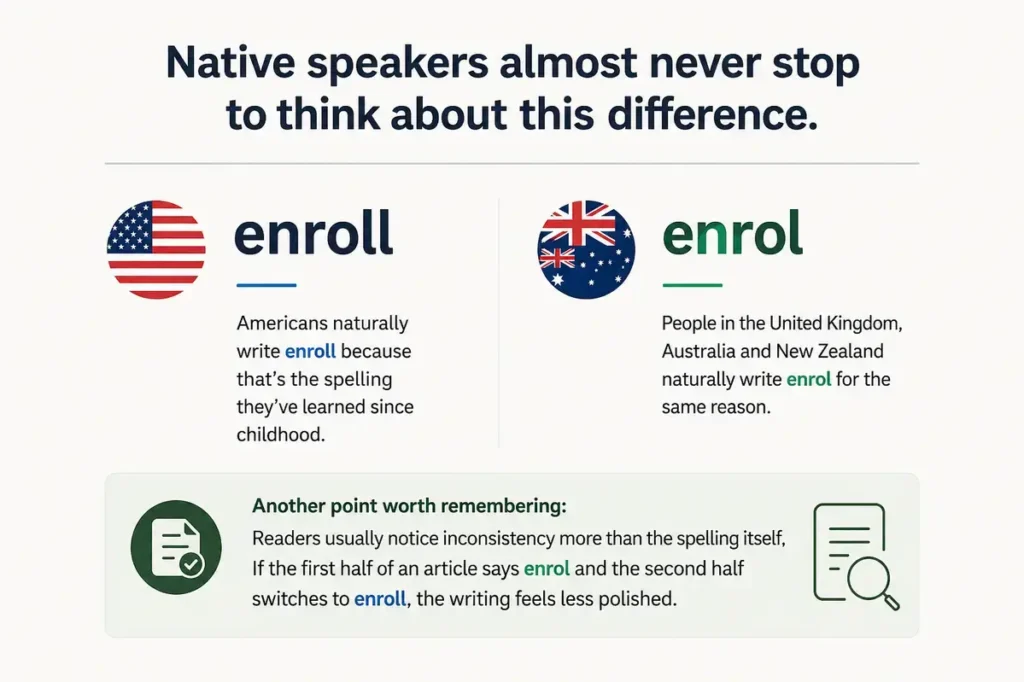
Native speakers almost never stop to think about this difference. Americans naturally write enroll because that’s the spelling they’ve learned since childhood. People in the United Kingdom, Australia and New Zealand naturally write enrol for the same reason. Another point worth remembering is that readers usually notice inconsistency more than the spelling itself. If the first half of an article says enrol and the second half switches to enroll, the writing feels less polished.
If you’re writing for an international audience, look at the organization you’re writing for. An American university expects American spelling. A British university expects British spelling. Following the local style guide shows professionalism and attention to detail.
One final editing tip can save time. If you’re writing a long document, run a search before publishing. Make sure every instance uses the same spelling. This small step catches mistakes that are easy to miss during proofreading.
Frequently Asked Questions
Is enrol or enroll correct?
Both are correct. Enroll is the standard spelling in American English. Enrol is the preferred spelling in British English and is widely used in Australia, New Zealand and many other English speaking countries. Choose the spelling that matches your audience and use it consistently.
What is the difference between enrol and enroll?
There is no difference in meaning, pronunciation or grammar. The only distinction is regional spelling. Americans write enroll, while British English usually uses enrol.
Is enrol a misspelling?
No. Enrol is a standard dictionary spelling in British English. It appears in schools, universities, government documents and newspapers throughout the United Kingdom and several other countries.
Why does American English use enroll?
American English adopted enroll as part of its spelling conventions. Over time this version became the accepted standard in the United States, while British English continued using enrol.
Do enrol and enroll sound different?
No. They have the same pronunciation. Native speakers cannot tell which spelling you are using just by hearing the word.
Should I write enrollment or enrolment?
Use enrollment in American English.
Use enrolment in British English.
The noun should always match the spelling style of the verb.
Which spelling should students use?
Use the spelling preferred by your school, university or instructor. If no style has been requested, match the variety of English used throughout your assignment.
Can I use both spellings in one article?
It is best not to. Mixing American and British spelling makes writing look inconsistent. Pick one style before you start and keep it throughout the entire document.
For another common grammar confusion, see Until or Untill Which Spelling Is Correct in 2026.
Conclusion
The answer is simple.
Both enrol and enroll are correct spellings. They share the same meaning, pronunciation and grammar. The only real difference is the variety of English you’re using.
If you’re writing for an American audience, use enroll.
If you’re writing for readers in the United Kingdom, Australia, New Zealand or organizations that follow British English, use enrol. The most important rule is consistency. Using the same spelling throughout your document makes your writing look polished, professional and trustworthy. Once you understand the regional difference, choosing the right spelling becomes second nature. You can write with confidence knowing that both forms are correct when they match your audience.