
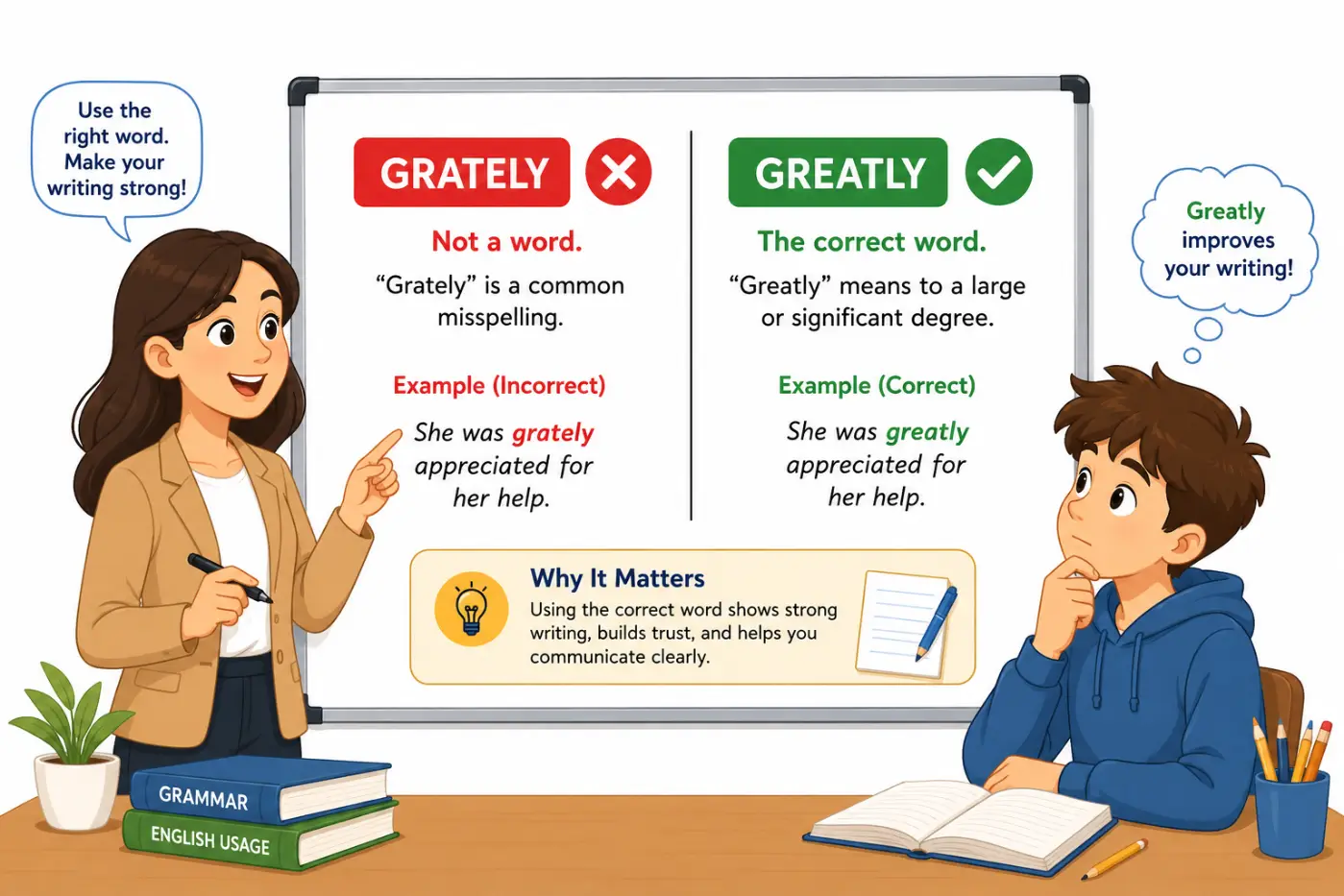
Grately vs greatly is a spelling question that confuses many English learners and native speakers alike. The two spellings look very similar and sound almost identical in fast speech, making it easy to type grately by mistake. Even experienced writers occasionally overlook the error when writing quickly.
The correct spelling is greatly. It is the only standard English word recognized by major dictionaries and is used to mean to a great extent or very much. Grately is simply a misspelling and has no accepted meaning in modern English.
This guide explains everything you need to know about grately vs greatly, including the meaning of greatly, pronunciation, grammar rules, real sentence examples, common spelling mistakes, regional usage, expert editing tips, and simple memory tricks to help you use the correct spelling with confidence every time.
Many readers also check recieve or receive: Correct Spelling and Usage Guide.
Quick Definition
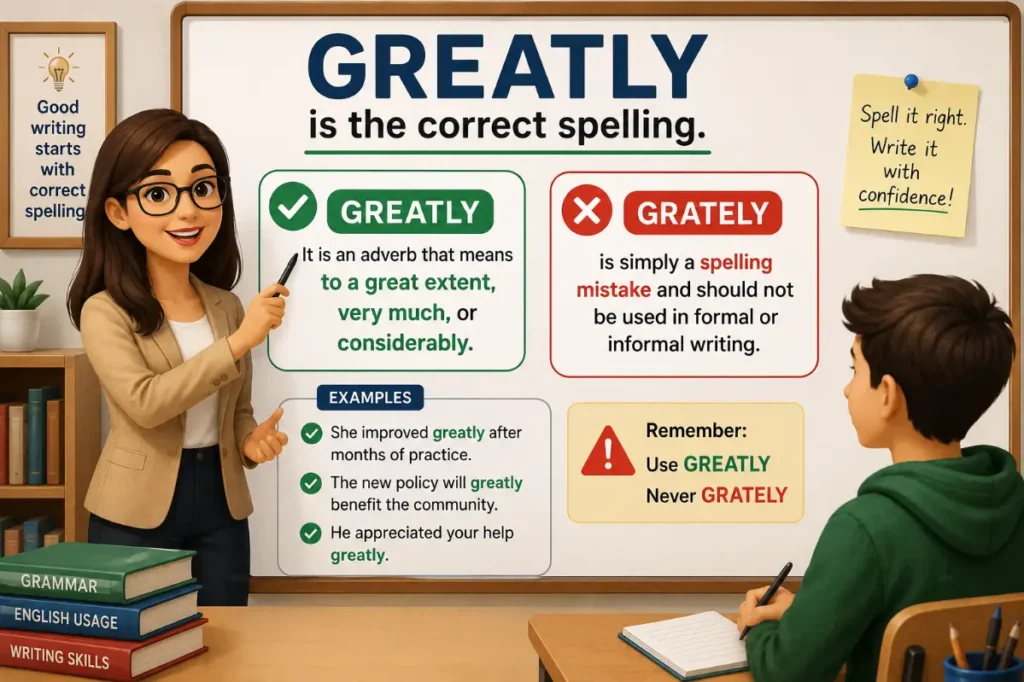
Greatly is the correct spelling. It is an adverb that means to a great extent, very much, or considerably. Grately is simply a spelling mistake and should not be used in formal or informal writing.
Quick Answer
The winner in grately vs greatly is easy to identify.
- Greatly is correct.
- Grately is incorrect.
- Greatly means very much, to a large degree, or considerably.
- Grately is not recognized as a standard English word.
If you want clear, professional writing, always choose greatly.
Grately vs Greatly Comparison Table
| Feature | Grately | Greatly |
|---|---|---|
| Correct spelling | No | Yes |
| Dictionary word | No | Yes |
| Part of speech | None | Adverb |
| Meaning | None | To a great extent or very much |
| Origin | Misspelling | From great plus the suffix ly |
| Usage frequency | Extremely rare | Very common |
| Formality | Incorrect | Suitable for all writing |
| Common contexts | Typing error | Academic, business, literature, daily speech |
| Example | ❌ I grately appreciate your help. | ✅ I greatly appreciate your help. |
Meaning of Grately
Although many people search for grately, it has no accepted meaning in standard English. It usually appears because someone accidentally leaves out the second e in greatly. Since English contains many words ending in ately, such as privately or separately, writers sometimes assume grately follows the same pattern. It does not. Professional editors treat grately as a spelling error rather than an alternative spelling.
Meaning of Greatly
Greatly is an adverb. It describes the degree or extent of an action, feeling, or situation.
Common meanings include:
- Very much.
- To a large extent.
- Considerably.
- Significantly.
Examples include:
- We greatly appreciate your support.
- The new policy greatly improved productivity.
- Her confidence has greatly increased.
- Their advice greatly influenced my decision.
The word strengthens a statement without making it sound exaggerated.
Etymology of Greatly
The word greatly comes from the adjective great, which has roots in Old English grēat, meaning large, big, or important. The suffix ly turns many adjectives into adverbs.
Examples include:
- Quick → Quickly.
- Slow → Slowly.
- Happy → Happily.
- Great → Greatly.
This pattern has existed in English for centuries. By contrast, grately has no historical development because it has never been an accepted English word.
Grately vs Greatly Meaning Differences
There is actually no meaning comparison because only one word exists.
| Word | Meaning |
|---|---|
| Grately | No accepted meaning |
| Greatly | Very much or to a large extent |
Whenever you see grately, mentally replace it with greatly.
Grately vs Greatly Grammar Differences
Grammar is another area where the answer is straightforward. Greatly functions as an adverb.
It modifies:
- Verbs.
- Adjectives.
- Other adverbs.
Examples include:
- She greatly admired the author.
- Costs were greatly reduced.
- I greatly enjoyed the movie.
Since grately is not a real word, it has no grammatical role.
Which One Is Correct
The correct spelling is greatly.
Use it in:
- Essays.
- Emails.
- Business writing.
- Academic papers.
- Books.
- Newspapers.
- Blogs.
- Everyday conversations.
Never intentionally use grately unless you are discussing the misspelling itself.
Why People Write Grately Instead of Greatly
Several factors contribute to this common mistake.
Similar pronunciation
When spoken quickly, the missing letter is difficult to notice.
Fast typing
People often skip the second e while typing.
Memory mistakes
Some writers remember the sound but not the exact spelling.
Pattern confusion
English contains many words ending in ately, leading people to assume grately follows the same pattern.
It does not.
Examples Using Grately
These examples are intentionally incorrect.
- ❌ I grately appreciate your kindness.
- ❌ She was grately impressed.
- ❌ Your help was grately needed.
- ❌ We grately benefited.
- ❌ The company grately expanded.
- ❌ They grately improved their results.
- ❌ I grately admire your work.
- ❌ He was grately respected.
- ❌ The project grately succeeded.
- ❌ Everyone grately enjoyed the concert.
Each sentence should use greatly instead.
Examples Using Greatly
- I greatly appreciate your kindness.
- She greatly admired her mentor.
- Your support greatly encouraged us.
- The update greatly improved performance.
- We greatly value your feedback.
- Sales greatly increased this year.
- The medicine greatly reduced pain.
- They greatly enjoyed the vacation.
- His speech greatly inspired the audience.
- The experience greatly changed my perspective.
Common Mistakes in Grately vs Greatly
Although greatly is the only correct spelling, many writers still accidentally type grately. Understanding why the mistake happens can help you avoid it.
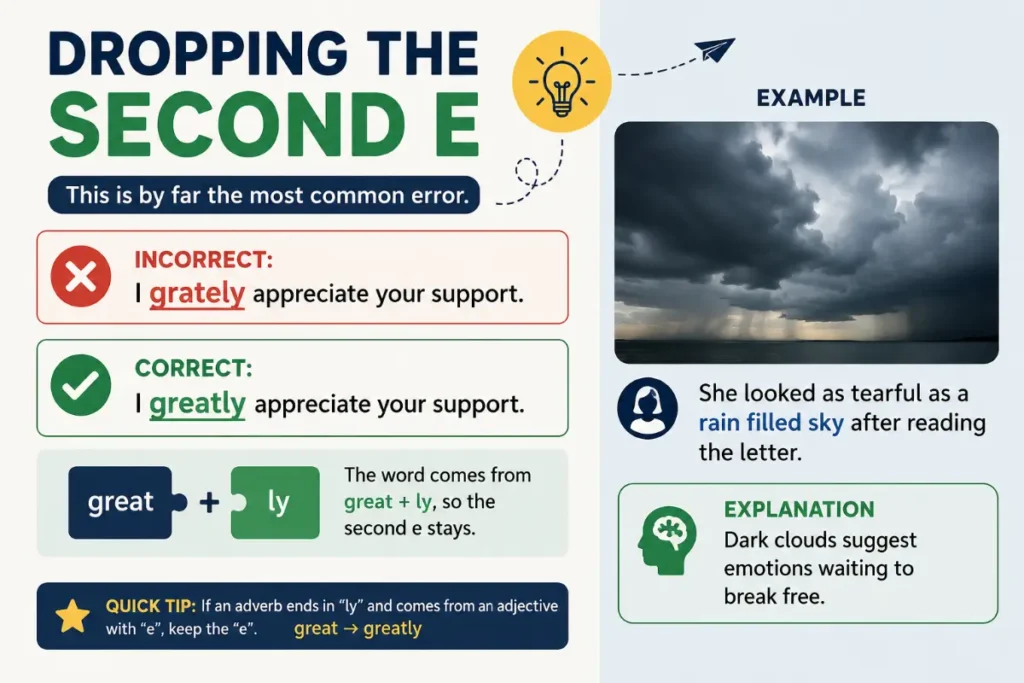
1. Dropping the Second E
This is by far the most common error.
Incorrect:
❌ I grately appreciate your support.
Correct:
✅ I greatly appreciate your support.
The word comes from great + ly, so the second e stays.
2. Relying on Pronunciation
In casual speech, greatly may sound like grately. English pronunciation often hides letters, which is why spelling based only on sound can be misleading.
3. Ignoring Spell Check Warnings
Modern spelling tools usually flag grately, but mistakes still appear when people:
- Type too quickly.
- Copy unedited text.
- Ignore proofreading.
4. Confusing Similar Word Patterns
English contains words like:
- Privately.
- Separately.
- Immediately.
- Definitely.
These endings sometimes make writers assume grately follows the same spelling pattern. It does not.
Many readers also check Provider vs Providor Which Is Correct? (2026).
Pronunciation Guide
Only greatly has a standard pronunciation.
| Word | IPA | Syllables | Pronunciation |
|---|---|---|---|
| Greatly | /ˈɡreɪtli/ | Great • ly | GRAYT lee |
| Grately | None | None | Incorrect spelling |
Syllable Breakdown
Great • ly
The stress falls on the first syllable.
Common Pronunciation Mistakes
People sometimes pronounce the word too quickly, making it sound as if the second e disappears. The pronunciation is still greatly, even if rapid speech makes it sound closer to grately.
Etymology and Word Origin
Understanding a word’s history often makes its spelling easier to remember.
Origin of Great
The adjective great comes from Old English grēat, meaning:
- Large.
- Big.
- Powerful.
- Important.
Over time, its meaning expanded beyond physical size to describe importance, intensity, and significance.
Examples include:
- Great achievement.
- Great leader.
- Great success.
- Great opportunity.
Formation of Greatly
The suffix -ly converts many adjectives into adverbs.
Examples include:
| Adjective | Adverb |
|---|---|
| Slow | Slowly |
| Happy | Happily |
| Quiet | Quietly |
| Great | Greatly |
Since greatly is formed directly from great, removing the second e breaks the spelling pattern.
Why Grately Never Developed
Unlike many English spelling variations, grately never became an accepted alternative. It does not appear as a standard word in major dictionaries because it has always been viewed as a simple typographical error.
Regional Usage of Greatly
One advantage of greatly is its consistency across major English-speaking countries.
American English
Americans frequently use greatly in business writing, journalism, education, and everyday conversation.
Examples include:
- We greatly appreciate your business.
- The software greatly improved efficiency.
British English
British English uses greatly with exactly the same spelling and meaning.
Examples include:
- The findings greatly surprised researchers.
- Your efforts are greatly appreciated.
Canadian English
Canadian writers also use greatly without variation.
Examples include:
- Tourism has greatly benefited the local economy.
- We greatly value our customers.
Australian English
Australian English follows the same spelling.
Examples include:
- The rainfall greatly helped farmers.
- Costs have greatly increased.
Regional Preference Summary
| Region | Preferred Form |
|---|---|
| United States | Greatly |
| United Kingdom | Greatly |
| Canada | Greatly |
| Australia | Greatly |
| New Zealand | Greatly |
There is no English dialect where grately is considered correct.
Grammar Rules for Greatly
Because greatly is an adverb, understanding how adverbs work will help you use it correctly.
Greatly Modifies Verbs
Examples:
- She greatly admired the scientist.
- They greatly expanded the company.
- We greatly appreciate your patience.
Greatly Modifies Adjectives
Examples:
- The process became greatly simplified.
- The city was greatly improved.
- His confidence was greatly strengthened.
Greatly Modifies Past Participles
This is especially common in formal writing.
Examples:
- Greatly respected.
- Greatly admired.
- Greatly appreciated.
- Greatly improved.
- Greatly reduced.
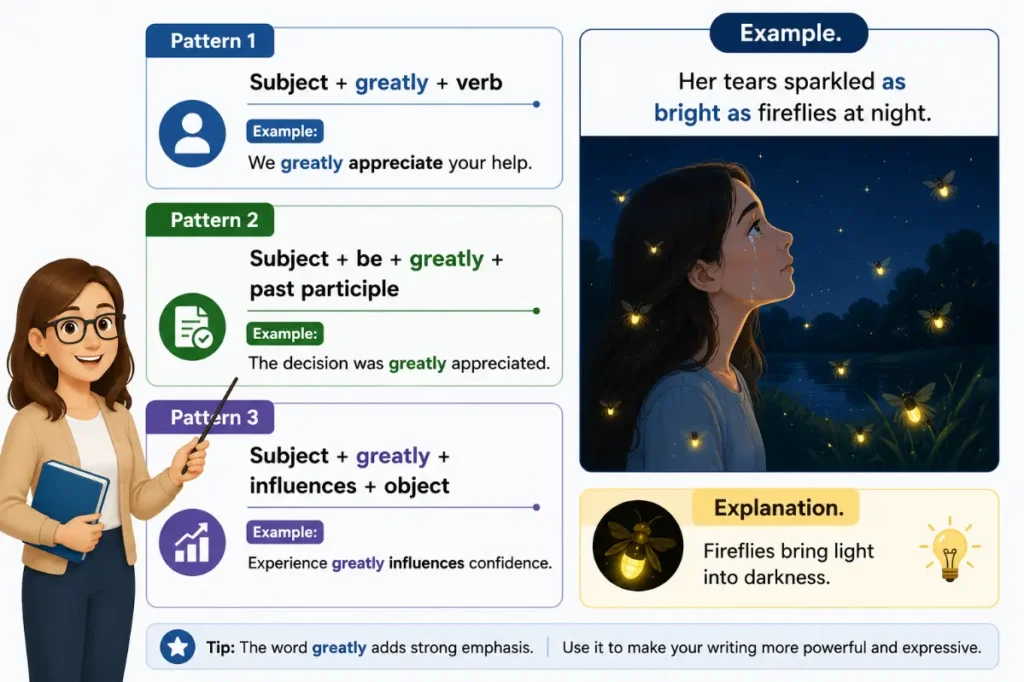
Common Sentence Patterns
Pattern 1
Subject + greatly + verb
Example:
We greatly appreciate your help.
Pattern 2
Subject + be + greatly + past participle
Example:
The decision was greatly appreciated.
Pattern 3
Subject + greatly + influences + object
Example:
Experience greatly influences confidence.
Real Life Usage Examples
Daily Conversation
- I greatly enjoyed dinner.
- Thanks. I greatly appreciate it.
- That vacation greatly helped me relax.
Academic Writing
- Climate greatly affects crop production.
- Reading greatly improves vocabulary.
- Practice greatly enhances learning.
Professional Communication
- We greatly appreciate your continued partnership.
- Your feedback greatly helps our team.
- The upgrade greatly improved performance.
Literature Style
- The king was greatly loved by his people.
- She was greatly saddened by the news.
- His courage greatly impressed everyone.
News and Media
- The new law greatly reduced traffic accidents.
- Inflation has greatly affected household budgets.
- Technology has greatly changed communication.
Common Collocations with Greatly
Native speakers often pair greatly with specific verbs and adjectives. Some of the most common combinations include:
- Greatly appreciate.
- Greatly admire.
- Greatly improve.
- Greatly reduce.
- Greatly increase.
- Greatly benefit.
- Greatly influence.
- Greatly value.
- Greatly exceed.
- Greatly respect.
- Greatly encourage.
- Greatly enhance.
- Greatly assist.
- Greatly strengthen.
- Greatly simplify.
Learning these combinations will make your writing sound much more natural.
When Should You Use Greatly Instead of Very?
Both words express degree, but they are not always interchangeable. Consider these examples: Very happy. Greatly appreciated. You would naturally say:
✅ I greatly appreciate your help.
Instead of:
❌ I very appreciate your help.
Similarly:
✅ The changes greatly improved productivity.
Sounds stronger and more formal than: The changes very improved productivity. In many professional contexts, greatly provides a smoother and more polished tone than very.
Style Tips From Professional Editors
Editors often recommend greatly because it communicates emphasis without sounding exaggerated.
For example:
Weak:
The update really helped our customers.
Stronger:
The update greatly improved the customer experience. Instead of stacking multiple intensifiers like really, very, and so, a single well-placed greatly often creates cleaner, more professional writing. In business communication, phrases such as greatly appreciate, greatly value, and greatly improve are widely accepted because they sound respectful and precise rather than overly emotional. In the next part, we’ll cover related confused words, expert language insights, eight SEO-focused FAQs, the conclusion, meta description, and final editorial recommendations.
Related Words and Commonly Confused Terms
People searching for grately vs greatly are often unsure about other similar-looking words. Here are a few that frequently cause confusion.
| Incorrect or Confusing | Correct Form | Explanation |
|---|---|---|
| Grately | Greatly | Greatly is the only correct spelling. |
| Greatful | Grateful | Grateful means thankful. |
| Greatness | Greatness | A noun meaning the quality of being great. |
| Great | Great | An adjective meaning excellent, large, or important. |
| Greatly | Greatly | An adverb meaning to a great extent. |
| Grate | Grate | A verb meaning to shred or irritate. |
| Grater | Grater | A kitchen tool used for shredding food. |
| Grating | Grating | Something harsh, irritating, or a metal framework. |
Notice that many of these words begin with grat or great, making typing mistakes easy. Paying attention to the root word helps you choose the correct spelling.
Greatly Synonyms
Depending on your sentence, you can replace greatly with several alternatives.
- Significantly.
- Considerably.
- Substantially.
- Remarkably.
- Extremely.
- Immensely.
- Thoroughly.
- Profoundly.
- Highly.
- Seriously.
Examples
Instead of:
The changes greatly improved efficiency.
You could write:
- The changes significantly improved efficiency.
- The changes considerably improved efficiency.
- The changes substantially improved efficiency.
Each option has a slightly different tone, but all are grammatically correct.
Greatly in Common Expressions
Native English speakers regularly use greatly in fixed expressions. Some of the most common include:
- Greatly appreciated.
- Greatly admired.
- Greatly respected.
- Greatly missed.
- Greatly loved.
- Greatly improved.
- Greatly increased.
- Greatly reduced.
- Greatly influenced.
- Greatly encouraged.
Because these combinations appear so frequently in books, newspapers, research papers, and business writing, they sound natural to fluent speakers.
Expert Language Insight
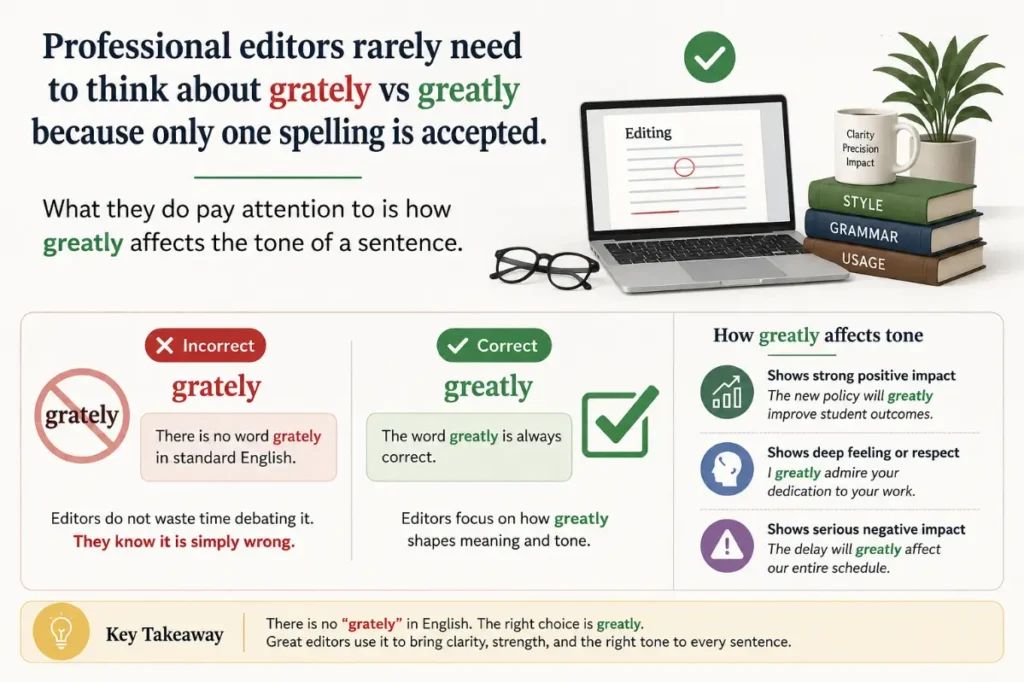
Professional editors rarely need to think about grately vs greatly because only one spelling is accepted. What they do pay attention to is how greatly affects the tone of a sentence.
For example:
Basic: We appreciate your support. More professional: We greatly appreciate your support. The second sentence sounds warmer, more sincere, and more polished without becoming overly dramatic. Editors also know that greatly works best when it emphasizes measurable improvement, appreciation, influence, or importance.
Examples include:
- Greatly improved.
- Greatly appreciated.
- Greatly exceeded expectations.
- Greatly influenced history.
- Greatly benefited the community.
A related grammar guide is counselor vs councilor: Meaning and Correct Usage.
Conclusion
When comparing grately vs greatly, the correct choice is always greatly. It is the only accepted spelling in standard English and means to a great extent, very much, or considerably. Grately is simply a spelling mistake and should never be used in formal or informal writing.
A simple way to remember the correct spelling is to keep the complete word great and then add ly. This easy trick can help you avoid a common writing error and improve the accuracy of your English.
Whenever you’re unsure about grately vs greatly, choose greatly with confidence. Using the correct spelling will make your writing clearer, more professional, and more credible, whether you’re writing an email, an essay, a report, or a social media post.
Frequently Asked Questions
Is grately a real word?
No. Grately is not a recognized English word. It is a common misspelling of greatly and does not appear as a standard entry in major English dictionaries. In every normal writing situation, you should replace grately with greatly.
Is greatly the correct spelling?
Yes. Greatly is the correct spelling. It functions as an adverb and means to a great extent, very much, or considerably. It is appropriate for formal, academic, business, and everyday writing.
Why do people spell greatly as grately?
Most people make this mistake because the pronunciation is similar and fast typing can cause the second e to be omitted. Confusion with other English words ending in ately also contributes to the error.
What part of speech is greatly?
Greatly is an adverb. It modifies verbs, adjectives, and past participles by showing degree or extent.
Examples include:
- We greatly appreciate your help.
- The process was greatly improved.
Can I use grately in informal writing?
No. Even in text messages or casual conversations, grately is still considered a spelling mistake. Using greatly ensures your writing remains clear and accurate.
Does greatly have the same spelling in British and American English?
Yes. British English, American English, Canadian English, Australian English, and New Zealand English all use the spelling greatly. There are no regional spelling differences.
What are some common phrases with greatly?
Native speakers often use expressions such as:
- Greatly appreciated.
- Greatly admired.
- Greatly respected.
- Greatly improved.
- Greatly reduced.
- Greatly influenced.
- Greatly benefited.
These combinations appear frequently in professional and everyday English.
How can I remember the correct spelling?
Think of the word as great + ly. Since the adjective great already ends with the letter e, keep the entire word before adding ly. This simple memory trick helps prevent the common mistake of writing grately.