
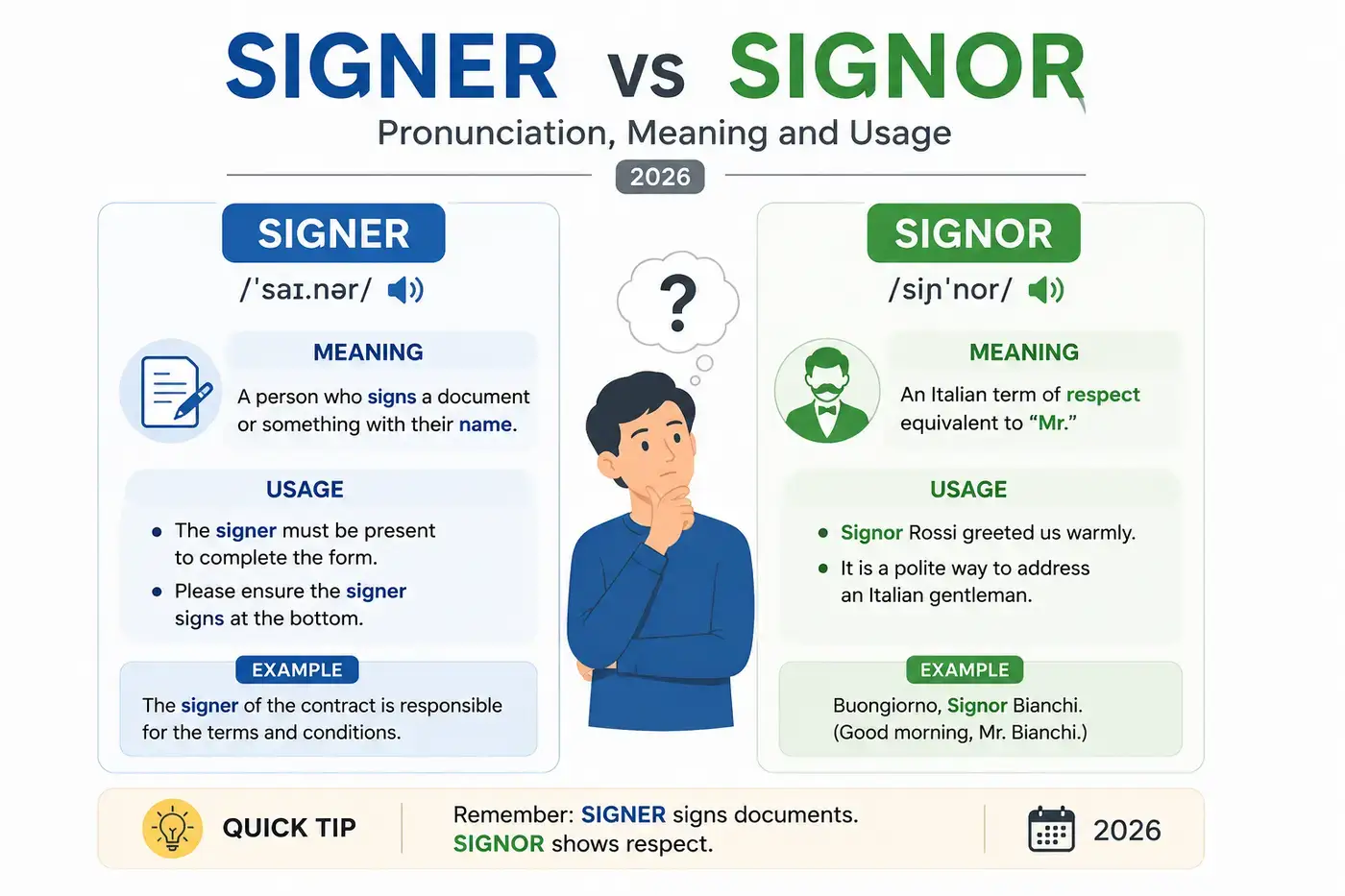
The confusion between Signer or Signor is more common than many people realize. Although these two words look remarkably similar, they have entirely different meanings, origins, and uses. A single misplaced letter can change your sentence from referring to a person who signs a document to an Italian title of respect.
Many English learners, writers, students, and professionals encounter this confusion when writing formal documents, legal agreements, emails, or international correspondence. Because both words are legitimate dictionary entries, spell-checkers may not always catch the mistake.
The short answer is simple: signer refers to someone who signs a document, while signor is an Italian honorific equivalent to “Mr.” in English. They are not interchangeable.This guide will explain the difference between these words in detail. You’ll learn their meanings, pronunciation, origins, grammar rules, examples, regional usage, common mistakes, and expert language tips. By the end, you’ll know exactly when to use each word and how to avoid one of the most common spelling mix-ups involving these terms.
Still confused? Compare stoped or stopped Correct Spelling And Usage.
Signer vs Signor Quick Definition
Signer means a person who signs a document, contract, petition, letter, or agreement. Signor is an Italian title of respect used before a man’s name, similar to “Mr.” in English. Although the words look alike, they belong to different language systems and serve completely different purposes.
Signer or Signor Quick Answer
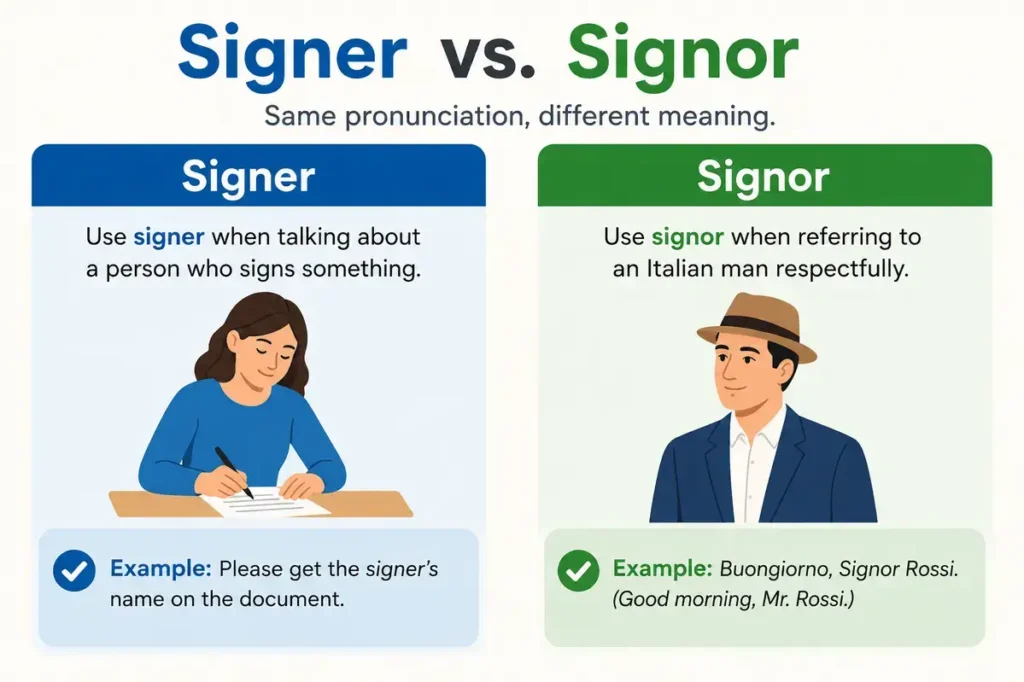
If you are referring to a person who signs something, use signer.
If you are referring to an Italian man respectfully, use signor.
Examples:
- The signer completed the contract.
- Signor Rossi welcomed the guests.
- She was listed as the primary signer on the agreement.
- Signor Bianchi owns the restaurant.
In modern English writing, signer appears far more frequently because it is commonly used in legal, business, and administrative contexts.
Signer vs Signor Comparison Table
| Feature | Signer | Signor |
|---|---|---|
| Correct spelling | Yes | Yes |
| Primary meaning | Person who signs | Italian title meaning Mr. |
| Part of speech | Noun | Noun |
| Language origin | English | Italian |
| Usage frequency | Common | Less common |
| Used in legal documents | Frequently | Rarely |
| Used as a title before names | No | Yes |
| Formality level | Neutral to formal | Formal |
| Typical context | Contracts, forms, agreements | Italian names and culture |
| Example | The signer approved the contract. | Signor Romano attended the meeting. |
Meaning of Signer and Signor
Understanding the exact meaning of each word is the key to avoiding mistakes.
What Does Signer Mean?
A signer is a person who signs a document, agreement, petition, form, letter, or official record.The word comes from the verb “sign,” meaning to write one’s name or mark as evidence of agreement, authorship, or acknowledgment.
Common contexts include:
- Legal contracts
- Banking documents
- Government forms
- Real estate agreements
- Petitions
- Official letters
Examples:
- Every signer must provide identification.
- The signer agreed to all terms.
- The bank verified the signer’s identity.
- Each signer received a copy of the contract.
What Does Signor Mean?
Signor is an Italian title of respect used before a man’s surname or full name.
It functions much like “Mr.” in English.
Examples:
- Signor Ferrari arrived early.
- Signor Ricci welcomed the visitors.
- The waiter greeted Signor Moretti warmly.
- Signor Lombardi owns the vineyard.
Outside Italian contexts, signor is mostly encountered in:
- Literature
- Travel writing
- Italian culture
- Historical documents
- International correspondence
Signer vs Signor Key Differences
Although signer and signor differ by only one letter, their meanings are entirely unrelated.
Meaning Difference
Signer refers to someone who signs.
Signor refers to an Italian gentleman.
Examples:
- The signer approved the application.
- Signor Mancini approved the proposal.
Language Difference
Signer belongs to English vocabulary.
Signor comes directly from Italian.
Usage Difference
Signer appears in:
- Contracts
- Agreements
- Legal records
- Business paperwork
Signor appears in:
- Italian names
- Cultural references
- Historical works
- Travel literature
Function Difference
Signer identifies an action.
Signor identifies a person through a title.
Professional Difference
Business and legal professionals regularly use signer.
Travel writers, historians, translators, and Italian speakers commonly use signor.
Which One Is Correct?
This question has a simple answer.Both words are correct.The correct choice depends entirely on your intended meaning.Use signer when discussing a person who signs something.
Examples:
- The signer reviewed the agreement.
- The signer must provide proof of identity.
- The signer accepted the terms.
Use signor when addressing or referring to an Italian man respectfully.
Examples:
- Signor Rossi entered the room.
- Signor Conti hosted the event.
- Signor Bianchi owns the property.
A helpful memory trick:
- Signer = Sign
- Signor = Italian honorific
If the sentence involves signatures, contracts, or documents, the correct word is almost always signer
Examples in Sentences for Signer and Signor
The best way to master these words is to see each word used naturally in context.
10 Examples Using Signer
- The signer reviewed every page before signing the contract.
- Each signer must present a valid photo ID.
- The signer agreed to the terms and conditions.
- The bank contacted the signer for verification.
- Every signer received a copy of the legal document.
- The signer acknowledged responsibility for the transaction.
- The primary signer authorized the payment.
- The signer carefully read the agreement before approval.
- The company requested the signer’s full address.
- The signer confirmed the information was accurate.
10 Examples Using Signor
- Signor Rossi welcomed the guests to the ceremony.
- The hotel manager greeted Signor Bianchi personally.
- Signor Conti owns a vineyard in Tuscany.
- We thanked Signor Romano for his hospitality.
- Signor Ferrari spoke at the cultural event.
- The letter was addressed to Signor Moretti.
- Signor Ricci arrived before the meeting began.
- Everyone listened carefully to Signor Lombardi’s presentation.
- Signor De Luca was honored for his contributions.
- The guide introduced us to Signor Bellini.
Common Mistakes With Signer and Signor
Because the words look alike, writers frequently confuse them.
Mistake 1: Using Signor in Legal Documents
Incorrect:
- The signor must complete all sections of the contract.
Correct:
- The signer must complete all sections of the contract.
Why?
A contract requires a person who signs, not an Italian title.
Mistake 2: Using Signer as a Title
Incorrect:
- Signer Rossi will join us shortly.
Correct:
- Signor Rossi will join us shortly.
Why?
Signer is not a title before a person’s name.
Mistake 3: Assuming One Is a Misspelling
Many people believe signor is simply a misspelling of signer.
It is not.
Both words are legitimate dictionary entries with different meanings.
Mistake 4: Relying Only on Spell Check
Because both words are correctly spelled, spell-check software often fails to identify misuse.Always check the context.
Mistake 5: Confusing Pronunciation With Meaning
The words sound somewhat similar, causing writers to substitute one for the other accidentally.The safest approach is to ask:
“Am I talking about a signature or an Italian gentleman?”
Learn the difference in Focussing or Focusing Which Spelling Is Correct 2026.
Pronunciation Guide
Pronunciation can help reinforce the difference.
Signer Pronunciation
IPA:
/ˈsaɪnər/
Syllable breakdown:
sign-er
Sounds like:
SYE-ner
Example:
“The signer approved the agreement.”
Signor Pronunciation
IPA:
/siːnˈjɔːr/ (Italian pronunciation)
Common English approximation:
/siːnˈyɔːr/
Syllable breakdown:
see-NYOR
Example:
“Signor Rossi greeted the audience.”
Common Pronunciation Mistakes
- Pronouncing signor exactly like signer.
- Ignoring the Italian influence in signor.
- Stressing the wrong syllable in signor.
- Misreading signer as “sign-or.”
Etymology and Word Origin of Signer and Signor
The history of these words reveals why they are unrelated despite their similar spelling.
Origin of Signer
Signer developed from the English verb “sign.”The word “sign” traces back through:
- Middle English
- Old French
- Latin signum meaning mark, symbol, or indication
As legal systems evolved, signer became the noun describing a person who signs a document.Over time, the word became especially important in:
- Government administration
- Commerce
- Banking
- Law
- Real estate
Origin of Signor
Signor comes directly from Italian.It derives from the Latin word senior, meaning elder or respected person.
Related words include:
- Señor in Spanish
- Senhor in Portuguese
- Seigneur in French
- Sir in English (distantly related through concepts of respect)
Historically, signor functioned as a title of respect throughout Italy.
How Their Histories Differ
Although signer and signor appear visually similar, they evolved through entirely separate linguistic paths. Signer is linked to signatures. Signor is linked to social titles and respect.
Regional Usage of Signer or Signor
American English
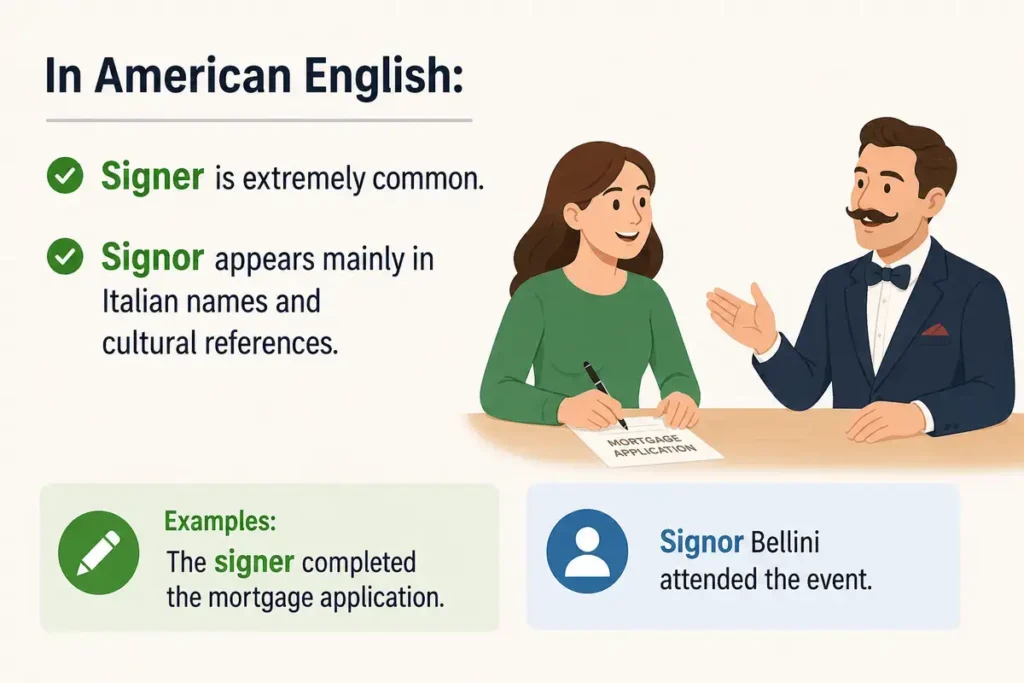
In American English:
- Signer is extremely common.
- Signor appears mainly in Italian names and cultural references.
Examples:
- The signer completed the mortgage application.
- Signor Bellini attended the event.
British English
British English follows the same distinction. Signer remains common in legal and administrative writing. Signor is generally limited to Italian contexts.
Australian English
Australian English uses signer in professional and legal settings. Signor appears primarily in references to Italian individuals or communities.
Canadian English
Canadian English follows the same pattern.The distinction between signer and signor remains consistent across formal and informal communication.
Regional Preference Summary
Unlike many word comparisons, it does not involve British versus American spelling differences. The meanings remain the same worldwide.
Grammar Rules for Signer vs Signor
Understanding grammar helps prevent confusion.
Part of Speech
Both words are nouns.
Examples:
- The signer accepted the agreement.
- Signor Romano attended the conference.
Countable Nouns
Both are countable nouns.
Examples:
- Three signers approved the document.
- Several signors attended the event.
Possessive Forms
Signer:
- The signer’s signature was verified.
Signor:
- Signor Rossi’s speech impressed the audience.
Plural Forms
Signer → Signers
Examples:
- All signers must be present.
- The signers reviewed the contract.
Signor → Signori (traditional Italian plural) or Signors in some English contexts.
Examples:
- The signori gathered for dinner.
- Several signors attended the reception.
Common Sentence Structures
With signer:
- The signer signed the form.
- Each signer received instructions.
- The signer approved the transaction.
With signor:
- Signor Bianchi arrived early.
- We welcomed Signor Romano.
- Signor Ferrari owns the company.
Real-Life Usage Examples
Daily Conversation
- The signer forgot to date the form.
- Signor Rossi owns the café downtown.
Academic Writing
- The signer acknowledged participation in the study.
- Historical records mention Signor Medici frequently.
Professional Communication
- The signer must review the updated agreement.
- The invitation was addressed to Signor Ricci.
Literature
Writers often use signor when depicting Italian settings, characters, or culture.
Example:
“Good evening, Signor,” the shopkeeper said warmly.
Media and Journalism
Examples:
- The signer authorized the public statement.
- Signor Bellini spoke at the international conference.
By examining real-world examples, the distinction becomes easy to remember:
- Signer = person who signs.
- Signor = Italian title of respect.
Related Words and Confused Terms Related to Signer or Signor
Many English learners encounter other words that resemble these words. Understanding these related terms helps prevent mistakes.
Words Related to Signer
- Sign
- Signature
- Signatory
- Co-signer
- Endorser
- Witness
- Subscriber
- Applicant
Words Related to Signor
- Signora (Mrs. in Italian)
- Signorina (Miss in Italian)
- Señor (Spanish)
- Senhor (Portuguese)
- Monsieur (French)
- Mister (English)
- Sir
- Gentleman
Commonly Confused Words
Signer vs Signatory
A signer is anyone who signs.A signatory is an official party who signs an agreement or treaty.
Example:
- Every signer completed the form.
- The signatories approved the international agreement.
Signor vs Señor
These words have similar meanings but belong to different languages.
- Signor = Italian
- Señor = Spanish
Examples:
- Signor Rossi
- Señor Garcia
Signer vs Signal
These words share the same root but have unrelated meanings.
- Signer = person who signs
- Signal = indication or message
Signor vs Sir
Both express respect.
However:
- Sir is English.
- Signor is Italian.
Expert Language Insight on Signer or Signor
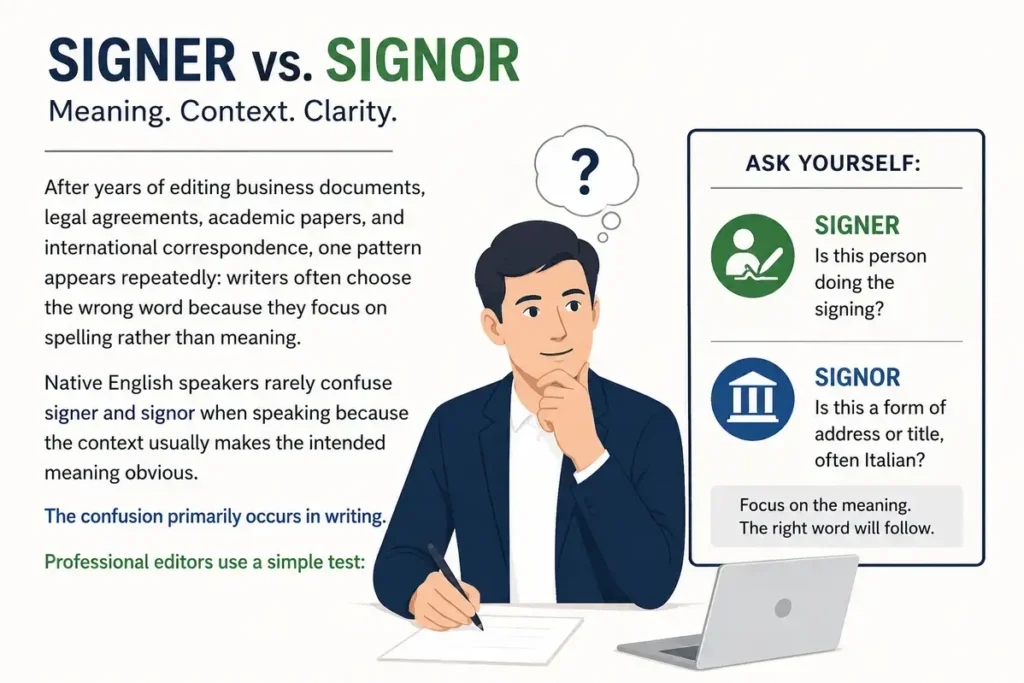
After years of editing business documents, legal agreements, academic papers, and international correspondence, one pattern appears repeatedly: writers often choose the wrong word because they focus on spelling rather than meaning.
Native English speakers rarely confuse signer and signor when speaking because the context usually makes the intended meaning obvious. The confusion primarily occurs in writing.Professional editors use a simple test:
Ask yourself:
“Am I referring to a signature or to an Italian title?”
If the answer involves documents, contracts, agreements, petitions, or forms, use signer.
If the answer involves an Italian name, greeting, title, or cultural reference, use signor.
Another useful observation is that signer belongs to everyday English vocabulary, while signor is a borrowed word from Italian. As a result, signer appears far more frequently in modern business and professional writing.
When proofreading, pay special attention to:
- Legal documents
- Contracts
- International correspondence
- Travel articles
- Historical writing
- Cultural discussions involving Italy
In these contexts, the distinction matters because using the wrong word can confuse readers and weaken credibility.
Frequently Asked Questions
Is signer or signor the correct word for someone who signs a contract?
Signer is the correct word. A signer is a person who signs a document, agreement, contract, petition, or form. Signor is an Italian title of respect and has no connection to signatures or legal paperwork.
Is signor a misspelling of signer?
No. Signor is not a misspelling. It is a legitimate Italian word used as a respectful title before a man’s name, similar to “Mr.” in English. Both words are correct but serve different purposes.
What does signor mean in English?
Signor translates roughly to “Mr.” or “Sir” when referring to an Italian man. It is commonly used before surnames and appears frequently in Italian culture, literature, travel writing, and formal introductions.
Can signer and signor be used interchangeably?
No. The words are not interchangeable. Signer refers to a person who signs documents, while signor is an Italian honorific title. Replacing one with the other creates a grammatical and contextual error.
Which word is more common in modern English?
Signer is significantly more common because it appears in legal, financial, governmental, and business communication. Signor is generally limited to references involving Italian people, culture, or language.
How do you pronounce signer and signor?
Signer is pronounced:
/ˈsaɪnər/
Signor is commonly pronounced:
/siːnˈjɔːr/
Although they look similar, their pronunciation differs noticeably.
What is the plural of signer?
The standard plural form is signers.
Examples:
- The signers reviewed the agreement.
- All signers must provide identification.
What is the female equivalent of signor?
The female equivalent is signora.
Examples:
- Signor Rossi
- Signora Rossi
In Italian, signora functions similarly to Mrs. or Madam in English.
For another common grammar confusion, see Wack or Whack Which Word Is Correct? (2026).
Conclusion
The debate over these words is not really about choosing the better word. It is about choosing the correct word for the situation. A signer is someone who signs a document, contract, agreement, petition, or form. The term belongs to standard English and is widely used in legal, financial, governmental, and business contexts.
A signor is an Italian title of respect equivalent to “Mr.” It appears before a man’s name and is primarily used in Italian language and cultural settings. The easiest way to remember the distinction is simple:
- If the sentence involves a signature, use signer.
- If the sentence involves an Italian gentleman, use signor.
Once you understand that these words come from completely different linguistic backgrounds and serve entirely different functions, the confusion disappears. Choosing the right term improves clarity, strengthens your writing, and ensures your message is understood exactly as intended.
.