
If you’ve ever stopped while writing and wondered focussing or focusing, you’re asking one of the most common spelling questions in English. Both forms appear in dictionaries, newspapers, books, and websites, making it easy to assume one must be wrong. In reality, both spellings are correct. The difference comes down to the variety of English you’re using.
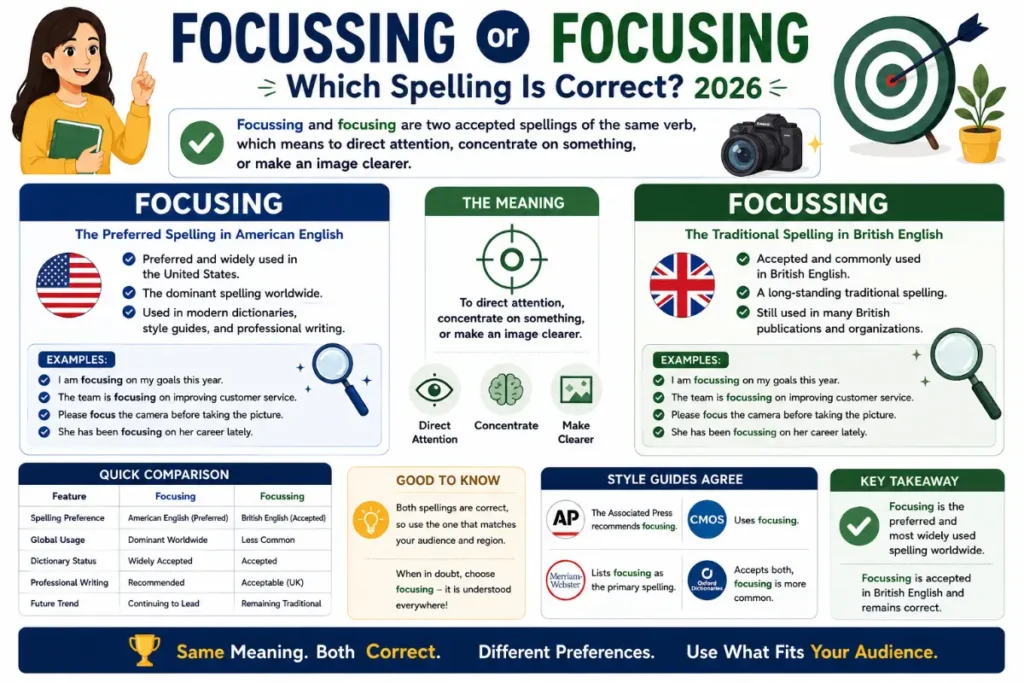
In American English, focusing is the standard spelling and is the form recommended by nearly every dictionary, publisher, university, and style guide. In British English, focussing has long been accepted because of traditional spelling rules that double the final consonant before adding a suffix. Even so, focusing has become increasingly common in the United Kingdom and is now preferred by many modern publishers.
If you’re writing for an international audience, using focusing is usually the safest choice because it is recognized worldwide and matches the spelling most readers expect.
Many readers also check Cryer vs Crier Which Spelling Is Correct 2026.
Quick Definition
Focussing and focusing are two accepted spellings of the same verb, which means to direct attention, concentrate on something, or make an image clearer. Focusing is the preferred spelling in American English and is now the dominant form worldwide, while focussing remains an accepted traditional spelling in British English.
Quick Answer
If you want the shortest possible answer, here it is.
- Focusing is correct.
- Focussing is also correct.
- American English almost always uses focusing.
- British English accepts both spellings.
- Most international publishers now prefer focusing.
- Use one spelling consistently throughout your writing.
Focussing or Focusing Comparison Table
| Feature | Focusing | Focussing |
|---|---|---|
| Correct spelling | Yes | Yes |
| Meaning | Concentrating attention or bringing into focus | Same meaning |
| Part of speech | Present participle or gerund | Present participle or gerund |
| Root word | Focus | Focus |
| Origin | Modern standard spelling | Traditional British spelling |
| Usage frequency | Very high | Lower |
| American English | Standard | Rare |
| British English | Accepted and increasingly preferred | Traditional alternative |
| Canadian English | Mostly preferred | Occasionally seen |
| Australian English | Common | Less common |
| Academic writing | Preferred | Less common |
| Business writing | Preferred | Less common |
| International audience | Recommended | Usually avoided |
Meaning of Both Terms
Since these words share the same meaning, the only real distinction is spelling.
What Does Focusing Mean
Focusing is the present participle and gerund of the verb focus. It means directing attention toward something, concentrating mental effort, highlighting an important subject, or adjusting a lens until an image becomes sharp. Examples include studying for an exam, concentrating during a meeting, improving business priorities, or adjusting a camera.
Examples.
- She is focusing on her final presentation.
- The photographer is focusing the camera.
- Our company is focusing on customer satisfaction.
- He is focusing his energy on recovery.
What Does Focussing Mean
Focussing means exactly the same thing. The spelling reflects an older British convention of doubling the consonant before adding ing. Many British dictionaries continue to list it as an acceptable alternative, although focusing has become more common in modern publications.
Focussing or Focusing Key Differences
The biggest misconception is that one spelling changes the meaning. It does not.
Meaning
There is absolutely no difference in meaning. Both describe directing attention or making something clearer.
Grammar
Both spellings perform exactly the same grammatical function. They can be used as:
- Present participles.
- Gerunds.
- Adjectival modifiers in some contexts.
Tone
Neither spelling sounds more formal or informal. The choice reflects regional spelling conventions rather than writing style.
Regional Preference
This is the only significant difference.
American English Almost exclusively uses focusing.
British English Accepts both spellings. Traditional publications often use focussing, while many modern publishers increasingly choose focusing.
Australian English Generally follows modern international practice by favoring focusing, although focussing still appears occasionally.
Canadian English Strongly leans toward focusing.
Editorial Preference
Professional editors generally recommend matching the spelling to the style guide being followed. If no style guide exists, focusing is usually the better choice because it is more widely recognized internationally.
Which One Is Correct
The answer depends on your audience rather than grammar. If you’re writing in American English, use focusing. If you’re writing in British English, both spellings are acceptable. Many respected British publishers, educational institutions, and newspapers have gradually shifted toward focusing, making it the safer option even outside North America. That means neither spelling is wrong. The important point is consistency. Avoid switching between focusing and focussing in the same document.
Examples Using Focusing
Here are natural examples showing how focusing appears in everyday English.
- She is focusing on finishing the project before Friday.
- The students are focusing during the lecture.
- He’s focusing on improving his writing skills.
- We’re focusing our marketing efforts on local customers.
- The camera keeps focusing automatically.
- Doctors are focusing on prevention instead of treatment.
- They spent the afternoon focusing on customer feedback.
- The coach is focusing on teamwork this season.
- I’m focusing more on healthy habits this year.
- Success comes from focusing on the right priorities.
Examples Using Focussing
These examples use the traditional British spelling.
- She is focussing on her coursework.
- The company is focussing on sustainable growth.
- They are focussing attention on climate research.
- He’s focussing his efforts on one task at a time.
- The photographer is focussing the lens manually.
- The article is focussing on practical solutions.
- We’re focussing resources where they are needed most.
- The teacher kept focussing students on the lesson.
- The report is focussing public attention on housing.
- They’re focussing entirely on customer experience.
Common Mistakes
Although the spelling difference is simple, many writers make mistakes because they misunderstand English spelling conventions.
Assuming Focussing Is Wrong
Many people believe focussing is a misspelling. It is not. It remains an accepted spelling in British English.
Assuming Focusing Is Only American
Another common myth is that focusing belongs only to American English. Modern British dictionaries and publishers increasingly use focusing, making it common throughout the English speaking world.
Mixing Regional Styles
A document should normally follow one variety of English. For example, avoid combinations such as:
- Focussing.
- Color.
- Organize.
This mixes British and American conventions.
Likewise, avoid:
- Focusing.
- Colour.
- Organise.
unless your chosen style guide allows it.
Believing Double Consonants Always Apply
Many English learners assume every word ending in a consonant doubles before ing. English spelling is more complicated than that. Some words double the final consonant. Others do not. The history of focus makes it a special case.
Pronunciation Guide
Despite the spelling difference, pronunciation never changes.
American IPA
/ˈfoʊ.kə.sɪŋ/
British IPA
/ˈfəʊ.kə.sɪŋ/
Syllable Breakdown
FOH kuh sing
Common Pronunciation Mistakes
- Stressing the second syllable.
- Pronouncing the final g too strongly.
- Saying foe CUSS ing instead of FOH kuh sing.
- Confusing focus with faucus, which is incorrect.
Etymology and Word Origin
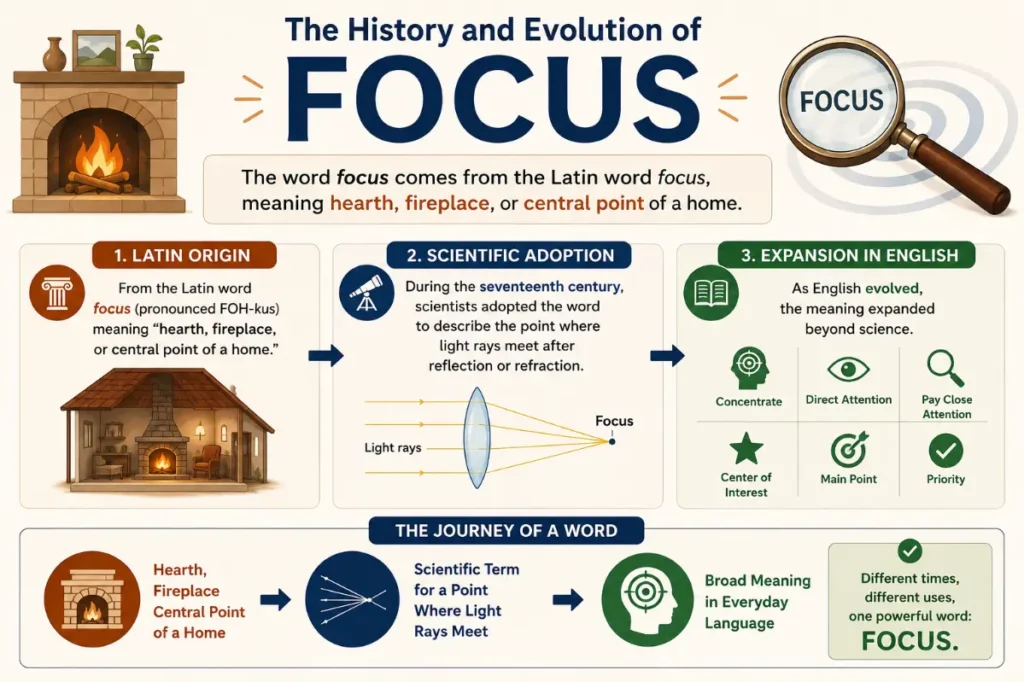
The word focus comes from the Latin word focus, meaning hearth, fireplace, or central point of a home. Scientists later adopted the word during the seventeenth century to describe the point where light rays meet after reflection or refraction. As English evolved, the meaning expanded beyond science.
Today, focus commonly means:
- Directing attention.
- Concentrating effort.
- Highlighting an important issue.
- Adjusting a camera or microscope.
- Making ideas clearer.
The spelling focussing developed from older British conventions that doubled the final consonant before adding suffixes. Over time, focusing became increasingly popular because many editors considered it simpler and more consistent with international English. Today, both forms remain acceptable, although focusing is clearly the dominant spelling across most of the English speaking world.
Learn the difference in In Route vs En Route Which Is Correct.
Focussing or Focusing in Regional Usage
One reason people search for focussing or focusing is that they encounter different spellings depending on where the text was written. Regional spelling conventions explain nearly all of the variation.
American English
American English almost always uses focusing. Major dictionaries, universities, newspapers, government publications, and style guides consistently recommend this spelling. If you’re writing for readers in the United States, focusing is the correct choice.
Examples.
- The company is focusing on innovation.
- She is focusing on her studies.
- The report focuses on economic growth.
British English
British English recognizes both spellings. Historically, focussing was more common because British spelling often doubles the final consonant before adding a suffix. Today, however, many British publishers and educational institutions prefer focusing, especially in digital and academic writing.
Examples.
- The charity is focussing on local communities.
- The charity is focusing on local communities.
Both are acceptable in British English.
Australian English
Australian English generally follows British spelling traditions but has increasingly adopted focusing. Many Australian universities, businesses, and newspapers now use focusing as their standard spelling.
Canadian English
Canadian English often blends British and American conventions. In practice, focusing appears far more frequently in professional, educational, and government writing.
International English
If your audience includes readers from multiple countries, focusing is the safest option. It is familiar to readers worldwide and aligns with the spelling preferred by most international publishers.
Focussing or Focusing Grammar Rules
Understanding the grammar behind these spellings helps you use them correctly in every sentence.
Parts of Speech
The word focus can function as both a noun and a verb.
As a noun.
- The focus of the meeting was customer service.
As a verb.
- Please focus on the main idea.
The forms focusing and focussing are verb forms.
Present Participle
Both spellings can describe an action that is happening now.
Examples.
- She is focusing on her assignment.
- She is focussing on her assignment.
Gerund
They can also function as nouns.
Examples.
- Focusing improves productivity.
- Focussing improves productivity.
Verb Forms
| Verb Form | Example |
|---|---|
| Base verb | Focus |
| Third person singular | Focuses |
| Present participle | Focusing or focussing |
| Past tense | Focused |
| Past participle | Focused |
Common Sentence Structures
- Focus on something.
- Focus attention on something.
- Focus your efforts.
- Focus your mind.
- Focus resources.
Examples.
- We need to focus on quality.
- She is focusing on customer needs.
- They’re focusing their attention on safety.
- The company focused its resources on research.
Why Do Both Spellings Exist
Many spelling differences between British and American English developed during the eighteenth and nineteenth centuries. British English often doubles the final consonant before adding endings such as ing or ed.
Examples include words like:
- Travelling.
- Labelled.
- Cancelled.
American English often simplifies these spellings.
Examples include:
- Traveling.
- Labeled.
- Canceled.
The word focus sits somewhere between these traditions. Although focussing followed older British spelling habits, focusing gradually became more common because many dictionaries and publishers considered it simpler and easier to standardize. Today, both forms survive, but one has clearly become more popular.
Which Spelling Do Dictionaries Prefer
Major dictionaries recognize both spellings, although many present focusing as the primary entry.
General trends include:
- American dictionaries strongly favor focusing.
- British dictionaries list both spellings.
- Modern learner dictionaries often place focusing first.
- Digital dictionaries increasingly recommend focusing for international readers.
This reflects actual language use rather than a grammatical rule.
Focussing or Focusing in Academic Writing
Academic writing values consistency above almost everything else. If you’re writing for an American university, use focusing throughout the paper. If you’re following British academic conventions, check your institution’s style guide. Some universities still use focussing, while many now prefer focusing. Never switch between the two spellings in the same assignment unless you’re directly quoting a source.
Correct.
- This study is focusing on language development.
Incorrect.
- This study is focusing on language development. Later, the report discusses focussing on vocabulary.
Focussing or Focusing in Professional Communication
Business writing should always match the expectations of the audience.
Examples include:
- Emails.
- Reports.
- Marketing materials.
- Company websites.
- Presentations.
For international businesses, focusing is generally the preferred spelling because it is instantly recognizable across English-speaking markets.
Example.
- Our team is focusing on delivering better customer service.
This version looks natural to readers in nearly every country.
Focussing or Focusing in Everyday Conversation
In spoken English, there is no difference because both spellings sound identical.The distinction exists only in writing.
Examples.
- I’m focusing on my health this year.
- She’s focusing on finding a new job.
- We’re focusing on saving more money.
- The teacher is focusing on reading skills.
A British writer may spell these with focussing, but listeners would never hear the difference.
Real Life Usage Examples
Daily Conversation
- I’m focusing on getting enough sleep.
- She’s focusing on her driving test.
- We’re focusing on eating healthier meals.
- He keeps focusing on the negative.
- Try focusing on one task at a time.
Academic Writing
- This paper is focusing on climate policy.
- The research focuses on language acquisition.
- The experiment is focusing on memory retention.
- Students should focus on reliable evidence.
- The discussion focuses on practical applications.
Professional Communication
- Our department is focusing on customer satisfaction.
- The company is focusing on long term growth.
- We’re focusing our resources more efficiently.
- Leadership is focusing on employee wellbeing.
- The strategy focuses on measurable results.
Literature
Writers often use focus and its related forms to describe emotional attention, determination, and observation. Examples include characters:
- Focusing on survival.
- Focusing on revenge.
- Focusing on hope.
- Focusing on love.
- Focusing on discovering the truth.
News and Media
Journalists frequently use the word when discussing government policies, business strategies, education, healthcare, sports, and technology.
Examples.
- The government is focusing on inflation.
- Scientists are focusing on renewable energy.
- Schools are focusing on literacy.
- The team is focusing on defense.
- Investors are focusing on interest rates.
Related Words and Commonly Confused Terms
Several words are closely related to focus or are commonly searched alongside focussing or focusing.
Related Words
- Focus.
- Focused.
- Focuses.
- Focusedly.
- Refocus.
- Refocused.
- Refocusing.
- Concentrate.
- Concentration.
- Attention.
- Emphasis.
- Priority.
- Spotlight.
- Clarity.
- Precision.
Commonly Confused Spellings
- Travelling or traveling.
- Labelled or labeled.
- Cancelled or canceled.
- Modelling or modeling.
- Fuelled or fueled.
- Jewellery or jewelry.
- Ageing or aging.
- Signalling or signaling.
These pairs follow the same broader pattern of British and American spelling differences.

Expert Language Insight
From an editor’s perspective, the question is rarely about right and wrong. It’s about consistency and audience. If I were editing an international website, business report, or academic article intended for readers worldwide, I would almost always choose focusing. It is the spelling most readers recognize immediately, and it aligns with the conventions used by many global publishers. If I were editing a document that follows traditional British English, I would respect the chosen house style. If that organization uses focussing, I would keep it throughout the document rather than changing individual instances. Native speakers generally don’t notice the spelling itself. What they do notice is inconsistency. Seeing both focusing and focussing in the same article makes the writing appear less polished.
The best editing advice is simple.
- Know your audience.
- Follow the appropriate style guide.
- Use one spelling consistently from beginning to end.
Doing so will make your writing look professional regardless of which accepted form you choose.
Still confused? Compare begun or began The Simple Grammar Rule 2026.
Final Verdict on Focussing or Focusing
The debate over focussing or focusing is less about correctness and more about regional spelling conventions. Both forms are legitimate, both carry the same meaning, and both are accepted by reputable dictionaries.
For most writers, however, focusing is the better choice. It is the standard spelling in American English, widely accepted in modern British English, and the version most commonly used by international publishers, businesses, universities, and digital platforms. Choosing focusing also helps maintain consistency when writing for a global audience.
If you’re following a traditional British style guide that prefers focussing, there’s no need to change it. The key is to remain consistent throughout your document and avoid mixing spellings.
Frequently Asked Questions
Is focussing or focusing correct?
Yes. Both spellings are correct. Focusing is the standard spelling in American English and is now the most widely used form internationally. Focussing remains an accepted alternative in British English, although many British publishers also prefer focusing.
Why do Americans write focusing instead of focussing?
American English generally favors simplified spellings. As a result, focusing became the standard form in dictionaries, schools, newspapers, and professional writing across the United States. Today, it is also the spelling most international readers expect.
Is focussing outdated?
Not entirely. Focussing is still considered correct in British English and appears in books, newspapers, and older publications. However, its use has declined as focusing has become more common in modern British and international English.
Which spelling should I use in academic writing?
Follow the style guide required by your school, university, or publisher. If no style guide is specified, focusing is usually the safest choice because it is the preferred spelling in most academic journals and international publications.
Are focusing and focussing pronounced differently?
No. They are pronounced exactly the same. The difference exists only in spelling, not in pronunciation. Readers and listeners hear the same word regardless of which spelling appears in writing.
Why do some British writers use focussing?
Traditional British spelling often doubles the final consonant before adding endings like ing. That convention produced focussing. Although many British writers still use it, focusing has become increasingly popular across the United Kingdom.
Does Microsoft Word or Google Docs accept both spellings?
Yes. Both spelling checkers generally recognize focusing and focussing. The suggested spelling depends on the language setting you choose, such as American English or British English.
Which spelling is better for websites and SEO?
For most websites, focusing is the stronger choice because it matches the spelling used by the majority of English speakers and international searchers. If your audience is primarily British and your content consistently follows British English, focussing is also appropriate.