
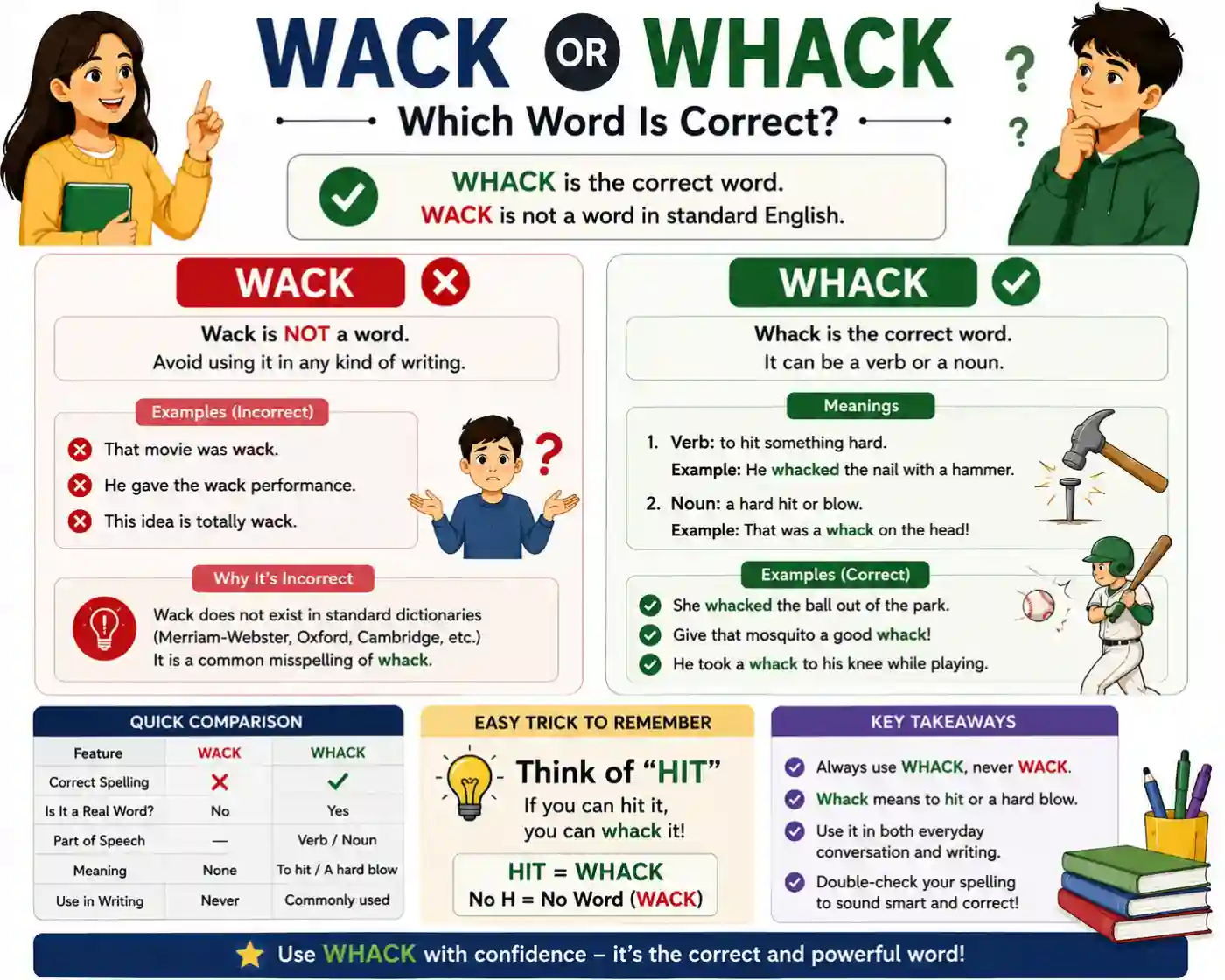
If you’ve ever typed wack or whack into a search engine, you’re not alone. These two words look almost identical, sound the same in everyday speech, and often appear in conversations online. That similarity makes it easy to assume one is simply a misspelling of the other. In reality, both words exist in English, but they have very different histories, meanings, and levels of acceptance.
The confusion usually begins because whack is the traditional English spelling found in dictionaries, books, newspapers, and professional writing. Wack, on the other hand, became popular through slang and modern culture, especially in hip hop, casual conversation, and social media. Many people use it to describe something that is bad, boring, strange, or disappointing.
Knowing the difference helps you choose the right word for the right situation. It also prevents mistakes in school assignments, business communication, creative writing, and online content.
Need another quick comparison? Read Lifetime or Life Time Which Spelling Is Correct.
Quick Definition
Whack is the standard English word that means to hit something forcefully or refers to a sharp blow. Wack is an informal slang adjective meaning bad, uncool, poor quality, or unimpressive. If you’re talking about striking something, use whack. If you’re using modern slang to criticize something, wack is the correct choice.
Quick Answer
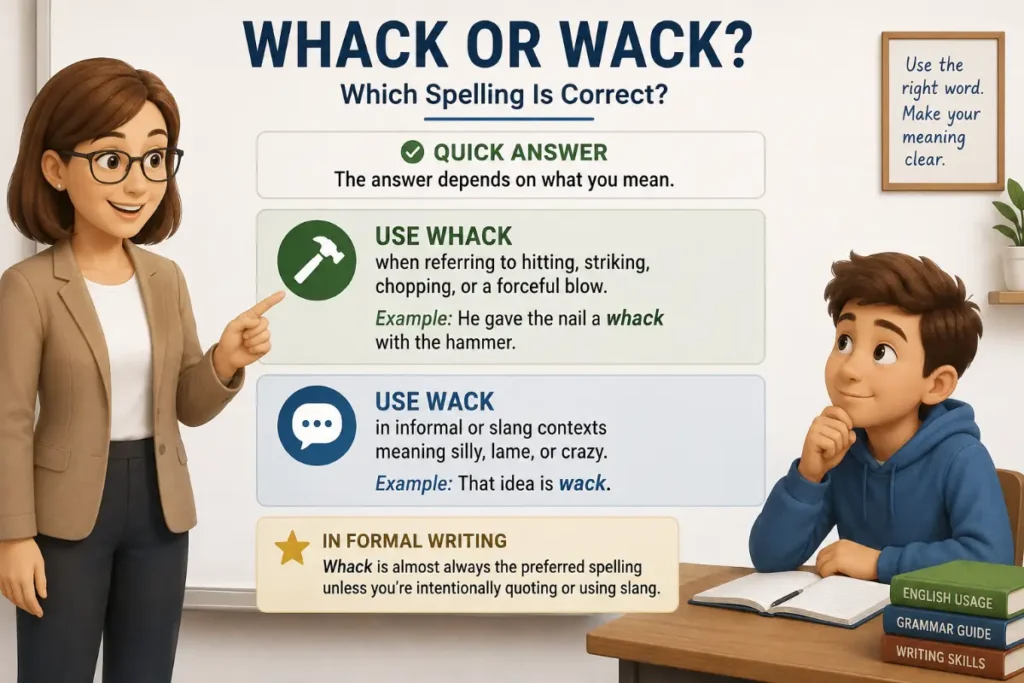
The answer depends on what you mean.
- Use whack when referring to hitting, striking, chopping, or a forceful blow.
- In formal writing, whack is almost always the preferred spelling unless you’re intentionally quoting or using slang.
Wack or Whack Comparison Table
| Feature | Wack | Whack |
|---|---|---|
| Correct spelling | Correct as informal slang | Correct standard English word |
| Main meaning | Bad, boring, poor quality | Hit forcefully or a strong blow |
| Part of speech | Adjective, occasionally noun | Verb, noun, interjection |
| Origin | Modern American slang | Middle English and Scottish English |
| Usage frequency | Common in casual speech and social media | Common in everyday English |
| Formality | Informal and slang | Neutral and accepted in all writing |
| Common contexts | Music, entertainment, sports, internet culture | Sports, cooking, gardening, daily conversation, literature |
| Dictionary status | Recognized as slang by many dictionaries | Fully established standard English word |
| Professional writing | Usually avoided | Widely accepted |
| Example | That movie was wack. | He whacked the ball across the field. |
Understanding Wack or Whack
Although wack and whack sound identical, they serve different purposes in English. Their relationship is a good example of how pronunciation does not always determine spelling or meaning. The traditional word whack has existed for centuries. It appears in literature, journalism, education, and everyday speech. People use it to describe hitting something with force or to refer to a sudden impact. The slang word wack developed much later. It became especially popular in American urban culture during the late twentieth century. Instead of referring to physical force, it expresses a negative opinion about a person, object, event, or idea. Because both words are pronounced the same, spellcheck cannot always identify the intended meaning. Readers must rely on context to understand which spelling is correct.
Meaning of Wack
Wack is an informal adjective used to criticize something. It suggests that something is disappointing, uncool, poorly made, boring, weak, or lacking quality.
It commonly appears in conversations about:
- Movies.
- Music.
- Fashion.
- Sports.
- Video games.
- Social media.
- Everyday conversations.
Examples include:
- That restaurant was wack.
- His excuse sounded wack.
- The ending of the movie was wack.
- Their latest album is wack compared with the previous one.
Although many dictionaries recognize wack, they also label it as slang. That means it fits casual communication but usually does not belong in formal reports, academic essays, or business documents.
Etymology of Wack
The exact origin remains uncertain, but wack gained widespread popularity in American slang during the 1980s. Hip hop culture, street language, and entertainment helped spread the word across the United States before it became common online. Over time, it evolved into a widely understood expression meaning poor quality or lacking style.
Meaning of Whack
Whack is a standard English word with several related meanings. As a verb, it means to strike something with force.
Examples include:
- She whacked the baseball over the fence.
- He whacked the branch with an axe.
- The child whacked the piñata until it broke.
As a noun, whack refers to a forceful hit.
Examples include:
- The hammer landed with a loud whack.
- One whack was enough to split the log.
As an interjection, speakers sometimes say whack to imitate the sound of a sudden hit. Because it appears in many situations, whack is common in both spoken and written English.
Etymology of Whack
The word whack dates back several centuries. Linguists trace it to Scottish and Northern English dialects, where similar words described striking, chopping, or making a sharp impact. Its meaning has remained remarkably consistent throughout modern English, making it one of the language’s well-established action verbs.
Wack or Whack Key Differences
Although only one letter separates these words, their meanings differ significantly.
| Category | Wack | Whack |
|---|---|---|
| Basic meaning | Poor quality | Strike forcefully |
| Function | Expresses opinion | Describes an action |
| Tone | Informal slang | Neutral |
| Formal writing | Rare | Common |
| Dictionary acceptance | Slang entry | Standard vocabulary |
| Typical audience | Casual conversation | Everyone |
| Emotional meaning | Negative judgment | Physical action |
Another important difference involves permanence. The meaning of whack has remained stable for generations. The meaning of wack depends much more on popular culture and informal speech, so its popularity can change over time.
Which One Is Correct?
Both words are correct, but only in the appropriate context.
Choose whack if you’re describing:
- Hitting something.
- A physical blow.
- Chopping.
- Striking.
- Impact.
- Standard English writing.
Choose wack if you’re describing:
- Something disappointing.
- Poor quality.
- Someone acting uncool.
- A weak performance.
- An unimpressive idea.
- Informal slang.
If you’re writing for school, work, journalism, publishing, or professional communication, whack is almost always the safer choice because it is the standard dictionary spelling. Use wack only when your audience expects casual language or slang.
Wack in Sentences
These examples show how native speakers naturally use wack.
- That movie was so wack that we left before it ended.
- His explanation sounded wack and nobody believed it.
- The new update is wack because it introduced more problems than improvements.
- Their performance felt wack compared with last year’s show.
- The restaurant looked promising, but the food was wack.
- I thought the joke was wack, so nobody laughed.
- That excuse is completely wack.
- The game’s graphics are great, but the storyline is wack.
- People online called the decision wack almost immediately.
- She refused to wear the outfit because she thought it looked wack.
A related grammar guide is Bellies vs Bellys Which Spelling Is Correct in 2026?.
Whack in Sentences
These examples demonstrate the standard English use of whack.
- He whacked the baseball over the left field fence.
- She whacked the dust from the rug with a stick.
- The chef whacked the coconut open with a heavy knife.
- Someone accidentally whacked the door with a shopping cart.
- The gardener whacked the weeds before planting new flowers.
- The carpenter gave the nail one more whack with the hammer.
- A strong wind whacked the window shut.
- He whacked the alarm clock to make it stop ringing.
- The boxer whacked his opponent with a quick punch during practice.
- The child laughed after whacking the piñata until candy fell everywhere.
Common Mistakes When Using Wack or Whack
Even native English speakers sometimes confuse wack and whack because they are pronounced the same. The mistake usually happens when people write the words instead of speaking them. Understanding the purpose of each word makes it much easier to choose the correct spelling.
1. Using wack Instead of whack for Physical Actions
This is the most common error.
Incorrect
- He wacked the ball over the fence.
Correct
- He whacked the ball over the fence.
If someone is hitting, striking, chopping, or delivering a blow, whack is always the correct word.
2. Using whack Instead of wack in Slang
People sometimes assume whack is correct because it is the standard dictionary spelling.
Less natural in slang
- That party was whack.
Natural slang
- That party was wack.
When expressing that something is boring, disappointing, or uncool in casual conversation, wack is the spelling most native speakers expect.
3. Using Wack in Formal Writing
Although dictionaries recognize wack as slang, it is still informal. Avoid sentences like these in professional writing.
- The company’s proposal was wack.
- The report contained several wack ideas.
Instead, choose a more formal word.
- The company’s proposal was poorly planned.
- The report contained several weak ideas.
4. Confusing Similar Pronunciation
English contains many words that sound alike but have different spellings and meanings. Wack and whack belong to this group. Always ask yourself one question. Am I describing a physical hit or expressing an opinion? If it is a hit, choose whack. If it is an opinion, choose wack.
5. Misspelling the Past Tense
Another frequent mistake involves verb forms.
Correct verb forms
| Tense | Form |
|---|---|
| Base verb | whack |
| Present participle | whacking |
| Past tense | whacked |
| Past participle | whacked |
Because wack is generally an adjective, forms like wacked are rarely appropriate unless they appear in highly informal slang.
Wack or Whack Pronunciation Guide
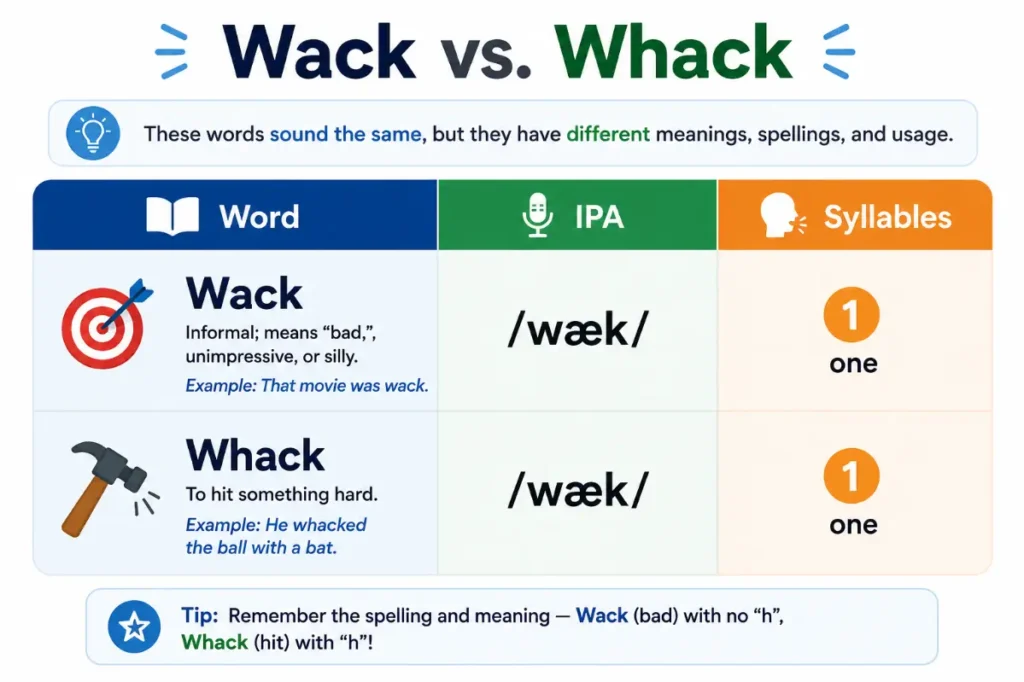
Although the spellings differ, both words are pronounced exactly the same.
| Word | IPA | Syllables |
|---|---|---|
| Wack | /wæk/ | one |
| Whack | /wæk/ | one |
Syllable Breakdown
Wack
- wack
Whack
- whack
Each word has only one stressed syllable.
Common Pronunciation Mistakes
Most learners pronounce these words correctly because they are short and simple. The challenge is spelling them correctly. Common writing mistakes include:
- Writing wack when describing a physical hit.
- Writing whack when using modern slang.
- Assuming the silent h changes pronunciation.
It does not. The wh in whack is silent in modern English pronunciation.
Etymology and Word Origin
Learning where these words came from explains why they have different meanings today.
Origin of Whack
Whack has been part of English for centuries. Language historians trace it to Scottish and Northern English dialects. Early forms referred to striking, chopping, or hitting something with force. As English evolved, whack became a standard verb and noun. Over time, writers also developed figurative meanings.
For example:
- The company took a financial whack.
- Inflation gave consumers a real whack.
In these examples, no physical blow occurs. Instead, the word describes a strong negative impact.
Origin of Wack
Wack is much newer. It emerged in American slang during the late twentieth century. Its popularity grew rapidly through:
- Hip hop music.
- Breakdancing culture.
- Urban communities.
- Television.
- Movies.
- Internet culture.
Rather than describing physical force, wack became a way to criticize something. Today, millions of English speakers immediately recognize sentences such as:
- That movie is wack.
- His attitude is wack.
- This update is wack.
Although informal, the word has become firmly established in modern slang.
Regional Usage of Wack or Whack
English changes from country to country, but the distinction between wack and whack remains fairly consistent.
American English
American English uses both words. Whack appears in newspapers, books, schools, workplaces, and everyday conversation. Wack is widely recognized in casual speech, music, sports, gaming, and social media.
British English
British English strongly favors whack. Many British speakers understand wack, especially younger generations, but it appears less frequently outside internet culture and entertainment.
Canadian English
Canadian English generally follows American usage. Whack is standard. Wack appears mostly in informal speech among younger speakers.
Australian English
Australians regularly use whack. The slang word wack is understood but competes with many local slang expressions, so it is less common than in the United States.
Regional Preference Summary
| Region | Whack | Wack |
|---|---|---|
| United States | Very common | Common slang |
| United Kingdom | Very common | Less common |
| Canada | Very common | Moderately common |
| Australia | Very common | Limited slang use |
Grammar Rules
Although these words are related by pronunciation, they follow different grammar patterns.
Whack as a Verb
This is its most common grammatical role.
Examples:
- They whack the weeds every spring.
- She whacked the baseball.
- He is whacking branches with an axe.
Whack as a Noun
The noun refers to a forceful blow.
Examples:
- One whack broke the board.
- The hammer landed with a loud whack.
Whack as an Interjection
Sometimes it imitates sound.
Example:
- Whack! The stick hit the tree.
Wack as an Adjective
Most often, wack functions as an adjective.
Examples:
- The ending was wack.
- His excuse sounds wack.
- Their latest song feels wack.
Can Wack Be a Noun?
Occasionally, especially in slang, speakers use wack as a noun to refer to poor quality or something undesirable.
Example:
- That whole event was pure wack.
This usage is uncommon and remains highly informal.
Plural Forms
Because whack usually functions as a verb or noun, plural forms appear only when used as a noun.
Example:
- We heard several loud whacks.
The adjective wack does not have a plural form.
Real Life Usage Examples
Looking at authentic contexts makes the difference much clearer.
Daily Conversation
- That restaurant was wack.
- Don’t whack the table so hard.
- His excuse sounds wack.
- She accidentally whacked her elbow.
Academic Writing
Academic writers almost never use wack unless discussing slang, language, or popular culture.
Example:
- Researchers examined the evolution of the slang term wack in American English.
By contrast, whack appears naturally.
Example:
- The scientist described the impact as a sudden whack against the metal surface.
Professional Communication
Business writing avoids slang.
Instead of:
- The proposal is wack.
Professional editors recommend:
- The proposal needs significant improvement.
- The proposal lacks supporting evidence.
- The proposal is poorly developed.
Literature
Novelists frequently use whack to describe movement and action.
Example:
- He gave the tree one final whack before it fell.
Modern novels featuring realistic dialogue may include wack to reflect natural speech.
Example:
- “That plan is wack,” Marcus said with a laugh.
News and Media
Traditional journalism almost always uses whack in standard reporting. Entertainment journalism may use wack when quoting someone directly or discussing music, gaming, sports, or internet culture.
Related Words and Confused Terms
Several English words resemble wack or whack in spelling, pronunciation, or meaning.
Words Related to Whack
- Hit.
- Strike.
- Smack.
- Slap.
- Punch.
- Bash.
- Knock.
- Beat.
- Chop.
- Slam.
These words describe physical force, though each carries its own nuance.
Words Related to Wack
- Bad.
- Weak.
- Terrible.
- Poor.
- Awful.
- Cheap.
- Corny.
- Uncool.
- Disappointing.
These words express negative opinions rather than physical actions.
Easily Confused Words
Many learners also confuse these pairs:
- Wack and whack.
- Than and then.
- Affect and effect.
- Compliment and complement.
- Principal and principle.
- Stationary and stationery.
- Lose and loose.
- Peak and peek.
Like wack and whack, these pairs require attention to context instead of pronunciation alone.
Expert Language Insight
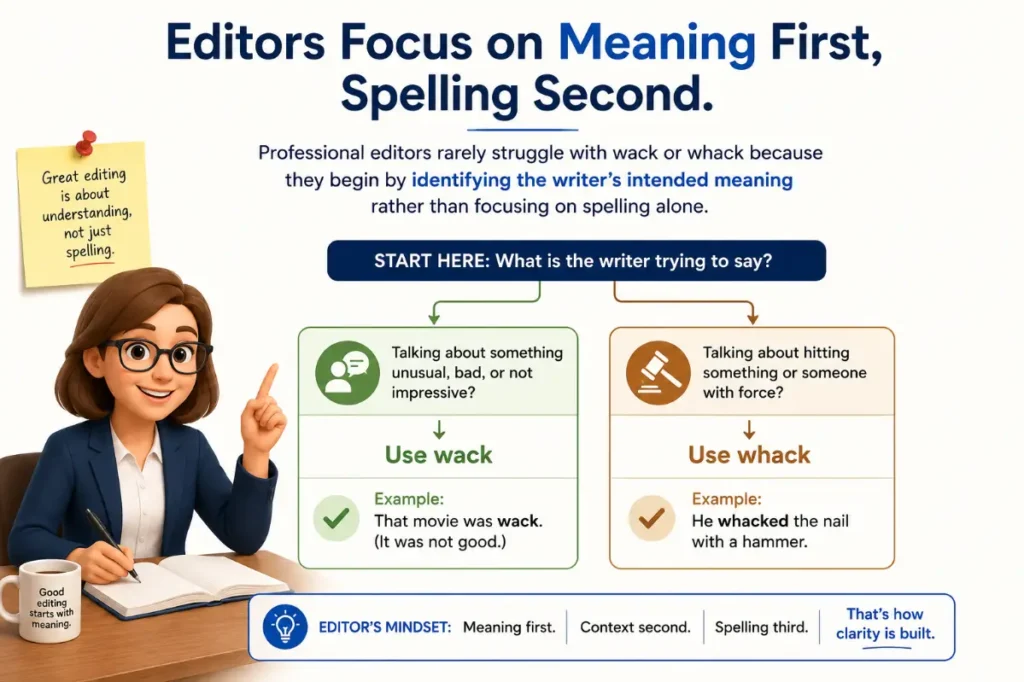
Professional editors rarely struggle with wack or whack because they begin by identifying the writer’s intended meaning rather than focusing on spelling alone. If the sentence describes physical action, experienced editors automatically choose whack because it is the long-established standard English word. It fits every level of writing, from children’s books and newspaper articles to legal documents and academic publications. If the sentence expresses a negative opinion in an informal voice, editors recognize that wack may be the better choice. It reflects authentic modern slang and often sounds more natural in dialogue, entertainment reviews, social media posts, and conversations between friends.
Still confused? Compare Wether or Whether Which Spelling Is Correct.
Conclusion
Choosing between wack or whack becomes simple once you understand the difference in meaning and usage.
Whack is the traditional English word. It describes striking something with force, a strong blow, or the sound of an impact. It is accepted in every type of writing, from casual conversations to academic papers and professional documents.
Wack, by contrast, is modern slang. It expresses a negative opinion about something that seems boring, low quality, uncool, or disappointing. While it is widely recognized in American English and popular culture, it remains informal and is best reserved for relaxed conversations, entertainment writing, or dialogue.
Frequently Asked Questions About Wack or Whack
Is it wack or whack?
Both are correct, but they have different meanings. Whack is the standard English word for hitting something forcefully or referring to a strong blow. Wack is informal slang that means bad, boring, uncool, or poor quality. Choose the spelling that matches your intended meaning.
Is wack a real word?
Yes. Wack is a real word recognized by many modern dictionaries as informal slang. It became popular in American English through hip hop culture and everyday conversation. Although it is widely understood, it is generally not suitable for formal or academic writing.
Is whack a real English word?
Yes. Whack is a long established English word that functions as a verb, noun, and sometimes an interjection. It appears in dictionaries, books, newspapers, and professional writing. It is the correct choice when referring to striking or hitting something.
Why do people spell whack as wack?
People often spell whack as wack because both words are pronounced the same. In addition, wack has become common in slang, especially online and in popular culture. Context determines which spelling is appropriate.
Can I use wack in school or business writing?
It is usually better to avoid wack in formal settings. Since it is slang, many teachers, editors, and employers prefer standard English alternatives such as poor, weak, disappointing, low quality, or unimpressive. Use wack only if you are intentionally writing in a casual or conversational style.
What is the past tense of whack?
The past tense and past participle are whacked.
Examples:
- She whacked the baseball into the stands.
- He whacked the tree with an axe.
Because whack is a regular verb, it simply takes -ed in the past tense.
Is wack more common than whack?
No. Whack is much more common in standard English because it appears in all types of writing and speech. Wack is common only in informal conversations, entertainment, music, gaming, and social media.
How can I remember the difference between wack and whack?
A simple memory trick is to connect whack with hit. Both involve physical action. Think of the silent h in whack as reminding you of a hard hit.