
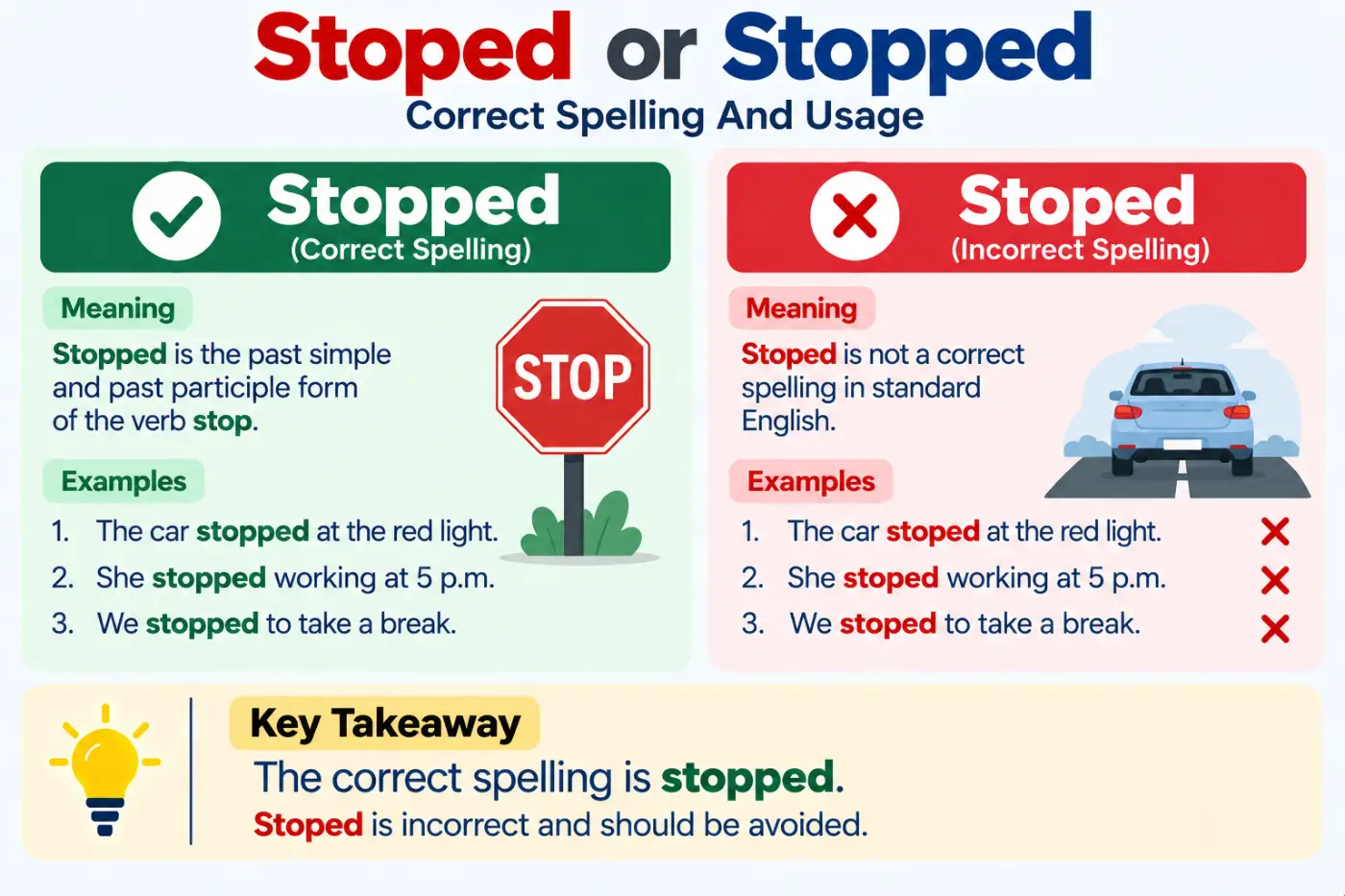
stoped or stopped is a common spelling question because the two forms look almost identical. The correct spelling is stopped when you mean the past tense or past participle of stop. The form stoped is not the standard spelling of this verb in modern English.
The reason for the extra p is a basic English spelling rule. When a one syllable verb ends in a single consonant preceded by a single vowel and you add an ending that begins with a vowel, the final consonant is often doubled. Stop becomes stopped in the past tense and stopping in the present participle. This same pattern appears in words such as plan, planned, and planning.
The spelling becomes easier once you connect the base word with its related forms. This article explains why the consonant doubles, how to use the past tense correctly, how to pronounce the word, which related forms cause confusion, and how American and British English handle the spelling. You’ll also see practical examples that make the rule easier to remember.
Need another quick comparison? Read Hopeing or Hoping: Correct Spelling and Usage Guide 2026.
Quick Definition
Stopped is the correct standard spelling for the past tense and past participle of stop. Stoped is not the standard form. The final p is doubled before the ed ending because stop is a one syllable verb ending in a single consonant preceded by a single vowel.
Quick Answer
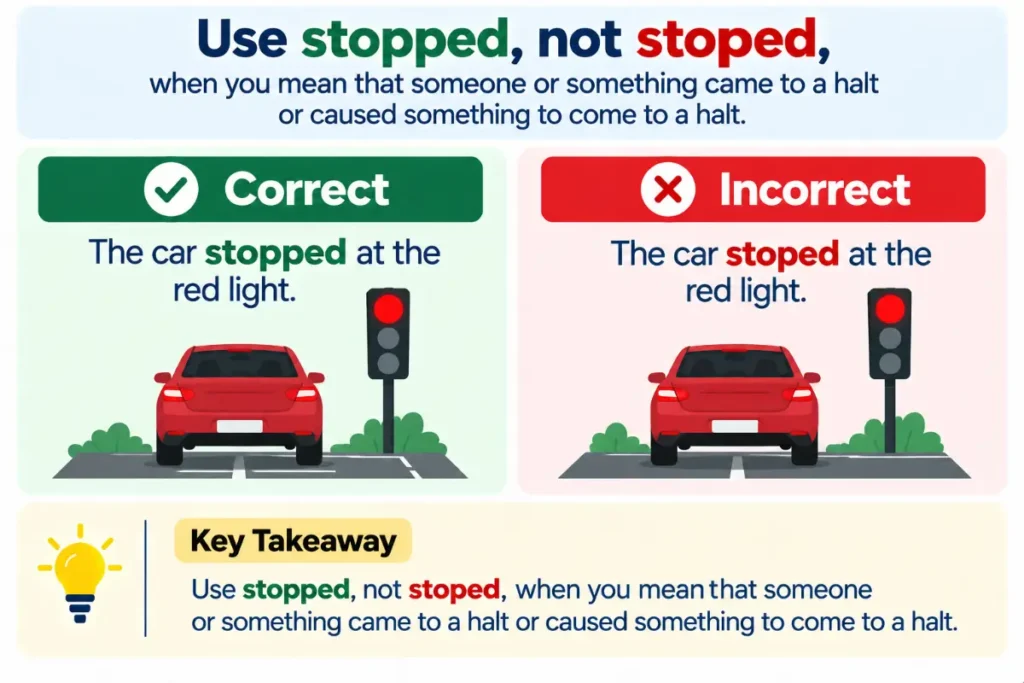
Use stopped, not stoped, when you mean that someone or something came to a halt or caused something to come to a halt.
For example:
The car stopped at the red light.
The train has stopped running.
The form stoped leaves out the second p and is a spelling error in standard English.
The same doubling pattern appears in stopping. You start with stop and double the final consonant before adding the ending.
Comparison Table For The Two Spellings
| Form | Meaning | Part of Speech | Origin | Usage Frequency | Formality | Common Contexts | Example |
|---|---|---|---|---|---|---|---|
| Stopped | Past tense or past participle of stop | Verb form | From Old English related to stopping or blocking | Very common | Standard | Conversation, school, work, formal writing | The bus stopped outside the building. |
| Stoped | Not the standard past tense spelling of stop | Nonstandard spelling | Spelling error rather than a standard modern form | Uncommon as a correct form | Not standard | Typing mistakes and spelling errors | She stoped the car is incorrect. |
The difference is only one letter, but that letter matters. English spelling rules determine why the final consonant needs to be doubled.
Meaning And Definition
Meaning Of Stoped
Stoped is generally a misspelling of stopped when the writer intends the past tense or past participle of stop.
For example:
Incorrect: The music stoped suddenly.
Correct: The music stopped suddenly.
There is no standard modern English verb form stoped that replaces stopped in ordinary usage.
The mistake usually happens because writers apply a simple ed pattern without considering the spelling of the base verb. They see stop and ed and naturally think that adding the ending should produce stoped. English spelling does not work that way for this particular verb.
The same issue appears with other short verbs.
Plan becomes planned.
Shop becomes shopped.
Drop becomes dropped.
The spelling pattern is consistent enough to learn as a useful rule.
Meaning Of Stopped
Stopped is the past tense and past participle form of stop.
The base verb stop means to cease moving, acting, happening, or operating. It can also mean to cause something to cease moving, acting, happening, or operating.
The past tense tells us that the stopping happened in the past.
For example:
The bus stopped near my house.
Here stopped tells us that the bus came to a halt at some point in the past.
Stopped can also work as a past participle.
The machine has stopped.
The word can also appear in passive constructions.
The project was stopped because of a lack of funding.
The basic meaning stays connected to the idea of bringing an action or movement to an end.
Why The Final P Is Doubled
The key spelling rule involves the final consonant.
Stop is a one syllable verb.
Its letters follow this basic pattern:
s + t + o + p
The final consonant p comes after the vowel o. When the past tense ending ed is added, English spelling normally doubles the final consonant in this type of short stressed verb.
So:
stop + ed = stopped.
The same thing happens with the ing form:
stop + ing = stopping.
This rule helps preserve the pronunciation and structure of the base word.
Compare these examples:
hop → hopped
shop → shopped
plan → planned
drop → dropped
rub → rubbed
These words follow the same general pattern.
The doubling rule is not limited to the letter p. Other consonants can double too.
For example:
admit → admitted
prefer → preferred
However, longer words require closer attention to stress and syllable structure. The simple stop to stopped pattern is one of the easiest examples to learn.
The Basic Spelling Rule
A useful general rule is this.
When a short stressed verb ends in one consonant preceded by one vowel, the final consonant is often doubled before an ending such as ed or ing.
For stop:
stop → stopped
stop → stopping
For plan:
plan → planned
plan → planning
For rub:
rub → rubbed
rub → rubbing
The rule also explains why some verbs do not double their final consonant.
Consider:
help → helped
walk → walked
jump → jumped
These words do not follow the same final consonant pattern because the spelling structure is different.
The rule also behaves differently with verbs ending in two consonants.
For example:
jump → jumped
The final consonant is not doubled.
English spelling rules can have exceptions and additional conditions, but you don’t need to memorize every technical detail to spell stopped correctly. Remembering the short vowel plus single final consonant pattern is enough for this word.
Key Differences Explained
- Spelling. Stopped contains two p letters. Stoped contains only one and is incorrect when used as the past form of stop.
- Grammar. Stopped is a valid verb form. Stoped is not the standard past tense or past participle.
- Meaning. Stopped means came to a halt or caused something to come to a halt.
- Pronunciation. Stopped is pronounced with the same basic vowel and consonant sounds found in stop, followed by the past tense ending sound.
- Formality. Stopped is standard in casual and formal English. Stoped should be corrected in both.
- Context. Stopped works in conversation, academic writing, business communication, journalism, and creative writing.
- Regional usage. American British Canadian and Australian English all use stopped as the standard spelling.
- Word formation. The double p comes from the consonant doubling pattern used when adding the past tense ending.
Which Spelling Is Correct?
Stopped is the correct standard spelling.
The reason is morphological and orthographic. The base verb is stop. When the regular past tense ending ed is added, the final consonant is doubled because the verb fits the consonant doubling pattern.
That gives us:
stop + ed = stopped.
The same spelling principle gives:
stop + ing = stopping.
Dictionaries list stopped as the standard past tense and past participle form of stop. Standard English does not use stoped as the regular past form.
This is a useful example of why English spelling cannot always be handled by simply adding an ending to the base word. Sometimes the spelling of the base changes slightly to follow established patterns.
If you are proofreading your writing and see stoped, change it to stopped.
Sentence Examples
Here are ten natural examples using the correct form.
- The bus stopped outside the school.
- She stopped talking when the teacher entered the room.
- The rain stopped before we left the house.
- I stopped by the store after work.
- He stopped playing video games before dinner.
- The company stopped selling the old model last year.
- The car stopped suddenly in the middle of the road.
- We stopped for coffee on the way home.
- The machine stopped working during the night.
- She has stopped checking her phone so often.
These examples show that stopped can describe movement, behavior, weather, business activity, machines, and habits.
Here are five examples showing the common incorrect spelling for learning purposes.
- Incorrect: The train stoped at the station.
- Incorrect: She stoped talking.
- Incorrect: The rain stoped suddenly.
- Incorrect: He stoped the car.
- Incorrect: The machine stoped working.
Each sentence should use stopped instead.
Common Mistakes And Misspellings
Writing Stoped Instead Of Stopped
This is the most common mistake. The writer simply adds ed to stop without doubling the final consonant.
Incorrect:
The car stoped near the house.
Correct:
The car stopped near the house.
Forgetting The Double P In Stopping
The same spelling rule applies before ing.
Incorrect:
The bus is stoping here.
Correct:
The bus is stopping here.
Once you remember stopped, remembering stopping becomes easier.
Adding An Extra Letter Elsewhere
Some writers produce unusual forms such as stoppped. This happens when they know a consonant should be doubled but accidentally add three copies.
The correct form has exactly two p letters:
stopped.
Confusing Stopped With Stop
Stop is the base form.
Stopped is the past tense and past participle.
For example:
I stop at this store every Friday.
I stopped at this store yesterday.
The first sentence describes a present or habitual action. The second describes a completed past action.
Using Stoped Because The Pronunciation Sounds Simple
The final p in stopped does not sound like a completely separate extra syllable. That can make the second p easy to overlook when spelling from sound.
Spelling and pronunciation do not always show every letter equally clearly. That is one reason repeated consonants can cause mistakes.
Still confused? Compare EKG vs ECG Which One Is Correct 2026.
Pronunciation Guide
Stopped is commonly pronounced /stɑːpt/ in American English.
A simple pronunciation guide is:
stahpt.
The word has one syllable.
The final ed does not create an extra syllable. This is an important point for learners.
Compare:
stop → one syllable.
stopped → one syllable.
The ending ed changes the grammatical form without adding a new syllable.
In stopped, the ed ending is pronounced with a t sound because the base verb ends in the voiceless consonant p.
This follows a broader pronunciation pattern for regular past tense verbs.
Compare:
washed.
laughed.
stopped.
In each case the ed ending is pronounced with a t sound.
The spelling contains ed, but the pronunciation does not sound like stop ed with two separate syllables.
This difference between spelling and pronunciation can explain why learners sometimes write stoped. They hear one simple word and may not realize that the spelling requires the doubled consonant.
Etymology And Word Origin
The verb stop has a long history in English and is related to older Germanic forms connected with blocking or closing something.
The modern word has developed several meanings over time. Today stop can describe ending an action, ceasing movement, preventing something, closing an activity, or pausing.
The past form stopped developed through the regular English process of adding the past tense ending while following established spelling patterns.
The consonant doubling is therefore not a separate historical word. It is an orthographic change that occurs when the grammatical ending is attached to the base verb.
The same relationship appears in other regular verbs.
stop → stopped.
stop → stopping.
The base remains recognizable while the final consonant is doubled.
Regional Usage
American English
American English uses stopped as the standard past tense and past participle of stop.
The spelling does not change based on American pronunciation.
Examples include:
The car stopped at the light.
The machine has stopped working.
The project was stopped last month.
The spelling rule is standard across everyday and formal American writing.
British English
British English also uses stopped.
There is no British spelling variant that changes stopped to stoped.
The pronunciation may vary slightly by accent, but the written form remains the same.
Australian English
Australian English uses stopped as the standard form.
The same consonant doubling pattern applies.
A writer in Australia would use stopped in school work, professional documents, journalism, and everyday messages.
Canadian English
Canadian English also uses stopped.
There is no major Canadian spelling difference for this verb. The same standard form appears across ordinary writing.
This is one of the cases where American British Canadian and Australian English agree completely.
Grammar Rules And Part Of Speech
Stopped is a verb form.
It can function as the simple past form of stop.
For example:
I stopped the car.
This sentence describes an action completed in the past.
Stopped can also function as a past participle.
For example:
I have stopped the car.
Here stopped works with have to form the present perfect.
It can also appear with had.
I had stopped the car before the police arrived.
The word can appear in passive constructions too.
The machine was stopped before anyone entered the room.
Stopped can describe an action that ends something.
She stopped the meeting.
It can also describe an action or process that ends by itself.
The meeting stopped.
In ordinary English, context determines which meaning applies.
Stop As An Intransitive Verb
An intransitive use means the subject comes to a halt without directly acting on an object.
The bus stopped.
The rain stopped.
The music stopped.
There is no direct object after stopped.
Stop As A Transitive Verb
A transitive use means the subject causes another person or thing to stop.
The driver stopped the car.
The teacher stopped the argument.
The police stopped the vehicle.
Here car, argument, and vehicle are direct objects.
Understanding this distinction can help you use the verb naturally.
Stop And Its Related Forms
The base verb is stop.
The third person singular present form is stops.
The past tense is stopped.
The past participle is stopped.
The present participle or gerund is stopping.
The noun can also be stop.
For example:
I stop here every morning.
She stops at the same store.
He stopped yesterday.
They have stopped the machine.
The bus is stopping now.
We made a quick stop.
This word family gives you a useful spelling pattern to remember.
The double p appears in stopped and stopping because of the consonant doubling rule. It does not appear in the base form stop or the third person singular form stops.
Stop Versus Stopped
Stop and stopped differ mainly in tense and grammatical use.
Use stop for the base form and present tense contexts.
I stop working at five.
Use stopped for a completed past action.
I stopped working at five yesterday.
Stopped also appears after auxiliary verbs such as have, has, and had.
She has stopped working.
They had stopped before we arrived.
The word can also appear after was or were in passive constructions.
The machine was stopped for safety reasons.
Knowing the grammatical structure can help you avoid spelling and tense mistakes at the same time.
Real Life Usage Examples
Daily Conversation
I stopped by your house yesterday.
The kids stopped playing when it started raining.
These sentences sound natural in ordinary conversation. Stop by is also a common phrasal verb meaning to visit briefly.
Workplace Communication
The team stopped production after finding a safety issue.
We stopped using the old system last month.
In workplace writing, stopped can describe changes in procedures, operations, production, or business activity.
Academic Writing
The experiment stopped after the temperature reached the specified limit.
The researchers stopped collecting data after the required sample was reached.
Academic writing often uses stopped to describe the point at which a process ended.
News Writing
Traffic stopped for several hours after the accident.
Officials stopped the operation after the weather worsened.
News writing uses the word in both active and passive constructions.
Literature And Storytelling
She stopped at the door and looked back.
He stopped walking when he heard his name.
In storytelling, stopped can create a clear change in movement or action. A single verb can shift the pace of a scene.
Related And Confused Terms
Stop
Stop is the base form of the verb. It can describe ending an action or movement.
Stopping
Stopping is the present participle and gerund form.
The bus is stopping.
Stopping suddenly can be dangerous.
Stops
Stops is the third person singular present form.
The bus stops here every morning.
Pause
Pause means to stop temporarily before continuing. A stop can be permanent or temporary depending on context.
Halt
Halt means to stop or bring something to a stop. It often sounds more formal than stop.
End
End means to bring something to a conclusion. It does not always involve physical movement.
Cease
Cease means to stop or come to an end. It is more formal than stop.
Quit
Quit means to stop doing something or leave an activity. It is common in everyday American English.
These words overlap but they are not always interchangeable. Stop is the broad everyday choice.
Why People Misspell The Word
The spelling error usually comes from a simple mental shortcut.
A writer starts with stop and adds ed.
stop + ed.
That seems logical at first glance. But English spelling adds another step.
The final p is doubled.
stop + p + ed.
The result is stopped.
This is an example of orthographic processing. When people write quickly, they may focus on the sound and grammatical ending rather than the spelling pattern.
The pronunciation also contributes to the problem. Stopped remains one syllable, so the doubled p does not create a noticeable extra sound.
Another factor is visual memory. Readers who have seen stopped many times usually recognize the correct form instantly. Learners who are still building spelling patterns may need to consciously remember the double consonant.
The best solution is not to memorize the misspelling. Memorize the word family.
stop.
stopped.
stopping.
Once the pattern becomes familiar, the spelling usually becomes automatic.
Expert Editor Insight
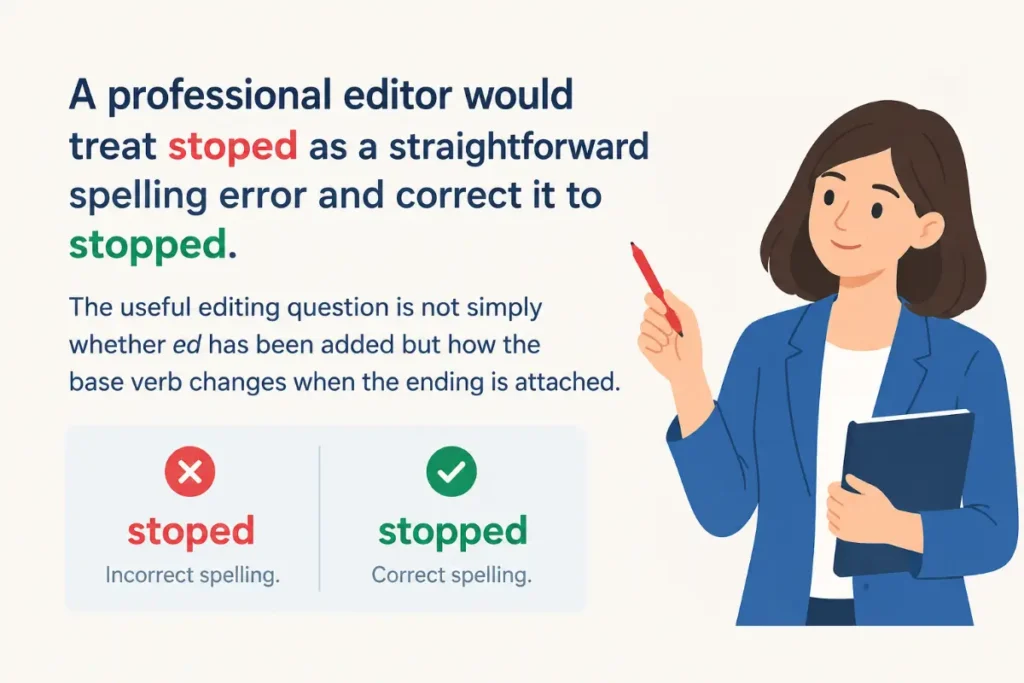
A professional editor would treat stoped as a straightforward spelling error and correct it to stopped. The useful editing question is not simply whether ed has been added but how the base verb changes when the ending is attached. Seeing the complete word family stop, stopped, and stopping makes the double p easier to remember. Spelling tools usually flag stoped, but proofreading should still catch the error because context makes the intended word obvious.
Still confused? Compare totaled or totalled Correct Spelling and Usage.
Conclusion
stoped or stopped has a clear answer. Stopped is the correct standard spelling when you need the past tense or past participle of stop. The extra p is required because stop follows the common consonant doubling pattern used before endings such as ed and ing. Stoped is a spelling error rather than a standard alternative.
The easiest way to remember the rule is to learn the word family together. Think of stop, stopped, and stopping as a set. The same pattern appears in words such as shop, shopped, and shopping, so the spelling becomes easier to recognize.
If you are proofreading your writing, look for the double p before ed. That quick check will catch the mistake immediately and keep your sentence correct in both casual and formal English.
FAQs
Is stoped a correct English word?
No. Stoped is not the standard spelling of the past tense or past participle of stop. The correct form is stopped with two p letters. The error happens when someone adds ed to stop without applying the consonant doubling rule. For standard school, professional, academic, and everyday writing, use stopped.
Why does stop become stopped?
Stop becomes stopped because the final consonant is doubled before the regular past tense ending ed. Stop is a short one syllable verb with a single vowel followed by a single final consonant. The same pattern appears in words such as plan and planned or shop and shopped. Therefore, stop becomes stopped rather than stoped.
Is stopped one syllable or two?
Stopped is one syllable. The ed ending does not create a separate syllable because the final sound is pronounced as a t sound. You can think of stopped as one compact sound rather than stop plus a separate ed syllable. This is also why the spelling can be easy to miss when someone learns the word mainly through listening.
How do you pronounce stopped?
Stopped is commonly pronounced /stɑːpt/ in American English. A simple pronunciation guide is stahpt. The word has one syllable and ends with a t sound. The spelling contains ed, but the ending is not pronounced as a separate syllable. The pronunciation reflects the regular past tense pattern for verbs ending in voiceless sounds such as p.
What is the difference between stop and stopped?
Stop is the base form of the verb, while stopped is the past tense and past participle. For example, I stop at the store every day describes a present or habitual action. I stopped at the store yesterday describes a completed past action. Stopped can also appear with have, has, or had to form perfect tenses.
Is stopping spelled with two p letters?
Yes. The correct spelling is stopping with two p letters. The same consonant doubling rule that creates stopped also creates stopping. The base word is stop. When you add ing, the final p is doubled before the ending. Therefore, stop becomes stopping rather than stoping.
Does British English use stoped?
No. British English uses stopped as the standard past tense and past participle of stop. American English, Canadian English, and Australian English also use stopped. The spelling does not change across these major English varieties. Pronunciation can vary by accent, but the standard written form remains stopped.
What is an easy way to remember stopped?
Connect stopped with stopping. Both forms have two p letters. You can remember the pattern as stop, stopped, stopping. Another useful comparison is shop, shopped, shopping. Seeing several words with the same spelling pattern helps turn the rule into a familiar visual pattern instead of something you have to calculate each time.