
If you’ve searched for realist vs realest, you’re probably trying to figure out which word is correct and when each one should be used. At first glance, the two words look similar because they share the same root word, real. That similarity often leads people to assume they’re interchangeable. They aren’t.
The confusion usually appears in casual conversations, social media posts, song lyrics, and online comments. Someone might say, “I’m a realist,” while another person claims to be “the realest person in the room.” Since both expressions relate to being genuine or realistic, it’s easy to wonder if they mean the same thing.
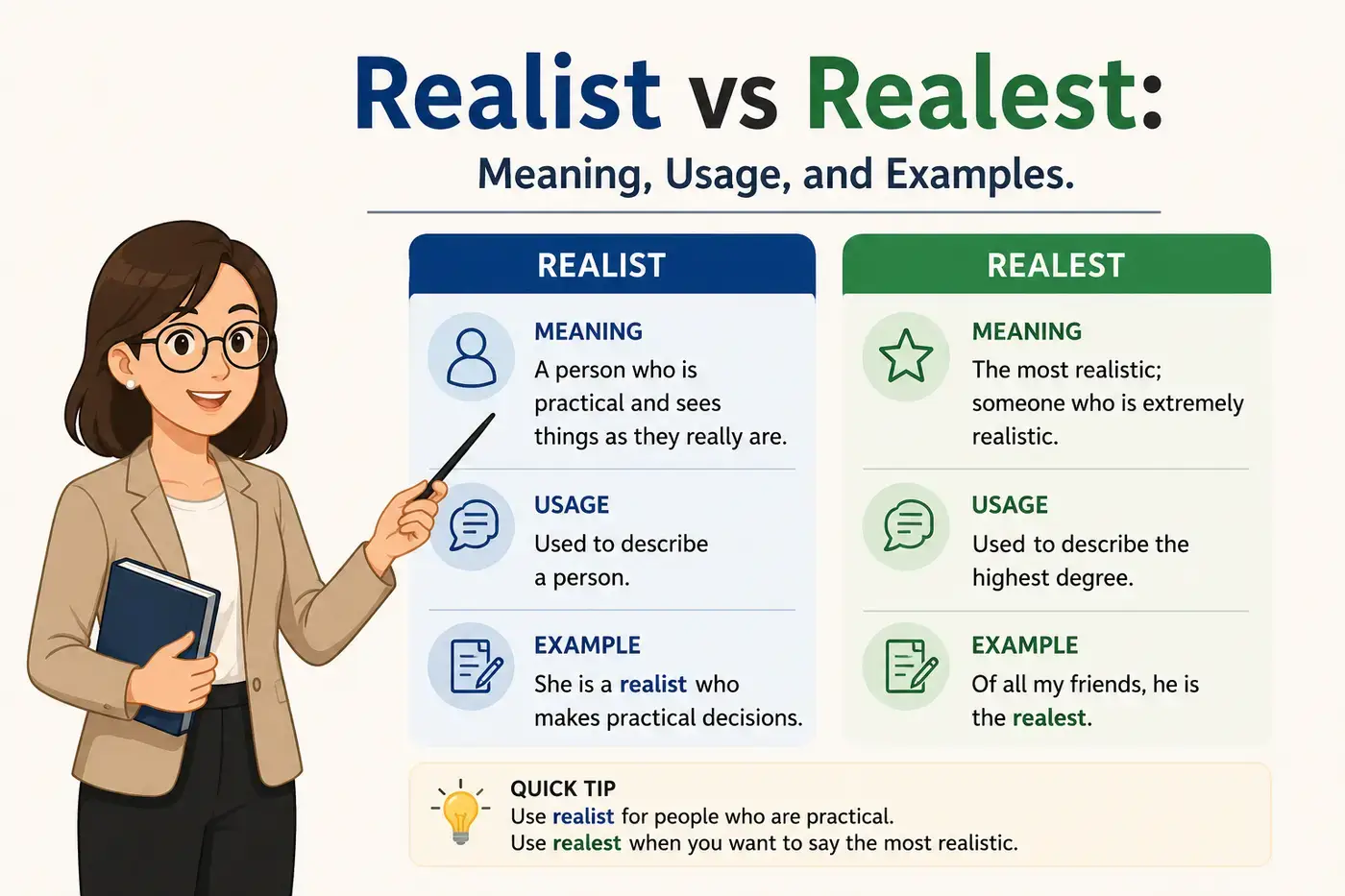
The short answer is that realist and realest are different words with different meanings and grammatical functions. One is a noun that describes a type of person. The other is a superlative adjective used to emphasize authenticity or genuineness.
In this guide, you’ll learn the exact difference between realist vs realest, their meanings, pronunciation, grammar rules, origins, examples, common mistakes, and how native English speakers actually use them in everyday communication.
You may also want to read half-day vs half day Correct Usage And Meaning.
Quick Definition
A realist is a person who sees situations as they truly are and focuses on practical facts rather than wishful thinking. Realest is the superlative form of real and means the most genuine, authentic, or true. Both words are correct, but they serve completely different purposes in English grammar.
Realist Vs Realest Quick Answer
The answer is simple.
- Realist is a noun.
- Realest is an adjective.
- A realist is a person.
- Realest describes something or someone as the most authentic or genuine.
- The words are not interchangeable.
Example:
- She is a realist who always considers the facts.
- He is the realest friend I’ve ever had.
Both sentences are correct, but the meanings are different.
Realist Vs Realest Comparison Table
| Feature | Realist | Realest |
|---|---|---|
| Correct Form | Yes | Yes |
| Part of Speech | Noun | Adjective |
| Basic Meaning | A person who accepts reality | Most genuine or authentic |
| Root Word | Real | Real |
| Origin | Realism | Real |
| Usage Frequency | Common | Common in informal speech |
| Formality Level | Formal and informal | Mostly informal |
| Typical Context | Philosophy, politics, daily life | Conversations, music, social media |
| Refers To | A person | A person, thing, or situation |
| Comparative Form | Not applicable | Realer |
| Superlative Form | Not applicable | Realest |
| Example | He is a realist. | She is the realest person here. |
Meaning Of Realist Vs Realest
Meaning of Realist
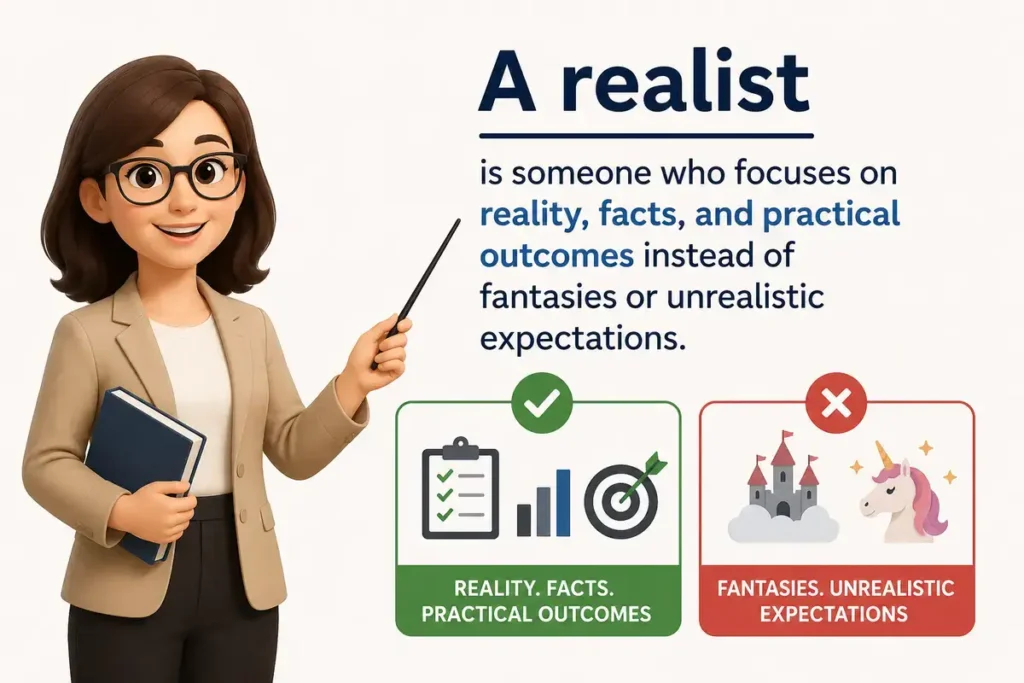
A realist is someone who focuses on reality, facts, and practical outcomes instead of fantasies or unrealistic expectations. The word often describes people who think logically and evaluate situations based on evidence.
Examples include:
- A business owner who plans for risks.
- A student who sets achievable goals.
- A leader who focuses on practical solutions.
A realist doesn’t ignore hope. They simply balance optimism with reality. In philosophy and politics, the word can carry more specialized meanings. A realist may support ideas based on practical realities rather than idealistic theories.
What Does Realest Mean
Realest is the superlative form of the adjective real. It means the most authentic, genuine, honest, or true among a group. People commonly use it in informal American English.
Examples include:
- She’s the realest friend I have.
- That was the realest conversation we’ve ever had.
- He stayed loyal through everything. He’s the realest.
The word often appears in entertainment, music, social media, and casual conversations. Unlike realist, realest does not describe a way of thinking. It describes authenticity.
Realist Vs Realest Meaning Differences
Understanding the distinction becomes easier when you focus on the role each word plays.
Realist Focuses On Perspective
A realist is defined by how they view the world.
Characteristics include:
- Practical thinking.
- Fact based decision making.
- Realistic expectations.
- Logical judgment.
Example:
“She’s a realist who always prepares for challenges.” The sentence highlights a person’s mindset.
Realest Focuses On Authenticity
Realest describes how genuine someone or something is.
Characteristics include:
- Honesty.
- Authenticity.
- Loyalty.
- Sincerity.
Example:
“He’s the realest person I’ve ever met.” The sentence highlights character and authenticity.
Simple Memory Trick
Think of it this way:
- Realist equals reality focused person.
- Realest equals most genuine person or thing.
That small distinction eliminates most confusion.
Realist Vs Realest Grammar Differences
Grammar provides the clearest way to separate these words.
Realist As A Noun
A noun names a person, place, thing, or idea.
Examples:
- She is a realist.
- Every realist understands risks.
- The realist in the group predicted the outcome.
Notice that the word functions as the subject or object in a sentence.
Realest Is An Adjective
An adjective describes a noun.
Examples:
- She is the realest friend I know.
- That was the realest moment of the interview.
- He gave the realest answer.
The word modifies another noun.
Sentence Structure Comparison
Realist:
- He is a realist.
- The realist warned us.
Realest:
- He is the realest friend.
- That was the realest experience.
The grammar pattern is completely different.
Which One Is Correct
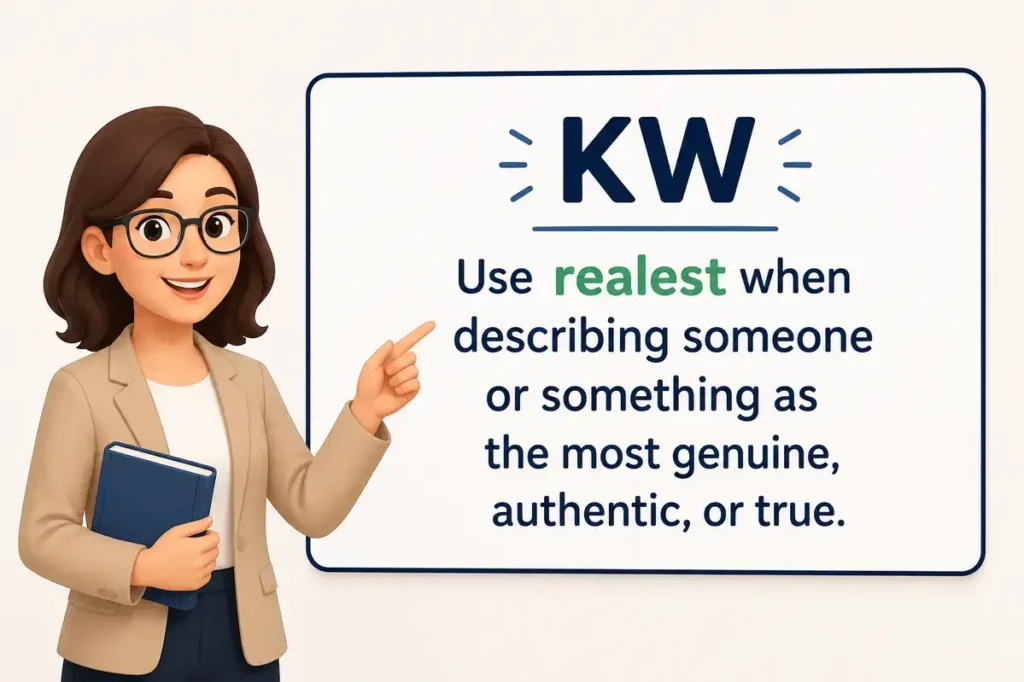
This question comes up often because people assume one word must be wrong. The truth is that both are correct. Use realist when referring to a person who sees things realistically. Use realest when describing someone or something as the most genuine, authentic, or true.
Correct:
- She’s a realist.
- He’s the realest person I know.
Incorrect:
- She’s a realest.
- He’s the realist friend I know.
The mistakes occur because people switch the grammatical roles of the words.
Realist Vs Realest In Modern English
Language changes constantly, and modern English has expanded the use of realest.
Realist In Modern Usage
Today, realist remains common in:
- Academic writing.
- Politics.
- Psychology.
- Business discussions.
- Daily conversations.
Examples:
- Investors often need to be realists.
- A realist evaluates evidence carefully.
Realest In Modern Usage
Realest has become especially popular in:
- Pop culture.
- Hip hop music.
- Social media.
- Casual speech.
- Online communities.
Examples:
- You’re the realest friend ever.
- That was the realest advice I’ve heard.
Its popularity comes from its emotional impact and emphasis on authenticity.
Key Differences Between Realist Vs Realest
The easiest way to remember the difference is to compare them side by side.
Purpose
- Realist identifies a person.
- Realest describes authenticity.
Grammar
- Realist is a noun.
- Realest is an adjective.
Meaning
- Realist relates to practical thinking.
- Realest relates to genuineness.
Typical Context
- Realist appears in formal and informal English.
- Realest appears mostly in casual English.
Example
- She is a realist.
- She is the realest friend I know.
Realist Vs Realest In Different Contexts
In Everyday Conversation
Realist:
- I’m a realist about my chances.
Realest:
- You’re the realest person I know.
In Business
Realist:
- Investors must be realists.
Realest:
- Rarely used in professional reports.
In Education
Realist:
- Historians often describe him as a realist.
Realest:
- Mostly appears in informal student conversations.
In Entertainment
Realist:
- The character is portrayed as a realist.
Realest:
- Fans call him the realest artist in the industry.
In Relationships
Realist:
- She’s a realist about long term commitments.
Realest:
- He’s the realest partner I’ve ever had.
For another common grammar confusion, see Me Either Vs Me Neither Examples and Meanings 2026.
Why People Confuse Realist And Realest
Several factors contribute to the confusion.
Similar Spelling
Both words begin with the same root.
Similar Themes
Both relate to truth and reality.
Informal Internet Usage
Online users often use words creatively without considering grammar.
Lack Of Grammar Awareness
Many people focus on meaning instead of grammatical function. Once you understand that one word names a person and the other describes authenticity, the confusion disappears.
Realist Vs Realest Examples In Sentences
Examples are often the fastest way to understand the difference between two words. Let’s look at each term in natural contexts.
Realist Examples In Sentences
- My brother is a realist who always plans for the worst case scenario.
- As a realist, she knew success would take time and effort.
- The coach was a realist and didn’t promise an easy victory.
- Every realist understands that mistakes are part of learning.
- He considers himself a realist rather than an optimist.
- The company’s realist approach helped it survive difficult economic conditions.
- A realist focuses on facts instead of wishful thinking.
- The author was known as a political realist.
- She remained a realist even when others became overly excited.
- Being a realist helped him make smarter financial decisions.
Realest Examples In Sentences
- She’s the realest friend I’ve ever had.
- That was the realest conversation we’ve had in years.
- He’s one of the realest people in the office.
- Her story felt like the realest part of the documentary.
- They stayed loyal through everything and proved they’re the realest friends around.
- This movie offers one of the realest portrayals of family life.
- He gave the realest answer during the interview.
- That’s the realest advice anyone has given me.
- She remained honest, making her the realest person in the group.
- The realest moments often happen when nobody is trying to impress anyone.
Common Mistakes With Realist Vs Realest
Many writers and speakers mix these words because they sound related. Understanding the most common mistakes can help you avoid them.
Using Realest As A Noun
Incorrect:
- He is a realest.
Correct:
- He is a realist.
- He is the realest person I know.
The first sentence is incorrect because realest is an adjective, not a noun.
Using Realist As An Adjective
Incorrect:
- She is the realist friend in the group.
Correct:
- She is the realest friend in the group.
A noun cannot replace an adjective in this sentence.
Assuming One Word Is A Misspelling
Some people think realest isn’t a real word. That’s incorrect. Realest is the standard superlative form of real and appears in dictionaries and everyday English.
Confusing Practicality With Authenticity
A realist may not be the realest person in a group. Likewise, the realest person may not be a realist. One term describes mindset. The other describes genuineness.
Realist Vs Realest Pronunciation Guide
Correct pronunciation helps build confidence in speaking and writing.
Realist Pronunciation
IPA:
/ˈriːə.lɪst/
Syllable Breakdown:
Ree • uh • list
Sounds like:
“REE uh list”
Realest Pronunciation
IPA:
/ˈriːə.lɪst/
or commonly
/ˈriː.əl.ɪst/
Interestingly, realist and realest are often pronounced very similarly in everyday speech.
Syllable Breakdown:
Ree • uh • list
Common Pronunciation Mistakes
- Overemphasizing the final syllable.
- Dropping the middle vowel sound completely.
- Pronouncing realest as “reel lest.”
Most native speakers naturally distinguish the words through context rather than pronunciation alone.
Realist Vs Realest Etymology And Word Origin
Understanding where words come from often makes their meanings easier to remember.
Origin Of Real
Both words trace back to the adjective real. The word entered English through Old French and ultimately comes from the Latin word realis, meaning actual or genuine.
Origin Of Realist
The noun realist appeared later. It developed from the concept of realism. Historically, a realist was someone who focused on reality rather than idealism. The term gained popularity in philosophy, politics, literature, and art.
Origin Of Realest
Realest developed through standard English adjective formation.
The pattern is simple:
- Real.
- Realer.
- Realest.
Over time, native speakers began using realest not only for truthfulness but also for authenticity, honesty, and loyalty. That broader meaning became especially popular in American culture.
Regional Usage Of Realist Vs Realest
English varies across regions, but the distinction between these words remains consistent.
Realist Vs Realest American English
American English frequently uses both words.
Examples:
- She’s a realist about the situation.
- He’s the realest person I know.
The informal use of realest is especially common in the United States.
Realist Vs Realest British English
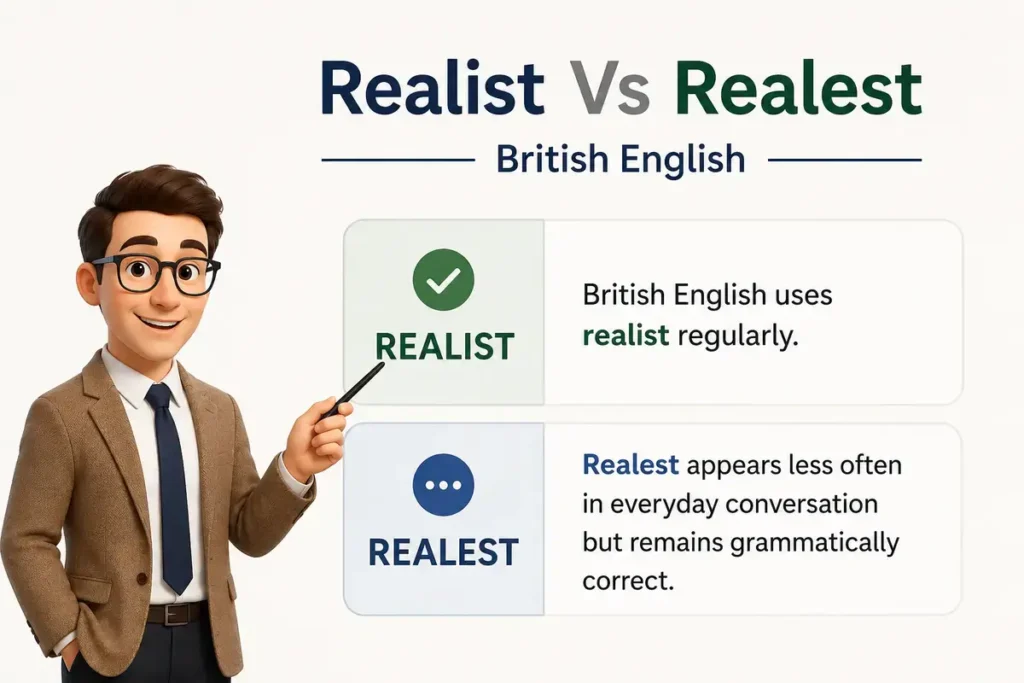
British English uses realist regularly.
Realest appears less often in everyday conversation but remains grammatically correct.
British speakers may prefer alternatives such as:
- Most genuine.
- Most authentic.
- Most sincere.
Realist Vs Realest Canadian English
Canadian usage closely mirrors American English.
Both words are widely understood and accepted.
Realist Vs Realest Australian English
Australians commonly use realist. The word realest appears more often in casual speech than in formal writing. Across all major English speaking regions, the meanings remain the same.
Realist Vs Realest Grammar Rules
Grammar provides the strongest clue for choosing the correct word.
Part Of Speech
Realist:
- Noun.
Realest:
- Adjective.
Singular And Plural Forms
Realist:
- Singular: realist.
- Plural: realists.
Examples:
- She is a realist.
- They are realists.
Realest:
Adjectives do not have plural forms.
Examples:
- The realest friend.
- The realest people.
Comparative And Superlative Structure
Real follows the standard pattern:
- Real.
- Realer.
- Realest.
Examples:
- This story feels real.
- This story feels realer than the last one.
- This is the realest story I’ve heard.
Sentence Position
Realist:
- Usually follows an article.
- Functions as a noun.
Example:
- He is a realist.
Realest:
- Usually appears before a noun.
- Can follow linking verbs.
Examples:
- She is the realest friend here.
- This feels realest to me.
Real Life Usage Of Realist Vs Realest
Understanding how native speakers use these words helps bridge the gap between grammar and real communication.
Daily Conversation
Realist:
- I’m a realist, so I always have a backup plan.
Realest:
- You’re the realest friend I’ve ever had.
Academic Writing
Realist:
- The scholar is often described as a political realist.
Realest:
- Rarely used in formal academic writing.
Professional Communication
Realist:
- Managers must be realists when setting expectations.
Realest:
- Generally avoided in formal business documents.
Literature
Realist:
- Many nineteenth century writers were considered realists.
Realest:
- Sometimes used in dialogue to reflect authentic speech.
Media And Entertainment
Realist:
- Critics describe the character as a realist.
Realest:
- Fans often praise celebrities as the realest people in the industry.
Related Words And Confused Terms
Several words share similarities with realist and realest.
Related To Realist
- Pragmatist.
- Rationalist.
- Skeptic.
- Idealist.
- Analyst.
- Realism.
Related To Realest
- Genuine.
- Authentic.
- Honest.
- Sincere.
- Truthful.
- Legitimate.
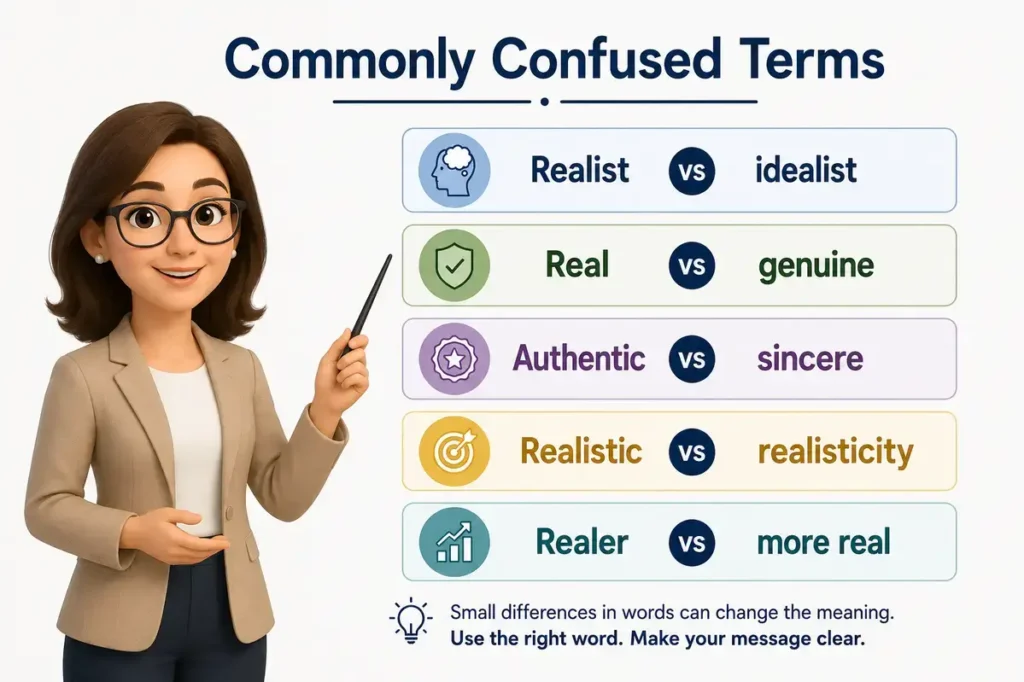
Commonly Confused Terms
- Realist vs idealist.
- Real vs genuine.
- Authentic vs sincere.
- Realistic vs realisticity.
- Realer vs more real.
Understanding these related terms improves vocabulary and writing precision.
Realist Vs Realest Expert Language Insight
As an editor, I often see writers confuse words that share the same root. Realist and realest are a perfect example. Native speakers rarely confuse the meanings during conversation because context makes the distinction obvious. The confusion usually appears in writing, especially when someone focuses on sound rather than grammar. A useful rule is to ask yourself a simple question. Are you talking about a person who views reality practically?
Use realist.
Are you describing the most authentic person or thing?
Use realest.
This approach works almost every time.
Another observation is that realist appears comfortably in both formal and informal writing. Realest feels more conversational and emotional. That’s why you’ll see it more often in social media posts, interviews, song lyrics, and everyday speech.
Frequently Asked Questions About Realist Vs Realest
Is Realest A Real Word?
Yes. Realest is the standard superlative form of the adjective real. It means the most genuine, authentic, or true among a group. Although it’s more common in informal English, it is a legitimate dictionary word.
Is Realist The Same As Realest?
No. A realist is a person who views situations realistically. Realest describes someone or something as the most authentic or genuine. The words have different meanings and grammatical functions.
Which Is More Common Realist Or Realest?
Realist is generally more common in formal writing, education, politics, philosophy, and business. Realest appears more frequently in casual conversations, social media, music, and popular culture.
Can Realest Be Used In Formal Writing?
It can, but many professional writers prefer alternatives such as most authentic or most genuine. Realest often sounds more conversational than formal.
What Is The Opposite Of A Realist?
The most common opposite is idealist. An idealist tends to focus on possibilities and ideals, while a realist focuses on facts and practical realities.
Why Do Realist And Realest Sound Similar?
Both words come from the root word real. Their similar spelling and pronunciation often create confusion, even though their meanings and grammatical roles are different.
Is Realist A Positive Or Negative Word?
Usually, it is neutral or positive. The word often suggests practicality, sound judgment, and a fact based perspective. The context determines the exact tone.
How Can I Remember The Difference Between Realist And Realest?
Think of the ending. A realist is a person. Realest describes the most authentic person or thing. If you’re naming someone, choose realist. If you’re describing authenticity, choose realest.
Need another quick comparison? Read Occured or occurred: Correct Spelling and Usage.
Realist Vs Realest Conclusion
The debate around realist vs realest becomes simple once you understand the grammar behind each word. A realist is a person who approaches life with practical thinking and realistic expectations. The word functions as a noun and often appears in discussions about philosophy, business, politics, and everyday decision making.
Realest is the superlative form of real. It describes someone or something as the most genuine, authentic, honest, or true. The word functions as an adjective and appears most often in informal speech and modern culture. If you’re talking about a mindset, use realist. If you’re emphasizing authenticity, use realest. That’s the distinction native speakers follow, and it’s the easiest way to choose the correct word every time.
1 thought on “Realist vs Realest Dictionary Meaning and Usage 2026”