
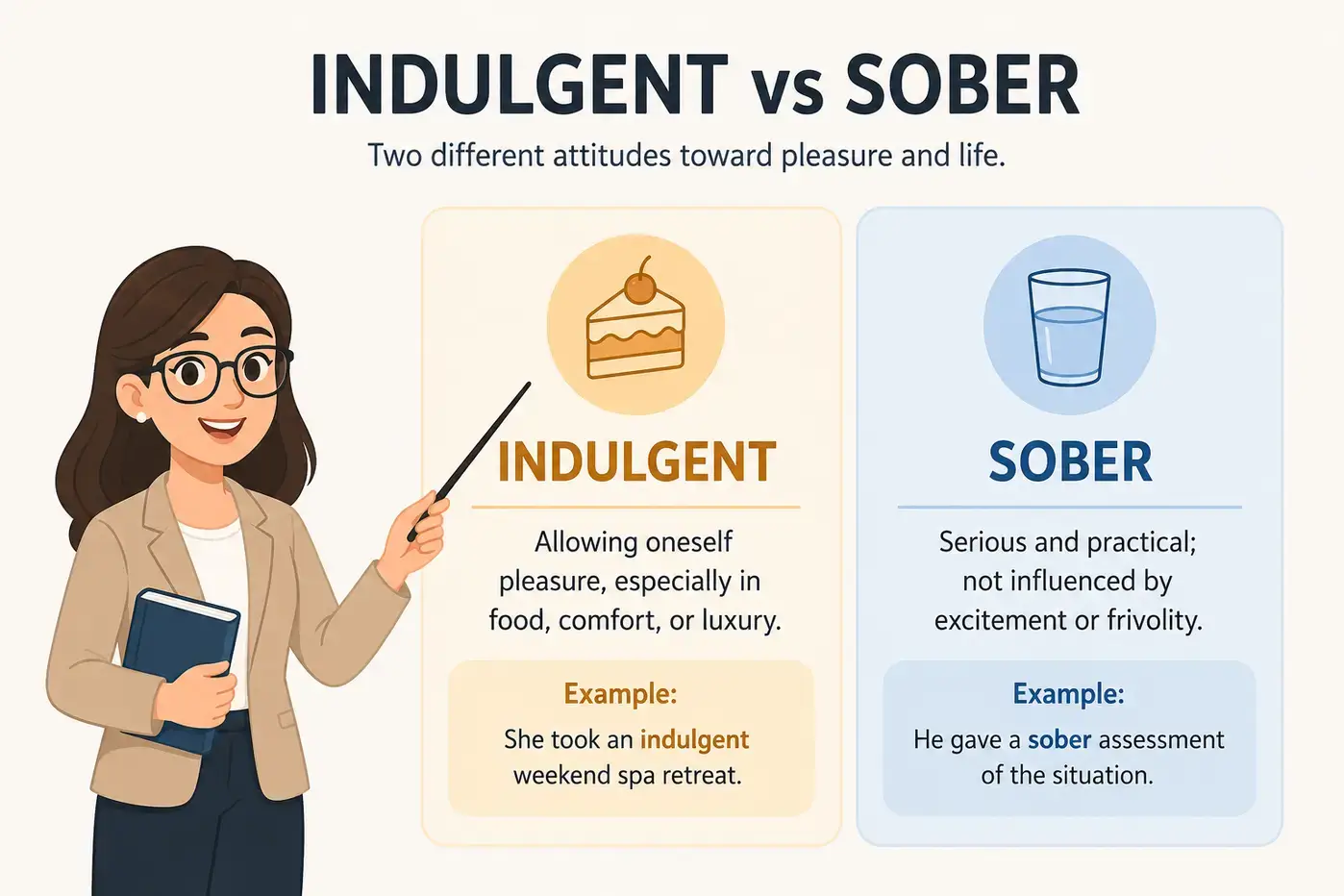
The comparison between indulgent vs sober goes far beyond vocabulary. These two words describe very different attitudes, behaviors, lifestyles, and ways of approaching life. One suggests giving in to desires, pleasures, or comforts. The other emphasizes restraint, self control, seriousness, or freedom from intoxication.
People often search for indulgent vs sober because they want to understand the contrast between the terms. Some encounter them in literature, psychology, self improvement content, lifestyle discussions, or everyday conversation. Others simply want clearer guidance on when to use each word correctly. Unlike many word comparisons that focus on spelling mistakes, this comparison centers on meaning. Both words are correct English terms, but they represent nearly opposite ideas in many contexts.
Understanding the distinction can improve your writing, strengthen communication, and help you choose the most accurate word for a situation. This guide explains the definitions, origins, grammar, pronunciation, examples, usage patterns, and practical differences between indulgent and sober. By the end, you’ll know exactly what each word means and when it should be used.
Learn the difference in Make Do Or Make Due Which Is Correct 2026.
Indulgent Vs Sober Quick Definition
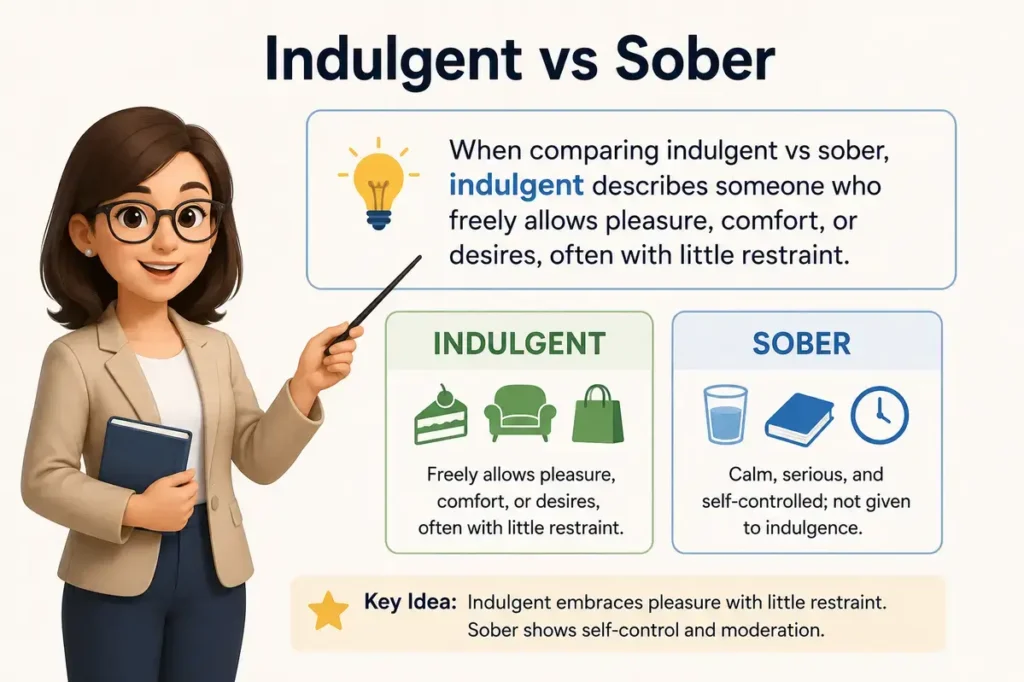
When comparing indulgent vs sober, indulgent describes someone who freely allows pleasure, comfort, or desires, often with little restraint. Sober describes someone who is not intoxicated, acts with self control, or maintains a serious and thoughtful attitude. The words often represent opposite approaches to behavior and decision making.
Indulgent Vs Sober Quick Answer
The difference is straightforward.
- Indulgent means allowing pleasures, desires, comforts, or luxuries.
- Sober means exercising restraint, avoiding intoxication, or maintaining seriousness and self control.
Examples:
- He enjoyed an indulgent weekend filled with rich food and relaxation.
- She made a sober assessment of the situation before acting.
Both words are correct, but they describe very different mindsets.
Indulgent Vs Sober Comparison Table
| Feature | Indulgent | Sober |
|---|---|---|
| Part Of Speech | Adjective | Adjective |
| Main Meaning | Allowing pleasure or desires | Showing restraint or seriousness |
| Emotional Tone | Relaxed and permissive | Controlled and disciplined |
| Common Contexts | Parenting, lifestyle, food, luxury | Judgment, behavior, recovery, thinking |
| Positive Usage | Enjoyment and generosity | Responsibility and clarity |
| Potential Negative Usage | Excess or lack of discipline | Lack of excitement or strictness |
| Formality Level | Standard English | Standard English |
| Opposite Relationship | Often opposite of sober | Often opposite of indulgent |
Meaning Of Indulgent Vs Sober
Meaning Of Indulgent
Indulgent describes a tendency to satisfy desires, cravings, pleasures, or preferences. The word can apply to people, lifestyles, experiences, food, spending habits, and parenting styles.
Examples:
- An indulgent dessert.
- An indulgent vacation.
- An indulgent parent.
- An indulgent lifestyle.
The term often carries a positive sense of enjoyment but can sometimes imply excess.
Meaning Of Sober
Sober has several related meanings.
Not Intoxicated
This is the most widely recognized meaning.
Examples:
- He remained sober throughout the evening.
- She has been sober for several years.
Serious And Thoughtful
The word can also describe a calm, realistic attitude.
Examples:
- A sober discussion.
- A sober evaluation.
- A sober response.
Restrained
Sober may describe something simple, moderate, or understated.
Examples:
- Sober clothing.
- Sober colors.
- Sober design.
Indulgent Vs Sober Meaning Differences
The contrast becomes clearer when examining the core ideas behind each word.
Indulgent Focuses On Pleasure
The word suggests:
- Enjoyment.
- Comfort.
- Luxury.
- Satisfaction.
- Reward.
Examples:
- An indulgent meal.
- An indulgent spa day.
- An indulgent shopping trip.
Sober Focuses On Restraint
The word suggests:
- Discipline.
- Responsibility.
- Clarity.
- Moderation.
- Seriousness.
Examples:
- A sober decision.
- A sober lifestyle.
- A sober assessment.
Practical Difference
Indulgent often asks: “What feels good right now?”
Sober often asks: “What is wise or responsible right now?”
Indulgent Vs Sober Key Differences
Emotional Difference
Indulgent creates feelings of pleasure and enjoyment. Sober creates feelings of calm judgment and control.
Behavioral Difference
Indulgent behavior may prioritize immediate satisfaction. Sober behavior tends to prioritize long term consequences.
Lifestyle Difference
An indulgent lifestyle may include luxury, treats, and relaxation. A sober lifestyle may focus on discipline, moderation, and careful choices.
Communication Difference
Indulgent language often sounds warm and generous. Sober language often sounds objective and measured.
Which One Is Correct
Both words are completely correct. The right choice depends entirely on your meaning. Use indulgent when discussing:
- Pleasure.
- Comfort.
- Luxury.
- Generosity.
- Self reward.
Use sober when discussing:
- Serious thinking.
- Self control.
- Clear judgment.
- Responsibility.
- Freedom from intoxication.
Examples:
- She enjoyed an indulgent afternoon at the spa.
- He offered a sober analysis of the financial report.
Neither word is better than the other. They simply describe different situations.
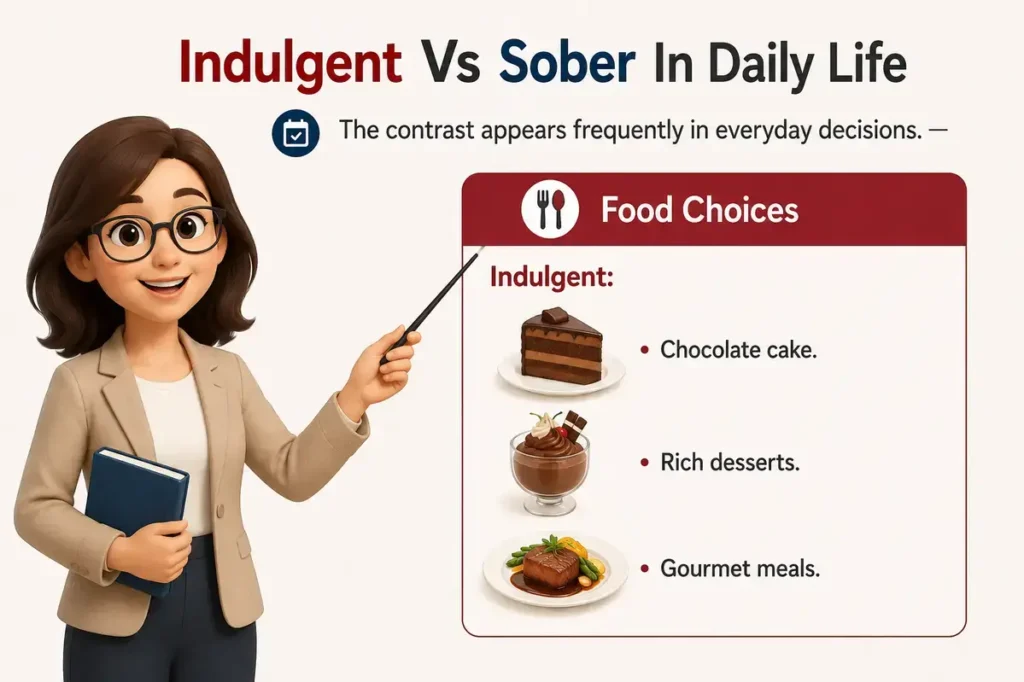
Indulgent Vs Sober In Daily Life
The contrast appears frequently in everyday decisions.
Food Choices
Indulgent:
- Chocolate cake.
- Rich desserts.
- Gourmet meals.
Sober:
- Balanced portions.
- Healthy choices.
- Moderate eating habits.
Spending Habits
Indulgent:
- Luxury purchases.
- Impulse buying.
- Expensive vacations.
Sober:
- Budget planning.
- Saving money.
- Financial discipline.
Entertainment Choices
Indulgent:
- Weekend getaways.
- Luxury resorts.
- Premium experiences.
Sober:
- Practical planning.
- Moderate spending.
- Thoughtful priorities.
Why People Compare Indulgent Vs Sober
Many comparisons arise because the words often represent competing values. Some situations encourage indulgence.
Examples:
- Celebrations.
- Vacations.
- Special occasions.
Other situations require sobriety.
Examples:
- Financial decisions.
- Medical choices.
- Professional responsibilities.
The challenge is finding balance. Most healthy lifestyles involve moments of both indulgence and sobriety.
Indulgent Vs Sober In Literature
Writers frequently use these terms to develop character traits.
An indulgent character may:
- Pursue pleasure.
- Avoid restrictions.
- Enjoy luxury.
A sober character may:
- Exercise caution.
- Think carefully.
- Value responsibility.
This contrast often drives conflict and character development in novels and stories.
Learn the difference in totalling or totaling Which Spelling Should You Use.
Indulgent Vs Sober In Modern Culture
Modern culture constantly presents both ideas. Advertising often promotes indulgence.
Examples:
- Treat yourself.
- Reward yourself.
- Enjoy luxury.
Financial advisors, educators, and health professionals often promote sober decision making.
Examples:
- Plan carefully.
- Think long term.
- Practice moderation.
Neither approach is inherently right or wrong. Context determines which mindset is more appropriate.
Indulgent Vs Sober Examples In Sentences
Examples help reveal how differently these words function in real communication.
Indulgent Examples In Sentences
- She treated herself to an indulgent chocolate dessert after dinner.
- The resort offered an indulgent experience with private pools and luxury suites.
- His indulgent spending habits made it difficult to save money.
- They planned an indulgent vacation filled with fine dining and relaxation.
- The movie was an indulgent celebration of glamour and excess.
- Her indulgent grandparents rarely said no to their grandchildren.
- The spa package included several indulgent treatments.
- The novel described the indulgent lifestyle of wealthy aristocrats.
- He enjoyed an indulgent weekend with no schedules or responsibilities.
- The restaurant became famous for its indulgent menu.
Sober Examples In Sentences
- She made a sober decision after reviewing all the facts.
- The judge delivered a sober assessment of the case.
- He remained sober throughout the celebration.
- Their discussion took a sober tone after the news was announced.
- The company issued a sober forecast for the coming year.
- Her sober clothing reflected a professional image.
- The documentary presented a sober view of history.
- He approached the challenge with a sober mindset.
- The meeting ended with a sober conclusion about future risks.
- After years of struggle, she proudly described herself as sober.
Common Mistakes With Indulgent Vs Sober
Because these words often represent contrasting ideas, people sometimes misuse them.
Mistake One Assuming They Are Direct Opposites In Every Situation
In some contexts they act as opposites.
For example:
- An indulgent lifestyle.
- A sober lifestyle.
However, sober can also mean not intoxicated, which creates a different contrast.
Mistake Two Using Indulgent As A Negative Word Every Time
Indulgent is not automatically negative.
Examples:
- An indulgent dessert can be enjoyable.
- An indulgent vacation can be healthy and refreshing.
The context determines the tone.
Mistake Three Assuming Sober Always Refers To Alcohol
Many people think sober only means not drinking alcohol. In reality, the word often means thoughtful, serious, restrained, or realistic.
Mistake Four Ignoring Context
An indulgent parent and a sober analysis refer to completely different areas of meaning. Always consider the situation before choosing a word.
Indulgent Vs Sober Pronunciation Guide
Indulgent Pronunciation
IPA:
/ɪnˈdʌldʒənt/
Syllable Breakdown:
In • dul • gent
Pronunciation:
in DUL jent
Sober Pronunciation
IPA:
/ˈsoʊbər/
Syllable Breakdown:
So • ber
Pronunciation:
SOH ber
Common Pronunciation Mistakes
- Some learners place the stress on the wrong syllable in indulgent.
- Others pronounce sober with an overly strong final syllable.
- Native speakers typically stress the first syllable in sober and the second syllable in indulgent.
Indulgent Vs Sober Etymology And Word Origin
Understanding a word’s history often makes its meaning easier to remember.
Origin Of Indulgent
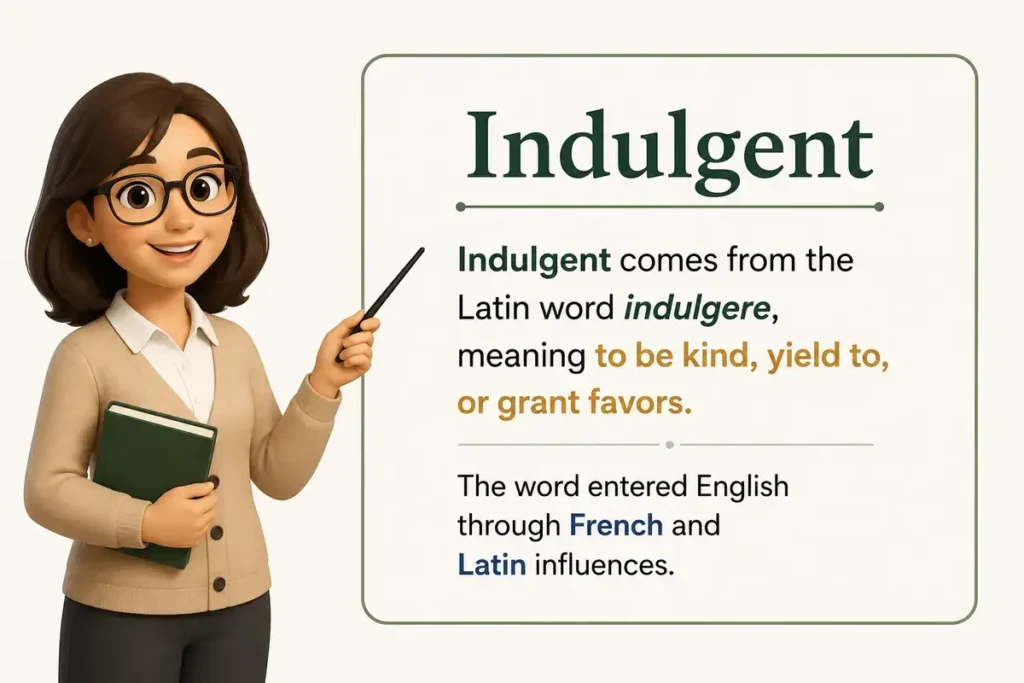
Indulgent comes from the Latin word indulgere, meaning to be kind, yield to, or grant favors. The word entered English through French and Latin influences. Over time, it developed meanings connected to generosity, leniency, pleasure, and satisfying desires.
Origin Of Sober
Sober comes from the Latin word sobrius, meaning moderate, temperate, or not intoxicated. English adopted the term centuries ago. Its meaning expanded to include seriousness, restraint, and thoughtful judgment.
Historical Development
Interestingly, both words have roots connected to moderation and behavior. One evolved toward the idea of granting pleasure. The other evolved toward the idea of limiting excess.
Indulgent Vs Sober Regional Usage
The meanings remain largely consistent throughout the English speaking world.
Indulgent Vs Sober American English
American speakers frequently use indulgent in lifestyle, food, travel, and parenting discussions. Sober commonly refers to recovery, self control, and serious decision making.
Indulgent Vs Sober British English
British English uses both words in much the same way.
Examples include:
- An indulgent meal.
- A sober assessment.
Indulgent Vs Sober Canadian English
Canadian usage closely follows American and British conventions.
Indulgent Vs Sober Australian English
Australian English also uses both words with similar meanings and grammatical patterns.
Indulgent Vs Sober Regional Summary
No major spelling differences exist across major English speaking regions. The meanings remain remarkably stable worldwide.
Indulgent Vs Sober Grammar Rules
Both words function primarily as adjectives.
Indulgent As An Adjective
Examples:
- An indulgent parent.
- An indulgent lifestyle.
- An indulgent purchase.
Sober As An Adjective
Examples:
- A sober discussion.
- A sober outlook.
- A sober judgment.
Predicate Adjective Usage
Indulgent:
- The vacation was indulgent.
- The experience felt indulgent.
Sober:
- The analysis was sober.
- The mood remained sober.
Comparative And Superlative Forms
Indulgent:
- More indulgent.
- Most indulgent.
Sober:
- Soberer.
- Soberest.
Many writers prefer:
- More sober.
- Most sober.
because they sound smoother in modern English.
Indulgent Vs Sober In Real Life
These words appear in many practical situations.
Daily Conversation
Examples:
- That dessert looks indulgent.
- We need a sober plan before moving forward.
Academic Writing
Examples:
- Researchers provided a sober evaluation of the evidence.
- The article examined indulgent consumer behavior.
Professional Communication
Examples:
- Management offered a sober assessment of market conditions.
- The company launched an indulgent premium product line.
Literature
Authors often use indulgent and sober to create contrast between characters, themes, and settings.
Media And Journalism
News reports frequently use sober to describe realistic assessments and serious responses. Lifestyle publications often use indulgent when discussing luxury products, travel, and dining experiences.
Related Words And Confused Terms
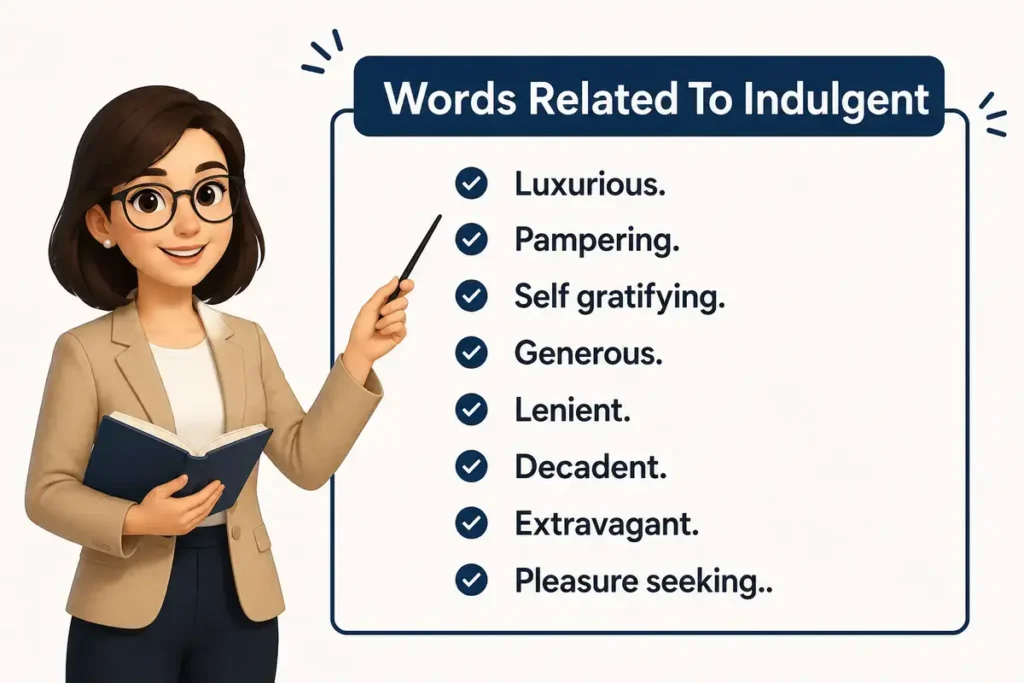
Words Related To Indulgent
- Luxurious.
- Pampering.
- Self gratifying.
- Generous.
- Lenient.
- Decadent.
- Extravagant.
- Pleasure seeking.
Words Related To Sober
- Serious.
- Restrained.
- Thoughtful.
- Practical.
- Temperate.
- Rational.
- Disciplined.
- Responsible.
Frequently Confused Terms
- Sober and serious.
- Indulgent and decadent.
- Temperate and sober.
- Luxury and indulgence.
- Discipline and restraint.
Expert Language Insight
As an editor, one of the most common observations is that people treat indulgent and sober as value judgments. In reality, they are descriptive words. Indulgent is not automatically irresponsible. A person can enjoy an indulgent meal, vacation, or hobby while still living a balanced life. Likewise, sober does not automatically mean boring.
A sober decision often reflects wisdom, maturity, and clear thinking. Native speakers usually choose indulgent when emphasizing enjoyment, comfort, luxury, or generosity. They choose sober when emphasizing realism, caution, discipline, responsibility, or emotional control. The strongest writing uses each word intentionally rather than treating one as good and the other as bad.
Frequently Asked Questions
What Is The Main Difference Between Indulgent And Sober?
Indulgent focuses on pleasure, comfort, and satisfying desires. Sober focuses on restraint, self control, seriousness, or freedom from intoxication.
Are Indulgent And Sober Opposites?
In many situations they function as opposites. An indulgent lifestyle often contrasts with a sober lifestyle. However, sober also has meanings related to alcohol use and serious thinking.
Can An Indulgent Experience Be Positive?
Yes. An indulgent experience often refers to a special treat, luxury, or enjoyable activity. The word frequently carries a positive tone.
Does Sober Always Mean Not Drunk?
No. Sober can also describe a thoughtful, serious, realistic, or restrained attitude.
Which Word Is More Formal?
Both words work well in formal and informal English. They regularly appear in academic, professional, literary, and everyday contexts.
Can Someone Be Both Indulgent And Sober?
Yes. A person might enjoy occasional indulgent experiences while maintaining a generally sober approach to important decisions.
Is Indulgent A Negative Personality Trait?
Not necessarily. The word can suggest generosity, warmth, and enjoyment. It becomes negative only when it implies excessive behavior.
Why Are These Words Often Compared?
They frequently represent contrasting approaches to life. One emphasizes pleasure and comfort. The other emphasizes discipline and thoughtful judgment.
Still confused? Compare Clutz or Klutz Meaning, Usage and Correct Form 2026.
Conclusion
The comparison between indulgent vs sober highlights two very different ways of approaching experiences, decisions, and behavior. Indulgent describes pleasure, comfort, luxury, generosity, and the willingness to satisfy desires. It often appears in discussions about food, travel, parenting, spending habits, and personal rewards. Sober describes self control, seriousness, restraint, realistic thinking, and freedom from intoxication. It commonly appears in professional communication, decision making, recovery discussions, and thoughtful analysis.
The right choice depends entirely on your intended meaning. Use indulgent when emphasizing enjoyment or luxury. Use sober when emphasizing discipline, clarity, responsibility, or moderation. Understanding this distinction allows you to communicate with greater precision and choose the word that best matches the situation.
2 thoughts on “Indulgent Vs Sober Understanding The Real Difference 2026”