
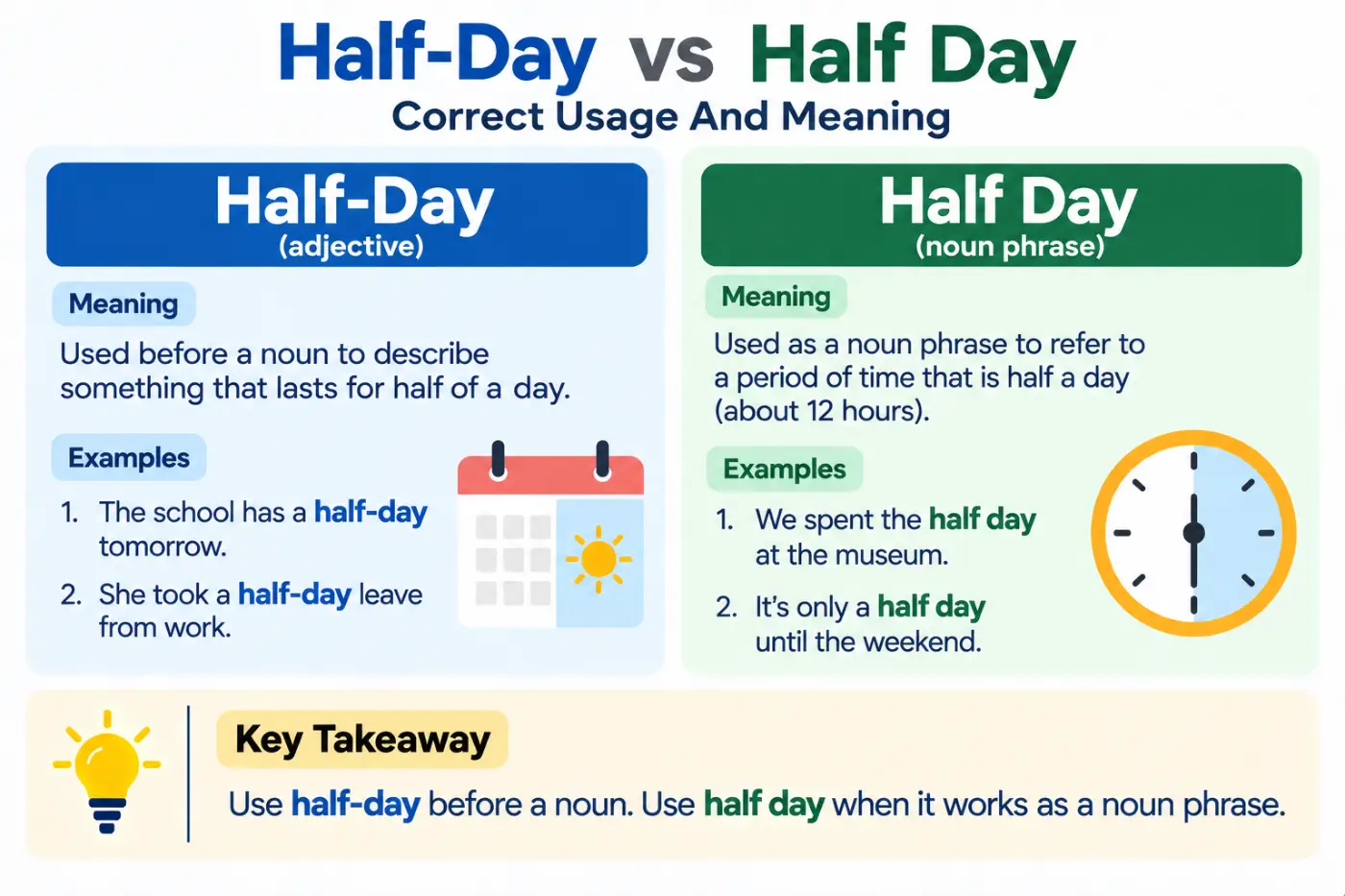
half-day vs half day can look like a tiny spelling question, but the correct form depends on how you use the expression in a sentence. Both forms are used in standard English, but they don’t always do the same grammatical job. The hyphenated form is commonly used before a noun as a compound modifier, while the open form is often used as a noun phrase.
For example, you can write, We attended a half-day workshop. Here the expression describes the workshop, so the hyphen helps connect the words into one modifier. But you can also say, The workshop lasted half a day. In that sentence, the expression works as a time phrase and doesn’t need a hyphen. You may also see half day used as a noun in phrases such as a half day of work.
This distinction becomes much easier once you look at the word’s position and function. This guide explains the spelling, grammar, pronunciation, meaning, punctuation, regional usage, common mistakes, and natural examples. You’ll also learn a simple editing rule that can help you choose the right form quickly.
A related grammar guide is Busyness Vs Business Which Word Should You Use in 2026?.
Quick Definition
Half day and half day with a hyphen are both used in English, but their grammatical roles differ. Use the hyphenated form when half-day works together as a compound adjective before a noun, as in a half-day meeting. Use the open form when the phrase functions as a noun or time expression.
Quick Answer
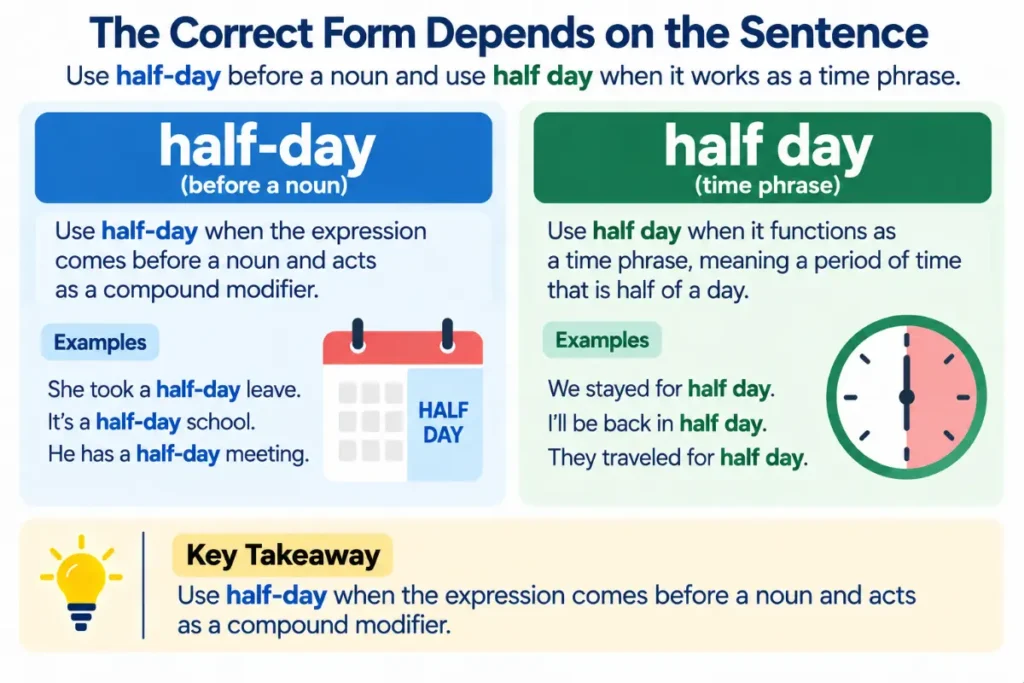
The correct form depends on the sentence. Use half-day when the expression comes before a noun and acts as a compound modifier.
Example: We attended a half-day training session.
Use half day when the expression functions as a noun phrase.
Example: I took a half day off work.
The distinction is mainly grammatical rather than a difference in meaning. Both forms refer to a period that lasts about half of a day.
Comparison Table
| Form | Meaning | Part of Speech | Origin | Usage Frequency | Formality | Common Contexts | Example |
|---|---|---|---|---|---|---|---|
| Half-day | Lasting for or covering about half a day when used before a noun | Compound adjective | Modern English compound formed from half and day | Common | Neutral and formal | Meetings, classes, workshops, events, schedules | We joined a half-day workshop. |
| Half day | A period that covers part of a day | Noun phrase | Modern English combination of half and day | Common | Neutral | Work schedules, leave, school, time descriptions | I took a half day off. |
| Half a day | A period equal to approximately one half of a day | Noun phrase | Standard English phrase | Very common | Neutral | Time descriptions and everyday speech | The trip took half a day. |
Meaning And Definition
Meaning Of Half Day
The open form describes a period that lasts for half of a day or refers to part of a day considered as a unit.
For example:
I only worked a half day today.
Here half day functions as a noun phrase. The speaker is describing the amount of work completed during the day.
You can also use it after certain verbs and prepositions.
She spent half a day cleaning the house.
He took a half day off work.
The exact grammar can vary slightly depending on the sentence. The key point is that the words are not functioning together as a single adjective directly before another noun in these examples.
The expression can also appear with the article a.
I need a half day to finish the project.
In this sentence, a half day refers to a period of time.
Meaning Of Half Day With A Hyphen
The hyphenated form is commonly used as a compound adjective before a noun.
For example:
We attended a half-day seminar.
The phrase half-day describes the seminar. It tells the reader that the seminar lasts about half a day.
Other examples include:
A half-day class.
A half-day event.
The hyphen makes the relationship between the words clear. It tells the reader that half and day work together as one modifier.
This is a common English pattern. Compound modifiers often use hyphens when they appear before a noun and could otherwise be misread.
The Main Grammar Difference
The easiest way to understand the distinction is to look at what comes next.
When the expression directly modifies a noun, use the hyphenated form in standard edited writing.
We planned a half-day trip.
Here half-day describes trip.
When the expression functions as a noun phrase, leave it open.
We spent half a day there.
Here half a day is the amount of time spent there.
Compare these sentences:
She attended a half-day class.
She attended the class for half a day.
The first sentence uses a compound adjective. The second uses a time expression.
This difference isn’t about changing the basic meaning. Both sentences tell us that the class lasted about half a day. The difference comes from grammar and sentence structure.
When To Use The Hyphenated Form
Use half-day when it works as a compound adjective before a noun.
Common examples include:
- A half-day meeting.
- A half-day course.
- A half-day workshop.
- A half-day event.
- A half-day trip.
- A half-day appointment.
- A half-day training session.
- A half-day conference.
- A half-day program.
- A half-day orientation.
In each case, the compound describes the noun that follows.
The hyphen acts like a small bridge between the words. It tells the reader to treat them as one descriptive unit.
This is especially helpful in longer sentences.
The company organized a half-day employee training program.
Without the hyphen, the reader could still understand the sentence. However, edited English often uses the hyphen to make the compound relationship immediately clear.
When To Use The Open Form
Use the open form when the phrase functions as a noun or appears in a time expression.
For example:
I worked a half day.
She took a half day off.
The project required half a day.
We spent half a day at the museum.
He was absent for half a day.
The children stayed at school for half a day.
Notice that half a day is especially natural when you’re describing duration.
The journey took half a day.
The meeting lasted half a day.
The repairs took half a day.
In these sentences, there is no compound adjective before a noun. The phrase simply describes a period of time.
Half Day As A Work Schedule
Workplace English creates many questions about this expression because employees often talk about taking part of a workday off.
These forms are common:
I took a half day off.
I worked a half day.
I’m taking a half day tomorrow.
The exact wording can depend on local workplace style and the sentence structure.
In many professional settings, half day is treated as a noun phrase when referring to leave.
For example:
I need to request a half day off on Friday.
The expression describes the amount of leave being requested.
You may also see half-day in workplace documents when it functions as a modifier.
The manager approved a half-day leave request.
Here half-day describes leave request.
This is a useful distinction. The same basic expression can appear with or without a hyphen in the same document because its grammatical role changes.
Half Day In School And Education
Schools and colleges frequently use the expression to describe schedules and events.
A school might announce:
Students will attend a half-day session on Friday.
Here half-day describes session.
A teacher might say:
The students will be dismissed after half a day.
Here half a day expresses duration.
You could also write:
The school has a half-day schedule.
The phrase modifies schedule and therefore works as a compound adjective.
Another example is:
The students spent half a day working on the project.
This describes the amount of time spent on the activity.
These small changes in structure explain why you may see different versions in school calendars, notices, emails, and schedules.
Half Day In Business Writing
Business writing often uses this expression for meetings, training, events, and employee schedules.
Consider these examples:
The company scheduled a half-day leadership workshop.
The workshop lasted half a day.
The first sentence uses a compound adjective. The second describes duration.
Another pair shows the same pattern:
We arranged a half-day planning session.
We spent half a day planning the next quarter.
The first phrase describes the session. The second describes the amount of time spent planning.
A professional editor doesn’t choose the hyphen based simply on how the expression looks. The editor checks its grammatical function in the sentence.
Half Day Or Half A Day
These expressions are closely related but can sound slightly different depending on the context.
Half a day is the most direct way to describe duration.
The repair took half a day.
The trip lasted half a day.
We spent half a day at the beach.
Half day often works as a noun phrase referring to a portion of a day.
I took a half day off.
She works a half day on Fridays.
The company offers a half day of training.
The choice can also depend on style. In ordinary speech, half a day is extremely natural when discussing duration. In workplace or scheduling language, a half day often sounds natural when referring to leave or a partial work period.
Key Differences Explained
- Grammar. The hyphenated form commonly works as a compound adjective before a noun. The open form commonly works as a noun phrase or time expression.
- Meaning. Both forms relate to a period covering about half of a day. The main difference is grammatical function.
- Punctuation. The hyphen connects the words when they act together as one modifier before a noun.
- Position. A compound modifier usually appears directly before the noun it describes.
- Duration. When you are simply saying how long something lasted, half a day is generally the natural choice.
- Workplace usage. A half day is common when discussing partial leave or part of a workday.
- Formality. Both forms are standard. The hyphenated form isn’t automatically more formal.
- Regional usage. American, British, Canadian, and Australian English generally follow the same basic grammatical distinction.
Which Form Is Correct?
Both forms can be correct. The important question is how you use the expression.
Use half-day before a noun when the expression functions as a compound adjective.
Example:
We booked a half-day tour.
Use half day as a noun phrase.
Example:
We booked the tour for a half day.
Use half a day when describing duration.
Example:
The tour lasted half a day.
This follows a broader English spelling principle. Compound modifiers that come before nouns are often hyphenated when the hyphen helps show that the words belong together.
For example:
A well-known author.
A five-year-old child.
A full-time job.
A half-day course.
The hyphen doesn’t belong there simply because the words are related. It has a specific job. It prevents the reader from having to figure out the relationship between the words.
Sentence Examples
Here are natural examples that show the different structures.
- We attended a half-day workshop on workplace safety.
- The school will hold a half-day orientation for new students.
- I took a half day off to handle a family appointment.
- The trip took half a day from start to finish.
- She signed up for a half-day cooking class.
- He worked a half day before leaving for the airport.
- The company organized a half-day training session.
- We spent half a day exploring the city.
- The doctor scheduled a half-day clinic for Saturday.
- The students completed the assignment in half a day.
These examples show why the three forms shouldn’t be treated as interchangeable in every sentence.
Still confused? Compare Offered Vs Offerred Meaning Usage And Correct Form.
Common Mistakes
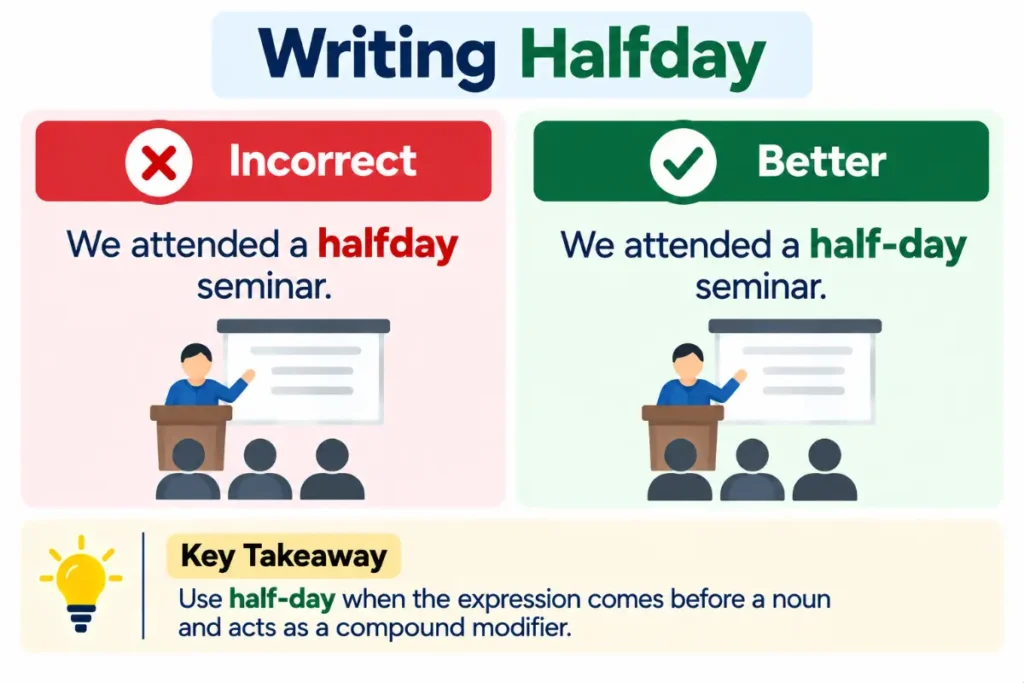
Writing Halfday
Incorrect: We attended a halfday seminar.
Better: We attended a half-day seminar.
English compound modifiers of this type are normally written with a hyphen when they appear before the noun they modify.
Using A Hyphen After The Noun
Less appropriate: The seminar lasted a half-day.
Natural: The seminar lasted half a day.
The hyphenated form is most useful when the phrase works as a modifier before a noun. After the noun, a simple time expression is usually clearer.
Hyphenating Half A Day
Incorrect: The project took half-a-day.
Correct: The project took half a day.
The expression half a day is a normal noun phrase. It doesn’t need hyphens.
Treating Every Use As Half-Day
Some writers learn the compound adjective and then use it everywhere.
That creates unnecessary hyphens.
The correct form depends on sentence structure rather than on a blanket rule.
Treating Every Use As Half Day
The opposite mistake also occurs. Writers may leave out the hyphen even when the expression directly modifies a noun.
A half day workshop can be understood, but a half-day workshop is the clearer standard form in edited writing.
Pronunciation Guide
Half is usually pronounced /hæf/ in American English.
Day is pronounced /deɪ/.
The phrase half-day is commonly pronounced as two spoken words even though the written form contains a hyphen.
A simple pronunciation guide is:
half day
The hyphen doesn’t create a new sound. It only connects the words in writing.
When saying half a day, the word a is pronounced with a reduced vowel in natural speech.
You may hear:
half uh day
The pronunciation is straightforward, but learners sometimes focus too much on the hyphen. Remember that the hyphen is a writing mark rather than a pronunciation mark.
The main stress generally falls naturally on the words carrying meaning in the sentence. There is no special pronunciation that tells you when to use the hyphen. Grammar and position determine the written form.
Etymology And Word Origin
Half comes from Old English forms related to the idea of one of two equal parts. Its Germanic history connects it with related words in other Germanic languages.
Day also has Old English roots. The modern English word developed from the Old English dæg and belongs to a broader Germanic word family.
The compound expression half-day is a relatively straightforward English combination. It joins the concept of half with the concept of a day to describe something lasting or covering about one half of a day.
The open expression half a day follows ordinary English noun phrase structure. The words retain their individual grammatical roles.
This history doesn’t create a complicated spelling rule. The important modern point is how English uses compound modifiers and noun phrases.
Regional Usage
American English
American English commonly uses half-day as a compound modifier before a noun.
Examples include:
A half-day workshop.
A half-day class.
For duration, American speakers commonly use half a day.
The repairs took half a day.
In workplace settings, a half day is also common for partial leave.
British English
British English follows the same general distinction. Half-day can function as a compound adjective before a noun, while half a day commonly expresses duration.
British workplace and school writing may also use half day when referring to a partial period.
There isn’t a major regional spelling difference here.
Australian English
Australian English uses the same basic forms. A half-day event is a natural compound adjective, while half a day can describe duration.
The choice is mainly determined by grammatical structure rather than regional preference.
Canadian English
Canadian English also follows the general English pattern. Writers commonly hyphenate the compound modifier before a noun and leave the duration phrase open.
For example:
A half-day training course.
The course lasted half a day.
The distinction remains clear and consistent.
Grammar Rules And Part Of Speech
Half-day usually functions as a compound adjective.
In:
We attended a half-day conference.
the entire expression describes conference.
Half day usually functions as a noun phrase.
In:
I took a half day off.
the expression refers to a portion of the working day.
Half a day is also a noun phrase.
In:
The work took half a day.
it identifies the amount of time required.
The hyphen therefore has a grammatical purpose. It isn’t simply decorative punctuation.
Compound Modifiers Before Nouns
A compound modifier appears before the noun it describes.
Examples include:
A half-day course.
A half-day appointment.
The hyphen helps the reader understand that half and day form one descriptive unit.
Time Expressions
When the expression describes duration, the open structure is normally appropriate.
The class lasted half a day.
The journey took half a day.
She spent half a day studying.
These sentences don’t need a hyphen because the words aren’t acting as one adjective before another noun.
Possessive And Article Patterns
You may see:
a half day.
half a day.
a half-day program.
These forms look similar but have different grammatical structures.
A half day refers to a partial day considered as a unit.
Half a day expresses one half of a day.
A half-day program uses the compound adjective to describe the program.
Punctuation And Hyphen Rules
Hyphens can be tricky because English doesn’t use them in exactly the same way in every compound.
The most useful practical rule is this:
Use the hyphen when the expression works together before a noun as one modifier.
For example:
A half-day meeting.
A half-day appointment.
If the expression follows the noun or simply describes duration, the hyphen is usually unnecessary.
The meeting lasted half a day.
The course runs for half a day.
The appointment took half a day.
This principle appears in many other compound expressions too.
A two-hour meeting.
The meeting lasted two hours.
A five-year plan.
The plan lasted five years.
The pattern is consistent. The compound modifier before the noun gets the hyphen. The ordinary measurement phrase after the verb stays open.
Real Life Usage Examples
Daily Conversation
I only worked a half day today.
We spent half a day at the park.
These forms sound natural because the first treats the time as a portion of the workday while the second describes duration.
Email And Workplace Communication
The team will attend a half-day training session on Monday.
I would like to request a half day off next Friday.
These sentences are common in workplace communication because schedules and partial work periods often need precise descriptions.
Academic Writing
The researchers conducted a half-day observation session.
The participants spent half a day completing the assigned tasks.
Academic writing can use both structures depending on the grammatical role of the expression.
News Writing
The city hosted a half-day public meeting on transportation plans.
The committee spent half a day reviewing the proposal.
News writing often uses compound modifiers for event descriptions and open time phrases for duration.
Literature And Storytelling
They planned a half-day journey through the countryside.
After half a day on the road, they reached the village.
The contrast works naturally because the first describes the journey while the second describes how long the travel took.
Related And Confused Terms
Half A Day
This is the clearest general expression for a period equal to one half of a day.
The project took half a day.
Half Day Off
This refers to taking part of a workday away from normal duties.
I need a half day off tomorrow.
Half Day Leave
This is common in workplace and school contexts where a person takes leave for part of a day.
She requested half day leave.
In formal workplace documents, house style may influence the exact wording.
Half Day Class
In edited writing, use a hyphen when the phrase acts as a compound modifier.
A half-day class starts at noon.
Half Day Session
The standard compound modifier form is:
A half-day session.
Full Day
Full day is related in meaning but follows its own context based spelling patterns.
A full-day conference.
The conference lasted a full day.
One Half Day
This is a more explicit way to describe the quantity.
The program covers one half day of training.
Part Of A Day
This broader phrase refers to any portion of a day rather than specifically half.
The appointment took part of a day.
These related expressions help show that English spelling depends heavily on grammar and meaning in context.
Half Day In Schedules And Calendars
Schedules often create another point of confusion because calendar labels are short.
You might see:
Half-day workshop.
Half-day closure.
These labels use the compound modifier form because half-day describes the event or activity.
A calendar note might instead say:
The office will be closed for half a day.
Here the phrase describes duration.
Short labels sometimes omit normal sentence structure, so organizational style guides may influence punctuation. In full sentences, the grammatical distinction is the safest guide.
Half Day In Job Applications And Resumes
Professional documents may use the expression when describing training, work schedules, or events.
For example:
Completed a half-day workplace safety course.
This is a compact phrase where half-day modifies course.
Another example:
Worked a half day during the holiday schedule.
Here half day acts as a noun phrase.
If you’re writing a resume or professional profile, consistency matters. Follow the same grammatical pattern throughout the document instead of switching randomly between forms.
Half Day In Formal Writing
The expression is fully acceptable in formal English. The main concern is correct sentence structure rather than formality.
A formal report might say:
The committee conducted a half-day review session.
Later, the same report might say:
The committee spent half a day reviewing the results.
Both are polished and correct because each structure matches its grammatical role.
You don’t need to replace the phrase with something more complicated. Simple wording is often the strongest choice.
Half Day In Informal Writing
Casual writing often uses simpler expressions.
I’m taking a half day tomorrow.
The trip took half a day.
We had a half-day event at school.
Text messages may be even less consistent with punctuation. Still, if you’re writing something that others will read professionally, use the standard compound modifier rule.
Good grammar doesn’t mean making every sentence formal. It means making the structure easy to understand.
Expert Editor Insight
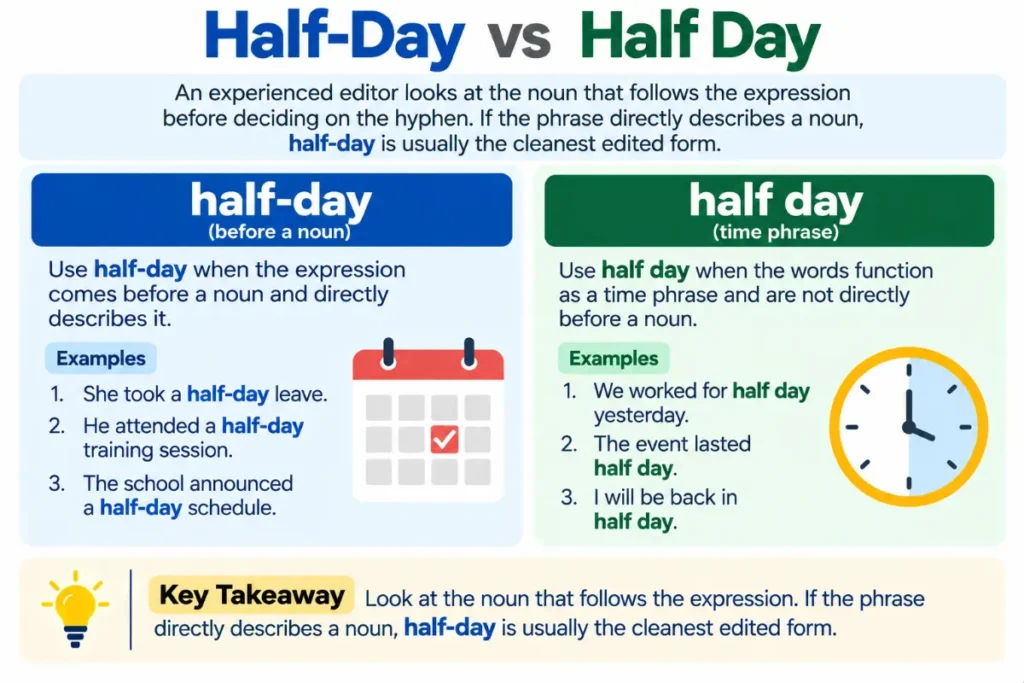
An experienced editor looks at the noun that follows the expression before deciding on the hyphen. If the phrase directly describes a noun, half-day is usually the cleanest edited form. If it refers to a portion of time or describes duration, half day or half a day is generally appropriate. Grammar tools may catch some inconsistent hyphenation, but they don’t always understand the intended relationship between words. The best editing tip is to read the entire phrase aloud and ask what grammatical job it is doing.
A related grammar guide is optimize or optimise Correct Spelling And Usage.
Conclusion
half-day vs half day is not a case where one form is always right and the other is always wrong. The hyphenated form usually works as a compound adjective before a noun, as in a half-day workshop. The open form works as a noun phrase in expressions such as a half day off, while half a day is a natural way to describe duration.
The easiest way to choose is to check the phrase’s job in your sentence. If it describes the noun that follows, connect the words with a hyphen. If you’re simply talking about an amount of time, leave the phrase open.
A useful editing habit is to look at the word immediately after the expression. That small check often tells you exactly which form you need.
FAQs
Is half-day or half day correct?
Both forms can be correct. Use half-day when the expression works as a compound adjective before a noun, as in a half-day workshop. Use half day as a noun phrase, as in I took a half day off. For duration, half a day is usually the natural choice, as in The project took half a day.
Should I write half-day workshop or half day workshop?
In edited standard English, half-day workshop is the clearer form because the two words work together as a compound modifier describing workshop. The hyphen shows that half and day belong together as one descriptive unit. The same pattern applies to phrases such as half-day course, half-day meeting, and half-day training session.
Is it half day off or half-day off?
When you mean a portion of a workday taken as leave, a half day off is a common structure. For example, I need a half day off tomorrow. The hyphenated form is more appropriate when the expression directly modifies another noun, such as a half-day schedule or a half-day program.
Is half a day hyphenated?
No. The standard expression is half a day without hyphens. For example, The journey took half a day. The words function as a normal noun phrase that expresses duration. Hyphens aren’t needed because half and day aren’t working together as a compound adjective before another noun.
Can I write half-day in formal writing?
Yes. Half-day is completely acceptable in formal writing when it functions as a compound modifier before a noun. Examples include a half-day seminar, a half-day review, and a half-day training program. In formal writing, the key is to match the hyphenation to the grammatical structure instead of adding or removing hyphens randomly.
What is the difference between half-day and half a day?
Half-day usually describes a noun, as in a half-day course. Half a day normally describes duration, as in The course lasted half a day. The underlying time period is similar, but the grammatical function changes. The first form is a compound adjective while the second is a noun phrase expressing duration.
Is half day leave grammatically correct?
Half day leave is widely understood in workplace and educational contexts, especially in regional varieties of English. In polished American English, phrases such as a half day off or half a day of leave may sound more natural depending on the sentence. A workplace’s established terminology can also influence the preferred wording.
How do you remember when to use the hyphen?
Look at the words that follow the expression. If half and day work together to describe a noun immediately afterward, use the hyphen, as in a half-day course. If the phrase refers to a period of time, use half a day or a half day depending on the sentence. This quick check prevents most mistakes.