
The confusion between reins vs reigns catches many writers off guard. The two words sound exactly alike, which makes them classic homophones in English. You might hear a phrase in conversation, know what it means, and still hesitate when it’s time to write it down.
This mix up appears in emails, blog posts, academic papers, business documents, and even published articles. One reason is that both words have legitimate meanings, but those meanings are completely different. Using the wrong one can change the sense of a sentence or make your writing look less polished.
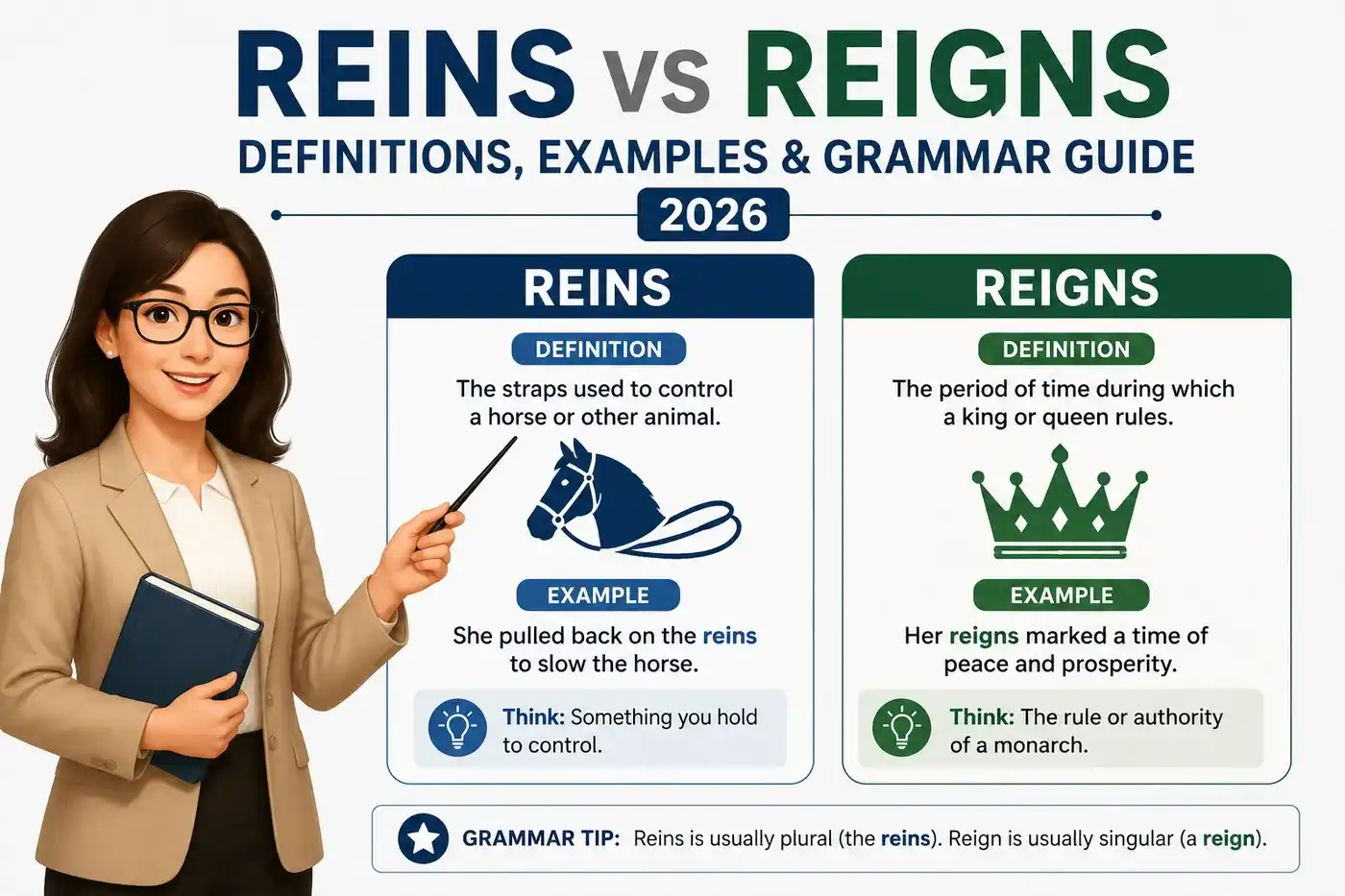
If you’re comparing reins vs reigns, looking for the correct spelling, wondering which word belongs in common expressions, or trying to improve your grammar, you’re in the right place. The short answer is simple. Reins relates to controlling a horse and is often used metaphorically to mean control or guidance. Reigns refers to ruling, governing, or holding royal authority. This guide explains the meaning, pronunciation, grammar, examples, origins, and real world usage of both words so you’ll never confuse them again.
Learn the difference in Preform vs Perform Meaning and Usage Guide in 2026.
Quick Definition
When comparing reins vs reigns, both words are correct but serve different purposes. Reins refers to straps used to control a horse and is often used metaphorically for control or direction. Reigns is the plural form of reign or a verb meaning to rule, govern, or hold power.
Reins Vs Reigns Quick Answer
The easiest way to remember the difference is this:
- Reins = control, guidance, or horse riding equipment.
- Reigns = periods of rule, royal authority, or governing power.
Examples:
- She took the reins of the company.
- The queen reigns over the kingdom.
Both words are correct. The right choice depends on the meaning you want to express.
Reins Vs Reigns Comparison Table
| Feature | Reins | Reigns |
|---|---|---|
| Part Of Speech | Noun | Noun and verb |
| Primary Meaning | Straps used to control a horse | Rules or governs |
| Figurative Meaning | Control or leadership | Authority or sovereignty |
| Origin | Horse riding terminology | Monarchy and government |
| Usage Frequency | Common in idioms | Common in historical and political contexts |
| Formality Level | Standard English | Standard English |
| Common Contexts | Leadership, control, management | Royal rule, government |
| Example | Take the reins | The king reigns |
Meaning Of Reins Vs Reigns
Meaning Of Reins
Reins are straps attached to a horse’s bridle that allow a rider to guide and control the animal. Over time, the word developed a figurative meaning connected to leadership and control.
Examples:
- The rider pulled the reins gently.
- She took the reins after the manager retired.
- The new CEO now holds the reins of the company.
Meaning Of Reigns
Reigns comes from the word reign. As a verb, it means to rule or govern. As a noun, it can refer to periods during which monarchs rule.
Examples:
- The king reigns with confidence.
- Peace reigns throughout the region.
- Historians study the reigns of ancient rulers.
Reins Vs Reigns Meaning Differences
Although they sound identical, their meanings are unrelated.
Reins Focus On Control
The word centers on guidance, direction, and management.
Examples:
- Taking control.
- Leading a team.
- Managing an organization.
Reigns Focus On Rule
The word centers on authority, governance, and sovereignty.
Examples:
- Royal leadership.
- Political power.
- Historical kingdoms.
Practical Difference
If you’re talking about control, leadership, or direction, use reins. If you’re talking about ruling or governing, use reigns.
Reins Vs Reigns Key Differences
Meaning Differences
- Reins means control.
- Reigns means rule.
Historical Differences
- Reins originated from horseback riding.
- Reigns originated from royal governance.
Context Differences
- Reins appears frequently in business and leadership discussions.
- Reigns appears frequently in history and politics.
Idiomatic Differences
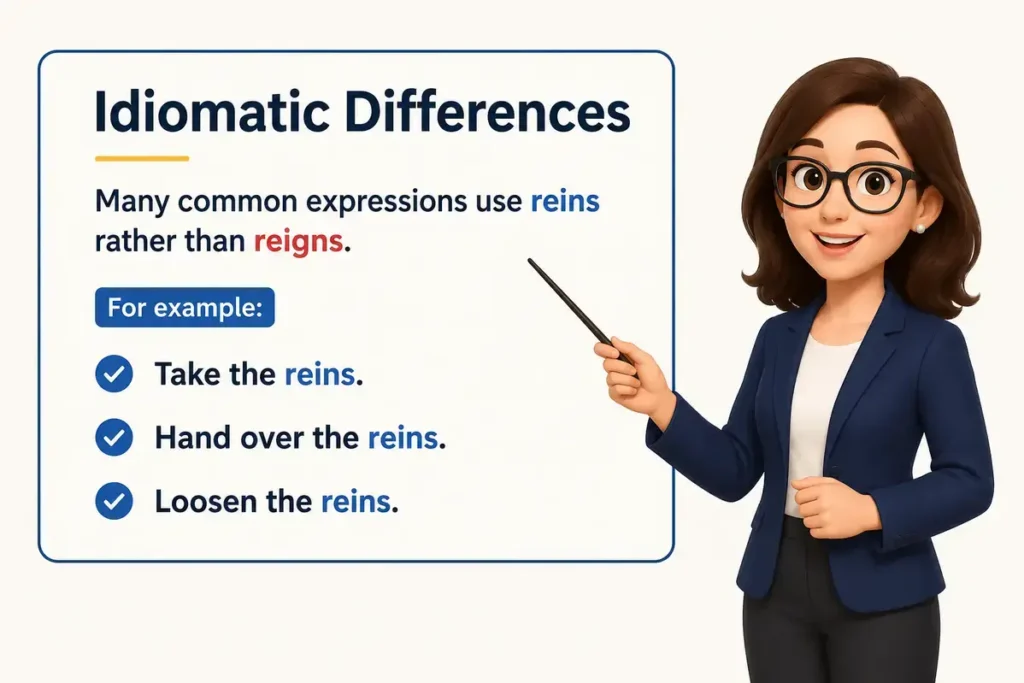
Many common expressions use reins rather than reigns.
For example:
- Take the reins.
- Hand over the reins.
- Loosen the reins.
These phrases do not use reigns.
Which One Is Correct
Both words are correct. The real question is which meaning fits your sentence. Use reins when discussing:
- Control.
- Direction.
- Leadership.
- Horse riding.
Use reigns when discussing:
- Kings.
- Queens.
- Rule.
- Government.
- Sovereignty.
Examples:
- She took the reins of the organization.
- The emperor reigns over a vast territory.
Choosing the wrong word can make a sentence inaccurate even though the spelling itself is valid.
Reins Vs Reigns In Popular Expressions
Many people confuse these words because of familiar idioms.
Correct expressions include:
- Take the reins.
- Hold the reins.
- Give someone the reins.
- Tighten the reins.
- Loosen the reins.
These expressions all come from horse riding. A rider controls a horse through the reins, which explains why the word became associated with leadership and authority. Using reigns in these expressions creates an error.
Incorrect:
- Take the reigns of the company.
Correct:
- Take the reins of the company.
Why People Confuse Reins Vs Reigns
Several factors contribute to the confusion.
Identical Pronunciation
The words sound exactly alike. Most people learn them through speech before writing.
Similar Associations
Both words can relate to authority and leadership. This overlap makes mistakes more likely.
Common Internet Errors
The phrase “take the reigns” appears online frequently even though it is incorrect. Repeated exposure causes many writers to assume the spelling is acceptable.
Limited Awareness Of Origins
Understanding the horse riding origin of reins often eliminates the confusion instantly.
Reins Vs Reigns In Professional Writing
Editors frequently correct mistakes involving these homophones.
Business examples:
- The new director took the reins.
- She was given the reins of the project.
Historical examples:
- The monarch reigns over the nation.
- Scholars compare the reigns of several kings.
Reins Vs Reigns Examples In Sentences
Examples are one of the best ways to understand the difference between reins vs reigns.
Reins Examples In Sentences
- The rider tightened the reins before entering the competition.
- She took the reins of the family business after her father retired.
- The manager handed the reins to his successor.
- It’s time for the next generation to take the reins.
- The coach kept a firm grip on the reins of the team.
- He loosened the reins and allowed the horse to move freely.
- The board gave her the reins of the new project.
- Strong leaders know when to hold the reins and when to delegate.
- She accepted the reins during a difficult period for the company.
- The experienced rider controlled the horse with steady reins.
Reigns Examples In Sentences
- The king reigns over the kingdom with wisdom.
- Peace reigns throughout the country.
- The queen reigns but does not govern directly.
- Historians often compare the reigns of different monarchs.
- Uncertainty reigns during times of economic instability.
- The emperor reigns over a vast territory.
- Silence reigns in the library.
- Happiness reigns in their home after the good news.
- The longest reigns in history often shaped entire nations.
- Justice reigns when laws are applied fairly.
Common Mistakes With Reins Vs Reigns
Because these words sound identical, writers frequently substitute one for the other.
Mistake One Writing Take The Reigns
This is the most common error.
Incorrect:
- She took the reigns of the company.
Correct:
- She took the reins of the company.
The expression comes from horse riding, not royalty.
Mistake Two Using Reins For Royal Authority
Incorrect:
- The king reins over the nation.
Correct:
- The king reigns over the nation.
Kings reign. They do not reins.
Mistake Three Assuming The Words Are Interchangeable
Although they sound the same, their meanings are completely different.
Always focus on the idea behind the sentence.
Ask yourself:
- Is this about control?
- Is this about ruling?
The answer usually reveals the correct spelling.
Mistake Four Ignoring Idiomatic Usage
Many established English expressions use reins.
Examples:
- Take the reins.
- Hold the reins.
- Hand over the reins.
These phrases should never use reigns.
A related grammar guide is Laid or Layed Which Word Should You Use in 2026.
Reins Vs Reigns Pronunciation Guide
Interestingly, pronunciation does not help distinguish the words because they are true homophones.
Reins Pronunciation
IPA:
/reɪnz/
Sounds Like:
Raynz
Syllable Count:
1 syllable.
Reigns Pronunciation
IPA:
/reɪnz/
Sounds Like:
Raynz
Syllable Count:
1 syllable.
Common Pronunciation Mistakes
Most pronunciation issues occur when learners overemphasize the spelling differences.
In spoken English:
- Reins and reigns sound identical.
- Context determines the intended meaning.
Reins Vs Reigns Etymology And Word Origin
The origins of these words reveal why their meanings differ so dramatically.
Origin Of Reins
The word rein comes from Old French and Latin roots connected to controlling horses. For centuries, reins have been essential riding equipment. Because reins allow riders to direct movement, the word gradually developed a figurative meaning related to leadership and control.
Examples:
- Holding the reins.
- Taking the reins.
- Giving someone the reins.
Origin Of Reigns
The word reign comes from Latin roots associated with ruling and kingship. It entered English through French and became closely tied to monarchies, governments, and authority. Over time, the term expanded beyond royal contexts. Today, phrases such as “peace reigns” and “chaos reigns” are common.
Why The Words Sound Alike
English contains many homophones that evolved from entirely different roots. Reins and reigns happen to share pronunciation despite having unrelated origins.
Reins Vs Reigns Regional Usage
The distinction remains consistent across major English speaking countries.
American English
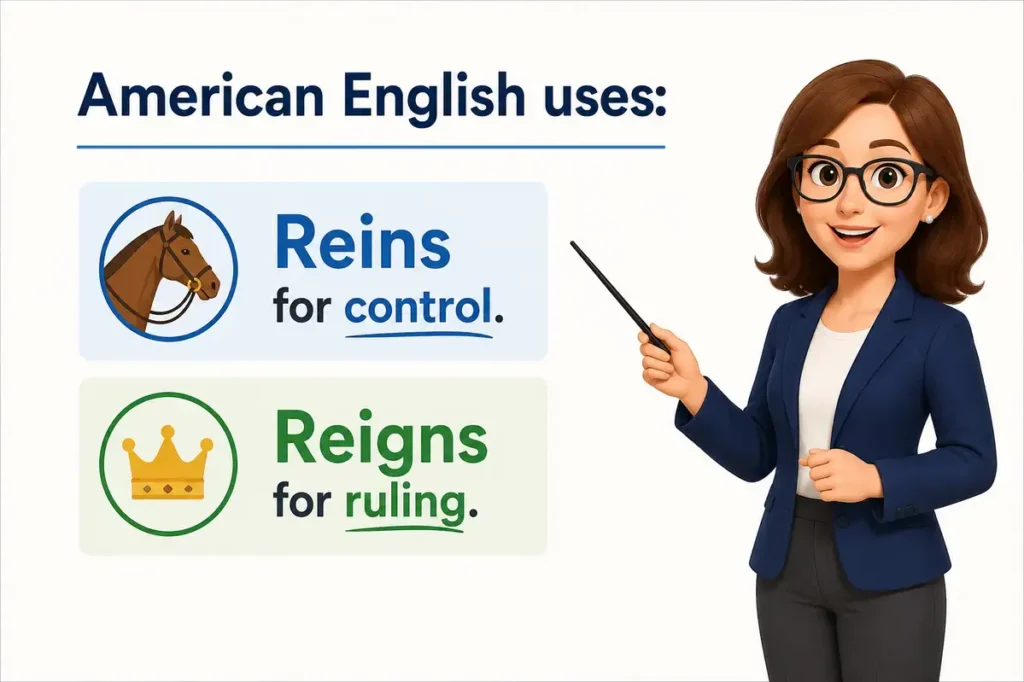
American English uses:
- Reins for control.
- Reigns for ruling.
Examples:
- Take the reins of the business.
- The president reigns over no kingdom.
Reins Vs Reigns British English
British English follows the same distinction. Historical writing frequently uses reigns because of the country’s long royal tradition.
Reins Vs Reigns Canadian English
Canadian English recognizes both terms with identical meanings and usage rules.
Reins Vs Reigns Australian English
Australian English also maintains the same distinction. Business and leadership writing often uses expressions involving reins.
Reins Vs Reigns Regional Differences
There are virtually no spelling differences between major English varieties. The meanings remain consistent worldwide.
Reins Vs Reigns Grammar Rules
Understanding the grammatical role of each word makes correct usage easier.
Grammar Of Reins
Reins functions primarily as a plural noun.
Examples:
- The reins were made of leather.
- She grabbed the reins.
It can also appear in figurative expressions.
Examples:
- Take the reins.
- Hold the reins.
Grammar Of Reigns
Reigns functions as:
- A plural noun.
- A third person singular verb.
Verb examples:
- The king reigns over the kingdom.
- Peace reigns today.
Noun examples:
- Historians study royal reigns.
- Several reigns shaped the nation.
Common Structures
Reins:
- Take the reins.
- Hold the reins.
- Give someone the reins.
Reigns:
- Reigns over.
- Peace reigns.
- Chaos reigns.
Reins Vs Reigns In Real Life
These words appear frequently in everyday communication.
Daily Conversation
Examples:
- She finally took the reins at work.
- Calm reigns in the neighborhood today.
Business Communication
Leadership discussions often use reins.
Examples:
- The new executive has taken the reins.
- He was handed the reins of the department.
Academic Writing
Historical and political studies frequently use reigns.
Examples:
- The reigns of medieval rulers influenced European history.
- The monarch reigns symbolically.
Literature
Writers often use both words.
Examples:
- The prince reigns over distant lands.
- The hero takes the reins of destiny.
Journalism And Media
News articles commonly feature both meanings.
Examples:
- Uncertainty reigns after the election.
- The CEO takes the reins next month.
Related Words And Confused Terms
Several English words create similar confusion.
Related To Reins
- Control.
- Guidance.
- Leadership.
- Direction.
- Management.
Related To Reigns
- Rule.
- Authority.
- Sovereignty.
- Governance.
- Dominion.
Commonly Confused Homophones
- Reins and reigns.
- Principal and principle.
- Stationary and stationery.
- Complement and compliment.
- Their there and they’re.
- Peak peek and pique.
- Brake and break.
Reins Vs Reigns Expert Language Insight
From an editor’s perspective, reins vs reigns is one of the most common homophone mistakes in modern English. The error usually appears in leadership related phrases. Writers often type “take the reigns” because they associate leadership with kings and queens. While that connection feels logical, the phrase actually comes from horseback riding.
Think about a rider controlling a horse. The rider holds the reins. When someone assumes leadership, they metaphorically take those reins and guide the organization, project, or team. For reigns, think about crowns, kingdoms, rulers, and authority.
A simple memory trick helps:
- Reins guide a horse.
- Reigns guide a kingdom.
Remembering that distinction can eliminate this mistake permanently.
Frequently Asked Questions
Is It Reins Or Reigns Of A Company?
The correct phrase is reins of a company. The expression comes from horse riding and refers to taking control or leadership.
What Is The Difference Between Reins And Reigns?
Reins refers to control, guidance, or horse riding equipment. Reigns refers to ruling, governing, or periods of royal authority.
Is Take The Reigns Incorrect?
Yes. In standard English, “take the reigns” is considered incorrect. The proper expression is “take the reins.”
Why Do People Confuse Reins And Reigns?
The words are pronounced exactly the same. Because leadership can be associated with kings and rulers, many writers mistakenly choose reigns instead of reins.
What Does Peace Reigns Mean?
The phrase means peace dominates or prevails in a place. In this context, reigns is the correct choice because it means to hold influence or authority.
Can Reins Be Used Figuratively?
Yes. Reins is frequently used figuratively to describe leadership, management, guidance, and control.
Is Reigns Always Related To Kings?
No. While it often refers to monarchs, it can also describe situations where something dominates, such as peace reigns, chaos reigns, or uncertainty reigns.
How Can I Remember Reins Vs Reigns?
Think of horses and control for reins. Think of kings and kingdoms for reigns. This simple association usually prevents mistakes.
For another common grammar confusion, see jersies or jerseys Correct Spelling And Usage.
Reins Vs Reigns Conclusion
The difference between these words comes down to meaning, not pronunciation. Reins refers to the straps used to control a horse and, by extension, control, leadership, or guidance. Reigns refers to ruling, governing, or holding authority.
Remember these simple rules:
- Take the reins of a project.
- A king reigns over a kingdom.
- Peace reigns in a quiet town.
- Leaders hold the reins of an organization.
Although the words sound identical, they serve very different purposes. Choosing the correct one makes your writing clearer, more accurate, and more professional.
1 thought on “Reins and Reigns Definitions Examples and Grammar Guide 2026”