
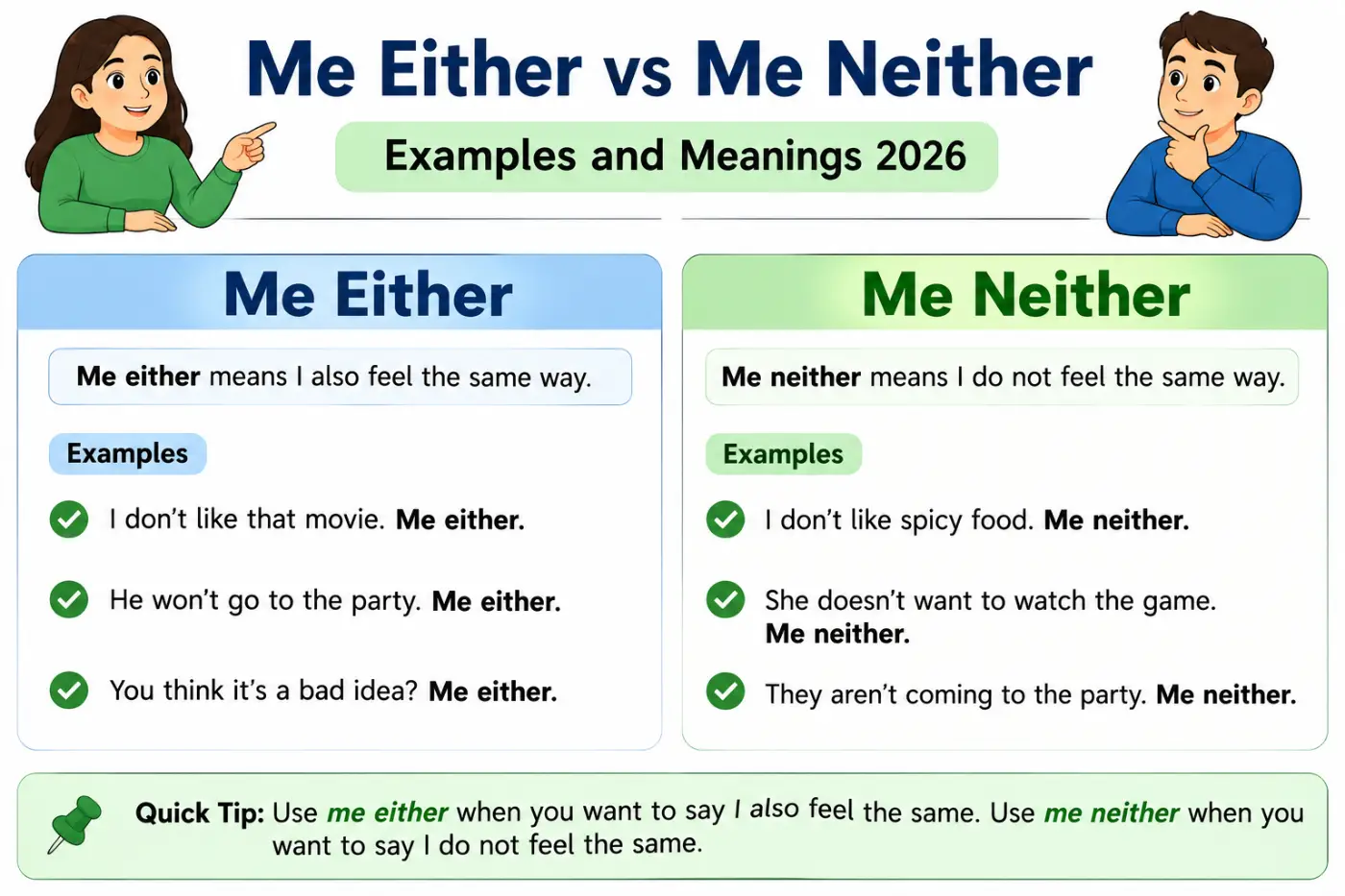
Have you ever heard someone say “I don’t like horror movies” and paused because you weren’t sure how to reply? The question of me either vs me neither comes up often because both expressions can sound natural in casual conversation. Yet they don’t have the same standing in standard English.
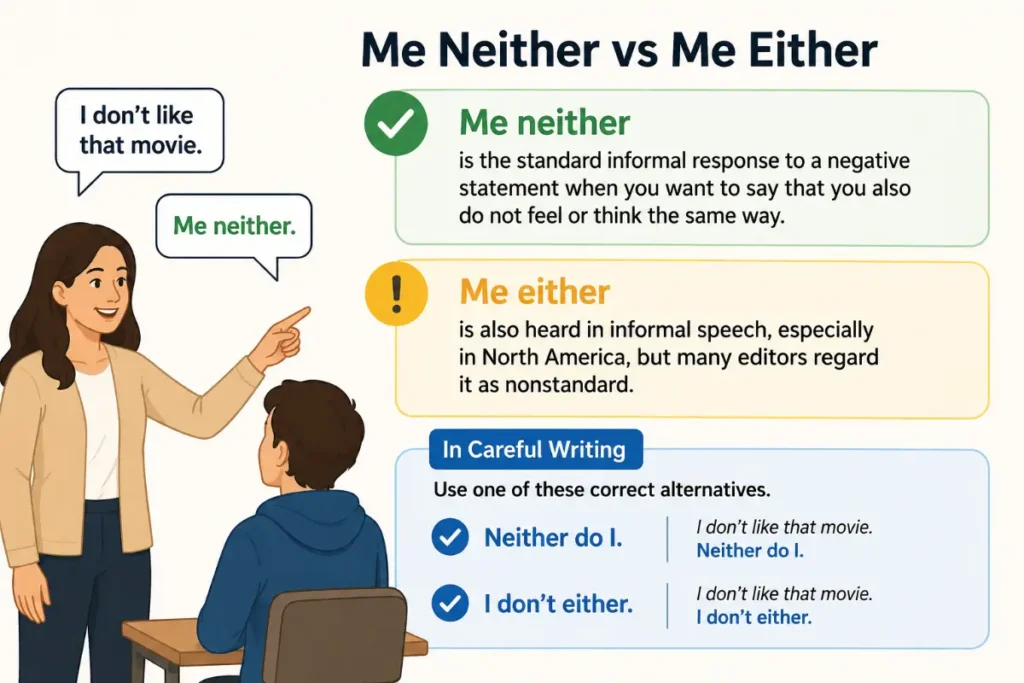
If someone says “I don’t like horror movies” the safest response is Me neither. It means you also don’t like horror movies. You can also say Neither do I or I don’t either when you want a fuller grammatical response. Me either is heard in informal speech, especially in North American English, but many editors consider it less standard.
The confusion makes sense. English uses either after a negative verb, as in “I don’t like coffee either.” It also uses neither in responses such as “Neither do I.” In everyday conversation, speakers often shorten these structures to save time and avoid repeating information.
This guide explains me either vs me neither in clear and simple English. You’ll learn the meaning, grammar, pronunciation, regional usage, common mistakes, natural examples, and the best choice for casual and formal communication.
For another common grammar confusion, see Tie vs Tye Correct Spelling and Usage.
Quick Definition
Me neither is the standard informal response to a negative statement when you want to say that you also do not feel or think the same way. Me either is also heard in informal speech, especially in North America, but many editors regard it as nonstandard. In careful writing, use Neither do I or I don’t either.
Quick Answer
If someone says “I don’t like spicy food,” the safest reply is Me neither.
It means I don’t like spicy food either.
You can also say Neither do I. This version follows a more complete grammatical structure and works well when you want your speech or writing to sound polished.
You may hear Me either in casual American conversation. It isn’t simply a spelling mistake. Real speakers use it. However, it has a less secure position in standard edited English, so me neither remains the better choice when you want the form that most grammar authorities and editors will accept.
A useful rule is this.
- Positive statement → Me too
- Negative statement → Me neither
- More formal negative agreement → Neither do I or I don’t either
For example:
“I love jazz.”
“Me too.”
“I don’t like country music.”
“Me neither.”
“I haven’t seen that movie.”
“Neither have I.”
The pattern becomes much easier once you connect me neither with the idea of also not.
Comparison Table
| Feature | Me neither | Me either |
|---|---|---|
| Correct form | Widely accepted informal form | Used in informal speech |
| Basic meaning | I also do not | I also do not |
| Part of speech | Informal elliptical response using a pronoun and negative agreement word | Informal elliptical response using a pronoun and either |
| Core context | Agreement with a negative statement | Agreement with a negative statement |
| Formality | Informal | Very informal |
| Standard edited English | Preferred over me either | Often avoided |
| Common setting | Everyday conversation | Casual conversation |
| Regional pattern | Broad English usage | Particularly noticeable in North American speech |
| Full equivalent | Neither do I | I don’t either |
| Example | “I can’t swim.” “Me neither.” | “I can’t swim.” “Me either.” |
| Best choice for formal writing | Neither do I | I don’t either |
| Main grammatical idea | Negative agreement | Informal negative agreement |
The important point is that me either and me neither can communicate the same practical message in conversation. The difference lies mainly in grammatical convention, register, and acceptance.
Cambridge Grammar specifically notes that speakers often use me neither in informal speech as an alternative to a fuller response such as I can’t either. Cambridge also explains that not … either can mean “also not” in negative sentences.
Meaning Of Me Neither
Me neither means that you share the negative situation, opinion, feeling, or experience that another person has just expressed.
Consider this conversation.
“I don’t enjoy crowded restaurants.”
“Me neither.”
The second speaker means:
“I don’t enjoy crowded restaurants either.”
The response leaves out the repeated subject and verb because the meaning is already obvious from the first sentence. This is a common feature of conversation. People regularly shorten predictable responses because repeating the entire sentence would sound stiff.
You can use me neither after many kinds of negative statements.
“I’m not hungry.”
“Me neither.”
“I don’t watch reality shows.”
“Me neither.”
“I haven’t finished the report.”
“Me neither.”
“I can’t remember his name.”
“Me neither.”
“I wasn’t expecting that result.”
“Me neither.”
The expression therefore works across different verb forms. The key requirement is the negative meaning of the statement that comes before it.
Meaning Of Me Either
Me either is used by some speakers as an informal way to agree with a negative statement.
For example:
“I don’t want to leave yet.”
“Me either.”
The intended meaning is clear. The speaker means:
“I don’t want to leave either.”
You’ll hear this form in casual conversation and informal online communication. It can sound perfectly natural to speakers who grew up with it. That does not automatically make it the preferred form in edited standard English.
This distinction matters because grammar has two related sides.
One side describes how people actually speak.
The other side concerns the forms that editors teachers style guides and formal writing conventions generally prefer.
Me either has a place in real spoken English. At the same time, me neither has stronger acceptance as the short negative agreement response. The Blue Book of Grammar and Punctuation describes both expressions as idiomatic rather than precise formal constructions and notes that me neither is the grammatically preferable choice between the two.
That is why calling me either simply “fake English” goes too far. It exists in actual usage. A better description is informal and less standard.
Me Either Vs Me Neither In Everyday English
The easiest way to understand the difference is to look at the structure behind the response.
Suppose someone says:
“I don’t eat seafood.”
There are several natural ways to agree.
“Me neither.”
“Neither do I.”
“I don’t either.”
All three communicate the same basic idea.
The first is short and conversational.
The second uses neither with subject auxiliary inversion.
The third uses either after a negative verb.
Now consider the form that causes the debate.
“Me either.”
Many speakers understand it immediately. Some use it themselves. Others find it ungrammatical or noticeably casual.
That difference in judgment explains why learners often encounter conflicting advice online. One source may say that me either is wrong. Another may say that people use it in informal American English. Both observations can describe part of the language picture.
For learners who want a dependable rule, there is no need to gamble.
Use me neither for casual negative agreement.
Use neither do I or I don’t either when you want a fuller and more polished construction.
Why Me Neither Works
The word neither carries negative meaning.
In a structure such as:
“Neither do I.”
the speaker means:
“I do not either.”
Cambridge explains that neither and nor can combine with an auxiliary or modal verb and the subject to express the meaning also not. For example, “Neither can I” means “I can’t either.”
That same idea appears in the shorter conversational expression me neither.
Think of the exchange as a compressed sentence.
“I don’t like that restaurant.”
“Me neither.”
The second speaker is not presenting a complete formal sentence. The response is an elliptical conversational construction. The missing information is supplied by context.
The expanded meaning is:
“I don’t like that restaurant either.”
Or:
“Neither do I.”
This is one reason me neither feels natural to many speakers. The negative meaning of neither matches the negative statement that came before it.
Why Me Either Causes Confusion
The word either has several jobs in English.
It can refer to one of two possibilities.
“You can choose either option.”
It can connect alternatives.
“You can either stay here or come with us.”
It can also appear in negative sentences with the meaning also or too.
“I don’t like it either.”
Cambridge gives this negative use as a standard function of either.
That last use is the source of much of the confusion.
A learner sees:
“I don’t like it either.”
Then hears:
“Me either.”
The connection feels obvious. In both cases either relates to negative agreement. The problem is that the grammatical structures are not identical.
In I don’t like it either, the negative element don’t appears in the sentence. Either adds the idea of another person sharing the negative situation.
In Me neither, the word neither itself expresses the negative agreement in the shortened response. This distinction helps explain why editors often prefer me neither while accepting I don’t either as a standard full construction.
Which One Is Correct
If you have to choose between me either and me neither, choose me neither. It is the safer form in standard English and the better choice for learners who want to sound natural without inviting a grammar objection.
For example:
“I don’t like horror movies.”
“Me neither.”
That response is natural and widely understood.
You can also use:
“Neither do I.”
“I don’t either.”
These forms are especially useful in professional or academic settings where a short conversational fragment may not fit the tone. Me either is not best treated as a simple spelling error. It occurs in real informal speech. Some speakers use it regularly and understand it without hesitation. However, it does not have the same level of acceptance as me neither in careful standard English.
An experienced editor would therefore make the choice based on context.
For casual dialogue, me neither is a safe natural choice.
For formal writing, use neither do I or I don’t either.
Examples With Me Neither
Here are ten natural examples showing how native speakers can use me neither in conversation.
- “I don’t like coffee.” “Me neither.”
- “I’m not ready to leave.” “Me neither.”
- “I haven’t seen that movie.” “Me neither.”
- “I can’t remember where I parked.” “Me neither.”
- “I don’t understand this question.” “Me neither.”
- “I wasn’t expecting so many people.” “Me neither.”
- “I haven’t finished my homework.” “Me neither.”
- “I don’t feel like cooking tonight.” “Me neither.”
- “I won’t be going to the concert.” “Me neither.”
- “I didn’t enjoy the ending.” “Me neither.”
Notice how the verb changes from sentence to sentence. Me neither does not require one particular tense or auxiliary. The preceding statement provides the grammatical information that the listener needs.
Examples With Me Either
Here are ten examples of me either as it appears in informal conversation.
- “I don’t want to wait any longer.” “Me either.”
- “I don’t like crowded places.” “Me either.”
- “I can’t see the screen from here.” “Me either.”
- “I haven’t finished the book.” “Me either.”
- “I wasn’t expecting that answer.” “Me either.”
- “I don’t remember his name.” “Me either.”
- “I didn’t enjoy the movie.” “Me either.”
- “I’m not going back there.” “Me either.”
- “I can’t believe they canceled the game.” “Me either.”
- “I don’t want to spend that much money.” “Me either.”
These examples reflect actual informal usage. They should not be confused with the standard construction I don’t either, which is completely different grammatically.
For example:
“I don’t want to go either.”
That sentence is standard.
“Me either.”
That short response is informal and less widely accepted. This distinction gives you a practical way to write naturally without pretending that spoken English always follows textbook patterns.
Me Either Vs Me Neither In Formal Writing
Formal writing changes the recommendation.
You generally should not write a report like this:
“I don’t support the proposal.”
“Me neither.”
The second sentence sounds conversational. It may work in a transcript or a fictional conversation, but it does not suit most formal prose.
Instead, write:
“Neither do I.”
Or:
“I don’t support the proposal either.”
These forms make the grammatical relationship clear.
The same principle applies to academic writing.
Instead of:
“I don’t agree with this interpretation. Me neither.”
write:
“I don’t agree with this interpretation either.”
Or:
“Neither do I.”
Professional communication usually benefits from complete structures because the reader cannot rely on conversational context and tone in the same way a listener can. That does not mean conversational English is inferior. It simply means register matters. A good editor does not treat every informal expression as a mistake. The real question is whether the expression fits the situation.
The Grammar Behind Negative Agreement
Negative agreement is the central grammar concept behind this entire issue. When one person makes a negative statement and another person wants to say that the same negative condition applies to them, English has several structures available.
The simplest conversational structure is:
“Me neither.”
A more grammatical full response is:
“Neither do I.”
Another standard option is:
“I don’t either.”
These structures work because English has more than one way to express the idea of also not.
Me Too Vs Me Neither
A related confusion involves me too.
The basic contrast is easy.
Use me too after a positive statement.
Use me neither after a negative statement.
For example:
“I love Italian food.”
“Me too.”
“I don’t like sushi.”
“Me neither.”
This distinction gives learners a simple mental shortcut.
Positive agreement uses too.
Negative agreement can use neither.
You can also replace me neither with a complete grammatical structure.
“I don’t like sushi.”
“Neither do I.”
Or:
“I don’t like sushi either.”
The important thing is to match the response with the meaning of the original statement.
For another common grammar confusion, see Leary or Leery Which Word Is Correct in 2026.
Pronunciation Guide
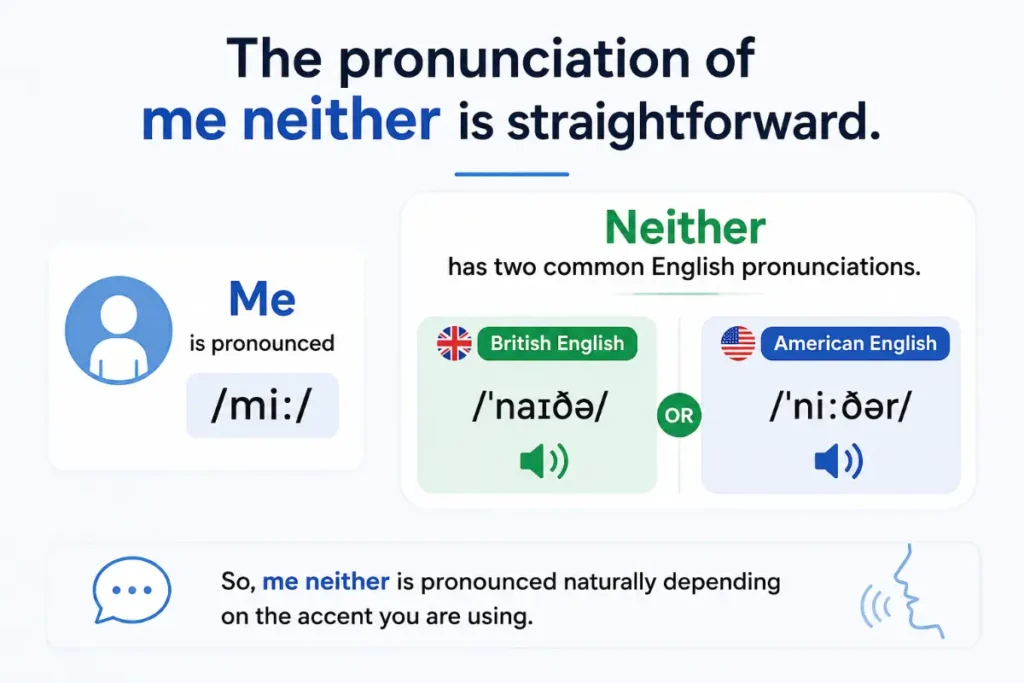
The pronunciation of me neither is straightforward.
Me is pronounced /miː/.
Neither has two common English pronunciations.
In American English you may hear:
/ˈniːðɚ/
or
/ˈnaɪðɚ/
In British English you may hear:
/ˈnaɪðə/
or
/ˈniːðə/
The first syllable can therefore sound like nee or nye depending on the speaker and variety of English.
The word either also has two common pronunciation patterns.
American English commonly uses:
/ˈiːðɚ/
or
/ˈaɪðɚ/
British English commonly uses:
/ˈaɪðə/
or
/ˈiːðə/
Cambridge lists both pronunciation patterns for either, reflecting the variation found across English varieties.
The pronunciation difference does not change the grammar of me either or me neither.
The most common pronunciation mistake is not a major error. It usually comes from assuming that every English speaker pronounces either and neither in exactly the same way. Native English has considerable regional variation in these words.
Common Mistakes
Several mistakes appear again and again when people learn negative agreement.
- Using me too after a negative statement.
“I don’t like onions.”
“Me too.”
This can create ambiguity because me too normally agrees with a positive statement. Use me neither or I don’t either instead.
- Treating me either as the only correct form.
Some speakers use me either naturally. Still, it is not the safest choice for standard edited English.
- Treating me either as a spelling mistake.
The problem is not spelling. The phrase exists in real speech. The debate concerns grammatical convention and register.
- Using neither in the wrong full sentence.
“I don’t like coffee neither” is not the standard structure intended here.
Use:
“I don’t like coffee either.”
Or:
“Neither do I.”
- Forgetting the auxiliary in a neither response.
If you use the full structure, the auxiliary must match the original statement.
“I can’t swim.”
“Neither can I.”
“I haven’t finished.”
“Neither have I.”
“I don’t drive.”
“Neither do I.”
This pattern becomes easy once you identify the auxiliary in the first sentence.
Etymology And Word Origin
Understanding the history behind me either vs me neither helps explain why the two expressions can feel so closely connected. The word either comes from Old English ǣgther which developed from an earlier form meaning each of two or one of two. Over time English expanded its use. It came to function not only in positive alternatives but also in negative sentences where it can mean also.
That negative use appears in expressions such as:
“I don’t like it either.”
“I can’t go either.”
“She wasn’t there either.”
In each example either adds another negative item to the sentence.
The word neither has a different historical path. It developed from an Old English expression meaning not either. Its modern meaning still reflects that negative idea.
That connection explains an important point.
Neither already carries negative meaning.
Either does not normally carry negative meaning by itself. It gets that negative relationship from the surrounding sentence.
Consider these two examples.
“I don’t like it either.”
“Me neither.”
The first sentence contains not. The second uses neither to carry the negative meaning in the short response.
English speakers have used these patterns for centuries as the language developed different ways to express alternatives and agreement.
The modern disagreement over me either is therefore not really about the history of one isolated phrase. It comes from the way English speakers have extended familiar grammatical patterns in conversation.
Regional Usage
Regional English can make the choice between me either and me neither even more confusing. The basic meaning remains easy to understand across major English varieties. The difference appears mainly in how comfortable speakers feel with the informal construction.
American English
American English commonly uses me neither in casual conversation. You may also hear me either, particularly in relaxed speech.
For example:
“I don’t want to go.”
“Me neither.”
Another speaker might say:
“Me either.”
The meaning is immediately clear in both exchanges.
For careful American English writing, however, me neither is the safer short response. I don’t either and neither do I are also strong choices.
British English
British speakers commonly use me neither in informal conversation. You can also hear the fuller forms.
“Neither do I.”
“I don’t either.”
The pronunciation of neither and either can vary. Some speakers use the long ee sound while others use the eye sound. Both patterns have a long history in English.
Canadian English
Canadian English shares many features with American English while also retaining patterns associated with British English. You may therefore encounter me neither, neither do I, and I don’t either without difficulty. Me either can occur in casual conversation too. It remains a less secure choice for edited writing.
Australian English
Australian English also uses me neither as a natural informal response. The fuller constructions remain common when speakers want to make the grammar more explicit. As with other English varieties, pronunciation can vary from speaker to speaker. The important lesson is that regional variation does not change the practical recommendation. If you want one short form that works safely across English varieties, choose me neither.
Grammar Rules For Negative Agreement
The grammar becomes much easier when you stop treating me either and me neither as isolated expressions. Instead, look at the grammatical pattern behind them. English has several ways to agree with a negative statement.
Using Me Neither
This is the short conversational pattern.
“I don’t like tea.”
“Me neither.”
The complete meaning is:
“I don’t like tea either.”
Using Neither Do I
This structure uses neither followed by an auxiliary verb and subject.
“I don’t like tea.”
“Neither do I.”
The auxiliary do matches the original present simple structure.
Consider a few more examples.
“I can’t drive.”
“Neither can I.”
“I haven’t finished.”
“Neither have I.”
“I wasn’t invited.”
“Neither was I.”
“I won’t complain.”
“Neither will I.”
The auxiliary changes according to the original sentence.
Using I Don’t Either
This construction keeps the negative verb and places either at the end.
“I don’t like tea either.”
“I wasn’t invited either.”
This structure is completely natural in standard English.
Why The Auxiliary Matters
One common mistake occurs when learners use neither without matching the auxiliary.
For example:
“I can’t swim.”
“Neither do I.”
That response does not match the original verb correctly.
The better response is:
“Neither can I.”
The same principle works across tenses and modal verbs.
“I haven’t seen it.”
“Neither have I.”
“I didn’t understand.”
“Neither did I.”
“I won’t go.”
“Neither will I.”
“I shouldn’t complain.”
“Neither should I.”
The trick is simple. Look at the auxiliary or modal in the first statement and use the same one after neither.
Me Either Vs Me Neither In Different Tenses
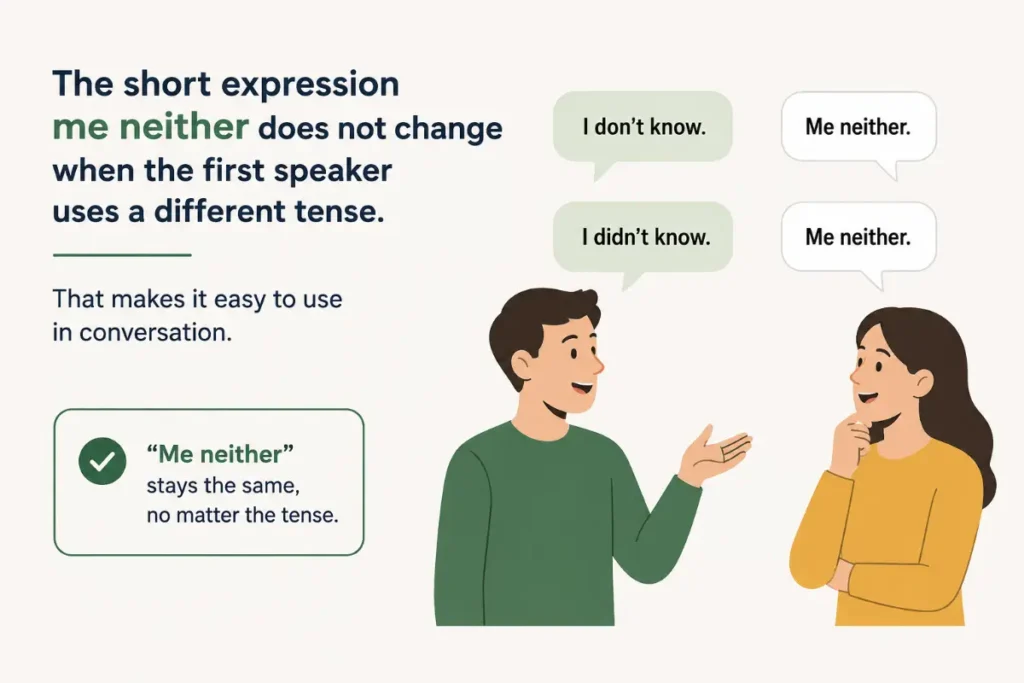
The short expression me neither does not change when the first speaker uses a different tense.
That makes it easy to use in conversation.
“I don’t know.”
“Me neither.”
“I didn’t know.”
“Me neither.”
“I haven’t known him long.”
“Me neither.”
“I won’t know until tomorrow.”
“Me neither.”
“I can’t remember.”
“Me neither.”
The response stays the same because the surrounding conversation supplies the grammatical information.
The fuller neither construction changes.
“I don’t know.”
“Neither do I.”
“I didn’t know.”
“Neither did I.”
“I haven’t seen it.”
“Neither have I.”
“I can’t remember.”
“Neither can I.”
This difference is useful for learners. Me neither is a fixed conversational response. Neither do I requires active grammar matching.
Me Either Vs Me Neither In Questions
Negative questions can create another layer of confusion.
Suppose someone asks:
“Don’t you like pizza?”
If you agree with the negative idea, you might answer:
“No. I don’t.”
If you want to agree with another speaker who says:
“I don’t like pizza.”
you can say:
“Me neither.”
The important point is that me neither normally responds to a negative statement rather than functioning as a direct answer to every negative question.
For example:
“Don’t you like jazz?”
A natural answer could be:
“No. I don’t.”
Or:
“Actually I do.”
The correct response depends on what the speaker means.
This distinction matters because English negative questions can be tricky. The words yes and no may not always provide the clarity that learners expect.
Me Either Vs Me Neither In Professional Communication
Professional writing requires a little more care.
Imagine an employee writes:
“I don’t agree with the proposed schedule.”
A colleague replies:
“Me neither.”
That exchange could work in an informal workplace chat.
In a formal email or report, a better response would be:
“Neither do I.”
Or:
“I don’t agree with the proposed schedule either.”
These alternatives sound clearer and more deliberate.
The same principle applies to academic writing.
Instead of:
“I don’t support this interpretation. Me neither.”
write:
“I don’t support this interpretation either.”
The second version keeps the meaning while avoiding a conversational fragment.
An editor should always consider audience and purpose before changing an expression.
A phrase that works perfectly in dialogue can sound out of place in a research paper.
Real Life Usage Examples
Daily Conversation
Everyday speech is where me neither feels most natural.
“I don’t feel like going out tonight.”
“Me neither.”
“I haven’t eaten yet.”
“Me neither.”
“I can’t find my keys.”
“Me neither.”
The responses are short because the context already supplies the missing information.
Academic Writing
Academic writing usually favors complete constructions.
“I don’t agree with this interpretation either.”
“Neither do I.”
These forms make the relationship between the ideas clearer.
Professional Communication
Professional communication depends on the level of formality.
In a quick internal message:
“I don’t think we should change the schedule.”
“Neither do I.”
In a formal document:
“Neither researcher supports this interpretation.”
The second example does not use a conversational response at all. It states the shared negative position directly.
Literature
Writers often use conversational grammar in dialogue because people rarely speak like textbooks.
A fictional character might say:
“I don’t trust him.”
“Me neither.”
That dialogue can feel more natural than:
“Neither do I.”
The choice depends on the character and the voice the writer wants to create.
Media And Online Conversation
Social media and online chat often reflect spoken English.
You may encounter:
“Me neither.”
“Me either.”
“I don’t either.”
“Neither do I.”
The first two are especially short and conversational.
Online writing often sits somewhere between speech and formal writing. That is why expressions that editors might avoid in an academic paper can appear frequently in casual posts and messages.
Related Words And Confused Terms
The topic connects with several other English expressions.
Me Too
Me too normally expresses agreement with a positive statement.
“I love this song.”
“Me too.”
It contrasts naturally with me neither.
“I don’t like this song.”
“Me neither.”
I Don’t Either
This is one of the clearest standard alternatives to me neither.
“I don’t like seafood either.”
The negative element comes from don’t. The word either adds the meaning of another person sharing the negative situation.
Neither Do I
This is another standard alternative.
“I don’t like seafood.”
“Neither do I.”
The construction uses subject auxiliary inversion.
Nor Do I
Nor do I can also express negative agreement.
“I don’t like seafood.”
“Nor do I.”
This version can sound slightly more formal or literary depending on the context.
Either And Neither
These words are closely related but do not behave identically.
Either often refers to one of two possibilities or appears in negative sentences.
Neither means not one and not the other.
For example:
“You can choose either option.”
“Neither option works.”
The first presents two possibilities.
The second rejects both.
Neither Nor
The pair neither … nor connects two negative alternatives.
“Neither John nor Maria attended.”
This structure differs from the conversational expression me neither.
Expert Language Insight
The most useful way to think about me either vs me neither is through the idea of negative agreement. The speaker is not merely repeating a negative sentence. The speaker is saying that the same negative condition applies to them.
Consider:
“I don’t like cold weather.”
“Me neither.”
The second speaker means:
“I don’t like cold weather either.”
The response is elliptical because the full sentence is unnecessary.
Native speakers rely heavily on context. When a phrase is predictable, they often leave parts of it unstated.
This happens everywhere in English.
“Want some coffee?”
“No thanks.”
“Coming with us?”
“Maybe.”
“Finished?”
“Not yet.”
These responses are not full traditional sentences. They work because conversation allows speakers to omit information that both people can recover easily.
Me neither belongs to this broader conversational pattern.
The phrase is therefore best understood as an informal elliptical response rather than as a sentence that needs to stand alone under formal written grammar rules.
That distinction also explains why me either can appear in natural speech even though many editors prefer me neither.
Spoken language evolves through usage. Speakers create patterns that make communication fast and easy. Some patterns become widely accepted. Others remain informal. Some eventually enter standard written usage.
Good language advice should recognize that process.
How An Editor Would Choose
If I were editing a piece of writing containing one of these expressions, I would use a simple decision process.
- If the text is casual conversation, choose me neither as the safest short response.
- If the text is formal writing, replace the conversational expression with neither do I or I don’t either.
- If the text is realistic dialogue, consider the character and speaking style before changing me either.
- If the writer wants broadly accepted standard English, avoid me either.
- If the sentence uses a full negative construction, either is perfectly normal.
For example:
“I don’t like it either.”
There is no reason to replace either with neither.
That would change the grammatical structure rather than improve it.
A Simple Memory Trick
You can remember the difference with one small pattern.
Positive agreement uses me too.
Negative agreement uses me neither.
For example:
“I love swimming.”
“Me too.”
“I don’t like running.”
“Me neither.”
If you want to use either, keep the negative word in the sentence.
“I don’t like running either.”
This memory trick will not explain every possible use of either and neither, but it works extremely well for this particular confusion.
Me Either Vs Me Neither For English Learners
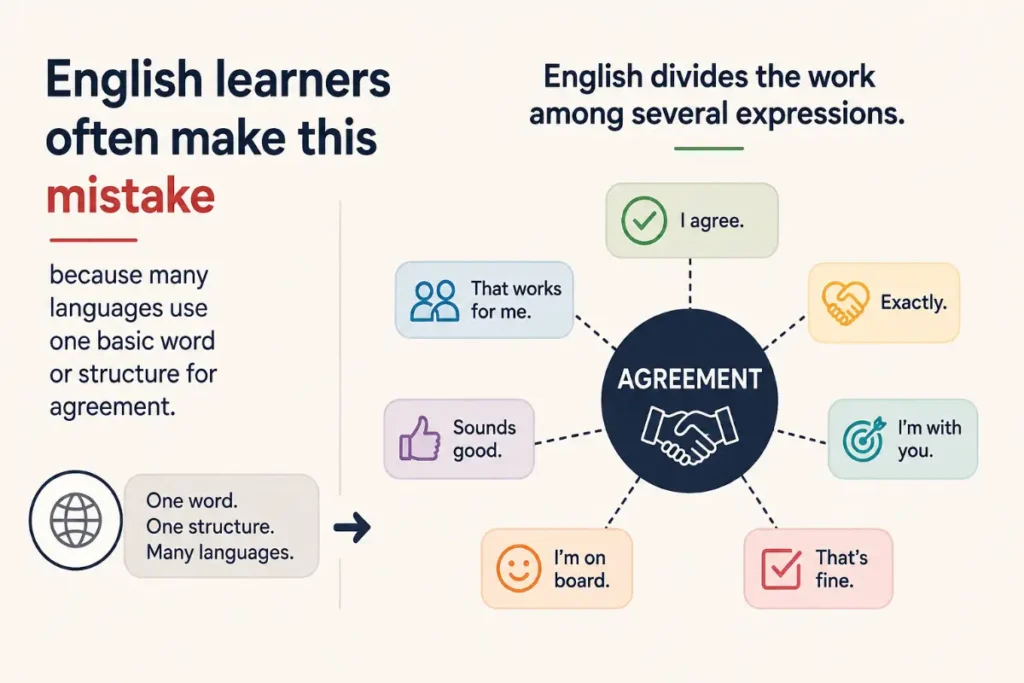
English learners often make this mistake because many languages use one basic word or structure for agreement.
English divides the work among several expressions.
Positive agreement:
“I do too.”
“Me too.”
Negative agreement:
“Neither do I.”
“Me neither.”
“I don’t either.”
Once you learn these patterns as groups, the choice becomes much easier.
Do not try to translate every expression word for word from your first language.
Instead, learn the English pattern as a complete unit.
For example:
“I don’t either.”
“Neither do I.”
“Me neither.”
These three expressions belong to the same family of negative agreement.
The grammar differs, but the communicative purpose overlaps.
A related grammar guide is infront or in front Correct Spelling Meaning and Usage.
Final Answer
When choosing between me either vs me neither, use me neither as your default short response to a negative statement. Me either can also be heard in casual speech and is widely understood. Some native speakers use it naturally. However, it is less secure in standard edited English, so it is not the form I would recommend to an English learner who wants one dependable choice.
For formal writing, skip both short conversational forms and use neither do I or I don’t either Once you see the pattern, the confusion disappears. Either commonly works with an existing negative such as not, while neither already carries the negative meaning. That small grammatical difference explains why me neither is the stronger choice.
When in doubt, choose me neither for casual negative agreement and neither do I for a more formal response. It is a small distinction, but getting it right makes your English sound more natural and controlled.
Frequently Asked Questions
Is Me Neither Correct?
Yes. Me neither is a widely accepted informal response to a negative statement. It means that you also do not share the situation or opinion just mentioned. For example, “I don’t like horror movies.” “Me neither.” In formal writing, use neither do I or I don’t either.
Is Me Either Grammatically Correct?
Me either occurs in real informal English, especially in casual conversation. Many speakers use it naturally. However, it is less accepted in standard edited English than me neither. If you want the safest form, use me neither in casual speech and neither do I or I don’t either in formal writing.
Should I Say Me Either Or Me Neither?
Choose me neither when you want a short response to a negative statement. For example, “I don’t eat meat.” “Me neither.” If you prefer a complete sentence, say “I don’t either” or “Neither do I.” These choices work reliably across most standard English contexts.
Can I Use Me Either In American English?
Yes. You can hear me either in informal American conversation. It is not simply a misspelling. It represents a real usage pattern. Still, many editors and grammar references prefer me neither as the short negative agreement response. Use me neither when you want the safer standard choice.
What Is The Difference Between Me Neither And I Don’t Either?
Both expressions can mean that you also do not share a negative situation. Me neither is a short conversational response. I don’t either is a complete negative sentence with either at the end. For example, “I don’t like tea.” “Me neither.” Or “I don’t like tea either.”
Is Neither Do I More Formal Than Me Neither?
Yes. Neither do I generally sounds more complete and polished than me neither. Both can appear in conversation, but me neither has a distinctly informal conversational feel. Neither do I works better when you want your language to sound more formal or deliberate.
Can Me Neither Follow Any Tense?
Yes. Me neither can follow negative statements involving different tenses and modal verbs because the response itself remains unchanged. For example, “I didn’t see it.” “Me neither.” “I haven’t finished.” “Me neither.” “I can’t go.” “Me neither.”
Is Me Neither Better Than Me Either?
For most learners and writers, yes. Me neither is the safer short form for negative agreement. Me either appears in genuine informal speech but has weaker acceptance in edited standard English. For formal contexts, choose neither do I or I don’t either.