
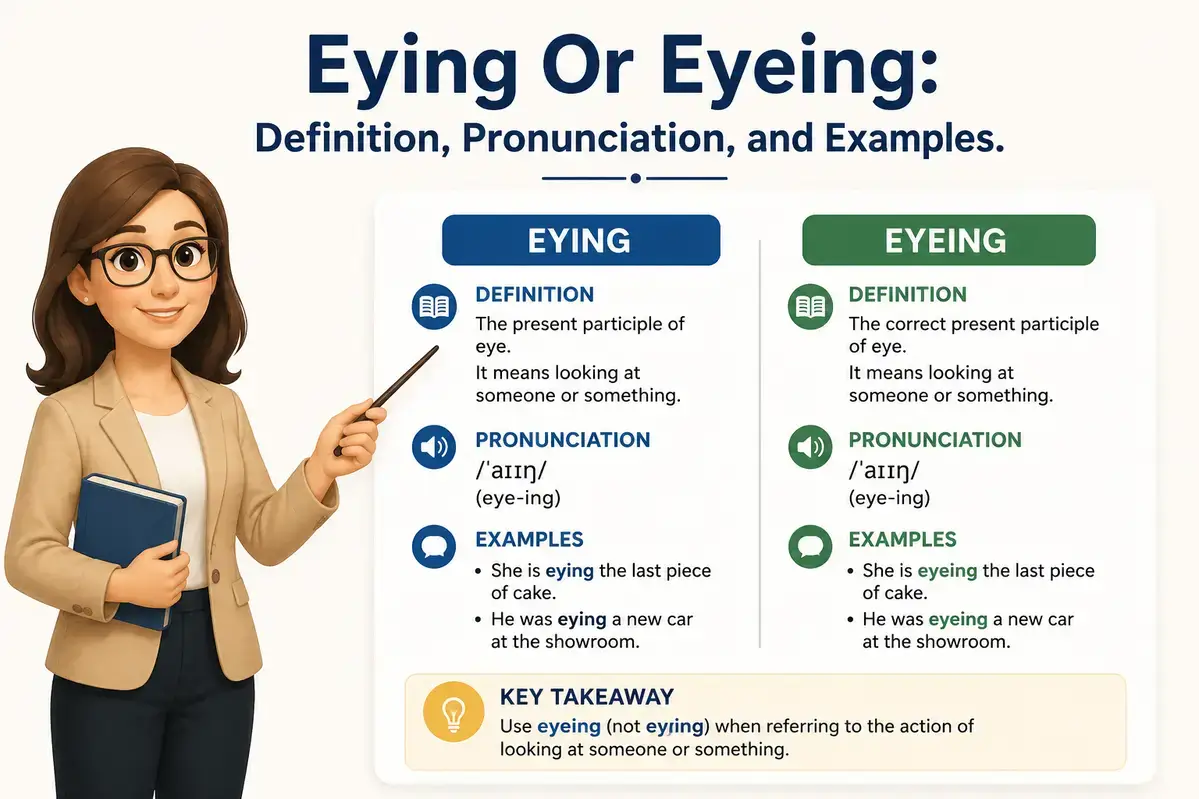
The debate over eying or eyeing catches many writers by surprise. At first glance, both spellings seem reasonable. After all, they come from the noun eye, and English spelling rules are not always predictable. It’s easy to assume that either version might be acceptable. The confusion becomes even more noticeable when writing emails, articles, social media posts, business documents, or academic papers. Some spell checkers accept one spelling, while others recognize both. That leaves many people wondering which form is actually correct.
If you’re comparing these words, searching for the correct spelling, looking for grammar guidance, or trying to improve your writing, the answer is more nuanced than many spelling comparisons. Unlike pairs where one spelling is clearly wrong, both words appear in reputable dictionaries. However, one form is significantly more common in modern English.
This guide explains the differences, meanings, pronunciation, grammar rules, examples, origins, regional preferences, and professional writing recommendations. By the end, you’ll know exactly when to use each spelling and which version most editors prefer.
For another common grammar confusion, see Natzi or Nazi Meaning, Usage, and Correct Form 2026.
Eying Or Eyeing Quick Definition
When comparing these words, both spellings are considered correct in English. They are present participle forms of the verb eye, meaning to look at, watch, observe, or consider carefully. However, eyeing is far more common in modern American and British English, while eying appears less frequently.
Eying Or Eyeing Quick Answer
The short answer is simple.
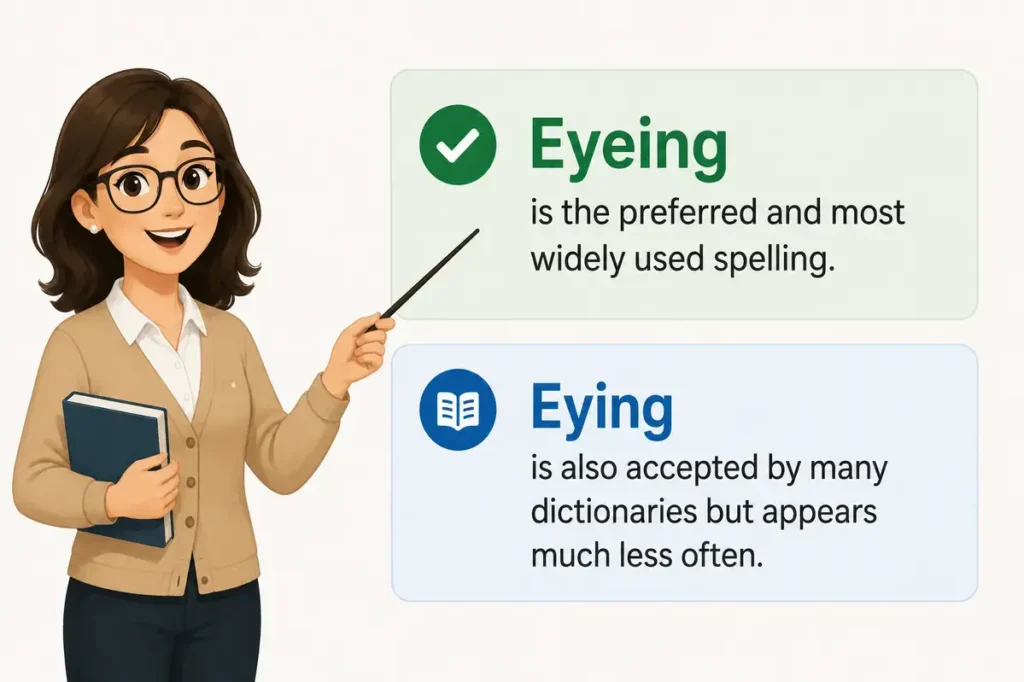
- Eyeing is the preferred and most widely used spelling.
- Eying is also accepted by many dictionaries but appears much less often.
Examples:
- She was eyeing the last piece of cake.
- Investors are eyeing new opportunities.
While both forms can be correct, most editors, publishers, and style guides favor eyeing.
Eying Or Eyeing Comparison Table
| Feature | Eying | Eyeing |
|---|---|---|
| Correct Spelling | Yes | Yes |
| Usage Frequency | Less common | Much more common |
| Part Of Speech | Verb form | Verb form |
| Base Word | Eye | Eye |
| Meaning | Looking at carefully | Looking at carefully |
| Formality Level | Standard English | Standard English |
| Preferred By Most Editors | Rarely | Yes |
| Modern Usage | Limited | Dominant |
| Example | She was eying the prize. | She was eyeing the prize. |
Meaning Of Eying Or Eyeing
Meaning Of Eying
Eying is a present participle form of the verb eye.
It means:
- Looking at something carefully.
- Observing closely.
- Considering something with interest.
- Watching suspiciously.
Examples:
- He was eying the clock during the meeting.
- The customer kept eying the expensive watch.
Although correct, this spelling appears less frequently today.
Meaning Of Eyeing
Eyeing carries exactly the same meaning.
It means:
- Looking closely.
- Observing carefully.
- Showing interest in something.
- Assessing a situation visually.
Examples:
- She was eyeing the dress in the store window.
- The company is eyeing international expansion.
This is the version most readers encounter.
Eying Or Eyeing Meaning Differences
One reason this topic confuses people is that there is virtually no meaning difference.
Same Definition
Both forms mean:
- Looking at something carefully.
- Observing with attention.
- Considering with interest.
- Watching closely.
Same Grammar Function
Both function as verb forms.
Examples:
- He is eying the opportunity.
- He is eyeing the opportunity.
Same Contexts
Both spellings can appear in:
- Conversation.
- Journalism.
- Business writing.
- Academic writing.
- Literature.
The difference is primarily one of spelling preference.
Eying Or Eyeing Key Differences
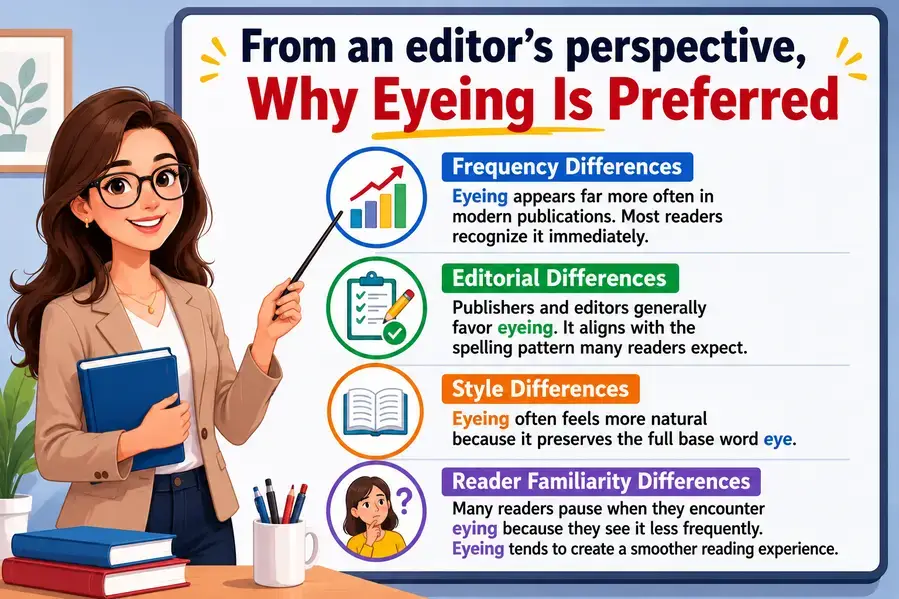
Frequency Differences
Eyeing appears far more often in modern publications. Most readers recognize it immediately.
Editorial Differences
Publishers and editors generally favor eyeing. It aligns with the spelling pattern many readers expect.
Style Differences
Eyeing often feels more natural because it preserves the full base word eye.
Reader Familiarity Differences
Many readers pause when they encounter eying because they see it less frequently. Eyeing tends to create a smoother reading experience.
Which One Is Correct
The answer is unusual because both spellings are accepted. However, if your goal is clear, modern, professional writing, choose eyeing.
Examples:
- She was eyeing the job opening.
- Investors are eyeing new markets.
- The child was eyeing the dessert table.
Most editors would leave eyeing unchanged. While eying is not technically incorrect, it is much less common.
Why People Confuse Eying Or Eyeing
Several factors contribute to the uncertainty.
Unusual Base Word
The word eye ends with a vowel combination that creates spelling questions when adding endings.
Conflicting Dictionary Entries
Some dictionaries list both spellings. This leads writers to wonder if there is a hidden difference.
Different Spelling Expectations
Some people expect the final “e” to disappear before adding “ing.” Others expect the full word to remain intact.
Exposure Differences
Because eyeing appears more often, many people assume eying must be wrong even though it is accepted by some authorities.
Eying Or Eyeing In Professional Writing
Professional editors generally recommend eyeing.
Examples:
- The company is eyeing a merger.
- Buyers are eyeing lower interest rates.
- The athlete is eyeing a championship title.
In journalism, business writing, and publishing, eyeing overwhelmingly dominates usage. For that reason alone, it is usually the safest choice.
Eying Or Eyeing In Everyday Communication
You’ll frequently see eyeing in phrases such as:
- Eyeing the competition.
- Eyeing a promotion.
- Eyeing the last slice of pizza.
- Eyeing a new house.
- Eyeing future opportunities.
These expressions are common in both formal and informal English. Because readers are familiar with this spelling, it generally feels more natural.
Need another quick comparison? Read wtv meaning and How to Use It Naturally.
Eying Or Eyeing Examples In Sentences
Examples make the distinction easier to understand and show how both spellings function in real writing.
Eying Examples In Sentences
- She was eying the final piece of cake on the table.
- The investor kept eying the company’s latest performance reports.
- He sat quietly, eying the exit door.
- The dog was eying the food on the counter.
- They were eying several properties before making a decision.
- The student spent the lecture eying the classroom clock.
- The athlete was eying a place on the national team.
- She stood in the store, eying a new handbag.
- The manager was eying potential candidates for promotion.
- Tourists were eying the historic building from across the street.
Eyeing Examples In Sentences
- She was eyeing the last seat on the bus.
- Investors are eyeing new opportunities in emerging markets.
- The company is eyeing international expansion.
- He spent the afternoon eyeing a vintage car for sale.
- The child was eyeing the dessert menu with excitement.
- Several teams are eyeing the championship trophy.
- She kept eyeing her phone during the meeting.
- Buyers are eyeing lower mortgage rates.
- The cat was eyeing a bird outside the window.
- The entrepreneur is eyeing a partnership with a larger firm.
Common Mistakes With Eying Or Eyeing
Although both forms are accepted, writers still make several common mistakes.
Mistake One Assuming Eying Is Always Wrong
Many people believe eying is incorrect. In reality, many dictionaries recognize it as a valid spelling. The issue is not correctness but frequency.
Mistake Two Assuming Both Spellings Are Equally Common
Both forms are accepted, but they are not equally common. Eyeing appears far more often in newspapers, books, websites, and professional publications.
Mistake Three Switching Spellings In The Same Document
Consistency matters. Choose one spelling style and use it throughout a document. For most writers, eyeing is the safer option.
Mistake Four Applying The Same Rule To Every Word Ending In E
English spelling patterns vary. The way eye becomes eyeing does not necessarily apply to every word ending with the letter e.
Eying Or Eyeing Pronunciation Guide
Pronunciation does not help distinguish these spellings because they sound exactly the same.
Eying Pronunciation
IPA:
/ˈaɪɪŋ/
Syllable Breakdown:
Eye • ing
Sounds Like:
Eye ing
Eyeing Pronunciation
IPA:
/ˈaɪɪŋ/
Syllable Breakdown:
Eye • ing
Sounds Like:
Eye ing
Common Pronunciation Mistakes
Some learners try to pronounce the spellings differently. That is unnecessary. Both forms share the same pronunciation and meaning. Only the spelling changes.
Eying Or Eyeing Etymology And Word Origin
Understanding the history of the word helps explain why two spellings exist.
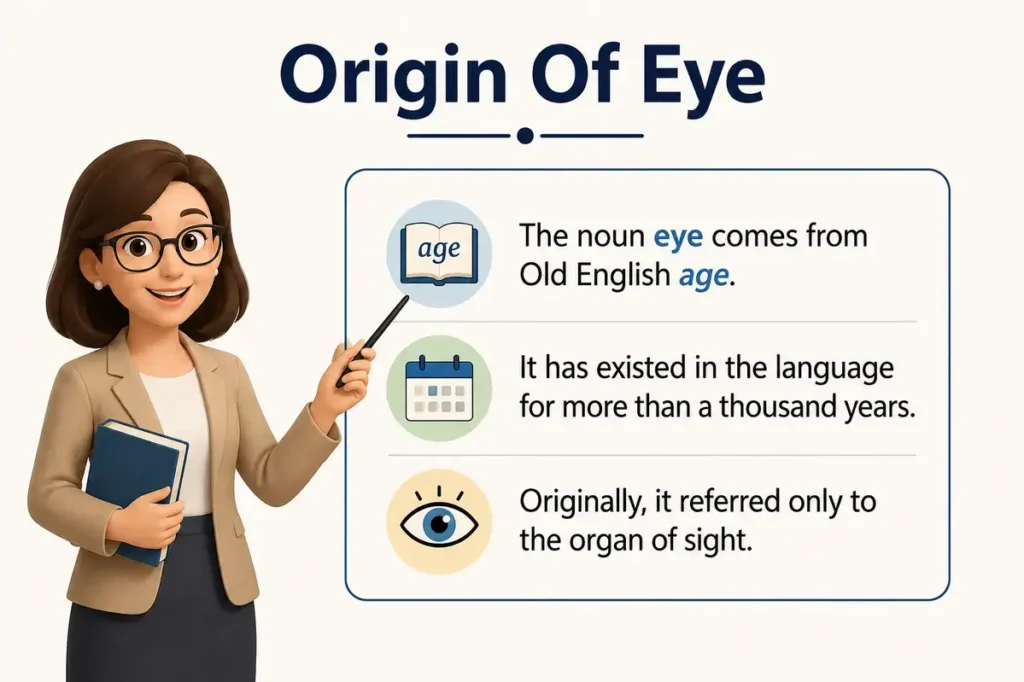
Origin Of Eye
The noun eye comes from Old English age. It has existed in the language for more than a thousand years. Originally, it referred only to the organ of sight.
Development Of The Verb Eye
Over time, English speakers began using eye as a verb.
Examples:
- To watch.
- To observe.
- To inspect.
- To consider.
This conversion from noun to verb is common in English.
Development Of Eying And Eyeing
As the verb gained popularity, writers formed present participle versions. Different spelling traditions emerged. Eventually, eyeing became the dominant form, though eying remained acceptable in some dictionaries and style references.
Eying Or Eyeing Regional Usage
Both spellings appear across English speaking countries, but one is noticeably more common.
American English
American English strongly favors eyeing. Most newspapers, publishers, and style guides use this spelling.
Examples:
- The company is eyeing growth opportunities.
- She is eyeing a promotion.
Eying Or Eyeing British English
British English also prefers eyeing.
While eying can occasionally appear, it is much less frequent.
Eying Or Eyeing Canadian English
Canadian publications overwhelmingly use eyeing.
Eying Or Eyeing Australian English
English follows the same pattern. Most editors choose eyeing because it aligns with reader expectations.
Regional Preference Summary
Across major English speaking regions:
- Eyeing is dominant.
- Eying is accepted but uncommon.
Grammar Rules
The grammar behind these spellings is straightforward.
Part Of Speech
Both forms are present participles and gerunds derived from the verb eye.
Examples:
- She is eyeing a new apartment.
- He is eying the competition.
Present Continuous Tense
Examples:
- They are eyeing expansion plans.
- She is eyeing a scholarship opportunity.
Gerund Usage
Examples:
- Eyeing the market carefully helped investors make better decisions.
- Eyeing the target gave the athlete confidence.
Common Sentence Structures
Examples:
- Subject plus is plus eyeing.
- Subject plus was eyeing.
- Subject plus keeps eyeing.
Sentences:
- She is eyeing a career change.
- He was eyeing the vacant office.
- They keep eyeing the same property.
Eying Or Eyeing In Real Life
These spellings frequently appear in everyday communication.
Daily Conversation
Examples:
- I’m eyeing a new laptop.
- She’s eyeing that corner table.
Business Communication
Examples:
- The company is eyeing expansion into Asia.
- Investors are eyeing new opportunities.
Academic Writing
Researchers occasionally use the term when discussing observation or consideration.
Example:
- Scholars are eyeing new evidence related to the study.
Journalism
News articles regularly use eyeing.
Examples:
- The city is eyeing infrastructure improvements.
- The athlete is eyeing an Olympic medal.
Literature
Authors often use the word to create tension or highlight interest.
Example:
- He stood silently, eyeing the mysterious package.
Related Words And Confused Terms
Several words are connected to eyeing and share similar meanings.
Related Words
- Watching.
- Observing.
- Inspecting.
- Studying.
- Monitoring.
- Considering.
- Examining.
- Noticing.
Similar Expressions
- Looking at.
- Keeping an eye on.
- Checking out.
- Taking notice of.
- Watching closely.
Commonly Confused Spelling Pairs
- Eying and eyeing.
- Ageing and aging.
- Judgement and judgment.
- Travelling and traveling.
- Cancelled and canceled.
These pairs often create confusion because English spelling conventions vary across dictionaries and style guides.
Expert Language Insight
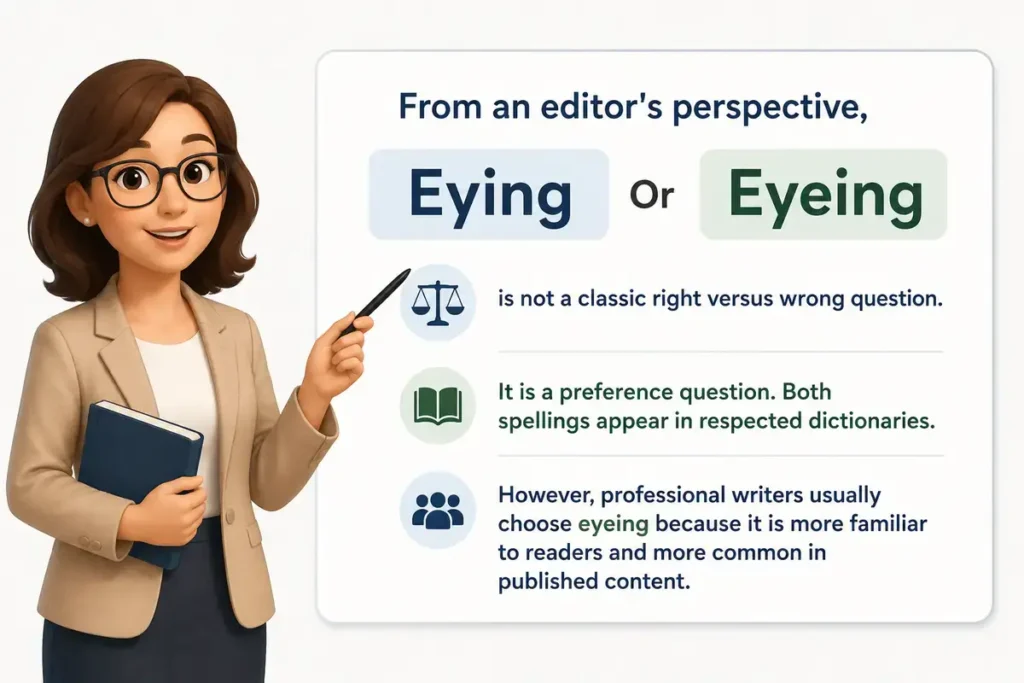
From an editor’s perspective, Eying Or Eyeing is not a classic right versus wrong question. It is a preference question. Both spellings appear in respected dictionaries. However, professional writers usually choose eyeing because it is more familiar to readers and more common in published content.
When editing articles, business reports, marketing materials, or academic work, consistency and readability matter. Most readers recognize eyeing instantly. Some readers pause when they encounter eying because they see it less often. That brief hesitation can disrupt reading flow. For that reason, many editors standardize documents to eyeing. If your goal is modern, polished, professional English, eyeing is usually the strongest choice.
Frequently Asked Questions
Is Eying Or Eyeing Correct?
Both spellings are considered correct. However, eyeing is significantly more common and is the version most editors and publishers prefer.
Which Spelling Is More Common?
Eyeing is much more common in newspapers, books, websites, magazines, and professional writing.
Is Eying Wrong?
No. Many dictionaries recognize eying as an acceptable variant. It is simply less common than eyeing.
Why Do Most People Use Eyeing?
Most writers use eyeing because it preserves the complete base word eye and aligns with modern usage patterns.
Do American And British English Use Different Spellings?
Both American and British English generally favor eyeing. Eying appears occasionally but is much less frequent.
How Do You Pronounce Eyeing?
Eyeing is pronounced /ˈaɪɪŋ/, which sounds like “eye ing.”
What Does Eyeing Mean?
Eyeing means looking at, observing, watching, considering, or showing interest in something.
Should I Use Eyeing In Professional Writing?
Yes. Eyeing is typically the safest choice for professional, academic, journalistic, and business writing because it is the spelling most readers expect.
You may also want to read dialog vs dialogue Meaning Difference And Usage.
Eying Or Eyeing Conclusion
The answer to this question is more flexible than many spelling comparisons. Both spellings are accepted in English and carry the same meaning. They describe looking at, observing, considering, or watching something closely. However, modern usage strongly favors eyeing.
It appears more often in published writing, professional documents, journalism, business communication, and everyday English. While eying is not incorrect, it is much less common and may look unusual to some readers. If you’re aiming for clarity, consistency, and a polished writing style, choose eyeing.
A simple rule to remember is this:
- Both are correct.
- Eyeing is preferred.
- Eyeing is the spelling most readers expect.
Following that guideline will help your writing feel natural and professional.
2 thoughts on “Eying Or Eyeing: Definition, Pronunciation, and Examples”