
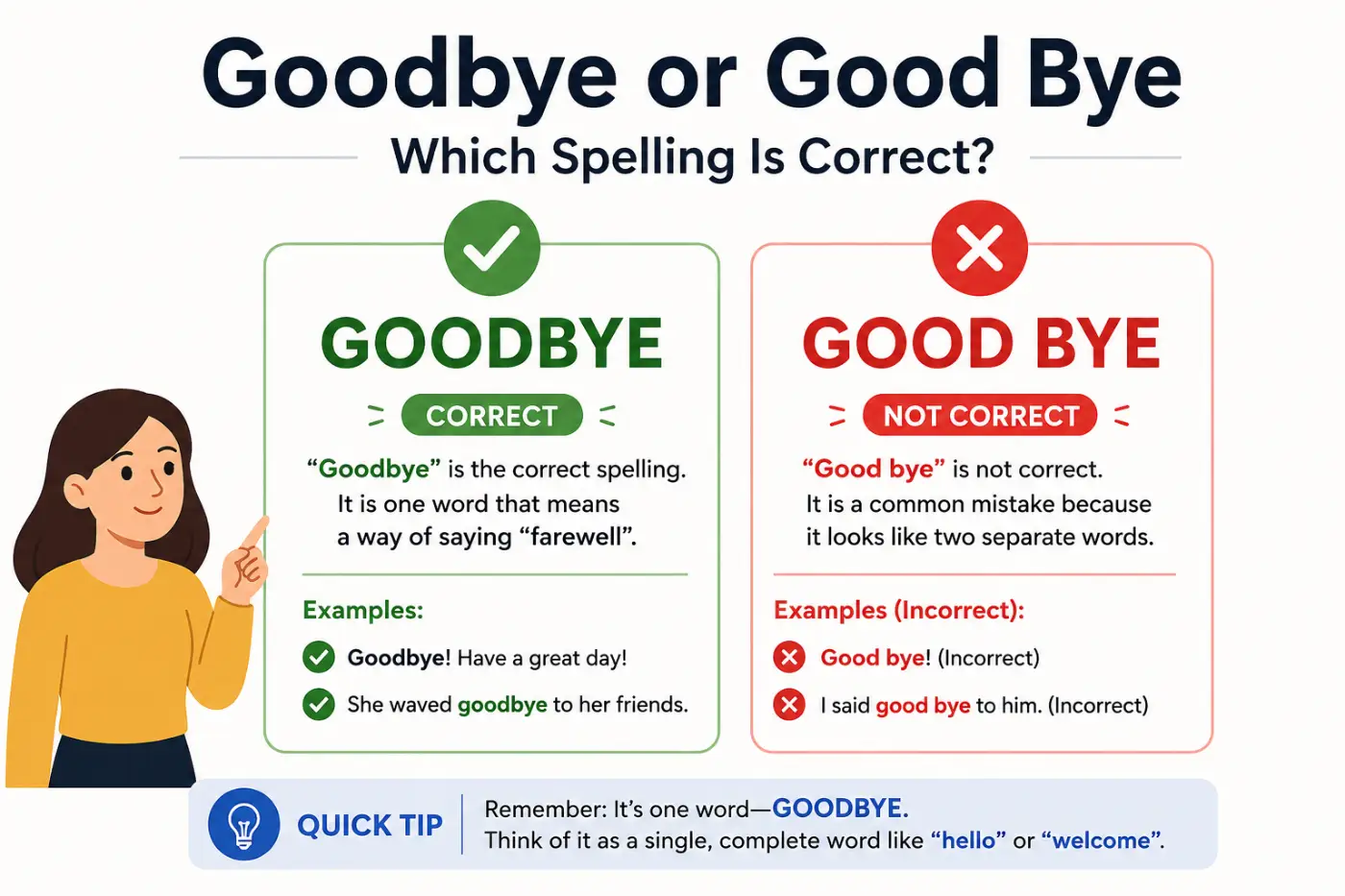
The exact keyword Goodbye or Good Bye explains a common spelling confusion in English. If you are writing a farewell message, you may wonder if goodbye should be written as one word or two. The standard modern spelling is goodbye, written as a single word. The two word form good bye is generally nonstandard in everyday English, although it may appear in older texts, creative writing, or stylized expressions.
The confusion makes sense because the expression began as a phrase made from separate words. Over time, those words joined to form the familiar spelling used today. You should write goodbye when ending a conversation, leaving a place, signing off an email, or saying farewell to someone.
Knowing the correct spelling helps you avoid a common mistake and choose the right expression for different situations. You will also learn what the word means, how to pronounce it, where it came from, and how it differs from related expressions such as farewell, bye, and see you later. The examples and grammar tips will help you use it naturally in American English.
Need another quick comparison? Read Challenge vs Challange Which Spelling Is Correct.
Quick Answer
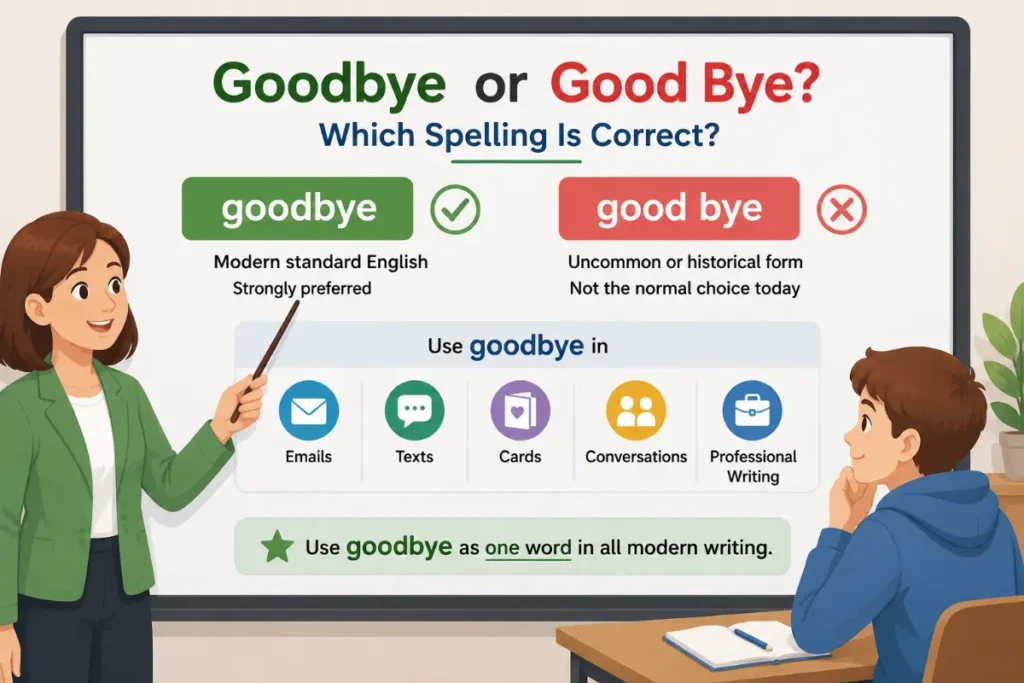
Goodbye is the standard spelling in modern English. It is written as one word and is used when leaving someone or ending a conversation. Good bye is generally considered an outdated or nonstandard form in ordinary modern writing, so use goodbye in emails, messages, schoolwork, and professional communication.
Comparison Table
| Feature | Goodbye | Good Bye |
|---|---|---|
| Standard spelling | Yes | Generally no in modern usage |
| Meaning | A word used when parting | Intended as the same farewell expression |
| Part of speech | Interjection and noun | Nonstandard two word form |
| Word structure | One word | Two separate words |
| Pronunciation | /ˌɡʊdˈbaɪ/ | Usually intended to sound the same |
| Formality | Suitable for formal and informal use | Generally avoided in standard writing |
| Common contexts | Messages, conversations, letters, speeches | Older texts or deliberate stylistic use |
| Example | She waved goodbye to her friends. | Write goodbye instead of good bye. |
Meaning and Definition
What Does Goodbye Mean?
Goodbye is an expression used when leaving someone, ending a conversation, or parting from a person or place. It can be spoken directly, written in a message, or used as a noun to describe a farewell.
For example, you might say goodbye to a friend after dinner, write goodbye at the end of a personal note, or wave goodbye to someone leaving for a trip. The word works in both friendly and serious situations.
It can express different feelings depending on the context. A quick goodbye may be casual and cheerful, while a final goodbye can express sadness, loss, or the end of an important relationship.
Here are some common uses:
- Saying goodbye before leaving a room.
- Writing goodbye at the end of a personal message.
- Giving someone a final goodbye before a long journey.
- Waving goodbye to a departing friend.
- Saying goodbye to a colleague on their last day at work.
- Describing the end of a relationship or stage of life.
The word does not always mean that people will never meet again. In most everyday situations, it simply marks the end of the current meeting or conversation.
Is Good Bye a Real Word?
The two word form has appeared in older English writing and can still be found in historical or deliberately stylized contexts. However, it is not the standard spelling for the ordinary modern farewell expression.
The modern form developed from an earlier phrase, and its spelling eventually became joined. That is why writing the expression as two separate words is generally treated as a spelling error in contemporary standard English.
For example:
Incorrect in ordinary modern writing: She waved good bye before getting into the car.
Correct: She waved goodbye before getting into the car.
The meaning is easy to understand in both versions, but the single word form is the accepted choice for normal writing.
There may be special cases in which an author separates the words for a particular effect, such as a poem, song title, or creative design. Such choices are stylistic, not the standard spelling rule.
What Does Goodbye Mean as a Noun?
Goodbye can function as a noun when it refers to an act or expression of parting. In this use, it names the farewell itself rather than simply performing the act of saying farewell.
Examples include:
- Their goodbye was brief but emotional.
- She gave her parents a warm goodbye.
- The final goodbye brought tears to everyone’s eyes.
- He left without saying goodbye.
The word can appear with articles and describing words, such as a, the, warm, final, or emotional. These patterns show how it works as a noun in a sentence.
What Does Goodbye Mean as an Interjection?
An interjection is a word or short expression used to communicate a feeling or reaction. Goodbye works as an interjection when someone says it directly while leaving.
Examples include:
- Goodbye, everyone.
- Goodbye! I hope you have a safe trip.
- Goodbye, and thanks for visiting.
- Well, goodbye for now.
In this role, the word often appears at the beginning or end of a spoken statement. It can stand alone as a complete farewell.
Key Differences Explained
1. Spelling
The clearest difference is the number of words. Goodbye is written as one word in standard modern English. Good bye separates the expression into two words and is generally not accepted as the normal spelling.
This is an example of how English expressions can change over time. A phrase that once contained separate words can become a single established word through regular use.
When writing a modern email, school assignment, article, or personal message, use the joined form.
2. Meaning
Both forms are usually intended to communicate the same farewell meaning. The difference is not that one means a friendly farewell and the other means a sad farewell. The difference is mainly spelling and standard usage.
For example, goodbye can be cheerful, polite, emotional, or final depending on the situation. The two word form does not have a separate modern meaning that you need to learn.
3. Grammar
The standard form can work as an interjection or a noun.
As an interjection: Goodbye, Sarah. Have a safe journey.
As a noun: Their goodbye lasted several minutes.
The two word form does not have a separate grammatical role in standard modern English. You should not treat good and bye as two independent words in the ordinary farewell expression.
4. Pronunciation
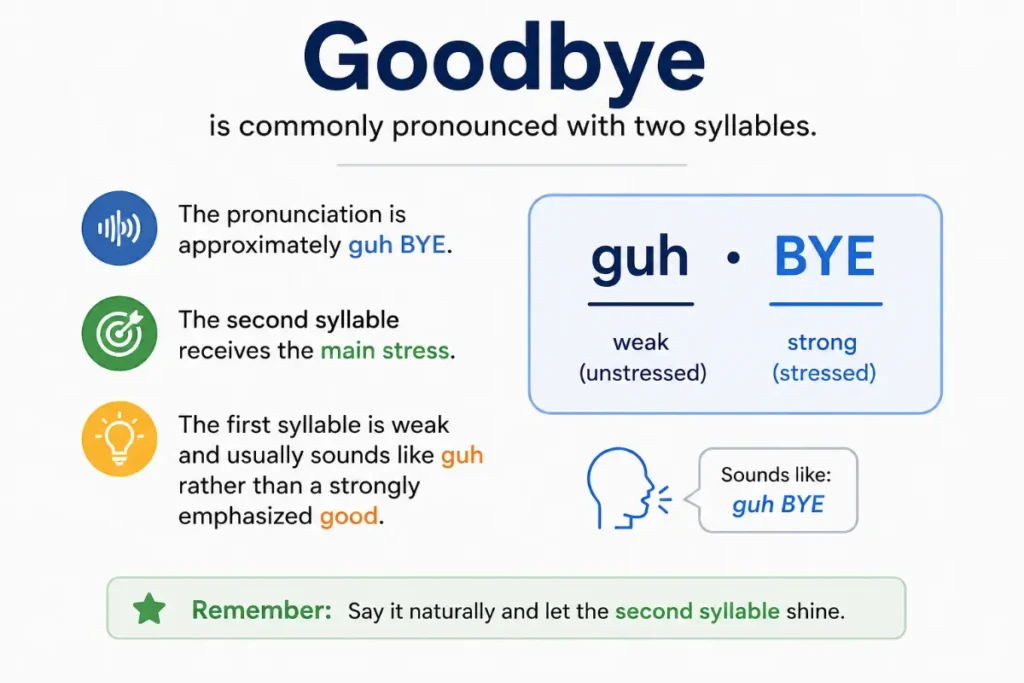
The standard spelling is pronounced as one word. It has three syllables in common pronunciation: good-bye, with the main stress on the final part.
The separate spelling does not normally indicate a different pronunciation. Both forms are generally intended to sound alike, which helps explain why writers sometimes separate them by mistake.
5. Formality
Goodbye is suitable for both casual and formal situations. You can say it to a friend, a teacher, a customer, a colleague, or someone you have just met.
The two word form is not more formal or polite. In fact, it may look like a spelling mistake in professional documents and edited writing.
6. Context
Use goodbye when ending a conversation, leaving a place, or expressing farewell. It works in speech, letters, emails, text messages, books, and public announcements.
The two word form may appear in older writing, historical documents, or creative work where the author wants a particular visual effect. These uses do not change the modern spelling convention.
7. Regional Usage
American, British, Canadian, and Australian English all use goodbye as the standard spelling. There is no major regional difference that makes the two word form standard in one of these varieties.
The pronunciation may vary slightly because of regional accents, but the spelling remains the same.
8. Standard and Nonstandard Usage
A spelling can remain understandable without being the preferred standard form. Readers will usually understand good bye, but that does not make it the correct choice for ordinary modern writing.
Goodbye is the form you should use in edited content, schoolwork, business communication, and everyday messages. It is also the form most readers expect to see.
Which Form Is Correct?
Goodbye is correct for standard modern English. It is written as one word because the original farewell expression became established as a single word over time.
The spelling follows a common pattern in English. Expressions that begin as separate words can gradually become joined when speakers and writers use them as one fixed unit. Goodbye is an example of this development.
Consider these examples:
- Correct: I said goodbye to my teacher after class.
- Incorrect in standard modern usage: I said good bye to my teacher after class.
- Correct: She wrote goodbye at the end of the letter.
- Incorrect in standard modern usage: She wrote good bye at the end of the letter.
- Correct: Their final goodbye was emotional.
The joined form is the safest choice in nearly every modern writing situation. If you are editing an article, preparing an assignment, writing a business email, or sending a personal message, use goodbye.
There is no need to hyphenate it as good-bye in ordinary contemporary writing either. The standard form is simply goodbye.
Sentence Examples
The following examples show how the correct spelling works in different situations.
Ten Natural Examples Using Goodbye
- Everyday conversation: I said goodbye to my neighbors before leaving for work.
- Text message: Goodbye for now, and I’ll talk to you tomorrow.
- Workplace communication: Please say goodbye to the visiting team before they leave.
- School: The students waved goodbye to their teacher at the end of the year.
- Academic writing: The novel uses the final goodbye to show how the main character has changed.
- Formal writing: We would like to say goodbye and thank you for your years of service.
- Social situations: She gave everyone a warm goodbye before heading home.
- Online communication: He ended his video message with a cheerful goodbye.
- Travel: My parents came to the station to say goodbye before my journey.
- Personal relationships: Their goodbye was difficult because they knew they would not meet again soon.
These sentences show that the word can express a simple farewell or a more emotional parting. The meaning comes from the situation and the surrounding words.
Five Examples Showing the Nonstandard Form
The following examples show the spelling mistake and its standard correction.
1. Nonstandard: We said good bye after the meeting.
Standard: We said goodbye after the meeting.
2. Nonstandard: She waved good bye from the doorway.
Standard: She waved goodbye from the doorway.
3. Nonstandard: He wrote good bye in his final message.
Standard: He wrote goodbye in his final message.
4. Nonstandard: The children shouted good bye to their friends.
Standard: The children shouted goodbye to their friends.
5. Nonstandard: It was time to say good bye to the old house.
Standard: It was time to say goodbye to the old house.
The meaning is clear in each nonstandard example, but the spelling should be joined in standard modern writing.
Common Spelling Mistakes
Several forms can appear when people write this farewell expression. Some come from separating the words, while others come from adding punctuation or changing the spelling.
1. Writing Good Bye as Two Words
Incorrect: Good bye, everyone.
Correct: Goodbye, everyone.
This is the most common confusion in this comparison. The expression may sound like two separate words, but the standard modern spelling joins them.
2. Adding a Hyphen
Less preferred in modern standard writing: Good-bye, everyone.
Standard: Goodbye, everyone.
The hyphenated spelling has appeared historically and may still be encountered in older material. However, the one word form is the usual modern spelling. Use it unless you are preserving the spelling of a historical source or title.
3. Writing Goodby
Incorrect: Goodby, my friend.
Correct: Goodbye, my friend.
This mistake often happens when someone leaves out the final letter. The standard form ends with e, so remember the complete spelling: g-o-o-d-b-y-e.
4. Writing Good Byee
Incorrect: Goodbyee, see you tomorrow.
Correct: Goodbye, see you tomorrow.
Extra letters may appear in playful text messages or informal online writing. They can communicate excitement or affection, but they are not standard spelling. Use the regular form in professional and academic writing.
5. Using Goodbye as Two Separate Words in a Phrase
Incorrect: She said a good bye to her friends.
Correct: She said goodbye to her friends.
In the standard expression, goodbye is one word. When it is used as a noun, it can take an article in certain sentence patterns, such as “a warm goodbye,” but the word itself remains joined.
Pronunciation Guide
How Do You Pronounce Goodbye?
In American English, goodbye is commonly pronounced /ˌɡʊdˈbaɪ/. It has three syllables in this pronunciation: good-bye, with the final part receiving the main stress.
A simple way to say it is good-BYE. The first part sounds like good, while the second part rhymes with my, try, and sky.
The stress falls on bye, not good. This is why the word often sounds like one smooth farewell rather than two separate spoken words.
Syllable Breakdown
The word can be divided into these spoken parts:
- Good.
- Bye.
Although the spelling contains one word, the pronunciation has two main sound groups. Some pronunciation descriptions treat the initial sound sequence as two syllables, giving the word three syllables overall. The important point for everyday speech is to give the strongest stress to the final sound.
Common Pronunciation Mistakes
- Putting too much stress on good. The main stress normally falls on bye.
- Pronouncing the final part like bee. The ending should sound like the word bye.
- Adding a pause between the parts. In normal speech, the word flows smoothly.
- Pronouncing the word too quickly. Clear pronunciation helps the farewell sound warm and natural.
A related grammar guide is Anyway vs Anyways Which Form Is Correct.
Etymology and Word Origin
Where Did Goodbye Come From?
The history of goodbye is more interesting than its modern spelling suggests. It developed from the older farewell expression God be with you. This phrase was a way of wishing someone protection or blessing as they departed.
Over time, speakers shortened and changed the expression. Earlier forms included God be wy you and similar spellings found in historical English. As the phrase became shorter in everyday speech, its written form also changed.
The modern spelling is the result of this long development. It no longer looks like the original religious phrase, but its history helps explain why the word contains the familiar elements good and bye.
How Did God Be With You Become Goodbye?
The change happened gradually through spoken use and written variation. People shortened the original expression, and its sounds shifted as speakers used it in everyday farewells.
The word good in the modern spelling is not simply the original word God preserved without change. The spelling developed through historical forms and influence from the familiar word good.
This history is also a reminder that English spelling does not always show a word’s original meaning clearly. A modern word may look very different from the phrase that gave rise to it.
Why Is Goodbye Written as One Word?
As the expression became a fixed farewell, it developed into a single written unit. English has many examples of words that began as separate elements and later became joined through regular use.
Goodbye is now treated as one word in standard spelling. You do not need to separate it into its historical parts when writing a modern message.
Regional Usage
American English
Goodbye is the standard spelling in American English. It appears in everyday conversation, personal messages, business letters, school assignments, and formal speeches.
Americans may use alternatives such as bye, see you later, take care, or farewell depending on the situation. However, the spelling of the main farewell expression does not change. Good bye is generally treated as a nonstandard form in ordinary American writing.
British English
British English also uses goodbye as one word. There is no meaningful spelling difference between standard American and British usage.
The word can appear in formal writing, casual conversation, and literature. Speakers may choose different farewell expressions depending on their region or personal style, but the standard spelling remains the same.
Australian English
Australian English follows the same spelling convention. Goodbye is the accepted form in everyday and professional writing.
Casual expressions such as see ya and catch you later may be common in conversation, but they do not change the spelling of the standard farewell word.
Canadian English
Canadian English also uses goodbye as one word. The spelling is the same as in American, British, and Australian English.
The main difference between regions is often the choice of farewell expression rather than the spelling of this word. In all these varieties, goodbye is the standard form.
Grammar Rules and Part of Speech
Goodbye is useful because it can work as an interjection or a noun. Understanding these roles helps you place it correctly in a sentence and use punctuation naturally.
Goodbye as an Interjection
An interjection expresses a feeling or reaction. Goodbye works as an interjection when you use it directly to end a conversation or part from someone.
Examples:
- Goodbye, everyone. I hope you have a great evening.
- Goodbye! Please drive safely.
- Well, goodbye for now.
- Goodbye, and thank you for your help.
As an interjection, it can stand alone or appear at the beginning of a sentence. A comma often separates it from the name or group being addressed.
Goodbye as a Noun
Goodbye can also name the act or expression of parting. In this role, it can appear with an article or a describing word.
Examples:
- She gave her grandmother a warm goodbye.
- Their goodbye was short but emotional.
- He left without saying goodbye.
- The final goodbye was difficult for everyone.
The word remains one word in every example. Adding an article or adjective does not change its spelling.
Common Grammatical Patterns
Several sentence patterns are especially common:
- Say goodbye to someone. Example: I said goodbye to my coworkers.
- Wave goodbye to someone. Example: The children waved goodbye to their parents.
- Give someone a goodbye. Example: She gave him a quick goodbye.
- Say a final goodbye. Example: They gathered to say a final goodbye.
- Leave without saying goodbye. Example: He left without saying goodbye.
The expression say goodbye to someone is especially common. The preposition to identifies the person or group receiving the farewell.
Goodbye at the Beginning of a Sentence
You can begin a sentence with goodbye when you use it as a direct farewell.
Example: Goodbye, Mark. I hope everything goes well.
The comma separates the farewell from the name of the person being addressed. If you use the word as a standalone exclamation, an exclamation mark may be appropriate.
Example: Goodbye! We will miss you.
Goodbye in Formal and Informal Writing
The word works in both formal and informal situations, but the surrounding sentence should match the setting.
In a casual message, you might write, “Goodbye for now. Talk to you soon.” In a formal letter, you may choose a more complete closing such as “Thank you for your time and consideration.” The farewell word itself is not incorrect in formal writing, but the full closing should suit the reader and purpose.
Real Life Usage Examples
Daily Conversation
In everyday speech, goodbye is a simple way to end a conversation or leave someone.
- “Goodbye, I’ll see you at school tomorrow.”
- “We said goodbye to our guests after dinner.”
The word can sound friendly, polite, or emotional depending on the speaker’s tone. You can also use shorter expressions such as bye or see you later when the situation is casual.
Email and Workplace Communication
In professional communication, goodbye can be used when someone is leaving a job, a team, or a meeting. It is also common in farewell messages and retirement announcements.
- “We would like to say goodbye to our colleague and thank her for her hard work.”
- “Please join us for a farewell lunch before we say goodbye to the departing team.”
In a normal business email, a closing such as Best regards or Sincerely may be more suitable than goodbye. However, the word is perfectly appropriate in a message specifically about someone’s departure.
Academic Writing
In academic writing, the word may appear when discussing literature, language, or a character’s departure. It is less common in technical research because the topic rarely requires a personal farewell expression.
- “The character’s final goodbye marks a turning point in the novel.”
- “The use of farewell expressions shows how the characters respond to separation.”
These examples use the word as a subject of discussion rather than as a direct message to someone.
News and Journalism
News stories may use goodbye when reporting a retirement, departure, public farewell, or major change.
- “Fans gathered outside the stadium to say goodbye to the retiring player.”
- “The mayor delivered an emotional goodbye during her final public address.”
The word helps communicate the human side of an event. It is especially useful when a person is leaving a role or a community is marking an important departure.
Literature and Storytelling
Writers use goodbye to show separation, change, sadness, or the end of a relationship. The word can carry emotional weight when a character must leave someone or something important.
- “He whispered goodbye before closing the door.”
- “The letter was her final goodbye to the town where she had grown up.”
In storytelling, the effect comes from the scene around the word. A short farewell can feel light and ordinary, while a final one can signal a major change.
Related and Confused Terms
Several expressions have meanings close to goodbye, but they are not always interchangeable. Choosing the right one helps you match the tone and situation.
1. Bye
Bye is a shorter and more casual form of goodbye. It is common in everyday speech, text messages, and friendly conversations.
Example: “Bye, see you tomorrow.”
Use bye when you want a quick, relaxed farewell. Goodbye may sound slightly more complete or serious, depending on the situation.
2. Farewell
Farewell is a more formal or emotional expression used when someone is leaving. It can suggest a longer separation or a final parting.
Example: “The team gathered to bid farewell to their coach.”
It is suitable for speeches, ceremonies, formal messages, and emotional writing. In casual conversation, it may sound more dramatic than goodbye.
3. See You Later
See you later is a friendly expression that suggests you expect to meet the person again.
Example: “I have to go now. See you later.”
It is common in casual conversations and messages. Unlike a final farewell, it often carries an expectation of another meeting.
4. Take Care
Take care is a warm expression used when leaving someone. It communicates goodwill and concern for the other person’s well being.
Example: “Take care, and let me know when you get home.”
It can be used with friends, relatives, coworkers, and people you know casually. It often sounds more personal than a simple goodbye.
5. So Long
So long is an informal farewell expression. It can sound friendly, old fashioned, or slightly dramatic depending on the speaker and context.
Example: “So long, everyone. It was great seeing you.”
It is less common in some everyday conversations than bye or see you later, but it remains understandable.
6. Adieu
Adieu is a farewell word borrowed from French. In English, it often sounds formal, literary, or dramatic and may suggest a long or final separation.
Example: “With one last glance, she whispered adieu.”
It is not usually the first choice for an ordinary conversation. Goodbye is more natural in most modern situations.
7. Parting
Parting refers to the act of separating or leaving. It is a noun or an adjective depending on how it appears in a sentence.
Example: “Their parting was peaceful.”
Unlike goodbye, it does not normally function as a direct spoken farewell. It describes the separation itself.
8. See You Soon
See you soon is a friendly expression that suggests another meeting will happen in the near future.
Example: “Thanks for visiting. See you soon.”
It is useful when you expect to meet again, while goodbye can be used for both short and long separations.
Expert Editor Insight
An experienced editor uses goodbye as one word in standard modern writing. The confusion comes from the expression’s history and the fact that its pronunciation can make it sound like two separate words. Spelling tools may flag good bye as an error or suggest joining the words, but context still matters when editing historical quotations or creative titles. A useful editing habit is to search your document for both good bye and good-bye. Replace them with goodbye in ordinary modern prose unless you have a clear reason to preserve a special spelling.
Key Takeaways
- The standard modern spelling is goodbye.
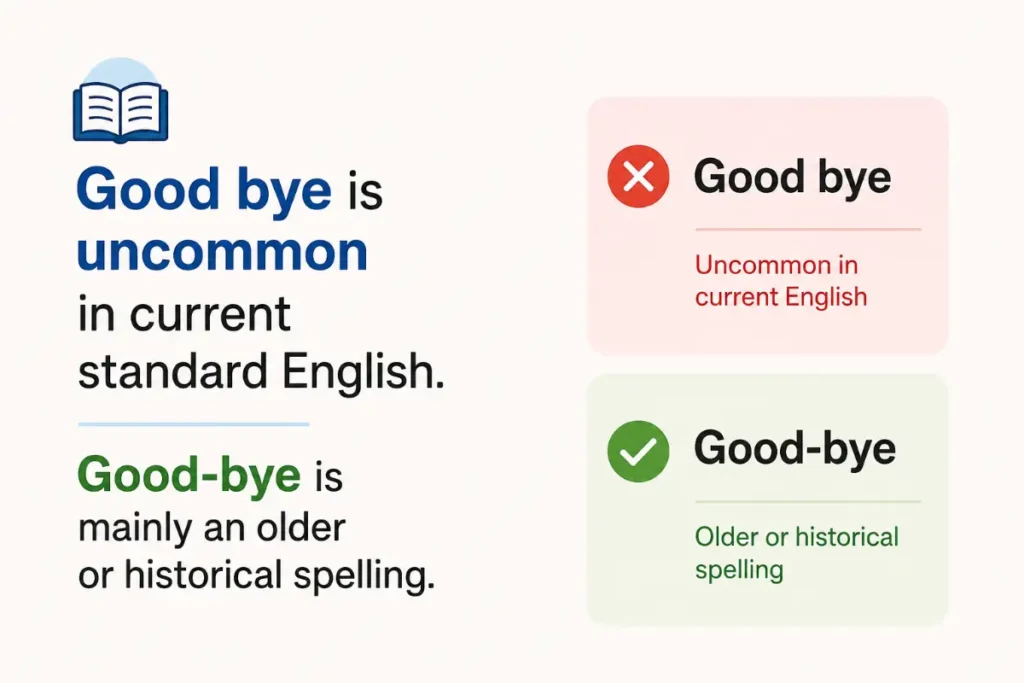
- Good bye is uncommon in current standard English.
- Good-bye is mainly an older or historical spelling.
- Goodbye can work as an interjection or noun.
- The plural form is goodbyes.
- Bye is a shorter and more informal alternative.
- Farewell often sounds more formal or literary.
- The word developed historically from a longer farewell expression connected with God be with you.
- American and British English both use goodbye as the standard modern spelling.
- For ordinary modern writing, use goodbye as one word.
Need another quick comparison? Read Moral vs Morale Meaning and Usage Explained.
Conclusion
The correct spelling in modern English is goodbye, written as one word. The two word form is generally nonstandard in everyday writing, even though it may appear in older texts or creative work. The word can function as a direct farewell or as a noun describing an act of parting. It is accepted in American, British, Canadian, and Australian English.
To remember the spelling, think of goodbye as one complete expression rather than two separate words. Before sending a message or publishing a document, search for good bye and join the words unless a special style requires otherwise.
FAQs
Is Goodbye One Word or Two?
Goodbye is one word in standard modern English. It developed from the older expression God be with you and gradually became a single written form. The two word spelling is generally considered nonstandard in ordinary modern writing. Use the joined form in messages, letters, school assignments, professional documents, and everyday communication.
Is Good Bye Ever Correct?
The two word form has appeared in older English writing and may still be used for a special creative effect. However, it is not the standard spelling for the modern farewell expression. If you are writing ordinary English, choose goodbye. You should only preserve the separated form when a historical source or deliberate stylistic choice requires it.
Why Is Goodbye Written as One Word?
The expression began as a longer phrase meaning God be with you. Over time, speakers shortened it, and the written form changed as the expression became a fixed farewell. The modern spelling joins the elements into one word. This kind of change has happened with other English expressions as well.
Is Goodbye Formal or Informal?
Goodbye works in both formal and informal situations. You can say it to a friend, a teacher, a customer, or a colleague. The tone depends on the setting and the rest of your message. In a formal email, a closing such as Sincerely may be more suitable, but goodbye itself is a standard English word.
How Do You Pronounce Goodbye?
In American English, goodbye is commonly pronounced /ˌɡʊdˈbaɪ/. It is often described as having three syllables, with the strongest stress on the final part. The first part sounds like good, and the ending rhymes with my. In everyday speech, the word flows smoothly as one farewell expression.
Can Goodbye Start a Sentence?
Yes. You can begin a sentence with goodbye when addressing someone directly. For example, Goodbye, Sarah. Have a safe trip. Use a comma after the word when it is followed by a person’s name or a group being addressed. You can also use an exclamation mark when the farewell is spoken with strong feeling.
What Is Another Word for Goodbye?
Common alternatives include bye, farewell, see you later, take care, so long, and see you soon. Each expression has a slightly different tone. Bye is casual, farewell can sound formal or emotional, and see you soon suggests another meeting. Choose the phrase that fits your relationship and the situation.
Is Goodbye Appropriate in Professional Writing?
Yes. Goodbye is appropriate in professional writing when the message concerns a departure, retirement, farewell event, or the end of a working relationship. However, it may not be the best closing for an ordinary business email. Expressions such as Best regards or Sincerely are often more suitable for routine professional correspondence.