

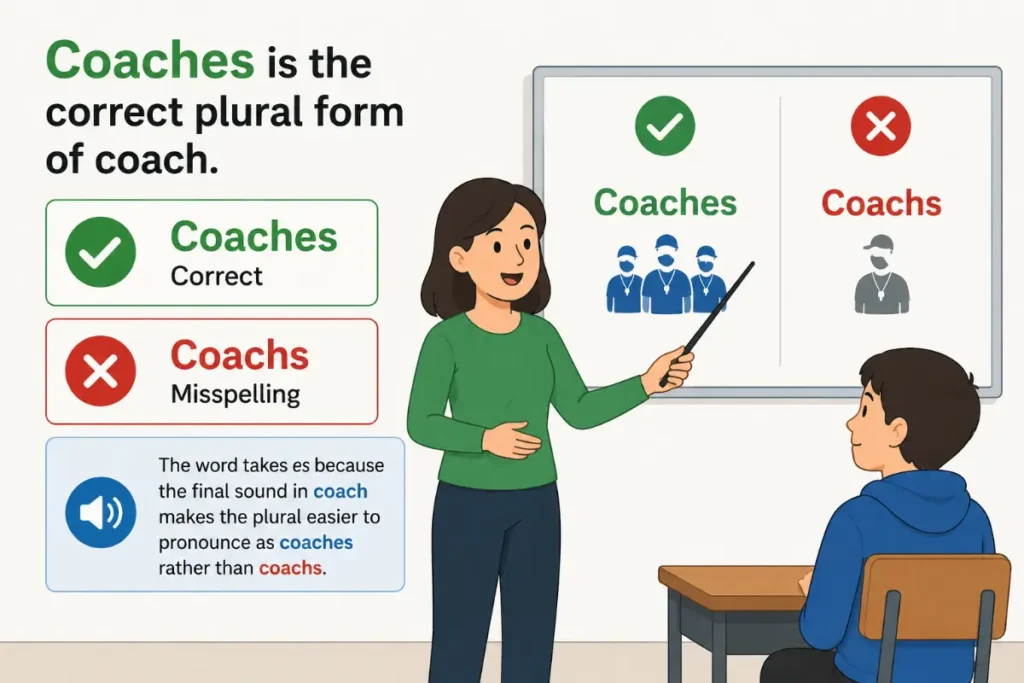
If you are unsure about coachs or coaches, the correct spelling is coaches. It is the standard plural form of coach, which can refer to a sports instructor, a professional who helps someone improve, or a type of bus. The word coachs is not the standard plural spelling in ordinary English.
The confusion comes from a common spelling rule. Many English nouns form their plurals by adding s, as in books and cars. However, nouns ending in ch often take es to form the plural. For example, one coach becomes two coaches, just as one match becomes two matches.
This small spelling difference matters in school assignments, workplace emails, sports reports, and everyday messages. Using the correct form helps your writing look clear and polished. It also makes your meaning easier for readers to understand.
The easiest way to remember the rule is to look at the ending of the singular noun. When coach refers to a person or vehicle, add es to make the plural. The same pattern applies to many other English words ending in ch.
Many readers also check Inconsolable or Unconsolable Correct Spelling and Meaning.
Quick Answer
Coaches is the correct plural spelling of coach. Coachs is generally a misspelling because nouns ending in ch usually form their plurals by adding es. Write one coach and two coaches when referring to multiple instructors, trainers, or buses.
Comparison Table
| Form | Meaning | Part of speech | Standard usage | Example |
|---|---|---|---|---|
| Coach | One instructor, trainer, or bus | Noun | Correct singular form | Our coach arrived early. |
| Coaches | More than one instructor, trainer, or bus | Plural noun | Correct plural form | The coaches planned the session. |
| Coach’s | Something belonging to one coach or a contraction in context | Possessive noun or contraction | Correct when used appropriately | The coach’s whistle was missing. |
| Coaches’ | Something belonging to multiple coaches | Possessive plural noun | Correct when used appropriately | The coaches’ meeting starts at noon. |
| Coachs | Intended as a plural of coach | Nonstandard spelling in ordinary English | Avoid in standard writing | Write coaches instead. |
Meaning and Definition
What Does Coach Mean
Coach is a noun or a verb depending on how you use it. As a noun, it commonly refers to someone who trains athletes, guides a person toward a goal, or teaches a skill. It can also refer to a large passenger bus used for travel.
As a verb, coach means to train, guide, or help someone improve. For example, a teacher might coach students before a competition, or a manager might coach an employee on communication skills.
Here are the main meanings.
- A sports instructor who trains a team or athlete.
- A professional who helps someone develop skills or reach personal goals.
- A person who provides guidance in a workplace or educational setting.
- A bus designed to carry passengers over longer distances.
- The act of training or guiding someone toward better performance.
The meaning depends on the sentence. In a sports article, a coach probably trains players. In a travel advertisement, a coach usually means a passenger bus.
What Does Coaches Mean
Coaches is the plural noun form of coach. It refers to two or more people who train, teach, or guide others, or to two or more passenger buses.
For example, a school might employ several coaches for different sports. A travel company might operate a fleet of coaches between cities. In both cases, the plural spelling remains the same.
Coaches can also be the third person singular form of the verb coach. For example, the sentence She coaches young athletes uses coaches as a verb, not as a plural noun.
This distinction is useful because the same spelling can serve different grammatical functions. The surrounding words tell you which meaning applies.
Is Coachs a Real Word
Coachs is not the standard plural of coach in modern general English. Readers will usually recognize it as an attempt to make the word plural, but standard writing requires coaches.
You might encounter coachs in a typo, a username, a product label, or a business name. A company could also deliberately use Coachs as a brand name. Such special uses do not make it the standard plural form of the common noun.
If you are writing an essay, email, article, school assignment, or professional report, use coaches when you mean more than one coach.
Key Differences Explained
Spelling
The main difference is the ending. Coachs adds only s, while coaches adds es. The second form follows the standard plural spelling pattern for nouns ending in ch when that ending represents the sound found in coach.
The rule is easy to apply once you recognize the final letters.
- One coach becomes two coaches.
- One match becomes two matches.
- One church becomes two churches.
- One bench becomes two benches.
- One lunch becomes two lunches.
These examples share the same spelling pattern. Adding es makes the plural form easier to pronounce and follows established English spelling conventions.
Meaning
Coachs and coaches are often intended to express the same idea, but only coaches is the standard spelling for the plural of coach. The difference is not a change in meaning. It is a difference in spelling accuracy.
For example, if a school has five basketball instructors, you should write The school hired five coaches. Writing The school hired five coachs would be a spelling error.
Grammar
Coach is the singular noun, while coaches is the plural noun. The plural form can also function as a verb when the subject is singular and uses the simple present tense.
Compare these sentences.
- The coach explains the rules.
- The coaches explain the rules.
- She coaches the junior team.
- They coach the junior team.
Notice that the subject controls the verb form. In the first sentence, coach is a singular noun and explains is the verb. In the third sentence, coaches is the verb because it describes what she does.
Pronunciation
Coach is pronounced with one syllable. Coaches has two syllables, with the ending pronounced as an extra syllable.
In standard American English, coach is commonly pronounced /koʊtʃ/, while coaches is pronounced /ˈkoʊtʃɪz/.
The added ending sounds like iz. It is not pronounced as a simple s attached to the end of coach. This extra syllable is another clue that the standard plural form is coaches.
Formality
Coaches is appropriate in every ordinary writing style, including casual texts, academic work, business communication, news reports, and formal documents. It does not sound overly formal or old fashioned.
Coachs is generally unsuitable in standard writing. A reader may understand what you intended, but the spelling can make the text look careless. In professional communication, spelling the plural correctly is a simple way to maintain credibility.
Regional Usage
The spelling coaches is standard in American, British, Canadian, and Australian English. There is no major regional spelling difference for this plural form.
Pronunciation and some meanings of coach can vary by context or region, especially when the word refers to transport. However, those differences do not change the plural spelling.
Which Form Is Correct
Coaches is the correct form when you mean more than one coach. It follows the standard English rule for many nouns ending in ch. Coachs does not follow that usual pattern and should be treated as a misspelling in ordinary writing.
The rule is not based on personal preference. It reflects an established spelling convention used in standard English dictionaries and edited writing.
Consider these examples.
- Correct: The coaches arrived before the game.
- Incorrect: The coachs arrived before the game.
- Correct: We spoke to three coaches after practice.
- Incorrect: We spoke to three coachs after practice.
There is no need to change the word based on the type of coach. The same plural spelling applies to sports coaches, career coaches, life coaches, and passenger coaches.
Sentence Examples
The following examples show how to use the word naturally in different situations.
- The basketball coaches met after school to discuss the tournament.
- Our coaches encouraged us to keep practicing after a difficult loss.
- The company hired two career coaches to help new employees develop their skills.
- Several coaches attended the training session on Saturday morning.
- The school needs more coaches for its growing sports program.
- The coaches reviewed the team’s performance before the next match.
- We booked two coaches for the school trip to Washington.
- Her coaches helped her prepare for the national swimming competition.
- The club thanked its volunteer coaches for their time and dedication.
- Experienced coaches often help young athletes build confidence as well as skill.
Each example uses coaches as the plural noun. The word works naturally in sports, education, travel, and professional development.
Common Spelling Mistakes
A small group of spelling and grammar errors often appears alongside this word. Learning the difference can help you avoid mistakes in your own writing.
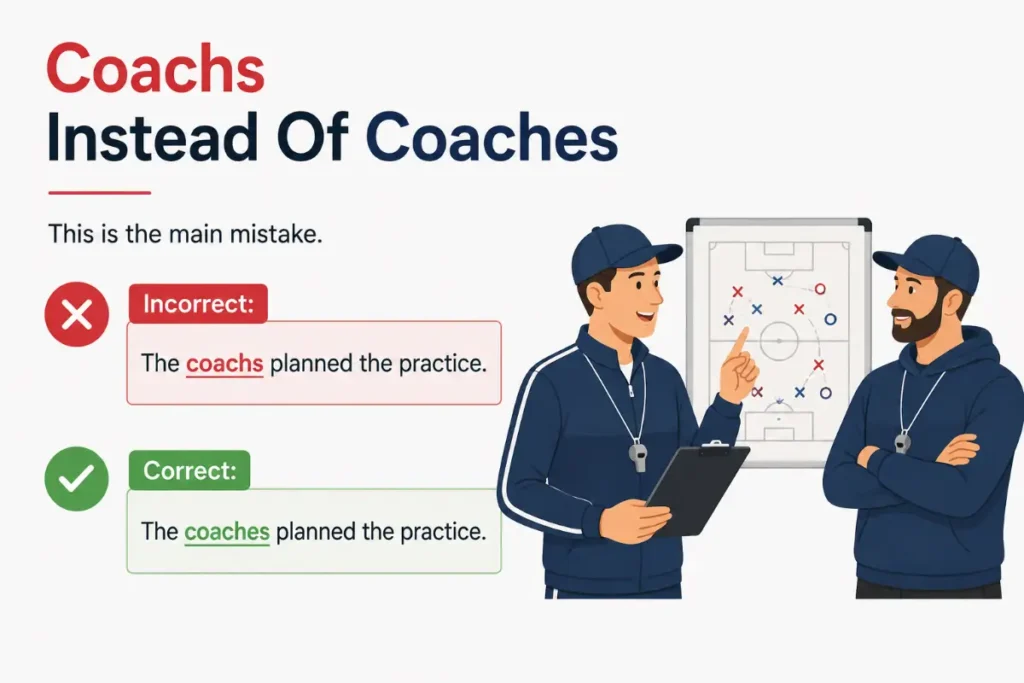
Mistake One Using Coachs Instead of Coaches
Incorrect: The coachs arrived early.
Correct: The coaches arrived early.
The mistake occurs when a writer applies the basic plural rule of adding s without accounting for the final ch. For this word, the standard plural requires es.
Mistake Two Using Coach’s for More Than One Coach
Incorrect: The coach’s attended the meeting.
Correct: The coaches attended the meeting.
An apostrophe does not normally create a plural. Coach’s usually indicates possession by one coach, as in the coach’s office. The plural noun coaches does not need an apostrophe.
Mistake Three Using Coaches’ for a Simple Plural
Incorrect: Three coaches’ attended practice.
Correct: Three coaches attended practice.
The apostrophe in coaches’ indicates possession by multiple coaches. It does not belong after the plural noun when the sentence simply says that several coaches attended practice.
Mistake Four Confusing Coaches With Coach Is
Incorrect: The coaches ready for practice.
Correct: The coaches are ready for practice.
Coaches is a plural noun in this example. It needs the plural verb are. The word coaches can also be a verb, as in She coaches the team, so readers should use the whole sentence to identify its role.
Mistake Five Using the Wrong Verb Form
Incorrect: She coach the younger players every week.
Correct: She coaches the younger players every week.
In the simple present tense, a verb generally takes s or es when its subject is he, she, or it. Because coach ends in ch, the correct form is coaches.
These mistakes involve different rules. Learning the difference between plurals, possessives, and verb forms will make your writing more accurate.
Pronunciation Guide
How to Pronounce Coach
Coach has one syllable. In American English, its IPA pronunciation is /koʊtʃ/.
A simple way to say it is to begin with the k sound, move into the long o sound, and finish with the ch sound. Keep the word in one smooth syllable.
How to Pronounce Coaches
Coaches has two syllables. Its common American English IPA pronunciation is /ˈkoʊtʃɪz/.
The stress falls on the first syllable. The second syllable sounds like iz, making the full word longer than coach.
A useful practice method is to say the singular form first, then add the plural ending aloud. This helps you hear the difference instead of relying only on the spelling.
Common Pronunciation Mistakes
- Saying coaches as one syllable. The standard pronunciation has two syllables.
- Dropping the final vowel sound. The ending includes an extra vowel sound before the final z sound.
- Placing the main stress on the second syllable. The first syllable carries the stress in the usual pronunciation.
Pronunciation may vary slightly among speakers, but the two syllables remain a useful guide to the standard form.
You may also want to read function vs functionality Which Word Should You Use.
Etymology and Word Origin
The word coach has an interesting history. English borrowed it from the Hungarian word kocsi, which referred to a carriage associated with the Hungarian town of Kocs. The term spread through European languages before becoming part of English.
In its earlier use, a coach was a horse drawn carriage used to carry people. Over time, the word became associated with passenger transport and later with buses designed for longer journeys.
The meaning then developed further. In sports and other areas of training, a coach became someone who guides people toward better performance. Today, the word is widely used in athletics, education, business, and personal development.
The plural spelling follows English grammar rather than a special rule tied to its Hungarian origin. Once coach became an established English noun, it formed its plural as coaches.
Regional Usage
American English
Coaches is the standard plural in the United States. The word commonly refers to sports instructors, athletic trainers, professional mentors, and long distance passenger buses.
In American schools, coaches often lead teams in basketball, football, baseball, soccer, and other sports. In business settings, career coaches and executive coaches help people improve their professional skills.
The spelling remains the same across these uses. Coachs is not an accepted standard alternative.
British English
British English also uses coaches as the standard plural. The word is particularly common when discussing passenger buses used for travel between towns or cities. It is also widely used for sports instructors and professional mentors.
For example, a travel company might advertise several coaches for a school excursion. A football club might employ coaches to train different age groups.
Neither context changes the spelling rule.
Australian English
Australian English follows the same plural spelling. Coaches can refer to sports instructors, personal development professionals, or passenger vehicles used for longer journeys.
A local sports club might have several volunteer coaches, while a tour operator might arrange coaches for a group trip. In both cases, coaches is the correct form.
Canadian English
Canadian English also uses coaches. The word can refer to sports staff, professional trainers, and passenger buses. There is no special Canadian spelling that replaces the standard plural with coachs.
Across these English varieties, the spelling rule is consistent. The meaning may depend on local context, but the plural form does not change.
Grammar Rules and Part of Speech
Understanding how the word works in a sentence is just as useful as remembering its spelling. Coach and coaches can function as nouns or verbs, and each form follows a clear grammatical pattern.
Coach as a Noun
A noun names a person, place, thing, or idea. When coach is a noun, it usually refers to one instructor, trainer, or passenger bus.
Examples include the following.
- The coach explained the team’s strategy.
- We waited for the coach outside the station.
- Her coach helped her prepare for the interview.
In each sentence, coach names a person or vehicle.
Coaches as a Plural Noun
Use coaches when referring to two or more people or vehicles. A plural noun generally takes a plural verb when it serves as the subject of a sentence.
Examples include the following.
- The coaches discussed the schedule.
- Several coaches attended the workshop.
- The coaches were pleased with the team’s progress.
Notice that the sentences use plural verbs such as discussed and were. The noun coaches tells readers that the subject includes more than one person.
Coaches as a Verb
Coaches can also be the simple present form of the verb coach. It describes what one person does when that person trains or guides someone.
Examples include the following.
- Maria coaches the school volleyball team.
- He coaches new managers at work.
- Our teacher coaches students for the debate competition.
In these sentences, coaches is not a plural noun. It is a verb that agrees with a singular subject such as Maria, he, or our teacher.
Coaching and Coached
Two other forms are useful to know.
- Coaching is the present participle or gerund form. For example, Coaching young players takes patience.
- Coached is the simple past and past participle form. For example, She coached the team last season.
These forms follow ordinary English verb patterns. They do not change the rule for forming the plural noun.
Possessive Forms
Possessives show ownership or association. Their spelling depends on the number of coaches.
- The coach’s office refers to the office of one coach.
- The coaches’ office refers to an office shared by multiple coaches.
- The coaches’ meeting refers to a meeting for or belonging to several coaches.
The apostrophe belongs in the possessive form, not in the ordinary plural. This distinction matters because an unnecessary apostrophe can change how a sentence reads.
Subject Verb Agreement
The subject and verb should agree in number. Use a singular verb with one coach when the coach is the subject. Use a plural verb when coaches is the subject.
For example, The coach is ready uses a singular subject. The coaches are ready uses a plural subject. The sentence structure helps readers understand the number of people involved.
Real Life Usage Examples
Daily Conversation
In everyday speech, people often use the word when discussing sports, school activities, travel, or personal goals.
- The coaches said we should arrive fifteen minutes early.
- Do you know any coaches who offer private tennis lessons.
The second sentence is a question. It shows how the plural form fits naturally into an ordinary conversation.
Email and Workplace Communication
The word also appears in professional messages about training, mentoring, and team development.
- The coaches will meet with the department heads on Thursday to review the training plan.
- We have invited three leadership coaches to speak with our managers next month.
In workplace writing, the correct spelling supports a professional tone. It also prevents confusion when discussing schedules, staffing, and responsibilities.
Academic Writing
Students and researchers may use the word in discussions of education, athletic performance, and skill development.
- The study examined how coaches influence motivation among young athletes.
- Several coaches participated in interviews about team communication and player development.
These examples use the plural form to refer to multiple participants. In academic writing, the sentence should make the role of each group clear.
News and Journalism
News articles often mention coaches when reporting on games, school programs, and professional sports.
- The coaches praised the team’s defense after its win on Friday.
- Local coaches called for more funding for youth sports programs.
Journalists generally choose direct wording and standard spelling. The plural form remains unchanged regardless of the sport or organization involved.
Literature and Storytelling
In stories, coaches can help develop characters by offering guidance, setting challenges, or creating conflict.
- The coaches gathered around the young runner and reminded her how far she had come.
- Although the coaches disagreed about the strategy, they shared one goal of helping the team succeed.
These examples show that the word works in both action focused scenes and descriptions of relationships.
Related and Confused Terms
Several words are connected to coach through meaning or grammar. Knowing the differences can help you choose the most precise expression.
Trainer
A trainer teaches or develops a skill. In sports, a trainer may focus on physical conditioning, exercise, or injury related support, depending on the setting. A coach often has a wider role in strategy, performance, and team development.
The two roles can overlap, and organizations may use them differently.
Mentor
A mentor offers advice and support based on experience. Mentoring often focuses on long term growth rather than a specific practice session or performance target.
A coach may act as a mentor, but the words are not exact synonyms.
Instructor
An instructor teaches a subject or skill. The term is common in formal lessons, such as driving instruction, fitness classes, and technical training.
A coach may teach skills too, but often also helps people apply those skills toward a goal.
Adviser
An adviser provides recommendations or guidance. The role may involve helping someone make decisions about work, education, or personal plans.
A coach often helps people work toward improvement through questions, practice, feedback, and action.
Coaching
Coaching is the process of guiding or training someone. It can refer to sports practice, career development, leadership support, or personal improvement.
For example, leadership coaching helps managers develop communication and decision making skills.
Coached
Coached is the past tense and past participle of coach. It describes training or guidance that happened earlier or has been completed.
For example, She coached the team last year. The word is a verb form rather than a plural noun.
Coach’s
Coach’s is a possessive form that usually means belonging to one coach. It can also represent coach is or coach has in a contraction when the sentence allows that reading.
For example, The coach’s whistle is on the table shows possession. The coach’s arrived early is not a correct contraction in standard English because coach’s cannot mean coach has in that sentence without a suitable grammatical structure.
Coaches’
Coaches’ is the possessive plural form. It shows that something belongs to or is associated with several coaches.
For example, The coaches’ room is next to the gym. The apostrophe comes after the s because the noun is already plural.
These distinctions are more useful than memorizing spellings in isolation. A quick look at the sentence often reveals the correct form.

Formal And Informal Usage
Coaches is suitable in both formal and informal English. You can use it in a text message. The coaches are here. You can use it in a work email. The coaches will meet with the staff this afternoon. You can use it in academic writing. The coaches evaluated the participants throughout the program. You can use it in professional journalism. The coaches discussed the team’s performance after the game. There is no need to replace the word with a more formal alternative simply because you’re writing for a professional audience. The important point is spelling it correctly and using it in the right grammatical role.
Expert Editor Insight
An experienced English editor would correct coachs to coaches in ordinary prose and then check the sentence for related grammar issues. The most common problem is applying the basic rule of adding s to every noun. Words ending in ch often need es instead. Editors also check for misplaced apostrophes, especially when writers confuse a plural with a possessive form. Spellcheckers may catch coachs, but they do not always identify the intended meaning or explain the grammar. Reading the full sentence helps you decide if you need coach, coaches, coach’s, or coaches’.
Learn the difference in Borrow vs Barrow Explained With Examples.
Conclusion
The choice between coachs or coaches is simple once you know the plural spelling rule. Coaches is the correct standard form when referring to multiple instructors, trainers, or passenger buses. Coachs is a misspelling in ordinary English and should be avoided in formal and informal writing.
Remember that nouns ending in ch often form their plurals by adding es. The same pattern appears in matches, churches, and benches. Also, keep plural forms separate from possessives. Coaches refers to several people, coach’s usually shows ownership by one coach, and coaches’ shows ownership by several coaches. When in doubt, check the ending and read the complete sentence before making your final choice.
FAQs
Is Coachs Ever Correct in English?
Coachs is not the standard plural of coach in ordinary English. The correct form is coaches. You might see coachs in a username, brand name, or other deliberately chosen label, but those special cases do not make it correct as a regular plural noun. For schoolwork, professional writing, and everyday communication, use coaches.
What Does Coaches Mean?
Coaches can mean more than one instructor, trainer, or passenger bus. It can also be the simple present form of the verb coach, as in She coaches the school team. The intended meaning depends on the sentence. If coaches names several people or vehicles, it is a plural noun. If it describes an action, it is a verb.
Why Does Coach Become Coaches?
English commonly adds es to nouns ending in ch when forming the plural. This pattern appears in words such as matches, churches, and benches. The ending also helps preserve a natural pronunciation. Because coach ends in ch, its standard plural is coaches rather than coachs. Learning a few similar examples makes the rule easier to remember.
How Do You Pronounce Coaches?
In standard American English, coaches is pronounced /ˈkoʊtʃɪz/. It has two syllables, with the main stress on the first syllable. The ending sounds like iz rather than a simple s attached to coach. Practice saying the singular form and then adding the ending to hear the difference clearly.
Can Coaches Be a Verb?
Yes. Coaches can be a plural noun or a verb. In She coaches the team, it is a verb describing what she does. In The coaches arrived early, it is a plural noun referring to several people. Look at the subject and the rest of the sentence to identify the grammatical role.
What Is the Difference Between Coaches and Coach’s?
Coaches is the standard plural form of coach. Coach’s usually shows possession by one coach, as in the coach’s office. It can also be a contraction of coach is or coach has in a suitable sentence. These forms serve different purposes, so choose the one that matches your intended meaning.
Is Coaches Correct in Formal Writing?
Yes. Coaches is correct in formal writing, including reports, research papers, business emails, and news articles. The spelling works in American English and other major English varieties. Coachs should be avoided in standard writing because it is not the accepted plural form. Correct spelling makes your message easier to read and more professional.
What Is Another Word for Coaches?
Useful alternatives include trainers, instructors, mentors, and advisers. The best choice depends on the role. Trainers often focus on developing physical or practical skills. Instructors teach specific subjects. Mentors offer guidance based on experience, while advisers help people make decisions. These terms overlap with coaches, but they are not always interchangeable.