
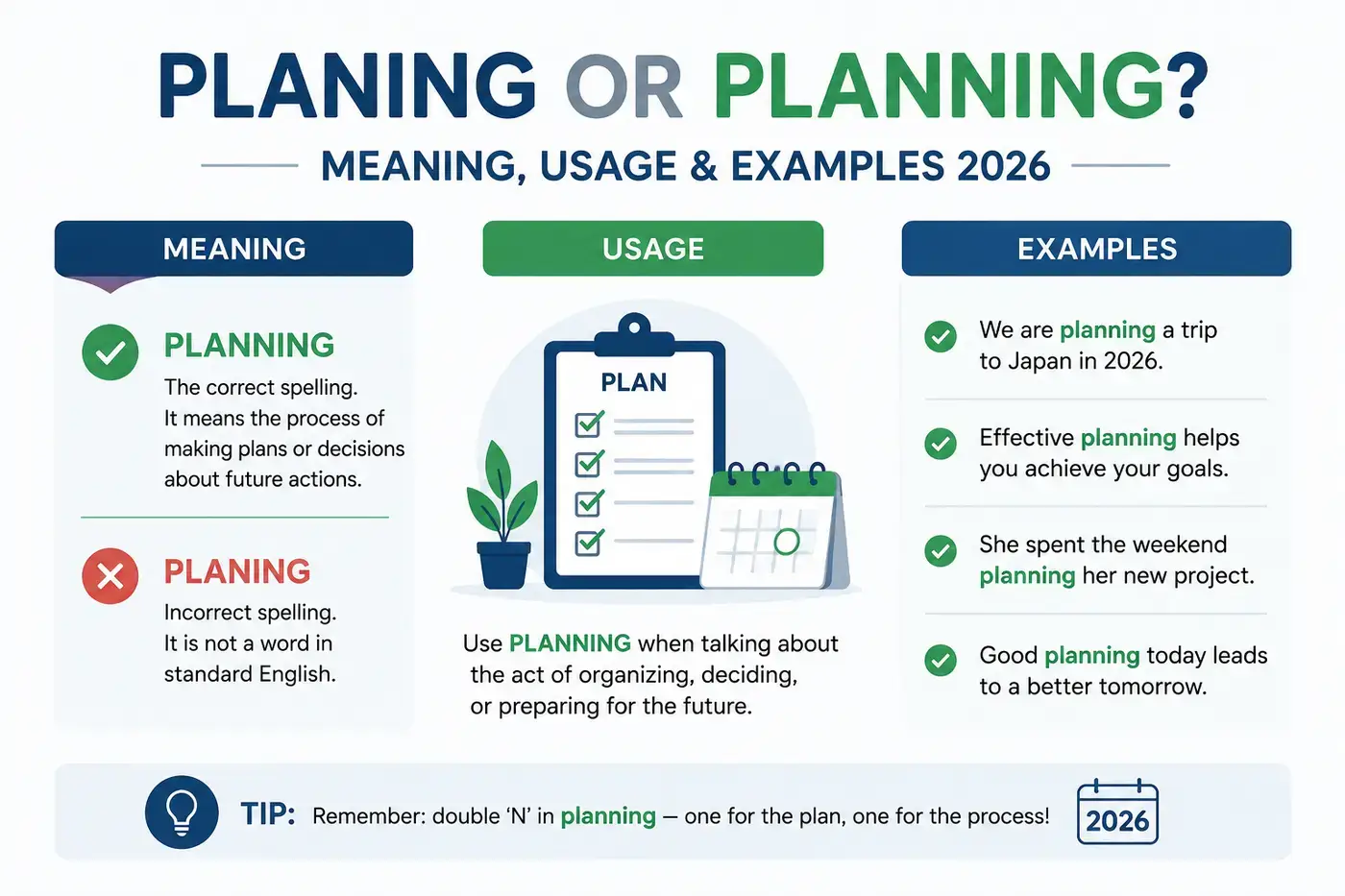
If you’ve searched for planing or planning, you’re probably writing an email, school assignment, business document, blog post, or social media caption and suddenly stopped to question the spelling. It’s an easy mistake to make because both words are real English words, and at first glance they look almost identical.
The difference is simple but important. Planning is the correct word when you’re talking about making plans, organizing tasks, or preparing for the future. Planing is also correct, but it has an entirely different meaning. It refers to smoothing wood with a plane or gliding across a surface, depending on the context.
This guide explains the difference between the two words in clear, simple language. You’ll learn their meanings, pronunciation, grammar, origins, real world examples, common mistakes, and practical editing tips so you can choose the right spelling with confidence every time.
Many readers also check Busyness Vs Business Which Word Should You Use in 2026?.
Planing Or Planning Quick Definition
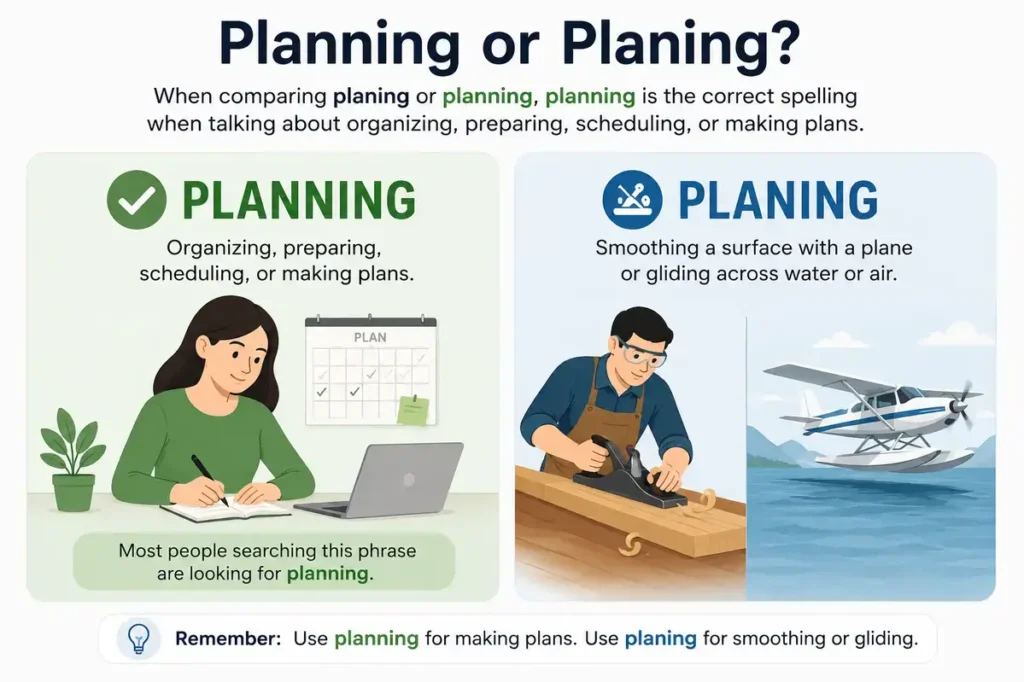
When comparing these words, planning is the correct spelling when talking about organizing, preparing, scheduling, or making plans. Planing is a separate word that refers to smoothing a surface with a plane or gliding across water or air. Most people searching this phrase are looking for planning.
Planing Or Planning Quick Answer
The correct spelling depends on your meaning.
- Use planning when talking about making plans, organizing events, preparing projects, or thinking ahead.
- Use planing when talking about woodworking, shaping surfaces, or a boat or aircraft gliding smoothly.
For everyday writing, business communication, education, and professional content, planning is usually the correct choice.
Planing vs Planning Comparison Table
| Feature | Planning | Planing |
|---|---|---|
| Standard English word | Yes | Yes |
| Most common usage | Very common | Relatively uncommon |
| Primary meaning | Making plans or preparing | Smoothing or shaping surfaces |
| Part of speech | Verb form and noun | Verb form and noun |
| Root word | Plan | Plane |
| Common context | Business, education, projects | Woodworking, engineering, aviation |
| Frequency in daily writing | Extremely high | Low |
| Formality level | All levels | Technical contexts |
| Grammar role | Present participle or noun | Present participle or noun |
| Example | We are planning a trip. | He is planing a wooden board. |
| Search intent match | Usually yes | Usually no |
| Common spelling mistake | Sometimes written as planing | Rarely confused with planning |
Meaning Of Planning In Planing Or Planning
To understand the difference, start with the more common word.
Definition Of Planning
Planning refers to the process of preparing, organizing, arranging, or deciding something in advance.
It comes from the verb plan.
Examples include:
- Planning a vacation.
- Planning a wedding.
- Planning a business strategy.
- Planning a school project.
- Planning future goals.
The word often describes thinking ahead before taking action.
Planning As A Verb Form
Planning is the present participle form of plan.
Examples:
- We are planning a conference.
- She’s planning her retirement.
- They’re planning a surprise party.
In these examples, planning functions as part of a verb phrase.
Planning As A Noun
Planning can also function as a noun.
Examples:
- Good planning prevents mistakes.
- Strategic planning improves results.
- Financial planning helps families manage money.
Here, the word refers to the activity itself.
Common Contexts For Planning
You’ll frequently see planning used in:
- Business.
- Education.
- Government.
- Project management.
- Personal development.
- Travel.
- Event organization.
- Construction.
Planing Or Planning Synonyms
The right synonym depends on which word you mean because planing and planning have completely different meanings.
When planning refers to preparing, organizing, or making plans, common synonyms include preparation, organization, scheduling, arranging, strategizing, coordination, forecasting, designing, mapping out, and outlining. The best choice depends on the sentence and the level of formality.
When planing refers to smoothing wood with a plane, suitable synonyms include smoothing, shaving, trimming, leveling, dressing, surfacing, and finishing. In aviation or boating, where planing means gliding across the surface, related words include skimming, gliding, and hydroplaning, depending on the context.
Although the two words look similar, they are never synonyms of each other. Planning relates to making plans, while planing describes a physical process involving woodworking or movement across a surface.
Meaning Of Planing In Planing Or Planning
The word planing is less common but still completely correct when used properly.
Definition Of Planing
Planing refers to smoothing, shaping, or leveling a surface using a plane.A plane is a tool commonly used in woodworking.
Examples:
- Planing a wooden board.
- Planing rough timber.
- Planing furniture surfaces.
The goal is usually to create a smooth and even finish.
Planing In Aviation
In aviation, planing can describe movement where an aircraft glides smoothly over air currents.Though this usage exists, it is less common in everyday conversation.
Planing In Marine Contexts
Boats can also plane across water.When a boat reaches sufficient speed, it rises partially above the water surface and glides more efficiently.
Examples:
- The boat began planing across the lake.
- High speed vessels often operate in a planing position.
Planing As A Technical Term
You’ll commonly encounter this word in:
- Carpentry.
- Woodworking.
- Manufacturing.
- Engineering.
- Marine transportation.
- Aviation.
Outside these fields, most people rarely use it.
Planing vs Planning Meaning Differences
The most important distinction involves meaning.
Planning Focuses On Preparation
Planning involves mental activity.You’re organizing ideas, creating schedules, setting goals, or preparing for future actions.
Examples:
- Planning a budget.
- Planning a move.
- Planning a launch.
- Planning a campaign.
The emphasis is on thought and preparation.
Planing Focuses On Physical Shaping
Planing involves physical action.Something is being smoothed, shaped, leveled, or gliding across a surface.
Examples:
- Planing wood.
- Planing a board.
- Planing a surface.
- Planing over water.
The emphasis is on movement or shaping.
Simple Memory Trick
Think about the root word.
- Planning comes from plan.
- Planing comes from plane.
If you’re talking about preparation, choose planning.If you’re talking about a plane tool or surface shaping, choose planing.
Grammar Differences
Grammar helps explain why one spelling contains a doubled letter.
Why Planning Has Double N
English follows a spelling rule involving stressed syllables.
The verb plan ends with:
- One vowel.
- One consonant.
When adding ing, the final consonant doubles.Plan becomes planning.This follows the same pattern as:
- Run becomes running.
- Sit becomes sitting.
- Begin becomes beginning.
- Stop becomes stopping.
Why Planing Does Not Double The N
Planing comes from plane.When adding ing, the silent E is dropped.Plane becomes planing.This follows patterns such as:
- Make becomes making.
- Shape becomes shaping.
- Drive becomes driving.
- Smile becomes smiling.
Because the root word differs, the spelling rule differs too.
Which One Is Correct
The answer depends entirely on context.
Planning Is Correct For Most Writers
If your sentence involves:
- Organizing.
- Scheduling.
- Preparing.
- Designing strategies.
- Setting goals.
The correct spelling is planning.
Examples:
- We are planning our vacation.
- She’s planning next year’s budget.
- The team is planning a product launch.
Planing Is Correct In Technical Situations
If your sentence involves:
- Woodworking.
- Surface smoothing.
- Marine movement.
- Aviation movement.
The correct spelling is planing.
Examples:
- He spent hours planing the wooden table.
- The speedboat was planing across the water.
Common Internet Confusion
Search engines receive thousands of searches for this spelling question because people often encounter the word while writing.Most searchers mean planning.The confusion happens because:
- Both spellings look believable.
- English spelling rules can be inconsistent.
- Spell check tools don’t always explain the difference.
- Both words actually exist.
That’s important.
This isn’t a case where one spelling is completely wrong. Instead, it’s a case where two legitimate words have different meanings.
You may also want to read totaled or totalled Correct Spelling and Usage.
Planing Or Planning In The Oxford Dictionary
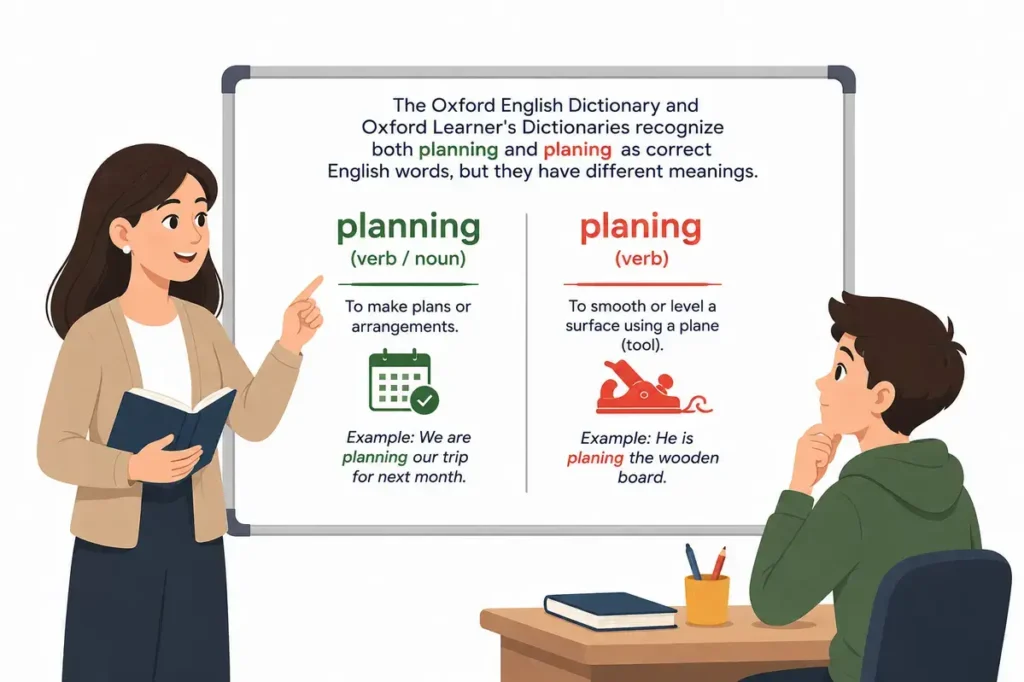
The Oxford English Dictionary and Oxford Learner’s Dictionaries recognize both planning and planing as correct English words, but they have different meanings.
Planning is the present participle and gerund of the verb plan. It means preparing for the future, organizing activities, or deciding how something will be done. This is the word used in everyday writing, business, education, and general communication.
Planing is the present participle of the verb plane. It refers to smoothing or shaping wood with a plane. In specialized contexts, it can also describe a boat or aircraft moving across the surface of water or through the air in a particular way.
Oxford dictionaries clearly distinguish these two words based on their meanings. If you’re writing about making plans, planning is the correct choice. If you’re describing woodworking or a technical movement, planing is the correct spelling.
Planing and Planning Pronunciation Guide
Another reason confusion persists is pronunciation.The words sound very similar.
Planning IPA Pronunciation
/ˈplæn.ɪŋ/
Planing IPA Pronunciation
/ˈpleɪ.nɪŋ/
Syllable Breakdown
Planning:
- Plan.
- Ning.
Planing:
- Play.
- Ning.
When spoken carefully, the vowel sounds differ.However, in fast conversation, many listeners miss the distinction.That often leads to spelling mistakes.
Common Mistakes
Editors frequently encounter the same errors.
Using Planing Instead Of Planning
Incorrect:
- We are planing a family vacation.
Correct:
- We are planning a family vacation.
Using Planning Instead Of Planing
Incorrect:
- The carpenter was planning the board.
Correct:
- The carpenter was planing the board.
Assuming One Word Is Always Wrong
Many people believe planing is not a real word.
It absolutely is.
The issue is that it belongs to specialized contexts.
Ignoring The Root Word
The easiest way to avoid mistakes is remembering the root.
- Plan → Planning.
- Plane → Planing.
Examples In Sentences
One of the easiest ways to understand the difference between these words is to see them used naturally.
Ten Examples Using Planning
- We’re planning a road trip along the West Coast this summer.
- The company is planning a major expansion next year.
- She’s planning her wedding months in advance.
- Careful planning helped the project stay within budget.
- They’re planning a surprise birthday party for their father.
- The city is planning new transportation improvements.
- I spent the weekend planning my goals for the upcoming year.
- Strategic planning plays a major role in business success.
- The team is planning a new marketing campaign.
- Good planning often prevents costly mistakes.
Ten Examples Using Planing
- The carpenter spent the morning planing a rough oak board.
- He continued planing the wood until the surface felt smooth.
- The workshop instructor demonstrated proper planing techniques.
- She practiced planing several pieces of timber before starting the project.
- The craftsman focused on planing the edges evenly.
- The boat began planing across the water at high speed.
- Modern speedboats are designed for efficient planing performance.
- Engineers studied the vessel’s planing characteristics.
- The aircraft appeared to be planing smoothly during descent.
- Proper planing improved the final quality of the furniture.
Notice how the subjects and situations differ completely. Planning deals with preparation. Planing deals with shaping surfaces or movement across water or air.
Etymology And Word Origin
Understanding the history of these words makes the spelling difference easier to remember.
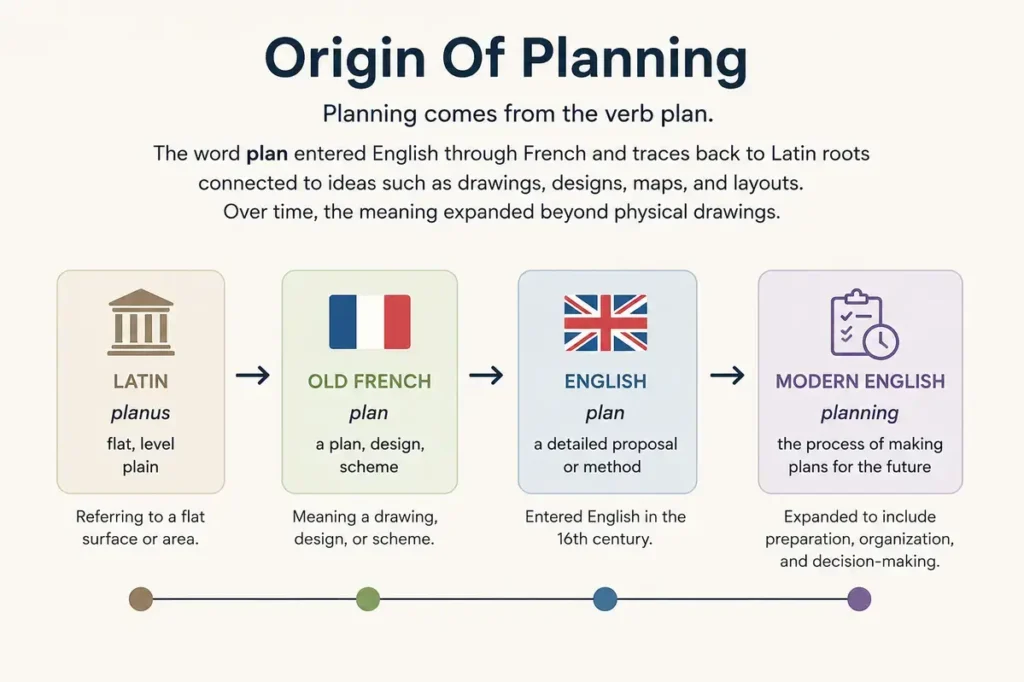
Origin Of Planning
Planning comes from the verb plan. The word plan entered English through French and traces back to Latin roots connected to ideas such as drawings, designs, maps, and layouts. Over time, the meaning expanded beyond physical drawings.
It began referring to:
- Organizing activities.
- Designing strategies.
- Preparing future actions.
- Setting objectives.
As English developed, planning became one of the most commonly used words in business, education, government, and everyday life.
Origin Of Planing
Planing comes from the noun and verb plane.This word has roots connected to tools used for smoothing and leveling surfaces.For centuries, carpenters and woodworkers used planes to create flat, even surfaces on wood.The participle form became planing, referring to the action performed with the tool.Later, engineers and marine specialists adopted the term to describe boats moving efficiently across water surfaces.
Why The Words Diverged
Although the spellings look similar, they evolved from different root words.
- Planning comes from plan.
- Planing comes from plane.
That distinction explains the different spelling patterns.
Planing Or Planning Regional Usage
Many spelling questions vary between countries. This one does not.
American English
American English uses both words according to their meanings.
Examples:
- Planning a project.
- Planning a vacation.
- Planing lumber.
- Planing wood surfaces.
Planning appears far more frequently because it applies to everyday situations.
British English
British English follows the same rules.Writers, editors, publishers, and educators consistently use:
- Planning for preparation.
- Planing for woodworking or technical applications.
There is no alternative British spelling.
Australian English
Australian English also follows standard spelling conventions.
Examples:
- Planning a business strategy.
- Planing timber for construction.
Again, planning appears much more often in general writing.
Canadian English
Canadian English treats the words exactly the same way.Professional editors expect:
- Planning when discussing preparation.
- Planing when discussing surface shaping.
Regional Verdict
Across major English speaking countries:
- Planning keeps the same meaning.
- Planing keeps the same meaning.
- No major regional variation exists.
- The distinction remains consistent worldwide.
Planing Or Planning Grammar Rules
Grammar is where many spelling mistakes begin.
Planning As A Present Participle
Planning functions as the present participle of plan.
Examples:
- We are planning a conference.
- She’s planning a new business.
- They’re planning a move.
The word forms part of a continuous verb tense.
Planning As A Gerund
Planning can also function as a noun.
Examples:
- Planning takes time.
- Financial planning is important.
- Strategic planning improves efficiency.
Here, planning names an activity.
Planing As A Present Participle
Planing functions as the present participle of plane.
Examples:
- He is planing the wood.
- They are planing the boards.
- The worker is planing the surface.
Planing As A Noun
Planing can also act as a noun.
Examples:
- The planing was completed yesterday.
- Machine planing reduced production time.
- The planing process improved the finish.
Plural Forms
Since these words are usually verb forms or activity nouns, pluralization rarely creates confusion.Instead, related nouns may become plural.
Examples:
- Plans.
- Planes.
- Planning sessions.
- Planing operations.
Common Structures
Planning commonly appears with:
- Goals.
- Projects.
- Events.
- Budgets.
- Strategies.
- Schedules.
Planing commonly appears with:
- Wood.
- Boards.
- Timber.
- Surfaces.
- Boats.
- Aircraft.
Real Life Usage Examples
Real world examples help demonstrate how native speakers use these terms.
Daily Conversation
Planning examples:
- I’m planning a family reunion.
- We’re planning a weekend getaway.
- She’s planning her next career move.
Planing examples:
- My grandfather enjoys planing wood in his workshop.
- The carpenter spent hours planing the boards.
Academic Writing
Planning examples:
- Effective planning improves educational outcomes.
- Strategic planning supports long term development.
Planing examples:
- Planing techniques influence material quality.
- Surface planing enhances manufacturing precision.
Professional Communication
Planning examples:
- The management team is planning next quarter’s objectives.
- Proper planning reduces project risks.
Planing examples:
- The production line includes automated planing equipment.
- Planing operations require regular maintenance checks.
Literature
Authors frequently use planning because human goals and intentions play a major role in storytelling.
Examples include:
- Planning an escape.
- Planning revenge.
- Planning a journey.
Planing appears mainly in technical or descriptive passages involving craftsmanship.
Media And Journalism
News reports regularly mention:
- Urban planning.
- Financial planning.
- Strategic planning.
- Event planning.
References to planing usually appear in engineering, transportation, manufacturing, or marine industry reporting.
Planing Or Planning Related Words And Confused Terms
People who search this topic often confuse several related words.
Plan And Planning
Plan is the base word.Planning is the ongoing action or process.
Examples:
- I have a plan.
- I am planning the project.
Plane And Planing
Plane refers to a tool, flat surface, aircraft, or geometric concept.
Planing refers to the action connected to certain meanings of plane.
Planner And Planning
A planner is a person or tool used for organization.
Planning is the activity itself.
Strategic Planning
A common business phrase involving long term organizational goals.
Project Planning
A widely used project management term describing preparation and scheduling activities.
Event Planning
The process of organizing gatherings, conferences, weddings, and celebrations.
Surface Planing
A technical phrase used in woodworking and manufacturing.
Urban Planning
A professional field focused on city development and land use.
Planing Or Planning Expert Language Insight
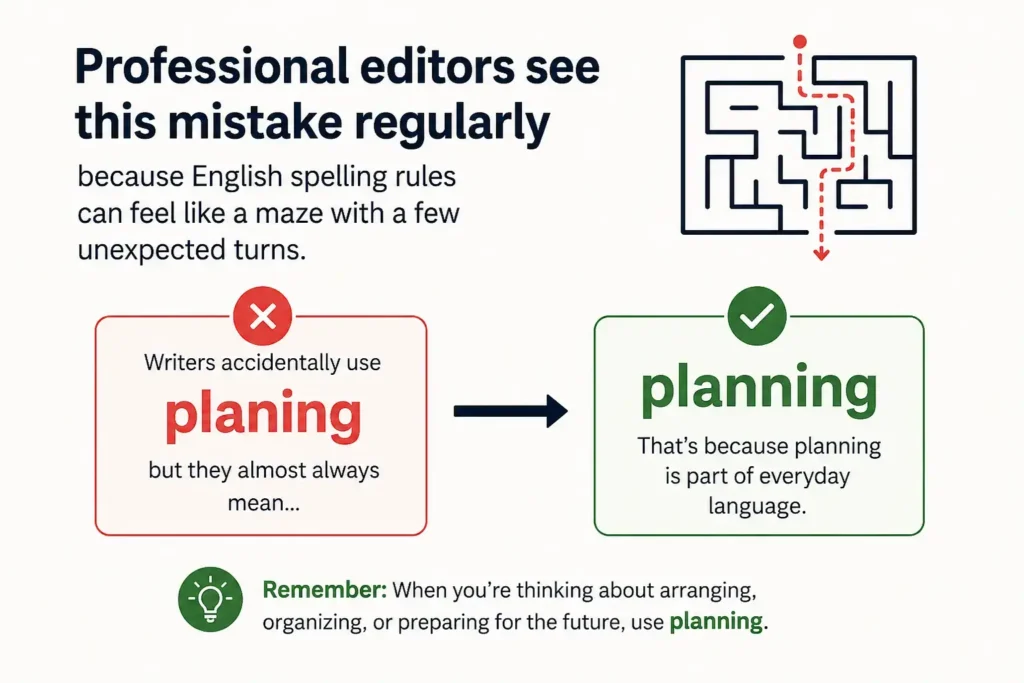
Professional editors see this mistake regularly because English spelling rules can feel like a maze with a few unexpected turns.The key observation is simple.When writers accidentally use planing, they almost always mean planning.That’s because planning is part of everyday language.People plan vacations, budgets, careers, projects, meals, meetings, and goals. The word appears constantly in modern communication.
Planing lives in a much narrower world. Carpenters, engineers, boat designers, and manufacturing specialists use it accurately because it serves a technical purpose.When editing content, one question usually resolves the issue immediately.
Ask yourself:
“Am I preparing for something or shaping something?”If you’re preparing, organizing, scheduling, or thinking ahead, the answer is planning.If you’re smoothing wood, shaping a surface, or describing specialized movement across water or air, the answer is planing.That single distinction eliminates nearly every mistake.
FAQs
Is planning the correct spelling?
Yes. Planning is the correct spelling when referring to making plans, organizing activities, preparing projects, or thinking about future actions. This is the spelling most people need in everyday writing.
Is planing a real word?
Yes. Planing is a legitimate English word. It usually refers to smoothing wood with a plane, shaping surfaces, or describing how certain boats move across water at high speeds.
Why does planning have two Ns?
The final N doubles because the base word is plan. English spelling rules often double the final consonant when adding ing to certain short words ending with a vowel followed by a consonant.
What is the difference between planning and planing?
Planning refers to preparation and organization. Planing refers to smoothing surfaces or specialized movement in woodworking, engineering, aviation, or marine contexts.
Which spelling should I use in a business email?
Use planning. Business communication almost always involves organizing, preparing, scheduling, or strategy development rather than woodworking or technical surface shaping.
How do native English speakers use these words?
Native speakers use planning frequently in daily life. Planing appears mainly in technical industries and specialized discussions involving carpentry, manufacturing, aviation, or marine engineering.
Is planing ever correct in academic writing?
Yes. It is correct when discussing woodworking, engineering, manufacturing, or marine subjects. In most academic fields, planning remains the more common word.
How can I remember the difference?
Remember the root word. Planning comes from plan. Planing comes from plane. If you’re organizing something, use planning. If you’re shaping a surface, use planing.
Many readers also check focussed or focused Correct Spelling and Usage.
Planing Or Planning Conclusion
The answer to this depends on meaning, but for most writers, the correct choice is planning.Planning relates to preparation, organization, scheduling, goal setting, and future actions. It appears in business, education, project management, personal development, and everyday conversation.Planing is also a correct word, but it belongs to specialized contexts such as woodworking, manufacturing, aviation, and marine engineering.
A simple rule works almost every time. If you’re preparing for something, choose planning. If you’re smoothing a surface or describing technical movement across water or air, choose planing. Get that distinction right, and you’ll avoid one of the most common spelling mistakes in English.