
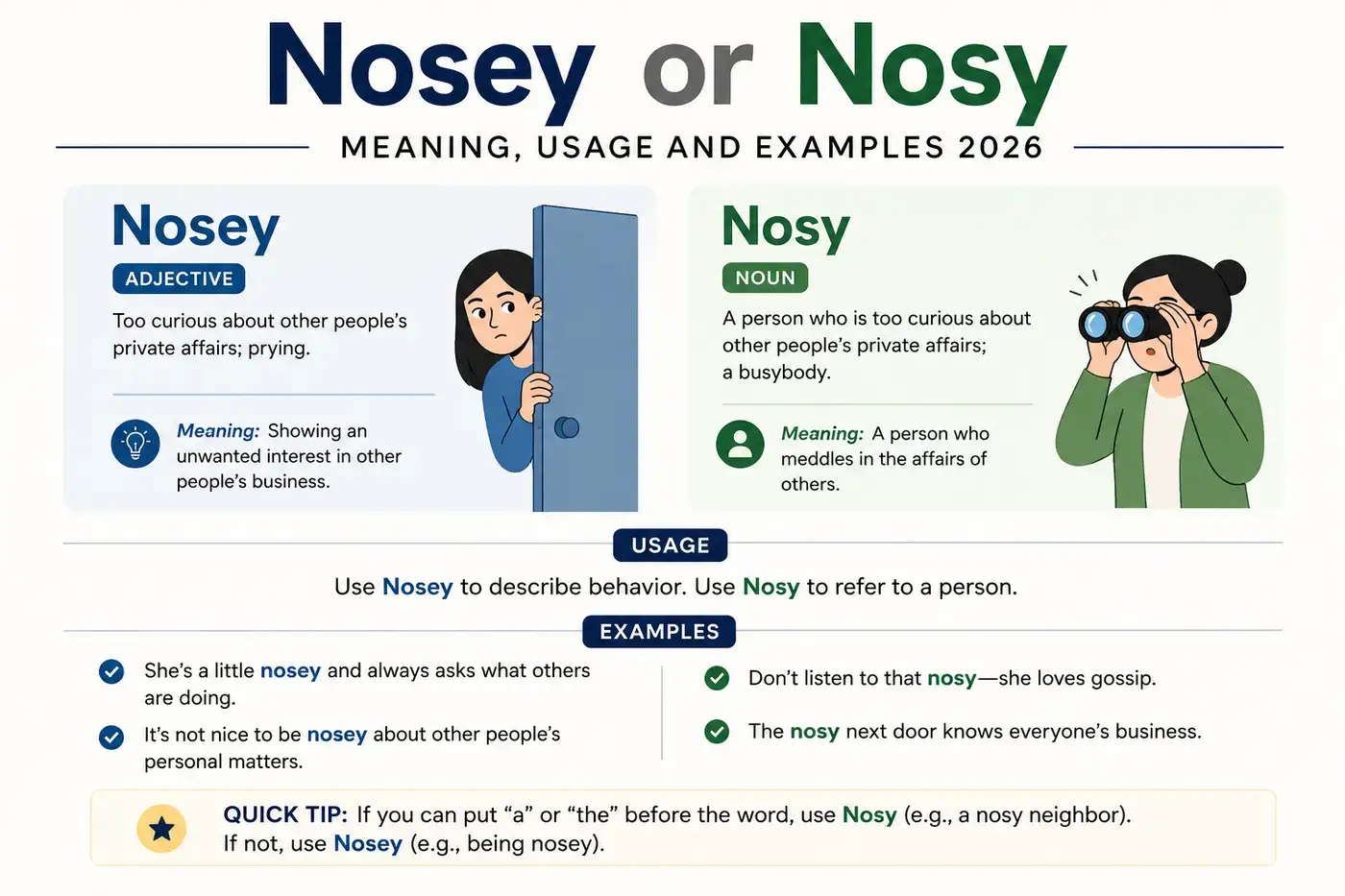
If you’ve ever paused while writing nosey or nosy, you’re not alone. The two spellings look similar, sound identical, and often appear in the same contexts. That leaves many writers wondering which version is actually correct and which one belongs in polished writing.The confusion gets worse because dictionaries recognize both spellings. You may see nosy in one article and nosey in another, making it difficult to know which form to trust.
The good news is that the answer is straightforward. Both words have the same meaning, but one spelling is much more common in modern English. Understanding the difference can help you write with confidence and avoid second guessing yourself.In this guide, you’ll learn the correct spelling, meaning, pronunciation, history, regional preferences, grammar rules, real world examples, and expert writing advice. By the end, you’ll know exactly when to use these words and which spelling most editors prefer today.
Need another quick comparison? Read Conex Or Connex Differences, Meaning and Correct Usage(2026).
Quick Definition of Nosey Or Nosy
Nosy and nosey are two accepted spellings of the same adjective. Both describe a person who is overly curious about other people’s private matters. In modern English, nosy is the preferred and more common spelling, while nosey is considered a less common variant.
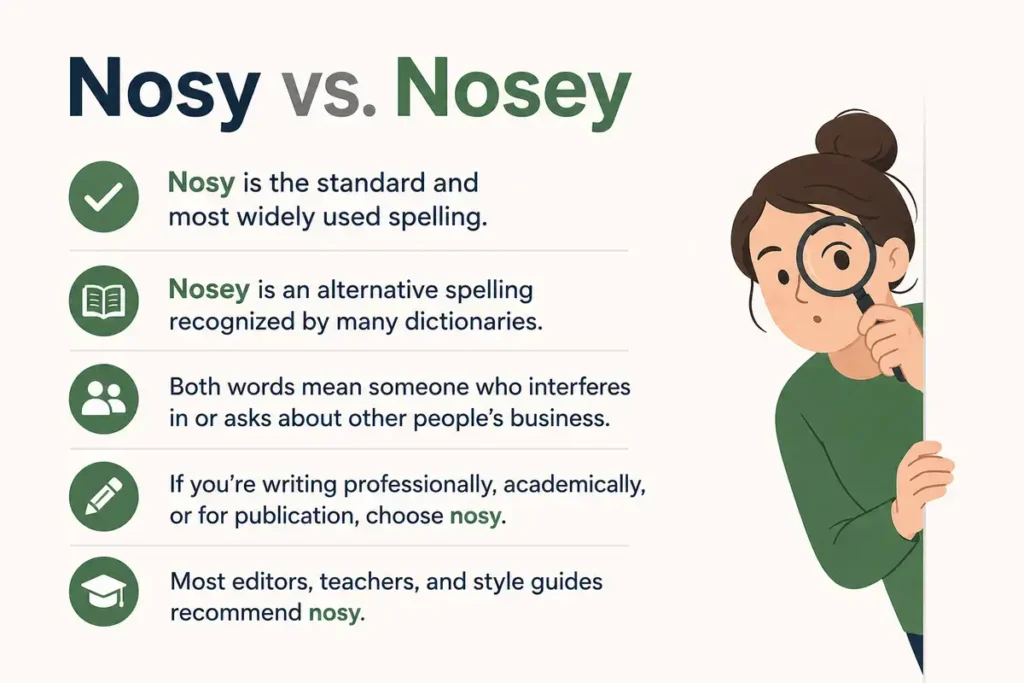
Nosey Or Nosy Quick Answer
The short answer is simple.
- Nosy is the standard and most widely used spelling.
- Nosey is an alternative spelling recognized by many dictionaries.
- Both words mean someone who interferes in or asks about other people’s business.
- If you’re writing professionally, academically, or for publication, choose nosy.
Most editors, teachers, and style guides favor nosy because it appears far more frequently in modern usage.
Nosey vs Nosy Comparison Table
| Feature | Nosy | Nosey |
|---|---|---|
| Correct spelling | Yes | Yes |
| Preferred spelling | Yes | No |
| Meaning | Overly curious about others | Overly curious about others |
| Part of speech | Adjective | Adjective |
| Pronunciation | NOH zee | NOH zee |
| Origin | Derived from nose | Derived from nose |
| Usage frequency | Very common | Less common |
| Formality level | Standard | Acceptable but less common |
| Dictionary status | Widely accepted | Accepted variant |
| Professional writing | Recommended | Usually avoided |
| Everyday conversation | Common | Sometimes used |
| Academic writing | Preferred | Rare |
Meaning Of Nosey Or Nosy
Although the spellings differ slightly, the meaning remains identical.
Meaning Of Nosy
Nosy describes a person who takes excessive interest in matters that do not concern them.The word often carries a mildly negative tone. It suggests curiosity that crosses personal boundaries.
Examples include:
- A neighbor constantly asking personal questions.
- A coworker trying to learn private office gossip.
- A relative digging into someone’s finances.
Meaning Of Nosey
Nosey carries exactly the same definition.It refers to someone who sticks their nose into situations where they are not invited or needed.The difference lies only in spelling preference, not meaning.
Nosey vs Nosy Meaning Explained
The image behind both spellings comes from the idea of putting one’s nose where it does not belong.Think of a dog sniffing around every corner of a room. That visual perfectly captures the behavior associated with a nosy person.
Someone described as nosy often:
- Asks personal questions.
- Seeks private information.
- Listens to conversations not meant for them.
- Interferes in other people’s affairs.
- Enjoys gossip and rumors.
Curiosity itself is not negative. Curiosity helps people learn and grow.Nosiness begins when curiosity ignores personal boundaries.
Nosey Or Nosy Which One Is Correct
Both spellings are technically correct. However, modern English strongly favors nosy. Language experts, editors, publishers, and educational institutions generally recommend using nosy. If your goal is clear and professional communication, nosy should be your default choice.
You can think of it this way:
- Nosy = standard spelling.
- Nosey = accepted alternative spelling.
In most cases, choosing nosy is the safer option.
Nosey and Nosy In Modern English
Modern usage data consistently shows that nosy appears much more often than nosey.
You will encounter nosy in:
- Newspapers.
- Magazines.
- Academic resources.
- Online publications.
- Professional writing.
- Educational materials.
Meanwhile, nosey still appears occasionally in novels, personal blogs, and informal writing.Because readers are more familiar with nosy, it tends to look more natural on the page.
Meaning Of Both Terms In Detail
Nosy
Definition: Excessively interested in other people’s private affairs.
Part of Speech: Adjective.
Typical Tone: Informal and mildly critical.
Example:
My nosy neighbor always wants to know who’s visiting.
Nosey
Definition: Excessively curious about matters that are not one’s concern.
Part of Speech: Adjective.
Typical Tone: Informal and mildly critical.
Example:
Her nosey questions made everyone uncomfortable.Since the definitions match perfectly, spelling preference becomes the deciding factor.
Key Differences Between Nosey and Nosy
The differences are surprisingly small.
Meaning Differences
There are no meaningful differences.Both words describe the same behavior.
Tone Differences
The tone is virtually identical.Both usually carry mild criticism.
Grammar Differences
No grammar differences exist.Each functions as an adjective.
Regional Differences
Some regions show slight preferences, but both forms are understood.
Context Differences
Professional contexts usually favor nosy.
Informal contexts may use either spelling.
Nosey and Nosy In Everyday Conversation
Native speakers use the word frequently when discussing personal boundaries.
Examples include:
- Don’t be so nosy about her salary.
- My brother can be nosy sometimes.
- The reporter asked a few nosy questions.
- Stop being nosy and let them handle it.
- She sounded nosy when she asked about their argument.
The word often appears jokingly among friends and family. The tone depends on context and delivery.
For another common grammar confusion, see Shinning or Shining Which Is Correct in 2026?.
Nosey Or Nosy Examples In Sentences
Seeing words in context makes the distinction much easier to remember.
Nosy Examples
- My nosy neighbor always notices when someone parks in the driveway.
- The reporter asked a few nosy questions during the interview.
- Stop being nosy and let them solve the problem themselves.
- Her nosy behavior annoyed everyone at the party.
- The child became nosy after hearing adults whispering.
- He sounded nosy when he asked how much money she earned.
- A nosy coworker kept asking about my vacation plans.
- The teacher reminded students not to be nosy about private matters.
- Their nosy comments made the conversation uncomfortable.
- Nobody likes dealing with a nosy person who ignores boundaries.
Nosey Examples
- My nosey aunt always wants updates about everyone’s relationships.
- The nosey customer asked questions unrelated to the service.
- She felt uncomfortable around her nosey neighbor.
- A nosey relative kept bringing up personal topics.
- His nosey attitude caused tension during family gatherings.
- The nosey journalist searched for details that were not relevant.
- Their nosey curiosity crossed a line.
- A nosey classmate tried to read her private messages.
- The nosey visitor wandered into rooms without permission.
- Everyone laughed when the nosey puppy started sniffing around the house.
Common Mistakes With Nosey Or Nosy
Many writers make the same mistakes when using these spellings.
Using Nosey In Formal Writing
While nosey is accepted, it can look unusual in professional documents.
A safer choice is nosy.
Assuming One Spelling Is Completely Wrong
Some people believe nosey is incorrect.
That is not true.
Major dictionaries recognize it as a valid variant spelling.
Confusing Curious With Nosy
Curiosity is often positive.Nosiness usually has a negative meaning because it involves unwanted interest in private matters.Compare these examples:
- She is curious about science.
- She is nosy about her coworkers’ personal lives.
The first sentence suggests healthy interest.The second suggests intrusion.
Using The Word Too Harshly
Not every question makes someone nosy.
Context matters.
A genuine concern for another person is different from unwanted prying.
Nosey vs Nosy Pronunciation Guide
The pronunciation remains the same regardless of spelling.
IPA Pronunciation
Nosy: /ˈnoʊzi/
Nosey: /ˈnoʊzi/
Syllable Breakdown
No • sy
Two syllables.
How Native Speakers Say It
The first syllable sounds like the word no.The second syllable sounds like zee in American English.Together they sound like:
NOH zee
Common Pronunciation Mistakes
- Adding an extra syllable.
- Stressing the second syllable.
- Pronouncing it as nose ee.
Native speakers place the stress on the first syllable.
Nosey Or Nosy Etymology And Word Origin
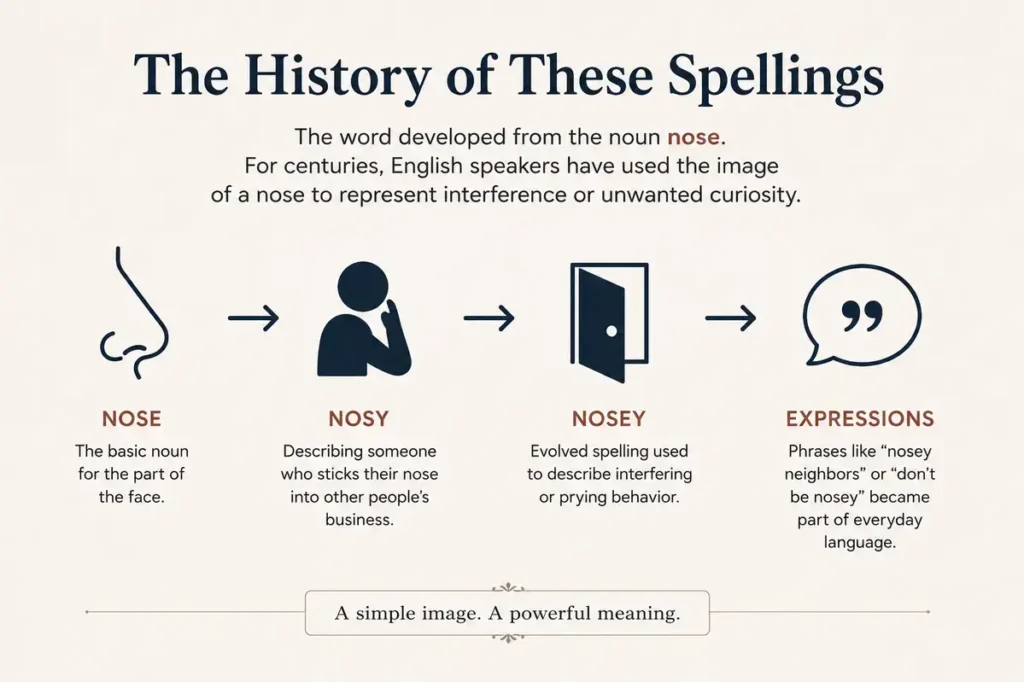
The history of these spellings is surprisingly interesting.The word developed from the noun nose.For centuries, English speakers have used the image of a nose to represent interference or unwanted curiosity.
Expressions such as:
- Stick your nose into someone’s business.
- Keep your nose out of it.
- Have your nose in everything.
helped shape the meaning. Over time, the adjective emerged to describe people who constantly inserted themselves into matters that did not concern them. Both nosy and nosey appeared in English usage. Eventually, nosy became the dominant spelling in most published writing. Today, dictionaries generally list nosy first and nosey as a variant.
Nosey vs Nosy Regional Usage
English speaking countries largely agree on the meaning of the word. The biggest difference involves spelling preference.
American English
American English strongly favors nosy.
This is the spelling most Americans expect to see.
British English
British English also prefers nosy, although nosey appears occasionally.
Canadian English
Canadian publications generally follow the nosy spelling.
Australian English
Australian writers typically choose nosy as well.
Global Preference
Across major English speaking regions, nosy has become the standard form.
That widespread preference explains why editors usually recommend it.
Grammar Rules
Understanding how the word functions grammatically helps avoid mistakes.
Part Of Speech
Both spellings function primarily as adjectives.
Examples:
- A nosy neighbor.
- A nosy reporter.
- A nosey relative.
Comparative Form
When comparing people, use:
- Nosier.
- Noseier.
Examples:
- My brother is nosier than my sister.
- That reporter became nosier after the story gained attention.
Superlative Form
Use:
- Nosiest.
- Noseiest.
Examples:
- She is the nosiest person in the office.
- He was the noseiest guest at the party.
Adverb Form
The adverb form is uncommon.
Writers usually rephrase the sentence instead of creating an adverb.
Noun Forms
Related nouns include:
- Nosiness.
- Noseiness.
Again, nosiness appears much more frequently.
Nosey and Nosy In Real Life Usage
The word appears across many types of communication.
Daily Conversation
- Stop being nosy.
- That’s a pretty nosy question.
- Don’t worry about their business.
Professional Communication
Professional writers tend to avoid direct personal labels. Still, the term appears in workplace discussions and commentary.
Example:
The employee felt uncomfortable with several nosy questions from coworkers.
Academic Writing
Academic texts rarely use the term because it is informal.
Researchers often choose phrases like:
- Excessive curiosity.
- Boundary crossing behavior.
- Intrusive questioning.
Literature
Novelists frequently use the word to reveal character traits.A single description of someone as nosy immediately creates a vivid image for readers.
Media And Entertainment
Television shows, movies, and social media regularly use the term when discussing gossip, rumors, or personal interference.
Related Words And Confused Terms
Several related words share similar meanings.
Curious
Interested in learning or understanding.
Usually positive.
Inquisitive
Eager to ask questions and gain knowledge.
Often positive.
Intrusive
Entering private matters without permission.
Usually negative.
Meddlesome
Interfering in situations unnecessarily.
Prying
Trying to uncover private information.
Snoopy
Interested in secrets or private matters.
Interfering
Getting involved where involvement is not welcome.Understanding these related words helps writers choose the most accurate term for a situation.
Nosey Or Nosy Expert Language Insight
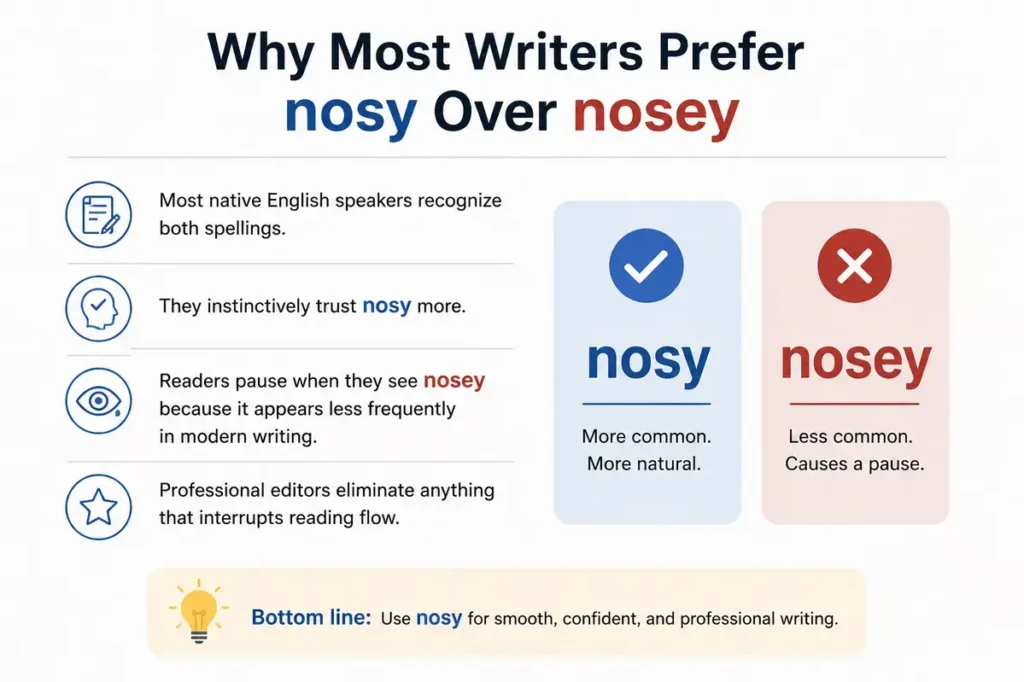
After years of editing articles, essays, business documents, and digital content, one pattern stands out.Most native English speakers recognize both spellings, but they instinctively trust nosy more.When readers encounter nosey, they often pause for a second because it appears less frequently in modern writing.That pause may seem minor, but professional editors work hard to eliminate anything that interrupts reading flow.
For that reason, experienced editors almost always choose nosy.If your goal is clarity, consistency, and credibility, use nosy unless you have a specific stylistic reason to choose the alternative spelling.
FAQs
Is nosy or nosey the correct spelling?
Both spellings are correct. However, nosy is the preferred spelling in modern English and appears far more often in books, websites, newspapers, and professional writing.
Why are there two spellings of the same word?
English has a long history of spelling variations. Over time, both forms entered common usage, but nosy eventually became the dominant spelling in most regions.
Do nosy and nosey mean different things?
No. They have the same meaning. Both describe someone who takes too much interest in other people’s private affairs.
Which spelling should I use in professional writing?
Choose nosy. It is the standard spelling preferred by editors, publishers, teachers, and style guides.
Is nosey considered wrong?
No. Many dictionaries list nosey as an accepted variant spelling. It is less common but still correct.
How do you pronounce nosy?
The word is pronounced /ˈnoʊzi/ and sounds like NOH zee.
Is being nosy always negative?
Usually yes. The word often suggests unwanted curiosity or interference. However, friends and family sometimes use it jokingly.
What is the noun form of nosy?
The most common noun form is nosiness, which refers to the habit of being overly curious about other people’s affairs.
You may also want to read share me vs share with me Which Is Correct.
Conclusion
The answer to this question is simple .Both spellings are correct, and both mean a person who takes too much interest in other people’s private matters. Still, nosy is the preferred spelling in modern English. It appears more frequently in professional writing, publishing, education, journalism, and everyday communication.
If you’re unsure which version to choose, stick with nosy. It is the spelling most readers expect and the one most editors recommend. A good rule to remember is this: curiosity helps people learn, but nosiness starts when curiosity wanders into someone else’s business.