
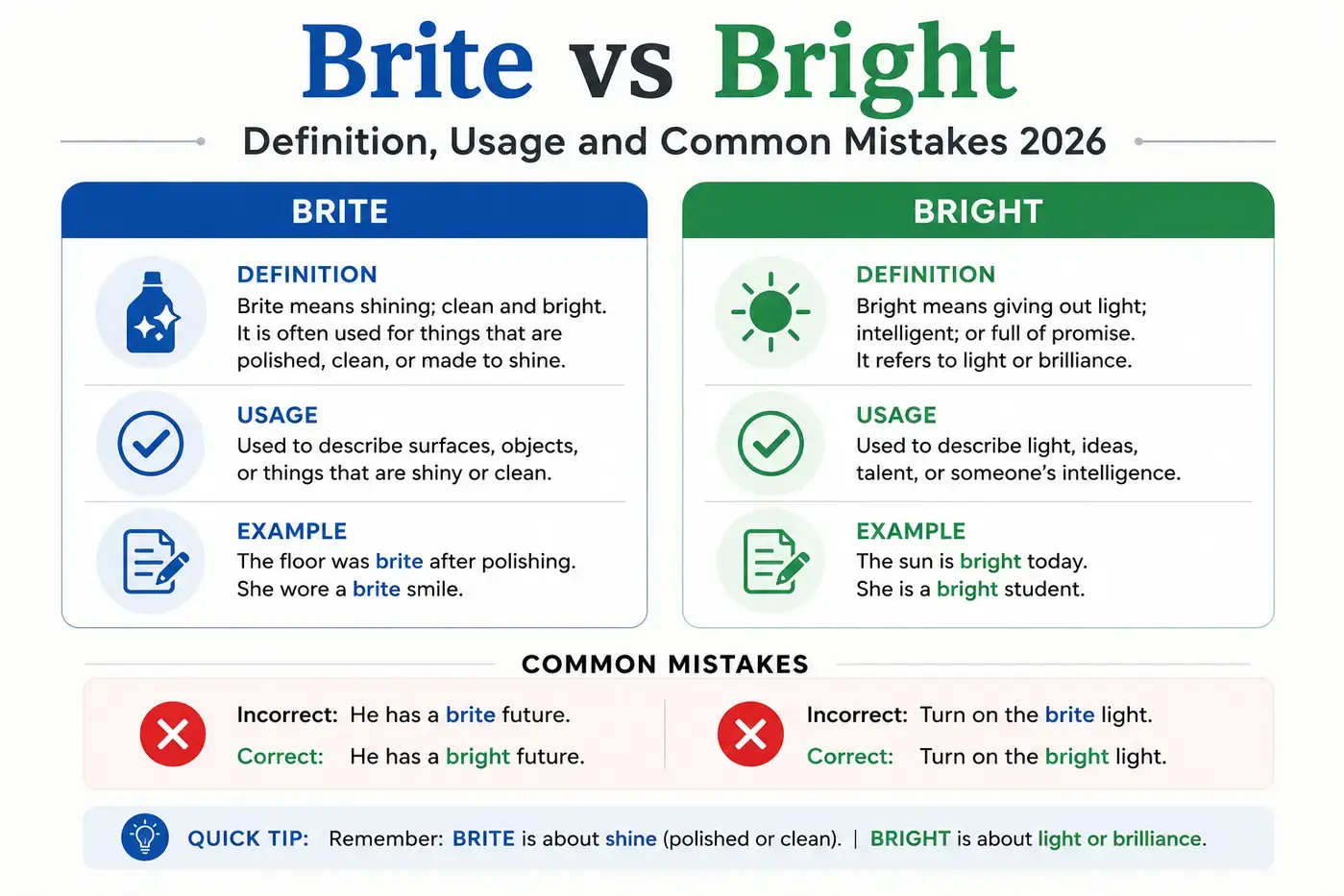
If you’ve searched for brite vs bright, you’re probably trying to figure out which spelling is correct and when each word should be used. It’s a common point of confusion because both words sound exactly the same when spoken. Yet they don’t serve the same purpose in English.
Most people encounter the word in everyday writing and assume brite is simply an alternative spelling of bright. Others see brand names or product names using brite and wonder if it’s an accepted dictionary word. The short answer is simple. Bright is the standard English word used in formal and everyday writing. Brite is usually a nonstandard spelling or a brand name variation. In most situations, you’ll want to use bright.
The confusion exists because English contains many words with silent letters and unusual spelling patterns. Since bright and brite share the same pronunciation, many writers naturally assume both spellings are equally correct.In this guide, you’ll learn the difference between the two words, their meanings, pronunciation, grammar rules, origins, examples, common mistakes, and how native speakers actually use them. By the end, you’ll know exactly which spelling belongs in your writing.
Learn the difference in Fewer Meaning And How To Use It Correctly.
Brite vs Bright Quick Definition
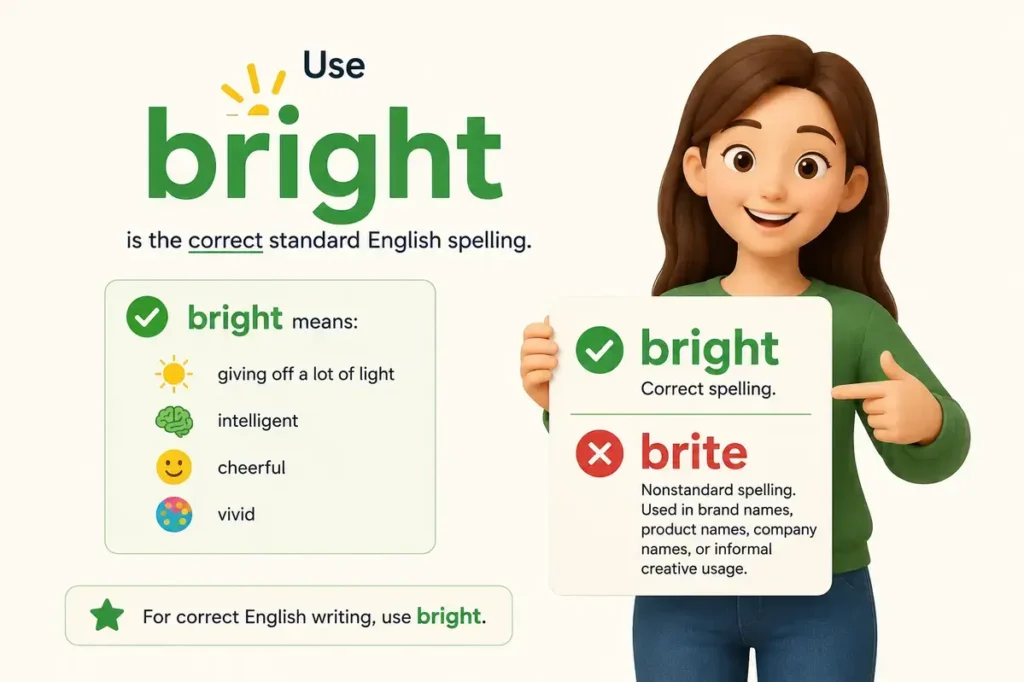
Bright is the correct standard English spelling that means giving off a lot of light, intelligent, cheerful, or vivid. Brite is generally a nonstandard spelling and is most often found in brand names, product names, company names, or informal creative usage. For correct English writing, use bright.
Quick Answer
When comparing brite vs bright, bright is the correct English word.Use bright when talking about:
- Light.
- Intelligence.
- Cheerfulness.
- Strong colors.
- A promising future.
Use brite only when referring to a specific brand, company, product, or intentionally stylized name.
Brite Vs Bright Comparison Table
| Feature | Bright | Brite |
|---|---|---|
| Correct standard English word | Yes | No |
| Dictionary recognition | Yes | Limited |
| Part of speech | Adjective primarily | Usually proper noun or stylized spelling |
| Meaning | Full of light, intelligent, cheerful, vivid | Usually intended to represent bright |
| Origin | Old English | Modern spelling variation |
| Formal writing | Appropriate | Not recommended |
| Academic writing | Appropriate | Incorrect in most cases |
| Professional communication | Appropriate | Usually incorrect |
| Brand names | Occasionally used | Frequently used |
| Everyday usage | Very common | Rare |
| Search popularity | Extremely high | Much lower |
| Accepted spelling | Yes | Generally no |
| Pronunciation | Same as brite | Same as bright |
| Common contexts | School, work, books, media | Products, companies, trademarks |
| Example | The room is bright. | Brite Clean Detergent |
Meaning Of Bright In Brite Vs Bright
The word bright has several meanings depending on context.
Bright As Light
This is the most common meaning.It describes something that produces or reflects a lot of light.
Examples:
- The sun looked bright this morning.
- The hallway became bright after the lights were switched on.
- A bright lamp helped me read comfortably.
Bright As Intelligent
The word can also describe a smart person.
Examples:
- She’s a bright student.
- Jake is bright and learns quickly.
- Their daughter is exceptionally bright.
Bright As Cheerful
It can refer to a happy personality or positive mood.
Examples:
- She greeted everyone with a bright smile.
- His bright attitude improved the team’s morale.
- The child remained bright despite the rainy weather.
Bright As Vivid
It may describe strong colors.
Examples:
- She wore a bright yellow jacket.
- The flowers displayed bright shades of red and orange.
- The artist used bright colors throughout the painting.
Bright As Promising
It can indicate a positive future.
Examples:
- The company has a bright future ahead.
- Her career prospects look bright.
- Scientists believe the technology has a bright future.
Meaning Of Brite
Unlike bright, the word brite doesn’t function as a standard English vocabulary word.
Most uses fall into one of these categories.
Brand Names
Many companies choose brite because it’s shorter and easier to market.Examples include product names, software names, cleaning products, and business brands.
Creative Spellings
Writers sometimes use brite as a stylistic alternative.
Examples:
- Event names.
- Advertising campaigns.
- Product packaging.
- Marketing slogans.
Informal Misspellings
Many instances of brite are simply spelling mistakes.People hear the pronunciation and write it phonetically.This happens frequently in online comments, social media posts, and informal messages.
Brite and Bright Meaning Differences
The biggest difference comes down to standard usage.
Bright Has Independent Meaning
The word bright carries established dictionary definitions.
It can describe:
- Light.
- Intelligence.
- Cheerfulness.
- Color intensity.
- Future potential.
Everyone understands its meaning immediately.
Brite Usually Depends On Context
The word brite rarely stands on its own.Its meaning usually comes from a product name or branding decision.Without context, many readers interpret it as a misspelling.
Brite Vs Bright Grammar Differences
Grammar provides another clear distinction.
Bright Functions As An Adjective
Examples:
- A bright room.
- A bright student.
- A bright future.
It follows standard English grammar rules.
Brite Rarely Functions Grammatically
Because it isn’t a standard adjective, brite generally doesn’t appear in formal grammatical structures.
For example:
- Correct: The room is bright.
- Incorrect: The room is brite.
In professional writing, editors would almost always correct the second sentence.
Brite or Bright Context Differences
Context matters more than many people realize.
Use bright in:
- Essays.
- Articles.
- Books.
- Emails.
- Reports.
- Academic papers.
- News content.
- Professional communication.
Use brite only in:
- Brand names.
- Product names.
- Trademarked terms.
- Creative marketing materials.
A good rule is simple.If you’re writing normal English, choose bright.
Brite or Bright Which One Is Correct
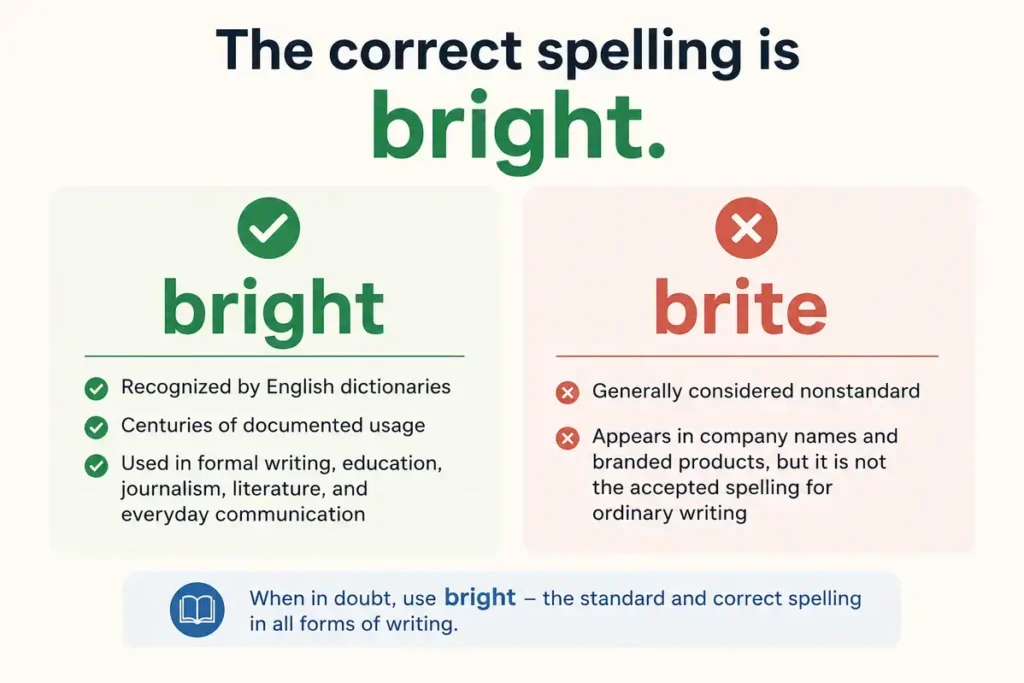
The correct spelling is bright.
English dictionaries recognize bright as the standard word. It has centuries of documented usage and appears in formal writing, education, journalism, literature, and everyday communication.The spelling brite is generally considered nonstandard. While it appears in company names and branded products, it isn’t the accepted spelling for ordinary writing.If you’re writing a school paper, business email, blog post, article, report, or social media caption, use bright.Choosing brite instead may make readers think you’ve made a spelling mistake.
Need another quick comparison? Read Grate or Great Which Word Is Correct.
Pronunciation Guide
One reason this confusion happens so often is pronunciation.The two spellings sound identical.
IPA Pronunciation
Bright:
/braɪt/
Brite:
/braɪt/
Syllable Breakdown
Bright:
- Bright
The word contains one syllable.
Common Pronunciation Mistakes
Most speakers pronounce the word correctly. The issue isn’t pronunciation. It’s spelling. People hear the sound correctly but choose the wrong written form because English spelling isn’t always phonetic.
Common Mistakes
Several mistakes appear repeatedly online.
Using Brite In Formal Writing
Incorrect:
- She has a brite future.
Correct:
- She has a bright future.
Assuming Both Spellings Are Equal
Many people believe both versions are accepted.They aren’t interchangeable in standard English.
Copying Brand Spellings
People see company names using brite and assume the spelling is universally correct.Branding rules differ from grammar rules.
Trusting Phonetic Spelling
English often breaks phonetic expectations.
The correct spelling remains bright even though brite sounds logical.
Examples In Sentences
Seeing words in real sentences often clears up confusion faster than definitions.
Ten Examples Using Bright
- The bright sunlight filled the kitchen early in the morning.
- Emma is a bright student who enjoys solving complex problems.
- We painted the walls a bright shade of blue.
- His bright smile instantly made everyone feel welcome.
- The stars looked especially bright on the clear night.
- Their startup has a bright future in the technology industry.
- She shared several bright ideas during the meeting.
- The photographer waited for bright natural light before taking pictures.
- The child remained bright and cheerful throughout the trip.
- Bright colors helped the advertisement stand out from competitors.
Ten Examples Using Brite
Keep in mind that these examples reflect brand or name usage rather than standard English.
- She bought a bottle of Brite floor cleaner.
- The company launched a new Brite software platform.
- Brite Dental opened a second office downtown.
- We ordered supplies from Brite Office Solutions.
- The conference was sponsored by Brite Technologies.
- Brite Learning introduced a new training program.
- The package featured the Brite logo prominently.
- Several retailers now carry Brite cleaning products.
- Brite Marketing expanded its services nationwide.
- Customers recognized the Brite brand immediately.
Notice something important. In every example above, Brite functions as a name rather than a regular English adjective.
Etymology And Word Origin
Word origins often reveal why one spelling became standard while another remained uncommon.
Origin Of Bright
The word bright traces back to Old English. Early forms included words such as beorht and briht.These ancient forms carried meanings connected to:
- Light.
- Radiance.
- Splendor.
- Clarity.
Over time, the spelling evolved into modern English bright.As English developed, the word gained additional meanings beyond physical light. Speakers began using it to describe intelligence, optimism, vivid colors, and promising futures.That’s why a single word now carries several related meanings.
Origin Of Brite
The spelling brite emerged much later.Unlike bright, it doesn’t have deep historical roots in traditional English vocabulary.Most appearances of brite came from:
- Commercial branding.
- Simplified spellings.
- Marketing strategies.
- Informal writing.
Businesses often prefer shorter spellings because they appear memorable and visually distinctive.As a result, brite became common in trademarks even though bright remained the accepted English word.
Regional Usage
One question many language learners ask is if certain countries prefer one spelling over the other.The answer is surprisingly simple.
American English
American English overwhelmingly uses bright.
Examples include:
- Bright future.
- Bright light.
- Bright colors.
- Bright student.
You may occasionally encounter brite in company names, but not as a standard word.
British English
British English also uses bright.Writers, journalists, teachers, and publishers follow the traditional spelling.
Examples:
- A bright morning.
- A bright child.
- A bright idea.
The spelling brite remains uncommon outside branding.
Australian English
Australian English follows the same pattern.The accepted spelling is bright.You’ll see it in schools, newspapers, government publications, and everyday communication.
Canadian English
Canadian English also prefers bright.Despite some spelling differences between Canadian and American English, there is no variation here.The standard spelling remains exactly the same.
Regional Verdict
Across major English speaking countries:
- American English uses bright.
- British English uses bright.
- Australian English uses bright.
- Canadian English uses bright.
No major English variety treats brite as the standard spelling.
Grammar Rules
Grammar helps explain why bright fits naturally into sentences.
Bright As An Adjective
Its primary role is an adjective.
Examples:
- A bright room.
- A bright child.
- A bright future.
The adjective modifies a noun.
Bright After Linking Verbs
The word frequently follows linking verbs.
Examples:
- The room is bright.
- The future looks bright.
- Her smile seems bright.
In these examples, bright describes the subject.
Comparative Form
The comparative form is brighter.
Examples:
- Today is brighter than yesterday.
- This lamp is brighter than the old one.
Superlative Form
The superlative form is brightest.
Examples:
- Venus is one of the brightest objects in the night sky.
- She was the brightest student in the class.
Noun Form
The noun form is brightness.
Examples:
- Adjust the screen brightness.
- The brightness of the sun made it difficult to see.
Adverb Form
The adverb form is brightly.
Examples:
- The stars shone brightly.
- The sign was brightly lit.
Can Brite Follow These Rules
Generally no.
Since brite is not a standard adjective, it doesn’t naturally produce accepted grammatical forms in ordinary English.
Forms such as:
- Briter.
- Britest.
- Briteness.
are not recognized standard English words.
Real Life Usage Examples Of Bright
Language becomes easier to understand when you see how native speakers use it in different settings.
Daily Conversation
- It’s bright outside today.
- You have a bright smile.
- That’s a bright idea.
Academic Writing
- Researchers observed bright light emissions during testing.
- The bright student achieved exceptional results.
- Bright minds often thrive in challenging environments.
Professional Communication
- We see a bright future for the organization.
- The team proposed several bright solutions.
- Market forecasts remain bright for next year.
Literature
Writers frequently use bright to create imagery.Examples include descriptions of:
- Bright stars.
- Bright skies.
- Bright eyes.
- Bright mornings.
The word helps readers visualize scenes instantly.
Media And Journalism
News articles often use bright in figurative ways.
Examples:
- Bright prospects for economic growth.
- Bright young talent entering the industry.
- Bright outlook for investors.
Related Words And Confused Terms
People searching for these words often confuse several related words.
Bright And Brilliant
Both can describe intelligence.However, brilliant suggests a higher level of intellectual ability.
Bright And Smart
These words frequently overlap.Smart is more common in everyday conversation.Bright often sounds slightly more formal.
Bright And Intelligent
The meanings are similar.Intelligent focuses more directly on mental ability.
Bright And Shiny
A bright object produces or reflects a lot of light.A shiny object reflects light from its surface.They aren’t always the same thing.
Bright And Vivid
Both can describe strong colors.Vivid emphasizes intensity and richness.
Bright And Light
A light source produces illumination.Something bright appears full of illumination.The meanings are connected but not identical.
Commonly Misspelled Variants
- Brite.
- Brigt.
- Briht.
- Brigth.
Among these spellings, only bright is correct.
Expert Language Insight
After years of editing articles, business documents, academic papers, and web content, one pattern appears again and again.Native speakers almost never choose brite intentionally in standard writing.When editors encounter brite, they typically assume one of two things:
- It’s a spelling error.
- It’s part of a brand name.
That’s important because language is ultimately about communication.A reader shouldn’t have to pause and wonder what you meant.The word bright communicates instantly. Every fluent English speaker recognizes it.The spelling brite creates friction because readers may stop and question the word.Professional writers generally follow a simple principle.Use standard spellings unless there’s a specific reason not to.In this case, that means choosing bright almost every time.
FAQs
Is brite a real word?
Brite exists as a spelling found in brand names and trademarks. However, it is not the standard English spelling used in formal writing. In most situations, bright is the correct choice.
Which spelling is correct brite or bright?
Bright is the correct standard English spelling. Dictionaries, schools, publishers, and professional writers use bright rather than brite.
Why do brite and bright sound the same?
English contains many words whose spelling doesn’t perfectly match pronunciation. Both words are pronounced the same way even though only bright is the accepted standard spelling.
Can I use brite in an essay?
No. Academic writing should use bright unless you are specifically referring to a company, product, or brand named Brite.
Is brite accepted in American English?
American English recognizes bright as the standard spelling. Brite appears mainly in commercial names and marketing materials.
What does bright mean?
Bright can mean full of light, intelligent, cheerful, vivid in color, or promising for the future. The exact meaning depends on context.
Is bright an adjective?
Yes. Bright primarily functions as an adjective. It describes nouns such as light, student, future, color, smile, or idea.
Why do companies use the spelling brite?
Many businesses choose brite because it is short, memorable, and distinctive. Creative spellings can help brands stand out while still sounding familiar to customers.
Still confused? Compare Cheff or Chef: Definition, Examples and Common Mistakes 2026.
Conclusion
The answer in the brite vs bright debate is straightforward. Bright is the correct and accepted English spelling. It appears in dictionaries, academic writing, professional communication, literature, journalism, and everyday conversation. Brite is usually a stylized spelling used in brand names, product names, and marketing materials. Outside those specific situations, it is generally viewed as a misspelling.
Remember this simple rule.If you’re writing standard English, choose bright.Use brite only when you’re referring to a name that officially uses that spelling.That small distinction will keep your writing accurate, professional, and easy for readers to understand.