
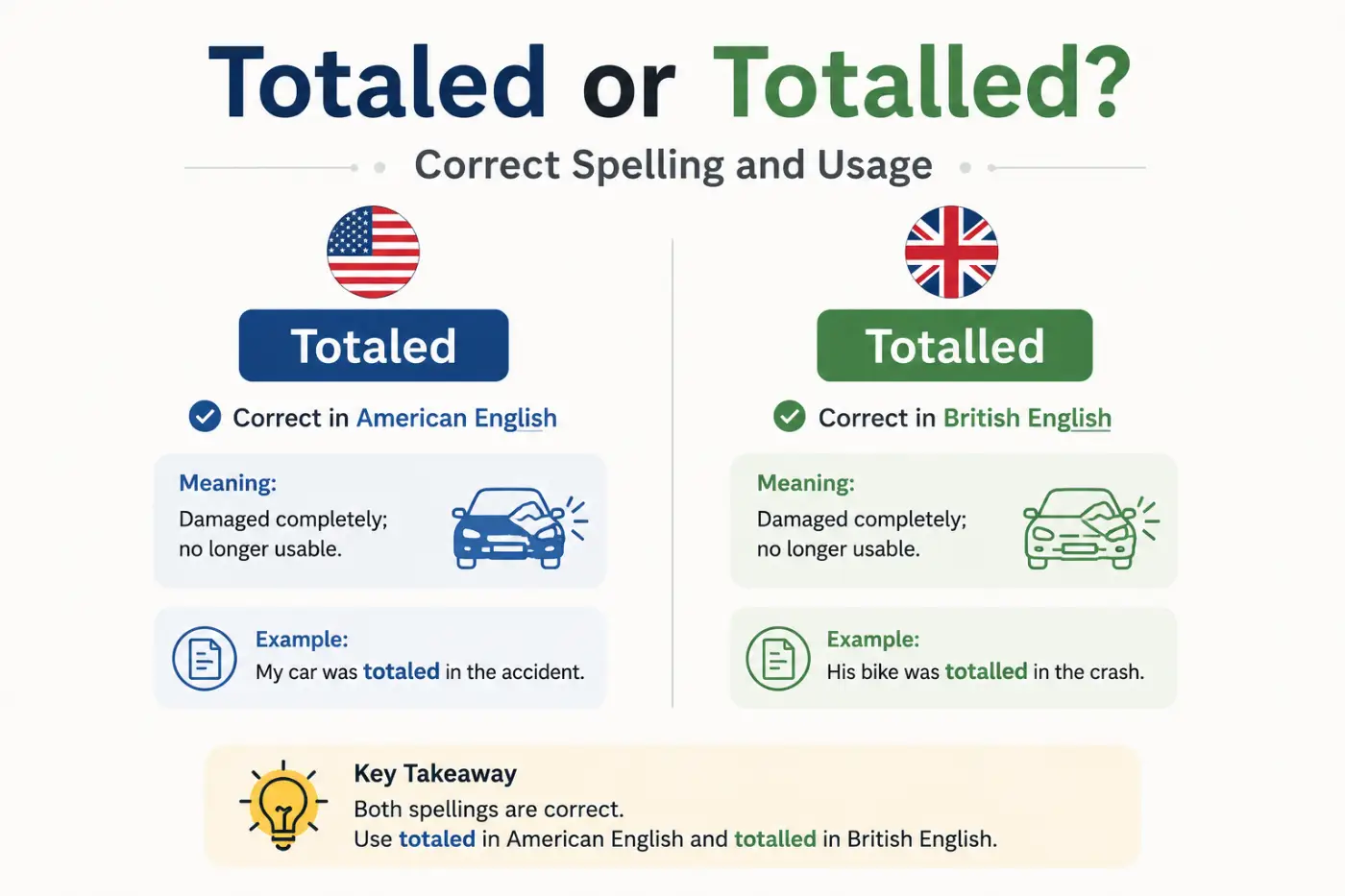
Few spelling questions look as simple as this one until you have to choose between the two forms. If you’re writing about a damaged car a financial figure or the final amount of a calculation you may pause over the spelling and wonder which version belongs on the page.
Both totaled and totalled are correct. The difference comes from regional spelling conventions rather than a difference in meaning. American English normally uses totaled with one l before the ending. British English normally uses totalled with two l’s. Canadian English can use either pattern depending on the style being followed.
The confusion comes from a familiar English spelling pattern. Words ending in a single consonant sometimes double that consonant when an ending is added. American English and British English don’t always apply that pattern in exactly the same way. The result is two accepted spellings that look different but perform the same grammatical job.
This guide explains the difference in plain English. You’ll learn which form to use in American writing how British English handles it why the spelling changes where the verb comes from how to pronounce it and how native speakers use it in everyday sentences. You’ll also see examples that make the rule easy to remember.
Learn the difference in Ensure vs Insure Meaning, Usage and Key Differences 2026.
Quick Definition
Totaled is the standard American English spelling of the past tense and past participle of total. Totalled is the standard British English form. Both can mean added up to a complete amount or damaged something so badly that it cannot reasonably be repaired. The spelling depends mainly on regional English conventions.
Quick Answer
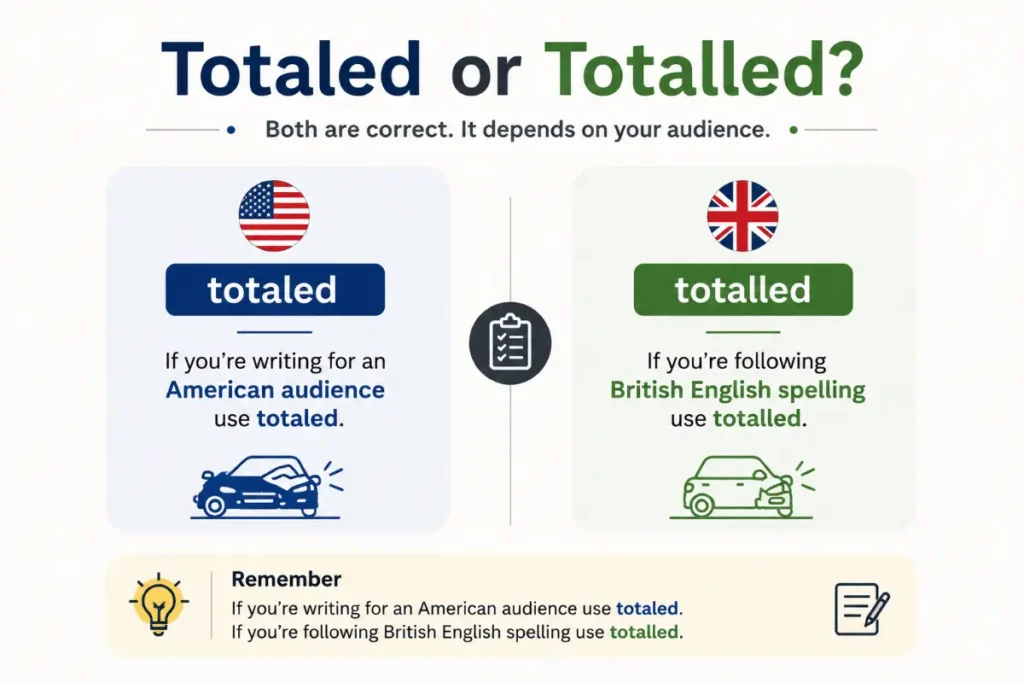
If you’re writing for an American audience use totaled. If you’re following British English spelling use totalled.
The meaning stays the same. The extra l is a spelling difference tied to regional convention rather than a difference in grammar or definition. Oxford lists totalled as the British form and totaled as the US form.
Comparison Table
| Correct Form | Meaning | Part of Speech | Origin | Usage Frequency | Formality | Common Contexts | Example |
|---|---|---|---|---|---|---|---|
| Totaled | Added up to an amount or damaged something beyond practical repair | Verb | From total | Common in American English | Standard | US writing business reports insurance and everyday speech | The repairs totaled five thousand dollars. |
| Totalled | Added up to an amount or damaged something beyond practical repair | Verb | From total | Common in British English | Standard | UK writing business reports finance and everyday speech | The repairs totalled five thousand pounds. |
Meaning and Definition
Meaning of Totaled
Totaled is the American English past tense and past participle of total. It has two especially common uses.
First it can describe an amount that has been added together.
For example:
The expenses totaled $4,500.
Here the word tells you that the combined expenses came to $4,500.
Second it can describe something that has been destroyed or damaged so badly that it is considered beyond economical repair. This use is especially common in North American English when people talk about cars.
For example:
The accident totaled her car.
In that sentence totaled doesn’t mean someone added numbers together. It means the vehicle was damaged severely enough to be considered a total loss. Cambridge identifies this as a mainly US use of the verb.
Totaled isn’t slang and it isn’t an incorrect shortened form. It is a standard spelling in American English.
Meaning of Totalled
Totalled has the same meanings as totaled. The main difference is spelling.
British English normally doubles the l before the past tense ending. Cambridge lists totalled as the past simple and past participle of total.
You might see it in sentences such as:
The costs totalled £8,000.
The donations totalled more than £20,000.
The figures were totalled at the end of the report.
The spelling doesn’t change the underlying meaning. If an American writer changes totalled to totaled the meaning remains intact. The same applies when a British writer uses totalled instead of the American form.
Key Differences Explained
- Spelling
American English normally writes totaled. British English normally writes totalled. The difference is the second l.
- Grammar role
Both forms are past tense and past participle forms of the verb total. They can describe a completed calculation or a completed action.
- Meaning
Both forms can mean reached a particular amount. In North American English totaled can also mean damaged a vehicle so badly that it is considered beyond repair.
- Tone
Neither spelling is more formal or more intelligent. Both are standard forms. The right choice depends on the English variety used in the surrounding text.
- Context
American publications usually favor totaled. British publications generally favor totalled. A consistent house style matters more than trying to make one spelling universal.
Which Spelling Is Correct
Both spellings are correct.
For American English the preferred form is totaled. For British English the preferred form is totalled. Oxford’s learner dictionaries show totalled as the standard British past form and totaled as the US form. Its American English entry specifically gives totaled as the past form.
Cambridge follows the same distinction. Its American dictionary material shows the US pattern with one l while its British entries use totalled.
That gives you a dependable rule.
If your audience is primarily in the United States write totaled.
If your audience is primarily in the United Kingdom write totalled.
If you’re editing a document that already follows one regional spelling system keep the same pattern throughout. Consistency makes your writing look polished and intentional.
Sentence Examples
Here are natural examples using the American form.
- The restaurant’s sales totaled $18,000 last month.
- The three invoices totaled more than $7,500.
- The repair bill totaled almost as much as the car was worth.
- The team totaled 42 points in the first half.
- Donations totaled $25,000 by the end of the campaign.
- The accident totaled my older sedan.
- Her expenses totaled less than she expected.
- The project costs totaled $1.2 million.
- The survey responses totaled 850 participants.
- The damage totaled thousands of dollars.
Now compare the British spelling.
- The restaurant’s sales totalled £18,000 last month.
- The three invoices totalled more than £7,500.
- The repair bill totalled almost as much as the car was worth.
- Donations totalled £25,000 by the end of the campaign.
- The project costs totalled £1.2 million.
The meaning doesn’t change. Only the regional spelling does.
Common Misspelling Examples
If you’re writing American English these forms are standard:
The expenses totaled $2,000.
The losses totaled $50,000.
The repairs totaled $3,500.
If you’re writing British English these forms are standard:
The expenses totalled £2,000.
The losses totalled £50,000.
The repairs totalled £3,500.
A related grammar guide is Momment or Moment Which Spelling Is Correct.
Common Mistakes and Misspellings
Spelling mistakes around this word usually happen because English has several competing patterns for adding endings.
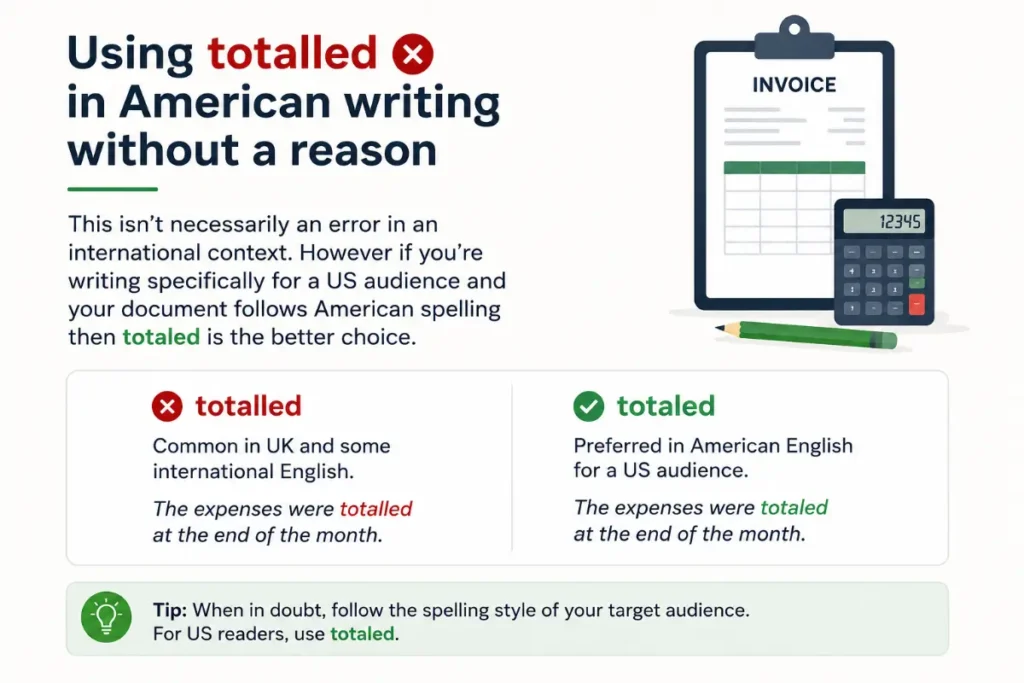
- Using totalled in American writing without a reason
This isn’t necessarily an error in an international context. However if you’re writing specifically for a US audience and your document follows American spelling then totaled is the better choice.
- Using totaled in a strongly British document
British readers understand the form easily. Still a document that otherwise uses British spelling will normally look more consistent with totalled.
- Changing the spelling inside one document
A report that uses totaled in one section and totalled in another can look poorly edited. Pick the regional style and stick with it.
- Assuming the extra l changes pronunciation
It doesn’t. Both forms are pronounced the same. The spelling difference doesn’t create a different spoken word.
- Confusing the past form with the present form
The present form is total.
The third person singular form is totals.
The past form is totaled in American English and totalled in British English.
The continuous form follows the same regional pattern. American English generally uses totaling while British English uses totalling. Cambridge and Oxford both document this distinction.
Why People Type Totaled or Totalled Differently
There is a useful NLP angle here. People don’t process spelling one letter at a time. Familiar patterns and learned word shapes strongly influence how they write.
The word total creates a predictable mental base. When a writer adds a past tense ending the spelling system of their regional English takes over. American English generally favors the shorter form totaled. British English favors totalled.
There is also visual interference from related words such as cancelled, travelled, and labelled in British English. A writer who has learned those patterns may naturally expect another l in totalled.
On the other hand an American writer who has learned forms such as traveled, canceled, and labeled may naturally choose totaled.
This isn’t random. It reflects a broader spelling system.
Pronunciation Guide
The pronunciation is essentially the same in both regional forms.
Cambridge gives the American pronunciation of total as approximately /ˈtoʊ.t̬əl/ and the British pronunciation as approximately /ˈtəʊ.təl/.
For the past form you can think of the pronunciation as:
TOH tuld in a simple American style.
The word has two main syllables.
TOH is the stressed syllable.
tuld is the unstressed second syllable.
The written double l in totalled doesn’t mean you pronounce two separate l sounds. The extra letter belongs to the spelling convention.
A common pronunciation mistake is to treat the word as though every written letter deserves a strong sound. English doesn’t work that way. Spelling and pronunciation often live by slightly different rules.
If you’re speaking naturally the difference between totaled and totalled won’t normally be heard. The distinction appears on the page rather than in ordinary speech.
Etymology and Word Origin
The story behind total reaches back much further than modern American and British spelling.
Oxford traces the word to late Middle English. It entered English through Old French from medieval Latin totalis. The Latin source relates to totum meaning the whole and totus meaning whole or entire.
The verb developed later. Oxford dates the verb’s early sense of adding things together to the late sixteenth century.
That history helps explain why the word can work in several grammatical roles today.
As a noun total means the complete amount.
As an adjective total means complete or entire.
As a verb total can mean to add amounts together or reach a complete amount.
In North American informal usage the verb can also describe destroying a vehicle so badly that repairing it doesn’t make financial sense. Oxford and Cambridge both record this sense.
The regional spellings developed within broader English spelling conventions. British English retained or developed many doubled consonant patterns while American English often adopted shorter spellings in comparable forms.
So the two spellings aren’t competing for linguistic survival. They’re two standard branches of the same word.
Regional Usage
United States
American English normally uses totaled.
This applies to both major meanings of the verb. You can write that expenses totaled $5,000 or that an accident totaled a car.
American English also commonly uses totaling for the continuous form. Oxford’s American English dictionary gives totaled and totaling as the standard forms.
If you’re writing an American resume report article email or school assignment use totaled unless you’re intentionally following another style.
United Kingdom
British English normally uses totalled.
The same spelling applies to the past tense and past participle. British English also commonly uses totalling for the continuous form.
Cambridge lists totalled as the past simple and past participle of total. Oxford gives the same British pattern.
Australia
Australian English generally follows British spelling conventions. As a result totalled is the expected form in standard Australian writing.
A particular organization may have its own style guide. When editing professional content always follow the publication’s established spelling system.
Canada
Canadian English can show more variation because Canadian writing sits between British and American traditions.
Oxford specifically notes totaled as the American form and identifies totalled as a Canadian variant in its American English dictionary material.
That means Canadian writers may encounter both forms. The safest approach is to follow the style guide used by the school employer publication or organization.
Grammar Rules and Part of Speech
Total is a verb when it describes adding amounts or reaching a complete amount.
For example:
The expenses total $9,000.
The verb is in the present tense.
To describe a completed action use the past form.
American English:
The expenses totaled $9,000.
British English:
The expenses totalled £9,000.
You can also use the past participle after forms of have.
American English:
The expenses have totaled $9,000.
British English:
The expenses have totalled £9,000.
The word can also take an object.
The accountant totaled the figures.
In this structure the accountant performed the calculation.
Another common construction doesn’t need a direct human subject.
The figures totaled $9,000.
Here the figures themselves represent the final combined amount.
Placement in a Sentence
The verb usually appears after the subject.
The costs totaled $4,000.
The donations totaled $12,000.
The losses totaled $1 million.
When the word describes a vehicle being destroyed in an accident it also works as a normal transitive verb.
The insurer totaled the vehicle.
The crash totaled her car.
Punctuation
There is no special punctuation rule for the word itself.
Use normal sentence punctuation.
The repairs totaled $6,000.
The repairs totaled $6,000, but the insurer covered most of the cost.
The comma in the second example comes from the sentence structure. It has nothing to do with the spelling of totaled.
Real Life Usage Examples
Daily Talk
People use this word naturally when discussing money numbers or accidents.
The groceries totaled about $180.
The mechanic said the accident totaled the car.
These examples show two different meanings of the same verb. Context tells the listener which meaning applies.
Professional email often uses the word when discussing costs.
The three invoices totaled $14,250.
The expenses have totaled more than we budgeted.
This usage is direct and professional. You don’t need a fancier word.
Academic Writing
Academic and research writing can use the verb to describe data.
The responses totaled 1,200 completed surveys.
The samples totaled 340 observations across four groups.
In academic writing precision matters. If you’re describing a numerical sum totaled or totalled can be perfectly appropriate depending on your regional style.
News Writing
News reports frequently use the verb when discussing financial figures casualties votes or other measurable quantities.
The losses totaled millions of dollars.
The donations totalled more than the organizers expected.
The construction costs totaled $40 million.
The style depends on the publication’s regional English.
Literature
The word can also appear in narrative writing.
By sunset the day’s expenses had totaled more than he could afford.
The damage totalled far more than anyone first expected.
In fiction the choice still follows the author’s chosen variety of English.
Expert Editor Insight
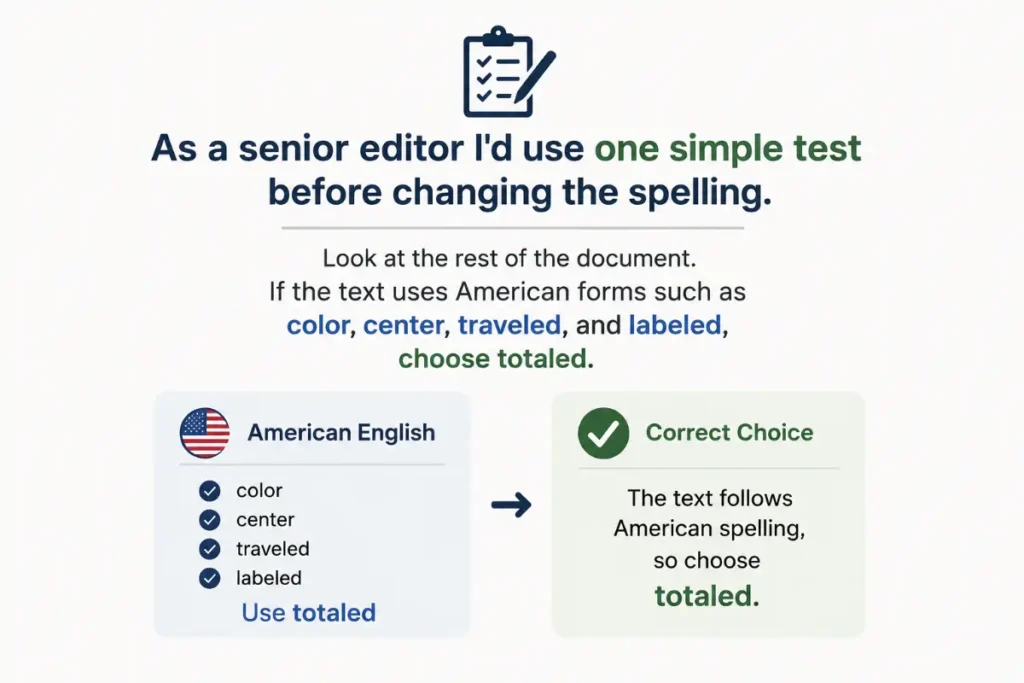
As a senior editor I’d use one simple test before changing the spelling. Look at the rest of the document. If the text uses American forms such as color, center, traveled, and labeled, choose totaled. If it uses British forms such as colour, centre, travelled, and labelled, choose totalled. Most professional spell checkers will flag one form only when a particular regional dictionary is selected. That doesn’t mean the flagged version is universally wrong. It often means the software is enforcing a chosen language setting.
Expert Tip
Don’t memorize this word in isolation. Memorize the regional pattern around it.
If you’re writing for the United States think totaled and totaling.
If you’re writing for British English think totalled and totalling.
That approach is much easier than trying to remember the spelling from scratch every time.
Need another quick comparison? Read Kinesthesiology vs Kinesiology Simple Rules Explained 2026.
Conclusion
Totaled or totalled can both be correct. American English normally uses totaled while British English normally uses totalled. The two spellings have the same meaning and grammatical role. The difference comes from regional spelling conventions rather than pronunciation or definition.
If you’re writing for a US audience use totaled for the past tense and past participle of total. If you’re following British English use totalled. Oxford and Cambridge both support this regional distinction.
The easiest practical tip is to match the spelling style used throughout your document. Don’t treat the extra l as a mistake. Treat it as a regional spelling signal. Once you connect totaled with American English and totalled with British English the choice becomes as easy as adding up the numbers themselves.
FAQs
Is Totaly a Real Word?
No. Totaly isn’t the standard spelling of the word in English. The correct forms are totally for the adverb and totaled or totalled for the past tense and past participle of the verb total. If you mean completely you need totally. If you mean added up or destroyed beyond repair you may need totaled or totalled instead.
What Does Totaled Mean?
Totaled is the standard American English past tense and past participle of total. It can mean that amounts were added together to reach a final figure. In North American English it can also mean that a vehicle was damaged so badly that it is considered a total loss. The British spelling is totalled.
Totaled or Totalled Which Is Correct?
Both are correct. Totaled is the standard American English spelling while totalled is the standard British English spelling. The two forms have the same meaning and grammatical function. Choose totaled for most US writing and totalled for most UK writing. Canadian usage can include both forms depending on the style being followed.
How Do You Pronounce Totaled?
Totaled is pronounced with two main syllables and sounds approximately like TOH tuld in natural American speech. The British form totalled has essentially the same pronunciation. The extra l in the British spelling doesn’t create an extra spoken syllable. The exact vowel quality can vary between American and British accents.
Can Totaled Start a Sentence?
Yes. A past tense verb can appear at the beginning of a sentence when the sentence structure supports it. For example you might write Totaled together the expenses came to $4,000 but this construction sounds awkward. A clearer sentence would be The expenses totaled $4,000. In normal writing put the subject before the verb.
What Is a Synonym for Totaled?
The best synonym depends on the meaning. When totaled means added together you can use amounted to, added up to, or came to. When it means a vehicle was destroyed beyond repair you might use wrecked, destroyed, or written off depending on the regional context. No single synonym fits every use.
Why Do People Misspell Totalled?
People often hesitate because English spelling conventions differ across regions. American English commonly removes the extra l in forms such as totaled while British English retains it in totalled. Writers may also switch between regional spelling systems without realizing it. Spell checkers can add to the confusion when their language setting doesn’t match the writer’s intended audience.
Is Totaled Suitable for Formal Writing?
Yes. Totaled is completely suitable for formal American English. You can use it in reports academic writing financial documents news writing and professional communication when it means reached a particular amount. British English normally uses totalled in the same contexts. The spelling itself isn’t casual or informal. The regional convention determines which version looks standard.