
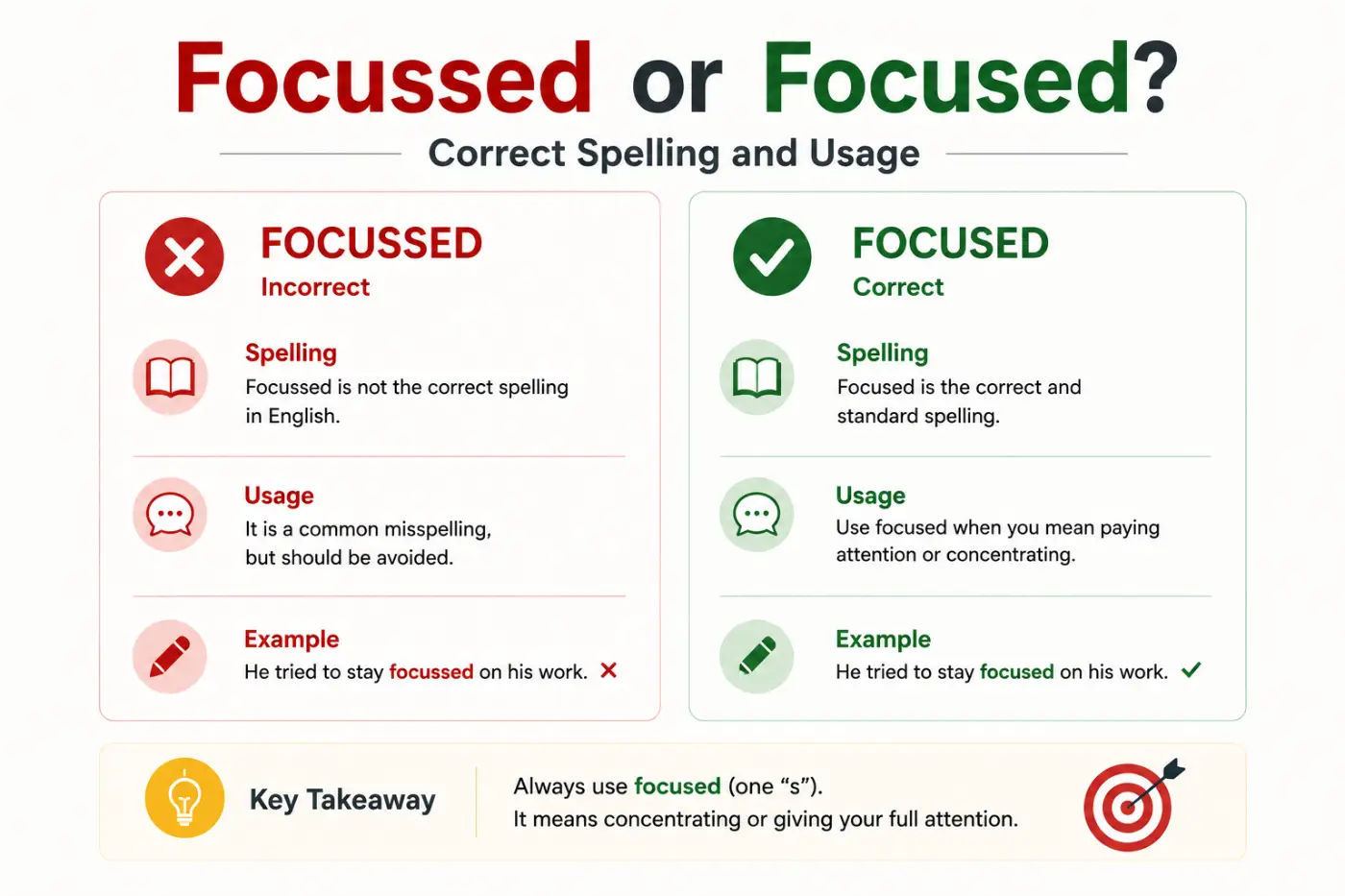
Few spelling questions cause more hesitation than focussed or focused because both forms look right. If you’ve seen both in books, articles, emails, and professional documents, it’s reasonable to wonder if one is a mistake.Both focused and focussed are correct English spellings. The main difference is regional and stylistic rather than grammatical.
Focused is the preferred spelling in American English, while focussed is widely used in British English and other varieties that commonly follow British spelling conventions. Major dictionaries such as Cambridge and Oxford list both forms. The confusion comes from the verb focus and the way English handles verbs ending in a consonant before a suffix. American English usually uses one s in focused, while British English often uses two s letters in focussed.
Both forms describe the same idea. They can mean giving close attention to something or making something clear in a camera or image. This guide explains the spelling difference, meaning, pronunciation, grammar, regional preferences, word history, sentence structure, common mistakes, and real life usage. By the end, you’ll know exactly which form to choose for American writing and why the other form still appears in reputable English sources.
Many readers also check Clutz or Klutz Meaning, Usage and Correct Form 2026.
Quick Definition
Focused and focussed are both correct spellings of the past tense and past participle of focus and also of the related adjective. Focused is the standard choice in American English. Focussed is common in British English. The two forms have the same meaning and pronunciation.
Quick Answer
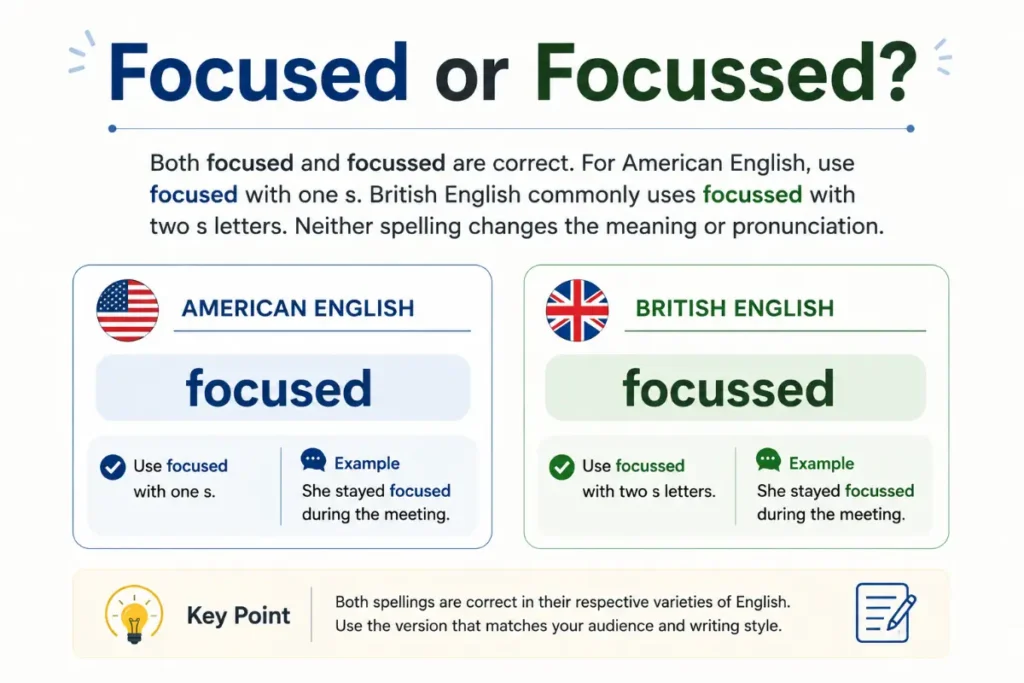
Both focused and focussed are correct. For American English, use focused with one s. British English commonly uses focussed with two s letters. Neither spelling changes the meaning or pronunciation.
If you’re writing for a US audience, focused is the safest and most natural choice. If you’re following British English conventions, focussed is perfectly acceptable.
Comparison Table for focussed or focused
| Correct Form | Meaning | Part of Speech | Origin | Usage Frequency | Formality | Common Contexts | Example |
|---|---|---|---|---|---|---|---|
| focused | Giving attention to something or directed toward a clear goal | Verb form and adjective | From focus plus ed | Very common in American English | Neutral and formal | US writing, business, education, journalism, everyday English | She stayed focused on her goal. |
| focussed | Giving attention to something or directed toward a clear goal | Verb form and adjective | From focus plus ed with British spelling convention | Very common in British English | Neutral and formal | UK writing, Commonwealth English, academic writing, journalism | She stayed focussed on her goal. |
Meaning and Definition
Meaning of Focused
Focused has several connected meanings. The most common meaning describes someone who gives strong attention to a particular task, subject, person, or goal.
For example:
She stayed focused during the meeting.
The sentence tells us that she kept her attention on the meeting instead of becoming distracted.
Focused can also describe something designed around a particular purpose.
The company developed a focused marketing strategy.
Here the word suggests that the strategy has a clear target rather than trying to cover everything at once.
Focused can describe an image or photograph too. A focused photograph is clear because the camera has adjusted the lens correctly.
The image is sharply focused.
Cambridge lists focused as an adjective meaning to give a lot of attention to one particular thing. It also gives a separate sense connected with a clear photograph.
The word can also describe someone with clear goals.
She is highly focused on her studies.
In this sentence, focused suggests concentration, direction, and purpose.
Meaning of Focussed
Focussed has exactly the same basic meaning as focused. The difference lies in spelling rather than meaning.
A British writer might say:
The team remained focussed on the main objective.
An American writer would normally write:
The team remained focused on the main objective.
The meaning stays the same.
Oxford lists focused as an adjective and explicitly gives focussed as an alternative spelling. Its American English dictionary also lists focused with focussed as the alternative.
That point is worth remembering because people sometimes assume that one spelling must be an error. It isn’t. Both forms have a place in standard English.
The Meaning of Focus
Understanding the base word makes the spelling difference easier to understand.
Focus can work as both a noun and a verb.
As a noun, focus refers to the main point of attention or interest.
The main focus of the report is education.
As a verb, focus means to direct attention toward something or to adjust a camera or similar device so that an image becomes clear.
Please focus on the instructions.
The photographer focused the camera on the building.
Cambridge recognizes these meanings and also notes that focus can refer to careful attention given to a task. When focused is formed from the verb focus, it carries those ideas into the past tense and past participle.
Key Differences Explained
Spelling
The only visible difference is the number of s letters.
American English generally uses focused.
British English commonly uses focussed.
Neither form has a different meaning.
Grammar Role
Both forms can function as the past tense and past participle of focus.
The team focused on the problem.
The team has focused on the problem.
They can also function as adjectives.
She is focused.
He is focussed on his career.
The grammatical role doesn’t change because the spelling changes.
Meaning
Both forms mean the same thing. They can describe concentration, attention, direction, or a clear image. There isn’t a separate definition for focussed.
Tone
Neither spelling is more intelligent, sophisticated, or formal. The choice mainly reflects the variety of English you’re using.
Focused feels natural to American readers.
Focussed feels natural to many British readers.
Context
Both forms appear in education, business, journalism, science, technology, photography, sports, and everyday conversation.
The regional preference matters most in edited writing.
Which Spelling Is Correct?
Both focused and focussed are correct. That answer is more useful than simply calling one spelling right and the other wrong. The distinction is based mainly on regional spelling conventions.
For American English, focused is the preferred spelling. Oxford’s American English dictionary lists focused and identifies focussed as an alternative spelling.
Cambridge also lists focused with focussed as an alternative and provides both British and American pronunciation information. Oxford’s main learner dictionary likewise lists focused and gives focussed as an alternative.
The practical rule is simple.
If you’re writing for readers in the United States, choose focused.
If you’re writing for an international audience, focused is often the more familiar choice because American English has enormous global influence. Still, the best approach for formal work is to follow the spelling system used by the publication, institution, client, or style guide you’re writing for.
Expert Tip
Don’t treat spelling variants as errors simply because they look unfamiliar. Good editing requires context. A British publication using focussed isn’t making a spelling mistake. An American publication using focused isn’t ignoring British English. The writer is following a regional convention.
Sentence Examples
Here are natural examples with focused.
- She stayed focused throughout the entire exam.
- The team remained focused on its main goal.
- I need to stay focused while I finish this report.
- His focused approach helped him solve the problem quickly.
- The discussion focused on improving customer service.
- The photographer focused the camera on the mountain.
- We need a more focused plan before we begin.
- She has become more focused since starting college.
- The research is focused on childhood language development.
- He looked calm and focused before the competition.
Here are examples with focussed.
- She stayed focussed throughout the entire exam.
- The team remained focussed on its main goal.
- I need to stay focussed while I finish this report.
- His focussed approach helped him solve the problem quickly.
- The discussion focussed on improving customer service.
These sentences aren’t different in meaning. The spelling simply follows a different regional convention.
Common Mistakes and Misspellings
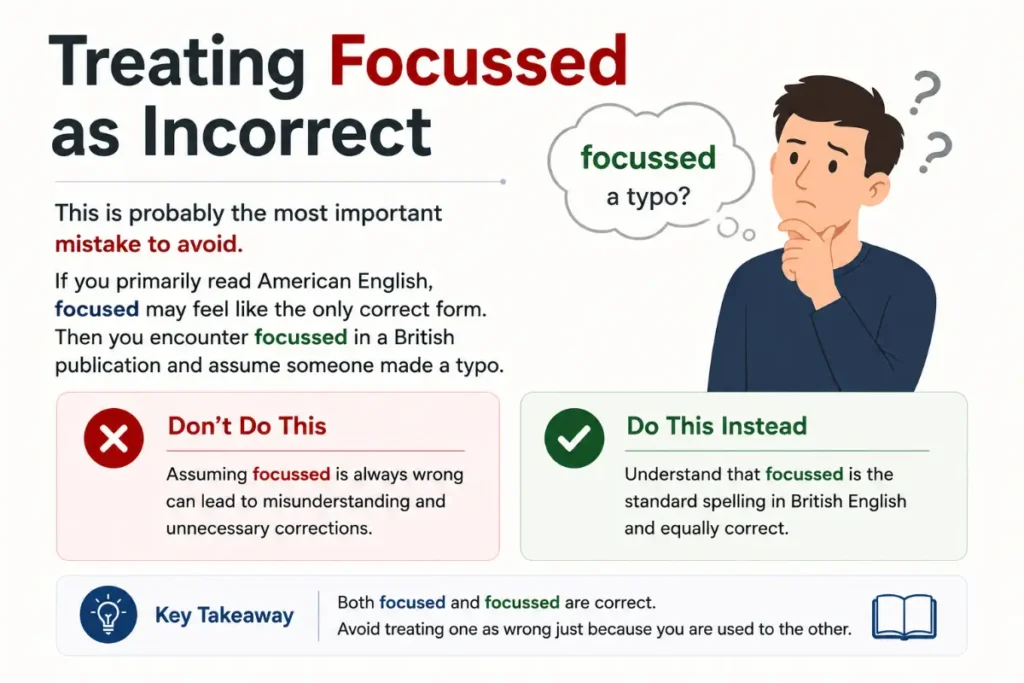
Treating Focussed as Incorrect
This is probably the most important mistake to avoid.
If you primarily read American English, focused may feel like the only correct form. Then you encounter focussed in a British publication and assume someone made a typo.
That’s not necessarily true.
Focussed is a recognized spelling. Oxford and Cambridge both acknowledge it.
Treating Focused as an American Only Error
The opposite mistake can happen too.
A learner familiar with British English may see focused and think the writer has dropped an s accidentally.
That assumption isn’t correct. Focused is the standard preferred form in American English.
Mixing Spelling Systems
A more subtle problem appears when writers mix regional conventions in the same document.
For example, a British English document might use focussed in one paragraph and other American spelling choices elsewhere.
Consistency matters.
If your document follows American English, use focused throughout.
If it follows British English, use focussed where that spelling convention applies.
Confusing Focused With Focussed Pronunciation
The two spellings don’t have different pronunciations.
You don’t need to pronounce focussed with an extra s sound simply because the spelling contains another s.
The extra letter represents a spelling convention rather than an additional spoken syllable.
Adding an Unnecessary Extra Letter in American Writing
American readers will understand focussed without trouble. Still, if you’re writing specifically for a US audience, focused is the conventional choice.
This matters in professional documents, educational content, websites, style guides, and published material where consistency affects editorial quality.
NLP and Orthographic Confusion
From an NLP perspective, focused and focussed are spelling variants rather than separate concepts. A language model, search engine, or spellchecker may treat them as related forms because their letters, pronunciation, grammatical role, and semantic meaning are closely connected.
The important distinction is orthographic. Orthography refers to the conventional way words are written.
Here, the semantic representation stays almost identical while the written representation changes.
That’s why readers usually understand both forms immediately.
Pronunciation Guide
Focused and focussed have the same pronunciation.
The common US pronunciation is:
/ˈfoʊ.kəst/
A simple sound based guide is:
FOH kust
The word has two syllables.
The first syllable receives the main stress.
FOH kust
The British pronunciation is commonly represented as:
/ˈfəʊ.kəst/
The main difference is the vowel quality in the first syllable between many British and American accents.
The spelling does not create an extra syllable.
This is an important point because some learners see focussed and assume it should sound different from focused. It doesn’t.
The pronunciation comes from the word focus and its inflected form rather than from the number of written s letters.
Oxford gives the pronunciation of focused and lists focussed as an alternative spelling. Cambridge also provides British and American pronunciation information.
Common Pronunciation Mistakes
One mistake is stressing the second syllable too heavily.
Another is trying to pronounce the two s letters in focussed as a separate sound.
A natural pronunciation keeps the word compact.
Think:
FOH kust.
The final sound is similar to the end of words such as asked or passed.
Etymology and Word Origin
The story of focus begins with Latin.
The Latin word focus meant hearth or fireplace. Over time, the word developed additional meanings connected with a central point.
The scientific sense became especially important as the language of optics developed. A focus came to describe the point where rays of light meet or from which they appear to come.
That scientific meaning helped expand the word beyond the physical idea of a hearth.
English later developed the figurative sense of focus as a central point of attention or interest.
Today focus is used constantly in everyday language.
We focus on a task.
A teacher focuses on a lesson.
A business focuses on a market.
A photographer focuses a camera.
The past tense and past participle are formed as focused or focussed depending on spelling convention.
The double s pattern is particularly associated with British spelling. Similar patterns appear in other verbs ending in a single l or related consonant structures, although English spelling rules are not completely uniform.
The history also explains why you shouldn’t assume that the spelling with more letters is somehow older or more formal. Spelling systems develop through convention. Regional standards can preserve different forms without creating different meanings.
Regional Usage in the US
American English strongly favors focused.
You will see it in newspapers, university publications, business communication, government writing, textbooks, websites, and everyday messages.
For a US audience, focused should be your default.
For example:
The program is focused on improving student outcomes.
That spelling will look completely natural to American readers.
Focussed is understandable in the United States but may look distinctly British to some readers.
The important point is consistency. If your content follows American English, use focused throughout the document.
Regional Usage in the UK
British English commonly uses focussed.
For example:
The study focussed on the effects of sleep deprivation.
British English also accepts focused. Modern British dictionaries list both forms, so British writers aren’t required to use the double s spelling in every context.
This is one reason the distinction can feel confusing. British English allows both while American English strongly favors focused.
In formal British writing, the choice may depend on the publisher, institution, or individual style guide.
A related grammar guide is Bellies vs Bellys Which Spelling Is Correct in 2026?.
Regional Usage in Australia
Australian English generally follows British spelling traditions, so focussed is a familiar form.
However, focused is also widely recognized and used.
Australian English has absorbed many influences from both British and American English. As a result, individual publications may make different choices.
If you’re writing for an Australian institution, follow its house style.
If no style guide exists, either form can be understood, but consistency should be your priority.
Regional Usage in Canada
Canadian English sits between British and American traditions in several areas.
Focused is common in Canadian writing, while focussed is also recognized.
The choice can depend on the publication or institution.
For general Canadian writing, focused is a safe and widely accepted form. In a document that follows British style, focussed may be preferred.
The key point is that Canadian readers understand both.
Grammar Rules and Part of Speech
Focused can serve several grammatical functions.
Focused as a Past Tense Verb
The simple past form describes an action that happened in the past.
The team focused on the main issue.
The photographer focused the lens.
In the first example, the subject directs attention toward an issue. In the second, the subject adjusts the camera or lens.
Focused as a Past Participle
Focused also works with auxiliary verbs.
The team has focused on the problem.
The camera was focused on the subject.
Here focused is part of a perfect or passive construction.
Focused as an Adjective
Focused can describe a person, approach, effort, image, or goal.
She is focused.
He has a focused approach to his studies.
The image is sharply focused.
Oxford defines focused as an adjective describing someone whose attention is directed toward what they want to do and whose aims are clear.
Focused With On
The most common construction for concentration is focus on.
She focused on her work.
They focused on customer needs.
The discussion focused on three major concerns.
Oxford gives focus on as a standard construction for directing attention or effort toward a particular subject or situation.
Avoid unnecessary prepositions.
She focused on the problem.
This is natural.
She focused at the problem.
This is not the normal construction when you mean giving attention.
Focused With Camera Language
Focused can describe visual clarity.
The camera focused on the bird.
The photograph is perfectly focused.
In this context, the word has a physical or optical meaning rather than a mental one.
Focused Versus Focusing
Focused describes a completed action, a state, or an adjective.
The team is focused on the goal.
Focusing describes an action in progress.
The team is focusing on the goal.
Both are correct but they aren’t interchangeable in every sentence.
Real Life Usage Examples
Daily Talk
Focused is common in everyday conversation.
I need to stay focused today.
She was really focused during the game.
These sentences describe concentration and attention.
Professional emails often use focused when describing goals or plans.
The meeting will remain focused on the main priorities.
We need a more focused approach to the project.
The word sounds natural without being overly formal.
Academic Writing
Academic writing uses focused to describe research questions, arguments, methods, and attention.
The study focused on language development in young children.
The researchers used a more focused approach in the second stage.
British academic writing may use focussed instead.
News Writing
News writers use focused when describing policies, investigations, campaigns, and public attention.
The investigation focused on financial records.
The new policy is focused on improving access to education.
The spelling depends on the publication’s regional style.
Literature
In literature, focused can describe a character’s attention or an author’s descriptive technique.
She remained focused on the road ahead.
His gaze was focused on the distant hills.
The word works naturally because its meaning is broad enough for both physical and mental attention.
Related and Confused Terms
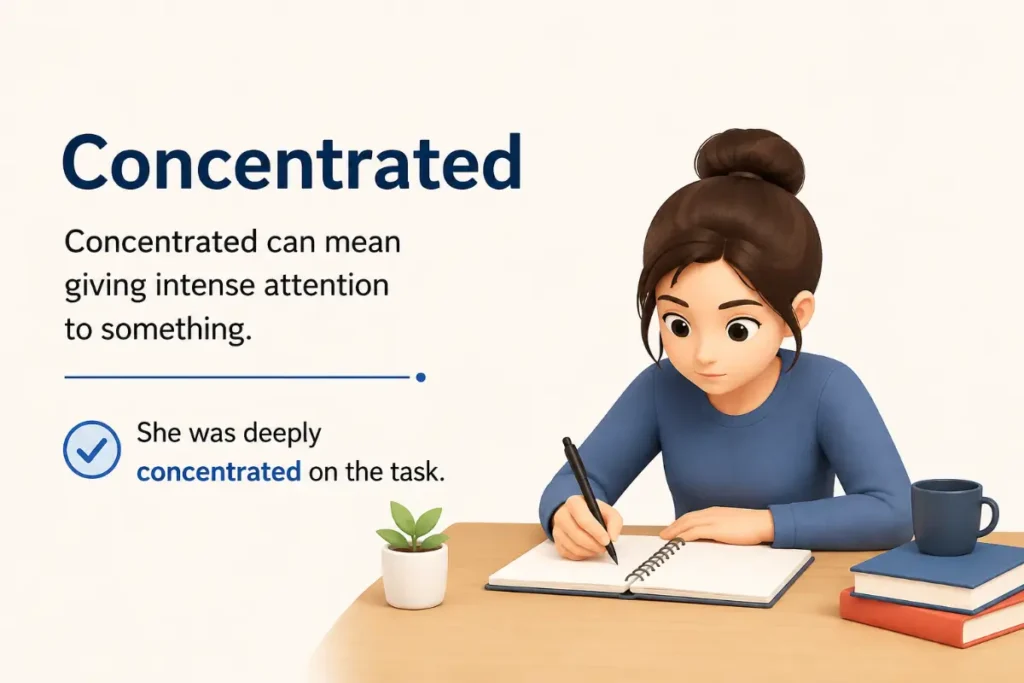
Concentrated
Concentrated can mean giving intense attention to something.
She was deeply concentrated on the task.
However, concentrated can also describe a substance that has had water or another component removed. That additional meaning makes it broader than focused in some contexts.
Attentive
Attentive describes someone who pays close attention.
The students were attentive during the lecture.
Focused suggests directed attention toward a particular goal or subject.
Absorbed
Absorbed suggests deep involvement.
He was absorbed in the book.
It often carries a stronger sense of being completely caught up in something.
Concentrating
Concentrating describes the action of giving attention.
She is concentrating on her work.
Focused can describe the resulting state.
Dedicated
Dedicated describes strong commitment.
She is dedicated to her career.
Focused emphasizes attention and direction. Dedicated emphasizes commitment.
Goal Oriented
Goal oriented describes someone who works toward clear objectives.
He is highly goal oriented.
Focused can describe the same quality but doesn’t always imply a specific long term goal.
Attuned
Attuned means highly aware or responsive to something.
The manager is attuned to customer concerns.
It overlaps with focused but has a stronger sense of awareness.
Directed
Directed can describe attention or effort aimed at a particular target.
The campaign was directed toward younger voters.
Focused is often more natural when discussing concentrated attention.
Focused and Focussed in Professional Writing
Professional writing benefits from consistency more than from choosing the form that looks more sophisticated.
If you’re preparing a US business report, use focused.
If you’re preparing a British English publication, focussed may fit the house style.
Don’t switch between the two forms simply because one appears in a source you’re reading.
For example, imagine an American report contains the following:
The first phase focused on research.
The second phase focussed on implementation.
That mixture may look careless because the document has no obvious reason to switch spelling systems.
A polished version should normally choose one convention and maintain it.
This is especially useful for websites and large documents where repeated terminology can affect editorial consistency.
Focused or Focussed in Academic Writing
Both forms can appear in academic writing.
American academic publications normally prefer focused.
British academic publications may use focussed.
The choice isn’t about the quality of the research. It is an editorial convention.
Academic writers should follow the required style guide whenever one exists.
For example, a university department may follow a specific British style. A US journal may follow American English conventions.
When a professor, publisher, journal, or institution specifies a spelling system, that instruction takes priority over personal preference.
Focused or Focussed in Business English
Business writing uses both forms depending on the audience.
American companies commonly write:
We remain focused on customer satisfaction.
British companies may write:
We remain focussed on customer satisfaction.
Both sound professional.
The important distinction is that focused is generally the better choice for US business communication.
If your audience is international and you want the form most likely to be recognized as standard across regions, focused is often the practical choice.
Why Both Forms Survive
English doesn’t have one central authority that controls every spelling choice worldwide.
Different English speaking regions developed their own spelling traditions.
That history created many pairs and groups of regional variants.
Focused and focussed belong to that larger pattern.
The same kind of regional variation appears in words such as organized and organised, analyzed and analysed, and traveled and travelled.
The presence of two spellings doesn’t mean English has become inconsistent. It means English exists as a family of related varieties.
A good writer learns to recognize those varieties rather than treating every difference as an error.
A Simple Memory Trick
If you’re writing for Americans, remember:
Focus becomes focused.
One s is enough.
If you’re following British spelling, remember:
Focus becomes focussed.
Two s letters are common.
You don’t need to memorize complicated grammar rules.
Instead, connect the spelling to your audience.
US audience means focused.
British style means focussed can be used.
That simple association will prevent most mistakes.
Expert Editor Insight
A professional editor looks at focused and focussed through the lens of consistency rather than personal preference. If I were editing a US article and saw focussed repeatedly, I’d change it to focused unless the text was intentionally preserving a British source or voice. If I were editing British English, I wouldn’t automatically change focussed because it is a legitimate spelling. Dictionary evidence matters here because it confirms that the difference is regional rather than a basic spelling error. Cambridge and Oxford both recognize the two forms.
For another common grammar confusion, see Dis and Mis Prefixes Explained With Examples.
Conclusion
When comparing focussed or focused, both spellings are correct. The main difference is regional preference rather than meaning or grammar. American English strongly favors focused, while British English commonly uses focussed. Both forms can describe concentration, clear goals, directed attention, or a properly adjusted image.
The smartest practical rule is to match the spelling to your audience. If you’re writing for Americans, choose focused. If you’re following British English conventions, focussed is acceptable. Don’t mark one as a mistake simply because the other feels more familiar. A final editorial check is simple: identify your English variety, choose one spelling system, and stay consistent from the first sentence to the last.
Frequently Asked Questions
Is focussed a correct word?
Yes. Focussed is a correct English spelling. It is especially common in British English and other varieties influenced by British spelling conventions. Focused is also correct and is the preferred form in American English. The two spellings have the same meaning and pronunciation. The difference is mainly a matter of regional spelling style rather than grammar or vocabulary.
Is focused or focussed correct?
Both are correct. American English generally prefers focused with one s, while British English commonly uses focussed with two s letters. Major dictionaries recognize both forms. If you’re writing for readers in the United States, focused is the best default. If you’re following British English style, focussed is perfectly acceptable.
How do you pronounce focused?
Focused is commonly pronounced /ˈfoʊ.kəst/ in American English. It has two syllables, with the main stress on the first syllable. A simple pronunciation guide is FOH kust. Focussed has the same basic pronunciation. The additional s in the British spelling doesn’t create another syllable or a separate spoken sound.
Is focussed British or American?
Focussed is more strongly associated with British English. American English generally prefers focused. However, focussed isn’t unknown to American readers and isn’t inherently wrong. It is simply less typical in US writing. Oxford and Cambridge both recognize focussed as an alternative spelling of focused.
Can you use focused in British English?
Yes. Focused is accepted in British English. British dictionaries recognize both focused and focussed. Some British publications prefer focussed because it matches a broader spelling pattern found in words such as focussed and other forms with doubled consonants. Other publishers use focused. Follow the style guide of the publication you’re writing for.
Which spelling should Americans use?
Americans should normally use focused. It is the standard and most familiar spelling in American English. You can use it in school assignments, professional emails, business reports, academic papers, websites, and everyday writing. Focussed will still be understood, but focused looks more natural to most US readers and aligns with American dictionary conventions.
Why does British English use focussed?
British English has spelling conventions that sometimes retain doubled consonants before certain endings. Focussed fits that pattern. American English often uses a simpler single consonant form in the same type of word. Similar differences can appear in other spelling pairs. The two systems developed through different editorial traditions rather than one being correct and the other being wrong.
Is focused formal English?
Yes. Focused is completely suitable for formal English. You can use it in academic writing, professional reports, business communication, journalism, research papers, and official documents. Its level of formality doesn’t depend on the number of s letters. The spelling should match the variety of English you’re using and remain consistent throughout the document.