
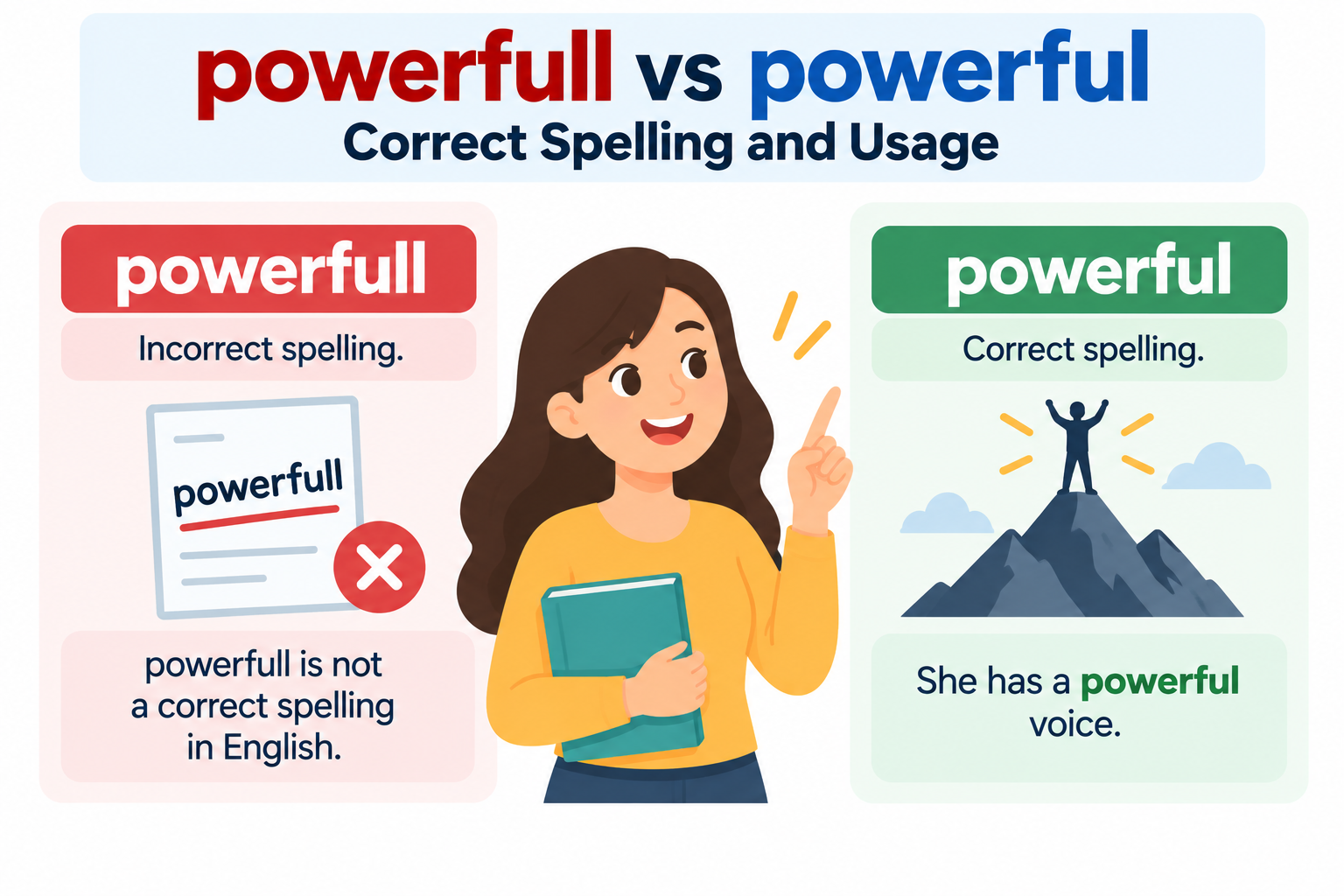
powerfull vs powerful is a common spelling confusion because the two forms look almost identical. The correct spelling is powerful with one l before the ending. Powerfull with two l letters is not the standard spelling of the adjective.
The mistake usually comes from the word power itself. Since many English words change their spelling when suffixes are added some writers assume that ful requires an extra l. It doesn’t. The suffix ful is attached directly to power and produces powerful. The pronunciation also doesn’t clearly tell you how many l letters belong in the written form.
Once you see the pattern the spelling becomes much easier to remember. This guide explains the meaning grammar pronunciation word formation regional usage and common mistakes associated with the adjective. You’ll also see practical examples from everyday conversation school writing professional communication and formal prose.
A related grammar guide is enrol or enroll: The Truth About These Two Spellings (2026).
Short Answer
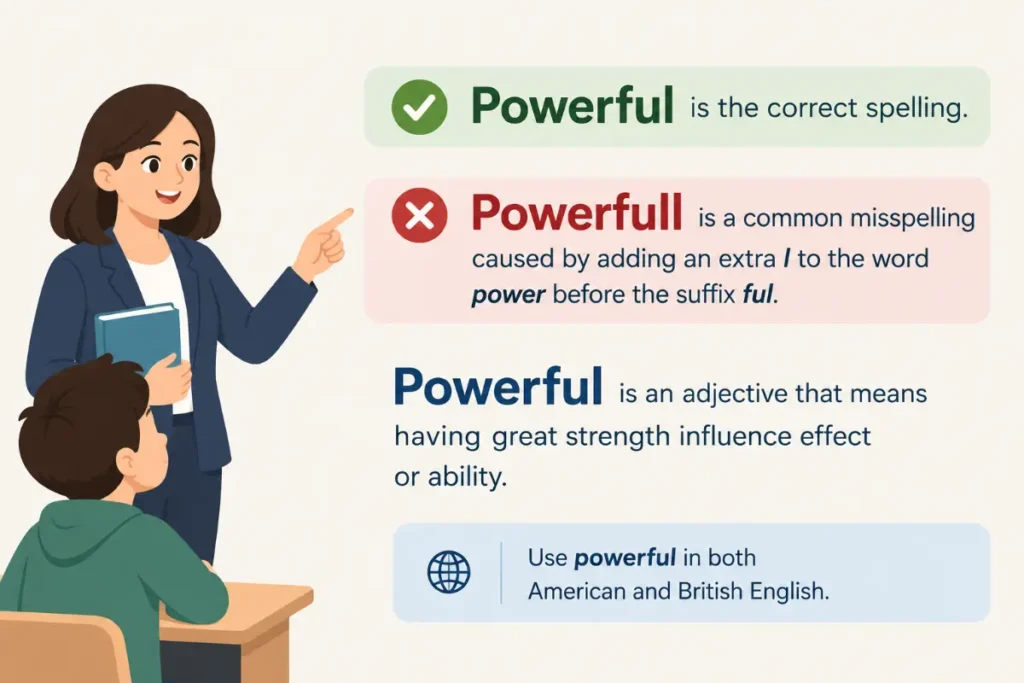
Powerful is the correct spelling. Powerfull is a common misspelling caused by adding an extra l to the word power before the suffix ful. Powerful is an adjective that means having great strength influence effect or ability. Use powerful in both American and British English.
Table of Contents
- Quick Answer
- Meaning and Definition
- The Main Spelling Difference
- Why The Extra L Appears
- Grammar and Part of Speech
- Pronunciation Guide
- Word Origin and Formation
- American and British Usage
- Sentence Examples
- Common Spelling Mistakes
- How The Word Works In Real Life
- Related Words and Expressions
- Memory Tips
- Formal and Informal Usage
- Expert Editor Insight
- Frequently Asked Questions
- Key Takeaways
- Conclusion
Meaning and Definition
Meaning of Powerfull
Powerfull is not the standard spelling of the adjective. In ordinary English it is considered a spelling mistake rather than a separate word with its own meaning.
You may encounter this form in online posts comments messages drafts or other informal writing. Its appearance doesn’t create a new accepted spelling. The writer almost always intends the standard adjective.
The error is understandable because English has many words where a final consonant is doubled in certain forms. Learners may also assume that adding ful requires a doubled l. That assumption doesn’t apply here.
For example a writer might think that power plus full should produce powerfull. The logic looks reasonable at first glance but the suffix used to form the adjective is ful rather than the independent word full.
That distinction matters.
Full is a separate adjective meaning containing as much as possible or having a large amount of something. Ful is a suffix used to create adjectives. When ful is attached to power the result is powerful.
Meaning of Powerful
Powerful is an adjective. It describes someone or something that has great power strength influence force or effect. The exact meaning depends on context. A powerful engine has a great ability to produce force. The word can describe physical strength but it can also describe ideas emotions experiences people institutions tools and effects.
Consider these examples.
The storm was powerful.
Here the word describes physical force.
She gave a powerful speech.
Here it describes the speech’s strong emotional or persuasive effect.
He has a powerful position in the company.
Here it refers to influence or authority.
This flexibility makes the word useful across many forms of English.
The Main Spelling Difference
The key difference is simple.
Powerful is correct.
Powerfull is incorrect in standard English.
The standard spelling has one l after the word power and before the ending.
You can think of the word as:
power + ful = powerful
You don’t add another l.
The confusion becomes clearer when you separate the adjective from the word full.
Full is spelled with two l letters because it is a complete word.
Ful is a suffix. It isn’t the same thing as full.
This is a useful distinction for spelling because English uses many suffixes that look like familiar words but don’t always behave like those words.
Compare these forms.
- Care plus ful becomes careful.
- Help plus ful becomes helpful.
- Hope plus ful becomes hopeful.
- Use plus ful becomes useful.
- Power plus ful becomes powerful.
Notice the pattern. The suffix is ful with one l.
Why The Extra L Appears
The extra l in the incorrect spelling often comes from visual confusion between ful and full. When you hear powerful you may mentally connect its ending with full. That can lead to the spelling powerfull. There is another reason this happens. English spelling contains many doubled consonants. Words such as happy and running or bigger show that letters can double during word formation. However those patterns depend on specific spelling rules. You can’t apply them to every suffix. The suffix ful has its own established spelling. The best way to avoid the mistake is to learn the suffix rather than trying to spell the entire word from sound.
Think of these common adjectives.
- Beautiful.
- Wonderful.
- Helpful.
- Careful.
- Peaceful.
- Useful.
- Meaningful.
- Powerful.
They all use ful as part of the adjective formation.
The spelling becomes much more predictable once you recognize that pattern.
Grammar and Part of Speech
Powerful is an adjective.
An adjective describes or gives more information about a noun or pronoun.
For example:
She has a powerful voice.
The adjective describes voice.
They built a powerful computer.
The adjective describes computer.
That was a powerful experience.
The adjective describes experience.
It can appear before a noun as an attributive adjective.
A powerful argument changed his mind.
It can also appear after a linking verb.
Her argument was powerful.
The word doesn’t normally function as a noun by itself. If you need the noun form you can use power.
For example:
The machine has great power.
The speaker has considerable power.
The adjective and noun belong to the same word family but they perform different grammatical jobs.
You can also create an adverb from powerful.
Powerfully is the standard adverb form.
For example:
She spoke powerfully about the issue.
That sentence uses powerfully to describe how she spoke.
The related forms are therefore useful to learn together.
Power is a noun.
Powerful is an adjective.
Powerfully is an adverb.
This word family helps you understand both meaning and spelling.
Pronunciation Guide
Powerful is commonly pronounced /ˈpaʊərfəl/ in American English.
A simple pronunciation guide is:
POW er ful
The first part sounds like power. The final syllable is usually weak and sounds similar to fuhl.
The main stress falls on the first syllable.
The word is generally spoken smoothly rather than as three equally strong syllables. In natural American speech the middle vowel can become less prominent.
The spelling mistake can happen because pronunciation doesn’t clearly announce the number of l letters. The final sound doesn’t tell you that the written word ends with the suffix ful.
A useful learning method is to connect pronunciation with word structure.
Say power.
Then add ful.
Powerful.
That approach helps you remember the written form without trying to hear letters that aren’t strongly pronounced.
Word Origin and Formation
Powerful belongs to the word family built around power.
Power entered English through Anglo Norman and Old French forms related to Latin potere which means to be able. The history of the word reflects ideas connected with ability strength authority and control.
The adjective powerful developed from power with the suffix ful.
The suffix ful has the general sense of full of or characterized by. It appears in many English adjectives.
For example:
Joyful means full of joy.
Helpful means providing help.
Careful means showing care.
Powerful means having great power.
This word formation explains why the correct spelling has only one l at the end. The adjective uses the suffix ful rather than the separate word full.
Understanding morphology can make spelling much easier. Instead of memorizing every adjective separately you can recognize recurring building blocks.
That is one reason vocabulary study and spelling study often work well together.
American and British Usage
American English
Powerful is the standard spelling in American English. It appears frequently in everyday speech as well as journalism academic writing business communication fiction and advertising. American writers use the word for physical force and for abstract influence. A powerful engine has strong physical performance. A powerful idea can have a strong effect on how people think. The spelling doesn’t change in American English.
British English
British English also uses powerful as the standard form. There is no meaningful British spelling variant that changes the number of l letters in this adjective. British speakers use it for physical strength emotional impact political influence persuasive ability and many other forms of power.
Australian English
Australian English follows the same standard spelling. Powerful is used naturally in conversation professional writing education journalism and literature. The extra l form remains a spelling error rather than a regional spelling.
Canadian English
Canadian English also uses powerful. The spelling remains consistent across Canadian formal and informal writing. There is no established Canadian version with two l letters. So this isn’t an American versus British spelling issue. The standard form is the same across the major English varieties discussed here.
Sentence Examples
Here are natural examples showing how the adjective works in different contexts.
- The new car has a powerful engine.
This sentence describes the engine’s ability to produce force or performance.
- She gave a powerful speech about education.
Here powerful describes the strong effect of the speech.
- The medicine had a powerful effect on his symptoms.
The adjective describes the strength of the effect.
- He made a powerful argument during the meeting.
The argument was persuasive or strongly supported.
- The storm produced powerful winds overnight.
Here the word refers to physical force.
- Music can be a powerful way to express emotion.
The adjective describes the strong effect music can have.
- The company has a powerful presence in the market.
Here powerful refers to influence and importance.
- That photograph tells a powerful story.
The image creates a strong emotional or intellectual response.
- She has a powerful voice that fills the entire room.
The adjective refers to the strength and impact of her voice.
- The book presents a powerful message about friendship.
The message has a strong emotional or persuasive effect.
Notice that the meaning changes slightly from sentence to sentence. The central idea remains the same. Something has a strong capacity force influence or effect.
A related grammar guide is Tweek vs Tweak Which Spelling Is Correct?.
Common Spelling Mistakes
Several mistakes can appear because of confusion around suffixes and doubled letters.
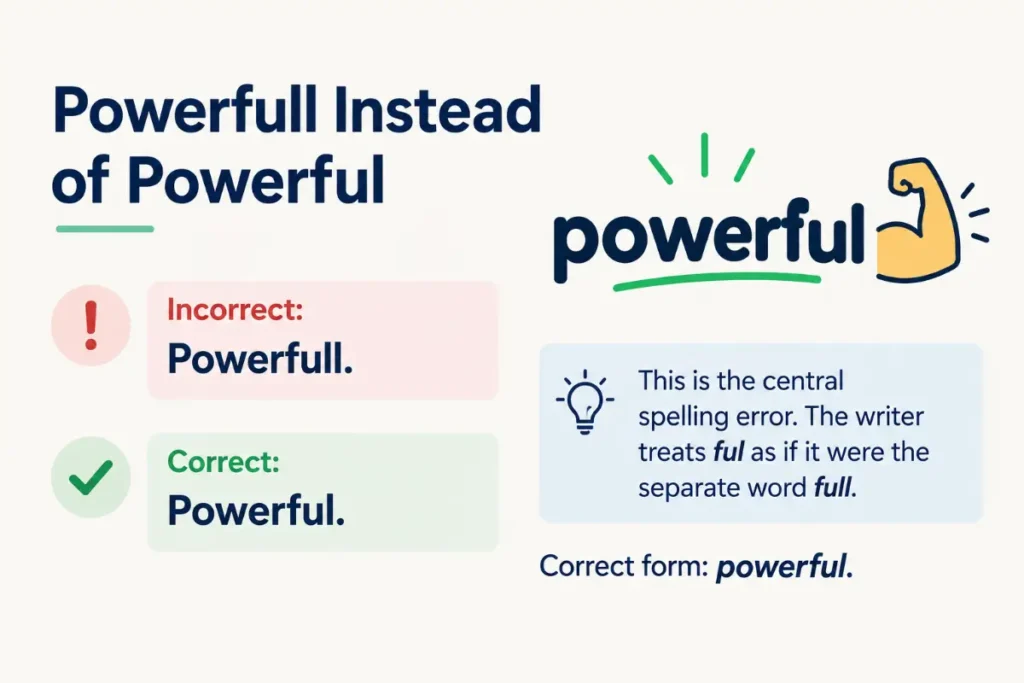
Powerfull instead of powerful
This is the central spelling error. The writer treats ful as if it were the separate word full.
Correct form: powerful.
Powerfullness instead of powerfulness
The noun form is usually powerfulness when this noun is needed. However many writers prefer the clearer expression strength or power depending on context. The important point is that adding ness doesn’t justify an extra l in powerful.
Powerfully with incorrect spelling
Some writers carry the extra l into the adverb and produce an incorrect form based on the same misunderstanding. The correct adverb is powerfully.
Powerfullest instead of most powerful
Writers sometimes create an unnecessary form when making comparisons. Most powerful is the natural standard form. For example: She is the most powerful speaker on the panel. This is generally better than trying to force a superlative ending onto a longer adjective.
Confusing powerful with powerfully
This is a grammar issue rather than a spelling issue. Powerful is an adjective. Powerfully is an adverb.
Compare:
He gave a powerful speech.
He spoke powerfully.
The first word describes speech. The second describes the manner of speaking.
How The Word Works In Real Life
Daily Conversation
People use powerful frequently in everyday speech. That was a powerful moment. This describes a moment that created a strong emotional response. He has a powerful car. Here the word describes the car’s performance or engine strength. The word is natural in casual conversation and doesn’t sound overly formal.
Workplace Communication
Powerful is also common at work. The team developed a powerful solution to the problem. The report presents a powerful case for changing the policy. In professional settings the word often refers to effectiveness influence or persuasive force rather than physical strength. Still use it carefully. If a simpler word such as effective or strong gives the exact meaning you need it may sound more precise.
Academic Writing
Academic writers use powerful to describe evidence arguments effects theories and findings. The study provides powerful evidence for the proposed explanation. The author presents a powerful critique of the existing theory. In academic writing the adjective should communicate a specific quality rather than serve as empty praise. Strong evidence is useful. Powerful evidence can work too when the context supports that degree of emphasis.
News Writing
News writers may use the word to describe political influence natural forces emotional moments or major events. The hurricane brought powerful winds to the coast. The senator delivered a powerful statement after the announcement. The context determines the exact sense.
Literature and Storytelling
In storytelling powerful can describe emotion atmosphere people memories images and moments. The old photograph carried a powerful memory. Her final words had a powerful effect on him. The adjective works well in narrative writing because it can express intensity without requiring a long explanation.
Similar Words And Related Expressions
Powerful has several related words but they aren’t all interchangeable.
Strong
Strong is one of the closest everyday alternatives. It can describe physical force ability influence flavor emotion or evidence. A strong argument can be persuasive. A powerful argument can also be persuasive but may suggest greater impact.
Forceful
Forceful often describes speech action or personality. It suggests energy confidence and determination. She made a forceful argument. This doesn’t always mean the same thing as powerful.
Influential
Influential focuses on the ability to affect people ideas or events. She is an influential writer. Powerful can also describe influence but has a broader range.
Effective
Effective means producing the desired result. The new method is effective. Powerful can suggest strong impact but doesn’t always guarantee effectiveness.
Mighty
Mighty suggests great strength or power and can sound dramatic or literary. The mighty river moved through the valley. It’s less common in ordinary professional writing.
Potent
Potent often describes substances effects ideas or forces with a strong impact. The medicine is potent. The word can sound more technical than powerful.
Persuasive
Persuasive means capable of convincing someone. His argument was persuasive. Powerful can describe a persuasive argument but can also refer to many other kinds of strength.
Dominant
Dominant describes something that has more control influence or importance than others. The company has a dominant position in the market. It focuses more on control or superiority than general strength.
Memory Tips
The easiest spelling trick is to remember the suffix.
Power + ful = powerful.
Don’t think of the ending as full.
Think of it as ful.
You can also remember the same pattern through familiar adjectives.
- Helpful.
- Careful.
- Hopeful.
- Peaceful.
- Useful.
- Powerful.
Each uses the suffix ful.
Another useful trick is to say the base word before adding the suffix.
Power.
Ful.
Powerful.
This makes the word structure visible.
If you see two l letters at the end ask yourself if you accidentally turned the suffix into the separate word full. That quick check will catch the most common spelling error.
Formal and Informal Usage
Powerful is appropriate in both informal and formal English. You can use it in conversation. That was a powerful moment. You can use it in a professional email. The presentation made a powerful case for the proposed change. You can use it in academic writing. The findings provide powerful evidence for the theory. You can also use it in creative writing. The character remembered the powerful storm that had changed his life. The word itself isn’t informal or slang. Its suitability depends mainly on the meaning and surrounding sentence. In professional writing precision still matters. Don’t use powerful simply because it sounds impressive. Choose it when you genuinely mean strong force influence impact or ability. For example effective may be better than powerful when you’re describing a method that achieves a goal. Influential may be better when you’re describing a person who changes public opinion.
Good editing isn’t just about choosing a correct word. It’s about choosing the most accurate word.
How Dictionaries Treat The Spelling
Standard dictionaries list powerful as the established adjective. The one l spelling doesn’t function as a normal alternative spelling in standard English dictionaries. This is consistent with the morphology of the word. The adjective is formed from power plus the suffix ful. That dictionary based approach is useful because it avoids relying on personal preference. English spelling can sometimes allow multiple accepted forms but this isn’t one of those cases. If you’re proofreading professional content and see the two l form you should correct it. The same applies to school assignments resumes applications articles reports and other edited writing.
Why Spellcheck May Catch It
Spelling software commonly identifies nonstandard forms by comparing written text against dictionaries and language models. If you type the incorrect form a spelling tool may suggest powerful. That correction is useful but it shouldn’t replace your understanding of the word. Automated tools can recognize patterns but they don’t always understand the intended meaning of every sentence. Human proofreading remains valuable because context can affect word choice even when spelling is correct. For this particular mistake the correction is straightforward. See powerfull. Check the suffix. Replace it with powerful. The more often you recognize the pattern the less often you’ll need the tool.
When Powerful Is The Best Word
Powerful works especially well when you want to emphasize strength or impact. Use it for physical force. The machine has a powerful motor. Use it for emotional impact. The ending was powerful. Use it for influence. She is a powerful political figure. Use it for persuasion. He made a powerful argument. Use it for effects. The treatment produced a powerful response. Use it for ideas or messages. The novel carries a powerful message. However don’t assume powerful is always the strongest choice. Sometimes another adjective gives a more exact meaning. A powerful tool may mean a tool with many capabilities. An effective tool means a tool that achieves its purpose. An influential person affects other people or decisions. A forceful speaker communicates with strong energy. The differences are subtle but useful.
Expert Editor Insight
An experienced editor will usually treat the two l form as a straightforward spelling error because the standard adjective follows a familiar suffix pattern. The mistake happens most often when writers mentally connect ful with the separate word full. During proofreading look at the word as power plus ful instead of trying to judge it by sound. This simple morphological check is faster and more reliable than guessing from pronunciation.
Key Takeaway
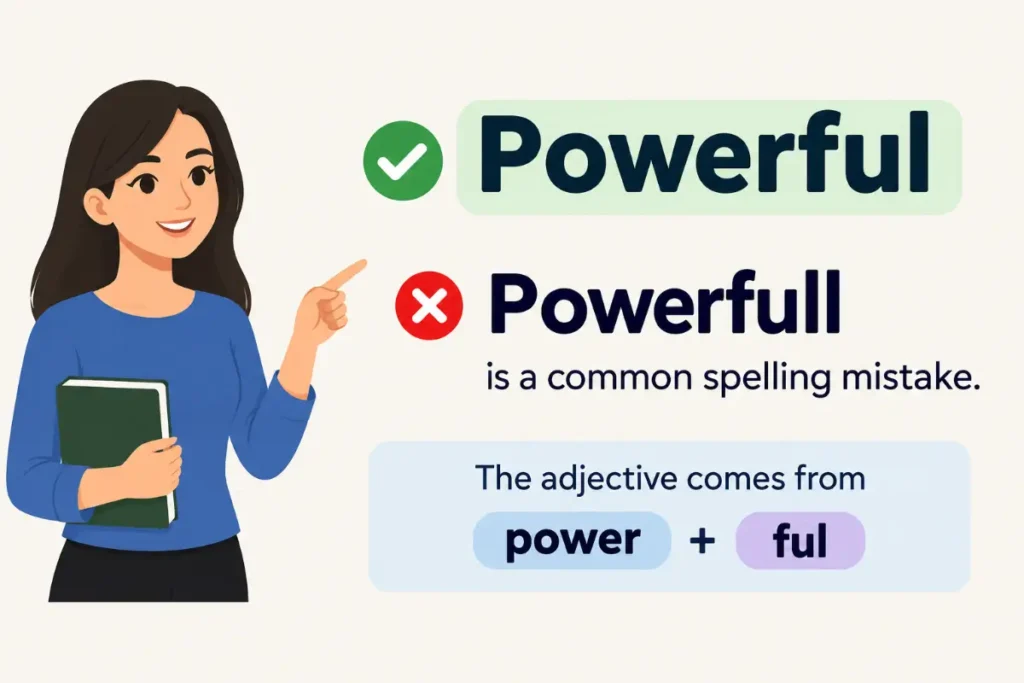
- Powerful is the correct spelling.
- Powerfull is a common spelling mistake.
- The adjective comes from power plus the suffix ful.
- The suffix ful has one l.
- Powerful can describe physical strength influence authority emotional impact or persuasive force.
- Powerful is an adjective.
- Power is commonly used as the related noun.
- Powerfully is the related adverb.
- The standard spelling is the same in American British Australian and Canadian English.
- The easiest memory trick is power plus ful equals powerful.
Learn the difference in counselor vs councilor: Meaning and Correct Usage.
Conclusion
powerfull vs powerful has a clear answer. Powerful is the correct spelling and powerfull is a common mistake. The adjective describes something with great strength force influence ability or impact. It works naturally in everyday speech as well as professional academic and creative writing.
The spelling becomes much easier once you recognize how the word is built. Power is the base word and ful is the suffix. The suffix has one l so the finished adjective also has only one l at the end.
For proofreading remember one simple pattern: power plus ful. If you see an extra l stop for a second and check the word. That small habit can keep this common spelling mistake out of your writing.
Frequently Asked Questions
Is powerfull a correct spelling?
No. Powerfull is not the standard spelling of the adjective. The correct form is powerful with one l before the ending. The mistake usually comes from treating the suffix ful as if it were the separate word full. If you’re writing an essay email report resume or other polished text use powerful.
What does powerful mean?
Powerful is an adjective that describes something with great strength force influence ability or effect. It can describe physical objects such as engines and storms as well as abstract things such as arguments emotions speeches and ideas. The exact meaning depends on context but the central idea is significant strength or impact.
What is the difference between powerfull vs powerful?
The difference is spelling rather than meaning. Powerful is the accepted English adjective. Powerfull is a common misspelling created by adding an unnecessary l. The correct word is formed from power plus the suffix ful. It can describe strength influence force effectiveness or emotional impact depending on the sentence.
How do you pronounce powerful?
The common American English pronunciation is /ˈpaʊərfəl/. The first syllable carries the main stress and sounds like the beginning of power. The final part is weak in natural speech. Because the pronunciation doesn’t clearly reveal the spelling pattern you shouldn’t rely on sound alone. Remember the word as power plus ful.
Is powerful an adjective?
Yes. Powerful is an adjective because it describes a noun or pronoun. You can say a powerful engine a powerful argument or a powerful experience. The related noun is power and the related adverb is powerfully. Keeping these forms separate helps you use them correctly in sentences.
Can powerful describe a person?
Yes. Powerful can describe a person who has significant physical strength authority influence ability or social position. For example a powerful leader may have substantial influence over decisions. The word can also describe someone’s presence voice or performance. Context tells you which kind of power the writer or speaker means.
Is powerful used in formal writing?
Yes. Powerful is standard English and works in formal writing. You can use it in academic papers reports business communication journalism and professional documents. Still choose it for a clear reason. If effective influential forceful or strong communicates your exact meaning better that word may be the better editorial choice.
How can I remember the spelling?
Remember power plus ful. The suffix is ful with one l rather than the separate word full. You can reinforce the pattern by comparing powerful with helpful careful hopeful and useful. If you see powerfull during proofreading check the ending. The extra l is the mistak