
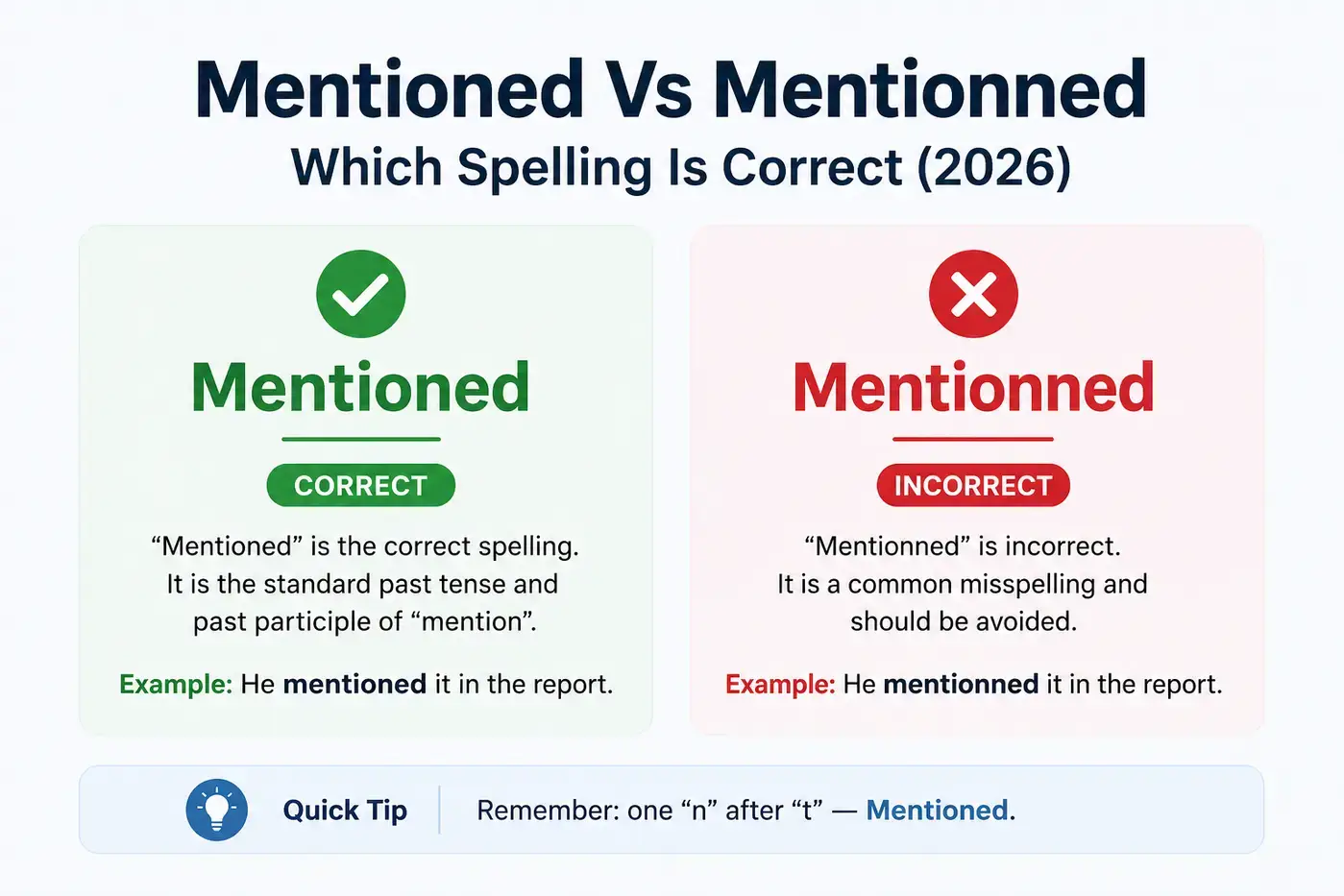
If you’ve searched for mentioned vs mentionned you’re probably trying to figure out which spelling is correct. The short answer is simple. Mentioned is the correct English spelling. Mentionned is not a standard English word and should be treated as a spelling mistake.
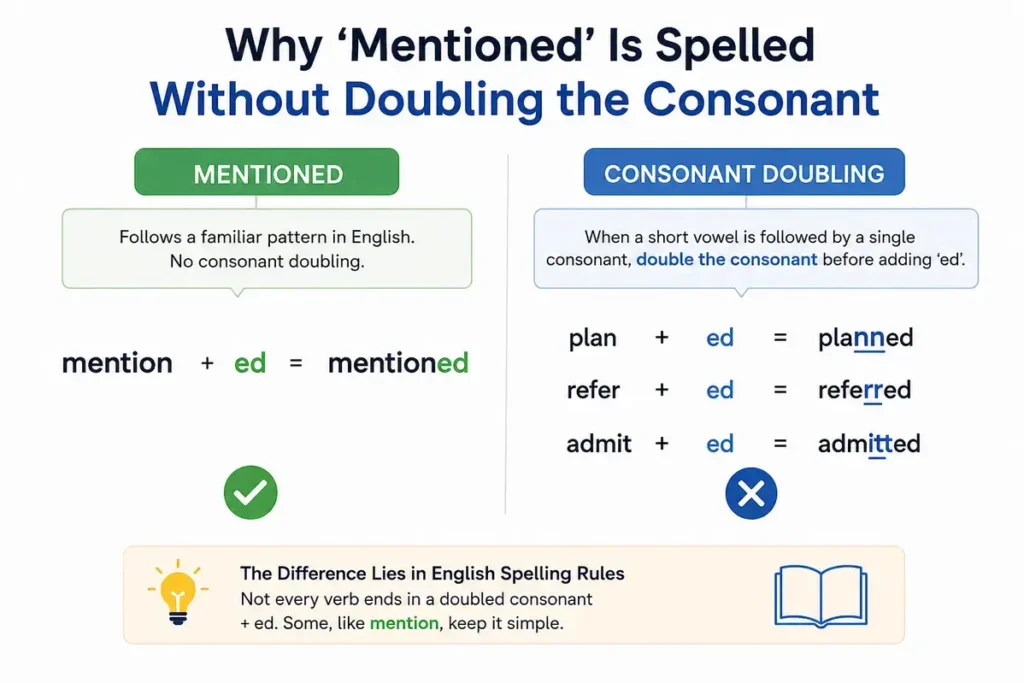
The confusion is easy to understand. English spelling doesn’t always follow the same pattern. Some verbs double the final consonant before adding ed while others don’t. If you’ve seen words like planned or preferred you might assume mention follows the same rule. It doesn’t. That’s why many English learners and even native speakers occasionally type mentionned, especially when writing quickly.
This guide clears up the confusion once and for all. You’ll learn the correct spelling, pronunciation, grammar rules, word origin, common mistakes, real life examples, regional usage, and practical writing tips. By the end you’ll know exactly when to use mentioned and why mentionned should never appear in standard English writing.
A related grammar guide is Passtime or Pastime Which Is Correct? 2026.
Quick Definition
Mentioned is the correct past tense and past participle of the verb mention. Mentionned is an incorrect spelling in English. The confusion usually comes from spelling patterns found in other English verbs or from the influence of French, where mentionné is a correctly spelled word.
Quick Answer
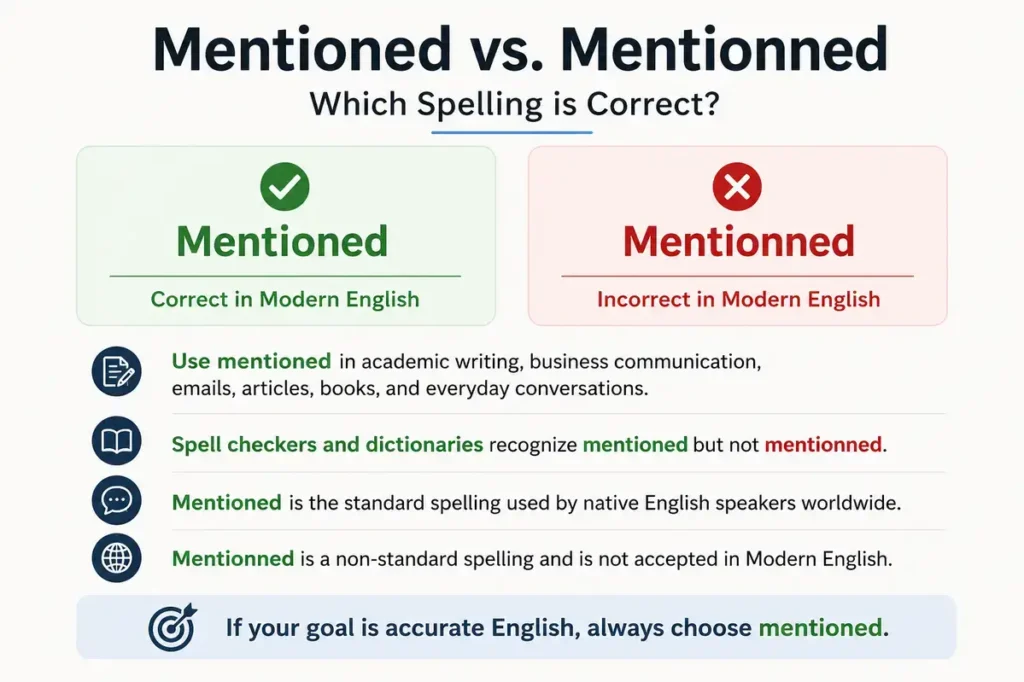
If you only need the answer, here it is.
- Mentioned is the correct English spelling.
- Mentionned is incorrect in modern English.
- Use mentioned in academic writing, business communication, emails, articles, books, and everyday conversations.
- Spell checkers and dictionaries recognize mentioned but not mentionned.
If your goal is accurate English, always choose mentioned.
Mentioned Vs Mentionned Comparison Table
| Feature | Mentioned | Mentionned |
|---|---|---|
| Correct English spelling | Yes | No |
| Meaning | Referred to something or someone | None in standard English |
| Part of speech | Verb past tense and past participle | Misspelling |
| Origin | From the verb mention | No English origin |
| Dictionary status | Listed in English dictionaries | Not listed |
| Usage frequency | Extremely common | Rare and almost always an error |
| Formality | Suitable for every writing style | Never appropriate |
| Common contexts | Speaking writing news education business | Typing mistakes only |
| Example | She mentioned the deadline yesterday. | She mentionned the deadline yesterday. Incorrect. |
Meaning Of Mentioned
Mentioned is the past tense and past participle of the verb mention. It means to refer to someone or something briefly without giving extensive detail.
Definition
To mention something means to bring it into a conversation, speech, document, email, or piece of writing.
Common Contexts
- Daily conversations.
- Business emails.
- Academic papers.
- News reports.
- Books and articles.
- Meetings.
- Interviews.
- Presentations.
Examples
- She mentioned your name during the meeting.
- He mentioned the weather before starting his presentation.
- The report mentioned several important findings.
- Nobody mentioned the schedule change.
- Our teacher mentioned that the exam would be next week.
Etymology
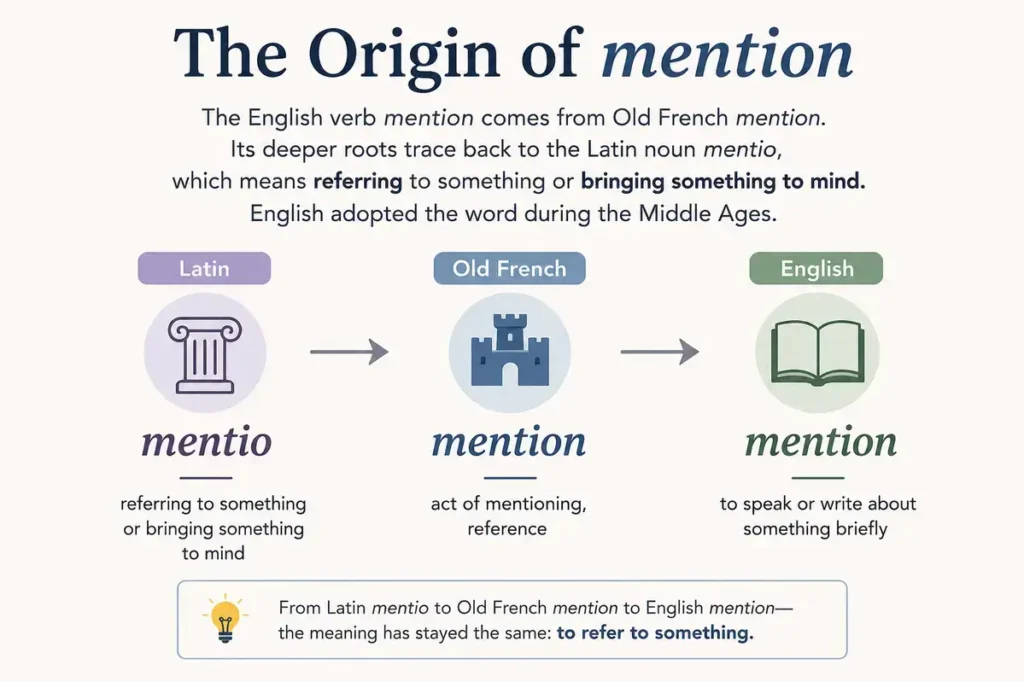
The verb mention entered English through Old French and ultimately comes from the Latin word mentio, which means a referring to or calling something to mind. Over centuries its meaning stayed remarkably consistent. Today it still means bringing a person, subject, or idea into a conversation or written text.
Meaning Of Mentionned
Unlike mentioned, mentionned is not an English word. It has no accepted definition in standard English dictionaries. Many people accidentally create this spelling because they think the letter n should double before adding ed. Another reason is the influence of French. The French past participle mentionné looks similar, which sometimes leads bilingual writers to add an extra n when writing in English.
Context
You might see mentionned in:
- Online comments.
- Drafts with typing errors.
- Social media posts.
- Messages written by English learners.
- Automatically translated content.
In professional writing, edited publications, schools, and workplaces, this spelling is treated as incorrect.
Mentioned Vs Mentionned Key Differences
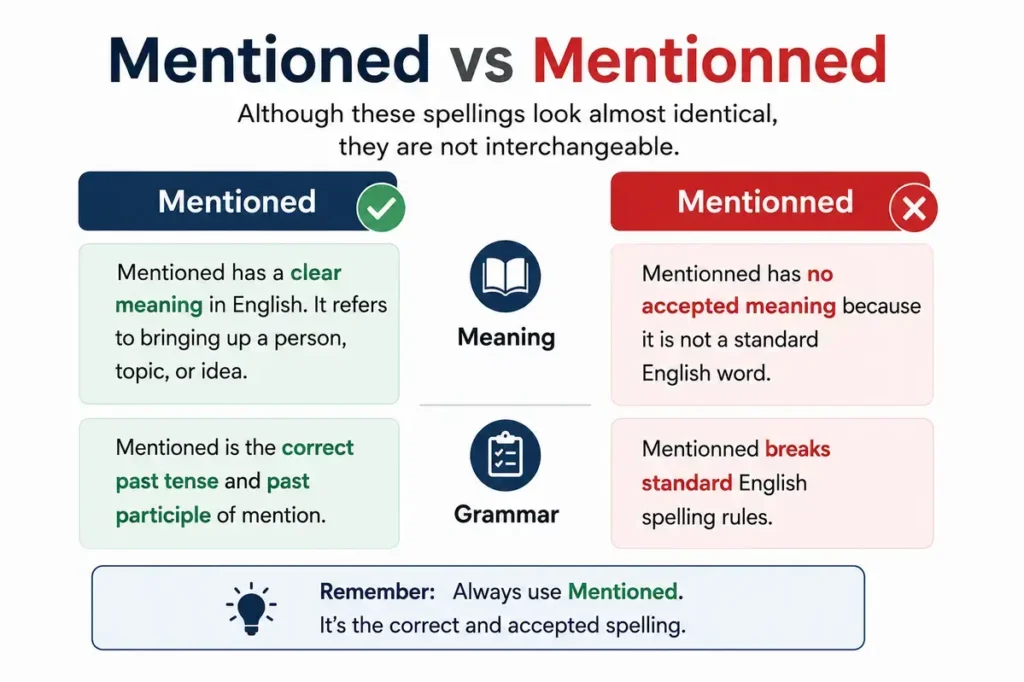
Although these spellings look almost identical, they are not interchangeable.
Meaning
Mentioned has a clear meaning in English. It refers to bringing up a person, topic, or idea.
Mentionned has no accepted meaning because it is not a standard English word.
Grammar
Mentioned is the correct past tense and past participle of mention.
Mentionned breaks standard English spelling rules.
Dictionary Status
Every major English dictionary includes mentioned.
No major English dictionary recognizes mentionned as a correct English spelling.
Usage
Native speakers use mentioned every day.
Professional editors automatically correct mentionned.
Writing
Mentioned belongs in essays, emails, reports, articles, books, and business documents.
Mentionned should never appear in polished English writing.
Which One Is Correct
The correct spelling is mentioned. There are no exceptions in American English, British English, Canadian English, or Australian English. This is one of those spelling questions with a clear answer.
Use mentioned every time.
Do not write mentionned in school assignments, professional documents, website content, emails, or published writing. If you accidentally type mentionned, simply remove the extra n. A good way to remember the correct spelling is to think about the base verb.
Mention.
Mention.
Mentioned.
The original word ends with one n, so the past tense keeps one n before adding ed.
Examples In Sentences
Mentioned Examples
- Sarah mentioned your idea during yesterday’s meeting.
- The professor mentioned several useful research papers.
- Nobody mentioned the road closure before we left.
- My friend mentioned a great restaurant downtown.
- The article mentioned new developments in medical research.
- She mentioned her vacation plans over lunch.
- The manager mentioned your excellent performance.
- They mentioned safety procedures before the event started.
- I mentioned this issue in my previous email.
- The witness mentioned details that helped investigators understand the situation.
Mentionned Examples
The spelling mentionned is incorrect in English. The following sentences show common mistakes followed by the correct version.
- She mentionned the deadline yesterday. Correct. She mentioned the deadline yesterday.
- He mentionned your name during class. Correct. He mentioned your name during class.
- The article mentionned several studies. Correct. The article mentioned several studies.
- My boss mentionned the new policy. Correct. My boss mentioned the new policy.
- They mentionned the price increase. Correct. They mentioned the price increase.
- The report mentionned customer feedback. Correct. The report mentioned customer feedback.
- She mentionned the meeting time. Correct. She mentioned the meeting time.
- We mentionned that problem earlier. Correct. We mentioned that problem earlier.
- The guide mentionned local attractions. Correct. The guide mentioned local attractions.
- I mentionned your suggestion yesterday. Correct. I mentioned your suggestion yesterday.
Need another quick comparison? Read Gradual Vs Insidious Which Word Should You Use in 2026.
Common Mistakes
Even though mentioned is the only correct spelling in English, people still make mistakes. Most errors happen because English spelling has exceptions that are not always obvious. Understanding these common mistakes will help you write with more confidence.
1. Adding An Extra N
This is the most common error.
Incorrect.
Mentionned.
Correct.
Mentioned.
Many writers assume the final n should double before adding ed. That rule does not apply to the verb mention.
2. Mixing English And French Spelling
French uses the past participle mentionné. Writers who speak both languages sometimes transfer that spelling pattern into English. English follows different spelling rules, so the correct form remains mentioned.
3. Confusing It With Other Verbs
Some English verbs double the final consonant before adding ed.
Examples include.
- Plan becomes planned.
- Refer becomes referred.
- Admit becomes admitted.
Because of these examples, people sometimes expect mention to become mentionned.
It does not.
4. Trusting Unedited Online Content
Not everything on the internet is accurate. Typing mistakes appear in blog comments, forums, social media posts, and automatically translated content. Seeing mentionned online does not make it correct. Reliable dictionaries, style guides, and professional editors all use mentioned.
5. Ignoring Spell Check Warnings
Modern writing tools usually flag mentionned as a spelling error. If your spell checker suggests mentioned, accept the correction unless you are intentionally quoting someone else’s mistake.
Pronunciation Guide
One reason people misspell mentioned is that its pronunciation does not clearly reveal the spelling.
Mentioned Pronunciation
IPA
American English.
/ˈmenʃənd/
British English.
/ˈmenʃənd/
Syllable Breakdown
Men.
Tioned.
The first syllable carries the stress. The ending sounds like shund in natural speech.
Common Pronunciation Mistakes
- Pronouncing every letter separately.
- Saying the ending as tee on ed.
- Adding an extra syllable.
- Stressing the second syllable instead of the first.
Native speakers usually pronounce the word smoothly without emphasizing the ending.
Mentionned Pronunciation
Since mentionned is not an English word, it has no accepted English pronunciation. If someone reads it aloud, they usually pronounce it exactly like mentioned, which explains why the spelling mistake often goes unnoticed.
Etymology And Word Origin
The history of mentioned helps explain why only one spelling is correct.
Origin Of Mention
The English verb mention comes from Old French mention. Its deeper roots trace back to the Latin noun mentio, which means referring to something or bringing something to mind. English adopted the word during the Middle Ages. Its meaning has remained remarkably stable for hundreds of years. Today mention still means referring to someone or something briefly.
Development Into Mentioned
English forms the past tense of most regular verbs by adding ed.
Mention.
Mentioned.
Since the base word already ends with n, English simply adds ed. There is no spelling rule that requires doubling the n.
Why Mentionned Appears
The incorrect spelling developed through spelling confusion rather than language history.
Several factors contribute to the mistake.
- Influence from French spelling.
- Confusion with verbs like planned and referred.
- Fast typing.
- Autocorrect failures.
- Limited familiarity with English spelling rules.
Professional dictionaries have never accepted mentionned as a standard English word.
Regional Usage
One helpful fact about this spelling question is that every major variety of English agrees.
American English
American English always uses mentioned.
Examples.
The teacher mentioned the homework.
She mentioned your proposal during the meeting.
You will not find mentionned in American dictionaries or edited publications.
British English
British English follows exactly the same spelling.
Examples.
The newspaper mentioned the event.
Our manager mentioned the policy update.
No regional spelling variation exists.
Canadian English
Canadian English also uses mentioned. Government documents, universities, publishers, and businesses all follow the same spelling.
Australian English
Australian English uses mentioned in every context.
Professional editors treat mentionned as a spelling error.
Regional Preference
Unlike words such as colour and color or organise and organize, there is no regional difference here. Every major English speaking country writes the word as mentioned.
Grammar Rules
Understanding the grammar behind mentioned makes the spelling easier to remember.
Part Of Speech
The base word mention is a verb.
Mentioned functions as both the simple past tense and the past participle.
Examples.
She mentioned my name yesterday.
The issue has already been mentioned.
Verb Forms
Base verb.
Mention.
Simple present.
Mention.
Third person singular.
Mentions.
Present participle.
Mentioning.
Simple past.
Mentioned.
Past participle.
Mentioned.
Tense Examples
Simple Present.
She mentions the problem often.
Present Continuous.
She is mentioning the issue now.
Simple Past.
She mentioned it yesterday.
Present Perfect.
She has mentioned it several times.
Past Perfect.
She had mentioned the idea before the meeting.
Future.
She will mention it tomorrow.
Passive Voice
The word also appears in passive constructions.
Examples.
The topic was mentioned during the interview.
His name was mentioned several times.
Although passive voice is grammatically correct, active voice often sounds stronger.
Active.
The speaker mentioned the new policy.
Passive.
The new policy was mentioned by the speaker.
Common Sentence Patterns
Mention someone.
She mentioned her brother.
Mention something.
He mentioned the budget.
Mention something to someone.
She mentioned the idea to her manager.
Mention that.
He mentioned that the meeting had been postponed.
These sentence patterns appear constantly in spoken and written English.
Real Life Usage Examples
Learning grammar is helpful, but seeing the word in everyday situations makes it much easier to remember.
Daily Conversation
People use mentioned naturally in casual speech.
Examples.
- You mentioned that restaurant before.
- My sister mentioned your new job.
- Dad mentioned we’re leaving early tomorrow.
- Someone mentioned your name at dinner.
Academic Writing
Researchers and students use mentioned to refer to earlier information.
Examples.
- As mentioned earlier the results support the original hypothesis.
- The author mentioned several historical sources.
- The study mentioned possible limitations.
Professional Communication
Business writing often includes the word.
Examples.
- As mentioned in yesterday’s meeting the deadline remains unchanged.
- The client mentioned additional requirements.
- Our director mentioned a possible expansion next year.
Literature
Authors use mentioned to introduce details naturally without interrupting the flow of a story.
Example.
The old sailor mentioned a forgotten island that nobody else believed existed.
News And Media
Journalists frequently use the word when reporting statements.
Examples.
- The governor mentioned several new education initiatives.
- The report mentioned rising housing costs.
- Officials mentioned ongoing safety improvements during the press conference.
Across every style of writing, mentioned remains the standard and trusted spelling.
Related Words And Confused Terms
Learning related words helps you build a stronger vocabulary and avoid common writing mistakes. Some words are close in meaning while others are often confused because they follow different spelling patterns.
Synonyms Of Mention
- Refer.
- State.
- Say.
- Note.
- Cite.
- Bring up.
- Point out.
- Indicate.
- Acknowledge.
- Allude to.
Each synonym has a slightly different tone. For example, refer sounds more formal, while bring up fits casual conversations.
Related Verb Forms
- Mention.
- Mentions.
- Mentioning.
- Mentioned.
These are the only standard forms of the verb in English.
Commonly Confused Spellings
- Mentioned and mentionned.
- Planned and planed.
- Referred and refered.
- Occurred and occured.
- Preferred and prefered.
These words confuse many learners because some English verbs double the final consonant while others do not.
Related Grammar Terms
- Regular verb.
- Past tense.
- Past participle.
- Present participle.
- Base verb.
- Subject.
- Object.
- Active voice.
- Passive voice.
- Verb conjugation.
Understanding these grammar concepts makes spelling patterns much easier to remember.
Expert Language Insight
Professional editors rarely think twice about the spelling mentioned because it follows a familiar pattern in English. The confusion usually comes from comparing it with verbs like planned, referred, or admitted, where the final consonant doubles before adding ed.
The difference lies in English spelling rules.
The verb mention does not end with a stressed vowel followed by a single consonant. Because that condition is missing, the final n stays single. Native speakers almost never write mentionned unless it is a typing mistake. If the extra n appears in published content, editors remove it immediately.
Another useful observation comes from everyday communication.
People use mentioned far more often than they realize.
It is often found in research papers.
It appears in everyday conversations.
That frequent exposure makes the correct spelling become almost automatic over time. If you want your writing to sound polished and professional, train yourself to think of the complete verb family.
Mention.
Mentioning.
Mentioned.
Keeping those three forms together is one of the easiest memory tricks you can use.
Frequently Asked Questions
Is mentioned or mentionned correct?
Mentioned is the correct English spelling. It is the past tense and past participle of the verb mention. Mentionned is a spelling mistake and does not appear in standard English dictionaries. If you want grammatically correct writing, always use mentioned.
Why do people write mentionned?
Most people add the extra n because they compare mention with verbs like planned or referred. Others are influenced by French spelling, where mentionné is a correct word. In English, that spelling rule does not apply.
Is mentionned ever accepted in English?
No. Modern English dictionaries, grammar books, style guides, and professional editors all recognize mentioned as the only correct spelling. Mentionned should always be corrected.
Is mentioned used in American and British English?
Yes. American English, British English, Canadian English, and Australian English all use mentioned. There is no regional spelling difference for this word.
How do you remember the correct spelling of mentioned?
Start with the base verb mention. Simply add ed to form the past tense.
Mention.
Mentioned.
There is no reason to add another n.
This simple pattern helps prevent future spelling mistakes.
Is mentioned a regular verb?
Yes. Mention is a regular English verb. Its past tense and past participle are formed by adding ed.
Mention.
Mentioned.
Mentioning.
Mentions.
These are the complete standard verb forms.
Can I use mentioned in formal writing?
Absolutely. Mentioned is appropriate in every writing style, including academic papers, business reports, professional emails, legal documents, news articles, and books. It works just as naturally in everyday conversations.
Why does English double some letters but not others?
English doubles the final consonant only when specific spelling rules apply. The stress pattern of the word plays an important role. Since mention does not meet those conditions, the final n remains single before adding ed.
Still confused? Compare Specialty Or Speciality Which Spelling Is Correct 2026.
Conclusion
The answer is simple. Mentioned is the only correct English spelling. Mentionned is a misspelling that appears because of typing mistakes, confusion with other verbs, or the influence of French spelling. If you remember the base verb mention, the correct form becomes easy.
Mention.
Mentioned.
That single spelling works in every variety of English, including American, British, Canadian, and Australian English. Using the correct spelling strengthens your writing, builds credibility, and helps you communicate more clearly. Every major dictionary, grammar guide, and professional editor agrees on this point. The next time you pause before typing the word, remember one simple rule. Use mentioned every time.