
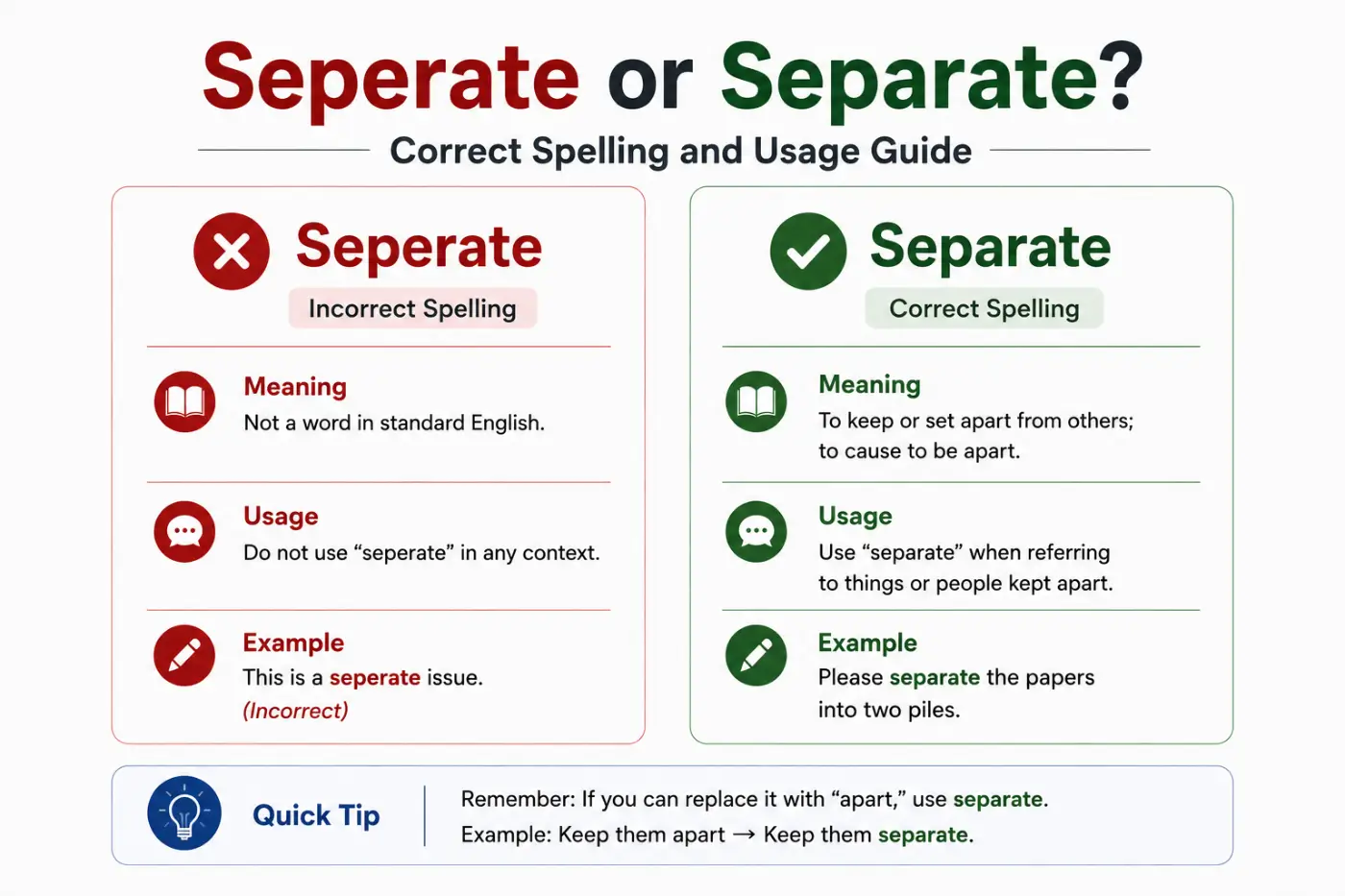
Some spelling mistakes survive for years because the incorrect version looks almost right. Seperate or separate is one of those mistakes. You can know exactly what the word means and still pause when you need to type it. The correct spelling is separate. The spelling seperate is incorrect in standard English.
If you’re writing an email a school paper a report or a professional document you should use separate. The confusion usually comes from pronunciation and memory. Many speakers pronounce the middle part of the word with a relaxed vowel sound. That makes it easy to remember the word as seperate instead of separate.
The letter arrangement also feels unusual because the first part sounds closer to sep than sep a rate when spoken naturally. This guide explains the difference between seperate or separate in a practical way. You’ll learn the meaning pronunciation grammar role word origin common mistakes sentence patterns regional usage and useful synonyms. You’ll also get a simple memory trick that makes the correct spelling much easier to recall.
You may also want to read Loot vs Lute Which Word Is Correct and What Is the Difference.
Quick Definition
Separate is the correct standard English spelling. It can be a verb meaning to divide or move apart an adjective meaning not joined or distinct and a noun referring to an individual item that is different from another. Seperate is a common spelling error and isn’t accepted as the standard spelling.
Quick Answer
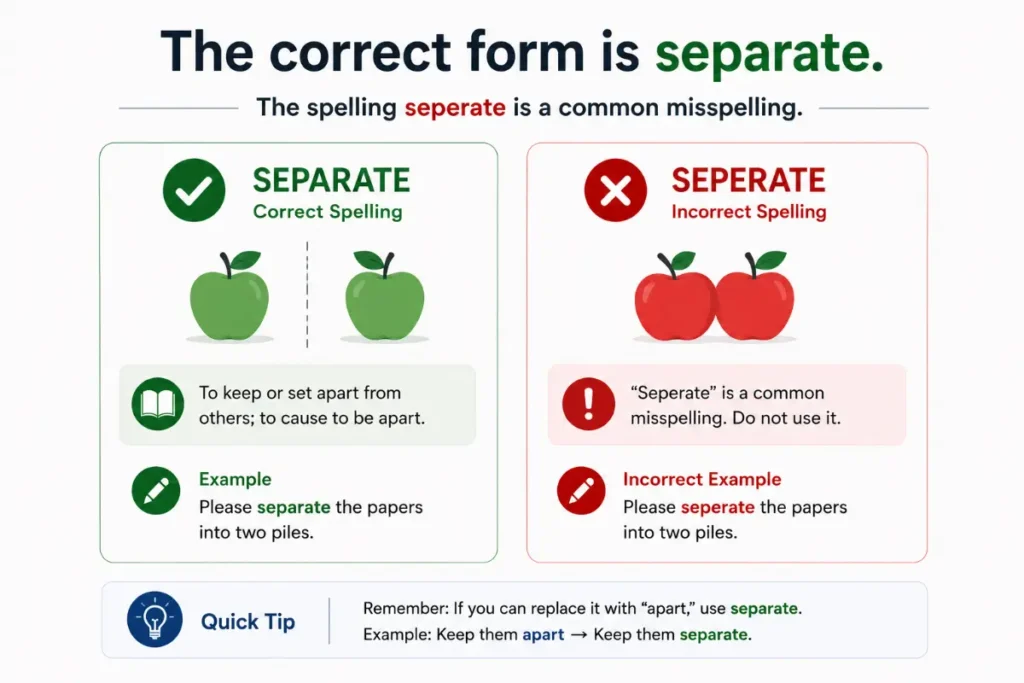
The correct form is separate. The spelling seperate is a common misspelling.
Use separate when you mean divided distinct apart or kept apart. For example you can write Please keep the two documents separate or The teacher asked the students to separate into groups.
Comparison Table for seperate or separate
| Correct Form | Meaning | Part of Speech | Origin | Usage Frequency | Formality | Common Contexts | Example |
|---|---|---|---|---|---|---|---|
| seperate | Incorrect spelling | Not a standard form | Misspelling of separate | Common as an error | Not standard | Typing mistakes and informal errors | Please keep the files seperate. |
| separate | Divided distinct or kept apart | Adjective verb and noun | From Latin separatus through French and English | Very common | Neutral and formal | Conversation school work business writing law science and everyday English | Please keep the files separate. |
Meaning and Definition
Meaning of seperate
Seperate isn’t the standard spelling of an English word. In normal writing it is treated as a misspelling of separate.
That doesn’t mean readers won’t understand it. Most people will recognize the intended word immediately because the surrounding sentence gives enough information. A spelling error can be obvious without making the meaning unclear.
You may occasionally see seperate used in a username a fictional name a company name or some other deliberately created label. Proper names don’t have to follow ordinary dictionary spelling rules. That doesn’t turn seperate into a standard English variant.
If you’re writing ordinary English you should replace seperate with separate.
Meaning of separate
Separate has several related meanings because it can work as an adjective a verb and a noun.
As an adjective separate means not joined or connected.
For example:
The two rooms have separate entrances.
Here separate tells us that the entrances aren’t shared.
It can also mean different or distinct.
The company has separate departments for sales and marketing.
As a verb separate means to divide or move something apart.
For example:
Please separate the white clothes from the dark clothes.
The teacher separated the students into two groups.
As a noun separate is less common. It can refer to an individual item that forms part of an outfit or collection.
For example:
The store sells separates that can be mixed and matched.
The central idea behind all these uses is distance or distinction. Something separate isn’t joined with something else.
Key Differences Explained
Spelling
The main difference is the placement of the vowels. The correct form is separate. The incorrect form is seperate.
The middle part of separate contains an a after the first r sound. That a is the letter people often forget or replace with e.
Grammar Role
Separate can function as an adjective a verb and a noun.
As an adjective:
The children have separate bedrooms.
As a verb:
Please separate the documents.
Used as a noun:
The jacket and trousers were sold as separates.
Seperate doesn’t have these grammatical roles because it isn’t the standard word.
Meaning
Separate carries meanings related to division distinction distance or independence.
Seperate has no separate dictionary meaning in standard English. It usually represents an attempt to spell separate.
Tone
Separate is neutral and flexible. You can use it in everyday conversation as well as academic professional technical and formal writing.
For example:
We have separate accounts.
The researchers analyzed the groups separately.
Please submit the forms in separate files.
Context
The word appears in almost every area of English. You can encounter it when discussing relationships rooms departments documents groups opinions objects processes or categories.
That broad use makes correct spelling especially useful. A mistake can appear repeatedly because the word itself is so common.
Which Spelling Is Correct?
Separate is the correct spelling. Seperate is incorrect in standard English.
The spelling reflects the historical development of the word. Separate comes through Old French from Latin separatus which is related to the Latin verb separare meaning to divide or keep apart.
The spelling is also supported by major English dictionaries. Dictionary entries consistently use separate as the standard form and recognize its adjective verb and noun uses.
There is a useful linguistic reason for remembering the spelling. The word is related to the idea of being apart. If you connect separate with the concept of separation you can make the spelling easier to remember.
A practical editor’s test is simple. When you type the word and see seperate pause before accepting it. The correct pattern is sep a rate rather than sep e rate.
Sentence Examples
Here are natural examples using the correct form.
- Please keep the receipts in a separate folder.
- The two buildings have separate entrances.
- We decided to separate the tasks between the two teams.
- She keeps her work and personal life separate.
- The teacher asked us to separate into smaller groups.
- They live in separate apartments.
- Please separate the recyclable materials from the trash.
- The company operates as a separate division.
- The doctor asked the patient to separate the medications by type.
- We need separate solutions for the two problems.
Here are examples showing the common misspelling. These sentences are incorrect because they use seperate. - Please keep the documents seperate.
- The students were placed in seperate rooms.
- We need to seperate the two files.
- The teams work in seperate offices.
- She keeps the two accounts seperate.
In each case replace seperate with separate.
Common Mistakes and Misspellings
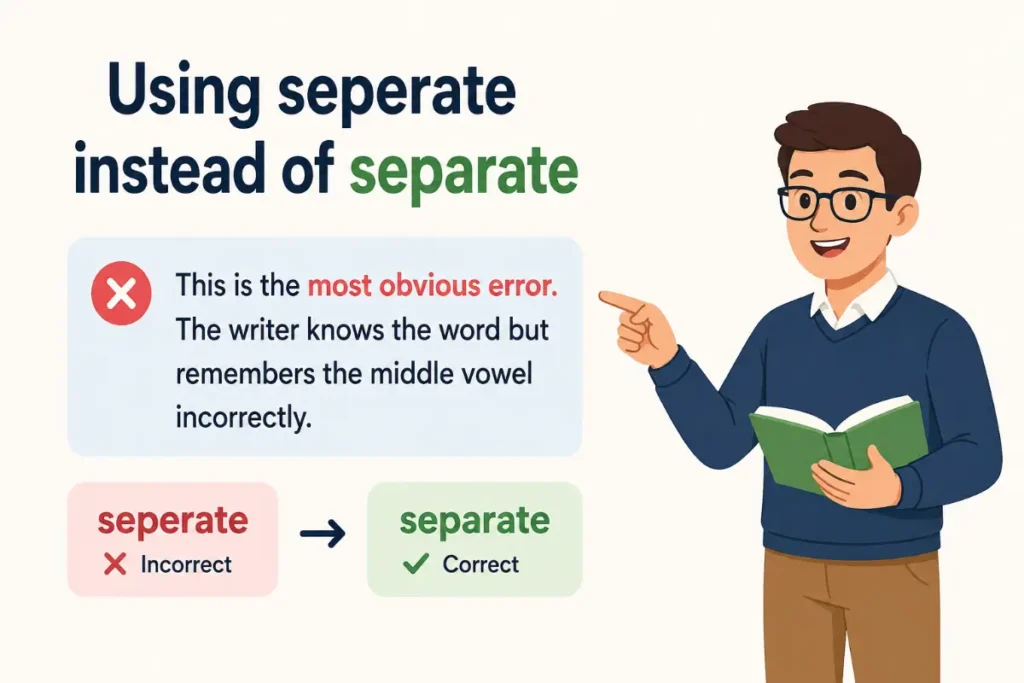
Using seperate instead of separate
This is the most obvious error. The writer knows the word but remembers the middle vowel incorrectly.
Confusing pronunciation with spelling
English pronunciation doesn’t always provide a perfect guide to spelling. In natural speech the middle vowel in separate can be reduced. That makes the written a easier to miss.
Forgetting the word family
Words such as separation and separately can help reinforce the spelling of separate. When you recognize the shared base you have another mental clue.
Writing separate as seperate when typing quickly
Fast typing can produce this mistake even when the writer knows the correct form. Repeated exposure to the wrong spelling can also make it look strangely familiar.
Treating the incorrect form as a variant
Seperate isn’t an accepted American or British spelling. It isn’t a regional alternative. In edited English it should be corrected.
From an NLP perspective this mistake is an orthographic confusion. The intended lexical item is usually correct in the writer’s mind but its written representation contains a vowel substitution. Similar errors happen when people spell words according to approximate pronunciation rather than their established written form.
Pronunciation Guide
The standard pronunciation of separate changes slightly depending on its grammatical role.
As an adjective the pronunciation is commonly represented as:
US IPA: /ˈsepərət/
UK IPA: /ˈsepərət/
In this form the word normally has three syllables.
You can think of it as:
SEP uh rut
The first syllable receives the strongest stress.
As a verb the final syllable is usually stronger:
US IPA: /ˈsepəreɪt/
UK IPA: /ˈsepəreɪt/
A simple pronunciation guide is:
SEP uh rate
The final sound is like the word rate.
This difference matters because separate can change pronunciation according to its grammatical role. Compare:
We have separate rooms.
Here separate is an adjective.
We need to separate the files.
Here separate is a verb.
The spelling stays the same even though the pronunciation changes.
Etymology and Word Origin
Separate has a long history that reaches back to Latin. The English word developed from Old French and ultimately from Latin separatus. The Latin form comes from separare which meant to divide or keep apart. The root is connected with the idea of being distinct from something else. That history helps explain the modern meanings. To separate something is to move it apart.
A separate object is distinct from another object. Separation describes the state or process of being apart. The word entered English during the Middle English period. Over time it developed into the adjective verb and noun forms used today. The connection between separate and separation is especially useful for spelling.
When you see separation you can clearly recognize the a in the related form. That can help you remember that separate also contains an a in its middle syllable. English has many words whose spelling reflects older forms even when modern pronunciation has changed. Separate is a good example. The written form preserves a pattern that isn’t always obvious from everyday speech.
Regional Usage in the US
American English uses separate as the standard spelling. The word is extremely common in everyday conversation and professional writing.
American speakers use it as an adjective in phrases such as separate rooms and separate accounts. They also use it as a verb in expressions such as separate the items or separate the groups.
Seperate isn’t an American spelling variant. If you see it in US writing it is normally an error.
Regional Usage in the UK
British English also uses separate as the standard form.
The word appears regularly in formal writing academic English journalism conversation and government documents. British speakers may have slightly different pronunciation patterns depending on region and context but the spelling remains the same.
There is no standard British form written as seperate.
A related grammar guide is Drier Vs Dryer Meaning And Usage Guide2026.
Regional Usage in Australia
Australian English follows the same standard spelling. Separate is used in education business government writing and everyday speech.
Australian pronunciation may differ from American pronunciation but the written form does not change. Seperate should be treated as a spelling mistake.
Regional Usage in Canada
Canadian English also uses separate as the standard spelling.
The word is common in both formal and informal contexts. Canadian writers don’t normally use seperate as an accepted variant.
Across these major varieties of English the spelling remains stable. That consistency makes separate one of those words you can safely use without worrying about regional spelling differences.
Grammar Rules and Part of Speech
Separate is especially useful because it can serve more than one grammatical purpose.
Separate as an adjective
As an adjective separate describes something that isn’t joined or that is distinct from something else.
For example:
They have separate bedrooms.
The word modifies bedrooms.
Another example is:
We need separate accounts.
Here separate tells us that the accounts are distinct.
Separate as a verb
As a verb separate means to divide something or cause things to move apart.
For example:
Separate the documents into two folders.
The verb tells you what action to perform.
It can also describe something naturally moving apart.
The two groups separated after the meeting.
Separate as a noun
As a noun separate is less common and usually appears in the plural form separates. In clothing terminology separates are individual pieces that can be combined into different outfits.
For example:
The store has several separates that work well together.
Separate and separately
Separately is the adverb form.
For example:
The applications were reviewed separately.
This relationship can help you remember the spelling. Separate contains the a pattern that continues into separately.
Punctuation with separate
Separate doesn’t require special punctuation. Use normal punctuation based on the structure of the sentence.
For example:
The departments are separate.
No comma is needed.
If separate appears in a longer sentence the punctuation depends on the surrounding clauses rather than the word itself.
Real Life Usage Examples
Daily Talk
Separate is common in ordinary conversation.
- We bought separate tickets.
- Keep those clothes separate from the others.
The word sounds natural because people constantly talk about objects groups and responsibilities that aren’t joined.
Separate works well in workplace communication.
- Please send the invoices as separate attachments.
- I’ll create a separate document for the updated figures.
These examples are direct and professional without sounding stiff.
Academic Writing
Academic writers often use separate when distinguishing groups concepts or variables.
- The researchers analyzed the two samples as separate groups.
- Each variable was examined in a separate model.
The word helps make distinctions precise.
News Writing
News writers use separate when describing institutions events or groups.
- The two investigations remain separate.
- Officials created a separate committee to review the issue.
The word is useful because news writing depends on clear distinctions.
Literature
Writers use separate to describe emotional physical or symbolic distance.
- The river kept the two villages separate.
- Years of silence left the characters emotionally separate.
In literary writing the word can describe more than physical distance. It can also express social or emotional division.
Related and Confused Terms
Apart
Apart means separated by distance or position.
The houses stood far apart.
Distinct
Distinct means clearly different or recognizable.
The two ideas are distinct.
Different
Different is broader. It simply indicates that something isn’t the same.
Their opinions are different.
Independent
Independent suggests that something operates without relying on another thing.
The departments are independent.
Divide
Divide is often a direct verb alternative when something is being separated into parts.
Separation
Separation is the noun connected with the act or state of being separate.
The separation of the two groups was temporary.
Separately
Separately is the adverb form.
The items were packaged separately.
Segregate
Segregate means to keep people or things apart. It can carry a stronger social or institutional meaning than separate.
These terms overlap but they aren’t interchangeable in every context. The best choice depends on the exact relationship you want to describe.
Why People Remember the Wrong Spelling
The brain doesn’t always store words as individual letters. Familiar words are often recognized as patterns. That’s useful for reading because you can understand a word quickly without consciously examining every character.
Spelling creates a different challenge. You have to reproduce the exact written pattern.
With separate the pronunciation creates another obstacle. The middle vowel isn’t strongly emphasized in ordinary speech. If you rely on sound alone you may naturally write seperate.
There is also a visual reason. The sequence sep a rate can feel less familiar than sep e rate because the latter resembles the sound many people expect.
The error can become even harder to notice after repeated exposure. If you’ve seen the misspelling many times online your brain may begin to recognize it as familiar. Familiarity isn’t proof of correctness.
That is why dictionary based checking and word family awareness are useful.
A Simple Memory Trick
There are several ways to remember separate but one is particularly useful.
Think:
There is a rat in separate.
The word sepARate contains the letters a r a t across its middle and ending pattern.
Another approach is to connect separate with separation.
Separate.
Separation.
Separately.
Seeing the same spelling family repeatedly strengthens the correct pattern.
You don’t need to memorize complicated spelling rules. You only need one reliable visual cue.
If you tend to write seperate pause and think about the a in separate. That quick mental check can prevent the mistake before it reaches the final version of your writing.
Separate in Formal Writing
Separate is completely appropriate in formal writing. It appears in academic papers business documents legal writing technical material government publications and professional correspondence.
You don’t need to replace it with a more complicated synonym simply to sound formal.
For example:
The researchers conducted separate analyses for each group.
This sentence is clear and professional.
You could use distinct in some contexts but the meaning changes slightly. Separate emphasizes division or lack of connection. Distinct emphasizes difference or recognizable identity.
Good editing isn’t about choosing the fanciest word. It is about choosing the most accurate word.
Separate Versus Separately
These two forms are closely related but perform different grammatical jobs.
Separate can be an adjective or a verb.
The rooms are separate.
Please separate the files.
Separately is an adverb.
The files were reviewed separately.
A common mistake is to use separate where separately is required.
For example:
Incorrect: The two cases were handled separate.
Correct: The two cases were handled separately.
The adverb separately modifies the verb handled. The adjective separate cannot perform that role in standard formal English.
Separate Versus Separation
Separate describes something divided or distinct. Separation names the state or process of being divided.
For example:
The families live in separate homes.
There was a long separation between the families.
The first sentence describes the homes. The second describes the state of being apart.
Knowing the word family gives you another way to understand the grammar and spelling.
Expert Editor Insight
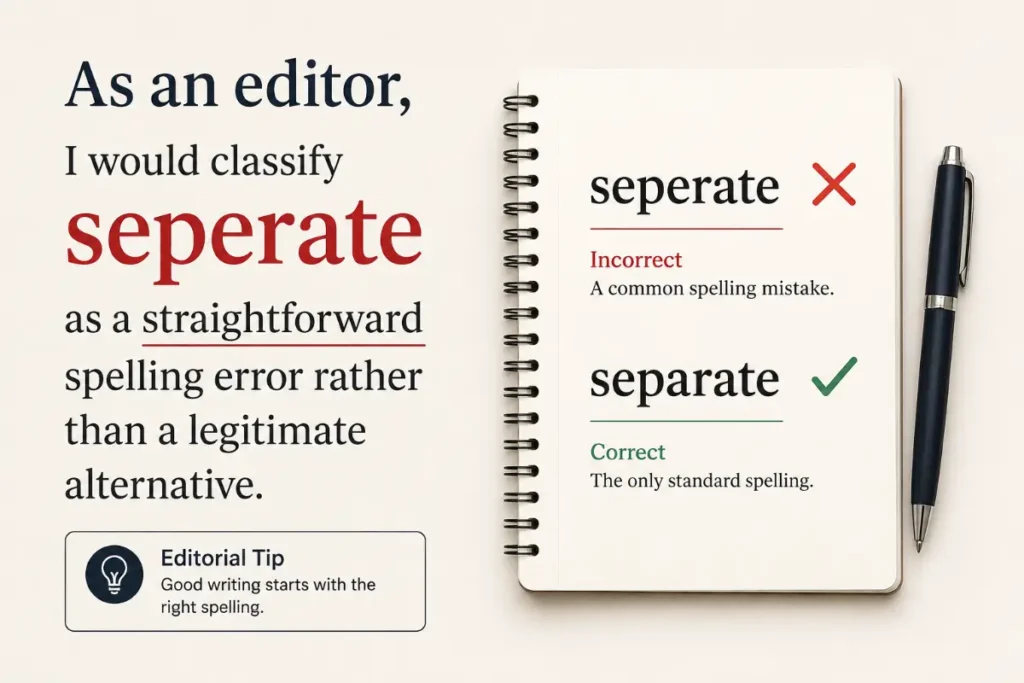
As an editor I would classify seperate as a straightforward spelling error rather than a legitimate alternative. Native speakers understand the intended meaning immediately but professional writing still needs the established form. Spellcheck tools usually flag seperate because it doesn’t match the standard dictionary entry. The better habit is to understand the word family rather than depend entirely on software. Think of separate alongside separation and separately. Once the shared spelling pattern becomes familiar the incorrect vowel becomes much easier to spot.
For another common grammar confusion, see Bony Vs Boney Which Spelling Is Correct 2026.
Conclusion
When comparing seperate or separate the answer is straightforward. Separate is the correct spelling and seperate is a common misspelling. Separate can work as an adjective a verb and a noun and its central meaning involves being divided distinct or kept apart. The easiest way to remember the spelling is to connect it with separation and separately.
You can also use the memory phrase there is a rat in separate. If you often make this mistake don’t rely only on pronunciation. Look at the word family and remember the middle a. That quick mental check will help you write the correct form confidently.
Frequently Asked Questions
Is seperate a real word?
Seperate isn’t the standard spelling of an English word. In ordinary edited writing it is treated as a misspelling of separate. Most readers can understand what the writer means because the error is visually close to the correct form. You may occasionally see seperate used as a made up name or username but that doesn’t make it a standard dictionary spelling.
What does separate mean?
Separate can mean divided distinct or not joined. As an adjective it describes things that aren’t connected. As a verb it means to divide or move apart. It can also appear as a noun in clothing terminology where separates are individual pieces that can be combined. The exact meaning depends on how the word functions in the sentence.
seperate or separate which is correct?
Separate is correct. Seperate is a common spelling mistake. The correct form contains an a in the middle rather than the e found in the incorrect version. A useful memory aid is to connect separate with separation and separately. Those related forms make the correct spelling pattern easier to recognize and reproduce.
How do you pronounce separate?
Separate has different pronunciation patterns depending on its grammatical role. As an adjective it is commonly pronounced SEP uh rut with the main stress on the first syllable. As a verb it is commonly pronounced SEP uh rate with a stronger final syllable. The spelling stays the same even though the pronunciation changes.
Can separate be used as a verb?
Yes. Separate is a common verb meaning to divide something or move things apart. For example you can say Please separate the documents into two folders. It can also describe people or objects moving apart naturally. The two groups separated after the meeting. Both uses are standard and common.
What is a synonym for separate?
The best synonym depends on the context. Apart can describe physical distance. Distinct emphasizes difference. Independent emphasizes freedom from another thing. Divide works well as a verb when something is split into parts. Segregate can mean keeping things or groups apart but often has a stronger social or institutional meaning.
Why do people misspell separate?
People often misspell separate because pronunciation doesn’t clearly reveal the middle vowel. The unstressed part of the word can sound weak in natural speech. That makes it easy to write the vowel that seems most likely. Fast typing and visual familiarity with the incorrect form can make the problem worse. Remembering separation can help reinforce the correct spelling.
Is separate suitable for formal writing?
Yes. Separate is fully suitable for formal writing. It appears in academic research business reports professional emails legal documents technical writing and government material. You don’t need a more complicated alternative to make your writing sound professional. Choose separate when you mean divided distinct or not connected. Clear and accurate vocabulary is usually stronger than unnecessarily formal language.