
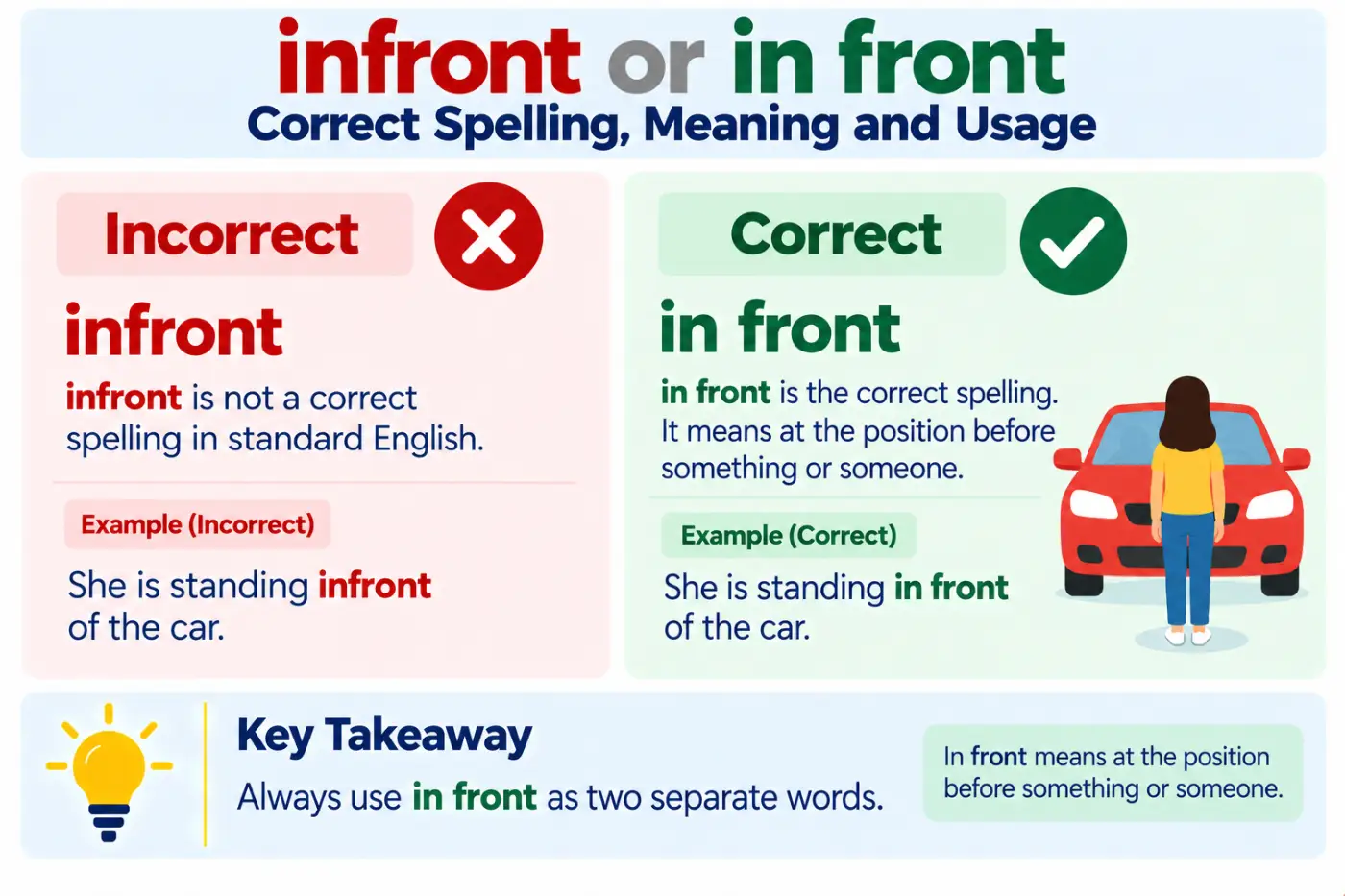
If you have ever stopped while writing and wondered if infront or in front is correct you’re not alone. The correct form is in front when you mean at or toward the position ahead of someone or something. Infront is not the standard spelling used for this phrase in English.
The confusion happens because English has many common expressions that combine words over time. Some phrases become single words while others stay separate. Since people often say the expression quickly in everyday speech it can sound like one word. That can make the written form less obvious especially when you’re typing fast or writing from memory.
The good news is that the rule is simple once you see how the phrase works. This guide explains its meaning grammar pronunciation word history sentence position common mistakes and differences from related expressions. You’ll also see examples from everyday speech school writing workplace communication and formal English so you can use the phrase naturally and confidently.
For another common grammar confusion, see Gait vs gate and the correct usage.
Quick Definition
In front is the standard English phrase used to describe a position ahead of someone or something. It can also describe being before someone in a line or sequence. Infront is generally considered a spelling error when used as this phrase. Write the words separately in standard English.
Quick Answer
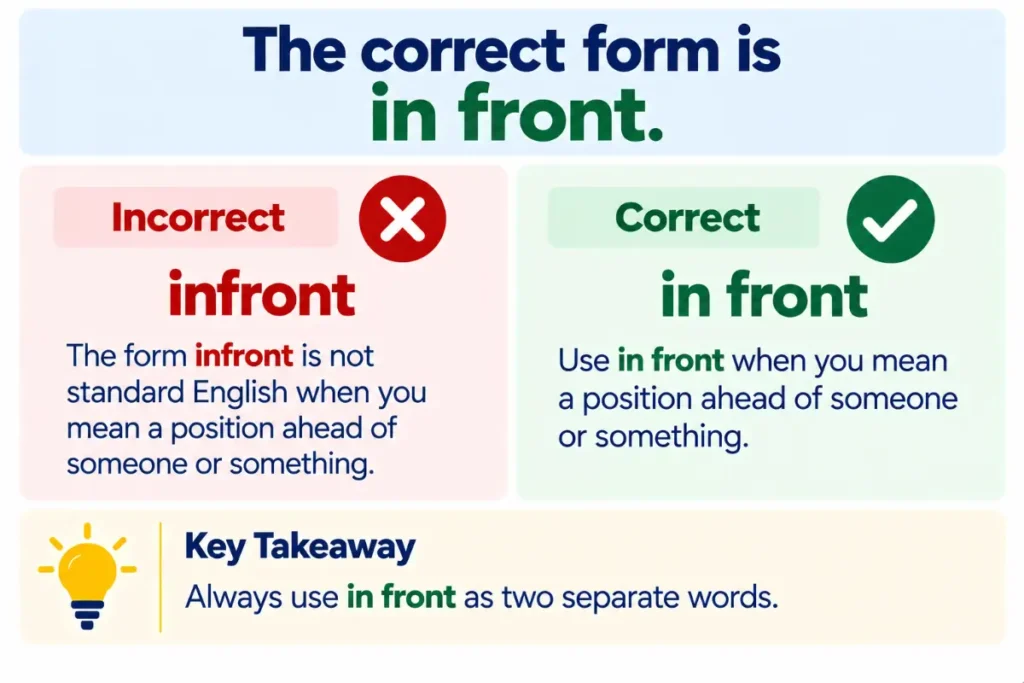
The correct form is in front. The form infront is not standard English when you mean a position ahead of someone or something.
For example, write The car is in front of the house. The phrase contains the preposition in and the noun front. They work together as a prepositional phrase.
Comparison Table
| Correct Form | Meaning | Part of Speech | Origin | Usage Frequency | Formality | Common Contexts | Example |
|---|---|---|---|---|---|---|---|
| In front | At or toward the position ahead of someone or something | Prepositional phrase | Native English words with Old English roots | Very common | Neutral | Location, movement, lines, comparisons, everyday speech | The bus is in front of the school. |
| Infront | No standard meaning as this phrase | Nonstandard spelling | Not a standard compound form | Uncommon | Not appropriate in standard writing | Typing errors and spelling mistakes | Write in front instead. |
Meaning and Definition
Meaning of Infront
Infront is generally not accepted as the standard written form of the phrase. When someone writes it in a sentence such as The teacher is infront of the class they normally mean The teacher is in front of the class.
The error usually comes from treating a spoken phrase as one word. English speakers often connect words naturally in speech. As a result the boundary between in and front may not feel obvious when you hear the expression.
You may occasionally encounter Infront as part of a company name product name username or other proper name. A specialized name can have its own spelling. That does not change the normal English rule for the location phrase.
For school assignments professional emails reports applications and other standard writing use the two word form.
Meaning of In Front
In front describes a position that is ahead of someone or something. It commonly answers questions about location.
The car is in front of the house.
Here the phrase tells us where the car is located.
The phrase can also describe movement.
She walked in front of me.
In this sentence the phrase shows that she moved ahead of the speaker.
It can describe position in a line.
There were three people in front of us.
It can also describe something positioned before another thing.
The title appears in front of the main text.
The exact meaning depends on context but the central idea stays the same. Something is positioned ahead of another person or thing.
Key Differences Explained
- Spelling. The standard phrase has two separate words. Infront combines them incorrectly for ordinary English usage.
- Meaning. In front describes a position ahead of someone or something. Infront does not have a separate standard meaning.
- Grammar. In front functions as a prepositional phrase. The word in is the preposition and front functions as the noun within the phrase.
- Pronunciation. In normal speech the two words often flow together. This can make them sound almost like one unit.
- Formality. In front is appropriate in casual conversation as well as formal writing. Infront should be corrected in polished standard English.
- Context. You can use in front for physical location lines movement and figurative situations. It appears in everyday English across many settings.
- Regional usage. Major varieties of English use the standard two word form. American British Canadian and Australian English do not normally treat infront as the standard spelling.
- Standard usage. The separate form is the established written pattern. Treating the phrase as one word is normally a spelling error rather than a meaningful alternative.
Which Form Is Correct?
The correct form is in front. English uses the two words separately because the phrase contains a preposition followed by a noun that together create a prepositional phrase.
This structure is similar to other common expressions such as in back of, in place of, in charge of and in addition to. The words work together grammatically but that does not automatically turn them into a single word.
A useful way to check your writing is to ask what role the phrase plays. If you mean a position ahead of someone or something you normally need the phrase in front.
Consider these sentences.
The teacher stood in front of the students.
A truck stopped in front of us.
He was standing in front of the line.
In each example the phrase identifies position or relative location.
Standard dictionaries treat front as a noun and in as a preposition. Together they form a familiar phrase rather than a standard single word. That grammatical structure explains why joining the two words creates an error.
Sentence Examples
The best way to understand a phrase is to see it in real sentences. These examples show how naturally the separate form works.
- My sister is waiting in front of the library.
- Please park your car in front of the garage.
- There was a long line in front of the ticket counter.
- The teacher stood in front of the class.
- I saw your brother in front of the restaurant.
- A large tree stands in front of our house.
- She walked in front of me during the tour.
- The children sat in front of the television.
- Someone left a bicycle in front of the office.
- He stepped in front of the camera just before the picture was taken.
The incorrect form can appear in writing because of typing habits. These examples show the kind of error you may encounter.
- Incorrect: The car is infront of the house.
Correct: The car is in front of the house. - Incorrect: She stood infront of me.
Correct: She stood in front of me. - Incorrect: Please wait infront of the building.
Correct: Please wait in front of the building. - Incorrect: He parked infront of the store.
Correct: He parked in front of the store. - Incorrect: The teacher is standing infront of the students.
Correct: The teacher is standing in front of the students.
These examples reveal the same pattern every time. The words should remain separate.
Common Mistakes and Misspellings
Several errors can appear when writers confuse the phrase with a single word. Most are easy to fix once you recognize the underlying pattern.
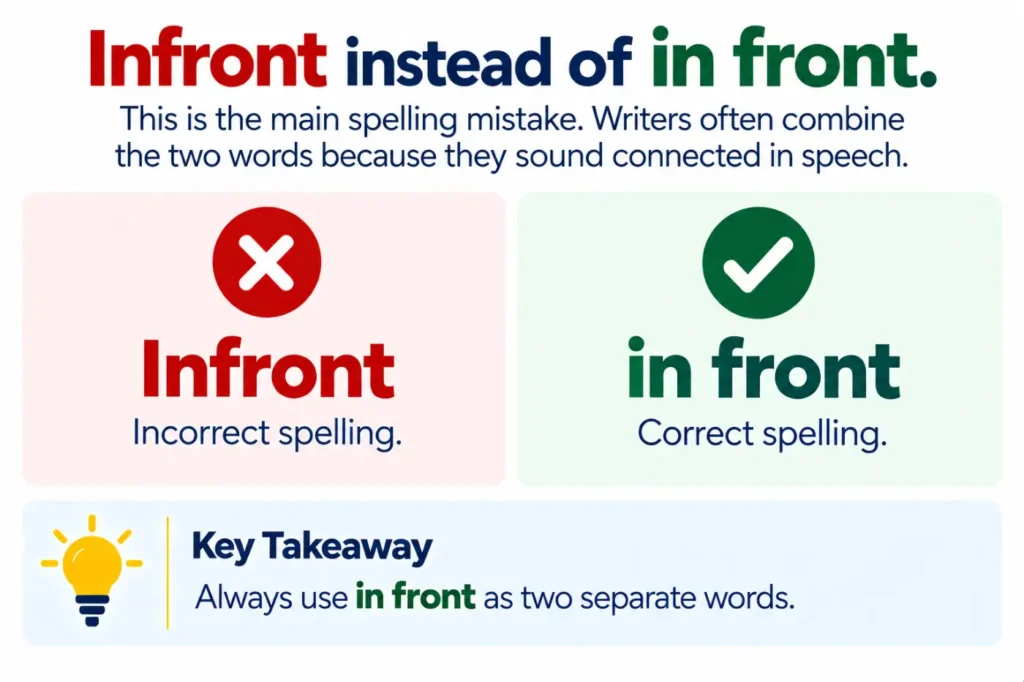
- Infront instead of in front. This is the main spelling mistake. Writers often combine the two words because they sound connected in speech.
- In frontof instead of in front of. Some writers accidentally combine front and of as they type. The standard phrase keeps all three words separate.
- Infront of instead of in front of. This error combines only the first two words while leaving of separate. The correction is simple: insert a space between in and front.
- In front off instead of in front of. The extra f usually comes from confusing the short function word of with off. The correct phrase uses of.
- Infronta. This kind of error can appear in very fast informal typing when several words are joined together. It is not a standard English form.
The most common reason behind these mistakes is word boundary confusion. In natural speech we don’t always hear clear pauses between individual words. The brain processes familiar phrases as meaningful units. That makes it easy to write a familiar phrase as one unit even though standard spelling keeps the words apart.
From an NLP perspective this can be described as a word segmentation problem. The meaning is usually clear from context but the written tokenization is wrong. Spellcheckers often recognize the intended phrase and suggest the standard form.
For another common grammar confusion, see Tear vs Tare: What is the Difference? (2026).
Pronunciation Guide
The phrase is commonly pronounced with the sounds flowing together naturally.
A common American English pronunciation can be represented approximately as:
in front
The IPA pronunciation varies slightly with speech style and surrounding sounds. A broad representation is /ɪn frʌnt/.
The first word sounds like the short vowel in sit. The second word begins with the consonant cluster fr and contains the vowel sound found in words such as cup and luck in many American accents.
The phrase has two spoken words even when they blend closely in fast conversation.
Try saying it slowly first.
in | front
Then say it at a natural speed.
in front
You may notice that the boundary becomes less noticeable. That is perfectly normal. Spoken English often connects nearby words. The spelling still keeps them separate.
One common mistake is to pronounce the phrase as if it were a special single word. That isn’t necessary. Treat it as two ordinary words that happen to form a common phrase.
Etymology and Word Origin
The phrase has a straightforward history because both words have deep roots in English.
In comes from an Old English preposition meaning inside or within. Over time it developed a wider range of meanings and became one of the most common prepositions in English.
Front entered English through French and ultimately traces back to Latin frontem which referred to the forehead or front part. Its meaning expanded to describe the forward part of something and later a position that faces or lies ahead.
The modern phrase combines these established words to express relative position. The construction has remained useful because it gives speakers a simple way to describe where something is located.
The history also helps explain why the phrase should not be treated as one invented word. Its structure comes from two separate words performing different grammatical roles.
Regional Usage
American English
American English uses the two word form in everyday conversation and writing. You’ll hear it when people describe locations lines movement and physical positions.
For example someone might say The pharmacy is in front of the bank. The same structure appears in school work workplace communication and formal writing.
British English
British English also uses the separate form. There is no standard British spelling that combines the phrase into infront.
The phrase works in much the same way as it does in American English. Differences in vocabulary may appear in specific contexts but the spelling of this phrase remains consistent.
Australian English
Australian English follows the same standard pattern. Writers normally use the separate words when describing position or location.
The combined form can still appear as a typing mistake but it isn’t a standard regional spelling.
Canadian English
Canadian English also uses the two word form. There is no meaningful Canadian variation that changes the normal spelling of this phrase.
Across these major varieties the basic rule is stable. Use the separate words in standard writing.
Grammar Rules and Part of Speech
The phrase is best understood as a prepositional phrase.
The word in functions as a preposition. Front is a noun that refers to the forward or leading part of something. Together they form a phrase that can describe location or position.
A common pattern is:
in front of + noun or pronoun
For example:
The dog is in front of the door.
She stood in front of me.
The word of introduces the person or thing relative to which the position is described.
Another common pattern is simply:
in front
For example:
The car is parked in front.
Here the listener may already know what the speaker means from the context.
The phrase can appear after a verb.
The children are sitting in front.
It can also appear after a noun.
The building in front of us is the new library.
It may appear near the beginning of a sentence.
In front of the house stood a large tree.
This construction sounds slightly more literary than the everyday The large tree stood in front of the house. Both are grammatically possible.
Position in a Sentence
There is no single required position. The phrase can move depending on what the writer wants to emphasize.
The boy stood in front of the door.
In front of the door stood the boy.
The first version is more common in ordinary conversation. The second places more attention on the location.
Punctuation
The phrase itself does not require special punctuation.
When it appears as part of a normal sentence there is usually no comma.
The car is in front of the house.
If a longer introductory phrase creates a natural pause the writer may use a comma based on sentence structure and style.
In front of the house, a small garden had been planted.
The comma belongs to the overall sentence structure rather than to the phrase itself.
Real Life Usage Examples
Daily Conversation
People use this expression constantly when describing places and positions.
The bus is right in front of us.
I’ll meet you in front of the store.
These sentences sound natural because the phrase gives a quick answer to the question where.
Email and Workplace Communication
The phrase also works naturally in professional messages.
Please leave the package in front of the reception desk.
The delivery truck is waiting in front of the main entrance.
There is nothing informal about the phrase itself. It fits professional communication perfectly.
Academic Writing
Academic writers may use the phrase when describing physical position or relationships between objects.
The sample was placed in front of the light source.
The participants sat in front of a computer screen during the experiment.
The wording is simple but precise. Academic writing doesn’t require complicated vocabulary when ordinary English communicates the point clearly.
News Writing
News reports often use location phrases to help readers picture an event.
Several people gathered in front of the courthouse.
A crowd formed in front of the stadium before the event.
The phrase gives readers a clear physical reference point.
Literature and Storytelling
Writers can also use the expression to create a visual scene.
She stopped in front of the old wooden gate.
A quiet river stretched in front of them as the sun began to set.
In storytelling the phrase can help place characters and objects in relation to one another. That makes scenes easier to picture.
Related and Confused Terms
Several expressions are connected to the idea of position or location. Knowing the differences can make your writing more precise.
- Behind. This describes a position at the back of someone or something. The opposite relationship is often expressed with in front.
- Ahead of. This means farther forward in position or progress. It can describe physical location or progress through a task.
- Before. This can describe position in time order or sequence. It doesn’t always refer to physical space.
- At the front. This refers to a position at the leading part of something. For example someone can sit at the front of a classroom.
- In back of. This can describe a position behind something. Usage and preferred style can vary by region and context.
- Next to. This means beside or immediately near something. It describes side by side position rather than forward position.
- Opposite. This can describe something located across from another object or place.
- Ahead. This means farther forward. It can refer to movement position time or progress.
These expressions overlap in some situations but they aren’t interchangeable in every sentence. The choice depends on the relationship you want to describe.
Expert Editor Insight
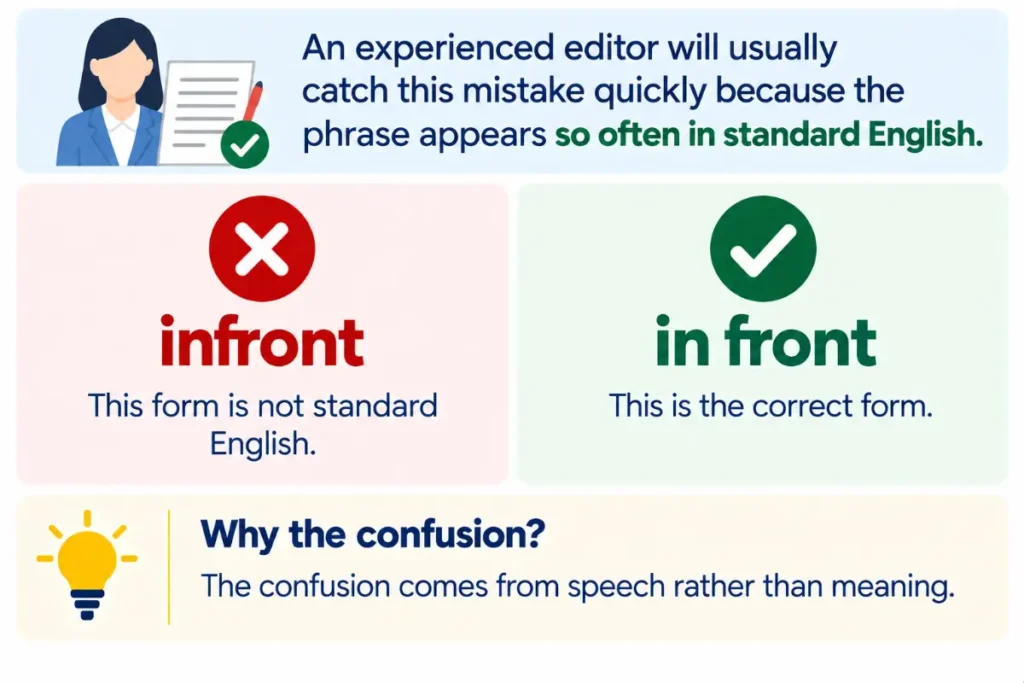
An experienced editor will usually catch this mistake quickly because the phrase appears so often in standard English. The confusion comes from speech rather than meaning. Native speakers naturally connect the sounds of in and front so the phrase can feel like one unit when spoken. During proofreading an editor checks word boundaries as carefully as spelling. A useful editing habit is to read the sentence slowly and ask if each part has a separate grammatical job. In this case in and front do, so keeping the space is the right choice.
Many readers also check one-third or one third Correct Spelling and Usage.
Conclusion
Infront or in front has a clear answer. In front is the standard English form when you mean at or toward a position ahead of someone or something. The combined form is normally a spelling mistake caused by treating two closely connected words as one. The phrase works as a prepositional phrase and appears naturally in conversation school writing professional communication journalism and formal documents.
The reason the mistake feels natural is easy to understand. When people speak quickly the words can blend together so the space is difficult to hear. That does not change the written form. English contains many phrases where separate words work together closely without becoming one word.
For an easy editing trick remember the structure in + front + of. If you can identify those separate parts in your sentence you’ll know where the spaces belong. Read the phrase slowly during proofreading and you’ll quickly spot the error before it reaches the final version.
FAQs
Is infront a real English word?
Infront is not the standard spelling of the common English phrase used to describe a position ahead of someone or something. In normal writing use in front as two words. A company name username or other proper name may use Infront as a special label but that does not make it the standard spelling of the everyday phrase.
Which is correct infront or in front?
In front is the correct standard form when you mean at a position ahead of someone or something. The phrase contains the preposition in and the noun front. They work together as a prepositional phrase but remain separate words. For example write The car is in front of the house rather than The car is infront of the house.
Why do people write infront as one word?
People often write the phrase as one word because the words flow together in normal speech. English speakers do not always pronounce a clear pause between in and front. Fast typing can make the problem more common because familiar phrases are sometimes treated as single units. The meaning remains understandable but standard spelling keeps the words separate.
Is in front used in formal writing?
Yes. In front is completely appropriate in formal writing. You can use it in academic papers reports business emails instructions news writing and other professional contexts. The phrase itself is neutral rather than casual. The key point is to preserve the standard two word spelling. Writing the words together can make otherwise polished writing look careless.
What does in front mean?
In front means at or toward a position ahead of someone or something. For example The teacher stood in front of the class means the teacher was positioned ahead of the students. The phrase can describe physical location movement or relative position. It can also appear in expressions such as in front of the house and in front of me.
Can in front start a sentence?
Yes. The phrase can appear at the beginning of a sentence when the writer wants to emphasize location. For example In front of the house stood a large tree. This structure is grammatical although a more ordinary conversational version would be A large tree stood in front of the house. Sentence position depends on emphasis and style.
How do you pronounce in front?
In front is commonly pronounced with two words that flow together naturally in connected speech. A broad American English pronunciation is approximately /ɪn frʌnt/. The first word sounds like in and the second begins with the fr sound. In fast speech the boundary can become less noticeable but the phrase still consists of two separate words in writing.
Is infront ever acceptable?
Infront may appear as part of a proper name such as a company name username or product label. In those cases the spelling belongs to that specific name. For the ordinary English phrase describing position use in front. If you’re writing an essay email report or other standard document the separate form is the appropriate choice.