
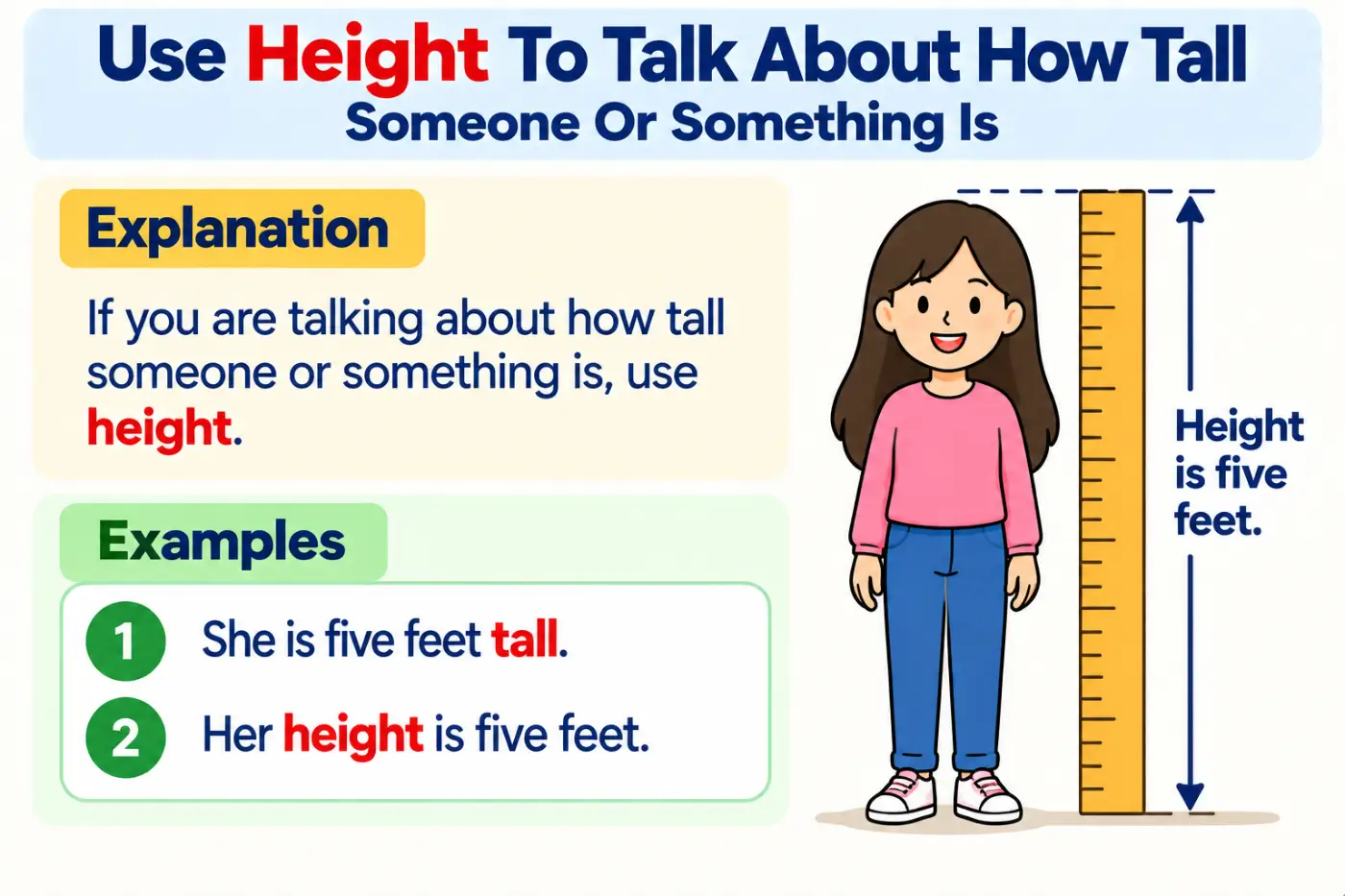
If you have ever typed hight instead of height, you are not alone. The correct standard English spelling is height when you mean how tall someone or something is, or how far something extends from bottom to top. Hight is generally a misspelling of this noun in modern English.
The confusion makes sense because the two forms look and sound similar. The extra letters in height can be easy to overlook, especially when you are typing quickly or spelling the word from memory. However, the correct spelling includes the letters e and i before the final gh and t.
You use this word to describe a person’s height, the height of a building, the height of a mountain, or the height of an object. It can also describe a high point or an advanced level of something. This guide explains the correct spelling, its meaning, pronunciation, grammar, word origin, common mistakes, and practical examples so you can use it confidently in everyday and formal writing.
A related grammar guide is Breath vs Breathe Which Word Should You Use.
Quick Answer
Height is the correct spelling when referring to how tall someone or something is. Hight is a common spelling mistake in modern everyday English, although it has appeared as an old or rare historical form and may occur in names. Remember the correct spelling as h e i g h t.
Comparison Table
| Feature | Height | Hight |
|---|---|---|
| Standard spelling | Yes | No, for the usual modern noun |
| Meaning | Measurement from bottom to top; tallness | Not normally used as the modern noun for tallness |
| Part of speech | Noun | Rare historical or specialized form; often a typo |
| Pronunciation | /haɪt/ | Usually intended to represent the same word when mistyped |
| Common usage | Everyday and formal English | Generally a spelling error |
| Formality | Standard in all writing styles | Avoid in standard writing |
| Common contexts | People, buildings, mountains, objects, measurements | Accidental typing or unusual historical and name uses |
| Example | The height of the door is seven feet. | The door has a hight of seven feet. |
Meaning and Definition
What Does Height Mean?
Height is a noun that describes the measurement of someone or something from the bottom to the top. It tells you how tall a person, building, tree, mountain, or object is.
For example, if a person measures five feet six inches from their feet to the top of their head, that measurement is their height. If a building measures 100 feet from the ground to its highest point, that is the building’s height.
The word also has broader meanings. It can describe the highest point of a place, the peak of an activity, or the strongest point of a feeling or condition.
Here are some common uses:
- Physical measurement: The height of the child is four feet.
- Building measurement: The tower has a height of 300 feet.
- Natural features: The mountain reaches a great height.
- Position or level: The airplane flew at a height of 30,000 feet.
- Peak or highest point: The singer reached the height of her career.
- Strongest degree: The excitement reached its height during the final match.
In everyday English, the most common meaning relates to vertical measurement. It answers a simple question: How tall is it?
Is Hight a Real Word?
Hight is not the standard spelling of the modern noun meaning tallness. If you write about a person’s measurement or the vertical size of an object, you should use height.
However, it would be inaccurate to claim that the letter sequence has never appeared in English. Hight has historical uses, including older forms associated with naming or calling, and it can also appear as a surname or place name. These specialized uses do not make it an acceptable replacement for height in ordinary modern writing.
For example:
- Incorrect: My hight is five feet eight inches.
- Correct: My height is five feet eight inches.
- Incorrect: What is the hight of this building?
- Correct: What is the height of this building?
If a spelling checker flags hight in a sentence about measurement, it is likely identifying the common error. In normal writing, replace it with height.
What Does Height Mean in Different Contexts?
The meaning of the word can change slightly depending on the subject, but the central idea remains connected to a top point, vertical measurement, or peak.
In personal measurements: It describes how tall a person is. Doctors, schools, sports teams, and clothing companies may use this measurement.
In construction: It describes the vertical size of a building, wall, ceiling, doorway, or other structure. Builders need accurate measurements to plan safe and suitable designs.
In geography: It can describe the elevation or vertical measurement of a mountain, hill, or other landform. The exact measurement may depend on the reference point used.
In aviation: It can describe how far an aircraft is above a reference level. In technical settings, specific terms such as altitude may be more precise and In figurative language: It can refer to the peak or strongest point of an experience, career, emotion, or activity. For example, the phrase the height of success describes a very high level of achievement.
Key Differences Explained
The main difference is spelling and standard usage. The two forms should not be treated as equal alternatives when you are writing about tallness or vertical measurement.
1. Spelling
The correct form is height. It contains six letters:
H E I G H T
The incorrect everyday form hight contains only five letters:
H I G H T
The missing e is the main reason for the spelling mistake. Many people hear the word and try to spell it according to its pronunciation. However, English spelling does not always match the sounds in a word.
A useful way to remember it is to focus on the sequence ei in the middle. The correct form has e before i, followed by gh.
2. Meaning
Height refers to how tall something is or the distance from its bottom to its top. It can also refer to a peak or the highest point of something.
Hight does not carry this standard modern meaning. If you use it in a sentence about a person’s size or a building’s measurement, most readers will see it as a typo.
3. Grammar
Height is a noun. It names a measurement, quality, or level. You can use it as the subject or object of a sentence.
Examples:
- Height is important in some sports.
- We measured the height of the fence.
- The height of the ceiling makes the room feel larger.
Hight is not the standard noun for these meanings. You should not use it in place of height in these sentence patterns.
4. Pronunciation
The standard pronunciation of height is /haɪt/. It has one syllable and rhymes with words such as light, night, and right.
The gh combination is silent. The letters do not create a separate sound in modern pronunciation. This silent letter pattern can make the spelling harder to remember.
5. Formality
Height is suitable for every type of writing. You can use it in a text message, school assignment, scientific report, construction plan, or official document.
Hight should be avoided in standard writing when you mean tallness. It may appear in historical material, names, or other special contexts, but those uses do not make it the correct spelling for ordinary measurement.
6. Context
You will commonly see the correct form in sentences about:
- A person’s physical measurement.
- The size of a building or room.
- The elevation of a mountain.
- The position of an aircraft.
- The highest point of an event or career.
- The level of a feeling or activity.
For these meanings, use height.
7. Regional Usage
American, British, Canadian, and Australian English all use height as the standard spelling. There is no meaningful regional spelling difference for this word.
Some accents may pronounce it with slight differences in vowel quality, but the standard spelling remains the same. The incorrect form is not an accepted regional alternative for the noun meaning tallness.
8. Standard and Nonstandard Usage
Standard English spelling uses height for the measurement of tallness. Hight is nonstandard for that meaning.
This distinction matters in professional communication. A spelling mistake can distract readers or make a document look less polished, even when the intended meaning is easy to understand.
Which Form Is Correct?
Height is the correct form. It is the standard English noun for the measurement of how tall someone or something is. Use it in sentences about people, buildings, objects, mountains, and vertical distance.
The spelling is supported by established modern English dictionary usage. Dictionaries list height as the noun for tallness, vertical measurement, and related figurative meanings. Hight is not the standard spelling for those definitions.
Here are some examples:
- Her height is five feet four inches.
- The height of the building is impressive.
- Please measure the height of the table.
- The mountain reaches a height of 2,000 feet.
- The pilot adjusted the aircraft’s height.
The reason for the spelling confusion is simple: the word contains silent letters. You hear a sound similar to hite, but the written form includes the letters e, i, g, h, and t after the initial h.
Do not remove the e just because you cannot hear it. English has many words with silent letters, and their spelling often needs to be learned as a complete pattern.
Sentence Examples
The following sentences show how to use the correct spelling in everyday and professional situations.
Ten Natural Examples
- Everyday conversation: What is your height?
- Text message: I need your height to order the right size.
- Workplace: Please check the height of the storage shelves before installation.
- School: The students measured the height of different plants.
- Academic writing: The study examined the relationship between a person’s height and body proportions.
- Formal writing: The maximum permitted height for the structure is 40 feet.
- Social situations: She was surprised by the height of the basketball player.
- Online communication: The video explains how to measure the height of a wall.
- Construction: The contractor confirmed the height of the new doorway.
- Travel: The hotel offers a beautiful view from a height of 20 floors above the street.
These examples show that the noun can describe people, objects, structures, and locations. It is also common in instructions and technical writing because accurate vertical measurements matter in many practical tasks.
Five Examples of the Common Spelling Mistake
The following sentences demonstrate the error. In each case, hight should be replaced with height.
1. Incorrect: What is your hight?
Correct: What is your height?
2. Incorrect: The hight of the tree is 25 feet.
Correct: The height of the tree is 25 feet.
3. Incorrect: I entered my hight on the form.
Correct: I entered my height on the form.
4. Incorrect: The hight of the ceiling is eight feet.
Correct: The height of the ceiling is eight feet.
5. Incorrect: The player has an unusual hight.
Correct: The player has an unusual height.
The error does not usually make the sentence impossible to understand, but it is still a spelling mistake. Correcting it makes your writing clearer and more professional.
Common Mistakes and Misspellings
The most common problem is leaving out a letter or changing the order of the letters. Other errors happen when writers confuse this noun with related words.
1. Writing Hight Instead of Height
Incorrect: The hight of the door is six feet.
Correct: The height of the door is six feet.
This is the most direct spelling error. The missing e changes the standard spelling. Remember that the correct form has six letters, not five.
2. Writing Heigth Instead of Height
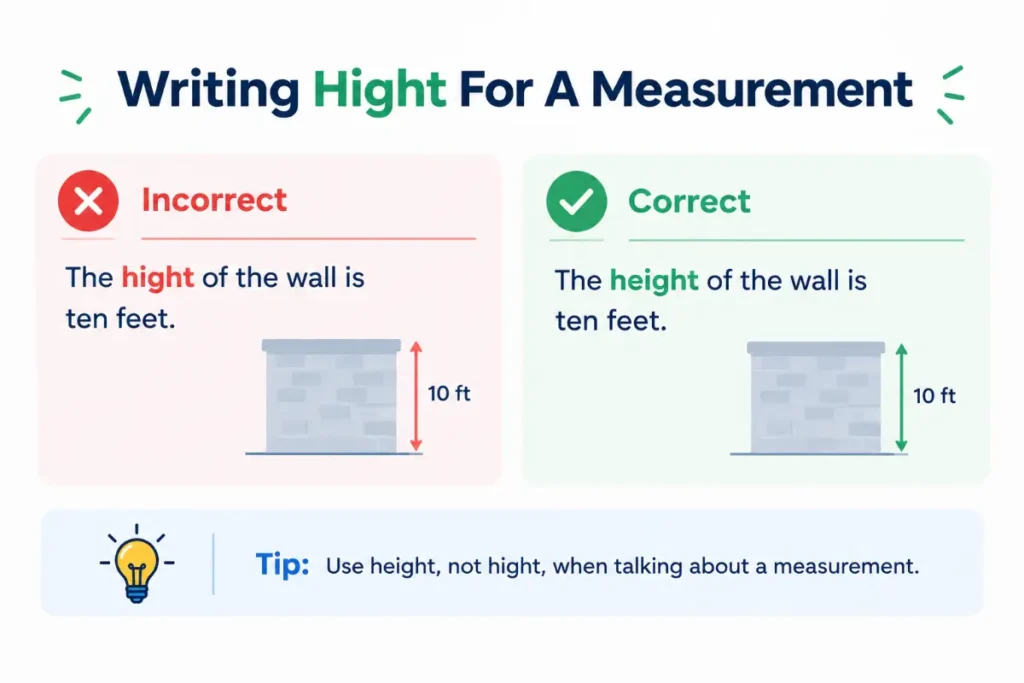
Incorrect: The heigth of the wall is ten feet.
Correct: The height of the wall is ten feet.
This mistake happens when the final letters are placed in the wrong order. The correct ending is ght, not gth. Reading the word carefully before submitting your writing can help you catch this error.
3. Writing Hieght Instead of Height
Incorrect: The hieght of the shelf is too low.
Correct: The height of the shelf is too low.
This error reverses the positions of e and i. The correct spelling places e before i. A simple spelling check can catch this mistake, but learning the letter pattern is more useful in the long run.
4. Confusing Height With High
Incorrect: The building has a high of 100 feet.
Correct: The building has a height of 100 feet.
High is usually an adjective that describes something with a great vertical measurement. Height is the noun that names the measurement itself.
Compare:
- The wall is high.
- The height of the wall is ten feet.
Both sentences are correct, but the words perform different grammatical jobs.
5. Confusing Height With Length
Incorrect: The height of the road is two miles.
Correct: The length of the road is two miles.
Height measures vertical distance, while length usually measures distance from one end to another. The right term depends on what you are measuring.
A road is normally measured by length, while a building is often measured by height. Using the correct measurement term prevents confusion in technical and everyday communication.
You may also want to read Impatient or Inpatient Which Word Do You Need.
Pronunciation Guide
How Do You Pronounce Height?
The standard pronunciation is /haɪt/. It is a one syllable word that sounds like hite. The vowel is the same diphthong found in words such as light, time, and right.
The letters gh are silent. You do not pronounce them as a separate sound. The word begins with the /h/ sound and ends with the /t/ sound.
Syllable Breakdown
Height has one syllable:
Height = hite
There is no second syllable. The word does not sound like hee ght or high get. It is pronounced as one smooth unit.
Stress Pattern
Because the word has only one syllable, it does not need a separate stress pattern. You pronounce the entire word with normal sentence stress.
For example:
- What is your height?
- The height of the building is 50 feet.
- We need to measure the height carefully.
Common Pronunciation Mistakes
Some learners try to pronounce the gh letters because they expect every written letter to have a sound. Others may add an extra syllable or use an incorrect vowel.
The easiest way to remember the pronunciation is to connect the word with light, night, and right. They share the same final sound pattern.
Remember that pronunciation and spelling do not always match in English. The silent letters are part of the correct written form, even though they are not heard when you say the word.
Etymology and Word Origin
The word height has a long history in English. It developed from Old English forms related to the word heah, meaning high. An earlier noun form, hiehthu, referred to height or highness.
Over time, the word changed in spelling and pronunciation as English developed. Its modern form reflects historical changes rather than a simple letter by letter match with the spoken sound.
The connection with high is still visible in modern English. High describes a position or level, while height names the measurement or quality associated with being high.
For example:
- The mountain is high.
- The mountain has an impressive height.
The two words share a historical relationship, but they serve different grammatical functions today.
The spelling also contains the gh letter combination found in several older English words. In modern pronunciation, these letters are silent. This is one reason the word can be difficult to spell correctly by sound alone.
You do not need to know the full history to use the word properly. The most useful point is that the modern standard spelling is height, and its connection with high can help you remember it.
Regional Usage
American English
In American English, height is the standard spelling. It is used in daily conversation, schoolwork, medical measurements, construction documents, sports, and scientific writing.
People commonly use feet and inches to describe personal height. For example, someone might say that they are five feet ten inches tall. The noun is also used with measurements in other units, such as meters and centimeters.
Hight is not an accepted American English alternative for this meaning. Use height in all standard writing.
British English
British English also uses height as the correct spelling. There is no separate British form of the word.
The main difference may involve measurement units. People in the United Kingdom may use feet and inches for personal height, while meters and centimeters are common in many technical and official contexts. The spelling itself does not change.
Australian English
Australian English follows the same standard spelling. Height is used for personal measurements, buildings, natural features, and vertical distance.
Meters and centimeters are common measurement units in Australia, but this does not affect the word’s spelling or meaning.
Canadian English
Canadian English also uses height. Writers and speakers use the same spelling found in American and British English.
Canada uses both metric and imperial measurements in different settings. The unit may change according to context, but the noun remains the same.
Is There Any Regional Difference?
No major regional spelling difference exists. The standard form is height across these English varieties. If you see hight in a modern sentence about tallness, treat it as a spelling error unless the text clearly uses it as a name or historical form.
Grammar Rules and Part of Speech
Height is a noun. It names a measurement, quality, or level rather than describing something directly. This means it often appears after articles, possessive words, or adjectives.
Using Height as a Noun
You can use it as the subject of a sentence:
- Height can affect the fit of some clothing.
- The height of the tower surprised visitors.
It can also act as the object:
- We measured the height of the room.
- The builder checked the height before installing the door.
In both cases, the word names the measurement.
Common Grammatical Patterns
Several sentence patterns are especially common.
The height of something: This is one of the most useful structures.
Example: The height of the fence is six feet.
Someone’s height: Use a possessive form to describe a person’s measurement.
Example: The doctor recorded the patient’s height.
At a height of: This phrase gives a specific vertical measurement or position.
Example: The aircraft was flying at a height of 10,000 feet.
Height above something: Use this pattern when naming the reference point.
Example: The platform is at a height of three feet above the floor.
Reach a height of: This expression describes the measurement something achieves.
Example: The tree can reach a height of 40 feet.
Height and High
A common grammar error is using the adjective high in place of the noun height.
High describes something:
- The ceiling is high.
- The mountain is high.
- The shelf is too high.
Height names the measurement:
- The ceiling has a height of ten feet.
- The mountain’s height is impressive.
- The shelf’s height needs to be adjusted.
A quick test can help. If you need a word to describe how tall something is, use high. If you need to name or measure that quality, use height.
Height and Tall
Tall is another adjective used to describe vertical size, especially for people, trees, and upright objects. Height is the noun form used to name the measurement.
Examples:
- My brother is tall.
- My brother’s height is six feet.
- That is a tall building.
- The height of that building is 200 feet.
Both adjectives and nouns have their own roles. Avoid using them as if they were interchangeable.
Singular and Plural Forms
The plural form is heights. Use it when referring to several measurements, levels, or high points.
Examples:
- The children have different heights.
- The aircraft flew at different heights during the test.
- The region contains mountains of impressive heights.
In some expressions, the plural can also refer to high or advanced levels of achievement or emotion. For example, the phrase great heights can describe major success.
Articles and Possessives
You can use height with articles such as a and the:
- The height of the wall is known.
- A height of six feet is enough for the design.
You can also use possessive forms:
- The building’s height is impressive.
- Her height makes it easy for her to reach the top shelf.
These patterns are common in everyday and formal English.
Real Life Usage Examples
Daily Conversation
People often discuss personal measurements when talking about clothing, sports, health, or family.
- What is your height in centimeters?
- My son has grown so much that we need to measure his height again.
The word sounds natural in both casual questions and family conversations. You do not need a technical term to describe how tall someone is.
Email and Workplace Communication
In professional settings, accurate measurements can affect furniture, building plans, equipment, and product design.
- Please confirm the height of the new office cabinets before placing the order.
- The installation team needs the exact height of the entrance before work begins.
Using the correct noun helps avoid misunderstandings, especially when measurements affect safety or fit.
Academic Writing
Students and researchers may use the word in studies involving people, plants, animals, buildings, or physical measurements.
- The research team recorded the height of each plant every week.
- The results showed a difference in average height between the two groups.
In academic writing, it is useful to state the measurement unit and explain how the measurement was taken. This makes the information easier to understand and compare.
News and Journalism
News reports often use the term to describe buildings, natural features, floods, aircraft, and other measurable subjects.
- The proposed tower will reach a height of 60 stories.
- Officials warned that floodwater could rise to a dangerous height overnight.
The noun helps readers understand the scale of a structure or event.
Literature and Storytelling
In stories, the word can describe a physical setting or create a sense of scale.
- From the height of the hill, the village looked like a collection of tiny lights.
- She stood at the height of the old stone wall and looked across the valley.
It can also appear in figurative expressions that describe a peak or important moment.
Related and Confused Terms
These eight words are closely related to the meaning of vertical measurement, tallness, and position.
1. High
High is an adjective that describes something located far above the ground or at a great level. For example, the ceiling is high. Use height when naming the measurement: the height of the ceiling is ten feet.
2. Tall
Tall describes someone or something with a greater than usual vertical measurement. It is commonly used for people, trees, buildings, and upright objects. For example, a tall person has a certain height.
3. Length
Length measures the distance from one end of something to the other. It is not usually used for vertical measurement when height is the intended dimension. A table may have a length, width, and height.
4. Width
Width describes how broad something is from side to side. For example, the width of a door measures its horizontal span, while its height measures the vertical distance from bottom to top.
5. Depth
Depth measures how far something extends downward or inward from a surface. You might measure the depth of a swimming pool, a box, or a hole. Height and depth can describe different directions of measurement.
6. Altitude
Altitude describes the vertical distance of a point or object above a reference level, often sea level. It is commonly used in aviation, geography, and outdoor activities. Although related to height, altitude has a more specific technical meaning.
7. Elevation
Elevation describes the height of a place or point above a reference level, commonly sea level. It is often used in maps, geography, construction, and land measurement. For example, a town may sit at an elevation of 1,500 feet.
8. Dimension
A dimension is a measurable feature of an object, such as its length, width, or height. The term is broader than the others because it can refer to any of the main measurements used to describe an object’s size.
Expert Editor Insight
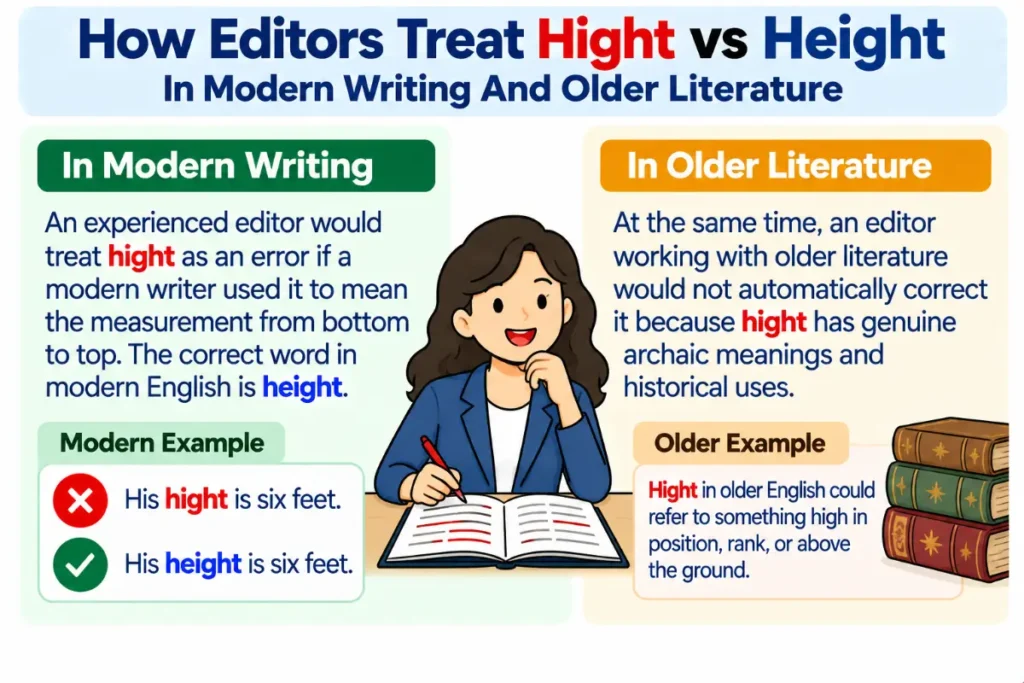
An experienced editor treats height as the standard spelling and checks that it fits the sentence as a noun. The confusion happens because the gh letters are silent and the spoken word gives little clue about the full spelling. Professional editors also check related terms such as high, tall, length, and altitude to make sure the writer has named the correct measurement. Spelling tools usually flag hight when it appears in ordinary writing, but they may not catch every context error. A useful editing tip is to check both the spelling and the meaning before submitting a document.
Learn the difference in Gorilla vs Guerrilla Meaning, Spelling and Differences.
Conclusion
The correct spelling is height, not hight, when you mean how tall someone or something is. The word is a standard noun used for people, buildings, objects, natural features, and vertical measurements. It can also describe a peak or the highest point of an experience.
The common error happens because the gh letters are silent, making the spelling harder to remember from pronunciation alone. A simple way to avoid the mistake is to connect height with high and remember the six letter spelling. Check the word before submitting important writing, especially in schoolwork, reports, and professional documents.
FAQs
Is Hight a Real Word?
Hight has appeared in older English and may also occur as a surname or place name. However, it is not the standard modern spelling for the noun meaning tallness or vertical measurement. If you are describing a person’s size, a building, or an object, use height.
What Does Height Mean?
Height means how tall someone or something is, measured from bottom to top. It can describe a person, building, tree, mountain, or object. The word can also refer to a peak or the highest point of an activity, feeling, or achievement. Its exact meaning depends on the sentence.
Why Is Height Spelled With an E?
The spelling reflects the word’s history and development in English, not a simple match between letters and sounds. The e is part of the standard written form, even though it is not pronounced as a separate sound. Remember the sequence e i g h t to avoid leaving out the letter.
How Do You Pronounce Height?
Height is pronounced /haɪt/ in standard American English. It has one syllable and sounds like hite, rhyming with light and night. The letters gh are silent, so you do not pronounce them separately. Say the word as one smooth syllable, beginning with an h sound and ending with a t.
Is Hight Ever Correct in a Sentence?
It may be correct in a special context, such as a person’s surname, a place name, or an older historical text. However, it is not correct as the ordinary modern noun for tallness. In a sentence such as My height is five feet eight inches, the standard spelling must include the e.
What Is the Difference Between Height and High?
High is an adjective that describes something located far above the ground or at a great level. Height is a noun that names the measurement or quality. You can say the wall is high, or you can describe the height of the wall. The two words are related but serve different grammatical roles.
Is Height the Same as Altitude?
Not exactly. Height generally describes vertical measurement from bottom to top or distance above a reference point. Altitude usually refers to the vertical distance of a location or object above a reference level, often sea level. The terms overlap in some contexts, but altitude is more specific in geography and aviation.
How Can I Remember the Correct Spelling?
Remember that the standard spelling contains six letters: h, e, i, g, h, and t. You can also connect height with high, which shares the same general idea of vertical position. When writing about tallness, check that the word includes the e before i and the silent gh before the final t.