
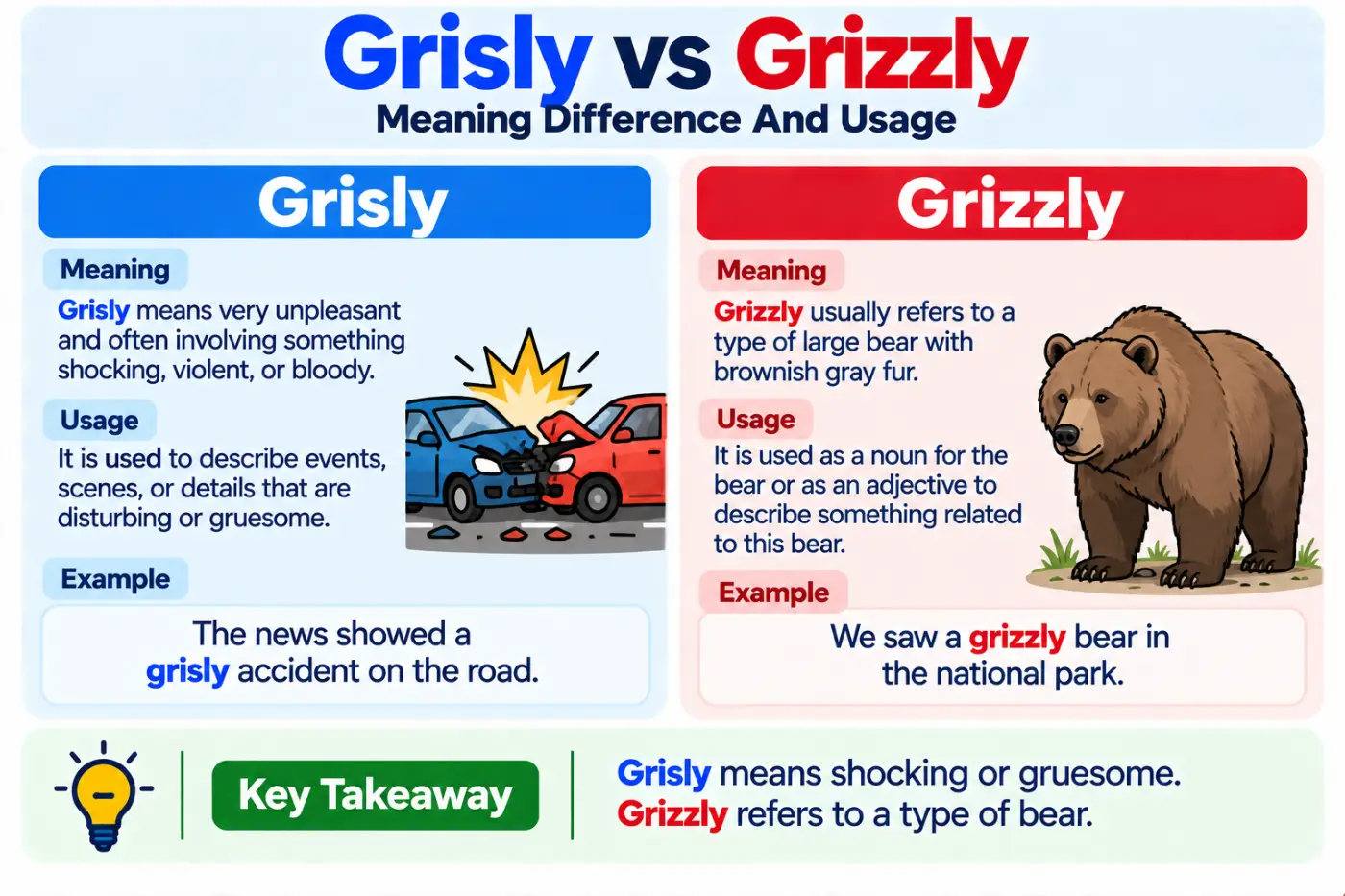
If you have ever hesitated between grisly and grizzly, you are dealing with two real English words, not one correct spelling and one simple typo. Grisly describes something horrifying, gruesome, or connected with death, while grizzly most commonly refers to a grizzly bear. The two words sound very similar, which makes them easy to mix up in writing.
The difference becomes much easier once you connect each spelling with its meaning. Think of grisly as a word for something disturbing or gruesome, such as a grisly murder or a grisly scene. Grizzly, on the other hand, is strongly associated with the grizzly bear, a large North American bear with brown or grayish fur.
This distinction matters because using one word in place of the other can completely change the meaning of a sentence. A grisly scene is horrifying, while a grizzly scene would not normally make sense unless grizzly is being used in a specific descriptive context. This guide explains the meanings, pronunciation, grammar, origins, common mistakes, examples, and practical memory tricks that will help you choose the right word quickly.
Need another quick comparison? Read hy meaning in text and chat.
Quick Answer
Grisly means horrifying, gruesome, or involving death, blood, or violence. Grizzly usually refers to the grizzly bear and can also describe something gray or streaked with gray. Both are correct English words, but they have different meanings and are not interchangeable.
Comparison Table
| Form | Meaning | Part of Speech | Origin | Usage | Formality | Common Contexts | Example |
|---|---|---|---|---|---|---|---|
| Grisly | Horrifying, gruesome, or involving death or violence | Adjective | From Middle English and related to the idea of causing fear or horror | Common in descriptive writing and news reporting | Neutral to formal | Crime, death, violence, horror, disturbing events | The investigators discovered a grisly scene. |
| Grizzly | A grizzly bear or something associated with it; sometimes gray or grayish in appearance | Noun and adjective | Related to an older spelling and pronunciation connected with grizzled or grayish coloring | Common in wildlife, nature, and general writing | Neutral | Wildlife, nature, animals, appearance | A grizzly crossed the trail. |
| Grizzly | Gray or streaked with gray | Adjective | Connected with the idea of grizzled coloring | Less common in everyday speech than the bear meaning | Literary or descriptive | Hair, fur, appearance | He had grizzly hair after years at sea. |
Meaning of Grisly
Grisly is an adjective used for something that causes horror because it involves death, blood, injury, violence, or disturbing details.
For example:
The reporter described the grisly discovery.
The adjective tells the reader that the discovery was horrifying or disturbing. It does not simply mean unpleasant. The word often carries a strong connection to death, physical injury, or graphic violence.
Common combinations include:
- A grisly murder.
- A grisly discovery.
- A grisly scene.
- A grisly accident.
- A grisly tale.
- A grisly sight.
- Grisly details.
- A grisly reminder.
The word can also appear in storytelling and journalism when a writer needs to describe something deeply disturbing without repeating a longer explanation.
For instance, saying the article contained grisly details tells the reader that the details were disturbing and probably related to death or violence.
Is Grisly Always About Death?
Not always, but death and violence are central to its common use.
The word can describe something horrifying or gruesome even when the sentence does not directly mention death. Still, the strongest and most familiar uses involve blood, injury, murder, corpses, accidents, or other disturbing events.
Compare these sentences:
- The police investigated a grisly murder.
- The documentary showed grisly images from the battlefield.
- The novel contains a grisly description of the attack.
In each example, the adjective adds the idea of horror or gruesomeness.
Meaning of Grizzly
Grizzly has several related uses, but the most familiar one is the animal.
A grizzly is a grizzly bear, a large bear native to parts of North America. The full name is grizzly bear.
For example:
We saw a grizzly near the edge of the forest.
Here, grizzly functions as a noun because it names the animal.
The word can also function as an adjective:
The hikers followed the grizzly bear from a safe distance.
In this sentence, grizzly modifies bear.
The word has another less common descriptive sense connected with gray or grayish coloring. This sense appears in expressions describing hair, fur, or another appearance.
For example:
The old sailor had grizzly hair.
This use is much less common in ordinary modern American conversation than the animal meaning.
Key Differences Explained
The easiest way to understand these words is to focus on the meanings they normally carry.
Spelling
The main spelling difference is the letter z in grizzly.
Grisly contains one z and has no second z after the i.
Grizzly contains two z letters and ends in ly.
The spellings are close enough that writers often type one when they mean the other.
Meaning
The meanings are sharply different.
Grisly means horrifying or gruesome.
Grizzly usually means a grizzly bear or something associated with that animal.
This is the most important distinction to remember.
Part of Speech
Grisly is an adjective.
It was a grisly scene.
Grizzly can be a noun.
A grizzly appeared on the hillside.
It can also be an adjective.
The park is home to grizzly bears.
Pronunciation
In standard American English, the two words are pronounced differently enough to distinguish them in careful speech, although they can sound very similar.
Grisly is commonly pronounced approximately like GRIZ lee.
Grizzly is commonly pronounced approximately like GRIZ lee as well.
Because the pronunciations are so close, the spelling difference does most of the work in writing. Context also helps listeners understand which word is intended.
Context
The surrounding words usually reveal the intended meaning.
A phrase such as grisly details strongly suggests something disturbing.
A phrase such as grizzly bear clearly refers to an animal.
This is why learning the words as part of common phrases can be more useful than memorizing the spellings alone.
Formality
Both words are standard English.
Grisly appears frequently in news reporting, crime writing, historical accounts, fiction, and descriptions of disturbing events.
Grizzly is standard in wildlife writing, nature discussions, travel writing, science communication, and everyday conversation about bears.
Neither word is inherently informal.
Regional Usage
There is no major American versus British spelling distinction between these two words. The meanings and spellings are broadly understood across major English varieties.
American English commonly uses grizzly bear for the North American animal. British English also recognizes the term.
The less common adjective grizzly meaning grayish can appear in literary or descriptive contexts, but it is not the main meaning most readers will expect.
Which Form Is Correct?
Both forms are correct, but they mean different things.
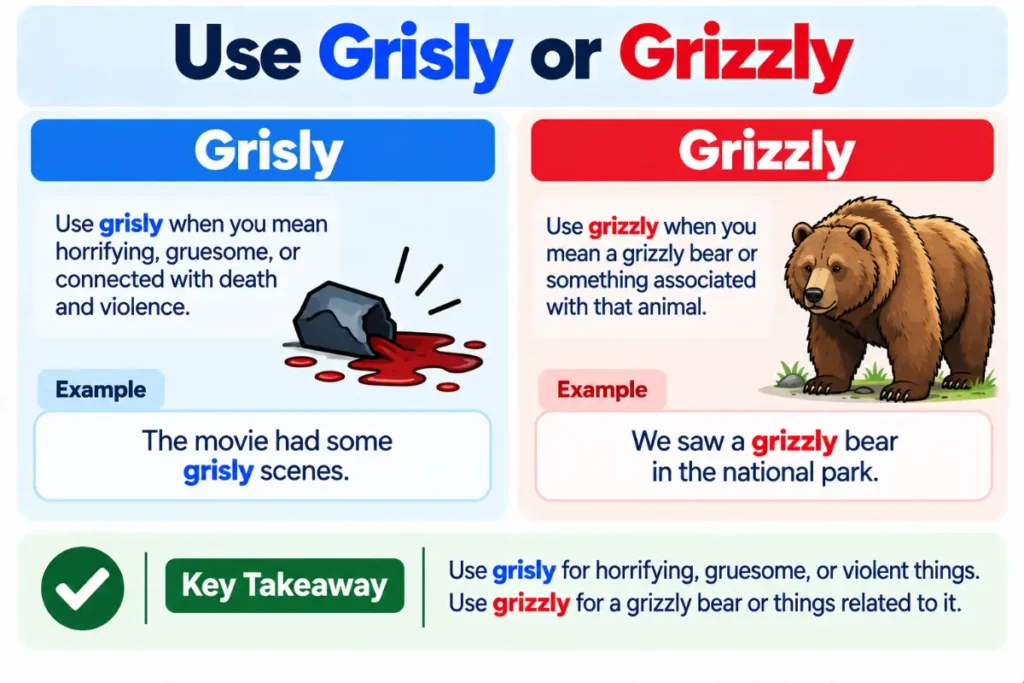
Use grisly when you mean horrifying, gruesome, or disturbing.
Use grizzly when you mean the bear or something connected with a grizzly bear. The word can also describe a gray or grayish appearance in less common usage.
The mistake happens because the words are close in sound and spelling. English contains many pairs like this, where a small spelling difference separates two unrelated meanings.
A useful test is to replace the word with a simple synonym.
If you can replace it with gruesome, choose grisly.
If you can replace it with bear, choose grizzly.
For example:
The newspaper described a grisly murder.
You could replace grisly with gruesome.
A grizzly walked through the valley.
You could replace grizzly with bear.
That simple substitution test works well when you are editing quickly.
Sentence Examples
Here are natural examples showing how the words work in context.
Examples With Grisly
- The detective uncovered a grisly detail during the investigation.
- The newspaper reported the grisly accident without showing graphic images.
- The horror novel begins with a grisly discovery in an abandoned house.
- The documentary included a few grisly scenes from the historic battle.
- The investigators found evidence of a grisly attack.
- The author is known for writing dark stories with grisly endings.
- The witness gave a grisly account of what happened.
- The museum exhibit described the grisly realities of medieval warfare.
- The film contains several grisly moments that may disturb some viewers.
- The old legend tells the story of a grisly event in the village.
Examples With Grizzly
- We saw a grizzly bear while driving through the national park.
- The ranger taught us how to behave if a grizzly approaches.
- The hikers carried bear spray because grizzly bears lived in the region.
- A grizzly wandered across the road before disappearing into the trees.
- The photographer spent weeks observing a family of grizzlies.
- The children learned about grizzly bears during their wildlife lesson.
- The guide warned visitors not to leave food near their tents because it could attract a grizzly.
- The wildlife center cares for an injured grizzly.
- The researchers tracked a grizzly through the mountain range.
- The documentary follows a mother grizzly and her cubs.
Common Mistakes and Misspellings
These words cause several predictable spelling and usage mistakes.
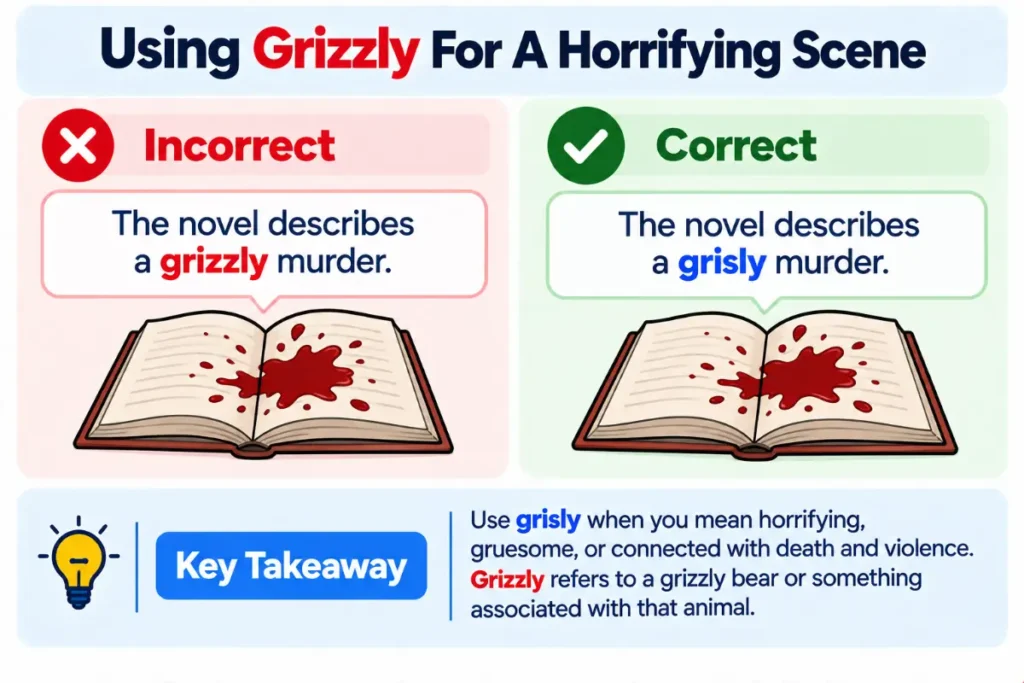
Mistake 1 Using Grizzly for Something Horrifying
Incorrect:
The police found a grizzly scene.
Correct:
The police found a grisly scene.
The intended meaning is probably horrifying or gruesome. That requires grisly.
Mistake 2 Using Grisly for the Bear
Incorrect:
We saw a grisly near the river.
Correct:
We saw a grizzly near the river.
The noun for the animal is grizzly.
Mistake 3 Adding an Extra Z
Incorrect:
The detective described a grizzley scene.
Correct:
The detective described a grisly scene.
The spelling grizzley is a common error created by mixing the spelling patterns of the two words.
Mistake 4 Using Grizzly Bear in a Horror Context
A writer may see grizzly and associate it with something frightening because grizzly bears can be dangerous. However, the word itself does not mean horrifying.
Correct:
The movie contains a grisly murder.
The animal meaning and the horror meaning are separate.
Mistake 5 Assuming Similar Sound Means Similar Meaning
The two words sound very close, but sound alone does not determine spelling or meaning.
English has many words that sound alike or almost alike but have different meanings. Learning the common phrase around each word can reduce this kind of error.
Pronunciation Guide
The pronunciation of the two words is one reason they are easy to confuse.
Grisly
IPA: /ˈɡrɪzli/
Easy pronunciation: GRIZ lee
Syllables: gris ly
The main stress falls on the first syllable.
Grizzly
IPA: /ˈɡrɪzli/
Easy pronunciation: GRIZ lee
Syllables: griz zly
The two words are pronounced the same in many standard varieties of English. They are therefore homophones in those varieties.
This is a key point: you cannot reliably choose the spelling from pronunciation alone.
If you hear someone say grisly or grizzly, the surrounding sentence gives you the clue.
For example:
The hikers spotted a grizzly.
The context tells you that the speaker means a bear.
But:
The hikers described the grisly accident.
The context tells you that the speaker means something gruesome.
This is a classic example of why spelling and meaning must be learned together.
Etymology and Word Origin
The two words have different histories, even though their modern forms and pronunciations are very close.
Origin of Grisly
Grisly comes from an older English word associated with fear, terror, or something frightening. Its history is connected with Middle English forms and ultimately with older Germanic language roots.
Over time, the word developed its modern sense of something that causes horror or appears gruesome.
Its connection with fear helps explain why grisly is used for disturbing scenes, violent events, and horrifying details.
Origin of Grizzly
Grizzly has a different historical path. The animal name is connected with the appearance of the grizzly bear, particularly its grayish or grizzled coloring.
The word grizzled is associated with hair or fur that contains gray or white strands. The bear name developed from this descriptive idea.
The spelling therefore makes more sense when you connect grizzly with the appearance of the animal rather than with horror.
The two words eventually came to look and sound extremely similar, but their meanings developed from different sources.
For another common grammar confusion, see Unphased or Unfazed Meaning And Usage Guide 2026.
Regional Usage
American English
Both words are standard in American English.
Grisly is used to describe disturbing or gruesome events.
The report contained grisly details.
Grizzly is especially familiar as a noun and adjective connected with the grizzly bear.
The park protects a large grizzly population.
American readers will generally understand the distinction from context.
British English
British English also recognizes both words with the same basic distinction.
Grisly describes something gruesome or horrifying.
Grizzly refers mainly to the North American bear and can also have its less common grayish descriptive sense.
There is no standard British spelling that replaces grisly with grizzly.
Australian English
Australian English also distinguishes the forms. The bear meaning of grizzly is understood, particularly in writing about North American wildlife.
Grisly retains its meaning related to horror and gruesomeness.
There is no major spelling change that creates a different standard form in Australian English.
Canadian English
Canadian English uses both words in their standard senses. The grizzly bear is particularly relevant in Canadian wildlife contexts because grizzly bears live in parts of western Canada.
Again, grisly retains the meaning of something horrifying or gruesome.
Grammar Rules and Part of Speech
Understanding the grammar of each word helps prevent mistakes.
Grisly as an Adjective
Grisly is an adjective. It describes a noun.
Common patterns include:
grisly + noun
a grisly murder
be + grisly
The scene was grisly.
verb + object + grisly adjective
The report made the details seem even more grisly.
Because it is an adjective, grisly normally modifies a person, place, thing, event, description, or situation.
Grizzly as a Noun
When grizzly means a grizzly bear, it can function as a noun.
A grizzly appeared near the campsite.
Plural:
Several grizzlies live in the region.
The plural form grizzlies changes the final y to ies, following a common English spelling pattern.
Grizzly as an Adjective
The word can also modify a noun.
grizzly bear
Here, grizzly describes the type of bear.
You can also encounter the adjective in descriptive uses connected with gray or grizzled coloring.
Punctuation
Neither word requires special punctuation.
They can appear naturally in ordinary sentences:
The article described a grisly discovery.
The guide spotted a grizzly.
Capitalization depends on position and proper names. Neither word is normally capitalized simply because it refers to an animal or describes something.
Real Life Usage Examples
The best way to master the distinction is to see how each word behaves in different settings.
Daily Conversation
People commonly use grizzly when talking about wildlife.
We saw a grizzly while hiking.
They may use grisly when discussing a disturbing story.
That movie had a pretty grisly scene.
The surrounding topic makes the intended meaning clear.
Workplace Communication
A workplace report may use grisly when discussing a serious accident or disturbing incident.
The report includes a grisly description of the accident.
In a workplace connected with wildlife, grizzly may appear frequently.
The team is studying grizzly behavior in the region.
The choice depends entirely on the subject.
Academic Writing
Academic writing may use grizzly in research about wildlife, ecology, conservation, or animal behavior.
Researchers observed grizzly bears in their natural habitat.
Grisly can appear in history, literature, journalism studies, or other fields discussing violence and death.
The novel uses grisly imagery to create a sense of fear.
News Writing
News reports may use grisly to describe disturbing events.
Investigators arrived at the scene after the grisly discovery.
Wildlife reporting may use grizzly:
Officials warned visitors about increased grizzly activity.
Editors need to choose carefully because changing one letter changes the meaning.
Literature and Storytelling
Writers often use grisly to create a dark or frightening mood.
The detective entered the room and found a grisly sight.
Grizzly can create a wilderness setting.
A grizzly stood silently among the pine trees.
These examples show how strongly context separates the two words.
Related and Confused Terms
Several words connect naturally with these terms.
Gruesome
Gruesome means causing horror or disgust, especially because something involves death, injury, or blood.
It is one of the closest everyday synonyms for grisly.
The novel contains gruesome scenes.
Gory
Gory refers specifically to bloodshed or excessive blood.
The movie contains several gory scenes.
A scene can be grisly without focusing heavily on blood.
Horrific
Horrific means extremely shocking, frightening, or disturbing.
The accident was horrific.
It is broader than grisly.
Gruesome
Gruesome and grisly overlap strongly, especially when describing disturbing details.
The report gave a grisly account of the attack.
The report gave a gruesome account of the attack.
Both work naturally in this context.
Grizzled
Grizzled means having gray or partly gray hair, fur, or another appearance.
The grizzled captain had spent decades at sea.
This word is closely related in form to grizzly, but it does not mean horrifying.
Bear
A bear is the general animal category. A grizzly is one specific type of bear.
We saw a bear.
This sentence gives no specific type.
We saw a grizzly.
This identifies the animal more specifically.
Grizzly Bear
Grizzly bear is the full common name for the animal.
The grizzly bear is an important part of several North American ecosystems.
Grizzlies
Grizzlies is the plural form when grizzly is used as a noun.
The park is home to several grizzlies.
This spelling is different from grisly, even though the pronunciation remains closely related.
A Simple Memory Trick
A strong memory trick can make this distinction almost automatic.
Think:
Grisly = gruesome.
Both words are connected with something disturbing.
Then think:
Grizzly = grizzly bear.
The extra z helps you connect the word with the animal.
You can also use a substitution test.
If the sentence makes sense with gruesome, use grisly.
If the sentence makes sense with bear, use grizzly.
For example:
It was a ___ scene.
Try gruesome.
It was a gruesome scene.
That tells you the correct choice is grisly.
Now try:
We saw a ___ in the woods.
Try bear.
We saw a bear in the woods.
That tells you the correct choice is grizzly if you mean the specific animal.
This technique works because it focuses on meaning instead of visual spelling alone.
Why These Words Are So Easy to Confuse
The main reason is pronunciation.
In standard English pronunciation, grisly and grizzly are generally pronounced alike. This means a listener cannot always know which spelling a speaker intends.
The spellings are also visually similar. Both begin with gri, contain an s or z sound, and end with ly.
There is another source of confusion. A grizzly bear can certainly be frightening or dangerous, so people may naturally connect grizzly with frightening things. But that association does not make grizzly a synonym for grisly.
English spelling often preserves distinctions that pronunciation does not reveal. This is why homophones and near homophones can cause trouble even for experienced writers.
The best solution is to learn the words in phrases rather than in isolation.
Remember:
grisly murder
grisly scene
grisly details
and:
grizzly bear
grizzly cub
grizzly population
Once these combinations become familiar, choosing the correct spelling becomes much faster.
Can Grizzly Mean Gray?
Yes, but this is not the meaning most readers expect in everyday American English.
Grizzly can be used as an adjective connected with gray or grayish coloring. This sense is related to the historical idea of something being grizzled or streaked with gray.
For most modern readers, however, the strongest association is the grizzly bear.
If you are writing for a general audience, context should make the intended sense clear.
For example:
The grizzly bear disappeared into the forest.
Here, the meaning is obvious.
A sentence such as:
His grizzly hair caught the sunlight.
may be understood as a description of grayish or streaked hair, although grizzled is often the more familiar choice for that idea.
Can Grisly Describe a Person?
Yes. Grisly can describe a person indirectly when the person or the person’s appearance is horrifying or gruesome, but it usually modifies a situation, event, scene, story, or detail.
For example:
The novel describes a grisly killer.
This means the killer is presented in a horrifying or gruesome way.
However, the word does not simply mean bad, mean, or dangerous.
That distinction matters. If you only mean that someone is unfriendly or threatening, another adjective may be more precise.
Can Grisly Start a Sentence?
Yes. Grisly can start a sentence normally because it is an adjective.
For example:
Grisly details emerged during the investigation.
There is no grammatical rule preventing an adjective from appearing at the beginning of a sentence. The important point is that it must connect naturally with the noun it describes.
You could also write:
Grisly images appeared throughout the novel.
Here, grisly modifies images.
The same principle applies to grizzly:
Grizzly bears live in several parts of North America.
In this sentence, grizzly modifies bears.
Expert Editor Insight
An experienced editor treats these as two separate vocabulary items rather than two competing spellings of one word. The fastest check is semantic: if the sentence means gruesome or horrifying, use grisly; if it means the animal, use grizzly. Spell checkers can sometimes identify an accidental spelling choice, but they may not catch a wrong word if both forms are valid dictionary words. That is why context and meaning remain essential during proofreading.
You may also want to read Camisole Meaning Slang: What Does It Really Mean?(2026).
Conclusion
The key distinction in grisly vs grizzly is simple once you connect each word with its meaning. Grisly means horrifying, gruesome, or disturbing, while grizzly usually refers to a grizzly bear and can also describe something grayish in less common usage.
Because the two words are pronounced the same in standard English, spelling mistakes are easy to make. The safest approach is to check the meaning before choosing the spelling. If you could replace the word with gruesome, choose grisly. If you mean the animal, choose grizzly. Remembering grisly equals gruesome and grizzly equals bear gives you a quick editing test that works in everyday writing, schoolwork, professional documents, and formal prose.
FAQs
Is grisly a real word?
Yes. Grisly is a standard English adjective meaning horrifying, gruesome, or disturbing. It commonly describes murders, accidents, discoveries, scenes, details, and stories involving death or violence. It is not a misspelling of grizzly. The two words are separate vocabulary items with different meanings.
Is grizzly a real word?
Yes. Grizzly is a standard English word. It most commonly refers to a grizzly bear, either as part of the phrase grizzly bear or as a noun on its own. It can also function as an adjective and has a less common descriptive sense related to gray or grayish coloring.
Which is correct for something horrifying?
Use grisly when you mean horrifying, gruesome, or disturbing. For example, The investigators discovered a grisly scene is correct. Grizzly does not normally mean horrifying. The fact that a grizzly bear can be frightening does not change the word’s meaning.
Which is correct for the animal?
Use grizzly. A grizzly is a type of bear found in parts of North America. You can write a grizzly bear or simply a grizzly when the context is clear. The plural noun is grizzlies, as in The park is home to several grizzlies.
Are grisly and grizzly pronounced the same?
In standard English, the two words are generally pronounced the same, or nearly the same depending on the speaker and variety of English. This makes them homophones and explains why people often confuse their spellings. Context is usually necessary to identify the intended word in speech.
What is a synonym for grisly?
Useful synonyms include gruesome, gory, horrific, horrifying, and macabre, depending on the sentence. These words are not perfect substitutes in every context. Gruesome is often the closest everyday alternative when describing something disturbing because of death, violence, injury, or graphic details.
Why do people confuse these words?
People confuse them mainly because they sound the same and look very similar. Both begin with gri and end with ly, so the difference is easy to overlook while typing. The meanings also create an indirect association because a grizzly bear can be frightening, even though grizzly itself does not mean horrifying.
Is grisly appropriate in formal writing?
Yes. Grisly is a standard adjective and can appear in formal writing, journalism, academic discussion, historical writing, and professional reports. Its suitability depends more on the subject than on formality. Because it has a strong meaning related to horror or gruesomeness, writers should use it only when that meaning accurately describes the subject.