
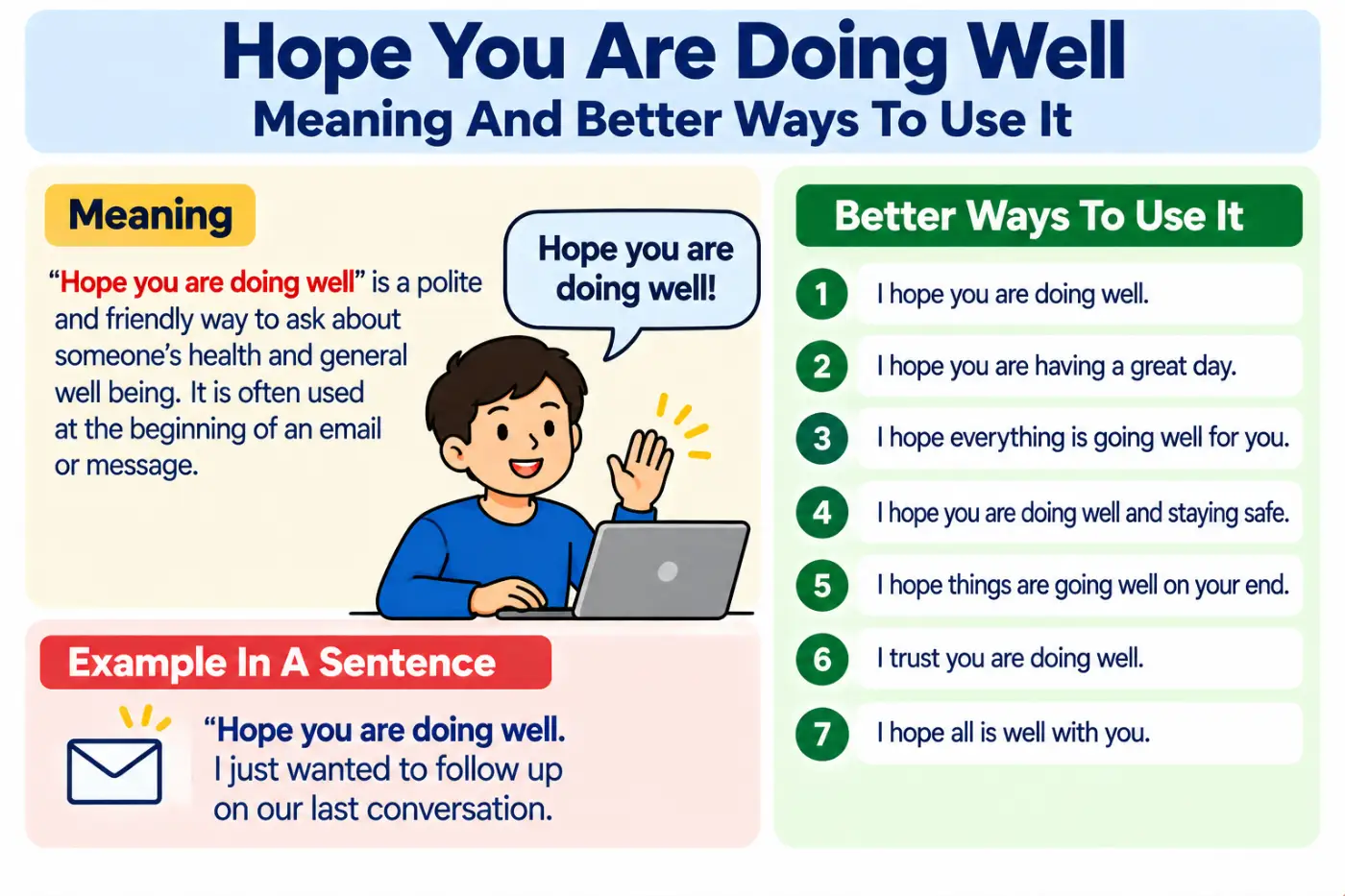
The phrase hope you are doing well appears in countless emails and messages, yet many writers still wonder if it sounds natural, professional, or grammatically complete. Yes, it is correct and widely understood. In a complete sentence, the traditional form is I hope you are doing well, while the shorter version is common in friendly and professional email openings.
The phrase expresses a simple wish for someone’s health, happiness, or general situation. It usually appears near the beginning of an email when the writer wants to sound polite before moving to the main reason for writing. The expression can work well, but using it in every email can make your writing feel repetitive. Small changes can make your message sound warmer and more personal.
This guide explains the meaning, grammar, punctuation, tone, pronunciation, sentence structure, and real world use of this familiar greeting. You’ll also see examples for work emails, school communication, friendly messages, formal correspondence, and follow ups. Most importantly, you’ll learn when the standard full sentence works best and when a shorter or more specific opening sounds more natural.
Quick Definition
The expression hope you are doing well is a polite way to ask or express a wish that someone is healthy, happy, and having a good experience. The complete grammatical sentence is I hope you are doing well. The shorter version commonly appears in emails because English often omits the subject and auxiliary structure in informal conversational openings.
Quick Answer
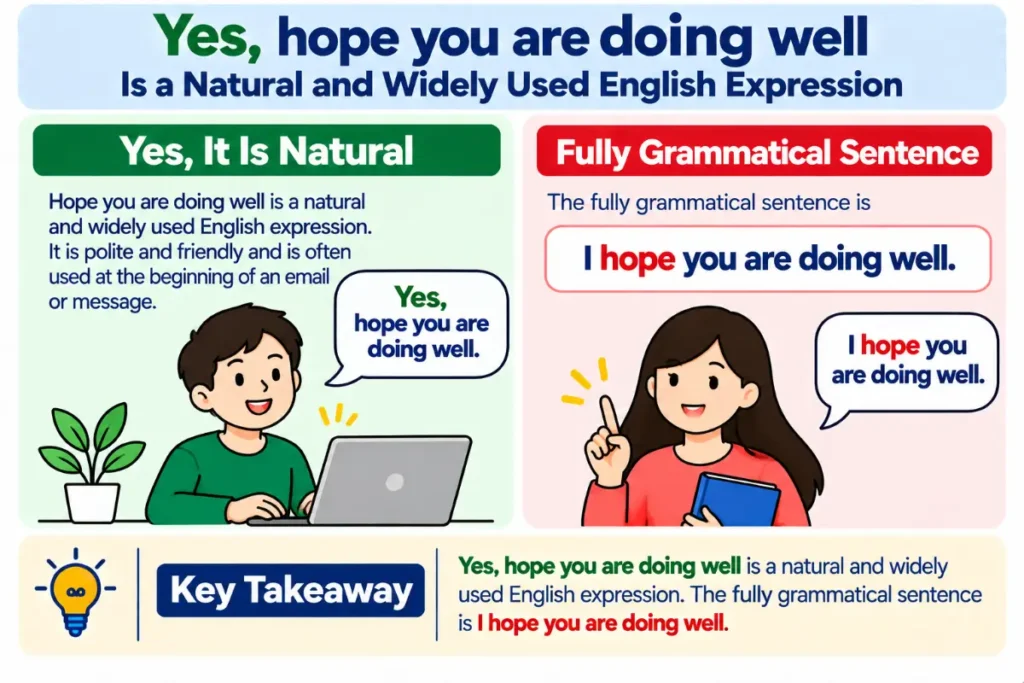
Yes, hope you are doing well is a natural and widely used English expression. The fully grammatical sentence is I hope you are doing well.
In emails, writers often leave out I because the meaning is obvious from the context. This creates a friendly and concise opening. In more formal writing, keeping I can make the sentence feel more complete and polished.
The expression does not necessarily ask for detailed information about someone’s life. It usually works as a polite goodwill statement before the main purpose of the message.
Comparison Table
| Form | Meaning | Part of Speech | Origin | Usage Frequency | Formality | Common Contexts | Example |
|---|---|---|---|---|---|---|---|
| I hope you are doing well | A complete expression of goodwill | Main clause with a verb phrase | Traditional English structure using hope and well | Very common | Neutral and professional | Emails, letters, workplace messages | I hope you are doing well. |
| Hope you are doing well | Shortened version of the complete expression | Conversational clause with omitted subject | Natural conversational shortening | Very common | Friendly to professional | Emails, messages, follow ups | Hope you are doing well. |
| I hope you are well | A concise wish for someone’s general wellbeing | Main clause with a verb phrase | Traditional English structure | Very common | Neutral and slightly more formal | Emails, letters, professional communication | I hope you are well. |
| Hope all is well | A general wish that things are going smoothly | Conversational clause | Common English expression | Very common | Friendly and professional | Emails and messages | Hope all is well. |
Meaning And Definition
What The Expression Means
The phrase communicates goodwill toward another person. In plain English, it means something close to I hope things are going well for you.
The word hope expresses a desire or expectation. The word you identifies the person receiving the message. The phrase are doing describes the person’s current situation or condition. The word well describes that condition in a positive way.
For example:
I hope you are doing well.
The writer is not necessarily asking for a detailed report. The sentence simply shows friendly concern.
That distinction matters because English speakers often use this expression as a social opening rather than as a serious question. Someone may write it before asking for a document, discussing a project, or following up on an earlier conversation.
Is It Grammatically Correct
The complete version I hope you are doing well is grammatically complete.
It contains a subject and verb in the main clause.
I hope.
It also contains a subordinate clause.
You are doing well.
The shorter version leaves out the subject I.
Hope you are doing well.
This is technically a sentence with an omitted subject. In conversational English, omitted subjects are common in greetings, messages, notes, and email openings. The reader easily understands that the writer means I hope you are doing well.
This does not mean the shorter version works equally well in every context. A highly formal letter may benefit from the complete sentence. A friendly email can comfortably use the shorter version.
What Does Doing Well Mean
Doing well usually means being in a good state or having things go successfully.
Its exact meaning depends on context.
If you ask someone how they are doing, doing well can refer to their general wellbeing.
If you discuss a student, doing well can refer to successful academic progress.
For example:
I hope your new business is doing well.
Here doing well refers to the business’s performance.
In the greeting I hope you are doing well, the meaning is broader. It usually refers to the person’s general situation.
The Grammar Behind The Expression
The sentence uses the verb hope followed by a clause.
I hope + subject + verb phrase.
In this case:
I hope + you + are doing well.
This structure is common in English.
Consider these examples:
I hope you feel better.
I hope your trip goes well.
The pattern is flexible. The writer can change the clause after hope to match the situation.
The phrase doing well uses the present progressive form are doing combined with the adverb well. This construction focuses on the person’s current condition or circumstances.
There is no grammar problem with using well after doing. Some learners incorrectly choose good because good is more familiar as an adjective.
For example:
I hope you are doing well.
This is standard.
I hope you are doing good.
This version appears often in casual American speech and informal writing. However, well is the traditional adverbial choice after the verb doing when describing how someone is doing.
Hope You Are Doing Well Or I Hope You Are Doing Well
The difference is mainly tone and completeness.
I hope you are doing well is a complete sentence. It works in professional emails, formal correspondence, school communication, and everyday messages.
Hope you are doing well is a shortened conversational form. It is extremely common in email and digital communication.
Compare these openings.
I hope you are doing well. I wanted to follow up on our meeting.
Hope you are doing well. Just checking in about our meeting.
Both sound natural. The second feels more relaxed and direct.
The choice depends on the relationship and the tone you want.
If you are writing to a professor, client, senior colleague, government office, or someone you do not know well, the complete sentence is a safe choice.
If you are writing to a familiar colleague, friend, classmate, or regular contact, the shorter version can sound perfectly natural.
When To Use It In An Email
The expression works best when you have a reason to acknowledge the other person before getting to the main subject.
For example:
I hope you are doing well. I wanted to follow up on the proposal we discussed last week.
The opening creates a polite transition into the purpose of the email.
It can also work after a long gap in communication.
I hope you are doing well. It has been a while since we last spoke.
This feels warmer because the writer connects the greeting to the relationship.
The expression can also work after a shared event.
I hope you are doing well after the conference. It was great speaking with you.
That version sounds more personal than using the same greeting in every message.
When It Can Sound Repetitive
The phrase is polite, but repetition can make it feel automatic.
Imagine receiving five emails from the same person. Each one begins with exactly the same sentence.
I hope you are doing well.
After a while, the greeting may feel like a template rather than genuine communication.
That does not make the phrase wrong. It simply means the context may call for something more specific.
Instead of using the same opening every time, connect your first sentence to the situation.
I hope your presentation went well yesterday.
These alternatives show that you remember something about the person or situation.
Good communication often feels personal because it responds to context.
Sentence Examples
Here are natural examples across different situations.
- I hope you are doing well. I wanted to ask about the meeting schedule.
- Hope you are doing well. I’m checking in about the documents you requested.
- I hope you are doing well after your trip.
- Hope you are doing well and enjoying the summer.
- I hope you are doing well. Thank you for getting back to me.
- I hope you are doing well. I’m writing to confirm our appointment.
- Hope you are doing well. It was great talking with you last week.
- I hope you are doing well. I wanted to follow up on my previous message.
- I hope you are doing well as the new school year begins.
- Hope you are doing well. Please let me know if you need anything from me.
These examples show that the phrase does not have to stand alone. It usually works as an opening before the actual purpose of the message.
Common Mistakes
Using Good Instead Of Well
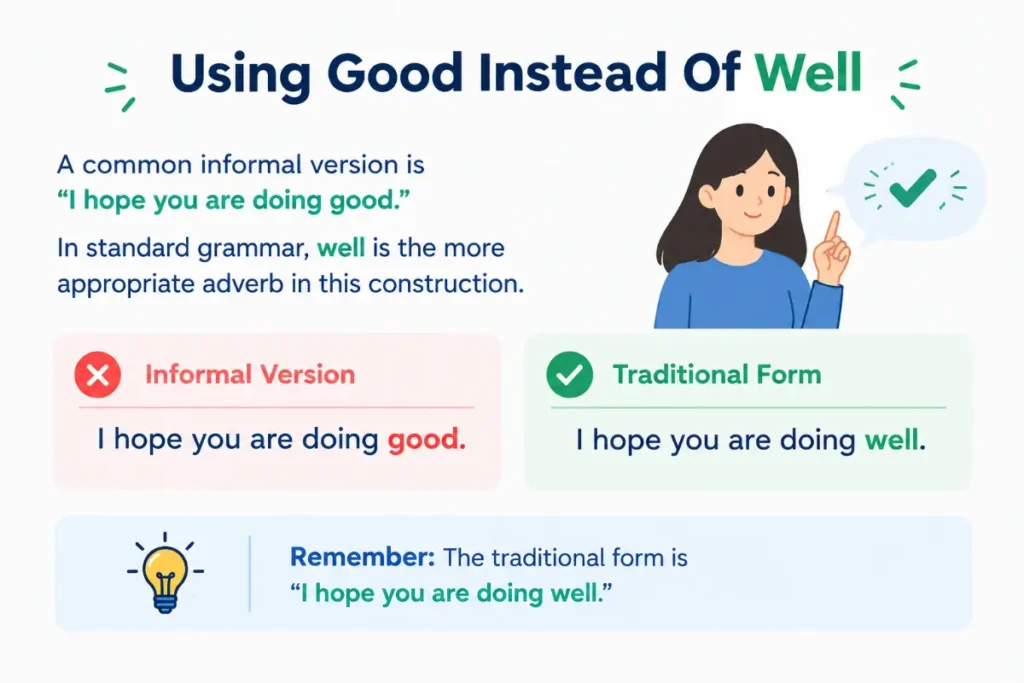
A common informal version is I hope you are doing good.
In standard grammar, well is the more appropriate adverb in this construction.
The traditional form is:
I hope you are doing well.
Good is normally an adjective.
Well commonly functions as an adverb describing how an action happens.
This distinction is small but useful for polished writing.
Adding An Unnecessary Question Mark
Writers sometimes treat the phrase as a direct question.
I hope you are doing well?
That punctuation can make the sentence sound uncertain or unusual.
If you are expressing goodwill, use a period.
I hope you are doing well.
If you genuinely want to ask how someone is doing, write a direct question.
How are you doing?
The punctuation should match the purpose.
Writing The Phrase In Every Email
The expression is not wrong, but repetition can make your writing feel formulaic.
If you have a specific reason for contacting someone, consider starting with that reason.
I’m following up on the proposal we discussed last Tuesday.
That opening gets to the point while remaining polite.
Using It In A Sensitive Situation Without Context
If someone has recently experienced a difficult event, a generic greeting may feel too distant.
Instead, acknowledge the situation directly.
I hope you’re getting some rest after the difficult week.
I’ve been thinking about you and hope things are improving.
Specific language can sound more thoughtful.
Making The Opening Too Long
Some writers combine several polite phrases before reaching the main point.
I hope you are doing well and that everything is going great and that your family is doing well and that you had a wonderful weekend.
That can feel excessive.
One sincere sentence is usually enough. Then move naturally to the purpose of the message.
Pronunciation Guide
The complete expression is pronounced naturally as a connected phrase rather than as a series of isolated words.
A common American English pronunciation for the main words is approximately:
Hope /hoʊp/
You /juː/
Are /ɑr/
Doing /ˈduːɪŋ/
Well /wɛl/
The phrase can sound like:
hope yuh are doing well
In relaxed speech, you may hear you reduced slightly. Native speakers often connect the words smoothly.
The main stress usually falls naturally on hope, doing, and well depending on the speaker’s intention.
If the writer wants to emphasize the person’s current condition, well may receive more stress.
I hope you are doing well.
If the speaker wants to emphasize the current situation, doing may receive more emphasis.
I hope you are doing well.
Pronunciation does not change the grammar. The phrase remains the same in writing.
Etymology And Word Origin
The individual words in the expression have long histories in English.
Hope comes from Old English hopian and has retained its central connection with desire, expectation, or a positive wish.
You comes from the older English second person forms that developed into the modern pronoun used for both singular and plural reference.
Do comes from Old English don and has a very broad range of uses in modern English. In doing well, it contributes to the expression describing a person’s current state or circumstances.
Well comes from Old English wel and has long been associated with being in a good or satisfactory condition.
The full expression is not an ancient fixed phrase that appeared as one unit. It is a natural combination of common English words using an established grammatical pattern.
That is why English speakers can easily adapt it.
I hope you are doing well.
I hope everything is going well.
The structure is productive rather than locked into one exact form.
Regional Usage
American English
The expression is extremely familiar in American English. It appears in workplace emails, personal messages, school communication, customer communication, professional networking, and everyday correspondence.
American writers commonly use both I hope you are doing well and the shortened Hope you are doing well. The shorter version is especially common in email because digital communication often favors concise conversational language.
British English
British English also uses the expression naturally. The core grammar and meaning remain the same.
You may encounter I hope you are well as a slightly more concise opening in professional correspondence. That does not make the longer form incorrect. Both are established expressions.
Australian English
Australian English uses the same basic structures. The expression can appear in professional emails, personal messages, and formal communication.
There is no major Australian grammar difference that changes its meaning.
Canadian English
Canadian English also uses the expression in much the same way as American English. Both the complete and shortened versions are familiar.
The main variation comes from personal style and level of formality rather than regional grammar.
Grammar And Punctuation Rules
The complete sentence should normally end with a period when it functions as a statement.
I hope you are doing well.
The shortened email opening can also use a period.
Hope you are doing well.
You do not need a comma between hope and you.
Incorrect:
I hope, you are doing well.
Correct:
I hope you are doing well.
The reason is grammatical. You are doing well forms the clause that completes the meaning of hope.
You can also connect the greeting to another sentence.
I hope you are doing well. I wanted to ask about the schedule.
Or you can use it as part of a longer sentence.
I hope you are doing well and enjoying your new role.
In this version the two ideas are joined by and.
Can It Start An Email
Yes. It commonly appears at the beginning of an email after the greeting.
Hi Maria,
I hope you are doing well. I wanted to follow up on our conversation.
The phrase creates a soft transition into the main purpose of the email.
However, it is not required. A direct opening can often be stronger.
Hi Maria,
I’m following up on the proposal we discussed yesterday.
That version works especially well when the recipient already knows the context.
Real Life Usage Examples
Daily Conversation
In face to face conversation, people often choose a shorter expression.
I hope you’re doing well.
How have you been?
How are things going?
The first sounds warm and polite. The second and third invite a more direct response.
In spoken English, people generally do not need a long formal opening before asking how someone is doing.
Email And Workplace Communication
A professional email might begin like this:
Hi James,
I hope you are doing well. I’m following up on the report from last week.
Another option is:
Hi James,
I hope your week is going well. I wanted to confirm our meeting time.
The second version feels more specific because it connects the greeting to the current week.
Academic Writing
This expression is not usually appropriate as a central sentence in academic research writing. It belongs more naturally in communication surrounding academic work.
For example, a student might write to a professor:
Dear Professor Lee,
I hope you are doing well. I’m writing to ask about the assignment deadline.
The phrase works because the message is an email rather than an academic argument.
News And Journalism
Journalists generally do not use this phrase in news reports because it is a personal greeting rather than an objective reporting structure.
It may appear in correspondence or interviews but is not a standard way to begin a news article.
This distinction matters because a phrase can be perfectly grammatical while still being inappropriate for a particular genre.
Literature And Storytelling
A character in a novel or letter within a story might naturally use the expression.
Dear Anna,
I hope you are doing well. I often think about our old neighborhood.
In fiction, the phrase can help establish a realistic letter or personal message.
Better Alternatives For Different Situations
You do not have to rely on the same greeting every time. The best alternative depends on your relationship with the reader and the reason for writing.
Professional And Neutral
I hope you are well.
I hope things are going well on your end.
These work well for ordinary workplace communication.
Warm And Friendly
I hope you’ve been well.
I hope everything has been going well.
These options feel more personal without becoming overly familiar.
After A Long Gap
I hope you’ve been doing well since we last spoke.
I hope life has been treating you well.
It’s been a while. I hope you’ve been well.
These versions acknowledge the time between conversations.
After A Specific Event
I hope your presentation went well.
I hope the conference was a success.
Specific openings often sound more genuine because they connect directly to the recipient’s experience.
For A Follow Up
I wanted to follow up on our conversation from last week.
I’m checking in about the proposal we discussed.
I’m following up to see if you had a chance to review the document.
These openings can be more efficient when the purpose of the email is already clear.
Related And Confused Expressions
I Hope You Are Well
This is a close alternative. It is shorter and often sounds slightly more formal.
Hope All Is Well
This is a common conversational expression. It gives a broad wish that things are going smoothly.
How Are You Doing
This is a direct question rather than a goodwill statement. It invites the other person to tell you about their current condition.
How Have You Been
This usually works best when you have not spoken with someone for some time.
I Hope Things Are Going Well
This has a broad meaning and can refer to someone’s personal or professional situation.
I Hope You’re Having A Good Day
This focuses on the person’s current day rather than their general wellbeing.
I Hope Everything Is Going Smoothly
This expression works especially well when the recipient is dealing with a project, move, event, deadline, or other known situation.
I’m Glad To Hear From You
This does not ask about wellbeing directly. Instead, it expresses pleasure at receiving someone’s message.
Each expression has a slightly different social purpose. Choosing one that matches the situation makes your writing feel less mechanical.
How To Make The Phrase Sound More Natural
The expression itself is fine. The real improvement often comes from what follows it.
Compare these two openings.
I hope you are doing well. I wanted to ask about the meeting.
The second feels more personal because it provides a reason for the goodwill.
You can also remove the generic greeting entirely.
I’m following up on the meeting we discussed last week.
That can be the strongest choice when the recipient is busy and the purpose is simple.
Professional writing does not require a long warm up. A polite tone and clear purpose can work together.
Expert Editor Insight
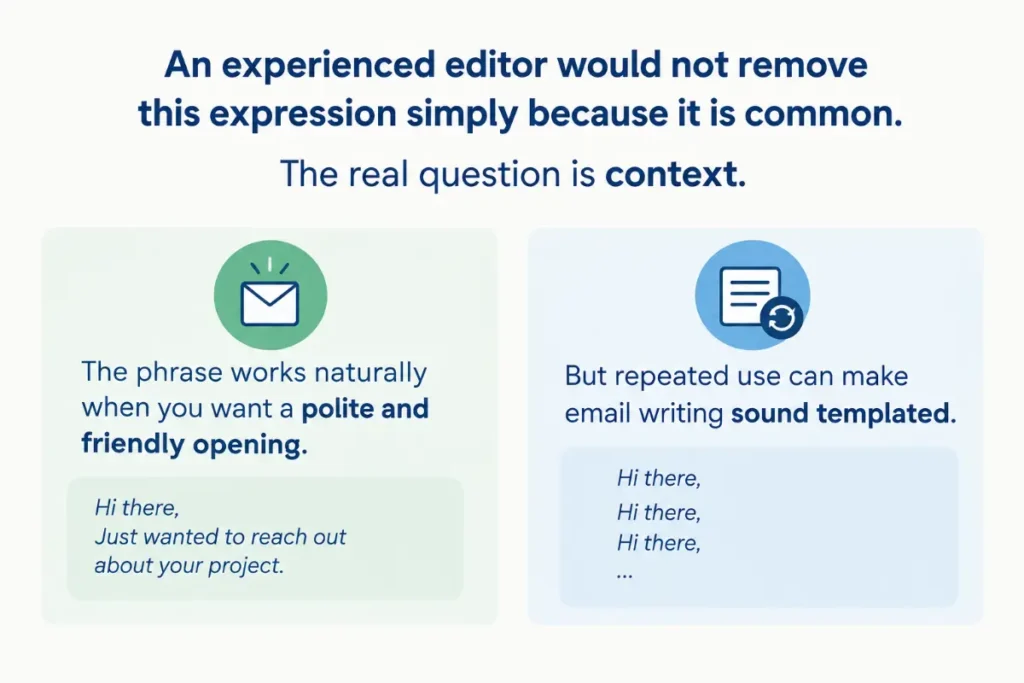
An experienced editor would not remove this expression simply because it is common. The real question is context. The phrase works naturally when you want a polite and friendly opening, but repeated use can make email writing sound templated. Editors often look for a specific connection between the opening and the reason for writing. A greeting such as I hope your presentation went well can feel more thoughtful than a generic opening because it shows awareness of the reader’s situation. Grammar tools usually recognize the complete sentence easily, while the shortened version may be treated as informal because its subject is understood rather than written.
Final Takeaway
Hope you are doing well is a correct and natural English expression used to show goodwill at the beginning of a conversation, email, or message. The complete form is I hope you are doing well, while the shorter version leaves out the understood subject I. Both forms are common, but the full version has a slightly more polished feel.
The expression works well in professional communication, personal messages, and friendly follow ups. Still, you do not need to use it every time. A greeting connected to the actual situation can make your message feel more personal and less routine.
A useful editing tip is simple. Before sending an email, ask yourself if the opening adds something meaningful. If it does, keep it. If it feels automatic, replace it with a specific greeting or move straight to your main point.
FAQs
Is hope you are doing well grammatically correct?
Yes. The complete grammatical sentence is I hope you are doing well. In the shorter version, the subject I is understood from context. This type of omission is common in conversational English and especially common in emails and messages. For formal correspondence, the complete version is a safe choice. For friendly professional communication, the shorter version is also widely accepted.
Should I write I hope you are doing well or hope you are doing well?
Both forms are used in English. I hope you are doing well is a complete sentence and has a slightly more polished tone. Hope you are doing well is shorter and more conversational. In most ordinary emails, either can work. Choose the complete form for a more formal tone and the shorter form for a relaxed professional message.
Is hope you are doing well too formal for an email?
No. The expression is common in both professional and personal email. It can sound polite without being stiff. The main issue is repetition. If you use the same greeting in every message, it may feel automatic. A more specific opening can sound warmer, such as I hope your presentation went well or I hope your week is going smoothly.
Can I use hope you are doing well in a formal email?
Yes, but the complete sentence I hope you are doing well is usually the safer choice for highly formal communication. It has a clear subject and verb structure. You can also use I hope you are well for a concise professional opening. For a very formal message, the best opening depends on your relationship with the recipient and the purpose of the correspondence.
What is the difference between I hope you are well and I hope you are doing well?
Both expressions communicate a positive wish about someone’s condition. I hope you are well is shorter and can sound slightly more formal. I hope you are doing well focuses a little more on the person’s current circumstances or how things are going. In most ordinary emails, the two expressions can be used in similar situations.
Is it better to ask how someone is doing instead?
That depends on your purpose. I hope you are doing well is often a polite statement of goodwill and does not strongly demand a personal response. How are you doing is a direct question that invites an answer about the person’s current situation. Use the direct question when you genuinely want to start a personal conversation.
Can I use this phrase in a text message?
Yes. The expression works in text messages, especially when you are reconnecting with someone or beginning a polite conversation. In casual texting, shorter alternatives can sound more natural. For example, you might write Hope you’re doing well or simply Hey, how have you been? The best choice depends on how close you are to the person.
How can I avoid repeating the same greeting in every email?
Connect your opening to the actual situation. Instead of using the same general greeting, try I hope your meeting went well, I hope you had a good weekend, or I hope the project is going smoothly. You can also skip a personal greeting and move directly to the purpose of the email. Clear and specific writing often sounds more natural.