
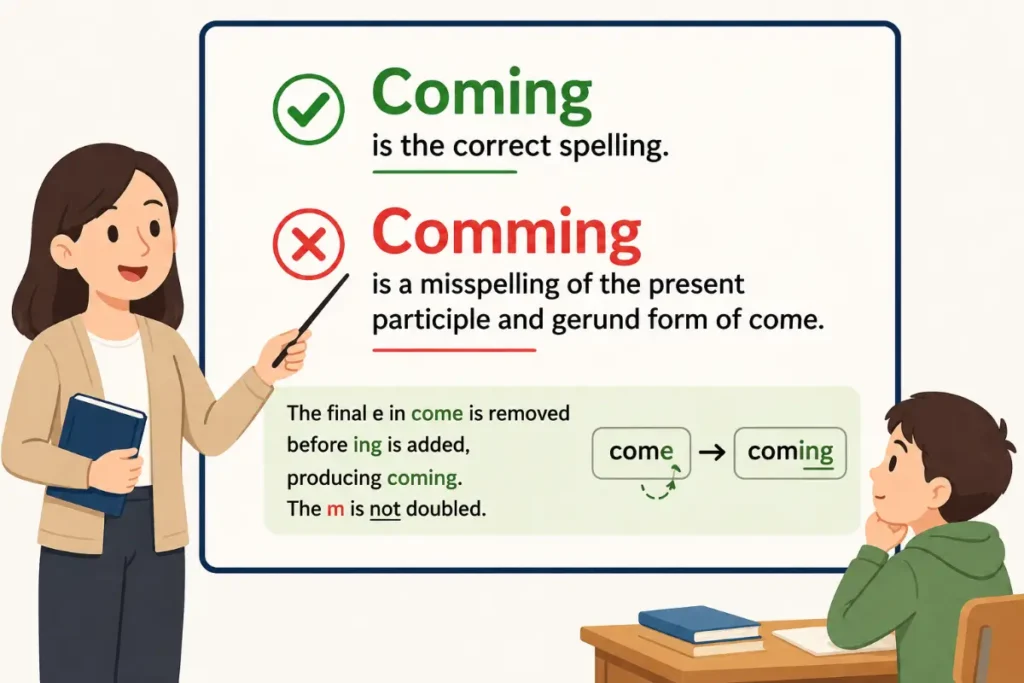
The confusion between comming or coming usually happens because the word is pronounced quickly in normal speech. The correct spelling is coming. The form comming is a common spelling mistake and should not be used in standard English.
The word coming is the present participle of come. It can describe someone moving toward a place, an event that will happen soon, or something that is approaching. For example, you can say, “She is coming home,” or “The coming year may bring new opportunities.”
The extra m in comming causes the problem. English spelling does not always work by simply adding letters to the base word. Once you understand how come changes when -ing is added, the spelling becomes much easier to remember.
For another common grammar confusion, see Inbalance Or Imbalance Which Spelling Is Correct? (2026).
Quick Answer
Coming is the correct spelling in standard English. Comming is a misspelling. The word coming is formed from come by removing the final silent e before adding -ing.
Comparison Table
| Form | Correctness | Meaning | Part of Speech | Common Use | Example |
|---|---|---|---|---|---|
| Coming | Correct | Moving toward something or happening soon | Verb form, adjective, or noun-related use | Everyday and formal English | She is coming home. |
| Comming | Incorrect in standard English | Intended to mean coming | Misspelling | Typing and spelling mistakes | Comming home is incorrect. |
The key point is simple: come becomes coming, not comming.
Introduction to the Word Coming
Coming is one of the most common forms of the verb come. You see it in everyday conversation, text messages, school writing, business communication, books, news reports, and many other forms of English.
The basic verb is come. When you want to describe an action that is happening now or around the present time, you often use coming with a form of be.
For example:
- I am coming home.
- He is coming to school.
- They are coming tomorrow.
- We are coming with you.
The word can also describe something that is approaching in time. For example, “the coming week” means the week that is about to begin or is approaching.
Because come ends in a silent e, some learners become unsure about what happens when -ing is added. The answer follows a common English spelling pattern.
What Does Coming Mean?
Coming has several related meanings. The exact meaning depends on the sentence.
The most basic meaning is moving toward a person or place.
For example:
Maria is coming to the office.
This means Maria is moving toward the office.
Coming can also describe an event that will happen in the future.
The coming holiday will be busy.
Here, coming means approaching or soon to happen.
The word can also describe something that is becoming available or expected soon.
The coming months may be difficult.
The months have not arrived yet, so they are approaching in time.
In simple English, coming can often mean:
- moving toward something
- arriving
- approaching
- happening soon
- about to happen
The context tells you which meaning is intended.
What Does Comming Mean?
In standard English, comming is not the correct spelling of the present participle of come.
People who write comming normally mean coming. The error often happens because the writer knows that many English verbs double a final consonant before adding -ing.
For example:
- run → running
- sit → sitting
- stop → stopping
- swim → swimming
This pattern can make comming look reasonable at first glance. However, come does not follow that pattern.
The correct form is:
come → coming
Not:
come → comming
So if you are writing an email, assignment, report, article, message, or professional document, use coming.
Why Do People Write Comming?
The spelling mistake has a few common causes.
One reason is confusion about consonant doubling. Learners often remember that some short verbs double their final consonant before -ing. They may then apply that rule to come.
Another reason is the pronunciation. In normal speech, the final sound of come and the beginning of -ing flow together. The spoken word does not clearly tell you how many letters should appear in the written form.
Typing speed can also cause mistakes. A person may type comming quickly without noticing the extra m.
Another cause is memory. If someone has seen the incorrect spelling many times online, the form may start to look familiar. Familiarity, however, does not make a spelling standard.
What Is the Difference Between Come and Coming?
Come is the base form of the verb.
Coming is the -ing form of the verb.
Compare these examples:
- I come here every day.
- I am coming here now.
The first sentence uses come as the basic verb. The second uses coming to describe an action in progress.
The form can also appear after certain verbs and expressions.
For example:
- She is coming home.
- They were coming toward us.
- I saw him coming.
- Thanks for coming.
- We are looking forward to coming back.
The meaning remains connected to the basic idea of moving, arriving, or approaching.
Why Is Coming Spelled With One M?
The spelling becomes easier when you look at the base word.
The base verb is:
come
It ends with a silent e.
When -ing is added, the final e is removed:
come + ing → coming
This is a common spelling pattern in English.
Consider a few similar examples:
- make → making
- take → taking
- write → writing
- drive → driving
- use → using
- hope → hoping
The same basic idea applies to come.
The important difference is that the final consonant is not doubled.
So:
come → coming
not:
come → comming
When Do English Words Double the Final Consonant?
This is where many spelling mistakes begin.
English does have a consonant-doubling rule, but it does not apply to every verb.
Look at these examples:
- run → running
- sit → sitting
- get → getting
- plan → planning
- stop → stopping
The final consonant is doubled in these forms.
But compare them with:
- come → coming
- make → making
- take → taking
- hope → hoping
- write → writing
These words do not double the final consonant.
The spelling pattern depends on the structure of the base word. You cannot simply add another consonant whenever you see -ing.
For come, the correct spelling is easy to remember because the final e disappears.
Which Form Is Correct?
The correct form is coming.
Use it in all standard forms of English
Correct:
Are you coming with us?
Correct:
Thank you for coming.
Incorrect:
I am comming home.
Incorrect:
Are you comming with us?
The extra m should be removed.
Is Comming Grammatically Correct?
No. In standard English, comming is not the correct spelling of the -ing form of come.
The problem is mainly spelling rather than meaning. A reader can usually understand what the writer intended, but the form is still incorrect in edited English.
For schoolwork, professional writing, academic assignments, websites, applications, and formal communication, use coming.
Is Coming a Verb?
Yes. Coming is an -ing form of the verb come.
Its exact grammatical role depends on the sentence.
Consider:
She is coming home.
Here, coming forms part of the verb phrase is coming.
Now consider:
The coming winter may be cold.
Here, coming describes winter. It works as an adjective.
Another example is:
I appreciate your coming to the meeting.
Here, coming refers to the act of attending.
This shows why it is useful to look at the whole sentence rather than trying to give one fixed grammatical label to every use.
How to Use Coming in a Sentence
Coming is very common in everyday English.
You can use it to describe movement:
The bus is coming.
You can use it to describe arrival:
My friends are coming tonight.
The coming weekend will be busy.
We need to prepare for the coming winter.
Thanks for coming.
Are you coming with me?
I saw him coming down the street.
10 Natural Examples of Coming
- I am coming home after work.
- Are you coming to the party tonight?
- The children are coming back from school.
- She is coming to visit us tomorrow.
- The coming week will be very busy.
- I heard someone coming down the stairs.
- Thanks for coming to my birthday party.
- We are coming with you.
- The coming months will bring many changes.
- He saw the train coming toward the station.
These examples show that the word can describe movement, arrival, an approaching time, or an action in progress.
Coming in Everyday Conversation
Native speakers use coming constantly in normal conversation.
Someone might say:
“Are you coming?”
This usually means, “Are you going to join us?”
A parent might say:
“Dinner is ready. Come and eat.”
The child might answer:
“I’m coming.”
Here, coming means the person is moving toward the place where dinner is being served.
Someone might also text:
“I’m coming in five minutes.”
The meaning is that the person expects to arrive soon.
These simple examples show why the word is so useful in daily English.
Coming in School Writing
Students often use coming in essays, stories, assignments, and classroom exercises.
For example:
The coming examination season can be stressful for students.
Or:
The students were excited about the coming school trip.
In school writing, correct spelling matters. A teacher may understand comming, but it can still be marked as a spelling error.
A useful editing habit is to check common -ing forms before submitting an assignment.
Coming in Workplace English
The word also appears often in professional communication.
For example:
Please prepare the documents for the coming meeting.
Or:
We will discuss the project during the coming week.
You might also use it in a message to a coworker:
I’m coming to your office now.
The spelling remains the same in casual and formal contexts.
Coming in Academic Writing
Academic writing usually requires careful spelling and clear grammar.
Coming can appear when discussing time, events, movement, or development.
For example:
The coming decade may bring major changes in technology.
Or:
The researchers observed the animals coming closer to the water.
There is no special academic spelling. The standard form is still coming.
Still confused? Compare Finaly or Finally Spelling Meaning and Usage Guide(2026).
Coming in News and Journalism
News writing also uses the word frequently.
For example:
Officials are preparing for the coming storm.
Or:
The coming election season is expected to receive significant public attention.
The meaning comes from context. In these examples, coming means approaching or soon to happen.
Coming in Stories and Literature
Writers often use coming to create a sense of movement or anticipation.
For example:
She heard footsteps coming from the hallway.
This creates a picture of someone moving closer.
Another example is:
A storm was coming from the west.
Here, coming tells the reader that the storm was approaching.
The word can therefore help writers describe both physical movement and future events.
Pronunciation of Coming
The standard pronunciation of coming is:
/ˈkʌmɪŋ/
An easy pronunciation guide is:
KUM-ing
It has two syllables:
com-ing
The stress falls on the first syllable.
The pronunciation does not have a separate sound for an extra m. That is one reason spelling the word can be confusing for learners.
English spelling often cannot be predicted perfectly from pronunciation. That is why learning common word forms is useful.
Common Spelling Mistakes
Several errors can appear around this word.
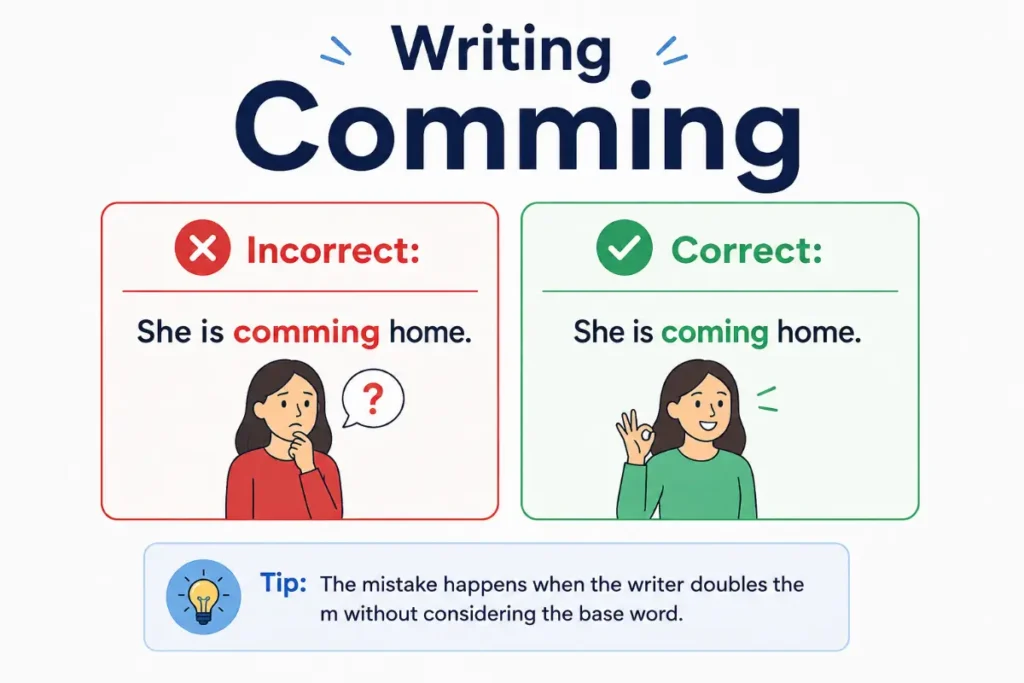
Mistake 1: Writing Comming
Incorrect:
I am comming home.
Correct:
I am coming home.
The extra m is unnecessary.
Mistake 2: Keeping the Final E
Incorrect:
I am comeing home.
Correct:
I am coming home.
The final e in come is removed before -ing is added.
Mistake 3: Using Come Instead of Coming
Incorrect:
I am come to your house now.
Correct:
I am coming to your house now.
The correct form depends on the grammar of the sentence.
Mistake 4: Writing Comming in Fast Messages
A quick text can contain spelling mistakes because the writer is typing quickly.
For example:
I’m comming now.
The intended meaning is clear, but the standard spelling is:
I’m coming now.
Mistake 5: Applying the Wrong Doubling Rule
Some learners remember forms like running and stopping and assume every verb behaves the same way.
That is not correct.
Come becomes coming without doubling the m.
Why Come Becomes Coming
The spelling change can be remembered as a simple two-step process.
Start with:
come
Remove the final silent e:
com
Add -ing:
coming
The result contains only one m after the o.
This is different from a word like run.
Run becomes:
running
The n is doubled because a different spelling pattern applies.
You do not need to memorize every English spelling rule at once. For common words, learning the correct word family is often the easiest approach.
Etymology and Word Origin
Come is a very old English word.
It comes from Old English cuman, meaning to come, move, or arrive. It is related to similar words found in other Germanic languages.
The modern form come developed over many centuries as English changed in pronunciation and spelling.
The word has remained highly useful because the basic idea of moving toward a place, person, or point in time is fundamental to communication.
The modern form coming is created from come using the -ing form used in English grammar.
You do not need to know the historical details to spell the word correctly, but the history shows that come is an old and established English verb with a long history of use.
American English Usage
American English uses coming as the standard form.
Examples include:
I’m coming home.
Are you coming tomorrow?
The coming year may be difficult.
There is no American spelling variation that changes coming to comming.
For US schoolwork, business writing, websites, emails, and everyday messages, use coming.
British English Usage
British English also uses coming.
Examples include:
Are you coming with us?
The coming winter could be cold.
There is no standard British spelling difference between coming and the American form.
So this is not a case like color and colour. The spelling coming is standard in both major varieties.
Australian and Canadian English
Australian English and Canadian English also use coming as the standard spelling.
The word does not have a special regional spelling in these varieties.
That means writers across major English-speaking regions can use the same form:
coming
The incorrect form comming is not a standard regional alternative.
Coming as a Present Participle
Coming is often used with forms of be to describe an action in progress.
For example:
I am coming.
She is coming.
They are coming.
We were coming.
The form of be changes according to the subject and tense, but coming remains the same.
This pattern is very common in English.
Coming as an Adjective
Coming can also describe something that is approaching.
For example:
the coming week
the coming year
the coming election
the coming winter
In these phrases, coming tells us that the event or period is near or approaching.
The meaning is similar to upcoming in many contexts.
For example:
the coming meeting
and
the upcoming meeting
can have very similar meanings.
Coming and Upcoming
She is coming home.
Upcoming usually cannot be used in the same way.
You would say:
The upcoming meeting starts at nine.
You would not normally say:
She is upcoming home.
So the words overlap when talking about future events, but coming has a much wider range of uses.
Coming and Arriving
Coming and arriving can sometimes describe similar situations.
For example:
She is coming to the office.
She is arriving at the office.
The first focuses on movement toward the place. The second focuses more directly on reaching the destination.
Coming and Going
Going usually means moving away from the speaker or reference point.
For example:
He is coming to my house.
This means he is moving toward my house.
He is going to his house.
This means he is moving toward his house and away from the current location.
The exact reference point depends on the situation.
Related Words You Should Know
Come
Come is the base verb.
Please come here.
Came
Came is the simple past form.
She came yesterday.
Coming
Coming is the -ing form.
She is coming now.
Comes
Comes is used with certain singular subjects in the present tense.
He comes here every Friday.
Comeback
Comeback can mean a return.
The team made a comeback.
Upcoming
Upcoming describes something that will happen soon.
We have an upcoming meeting.
Arrival
Arrival refers to the act of arriving.
We are waiting for his arrival.
Approaching
Approaching means moving closer or getting nearer.
The train is approaching the station.
Expert Editor Insight
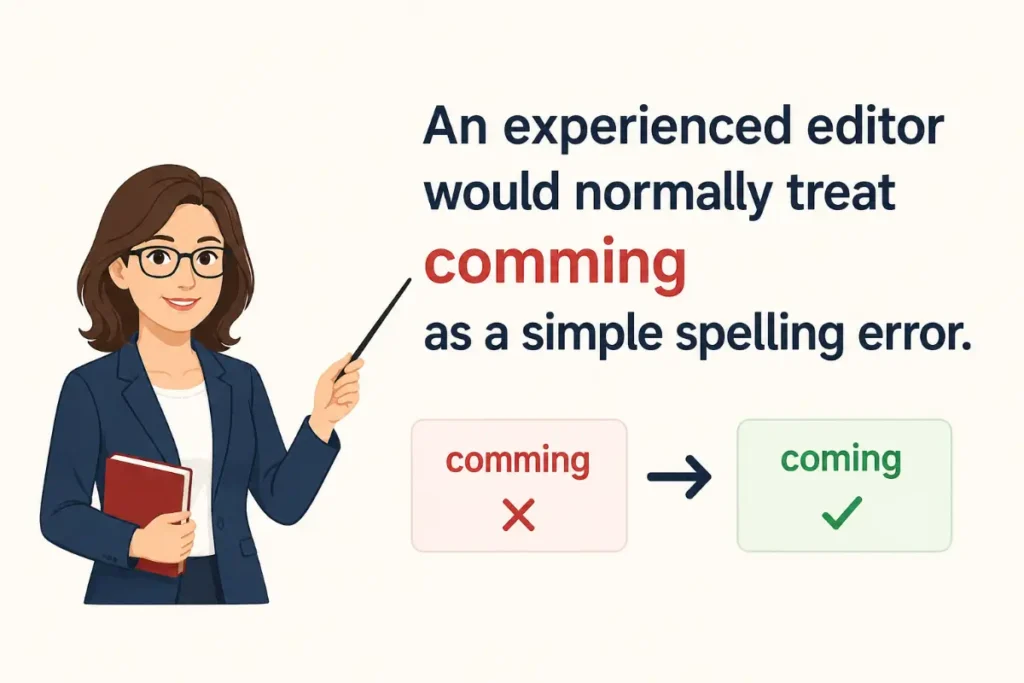
An experienced editor will usually catch comming quickly because the form does not match the standard spelling of the verb come. The best editing habit is to check the base word before adding -ing. With come, remove the silent e and add -ing: coming. This simple pattern prevents both the extra m and the incorrect spelling comeing.
How to Remember the Correct Spelling
A short memory trick can help.
Think:
COME loses E before ING.
So:
COME → COMING
Do not double the m.
You can also remember this sentence:
I am coming.
The phrase is so common that seeing it often can help make the spelling automatic.
Another useful comparison is:
- make → making
- take → taking
- come → coming
- write → writing
Each word loses the final silent e before -ing.
A Simple Spelling Test
If you are unsure, start with the base word.
Ask yourself:
- What is the base word?
- Is it come?
- Am I adding -ing?
- Does the final e disappear?
If the answer is yes, write:
coming
This method is more reliable than trying to spell the word from its sound.
A related grammar guide is Definately or Definitely Which Spelling Is Correct (2026).
Conclusion
The spelling question comming or coming has a simple answer: coming is the correct standard form. The word is the -ing form of come and can describe movement, arrival, an action in progress, or something approaching in time.
The extra m in comming often comes from confusion with words such as running and stopping, where the final consonant is doubled. Come follows a different pattern because its final silent e is removed before -ing is added. The result is coming, not comming.
For a quick editing check, remember one small rule: come loses the e before -ing. Write come, remove e, add ing, and you get coming. This simple habit will help you avoid one of the most common spelling mistakes connected with this word.
Common Questions About Coming
Is comming a real English word?
Comming is generally used as a misspelling of coming. It is not the standard spelling for the -ing form of come. In normal English writing, use coming instead.
Which is correct: comming or coming?
Coming is correct. Comming is a spelling error. The correct form comes from come plus -ing, with the final silent e removed.
Why is coming not spelled comming?
The final consonant is not doubled in come. The final e is removed before -ing is added, producing coming.
How do you pronounce coming?
Coming is pronounced approximately “KUM-ing.” Its standard IPA pronunciation is /ˈkʌmɪŋ/, with stress on the first syllable.
Can coming be used at the beginning of a sentence?
Yes. For example, “Coming home late, she called her parents.” Here, coming begins a phrase that describes an action connected to the main sentence.
Is coming formal or informal?
Coming is neutral. It works in everyday conversation, school writing, workplace communication, journalism, and formal writing.
Is comming accepted in American English?
No. American English uses coming as the standard spelling. Comming is not a normal regional spelling variant.
What is an easy way to remember coming?
Remember the pattern: come loses its final e before -ing. Therefore, come becomes coming, not comming.