
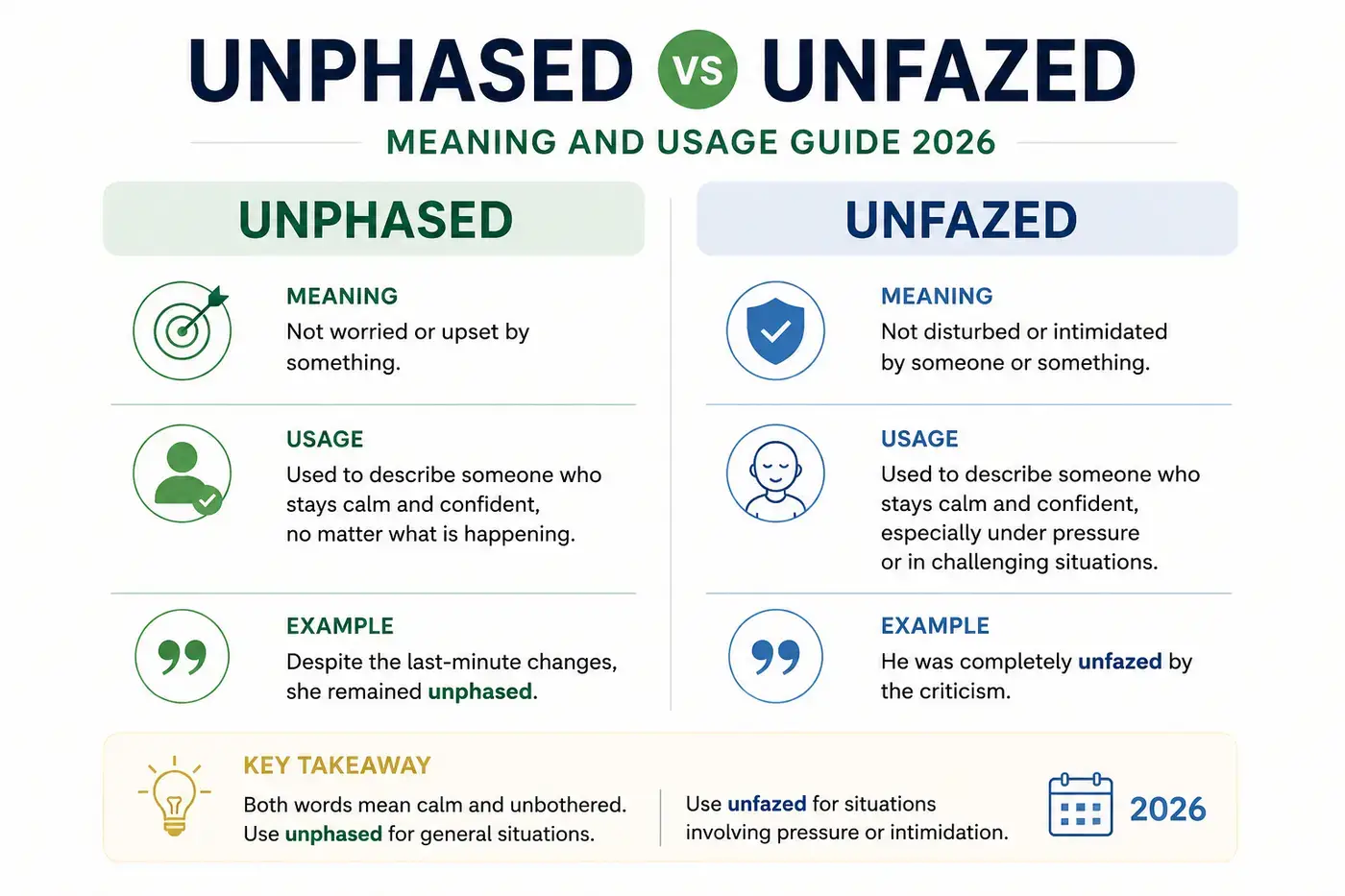
The confusion between unphased or unfazed is one of the most common spelling mistakes in modern English. The two words look similar, sound somewhat related, and often appear in conversations about confidence, calmness, and emotional control. Here’s the short answer. Unfazed is the correct word. Unphased is usually a misspelling.
People often write unphased because they connect the word to phase, which means a stage or period. However, unfazed actually comes from the verb faze, which means to disturb, disconcert, unsettle, or embarrass someone. If a person remains calm under pressure, ignores criticism, or stays composed during a difficult situation, they are unfazed.
Understanding this distinction can instantly improve your writing and help you avoid a mistake that editors frequently catch. In this guide, you’ll learn exactly why unfazed is correct, where the confusion comes from, how native speakers use the word, and how to remember the difference permanently.
Many readers also check wtv meaning and How to Use It Naturally.
Unphased or Unfazed Quick Definition
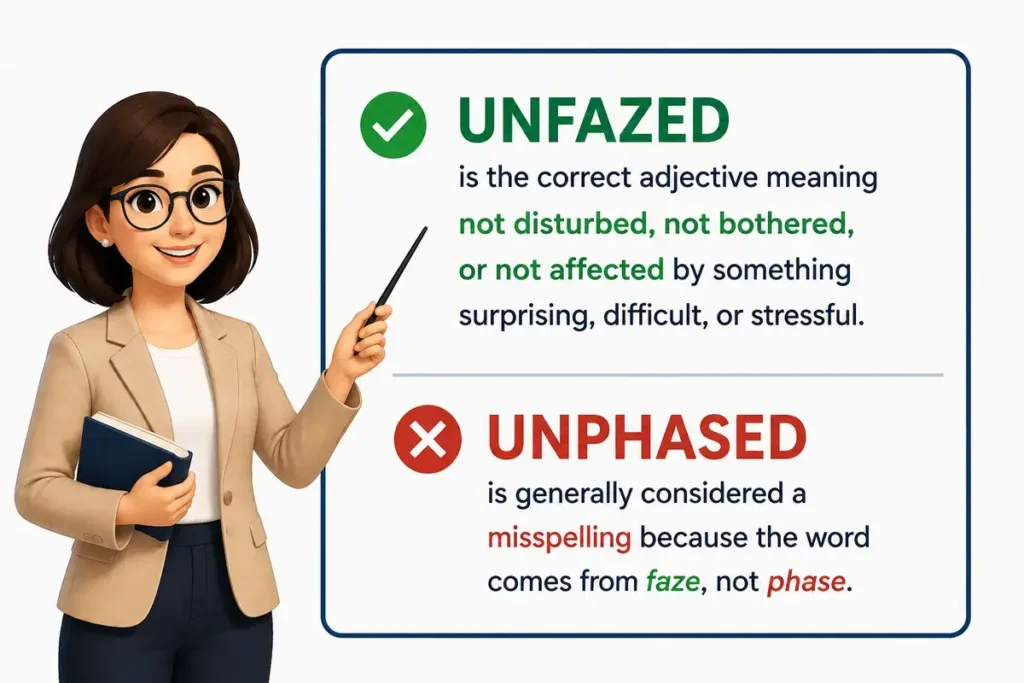
Unfazed is the correct adjective meaning not disturbed, not bothered, or not affected by something surprising, difficult, or stressful. Unphased is generally considered a misspelling because the word comes from faze, not phase.
Unphased or Unfazed Quick Answer
Use unfazed.
Avoid unphased.
Correct examples:
- She remained unfazed by the criticism.
- He seemed unfazed during the interview.
- The athlete stayed unfazed under pressure.
Incorrect examples:
- She remained unphased by the criticism.
- He seemed unphased during the interview.
- The athlete stayed unphased under pressure.
In standard English, unfazed is the accepted spelling.
Unphased Or Unfazed Comparison Table
| Feature | Unfazed | Unphased |
|---|---|---|
| Correct Spelling | Yes | No |
| Dictionary Recognition | Yes | Generally No |
| Meaning | Not disturbed or bothered | Common misspelling |
| Part Of Speech | Adjective | Nonstandard form |
| Origin | From the verb faze | Influenced by phase |
| Professional Writing | Accepted | Incorrect |
| Academic Writing | Accepted | Incorrect |
| Publishing Standards | Accepted | Rejected |
| Usage Frequency | Very common | Usually an error |
| Example | She was unfazed by the news. | She was unphased by the news. |
Meaning Of Unphased Or Unfazed
What Does Unfazed Mean?
Unfazed means calm, unaffected, untroubled, or undisturbed by something that might upset another person.
Examples:
- She remained unfazed during the emergency.
- He appeared unfazed by the difficult questions.
- The team stayed unfazed despite the setback.
- The actor looked unfazed by the criticism.
- The pilot remained unfazed throughout the turbulence.
The word often suggests confidence, composure, emotional control, and resilience.
What Does Unphased Mean?
Unphased is usually considered an incorrect spelling. Most people who write unphased actually intend to write unfazed. The mistake happens because writers mistakenly connect the word to phase instead of faze.
In standard English usage:
- Unfazed = Correct.
- Unphased = Incorrect.
Key Differences Between Unphased Or Unfazed
Meaning Difference
Unfazed carries a clear meaning. It describes someone who remains calm or unaffected. Unphased has no accepted standard meaning in modern English.
Dictionary Difference
Unfazed appears in major dictionaries. Unphased generally does not appear as a standard word.
Grammar Difference
Unfazed functions as a legitimate adjective. Unphased is treated as a spelling error.
Publishing Difference
Professional publishers use unfazed. Editors normally correct unphased.
Usage Difference
Native speakers overwhelmingly use unfazed in formal writing. Unphased appears mainly because of confusion.
Why People Confuse Unphased Or Unfazed
This mistake happens for understandable reasons. The word phase is much more common than faze. Most people encounter phrases such as:
- A phase of life.
- Development phase.
- Planning phase.
- Growth phase.
- Initial phase.
Because phase is familiar, writers naturally assume unphased must be connected to it. The actual root word is faze. Many people rarely use the verb faze in daily conversation. As a result, the correct spelling feels less intuitive.
Which One Is Correct In Unphased Or Unfazed?
The correct answer is unfazed.This spelling is recognized by dictionaries, style guides, editors, teachers, and professional writers.
Examples:
- She was unfazed by the unexpected announcement.
- He remained unfazed during the debate.
- The manager appeared unfazed despite the challenges.
- The speaker stayed unfazed after tough questions.
- The student seemed unfazed by the exam.
Every major style guide favors unfazed.
Why Unfazed Is Correct
The word comes from the verb faze.
Faze means:
- To disturb.
- To unsettle.
- To embarrass.
- To intimidate.
- To throw someone off balance.
Examples:
- The criticism didn’t faze her.
- Loud noises rarely faze him.
- The pressure failed to faze the athlete.
When the prefix un is added, the meaning becomes the opposite. Unfazed means not disturbed or not unsettled.
Unphased Or Unfazed Examples In Sentences
Correct Examples Using Unfazed
- She remained unfazed by the negative comments.
- The firefighter stayed unfazed during the rescue.
- He looked unfazed after the difficult interview.
- The CEO appeared unfazed by market fluctuations.
- The athlete was unfazed by the crowd noise.
- They seemed unfazed by the sudden change.
- The teacher remained unfazed by the interruption.
- She stayed unfazed throughout the discussion.
- The performer looked completely unfazed on stage.
- He was unfazed by the unexpected challenge.
Incorrect Examples Using Unphased
These examples contain the common mistake.
- She remained unphased by the criticism.
- The firefighter stayed unphased during the rescue.
- He looked unphased after the interview.
- The CEO appeared unphased by market changes.
- The athlete was unphased by the crowd.
- They seemed unphased by the delay.
- The teacher remained unphased.
- She stayed unphased throughout the meeting.
- The performer looked unphased on stage.
- He was unphased by the challenge.
Each sentence should use unfazed instead.
Common Mistakes In Unphased Or Unfazed
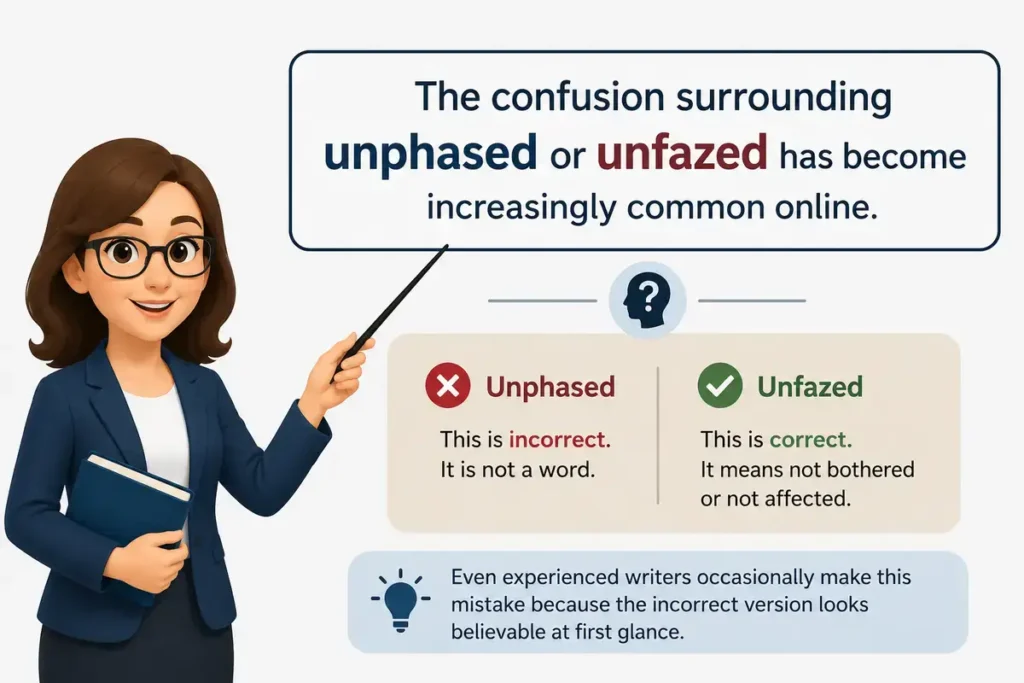
The confusion surrounding unphased or unfazed has become increasingly common online. Even experienced writers occasionally make this mistake because the incorrect version looks believable at first glance.
Mistake One Using Unphased Instead Of Unfazed
This is by far the most common error.
Incorrect:
- She was unphased by the criticism.
- He remained unphased during the interview.
- The team seemed unphased by the loss.
Correct:
- She was unfazed by the criticism.
- He remained unfazed during the interview.
- The team seemed unfazed by the loss.
The word comes from faze, not phase.
Mistake Two Assuming Phase And Faze Are Related
Many people mistakenly believe phase and faze are connected because they sound similar. In reality, they have different meanings and different origins. Phase means a stage or period in a process.
Examples:
- The project entered a new phase.
- Childhood is an important phase of life.
- The construction phase lasted six months.
Faze means to disturb or unsettle.
Examples:
- The criticism didn’t faze her.
- Pressure rarely fazes him.
- Unexpected problems failed to faze the team.
Because the meanings are unrelated, unphased does not logically replace unfazed.
Mistake Three Following Incorrect Online Usage
Social media, forums, and comment sections contain countless spelling errors. Many writers see unphased repeatedly and assume it must be acceptable. Frequency does not equal correctness. Professional editors, dictionaries, and style guides continue to recognize unfazed as the standard form.
Mistake Four Confusing Pronunciation With Spelling
Some writers assume that if two spellings sound reasonable, both must be correct. English doesn’t work that way. Many words have accepted spellings that cannot be determined by sound alone. Unfazed is one of those cases.
Mistake Five Using Unphased In Professional Writing
A spelling mistake in an email, article, report, proposal, or academic paper can undermine credibility. Editors routinely correct unphased because it signals unfamiliarity with the word’s origin.
For another common grammar confusion, see dialog vs dialogue Meaning Difference And Usage.
Unphased Or Unfazed Pronunciation Guide
Pronunciation often contributes to the confusion because people hear the word more often than they see it written.
Unfazed Pronunciation
IPA:
/ʌnˈfeɪzd/
Syllable Breakdown:
Un • fazed
Pronounced as:
un FAYZD
Examples:
- She remained unfazed.
- He looked unfazed.
- They stayed unfazed.
Unphased Pronunciation
If spoken, unphased would sound nearly identical.
IPA:
/ʌnˈfeɪzd/
This explains why the spelling error spreads so easily. People hear the word correctly but guess the spelling incorrectly.
Common Pronunciation Errors
- Overemphasizing the first syllable.
- Pronouncing the word as three syllables.
- Confusing phase and faze because they sound alike.
Native speakers typically pronounce unfazed smoothly as two syllables.
Etymology And Word Origin Of Unphased Or Unfazed
Understanding the history of the word makes the correct spelling much easier to remember.
The Origin Of Faze
The verb faze entered English during the nineteenth century. Its meaning centered on disturbing, unsettling, startling, or disconcerting someone.
Examples:
- Loud criticism didn’t faze her.
- The challenge failed to faze him.
- The pressure never fazed the team.
Over time, the verb became firmly established in standard English.
Development Of Unfazed
The adjective unfazed developed naturally from the verb faze. It describes someone who is not disturbed, not intimidated, and not emotionally affected.
Examples:
- She looked unfazed.
- He remained unfazed.
- They appeared completely unfazed.
The spelling follows directly from its root word.
Why Unphased Appears Logical
Many people know the noun phase but rarely use the verb faze. As a result, they subconsciously replace the unfamiliar root with the familiar one. This substitution creates unphased. Although understandable, it remains incorrect in standard English.
Historical Growth Of Unfazed
During the twentieth century, unfazed became increasingly common in journalism, literature, business writing, and everyday speech. Today it is widely recognized throughout the English speaking world.
Unphased Or Unfazed Regional Usage
Unlike some spelling debates, this one shows remarkable consistency across English speaking countries.
American English
American English strongly favors unfazed.
Examples:
- The player remained unfazed by the pressure.
- She appeared unfazed during the interview.
British English
British English also uses unfazed.
Examples:
- He seemed unfazed by the criticism.
- The manager remained unfazed.
Australian English
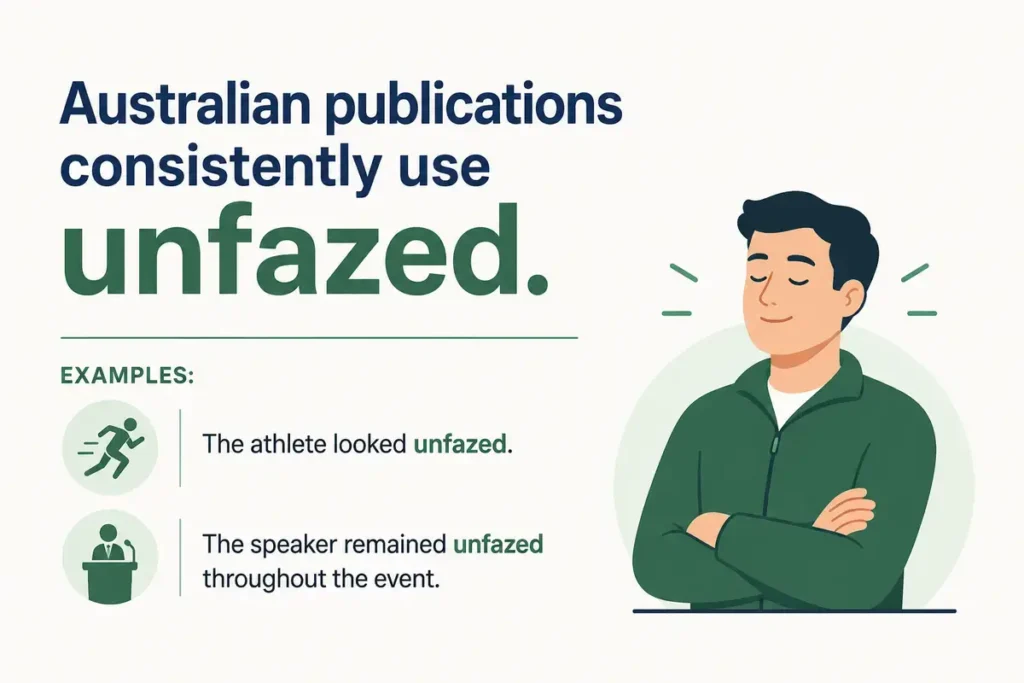
Australian publications consistently use unfazed.
Examples:
- The athlete looked unfazed.
- The speaker remained unfazed throughout the event.
Canadian English
Canadian English follows the same convention.
Examples:
- She was unfazed by the situation.
- The team appeared unfazed despite setbacks.
Global English
Across major English varieties:
- Unfazed is accepted.
- Unphased is considered a spelling error.
This consistency makes the choice straightforward regardless of audience location.
Unphased Or Unfazed Grammar Rules
Understanding the grammar behind unfazed helps writers use it confidently.
Part Of Speech
Unfazed functions primarily as an adjective. It describes a person’s emotional state or reaction.
Examples:
- The athlete was unfazed.
- She remained unfazed.
- They seemed unfazed.
Predicate Adjective Usage
Most often, unfazed appears after linking verbs.
Examples:
- He looked unfazed.
- She appeared unfazed.
- They remained unfazed.
Adjective Phrases
Unfazed frequently appears with prepositional phrases.
Examples:
- Unfazed by criticism.
- Unfazed by pressure.
- Unfazed by challenges.
- Unfazed by setbacks.
- Unfazed by uncertainty.
Common Sentence Structures
Subject + Linking Verb + Unfazed
Examples:
- She was unfazed.
- He remained unfazed.
- The team stayed unfazed.
Subject + Unfazed + By + Noun
Examples:
- She was unfazed by criticism.
- He remained unfazed by the pressure.
- They stayed unfazed by the delay.
Synonyms Of Unfazed
Understanding similar words can improve writing variety.
Common synonyms include:
- Calm.
- Composed.
- Unbothered.
- Undisturbed.
- Relaxed.
- Collected.
- Cool headed.
- Steady.
- Confident.
- Self possessed.
Antonyms Of Unfazed
Opposite words include:
- Disturbed.
- Nervous.
- Alarmed.
- Shaken.
- Anxious.
- Upset.
- Troubled.
- Panicked.
- Flustered.
- Intimidated.
Editor’s Language Observation
As an editor, I’ve noticed that unphased often appears in otherwise excellent writing. The mistake rarely reflects weak grammar. Instead, it reflects a misunderstanding of word origin. Most writers know phase very well. Far fewer regularly encounter the verb faze. That imbalance creates a mental shortcut that leads to the wrong spelling.
Once you remember the phrase:
“The situation didn’t faze me.”
The correct form unfazed becomes much easier to recall. Think about the root word first. If something doesn’t faze you, you’re unfazed. That simple connection eliminates the confusion permanently.
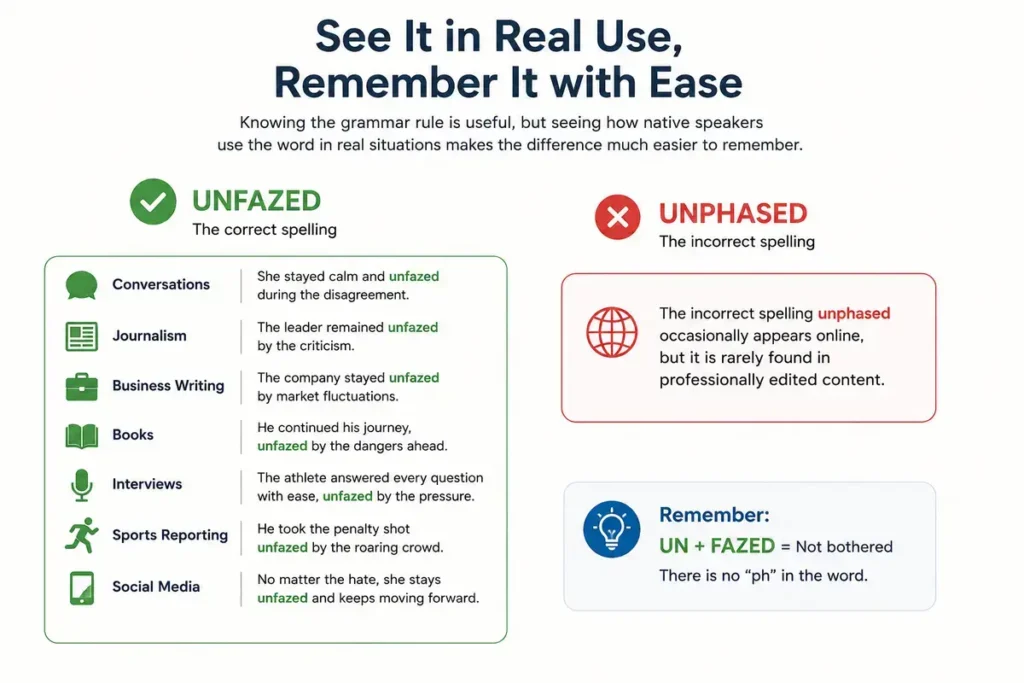
Unphased Or Unfazed In Real Life Usage
Knowing the grammar rule is useful, but seeing how native speakers use the word in real situations makes the difference much easier to remember. In everyday English, unfazed appears in conversations, journalism, business writing, books, interviews, sports reporting, and social media. The incorrect spelling unphased occasionally appears online, but it is rarely found in professionally edited content.
Unphased Or Unfazed In Daily Conversation
People often use unfazed to describe someone who remains calm during difficult situations.
Examples:
- She stayed unfazed when the meeting changed at the last minute.
- He seemed unfazed by the long wait.
- The teacher remained unfazed despite the classroom noise.
- My sister was unfazed by the storm warning.
- The driver looked completely unfazed in heavy traffic.
In casual speech, the word often suggests confidence and emotional control.
Unphased Or Unfazed In Academic Writing
Academic writers use unfazed when discussing behavior, psychology, leadership, or social reactions.
Examples:
- Participants appeared unfazed by the experimental conditions.
- The researchers noted that several subjects remained unfazed.
- Students seemed unfazed by the curriculum changes.
- The study examined how people stay unfazed during stressful events.
- Effective leaders often appear unfazed in difficult circumstances.
Using unphased in scholarly work would typically be corrected during editing.
Unphased Or Unfazed In Professional Communication
Business professionals frequently use unfazed to describe calm decision making.
Examples:
- The manager remained unfazed during the crisis.
- Investors appeared unfazed by short term market fluctuations.
- The executive stayed unfazed throughout negotiations.
- The spokesperson seemed unfazed by tough questions.
- The company remained unfazed by temporary setbacks.
This usage is common in reports, presentations, and workplace communication.
Unphased Or Unfazed In Literature
Authors often use unfazed to reveal a character’s personality.
Examples:
- The detective remained unfazed by the suspect’s threats.
- She looked unfazed as the crowd gathered.
- The captain stood unfazed during the storm.
- He appeared unfazed despite the chaos around him.
- The warrior remained unfazed before battle.
The word helps create an image of strength and composure.
Unphased Or Unfazed In Media
Journalists frequently rely on unfazed when covering politics, sports, business, and entertainment.
Examples:
- The athlete appeared unfazed by the criticism.
- The candidate remained unfazed during the debate.
- The actor looked unfazed by the rumors.
- The coach seemed unfazed after the loss.
- The CEO stayed unfazed amid market uncertainty.
News articles often use the term because it conveys resilience in a concise way.
Unphased Or Unfazed Related Words And Confused Terms
People searching for unphased or unfazed often encounter several related words that create additional confusion.
Faze
This is the root word behind unfazed.
Meaning:
To disturb, unsettle, or embarrass someone.
Examples:
- The criticism didn’t faze her.
- Nothing seems to faze him.
- The pressure failed to faze the team.
Phase
This word is unrelated.
Meaning:
A stage, period, or step in a process.
Examples:
- The project entered a new phase.
- Childhood is an important phase of life.
- The company completed the first phase of construction.
Unbothered
A close synonym of unfazed.
Examples:
- She seemed unbothered by the comments.
- He remained unbothered during the discussion.
Composed
Another common synonym.
Examples:
- The speaker stayed composed.
- She remained composed under pressure.
Calm
A simple alternative.
Examples:
- He stayed calm during the emergency.
- The pilot remained calm throughout the flight.
Collected
Often used alongside composed.
Examples:
- She appeared calm and collected.
- The manager stayed collected during the crisis.
Shaken
A common antonym.
Examples:
- He was visibly shaken.
- The news left her shaken.
Disturbed
Another opposite meaning.
Examples:
- She looked disturbed by the announcement.
- He seemed disturbed by the outcome.
Understanding these related terms helps writers choose the most precise word for each situation.
Expert Language Insight On Unphased Or Unfazed
As an editor, I can say with confidence that unphased is one of the most common spelling mistakes in modern English. The reason isn’t poor grammar. It’s familiarity.
Most people encounter the word phase far more often than the word faze. They see phrases like planning phase, development phase, and next phase throughout school, work, and everyday life. Meanwhile, faze appears less frequently. When writers hear the pronunciation of unfazed, their brains often connect it to the more familiar spelling phase. That’s why the error feels so convincing.
Professional editors rarely question a writer’s intelligence when they see unphased. Instead, they recognize it as a predictable spelling mistake. Native speakers overwhelmingly use unfazed. Newspapers use it. Publishers use it. Business leaders use it. Journalists use it. Educators use it. One memory trick works particularly well.
Ask yourself:
“Did the situation faze me?”
If the answer is no, then you were unfazed. That simple connection solves the problem almost every time.
Frequently Asked Questions About Unphased Or Unfazed
Is it unphased or unfazed?
Unfazed is the correct spelling. It means calm, unbothered, or unaffected by something challenging or surprising. Unphased is generally considered a misspelling.
Why do people write unphased?
People often write unphased because they are more familiar with the word phase than the word faze. Since the words sound similar, the incorrect spelling seems logical at first glance.
What does unfazed mean?
Unfazed means not disturbed, not intimidated, not worried, or not emotionally affected by a situation that might upset someone else.
Is unphased ever correct?
In standard English, unphased is generally not considered correct. Most dictionaries, editors, and style guides recommend using unfazed instead.
What is the root word of unfazed?
The root word is faze, which means to disturb, unsettle, or disconcert someone. Unfazed literally means not disturbed or not affected.
How do you pronounce unfazed?
Unfazed is pronounced /ʌnˈfeɪzd/. It has two syllables and sounds like un FAYZD.
Is unfazed formal or informal?
Unfazed works in both formal and informal writing. It appears regularly in journalism, business communication, academic discussions, and everyday conversation.
What are some synonyms for unfazed?
Common synonyms include calm, composed, unbothered, collected, cool headed, steady, confident, and undisturbed. Each carries a slightly different nuance, but all share the idea of emotional control.
Still confused? Compare pmg meaning Explained Clearly With Common Uses.
Conclusion
The answer to unphased or unfazed is straightforward. Unfazed is the correct word. Unphased is a common spelling mistake that results from confusion between the words faze and phase. The adjective unfazed comes directly from the verb faze, which means to disturb or unsettle someone. If a person remains calm, composed, and unaffected by challenges, criticism, pressure, or unexpected events, they are unfazed.
This spelling is recognized by dictionaries, publishers, educators, editors, and professional writers across the English speaking world. A simple memory trick can help. If something doesn’t faze you, you’re unfazed. Remember that connection, and you’ll never need to wonder about the spelling again.