
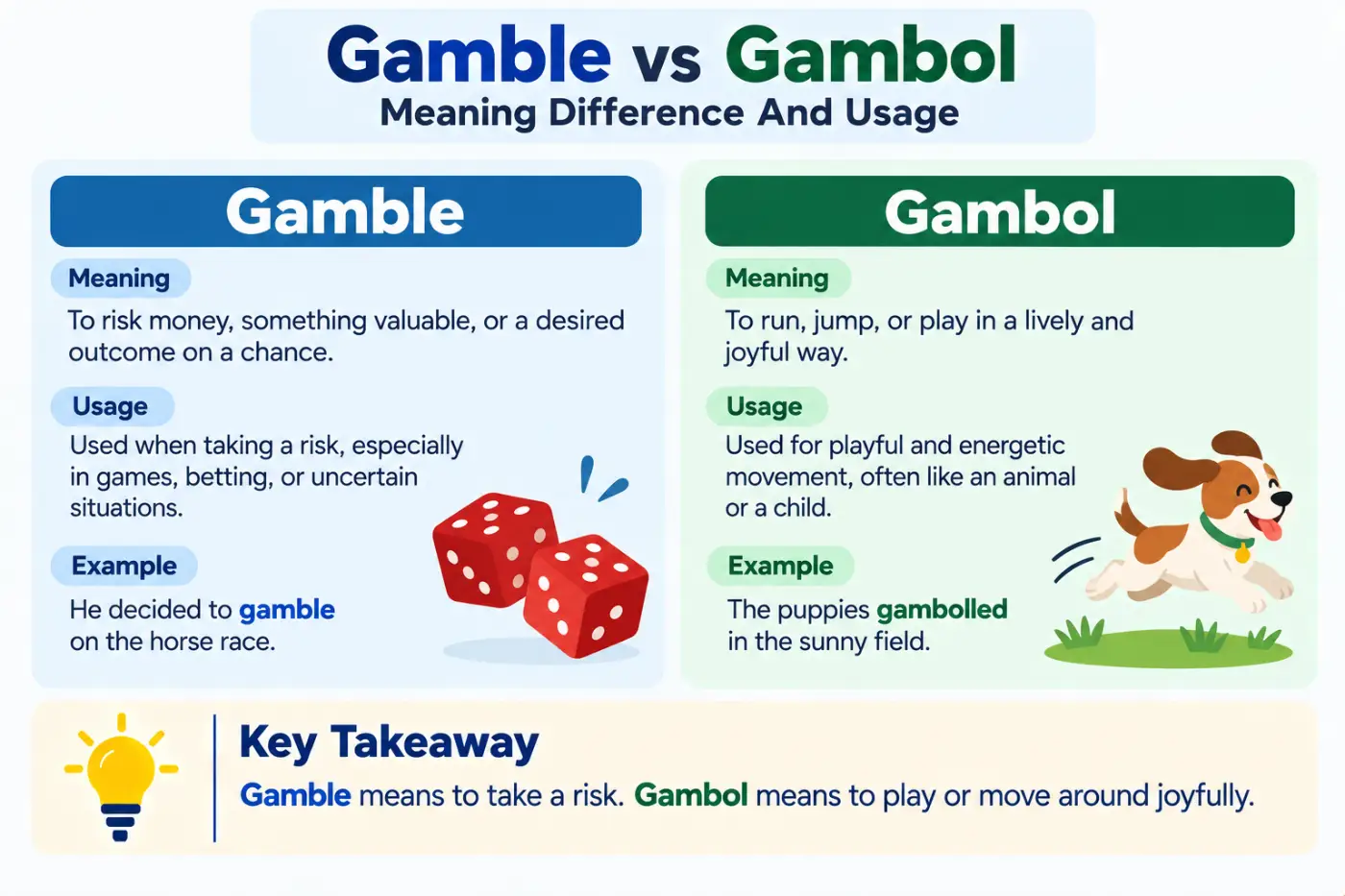
The difference between gamble vs gambol comes down to meaning. Gamble relates to risk, chance, or betting, while gambol describes playful movement such as running, jumping, or frolicking. Both are legitimate English words, so neither is simply a misspelling of the other.
The confusion is understandable. The words share most of their letters, have similar pronunciations, and can appear unfamiliar in everyday writing. Yet their meanings are worlds apart. You gamble when you take a risk or put money at stake. You gambol when you move around in a lively and playful way.
That small spelling difference changes the entire sentence. If you write that a group of puppies gambled across a field, you suggest risk or betting. If you write that the puppies gambolled across the field, you create a cheerful picture of them running and jumping. This guide explains the meanings, grammar, pronunciation, origins, regional usage, common mistakes, and natural examples so you can choose the right word without second guessing yourself.
Learn the difference in to bad or too bad which is correct.
Quick Definition
Gamble means to risk money or something valuable in the hope of gaining money or achieving a desired result. Gambol means to run, jump, or move around playfully and happily. Both words are standard English, but their meanings and grammatical uses are completely different.
Quick Answer
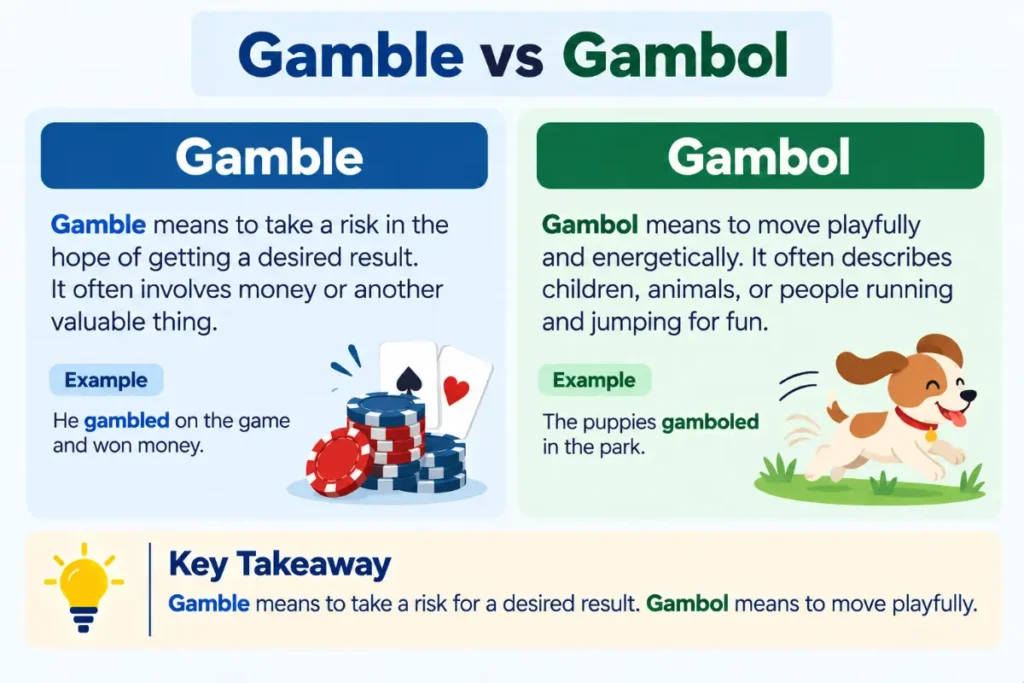
Use gamble when you mean taking a risk or betting money. Use gambol when you mean playful movement such as skipping, leaping, running, or frolicking.
For example, you might say, The investor decided to gamble on a new idea. You might also say, The children gambolled across the grass.
The easiest memory trick is simple. Gamble involves risk. Gambol involves playful movement.
Comparison Table Gamble And Gambol
| Word | Meaning | Part of Speech | Origin | Usage Frequency | Formality | Common Contexts | Example |
|---|---|---|---|---|---|---|---|
| Gamble | To risk money or something valuable or to take a chance on an uncertain result | Verb and noun | Connected to Middle English forms related to playing and merriment | Very common | Neutral | Betting, business, decisions, risk, everyday speech | The company gambled on a new product. |
| Gambol | To run or jump in a playful and happy way | Verb and noun | From French forms related to jumping and movement | Less common | Neutral to literary | Animals, children, nature, storytelling | The lambs gambolled across the field. |
The difference is not subtle once you know what each word describes. Gamble focuses on risk and uncertainty. Gambol focuses on playful physical movement.
Meaning And Definition
Meaning Of Gamble
Gamble can function as both a verb and a noun.
As a verb, it means to risk money or something valuable on an uncertain result. A person might gamble on a card game, horse race, sports event, or other outcome. The word can also describe taking a risky action without involving money.
For example:
The company gambled on strong holiday sales.
Here the company is taking a risk. It hopes the decision will succeed, but the result is uncertain.
The word also appears in expressions such as gamble on and gamble with.
They gambled on the new strategy.
He gambled with his savings.
Gamble can also work as a noun.
Opening a restaurant in that location was a gamble.
In this sentence, a gamble is a risky decision. The noun does not necessarily involve a casino or betting. It can describe any uncertain choice that could produce a good or bad result.
The central idea stays the same in both forms: risk is involved.
Meaning Of Gambol
Gambol is also a real English word, but its meaning is completely different.
As a verb, gambol means to run, jump, skip, or move around in a playful and happy way. Dictionaries often associate it with animals such as lambs, puppies, and young animals. It can also describe children or people moving energetically for fun.
For example:
The puppies gambolled around the yard.
The sentence creates an image of playful puppies running and jumping.
Gambol can also be a noun.
The lambs enjoyed a few cheerful gambols in the meadow.
Here a gambol is a playful movement or burst of activity.
The word often has a literary flavor. You may see it more often in descriptive writing, nature writing, storytelling, and older literary styles than in ordinary workplace conversation. Cambridge identifies the verb as literary while giving examples involving lambs and puppies.
Key Differences Explained
- Meaning. Gamble relates to risk, chance, or betting. Gambol relates to playful movement.
- Part of speech. Both can work as verbs and nouns, although the verb form is especially common for both words.
- Context. Gamble appears in conversations about money, business, decisions, chance, and risk. Gambol appears mainly in descriptions of animals, children, nature, and playful movement.
- Tone. Gamble is an ordinary everyday word. Gambol is less common and can sound literary or descriptive.
- Pronunciation. The words sound very similar in standard American English. The spelling and meaning provide the main distinction.
- Spelling. Gamble ends with ble while gambol ends with bol. The difference is only one letter, but that letter changes the meaning.
- Grammar. Gamble can take objects and commonly appears in patterns such as gamble on something and gamble with something. Gambol generally describes the subject performing playful movement.
- Emotional meaning. Gamble often suggests uncertainty and possible loss. Gambol usually suggests energy, happiness, freedom, and play.
The key is to picture the action before choosing the spelling. If you see a risk in your mind, choose gamble. If you see a puppy bouncing through a field, choose gambol.
Which Form Is Correct?
Both forms are correct because both are established English words. The right choice depends on what you want to say.
Use gamble when your sentence involves risk, betting, uncertainty, or a risky decision. Cambridge defines the verb in terms of risk and possible loss or failure and also recognizes its use for risking money.
Use gambol when your sentence describes someone or something moving playfully. Cambridge defines it as running and jumping in a happy way.
This distinction is especially useful during editing because a spellchecker may not catch the wrong word. Both gamble and gambol are correctly spelled. If you accidentally use one in place of the other, the sentence may still pass a basic spelling check.
That is a meaning error rather than a spelling error.
For example:
The children gambled across the playground.
The word is spelled correctly, but the intended meaning is probably wrong.
The children gambolled across the playground.
Now the sentence clearly describes playful movement.
A strong editor checks meaning rather than relying only on spelling tools.
Sentence Examples
Here are ten natural examples showing how the two words work in real sentences.
- The investor decided to gamble on the new technology.
- Starting a business without enough savings can be a serious gamble.
- She refused to gamble with her family’s financial security.
- The team gambled on an aggressive strategy during the final minutes.
- He knew he was taking a gamble by moving to a new city.
- The lambs gambolled across the field in the morning sun.
- The puppies gambolled around the garden while the children watched.
- The young goats began to gambol along the hillside.
- The children gambolled through the shallow water on a warm afternoon.
- The kittens seemed to gambol from one side of the room to the other.
The first five examples involve risk or uncertainty. The final five describe playful movement.
That contrast makes the difference easy to see. You can often determine the correct word simply by asking what is happening in the sentence.
Common Mistakes And Confusions
Using Gamble For Playful Movement
A common mistake is choosing gamble when the sentence describes an animal or child playing.
Incorrect in the intended meaning:
The puppies gambled through the grass.
Better:
The puppies gambolled through the grass.
The first sentence suggests that the puppies took a risk or made a wager. The second creates the intended image of playful movement.
Using Gambol For Risk
The opposite mistake also occurs.
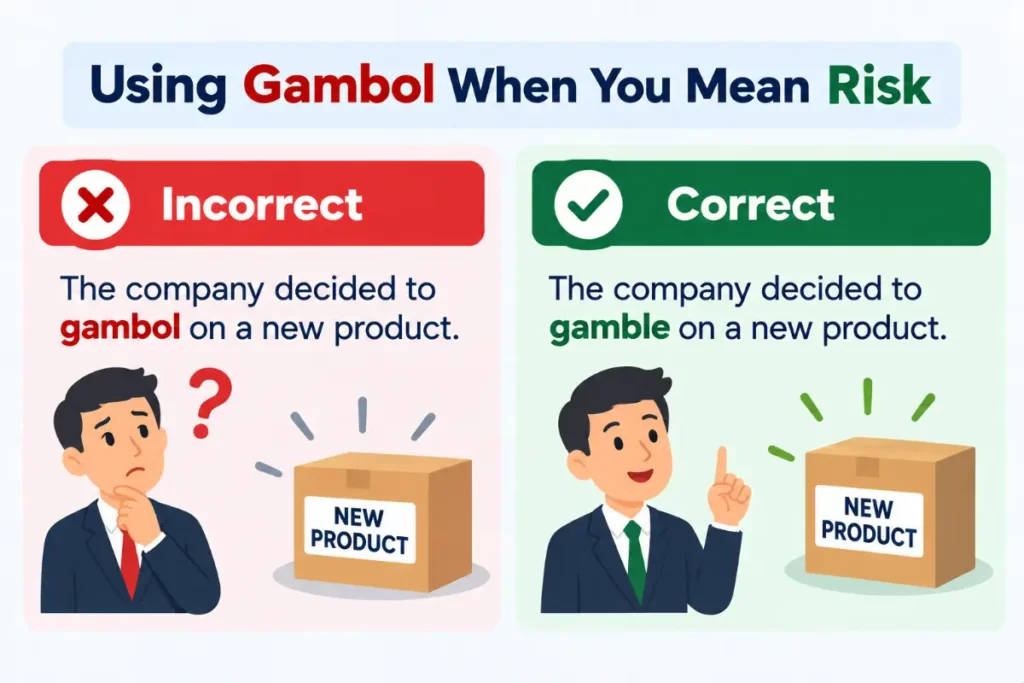
Incorrect in the intended meaning:
The company gambolled on a risky investment.
Better:
The company gambled on a risky investment.
The business is taking a chance. It is not running and jumping.
Confusing The Vowel Pattern
The words look nearly identical, so writers sometimes remember the general shape but forget the final vowel.
Gamble ends in ble.
Gambol ends in bol.
That small spelling difference carries the semantic distinction.
Assuming Gambol Is A Misspelling
Gambol is not an incorrect version of gamble. It is a separate word with its own history and meaning. A writer who marks every occurrence of gambol as a typo would change perfectly correct English.
This matters because context determines correctness.
Relying Only On Spellcheck
Both words appear in standard dictionaries. A spelling checker can therefore accept either one.
That creates a classic semantic error. The word may be spelled correctly while still being the wrong word for the sentence.
Professional proofreading goes one step further. It asks if the chosen word expresses the intended meaning.
Pronunciation Guide
In American English, gamble and gambol are pronounced very similarly.
Gamble is commonly represented as /ˈɡæmbəl/.
A simple pronunciation guide is:
GAM buhl.
The first syllable carries the main stress.
Gambol is also commonly represented as /ˈɡæmbəl/ in American English. Cambridge gives the same basic pronunciation pattern for the two words.
That close pronunciation explains much of the confusion.
When speaking, you may not hear a strong difference between the two words. In writing, however, the final vowel tells you which word you are using.
The safest approach is to connect the spelling to the meaning rather than trying to depend on sound alone.
Think:
Gamble means risk.
Gambol means play.
If you are describing an animal bouncing happily through a field, the surrounding context will guide you toward gambol even though the pronunciation is very close.
Etymology And Word Origin
The two words have different historical paths, even though their modern forms look remarkably similar.
The History Of Gamble
Gamble is recorded in English from the eighteenth century. Etymological evidence connects the verb with dialectal forms related to Middle English words for playing, joking, and being merry. One historical account also notes that the unusual b may have been influenced by confusion with the unrelated word gambol.
The word originally had a strong connection with playing or taking part in games before developing its modern sense of risking something valuable in a game of chance. The noun sense referring to a risky venture developed later.
This history is interesting because it helps explain why the spelling can look related to gambol even though the modern meanings differ.
The History Of Gambol
Gambol has a much older history in English. Etymological records trace the noun to forms meaning a skip, leap, or spring and connect the word through French to Late Latin gamba meaning the leg or hock of an animal. The verb developed with the sense of skipping or moving playfully.
The historical path fits the modern meaning quite well. The idea of movement through jumping or springing eventually became the familiar sense of frolicking or playing.
So although the two words look like close relatives today, their histories are not identical.
American English Usage
Both words are standard in American English.
Gamble is extremely common in the United States and appears in everyday speech, business writing, financial discussions, sports discussions, and descriptions of personal decisions. It can refer to literal betting or to a figurative risk.
Gambol is also standard American English, but it is much less common in ordinary conversation. It often appears in literary or descriptive writing. Cambridge marks the word as literary and gives examples involving playful animals.
American writers should not treat gambol as incorrect simply because it feels unusual. It is a legitimate word. Its lower frequency mainly reflects its specialized descriptive meaning.
Still confused? Compare one-third or one third Correct Spelling and Usage.
British English Usage
British English uses both words with the same basic distinction.
Gamble refers to risk or betting. Gambol refers to playful movement.
One small spelling point is worth knowing. British usage can show doubled consonants in forms such as gambolling and gambolled while American English commonly uses gamboling and gamboled. Cambridge specifically notes the difference in its dictionary entry.
The core word and meaning do not change. The regional difference mainly appears in certain inflected forms.
Australian English Usage
Australian English follows the same basic meaning distinction.
Gamble is used for risk, betting, and uncertain decisions. Gambol refers to playful movement and is much less common in ordinary speech.
Australian writers may encounter gambol in literature, descriptive prose, nature writing, or storytelling. The meaning remains the same as in American and British English.
There is no major regional change in the basic definition that would make one word interchangeable with the other.
Canadian English Usage
Canadian English also keeps the two meanings separate.
Use gamble for risk or betting. Use gambol for playful movement.
Canadian readers will generally understand gamble easily because it is a common everyday word. Gambol may sound more literary or descriptive, especially outside contexts involving animals and playful activity.
Again, the important distinction is semantic rather than regional.
Grammar Rules And Part Of Speech
Both words can function as verbs and nouns, but their sentence patterns differ.
Gamble As A Verb
Gamble can be intransitive when the action does not take a direct object.
He likes to gamble.
It can also take a preposition.
They gambled on the outcome.
Another common structure is gamble with.
She refused to gamble with her savings.
The verb can also take a direct object in contexts where something valuable is risked.
He gambled his entire fortune.
These patterns all revolve around risk.
Gamble As A Noun
As a noun, gamble refers to a risky action or decision.
Buying the company was a gamble.
The noun can also appear with modifiers.
It was a risky gamble.
The decision turned out to be a successful gamble.
Gambol As A Verb
Gambol is generally used as an intransitive verb. The subject performs the playful movement.
The lambs gambolled in the meadow.
The children gambolled across the lawn.
You normally do not use gambol to mean that someone moves another object.
Its natural pattern focuses on the subject itself moving playfully.
Gambol As A Noun
The noun gambol refers to an instance of playful movement.
The puppy’s gambol made everyone laugh.
The word is less common as a noun in ordinary modern conversation. It tends to appear in descriptive or literary writing.
Punctuation And Sentence Position
Neither word requires special punctuation simply because of its meaning.
Gamble can appear naturally at the beginning, middle, or end of a sentence.
You could write:
I wouldn’t gamble on that result.
You could also write:
Gamble carefully because the outcome is uncertain.
Gambol works in similar sentence positions, although its literary tone may make it more common in descriptive sentences.
The lambs began to gambol.
The puppies gambolled around the yard.
Punctuation depends on the larger sentence rather than the word itself.
The more important grammatical issue is choosing the correct meaning.
Real Life Usage Examples
Daily Conversation
Gamble appears naturally in everyday conversation when people discuss uncertain decisions.
- I wouldn’t gamble my savings on that idea.
- Starting over in another city was a big gamble.
Gambol is less common in casual speech, but it can appear when someone describes animals or playful children.
- The puppies were gambolling around the yard.
- The children were gambolling in the park.
In casual American speech, people often choose simpler verbs such as play, run, jump, or romp instead of gambol.
Email And Workplace Communication
Gamble is common in business writing because organizations regularly discuss uncertain decisions.
- The company is gambling on strong demand next year.
- Launching the product without more testing would be a gamble.
Gambol is unusual in workplace writing unless the subject involves animals, recreation, or descriptive material.
- The article describes lambs gambolling across the pasture.
- The campaign imagery shows puppies gambolling in a park.
Academic Writing
Gamble can appear in academic work when researchers discuss risk taking or uncertain choices.
- The study examines how people gamble when they face uncertain outcomes.
- The researchers argue that the decision involved considerable risk.
Gambol is more likely to appear in literature, biology, animal behavior, or descriptive studies.
- The young animals began to gambol after leaving the shelter.
- The passage describes lambs gambolling in open fields.
News Writing
News reports commonly use gamble when describing risky political, financial, business, or strategic decisions.
- The company gambled on a rapid recovery in consumer demand.
- The new strategy represents a significant gamble for the organization.
Gambol can appear in human interest stories and nature reporting.
- Young deer were seen gambolling near the edge of the forest.
- The report captured images of lambs gambolling in the spring sunshine.
Literature And Storytelling
Gambol has a natural place in descriptive storytelling because it creates a vivid image.
The puppies gambolled through the garden.
The children gambolled beneath the trees.
Gamble can also carry strong figurative meaning in stories.
He knew that leaving home was a gamble.
She gambled everything on one final decision.
The two words therefore create very different moods. Gamble can add tension. Gambol can add lightness and movement.
Related And Confused Terms
Risk
Risk means exposing yourself or something valuable to the possibility of harm, loss, or failure. Gamble is closely related because gambling involves risk.
Bet
A bet involves risking money or something valuable on an uncertain result. Gamble can refer to the act of betting or to a broader risky decision.
Wager
Wager is a more formal term for betting something on an uncertain outcome. It is especially common in discussions of contests, races, and games.
Frolic
Frolic means to play or move around in a lively and cheerful way. It is one of the closest everyday semantic relatives of gambol.
Romp
Romp means to play or move energetically. It is especially natural when describing children or animals.
Frisk
Frisk can describe lively playful movement, especially by animals.
Cavort
Cavort means to move or behave in a lively and playful way. It is often more expressive than simply saying play.
Gamble Away
Gamble away is a phrasal verb meaning to lose money or something valuable through gambling. For example, someone might gamble away their savings. Cambridge lists this as a standard phrasal verb.
These related words show why context matters. Gamble belongs to the semantic field of risk and chance. Gambol belongs to the semantic field of play and movement.
Why The Two Words Are So Easy To Mix Up
English contains many pairs that differ by only one letter but carry completely different meanings.
Gamble and gambol are especially tricky because the pronunciation is so close. A learner may know the meaning perfectly well but still choose the wrong spelling when writing.
There is also a visual reason. The beginning of each word is identical.
Gamb
The eye then reaches the final vowel and must select between e and o.
That small distinction can be easy to miss during fast typing.
The best solution is not to memorize the spelling alone. Build a meaning association.
Think of gamble beside words such as risk, bet, chance, and money.
Think of gambol beside words such as play, jump, frolic, puppy, and lamb.
Once those semantic groups become familiar, the spelling becomes easier to retrieve.
How Context Changes The Meaning
Context can usually tell you which word belongs in a sentence.
Consider:
The investors decided to ______ on the new project.
The word gamble fits because the sentence concerns a risky decision.
Now consider:
The puppies began to ______ across the lawn.
The word gambol fits because the puppies are moving playfully.
The sentence itself provides the clue.
This is an important lesson for English learners. You don’t always need to remember a definition word for word. Sometimes you can identify the correct word by asking what kind of action or idea the sentence describes.
Is there risk?
Choose gamble.
Is there playful movement?
Choose gambol.
That simple question solves most cases.
Expert Editor Insight
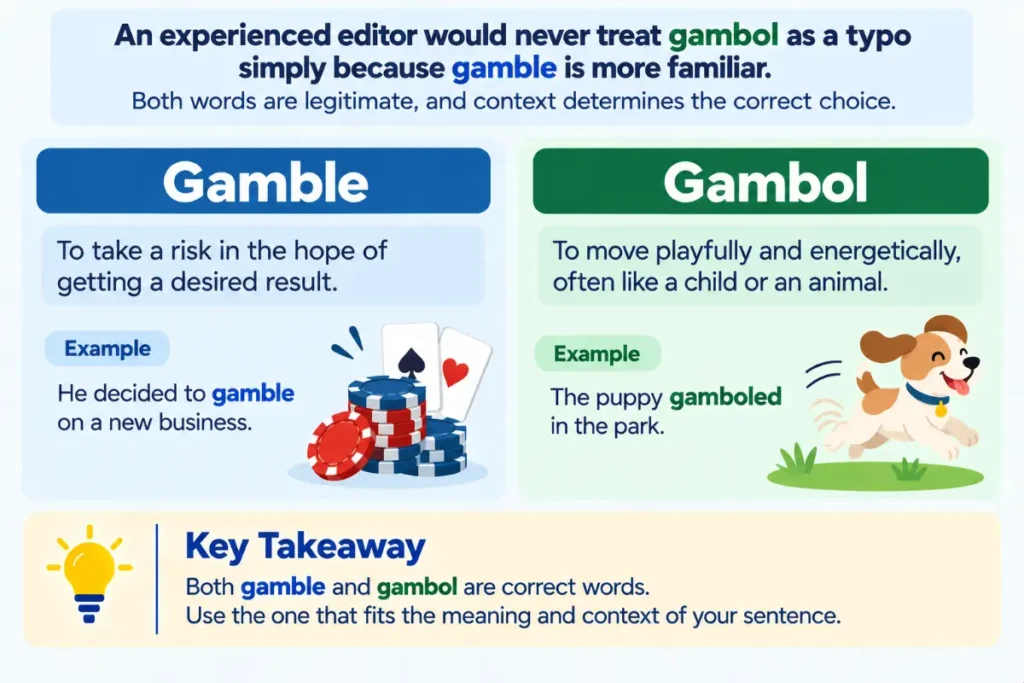
An experienced editor would treat these words as a meaning check rather than a spelling check. Both are legitimate dictionary words, so automated spelling tools may accept either one even when the wrong choice changes the sentence. The strongest editing habit is to read the entire sentence and ask what action or idea the word expresses. If the subject is taking a risk, gamble belongs there. If the subject is running and jumping playfully, gambol is the natural choice. Context beats spellcheck in this case.
A related grammar guide is sale vs sell Meaning Difference And Usage.
Conclusion
The difference between gamble vs gambol is a difference in meaning rather than correctness. Gamble refers to risk, betting, or an uncertain decision, while gambol describes playful movement such as running, jumping, or frolicking. Both words are correctly spelled and belong in standard English, but they cannot normally replace each other.
The easiest way to choose the right word is to focus on the action. If someone is risking money, making a risky choice, or betting on an outcome, use gamble. If an animal or person is moving happily and playfully, use gambol.
A useful editing trick is to connect each word with a picture. Think of gamble as risk and gambol as playful movement. That simple association will help you remember the difference even when the two words sound almost identical.
FAQs
Is gambol a real word?
Yes. Gambol is a standard English word. It means to run, jump, or move around in a playful and happy way. It can function as a verb and noun, although the verb is especially common. The word often appears in literary or descriptive writing and is frequently used for animals such as puppies, lambs, and young goats.
What does gamble mean?
Gamble means to risk money or something valuable on an uncertain result. It can also describe taking a risky action without involving money. As a noun, a gamble is a risky decision or action. For example, starting a new business can be described as a gamble when the outcome is uncertain and success is not guaranteed.
What does gambol mean?
Gambol means to move in a playful way by running, jumping, skipping, or leaping. It often describes animals or children enjoying themselves. For example, you might say that puppies gambolled around a garden. The word has a somewhat literary or descriptive tone and is less common in ordinary conversation than simpler words such as play, run, or jump.
Are gamble and gambol pronounced the same?
In standard American English, the two words are pronounced very similarly and may be indistinguishable in ordinary speech. Both commonly use the pronunciation pattern represented as /ˈɡæmbəl/. Because the sounds are so close, writers need to rely on context and spelling. Remembering risk for gamble and playful movement for gambol can make the distinction easier.
Is gambol a synonym for gamble?
No. The words are not synonyms. Gamble refers to risk, betting, or an uncertain decision. Gambol refers to playful movement. They may look related because their spellings are similar, but their meanings are different. Replacing one with the other can completely change the meaning of a sentence even though both words are correctly spelled.
Can gamble be used without money?
Yes. Gamble can describe any risky decision or action, even when no money changes hands. For example, A company gambled on an early product launch describes a risky business decision. The word therefore has a broader figurative meaning beyond casinos, betting, and games of chance. The central idea is uncertainty combined with a willingness to take a risk.
Is gambol common in everyday American English?
Gambol is understood in American English, but it is less common than everyday words such as play, run, jump, romp, or frolic. It often appears in literary or descriptive writing. Cambridge labels the word literary and gives examples involving playful animals. It is therefore correct but more specialized in tone than gamble.
How can I remember the difference?
Connect gamble with risk, betting, money, and uncertainty. Connect gambol with playful movement, running, jumping, and animals. A simple mental picture can help. Imagine an investor taking a risk when you see gamble. Imagine puppies bouncing across a lawn when you see gambol. That meaning based memory is more useful than memorizing the spelling alone.