
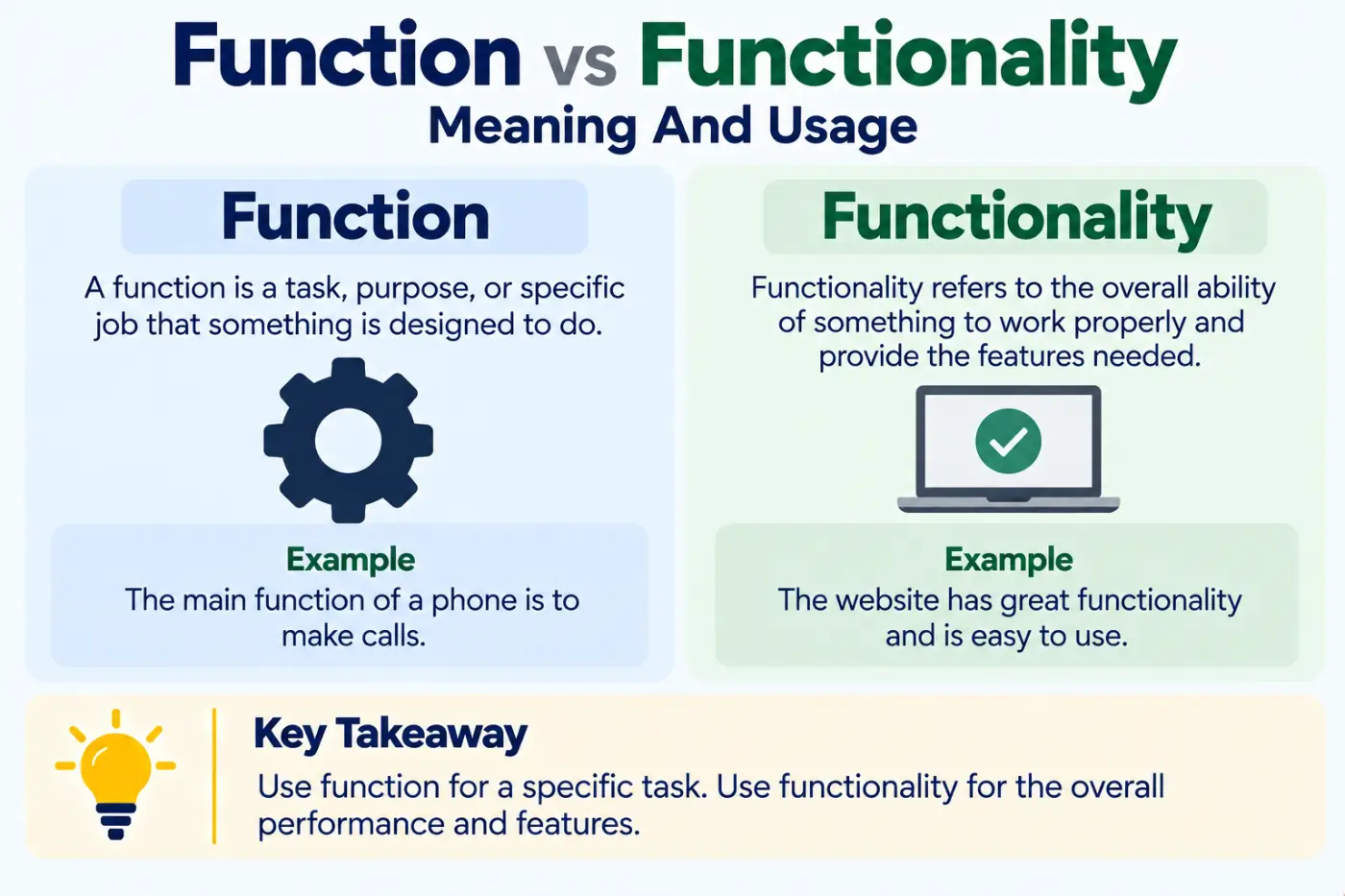
If you’ve ever wondered about function vs functionality, the key difference comes down to purpose and capability. A function describes what something does or the job it performs. Functionality describes what something can do, often through a set of features or abilities.
Both words are correct English, but they don’t always fit the same sentence. For example, a search button has a function. A website’s functionality includes everything users can do with it, such as searching, filtering results, saving items, and creating accounts.
The distinction matters most in software, business writing, technical documents, and everyday communication. Choosing the right word helps you explain an idea more clearly and avoid vague language. Once you understand the difference, you can select the right term without second guessing yourself.
Still confused? Compare Imply vs Infer The Difference Explained.
Quick Answer
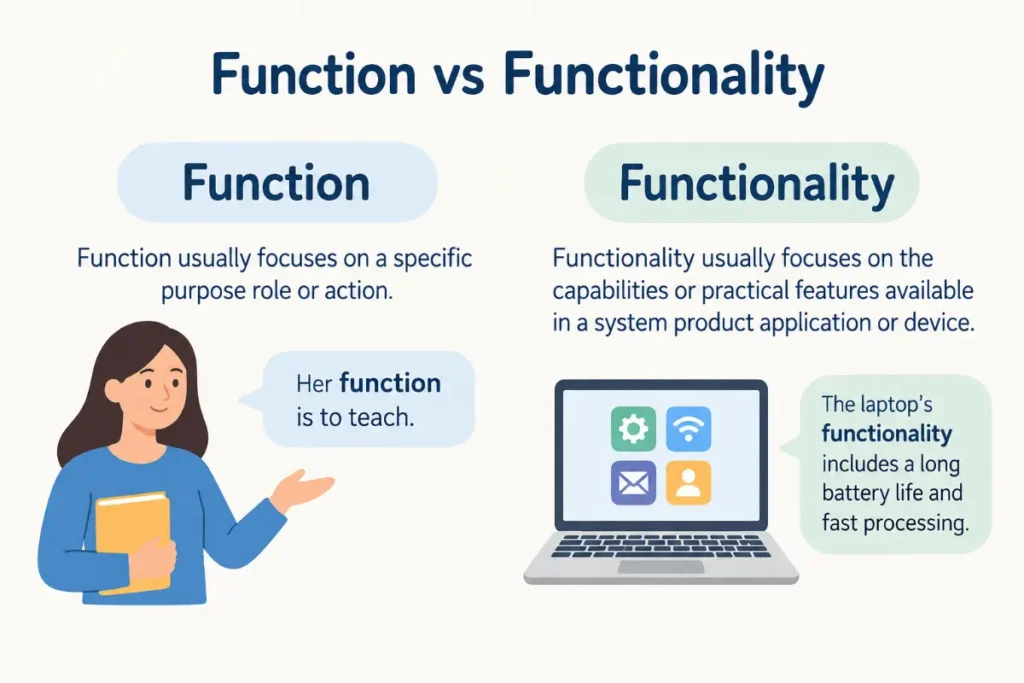
A function is a specific job, purpose, or action performed by a person, object, system, or piece of software. Functionality refers to the capabilities or features that allow something to perform tasks. Use function for a particular job and functionality for the broader set of things a product or system can do.
The Main Difference at a Glance
| Feature | Function | Functionality |
|---|---|---|
| Meaning | A particular job or purpose | The capabilities or features available |
| Part of speech | Noun | Noun |
| Main focus | What something does or why it exists | What something can do |
| Common contexts | Science, math, work, software, daily life | Software, websites, devices, product design |
| Typical example | The app has a search function. | The app offers advanced search functionality. |
| Formality | Standard in casual and formal writing | Standard in technical and professional writing |
| Grammatical form | Countable or uncountable depending on meaning | Usually an uncountable noun |
| Origin | From Latin through French | Formed from functional and the suffix ity |
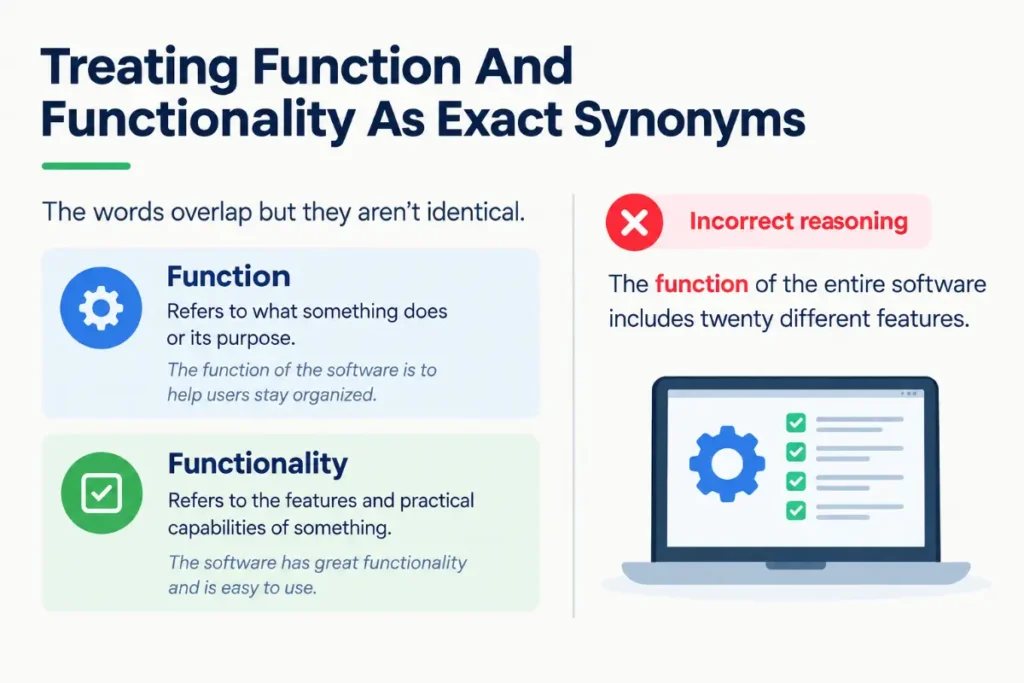
The central distinction is simple. One word often points to a particular task, while the other describes the capabilities available across a product or system. However, context matters because a function can also mean a mathematical relationship, a social event, or a role within an organization.
What Does Function Mean
A function is the job, purpose, or action of something. It explains what a person, object, process, or system does. Depending on the subject, the word can describe one clear task, a general role, or a technical concept.
For example, the function of a refrigerator is to keep food cold. The function of a manager includes guiding a team and making decisions. In mathematics, a function connects each permitted input to exactly one output.
The word also appears in computer programming. A function is a named or otherwise defined block of code that performs a task. A programmer might create a function to calculate a price, check a password, or format a date.
Function as a Specific Purpose
In everyday English, this word often describes the reason something exists or the role it serves.
Consider these examples.
- The main function of a smoke detector is to warn people about smoke.
- One function of a teacher is to help students understand new ideas.
- The heart’s primary function is to pump blood around the body.
Each sentence identifies a particular purpose or responsibility. The reader can point to a clear job rather than a broad collection of abilities.
Function in Software and Technology
In software, a function usually refers to a specific action or task. A login function checks user credentials. A payment function processes a transaction. A sorting function arranges information in a particular order.
These functions may work together to create a larger application. Each one handles a particular responsibility, which makes the software easier to understand, test, and maintain.
The term also has a precise meaning in programming languages. Depending on the language, a function may accept inputs, process them, and return an output. Some functions also change data or perform actions without returning a meaningful value.
Function as a Role or Activity
The word has other established meanings. A public official may perform an official function. A charity may organize a fundraising function, meaning a social event. In biology, a body part has a biological function.
These meanings share a common idea of purpose, activity, or role. The surrounding words tell readers which meaning applies.
What Does Functionality Mean
Functionality describes the features, capabilities, or operations available in a product, service, or system. It often refers to the range of tasks a user can complete rather than one individual task.
For example, a banking app might offer bill payments, money transfers, balance checks, and transaction history. Together, these capabilities form much of the app’s functionality.
The word is especially common in technology and product design. Teams use it to explain what a website, software application, device, or platform allows people to do.
Functionality as a Set of Capabilities
Imagine buying a new smartphone. You may care about its camera, fingerprint reader, voice assistant, and wireless charging. These features contribute to the phone’s functionality.
A product can have limited functionality even when its main function works well. A basic calculator might perform addition accurately but lack scientific calculations, graphing, or memory features.
This distinction helps explain product reviews. A reviewer might praise a device for its main function while criticizing its limited functionality.
Functionality in Software Development
Software teams often discuss functionality when planning features, testing releases, and evaluating user needs. They might ask if a new version includes the functionality customers requested.
In this setting, the word can cover several related capabilities. For example, an online store may include product search, inventory tracking, discount codes, checkout, and order notifications. Those features contribute to the store’s overall functionality.
However, functionality doesn’t automatically mean quality. A product may include many features and still be difficult to use. Good functionality gives people useful capabilities that work as intended.
Functionality Does Not Always Mean Every Feature
The word can refer to the available capabilities of a system as a whole or to one particular capability. For example, a team might discuss the functionality of a reporting tool or the functionality of its export feature.
This broader use explains why the word sometimes overlaps with function. The best choice depends on the level of detail and the point you’re trying to make.
Key Differences Explained
The distinction becomes easier to remember when you look at meaning, grammar, and context together.
Meaning and Scope
A function often refers to one purpose or task. Functionality usually describes a wider range of capabilities, especially in technology.
For example, the function of a calendar app is to help users organize dates and events. Its functionality may include reminders, shared calendars, recurring events, color coding, and time zone support.
The first statement identifies the main purpose. The second describes what the app allows users to do.
Grammar and Countability
Function can be countable. You can talk about one function, several functions, or the main functions of a system. It can also appear as an uncountable noun when describing the general purpose or operation of something.
Functionality is generally used as an uncountable noun. Writers commonly say the software has limited functionality rather than a limited functionality. When referring to separate items, words such as features or capabilities often sound more natural.
Compare these sentences.
- The device performs three main functions.
- The device offers useful functionality.
- The new version adds several features.
All three are grammatically correct, but each sentence frames the information differently.
Specific Action Versus Overall Capability
A function answers a question such as what job does this component perform. Functionality answers a broader question such as what can this product do.
Consider a website with a password reset option. Resetting a password is a function. The ability to recover accounts through email verification and security checks contributes to the website’s account recovery functionality.
This distinction is useful when writing product descriptions, technical requirements, help guides, and project plans.
Formality and Tone
Both terms work in formal and informal English. Neither is inherently more correct or more professional than the other.
Still, functionality can sound technical or abstract in everyday conversation. Someone might naturally say the new phone has more features instead of saying it has greater functionality.
In a technical report, however, functionality may be the most suitable word because it can describe a system’s overall capabilities in a compact way.
Pronunciation
In American English, function is pronounced /ˈfʌŋkʃən/. Functionality is pronounced /ˌfʌŋkʃəˈnæləti/.
Function has two syllables, with stress on the first. Functionality has five syllables, with primary stress on the third syllable.
Say function as FUNK shun. Say functionality as funk shuh NAL uh tee. The main pronunciation challenge is the middle of the longer word. Keep the syllables connected and place the strongest stress on NAL.
Context and Regional Usage
Both words are standard in American, British, Australian, and Canadian English. Their core meanings remain the same across these varieties.
You won’t need to change the word based on your audience’s country. Instead, consider the context. In everyday writing, features or abilities may sound more natural than functionality. In software specifications, the longer term may offer the precision you need.
Which Word Is Correct
Both words are correct. The right choice depends on the meaning you want to express.
Use function when you mean a particular job, purpose, role, or operation. Use functionality when you mean the features and capabilities available within a product or system.
For example, a camera’s function is to capture images. Its functionality may include portrait mode, night photography, video recording, image stabilization, and automatic focus.
Neither word is a misspelling or a nonstandard form. English dictionaries recognize both as established nouns with related but distinct meanings. The words sometimes overlap, especially in technology, but they aren’t interchangeable in every sentence.
A simple editing test can help. If you can name a particular task, function is often the better choice. If you’re describing a collection of available features, functionality may be more precise.
Ten Natural Sentence Examples
These examples show how both terms work in everyday speech, professional writing, and technical contexts.
1. Everyday conversation. The main function of this button is to turn the screen on and off.
2. Text message. The app works fine, but its sharing functionality keeps freezing.
3. Workplace communication. One important function of the operations team is to track daily performance.
4. Product review. The laptop offers excellent functionality for people who work with large spreadsheets.
5. School assignment. The function of the roots is to absorb water and nutrients from the soil.
6. Academic writing. This study examines the function of social support in student learning.
7. Software development. The developer created a function that checks each email address before submission.
8. Business report. The updated platform expands reporting functionality and gives managers more control over their data.
9. Online communication. The website’s search function makes it easy to find older posts.
10. Formal documentation. Before release, the team tested each major function and reviewed the application’s overall functionality.
Notice how the examples use each word to communicate a different level of detail. The specific action usually calls for function, while the broader set of capabilities often calls for functionality.
A related grammar guide is Inconsolable or Unconsolable Correct Spelling and Meaning.
Common Mistakes and How to Avoid Them
The main problem isn’t spelling. It’s choosing a word that doesn’t express the intended meaning clearly.
Using Functionality for One Simple Task
Incorrect or awkward. The main functionality of this switch is to turn on the light.
Better. The main function of this switch is to turn on the light.
Why it matters. A switch performs a specific task. Calling that task a function makes the sentence shorter and more direct. The longer word would make more sense when discussing several capabilities or the broader operation of a device.
Using Function When You Mean All Available Features
Less precise. The phone has many useful functions, including wireless charging, face recognition, and advanced camera settings.
Often clearer. The phone offers several useful features, including wireless charging, face recognition, and advanced camera settings.
Why it matters. Function isn’t incorrect here, but features describes the individual product options more naturally. Functionality would also work if you’re referring to the phone’s overall capabilities.
Treating Functionality as a Countable Noun
Awkward. The application includes five functionalities for managing files.
Better. The application includes five file management features.
Another option. The application offers file management functionality.
Why it matters. Functionality generally behaves as an uncountable noun. When you need to count separate items, use features, tools, operations, or capabilities.
Assuming Functionality Always Means Better Performance
Misleading. The application has more functionality, so it must run faster.
Better. The application has more features, but its speed depends on how efficiently those features work.
Why it matters. Functionality describes available capabilities. It doesn’t guarantee speed, reliability, ease of use, or quality. A feature rich product can still perform poorly.
Replacing Every Use of Function With Functionality
Awkward. The function of the new policy is to improve the functionality of the team.
Better. The purpose of the new policy is to improve how the team works.
Why it matters. Repeating technical language can make writing sound vague. Sometimes purpose, role, task, feature, or capability communicates the idea more clearly than either of the main terms.
Grammar Rules and Correct Usage
Understanding the basic grammar of each word makes it easier to use them naturally.
How to Use Function as a Noun
Function commonly appears in these patterns.
1. The function of something. The function of the filter is to remove dust from the air.
2. A function of something. One function of the committee is to review new proposals.
3. Perform a function. The sensor performs an important function in the safety system.
4. Serve a function. These small details serve a useful function in the design.
5. Main or primary function. The device’s primary function is to measure temperature.
The word can also appear in mathematical and programming contexts, where its meaning becomes more specialized. In each case, the sentence provides enough context to identify the intended use.
How to Use Functionality as a Noun
Functionality often appears in phrases that describe the capabilities of a product or system.
1. Improved functionality. The update offers improved functionality for mobile users.
2. Limited functionality. The free version has limited functionality.
3. Additional functionality. The new release adds additional functionality for account management.
4. Core functionality. The team tested the core functionality before launch.
5. Functionality of a system. The report describes the functionality of the payment platform.
These patterns are common in technical documents, software reviews, and product discussions. However, avoid using the word simply because it sounds more technical. Choose it when you genuinely mean capabilities or available operations.
Can Functionality Be Plural
In most everyday and technical writing, functionality is uncountable. You would usually write the software has useful functionality or the update adds more functionality.
The plural form functionalities can appear in specialized writing when authors refer to distinct types of operation or separate capabilities. Even so, features, functions, and capabilities will often be clearer for a general audience.
Can Function Start a Sentence
Yes. Both words can start a sentence when the grammar and meaning support them.
For example, Function is the core operation of this component. Functionality improves when users can complete more tasks within the same application.
In professional writing, though, sentence openings should serve the meaning rather than force a particular word into the first position.
Real Life Examples Across Different Settings
The same distinction appears in many areas of life. Seeing it in context helps you choose the word without relying on a rigid rule.
Daily Conversation
People usually prefer simple language when talking about everyday objects. Function often works best for one clear purpose, while features or abilities may sound more natural when discussing options.
1. The function of the remote is to control the television.
2. This washing machine has useful functionality, including quick wash and delayed start options.
Email and Workplace Communication
In the workplace, the right word can make a request more specific. Use function to identify a responsibility and functionality to discuss what a tool or system can do.
1. One function of the support team is to resolve customer complaints.
2. Could you confirm that the new dashboard includes the required reporting functionality before Friday.
Academic Writing
Academic writing uses function in fields such as biology, sociology, mathematics, and linguistics. Functionality is more common when a writer evaluates the capabilities of a system or tool.
1. The paper explores the function of memory in language learning.
2. The researchers evaluated the functionality of the digital learning platform.
News and Journalism
Journalists use both terms when describing public services, technology, and organizations. Function usually identifies a role, while functionality helps explain the options a system provides.
1. The report examines the function of local agencies during an emergency.
2. The latest software update expands the functionality available to small businesses.
Literature and Storytelling
In storytelling, function can describe the role a character, scene, or object plays in the plot. Functionality is less common in literary discussion unless the writer is describing a practical system or device.
1. The old key serves a crucial function in the mystery because it opens the locked room.
2. The author gives each character a clear function in the story, helping the plot move forward.
Related Terms You Should Know
Several words overlap with these concepts, but each carries its own meaning. Choosing the right alternative can make your writing clearer and less repetitive.
1. Purpose. The reason something exists or is done. The purpose of the meeting is to review the budget.
2. Role. The part a person or thing plays in a situation. Her role is to guide the project team.
3. Feature. A particular quality or option, especially in a product. The phone includes a useful screen recording feature.
4. Capability. The ability to perform an action or achieve a result. The system has the capability to process large files.
5. Operation. The way something works or the act of running it. The manual explains the operation of the machine.
6. Purpose built tool. A tool designed for a particular task. A purpose built calculator may focus on financial calculations.
7. Performance. How well or efficiently something works. The application offers many features, but its performance remains slow.
8. Usability. How easy a product is to learn and use. Better usability helps new customers complete tasks without extra support.
These terms are related, but they aren’t exact substitutes. For example, a feature may contribute to functionality, while performance describes how well the feature works. Usability focuses on the user’s experience rather than the number of available options.
Pronunciation and Word Origin
How to Pronounce Both Words
In American English, function has two syllables and functionality has five. Both share the same opening sound, but the longer word places its strongest stress later.
| Word | IPA | Syllables | Easy guide |
|---|---|---|---|
| Function | /ˈfʌŋkʃən/ | func tion | FUNK shun |
| Functionality | /ˌfʌŋkʃəˈnæləti/ | func tion al i ty | funk shuh NAL uh tee |
The most common pronunciation problem with the longer word is placing the stress on the wrong syllable. Keep the strongest emphasis on NAL. You don’t need to pronounce every syllable with equal force.
Where the Words Come From
Function entered English through French from Latin functio, meaning performance or execution. The Latin term comes from fungi, a verb meaning to perform or carry out. This history connects the modern word to the idea of performing a task or fulfilling a role.
Functionality developed from functional with the suffix ity, which forms nouns describing a state, quality, or condition. The word later became especially useful in discussions of technology and product design, where writers needed a term for the capabilities a system provides.
The shared origin explains the connection between the two words. Their modern meanings differ mainly in scope, not in their basic relationship to performing tasks.
Regional Usage in English
American English
Both words are standard in the United States. Function appears across everyday speech, education, science, business, and technology. Functionality is particularly common in software discussions, product reviews, and technical documents.
American writers often choose features or capabilities instead of functionality when speaking to a general audience. These alternatives can make product descriptions easier to understand.
British English
British English uses both words with the same basic distinction. A British software team may discuss a function that processes data and the functionality of an application that contains many such operations.
There is no special British spelling rule that changes one form into another. The choice depends on meaning and context.
Australian and Canadian English
Australian and Canadian English also recognize both terms. Their meanings remain consistent with standard American and British usage.
Regional preferences may affect the wording of a particular sentence, but they don’t create a different rule for choosing between these nouns. Writers in all four varieties should focus on the distinction between an individual purpose and a broader set of capabilities.
Expert Editor Insight
An experienced editor looks at meaning before choosing the word. If a sentence identifies one task, responsibility, or operation, function is usually direct and precise. If it describes a product’s wider range of capabilities, functionality may fit better. Grammar tools can flag awkward phrasing or suggest alternatives, but they may not understand the full context. Read the sentence aloud and ask what you want the reader to picture. If you mean a specific action, name it. If you mean a collection of features, explain the capabilities. Clear writing depends on the idea, not on choosing the longer word.
For another common grammar confusion, see Who vs Whom Explained With Simple Grammar Rules.
Conclusion
Understanding function vs functionality comes down to recognizing the difference between a specific task and a broader set of capabilities. A function describes what something does or the purpose it serves. Functionality describes the features and operations available within a product or system. Both words are correct, and neither is a substitute for the other in every situation.
To choose the right word, think about the idea you’re explaining. If you mean one job, use function. If you mean several related capabilities, use functionality. When writing about individual product options, features may be even clearer. This simple check will help you write more naturally and communicate your ideas with confidence.
FAQs
Is function or functionality the correct word?
Both words are correct English. Function usually describes a specific task, purpose, or role, while functionality describes the capabilities available in a product or system. For example, a calculator has a function for adding numbers, while its overall functionality may include addition, subtraction, multiplication, division, and memory features. Choose the word that best matches your intended meaning.
What does functionality mean in simple words?
Functionality means the things a product or system can do. A smartphone’s functionality might include taking photos, recording videos, sending messages, and making payments. The word often describes several related capabilities rather than one specific action. In everyday conversation, features or abilities may communicate the same idea more simply, depending on the sentence and audience.
Can function and functionality be used interchangeably?
Sometimes, but not always. Both terms relate to what something does, so their meanings can overlap in technical writing. However, function often identifies a particular task, while functionality usually refers to a broader set of capabilities. Replacing one with the other can make a sentence less precise. Consider the intended meaning before changing the wording.
Is functionality a real English word?
Yes. Functionality is an established English noun used in technical writing, business communication, and everyday discussions about products. It describes the capabilities or operations available in a system. It isn’t a misspelling of function, nor is it an incorrect attempt to make the shorter word sound more formal. Both forms have their own uses and meanings.
How do you pronounce functionality?
In American English, functionality is pronounced /ˌfʌŋkʃəˈnæləti/. It has five syllables, with the strongest stress on the third syllable. An easy guide is funk shuh NAL uh tee. Keep the opening sounds smooth and give the middle of the word the strongest emphasis. This helps the pronunciation sound natural during conversation.
What is a good synonym for functionality?
Features, capabilities, and available options can work as alternatives, depending on context. Features is often the clearest choice when discussing individual product options. Capabilities emphasizes what a system can accomplish. Available options works well when describing choices users can access. These expressions can make general writing easier to follow without changing the core meaning.
Is functionality appropriate for formal writing?
Yes. Functionality is suitable for professional reports, software specifications, academic discussions, and product documentation. However, formal writing should still favor precision and clarity over technical sounding language. If you mean one specific task, function may be more direct. If you mean several related capabilities, functionality may express the idea more accurately.
Why do people confuse function and functionality?
People confuse these words because they share the same root and relate to what something does. In software discussions, both can describe system behavior, so the difference may seem small. The key is scope. Function generally points to a particular job or operation, while functionality often describes a collection of capabilities. Looking at the sentence’s intended meaning usually resolves the confusion.