

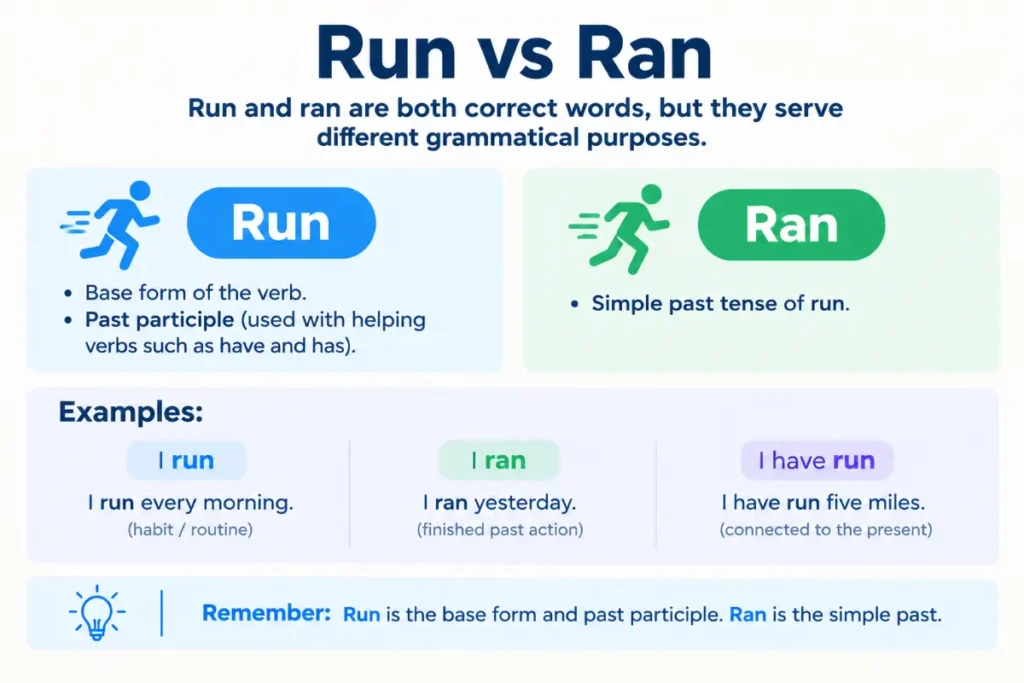
Choosing between run vs ran can feel tricky when you’re writing a sentence quickly. The good news is that both forms are correct. The difference comes down to time and grammar. Use run for the present tense with certain subjects and after helping verbs. Use ran when you describe an action that happened in the past.
For example, you might say, “I run every morning” to describe a habit. If you went for a jog yesterday, you’d say, “I ran yesterday.” The action stays the same, but the verb changes to show when it happened.
The confusion often comes from the fact that English doesn’t form every past tense by adding the same ending. Some verbs follow a regular pattern, like walk and walked. Others change their form, and run is one of them. Its three main forms are run, ran, and run.
Once you understand how these forms work, you’ll know which one to use in everyday speech, emails, school assignments, and formal writing. You’ll also learn why sentences such as “I have ran” are incorrect in standard English and how to fix them with one simple grammar rule.
You may also want to read Bring vs Take Which Word Should You Use.
Quick Answer
Run and ran are both correct forms of the verb run. Use run for present actions with the right subject, for repeated activities, and after helping verbs such as have, has, and will. Use ran for actions completed in the past. For example, “I run daily” describes a habit, while “I ran yesterday” describes a past event.
Comparison Table
| Feature | Run | Ran |
|---|---|---|
| Meaning | To move quickly on foot or operate or manage something | The past action of running, operating, or managing |
| Part of speech | Base form and present tense form | Simple past tense |
| Verb type | Irregular verb | Irregular verb |
| Time reference | Present, habitual, or future when used with a helping verb | Past |
| Pronunciation | /rʌn/ | /ræn/ |
| Syllables | One | One |
| Formality | Standard English | Standard English |
| Common contexts | Daily routines, instructions, future plans, and perfect tenses | Past events, completed activities, and historical accounts |
| Example | I run before work. | I ran before work yesterday. |
Meaning and Definition
The verb run has several meanings in English. It can describe movement on foot, the operation of a machine, the management of a business, or the continued operation of a service. Its meaning depends on the sentence, but its basic grammar follows the same pattern.
What Run Means
Run is the base form of an irregular verb. It also serves as the present tense form with the subjects I, you, we, and they, as well as plural nouns. It describes an action, a routine, or a general fact.
Consider these examples.
- I run three miles every morning.
- They run a small family business.
- We run the software on our computers.
- You run faster than I do.
In each example, the form fits the subject and the meaning of the sentence. It can also follow modal verbs such as can, could, should, and will.
For example, “She can run five miles” and “We will run the test tomorrow” both use the base form after a helping verb. The subject doesn’t change this rule.
What Ran Means
Ran is the simple past tense of run. Use it to describe an action that took place in the past. The sentence often includes a time expression such as yesterday, last week, or an hour ago, although the time can also be clear from context.
Here are a few examples.
- I ran to catch the bus.
- She ran the meeting yesterday.
- The machine ran all night.
- They ran several tests before releasing the product.
The action might last a few seconds or several hours. The key point is that the sentence presents it as a past event.
What About the Past Participle
The verb has three principal forms.
| Verb Form | Example |
|---|---|
| Base form | I run every day. |
| Simple past | I ran yesterday. |
| Past participle | I have run every day this week. |
The past participle is the form used with helping verbs such as have, has, and had to build perfect tenses. For this verb, the past participle looks exactly like the base form.
That similarity causes much of the confusion. People sometimes use the past tense after have because the sentence describes something that already happened. However, standard English requires the past participle after have.
Correct: “I have run five miles today.”
Incorrect: “I have ran five miles today.”
The second sentence uses the simple past form in a position that requires the past participle.
Key Differences Explained
The main difference involves grammar rather than spelling preference. Both forms belong to the same verb, but they perform different jobs in a sentence.
The Difference in Tense
Use run when the sentence describes a current routine or a general fact. For example, “He runs every Saturday” describes a habit, while “They run a busy restaurant” describes what they do.
Use ran when the action belongs to the past. “He ran on Saturday” describes a past event. “They ran a restaurant for ten years” describes a business activity that took place over a period in the past.
The surrounding words can help you identify the correct tense. Still, focus on the meaning of the whole sentence rather than relying only on words such as yesterday or today.
The Difference in Grammar
The base form appears in several common sentence patterns.
- With I, you, we, and they in the simple present. For example, “We run after school.”
- After modal verbs. For example, “You should run more slowly.”
- After to in an infinitive. For example, “I want to run a marathon.”
- After do, does, or did in questions and negatives. For example, “Did you run yesterday?”
The simple past form works differently. It can stand on its own in a statement about a past action, as in “She ran home.” It doesn’t follow did in a standard question or negative.
Correct: “Did she run home?”
Incorrect: “Did she ran home?”
The helping verb did already marks the past tense. The main verb must return to its base form.
The Difference in Pronunciation
Both forms have one syllable, but their vowel sounds differ.
- Run uses the short vowel sound /ʌ/, as in fun and sun.
- Ran uses the short vowel sound /æ/, as in cat and map.
The final consonant sound is /n/ in both forms. Listen for the difference in the vowel rather than adding another syllable or changing the final sound.
The Difference in Formality
Neither form is more formal than the other. Both are standard English, and both work in casual conversation, business communication, academic writing, and published material.
The right choice depends on the sentence. An editor won’t replace one with the other to make a sentence sound more professional. Instead, the editor checks the tense, the subject, and any helping verbs.
The Difference in Meaning and Context
The verb doesn’t always describe physical movement. English speakers also use it for machines, software, businesses, events, and public services.
- Physical movement. “The child runs around the yard” describes a regular activity. “The child ran across the yard” describes a past event.
- Business management. “She runs a design studio” describes her role now. “She ran the studio for five years” describes a past role.
- Machine operation. “The engine runs quietly” describes how it works. “The engine ran for six hours” describes a past period of operation.
- Events and campaigns. “They run a summer program” describes an ongoing activity. “They ran a summer program last year” describes a previous one.
The meaning changes with context, but the tense rule remains the same.
Which Form Is Correct
Both forms are correct. You need to choose the one that matches the sentence’s tense and grammatical structure.
Use ran for a simple statement about a past action. Use run as the base form in the present with I, you, we, and they, and after modal verbs, do, does, and did, or the word to and Use run as the past participle after have, has, or had.
The irregular pattern explains the difference. Many English verbs form the past tense by adding ed, such as clean and cleaned. Run doesn’t follow that pattern. Its simple past form changes to ran, while its past participle remains run.
You can confirm this pattern in standard English dictionaries, which list run as an irregular verb and identify ran as its past tense. This isn’t a difference between American and British spelling. It is a grammar rule shared across major English varieties.
Sentence Examples
These ten examples show how the forms work in everyday and professional situations.
- Daily conversation. I run around the neighborhood before breakfast.
- Text message. I ran to the store, so I’ll be home in ten minutes.
- Workplace communication. Our team runs a weekly review to track project progress.
- Schoolwork. The students ran an experiment to test their hypothesis.
- Academic writing. The researchers ran the analysis again after finding an error in the data.
- Formal writing. The organization runs several programs that support local families.
- Social situations. We ran into our old neighbors at the grocery store.
- Online communication. This app runs smoothly on my phone.
- News reporting. The city ran emergency buses during the storm.
- Storytelling. When the dog slipped through the gate, Maya ran after it.
Notice that the meaning of the verb changes with the context. It can describe exercise, business operations, a scientific process, or an unexpected event. The grammar still follows the same pattern.
Common Mistakes and Misspellings
Most errors happen when writers mix up the simple past, the past participle, or the base form after a helping verb. The following mistakes are worth learning because they appear in everyday writing.
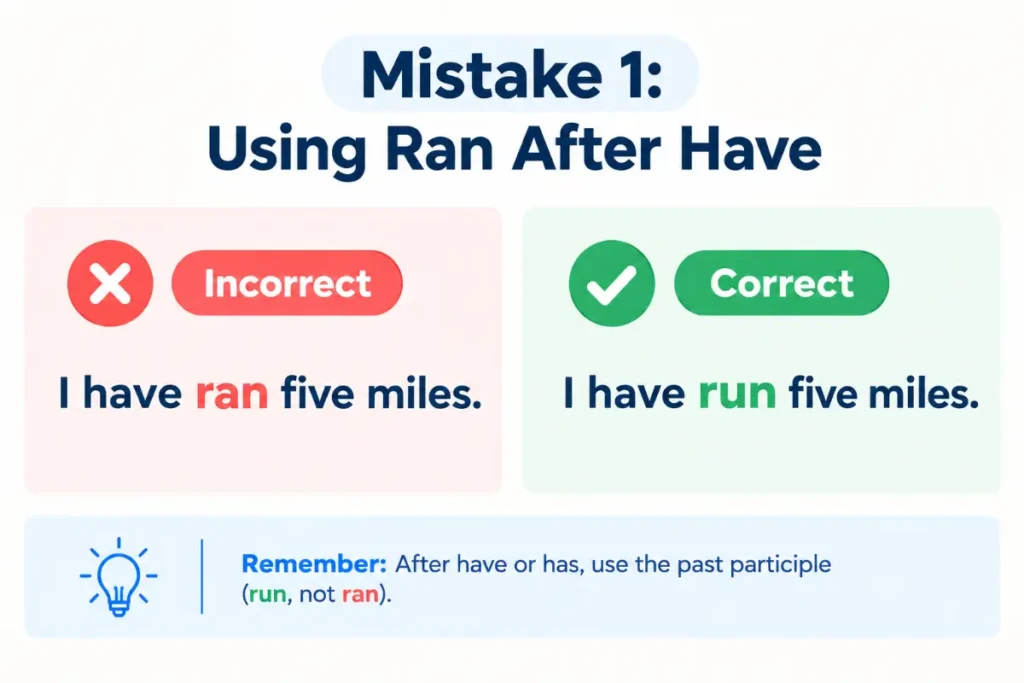
Using Ran After Have
Incorrect: “I have ran five miles today.”
Correct: “I have run five miles today.”
Have requires the past participle. Since the past participle of run is run, the sentence must use that form even though the action happened in the past.
Using Ran After Did
Incorrect: “Did you ran this morning?”
Correct: “Did you run this morning?”
Did already marks the question as past tense. Keep the main verb in its base form after did.
Using Run for a Completed Past Action
Incorrect: “Yesterday, I run to work.”
Correct: “Yesterday, I ran to work.”
The word yesterday places the action in the past. In a simple past statement, use ran rather than run.
Using Ran With a Modal Verb
Incorrect: “She can ran five miles.”
Correct: “She can run five miles.”
Modal verbs such as can, could, may, might, must, should, and will take the base form of the main verb. The same rule applies to other irregular verbs.
Adding an Unnecessary Ending
Incorrect: “He runned to the door.”
Correct: “He ran to the door.”
Run is irregular, so you can’t form its simple past by adding ed. Learn the three forms together to avoid this mistake.
A useful way to remember the pattern is to say the forms aloud: run, ran, run. The first is the base form, the second is the simple past, and the third is the past participle. Practicing the pattern in complete sentences makes it easier to use correctly.
Pronunciation Guide
Both forms have one syllable, and both end with the same n sound. The main difference is the vowel in the middle.
| Form | IPA | Easy Pronunciation |
|---|---|---|
| Run | /rʌn/ | Ruhn |
| Ran | /ræn/ | Ran, with the vowel sound in cat |
In the first form, the vowel /ʌ/ sounds like the vowel in cup or sun. In the second form, /æ/ sounds like the vowel in hat or back.
To practice, say “I run” and then “I ran.” Keep the beginning and ending sounds steady, but change the vowel. Both words have one syllable, so neither needs extra stress or an additional sound.
A common mistake is to pronounce both forms with the same vowel. This can make them harder to distinguish in conversation. Another mistake is to add a second syllable, such as saying “run uh” or “ran uh.” The correct pronunciation keeps each word short and clear.
Many readers also check fair vs good Meaning and Usage Explained.
Etymology and Word Origin
The verb run has a long history in English. It comes from Old English, where related forms of the verb already described moving quickly on foot. Its history reaches further back into older Germanic languages.
Over time, English developed several forms of this verb. The modern forms run, ran, and run reflect an older pattern in which vowel changes helped mark grammatical differences. Linguists call this type of pattern an irregular or strong verb pattern.
English once used more vowel changes to form past tenses than it does today. Many common verbs still preserve those patterns. For example, sing becomes sang and sung, while begin becomes began and begun. Run follows a related pattern, although its past participle matches its base form.
This history explains why adding ed doesn’t work. The past tense developed through an established irregular pattern rather than through the regular ending used in verbs such as jump and jumped.
You don’t need to memorize the full history to use the verb correctly. Learning its three modern forms is enough for most writing and speaking situations.
Regional Usage
The grammar rule is consistent across major English varieties. American, British, Australian, and Canadian English all use run as the base form and past participle, and ran as the simple past.
American English
In the United States, speakers use run for habits, present activities, and the base form after helping verbs. They use ran for simple past statements.
Examples include “I run five miles every week” and “I ran five miles last weekend.” Both sentences follow standard American English grammar.
British English
British English uses the same forms. A British speaker might say “She runs a shop” or “She ran a shop for ten years.” The spelling of the verb doesn’t change based on the speaker’s location.
Australian English
Australian English follows the same pattern. Speakers use ran for completed past actions and run in the present tense with the appropriate subject or after a helping verb.
Canadian English
Canadian English also follows this rule. There is no standard Canadian spelling difference that changes run to another form or makes ran incorrect.
Regional accents may affect how people pronounce the vowels. However, those accent differences don’t change the grammatical roles of the two forms.
Grammar Rules and Part of Speech
Understanding how the verb fits into a sentence is the easiest way to choose the right form. Pay attention to the subject, the time of the action, and any helping verb.
The Simple Present
Use run with I, you, we, and they, as well as plural subjects.
- I run before work.
- You run every weekend.
- We run a small business.
- The children run in the playground.
With he, she, it, or a singular noun, standard simple present grammar usually requires runs.
For example, “She runs every morning” is correct. “She run every morning” is incorrect as a standard present tense statement.
The Simple Past
Use ran for a completed action in the past, regardless of the subject.
- I ran to the bus stop.
- She ran to the bus stop.
- They ran to the bus stop.
- The dog ran into the garden.
Unlike the simple present, the simple past doesn’t change according to the subject. You don’t add s to ran when writing about he or she.
The Present Perfect
Use have or has followed by run when the sentence connects a past action to the present.
- I have run three races this year.
- She has run the department since January.
- They have run several tests today.
The exact time may be unstated, or the action may have a connection to the current situation. The key grammatical point is that have and has take the past participle.
The Past Perfect
Use had followed by run to describe an action that happened before another past event.
For example, “She had run five miles before the rain started.” The running happened first, and the rain started later.
Another example is “They had run the test twice before they found the problem.” The past perfect helps establish the order of events.
Questions and Negative Sentences
Use do or does with the base form in the present, and use did with the base form in the past.
- Do you run every morning?
- Does he run every morning?
- Did you run yesterday?
- She did not run yesterday.
In the last two examples, did signals the past. The main verb stays in its base form. This rule applies even when the subject is singular.
Infinitives and Modal Verbs
Use run after to when forming an infinitive, as in “I want to run a marathon.” Use it after a modal verb, as in “You should run carefully” or “They might run another test.”
Don’t use ran after these words. The main verb doesn’t take its simple past form simply because the action may happen later or has some connection to the past.
Punctuation and Sentence Position
The choice of verb doesn’t change punctuation rules. A sentence still needs appropriate capitalization and ending punctuation. For example, “Yesterday, I ran to school” uses a comma after the introductory time expression, while “I ran to school yesterday” doesn’t need one.
The verb can appear near the beginning or later in the sentence. Its position doesn’t determine its tense. The sentence structure and intended meaning do.
Real Life Usage Examples
The verb appears in many settings, from casual conversation to professional reports. Seeing it in context helps you recognize the correct form without stopping to think about every grammar rule.
Daily Conversation
People often use the verb to talk about exercise, errands, and unexpected events.
- “I run along the river before breakfast because it helps me clear my head.”
- “I ran into Sarah at the coffee shop yesterday, and we talked for an hour.”
The first example describes a routine. The second describes a chance meeting in the past.
Email and Workplace Communication
At work, the verb often describes managing a team, operating a process, or completing a test.
- “I run the weekly team meeting and send the notes to everyone afterward.”
- “We ran the final checks yesterday and found one issue that needs attention.”
These examples show how the same verb works in professional communication. The tense depends on the timing of the activity, not the formality of the email.
Academic Writing
Students and researchers often use the verb to describe experiments, analyses, and procedures.
- “The researchers ran three trials to compare the results.”
- “The laboratory runs routine tests to check the quality of each sample.”
Use the past tense to report a completed procedure. Use the present tense to describe a general practice or an activity that continues.
News and Journalism
News writing uses past tense for completed events and present tense for ongoing situations or established facts.
- “The city ran extra buses after the concert ended.”
- “The agency runs a public information service for residents.”
A reporter might also write that a candidate ran for office last year. In that context, ran means the person campaigned for an elected position rather than moved quickly on foot.
Literature and Storytelling
Stories often use the simple past to describe events in sequence. Present tense also appears in fiction when the writer wants to create an immediate sense of action.
- “The boy ran through the woods until he reached the old bridge.”
- “Every evening, the old train runs past the farmhouse just before sunset.”
The first example places the action in the past. The second describes a repeated event in the present.
Related and Confused Terms
Learning related verb forms can help you recognize the same grammatical patterns in other sentences.
- Runs. This is the simple present form used with he, she, it, or a singular noun. For example, “The engine runs quietly.”
- Running. This is the ing form used in continuous tenses or as a gerund. For example, “She is running late.”
- Run. This can be the base form or the past participle. For example, “I run daily” and “I have run daily this week.”
- Runned. This is not the standard simple past form. Use ran instead.
- Walk and walked. Walk follows the regular past tense pattern. Run doesn’t, which explains why its past form changes differently.
- Go and went. Go is another irregular verb. Went is its simple past form, while gone is its past participle.
- Sing, sang, and sung. These forms show a vowel change similar to the pattern found in run, ran, and run.
- Sprint. This verb means to run at top speed over a short distance. Its simple past form is sprinted, following the regular pattern.
These comparisons show that English verbs don’t all form their past tense in the same way. Some add ed, while others change their vowels or use entirely different forms.
Expert Editor Insight
An experienced English editor looks at the verb’s role in the sentence rather than treating one spelling as better than the other. The most common problems involve using the simple past after have or after did. Grammar tools can catch these errors, but they may miss a tense problem if the surrounding sentence is unclear. My practical editing tip is to check the helping verb first, then identify the main verb form it requires. If the sentence contains have, has, or had, use run. If it contains did, use run as well. For a simple past statement without a helping verb, ran is usually the right choice.
Key Takeaways
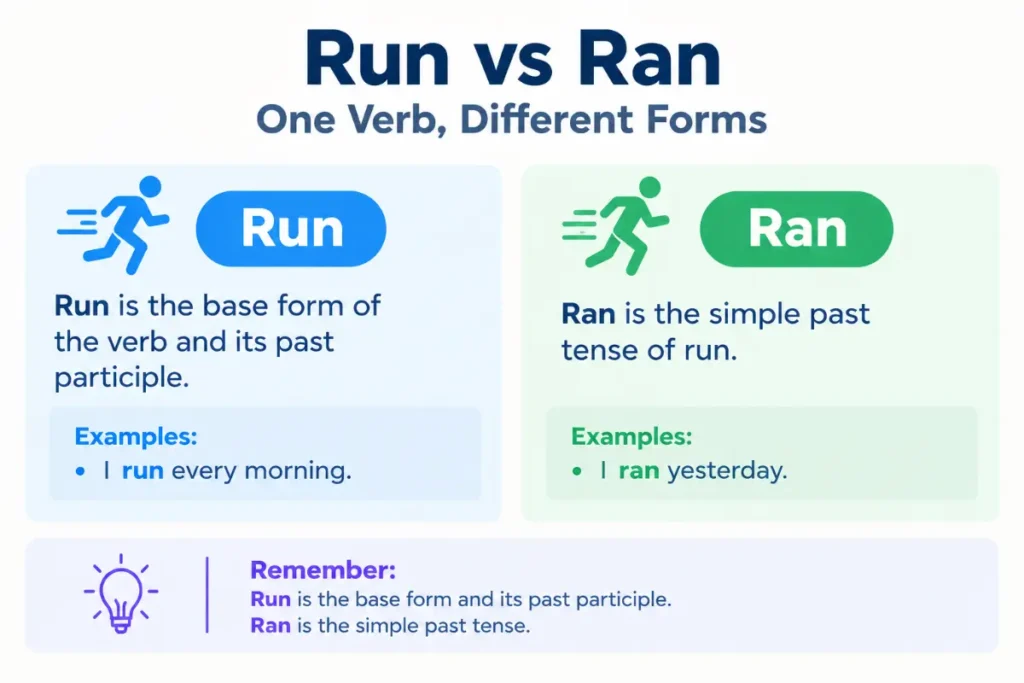
- Run is the base form of the verb and its past participle.
- Ran is the simple past tense of run.
- Use run for present habits with I, you, we, and they.
- Use runs with he, she, it, and singular third person subjects in the simple present tense.
- Use ran for completed past actions, such as I ran yesterday.
- Use run after have, has, and had when forming perfect tenses.
- Use run after modal verbs such as can, should, and will.
- Use run after did in past tense questions and negatives.
- Use running with forms of be to create continuous tenses.
- Remember the three main forms: run, ran, run.
A related grammar guide is Accross vs Across Which Spelling Is Correct.
Conclusion
The key to understanding run vs ran is knowing how the verb changes with tense. Both forms are correct, but they don’t serve the same purpose. Use run for present habits and after helping verbs such as did and have. Use ran for a simple statement about an action completed in the past. Remember the three main forms together: run, ran, run.
When you edit a sentence, check the helping verb first and then choose the form that fits. A little practice with complete sentences will help you avoid common mistakes and write with greater confidence in everyday conversation, schoolwork, and professional communication.
FAQs
Is Ran a Real Word?
Yes. Ran is the standard simple past tense of run. It describes an action that happened in the past, such as “I ran home after work.” It isn’t a misspelling or an informal substitute. The mistake happens when writers use it in a grammatical position that requires another form, such as after have or did.
What Does Run Mean?
Run can mean to move quickly on foot, operate a machine, manage a business, or conduct an activity. Its exact meaning depends on context. In grammar, it serves as the base form and the present tense form with certain subjects. It also serves as the past participle in perfect tenses, such as “I have run.”
Which Form Should I Use for Yesterday?
Use ran for a simple past statement about an action that happened yesterday. For example, “I ran to the store yesterday” is correct. If the sentence uses did to form a question or negative, return to the base form. Say “Did you run yesterday?” or “I did not run yesterday.”
How Do You Pronounce Run and Ran?
Both words have one syllable and end with the n sound. Run has the vowel sound /ʌ/, like the sound in sun. Ran has the vowel sound /æ/, like the sound in cat. Practice the two words side by side and focus on the vowel change. You don’t need to add another syllable to either word.
Can Run Start a Sentence?
Yes. Run can begin an instruction or command. For example, “Run to the nearest exit” is a command, and “Run every morning if it helps you feel better” is advice. You can also begin a sentence with a phrase that contains the word, such as “To run a successful business, you need a clear plan.”
What Is the Past Participle of Run?
The past participle is run, not ran. Use it with have, has, or had to form perfect tenses. For example, “I have run three miles” and “She had run before breakfast” are correct. Remember all three principal forms together: run for the base form, ran for the simple past, and run for the past participle.
Why Do People Confuse These Forms?
The confusion comes from the irregular pattern of the verb. Many English verbs form the past tense by adding ed, while others change their vowels. Writers may also confuse the simple past with the past participle because both refer to actions that happened earlier. Learning the three forms together helps prevent these errors.
Is Run Appropriate in Formal Writing?
Yes. Run is standard English and works in formal reports, academic papers, business emails, and professional documents. The correct choice depends on the sentence’s grammar and meaning. Use ran for a simple past statement and run after have, has, or had. Neither form is more formal than the other.